

Wyoming rare earths · Project comparison
Wyoming Rare Earth Deposits Compared: Size, Owners, Stage
Wyoming has three rare earth projects: Halleck Creek (2.63 billion tonnes at 3,292 ppm TREO), Bear Lodge (4.08% TREO measured and indicated) and the Brook Mine (inferred). None is producing yet.
Key takeaways
- Halleck Creek (American Rare Earths) reports 2.63 billion tonnes at 3,292 ppm TREO under the JORC Code; the mine plan uses only Indicated material (ASX, 30 September 2026).
- Bear Lodge (Rare Element Resources) holds 6.02 million tonnes at 4.08% TREO measured and indicated, about twelve times Halleck Creek’s grade (company release, March 2024).
- The Brook Mine (Ramaco) is a former coal mine with an in-place inferred rare earth resource; the Hatch study targets first production in 2031 (Ramaco, July 2026).
- Bear Lodge entered FAST-41 federal permitting on 20 March 2026 and the company targets early 2028 for all permits; Halleck Creek’s state mine permit application is still being prepared.
- The Cowboy State Mine study needs about US$900 million of initial capital and assumes NdPr oxide at US$151/kg; the USGS average for 2025 was US$69/kg and China prices were about US$103 to US$106/kg in October 2026 (Rare Earth Exchanges).
In this article
- Wyoming rare earth deposits compared
- Halleck Creek rare earth project: American Rare Earths
- Halleck Creek resource and reporting code
- Cowboy State Mine study
- Halleck Creek permits and land
- Bear Lodge rare earth project: Rare Element Resources
- Brook Mine rare earths: Ramaco in Sheridan County
- Other Wyoming rare earth minerals and occurrences
- How to read the resource figures: JORC, S-K 1300 and NI 43-101
- Permits and project stage for each project
- Listed companies behind the Wyoming projects
- NdPr price and project economics
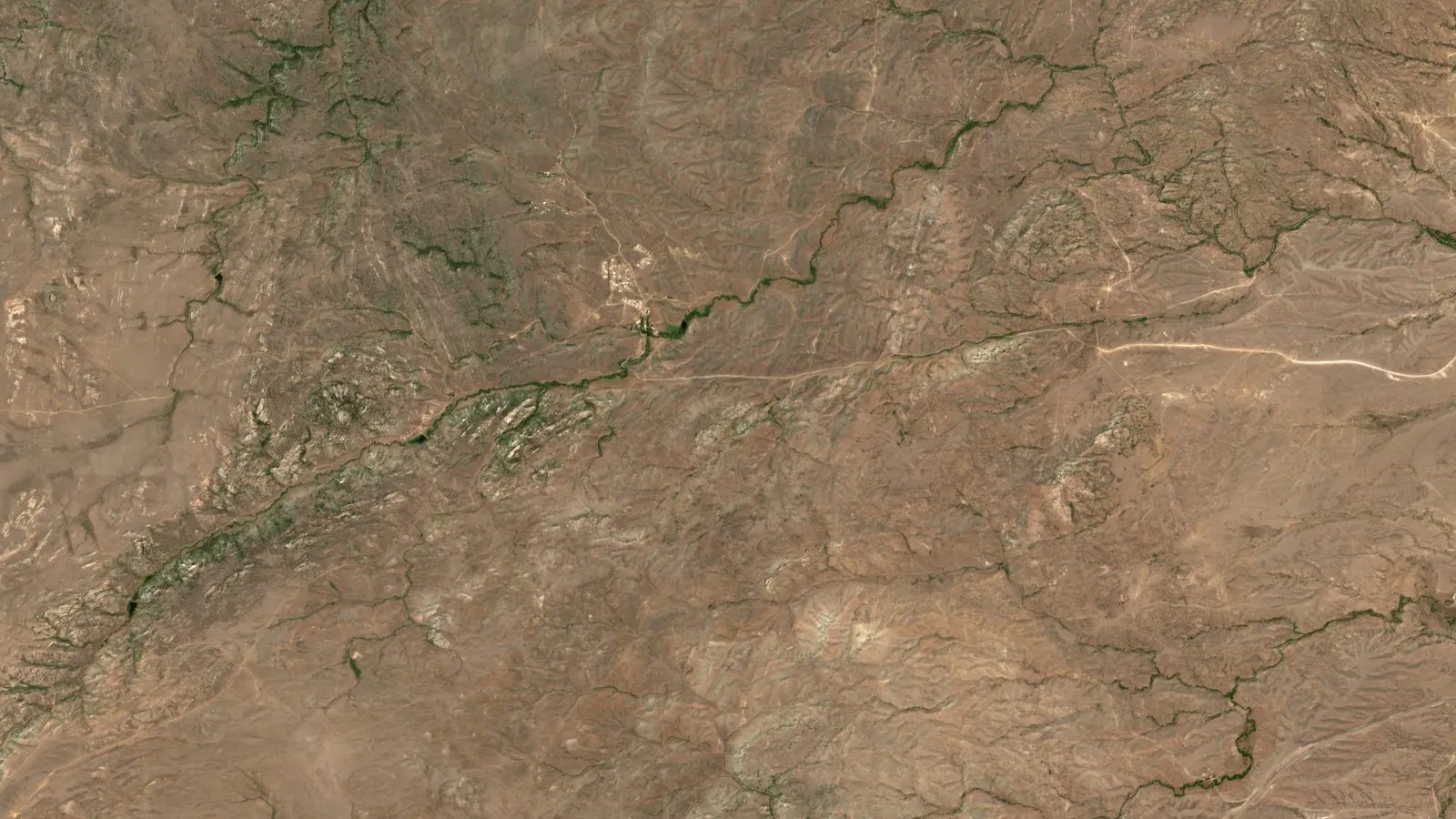
- Screening Wyoming ground with satellite data
- Frequently asked questions
Wyoming has three main rare earth projects: Halleck Creek in the Laramie Mountains (American Rare Earths, ASX: ARR), Bear Lodge in the Black Hills (Rare Element Resources, OTCQB: REEMF) and the Brook Mine near Sheridan (Ramaco Resources, Nasdaq: METC). They are very different deposits. Halleck Creek is huge and low in grade, with a reported resource of about 2.63 billion tonnes at 3,292 ppm total rare earth oxide (TREO) under the JORC Code (American Rare Earths, ASX release, 30 September 2026). Bear Lodge is small and rich, at 4.08% TREO in its measured and indicated Bull Hill resource (Rare Element Resources, March 2024). Brook is rare earths and other critical minerals in rock beside coal seams, and its resource is classed as inferred.
This page compares the three on the facts that decide whether a project is real: who owns it, how big it is, which reporting code the numbers follow, what permits are in hand and what stage the work has reached. Every figure carries its source and date, and none of it is investment advice.
Wyoming rare earth deposits compared
TREO means total rare earth oxide, the combined weight of all rare earth elements expressed as oxides. A grade quoted in ppm (parts per million) divides by 10,000 to give a percentage, so 3,292 ppm is 0.33% TREO. That one conversion explains most of the difference between the projects below.
Chart
Tonnes against grade: big and low or small and rich
Reported resource classes, million tonnes (log scale) against TREO grade (%). Cut-offs differ: 1,000 ppm TREO at Halleck Creek, 2.18% TREO at Bull Hill
| Project | Owner | Location | Rock type | Headline resource | Reporting code | Stage |
|---|---|---|---|---|---|---|
| Halleck Creek (Cowboy State Mine is phase one) | American Rare Earths, through its subsidiary Wyoming Rare (USA) | Albany and Platte counties, between Laramie and Wheatland | Allanite-bearing Red Mountain pluton | 2.63 billion tonnes at 3,292 ppm TREO (measured, indicated and inferred) | JORC 2012, with a parallel SEC S-K 1300 report | Scoping study; state mine permit application in preparation |
| Bear Lodge (Bull Hill deposit) | Rare Element Resources | Crook County, northeast Wyoming | Carbonatite dikes in an alkaline complex | 6.02 million tonnes at 4.08% TREO measured and indicated; 1.90 million tonnes inferred at 3.61% | SEC S-K 1300 and NI 43-101 | Federal environmental impact statement under way; demonstration plant at Upton |
| Brook Mine | Ramaco Resources | Sheridan County, northern Wyoming | Clay and carbonaceous rock beside coal seams | In-place inferred resource | SEC S-K 1300 | Exploration stage; pilot plant building under construction |
Sources for the table are in the sections below. If you only want the national picture, the US rare earth minerals map places Wyoming next to Mountain Pass in California and the other US projects, and the world rare earth map shows where Wyoming sits globally.
Halleck Creek rare earth project: American Rare Earths
Halleck Creek is the project people usually mean when they search for the Wyoming rare earth discovery. It is held indirectly 100% by American Rare Earths Limited (ASX: ARR; OTCQX: ARRNF) through its wholly owned subsidiary Wyoming Rare (USA) Inc. (American Rare Earths, Halleck Creek Technical Report Summary, September 2026).
Geology and discovery history
The rare earths sit in the Red Mountain pluton, a magmatic body in which allanite concentrated during the final stages of cooling. The main host mineral is allanite, a rare earth-bearing silicate, disseminated through the rock rather than concentrated in veins. That is why the grade is low and the tonnage is large: you mine a whole hillside of slightly enriched granite-like rock.
The technical report traces the discovery in four steps. A 1995 PhD thesis recorded unusual rare earth values at Red Mountain. Blackfire Minerals took state leases in 2010 and dropped them in 2011 when rare earth prices fell, without drilling. Zenith Mineral restarted work in 2018, staked five federal lode claims and took 87 surface samples in 2019 that showed broad mineralization above 2,000 ppm TREO. The state mineral leases were assigned to Wyoming Rare in June 2021, and drilling and resource work followed.
Halleck Creek resource and reporting code
The November 2025 resource estimate is reported at a 1,000 ppm TREO cut-off, meaning rock below that grade is not counted. It totals about 2,627 million tonnes at 3,292 ppm TREO, which holds roughly 8.65 million tonnes of contained TREO. The split by confidence class is below. The measured part comes from the Overton Mountain area, drilled at about 90 m spacing.
Chart
Halleck Creek resource by confidence class
Million tonnes at a 1,000 ppm TREO cut-off, November 2025 estimate
| Class | Tonnes (million) | TREO grade (ppm) | Contained TREO (million tonnes) |
|---|---|---|---|
| Measured | 206.7 | 3,720 | 0.77 |
| Indicated | 1,272.6 | 3,271 | 4.16 |
| Inferred | 1,147.2 | 3,239 | 3.72 |
The company states that no Ore Reserves have been declared and that mineral resources do not have demonstrated economic viability (American Rare Earths, September 2026). The study was written under the JORC Code (2012) and aligned with a parallel SEC Regulation S-K 1300 report, which the company says supports its preparation for a Nasdaq listing.
Cowboy State Mine study
The Cowboy State Mine is phase one of Halleck Creek. It sits on four Wyoming state mineral leases of about 1,844 acres, within a total land position of about 8,107 acres (3,281 hectares) that also includes 364 unpatented federal lode claims administered by the Bureau of Land Management. The September 2026 scoping study changed the plan substantially from the 2025 version.
Chart
Recovery to product fell in the 2026 study
Recovery to product, percent, 2025 against 2026 scoping study
| Measure | 2025 scoping study | 2026 scoping study |
|---|---|---|
| Mill feed | 3.0 million tonnes a year | 4.5 million tonnes a year |
| Mine life | 20 years | 26 years |
| NdPr oxide a year | about 1,833 tonnes | about 2,500 tonnes |
| Initial capital with contingency | US$456 million | US$900 million |
| After-tax NPV | US$558 million at 10% real | US$764 million at 10% real; about US$1.07 billion at 8% real |
| After-tax IRR | 24% | 21% |
| NdPr oxide price assumed | US$91/kg | US$151/kg |
Read the comparison with care. The company itself notes that the higher NPV cannot be credited to technical gains alone, because the 2026 case also changes the discount rate, price, recoveries, capital and operating cost. NdPr oxide (the neodymium and praseodymium oxide used in magnets) supplies about 87% of modelled revenue, and the US$151/kg price is a study input from Adamas Intelligence’s 2031 to 2040 outlook, not a sales contract. The mine plan feeds only Indicated material, and the study accuracy is stated as roughly plus or minus 30% to 50%.
The recovery assumptions went the other way. Recovery to product fell for every product, and the heavy rare earths fell hardest, which matters because terbium and dysprosium are the high-value magnet elements. Further test work at Nagrom in Perth, the Saskatchewan Research Council and Novex in the United States aims to lift them, with separated oxide from a pilot program targeted for late in the second quarter of 2027.
Halleck Creek permits and land
The Cowboy State Mine is on Wyoming state land, so the main permit is a Wyoming Department of Environmental Quality, Land Quality Division permit to mine. The report says the company holds a License to Explore by Dozer and an active exploration drilling permit, has not yet filed a mine permit application, and is preparing one with WWC Engineering. An aquatic resources report has received a US Army Corps of Engineers jurisdictional determination. Water rights are not adjudicated. The state royalty is a sliding 5% to 10% of revenue, plus a 2% Wyoming severance tax. Phase two, on federal land and minerals, would follow federal permitting.
Bear Lodge rare earth project: Rare Element Resources
Bear Lodge is the older and better-known Wyoming rare earth project. Exploration began in 1972 for copper and molybdenum and shifted to rare earths once their value was recognized. Hecla Mining identified the Bull Hill and Whitetail Ridge deposits between 1987 and 1991, and Rare Element Resources resumed work in 2004, drilling nearly 500 holes totaling more than 285,000 feet (Rare Element Resources, Bear Lodge Project page). The Wyoming State Geological Survey called it the most outstanding rare earth occurrence in the state in its 2013 statewide study (Wyoming State Geological Survey, Rare Earth Elements in Wyoming, 2013).
Geology
The deposits sit in the Bear Lodge Mountains, part of the Black Hills uplift, where alkaline rock intruded about 38 to 51 million years ago. Rare earths are carried by carbonatite and silicocarbonatite dikes, veins and stockwork, mainly in the minerals ancylite and bastnaesite. A carbonatite is an igneous rock made mostly of carbonate minerals, and it is the richest known host for light rare earths worldwide. The dike swarm at Bull Hill has been traced over 300 m and stays open down dip.
Bull Hill resource
The current resource covers the Bull Hill oxide and oxide-carbonate zones at a 2.18% TREO cut-off. It was built from 252 core holes drilled between 2009 and 2013 and is reported under SEC Regulation S-K 1300, with an NI 43-101 report filed in Canada (Rare Element Resources, 4 March 2024 release).
| Class | Tonnes (million) | TREO grade | Contained TREO (thousand tonnes) | Recovered NdPr (thousand tonnes) |
|---|---|---|---|---|
| Measured | 2.04 | 4.53% | 92.4 | 18.4 |
| Indicated | 3.98 | 3.85% | 153.1 | 31.3 |
| Measured and indicated | 6.02 | 4.08% | 245.5 | 49.7 |
| Inferred | 1.90 | 3.61% | 68.5 | 14.4 |
The estimate assumes 90% overall NdPr process recovery and counts only some elements as payable. Compared with Halleck Creek, Bull Hill holds a few percent of the contained oxide but at roughly twelve times the grade, which is why the proposed mine is small. Plans call for a small open pit at Bull Hill with about 17 years of mining, benches down to about 400 feet, and around 287 acres of new disturbance on National Forest land. A physical upgrading plant would remove barren rock, and a hydrometallurgical plant, which dissolves the concentrate in chemicals, would be in Upton about 40 miles away.
Permits and demonstration plant
The Permitting Council announced FAST-41 coverage for Bear Lodge on 20 March 2026 (Permitting Council, 20 March 2026). FAST-41 is a federal process that publishes a schedule and tracks agency reviews, but it does not waive environmental law. The company’s page says it submitted a Mine Plan of Operations in March 2026, the Forest Service deemed it complete in late July, and the Forest Service’s 29 July 2026 Notice of Intent started the environmental impact statement. The comment period ran to 28 August 2026. Approvals still needed include the Forest Service decision, a Clean Water Act Section 404 permit, Wyoming DEQ mine permitting and source-material licensing, because the ore contains thorium.
The company expects the federal review to run through 2027 and all permits to finish in early 2028 (Rare Element Resources, 9 June 2026 update). Its demonstration plant in Upton, Wyoming, is meant to produce separated NdPr oxide. In its 9 June 2026 update the company said full end-to-end operation was expected in late summer 2026 while filtration problems were fixed, and that the plant would run for up to 12 months. The plant’s status is as reported in that 9 June 2026 update.
Brook Mine rare earths: Ramaco in Sheridan County
The Brook Mine is often described as a “coal ash” rare earth project, but that is not accurate. It is an old surface coal mine whose adjacent rock, described in Ramaco’s annual report as coal and carbonaceous ore, carries rare earths and other critical minerals. Fly ash from burned coal is a different material. Brook consists of about 15,800 acres of Ramaco-owned and leased surface and minerals in Sheridan County, bought with the Ramaco Coal purchase in 2022 (Ramaco Resources, Form 10-K for 2025).
Ramaco released an initial mineral resource estimate in September 2025, based on a Technical Report Summary by Weir International and supported by a Fluor preliminary economic assessment. The company reports its rare earth and critical mineral estimates as in-place inferred mineral resources, and says they are not reserves (Ramaco Resources, critical minerals page). The elements named include the heavy magnet metals terbium and dysprosium, plus gallium, germanium and scandium. Three holes drilled after the report returned assays in line with it. The Weir report puts the total inferred in-place resource at about 1,391.6 thousand short tons of critical mineral oxides (rare earths plus other critical minerals), as of 30 June 2025 (Weir International, Brook Mine Technical Report Summary, September 2025).
The development plan changed in 2026. On 29 July 2026 Ramaco released a Hatch conceptual study that replaced the 2025 Fluor report. It puts construction capital at US$3.2 billion plus about US$0.8 billion of contingency and initial production in 2031. The company’s own modelling on those costs shows a potential NPV of US$8 billion, a number Ramaco calls internal, and it still describes Brook as an exploration stage property. A pilot plant building is due in fall 2026 with full-scale pilot operations in 2027, and a preliminary feasibility study is planned for 2027 (Ramaco Resources, second quarter 2026 results). Ramaco’s chief executive says that even at currently permitted levels, on roughly one-third of the mine’s total acreage, the mine could operate for generations (second quarter 2026 results).
Other Wyoming rare earth minerals and occurrences
The Wyoming State Geological Survey sampled rare earths across the state and found enrichment in a range of rock types, including carbonatites, pegmatites and old placer sands. Its report lists Laramie Range pegmatites and the Bald Mountain paleoplacers in Big Horn and Sheridan counties among the areas of interest, and it left Bear Lodge out of fieldwork because private companies were already exploring it. Those occurrences are survey findings, not resources. The survey reported sample results, not resource estimates.
The main minerals to know are bastnaesite and ancylite (carbonates, common in carbonatite), monazite and xenotime (phosphates, found in pegmatites and sands) and allanite (the silicate at Halleck Creek). Each processes differently, which is why a headline grade tells you less than the recovery test work behind it.
How to read the resource figures: JORC, S-K 1300 and NI 43-101
Three reporting codes appear in these projects. JORC is the Australasian code used by ASX-listed companies such as American Rare Earths; the JORC guide explains its terms. S-K 1300 is the US Securities and Exchange Commission rule that governs mining disclosure for companies filing in the United States. NI 43-101 is the Canadian national instrument. All three use the same three confidence classes. Measured is drilled closely enough to trust grade and shape. Indicated is drilled well enough for mine planning. Inferred is the least certain and cannot be used for the economic plan. Halleck Creek’s mine plan uses only Indicated material, and Brook’s estimate is entirely inferred.
Three checks help when you read any rare earth announcement. First, which class holds the tonnes. Second, which cut-off grade was used, since Halleck Creek’s 1,000 ppm and Bull Hill’s 2.18% are not comparable. Third, whether the economics are a scoping study, a preliminary economic assessment or a feasibility study, because those carry accuracy ranges of tens of percent. A study that is not a feasibility study cannot support reserves.

▶ Six kinds of AI geology tools and three questions to ask before you trust a claim. · 3:18
Permits and project stage for each project
Permitting speed is the biggest practical difference between the projects. The route depends on who owns the land and minerals.
| Project | Land | Lead approvals | Position in October 2026 |
|---|---|---|---|
| Halleck Creek, Cowboy State Mine | Wyoming state mineral leases | Wyoming DEQ Land Quality Division permit to mine | Application being prepared; no mine permit filed (September 2026 report) |
| Halleck Creek, phase two | Federal claims | Federal permitting | Later phase |
| Bear Lodge | National Forest and private land | Forest Service EIS, Clean Water Act 404, Wyoming DEQ, source-material license | FAST-41 project; EIS under way; company targets early 2028 |
| Brook Mine | Ramaco-owned and leased land at a former coal mine | Mine permits for the project area; the CEO says current permitted levels sit on roughly one-third of the acreage | Pilot plant stage; first production targeted 2031 |
The state route is why American Rare Earths describes the Cowboy State Mine as having a permitting advantage. That is the company’s view, and the study itself lists permitting, water and site selection as open work. Anyone holding or buying ground should also check claim and lease status on the public records; the mining cadastre portal guide covers how to search them.
Listed companies behind the Wyoming projects
These are the listings tied to the three projects, with the facts as stated in each company’s own filings. This is not a recommendation to buy or sell anything.
| Company | Listing | Wyoming asset | Latest stage fact |
|---|---|---|---|
| American Rare Earths Limited | ASX: ARR; OTCQX: ARRNF; ADR: AMRRY | Halleck Creek | Scoping study issued 30 September 2026 |
| Rare Element Resources Ltd. | OTCQB: REEMF | Bear Lodge | FAST-41 coverage 20 March 2026; EIS under way |
| Ramaco Resources, Inc. | Nasdaq: METC | Brook Mine | Hatch conceptual study 29 July 2026; coal remains the main revenue source |
Ramaco is mainly a metallurgical coal producer. It sold 3.8 million tons of coal in 2025 and recognized US$536.6 million of revenue from it (Form 10-K, 2025), so Brook is a development option rather than the business today. American Rare Earths and Rare Element Resources have no operating mine. Share prices move daily, so check a live quote rather than relying on any page, including this one.
NdPr price and project economics
NdPr oxide is the product that carries these projects. The USGS average price for NdPr oxide, 99% minimum, was US$55 per kilogram in 2024 and an estimated US$69 per kilogram in 2025, down from US$124 in 2022 (USGS, Mineral Commodity Summaries 2026, rare earths). The same summary reports US mine production of 51,000 tons of rare earth oxide in 2025, mainly from Mountain Pass, California.
Chart
NdPr oxide average price, USGS
US$ per kilogram, 99% minimum, annual average (2025 estimated)
Prices have since risen. Rare Earth Exchanges lists NdPr oxide (99.5% minimum) at US$103 to US$106 per kilogram in China and US$125 to US$140 outside China for October 2026 (page updated 17 October 2026). Halleck Creek’s study price of US$151/kg is a 2031 to 2040 average from Adamas Intelligence, above both of those and well above the USGS annual figures, and the study says price and recovery drive the result more than any other input. The calculator below lets you test it: enter your own price, and see what the revenue, levies and operating margin look like at the study’s 2,500-tonne output. It is a rough NdPr-led view, not the company’s financial model.
Calculator
What does NdPr oxide earn at your price?
Enter your own NdPr price and plant figures to see revenue, levies and margin.
- NdPr oxide revenue (US$ m): 275.0
- Total revenue incl. other products (US$ m): 315.7
- Royalty and severance (US$ m): 30.0
- Operating cost (US$ m): 178.6
- Years of margin to repay initial capital: 8.4
Example values, not a forecast. Defaults follow the Cowboy State Mine scoping study (American Rare Earths, September 2026): 2,500 t NdPr oxide a year, NdPr about 87.1% of revenue, 4.5 Mt a year, US$39.68 operating cost per tonne and US$900 million capital. Levies combine a 7.5% mid-range state royalty (the study range is 5% to 10%) and 2% severance tax. The price default is an example, use today’s price. China NdPr oxide was about US$103 to US$106/kg in October 2026 (Rare Earth Exchanges, page updated 17 October 2026).
Screening Wyoming ground with satellite data
Allanite granite, carbonatite and coal-bearing clays each leave a different surface signature. Satellite multispectral and radar data can map iron-oxide staining, clay alteration, structure and disturbed ground across a claim block before anyone drills, so you can rank targets and drop dead ground cheaply. A scan finds clues, not rare earths: grade comes only from assays. If you hold or are buying a Wyoming claim or lease, a land screen is a low-cost first step before field work.

▶ Mineral exploration from space: why a satellite scan comes before the first drill hole. · 4:26
Frequently asked questions
Where are the rare earth deposits in Wyoming?
The three developed projects are Halleck Creek in Albany and Platte counties near Laramie and Wheatland, Bear Lodge in Crook County in the northeast, and the Brook Mine in Sheridan County. The Wyoming State Geological Survey has also recorded smaller occurrences in the Laramie Range and elsewhere.
What is the biggest Wyoming rare earth discovery?
By tonnage, Halleck Creek, at about 2.63 billion tonnes at 3,292 ppm TREO (JORC, American Rare Earths, September 2026). By grade, Bear Lodge’s Bull Hill deposit, at 4.08% TREO measured and indicated (Rare Element Resources, March 2024).
Is there a rare earth mine operating in Wyoming?
No. None of the three projects is a producing rare earth mine. Halleck Creek is at scoping study stage, Bear Lodge is in federal permitting with a demonstration plant, and Brook is at pilot plant stage.
Who owns the Halleck Creek project?
American Rare Earths Limited owns it indirectly 100% through Wyoming Rare (USA) Inc. The Cowboy State Mine area is on Wyoming state mineral leases, and a Wyoming royalty of 5% to 10% applies there.
How much will the Cowboy State Mine cost to build?
The September 2026 scoping study estimates about US$900 million of initial capital including 30% contingency on direct costs, at a stated accuracy of roughly plus or minus 30% to 50%.
Is Brook Mine a coal ash rare earth project?
No. The rare earths are in rock beside the coal seams, not in burned fly ash. Ramaco describes the material as coal and carbonaceous ore and reports the resource as in-place inferred.
When could Bear Lodge get its permits?
The company expects the federal review to run through 2027 and permits to finish in early 2028. The Forest Service decision depends on the environmental impact statement, so dates may move.
What is the difference between JORC and S-K 1300?
Both classify resources as measured, indicated and inferred. JORC is the Australasian code; S-K 1300 is the SEC rule for US filers. American Rare Earths’ September 2026 study was prepared under JORC and aligned with an S-K 1300 report.
Are Wyoming rare earths heavy or light?
Mostly light. Halleck Creek’s resource is about 7.68 million of 8.65 million tonnes of contained TREO as light rare earths (American Rare Earths, September 2026). Bear Lodge is rich in neodymium, praseodymium, samarium and terbium. Brook reports terbium and dysprosium.
Can I buy or stake rare earth claims in Wyoming?
Federal lode claims are staked under US mining law and recorded with the Bureau of Land Management, while state minerals are leased through the Wyoming Office of State Lands and Investments. Confirm the rules with the agency before you act.
This page is for information only. It is not investment advice, and no company named here is recommended. It is not legal advice: confirm claim, lease and permit rules with the Bureau of Land Management, the Wyoming Office of State Lands and Investments and the Wyoming Department of Environmental Quality. Farmonaut results are exploration targets, not mineral resources or reserves. If you prospect in the field, get permission from the landowner or agency first and follow safety rules.
Farmonaut mining
Screen your claim block from space
Send a KML, KMZ or polygon and request a quote for a satellite mineral detection report on your Wyoming claims or lease area.

Mining Pro sample view, synthetic data
Keep reading

Sources
- American Rare Earths, Cowboy State Mine updated Scoping Study and Halleck Creek Technical Report Summary (ASX, 30 September 2026): announcements.asx.com.au
- American Rare Earths, Halleck Creek project page: americanree.com
- Rare Element Resources, updated Bear Lodge mineral resource (4 March 2024): rareelementresources.com
- Rare Element Resources, Bear Lodge Project page (permitting and operations): rareelementresources.com
- Rare Element Resources, project update (9 June 2026): rareelementresources.com
- Permitting Council, Bear Lodge FAST-41 coverage (20 March 2026): permitting.gov
- Ramaco Resources, Form 10-K for 2025 (SEC EDGAR): sec.gov
- Ramaco Resources, second quarter 2026 results (4 August 2026): finviz.com
- Ramaco Resources, critical minerals page: ramacoresources.com
- USGS, Mineral Commodity Summaries 2026: rare earths: pubs.usgs.gov
- Wyoming State Geological Survey, Rare Earth Elements in Wyoming (2013): wsgs.wyo.gov
- Weir International, Brook Mine Technical Report Summary – Initial Assessment (Ramaco exhibit 96.1, September 2025): sec.gov
- Rare Earth Exchanges, Rare earth prices (October 2026): rareearthexchanges.com
Discussion
Questions, corrections or field experience? Share them below. First-time comments are reviewed before they appear, and your email is never published.
No comments yet. Be the first to add a question or your experience.

 Sahara Mining
 Sean Mining Limited
 NTS Group (Pty) Ltd
 Mine4Africa
 Lithspo Minerals Limited
 Tintina Mining Group
 Dalgety Minerals Pty Ltd
 Vortex Minerals Pty Ltd
 Faith At Work (Pty) Ltd
 Geotech Mining Solutions plc
 Vulcan International Limited
 Kidepo Associates
 GKY Mining
 Alkimy SARL
 Double A Trading
 GemSprout Metals Limited
 Qader Group
 Ileys General Trading
 SG Gold Mining LLC
 VRV Global Pte Ltd
 Omsri International FZE
 G.I.T.T.
 Jaunita Erss Ltd
 SRK Consulting
 Berks Gold Limited











