

Pegmatite deposits · Geology guide
Pegmatite Deposits: LCT vs NYF, Minerals and Examples
A pegmatite deposit is coarse granitic rock rich in lithium, tantalum, caesium, beryllium or tin. The USGS puts pegmatites at 26% of identified lithium resources.
Key takeaways
- Pegmatites hold about 26% of identified world lithium resources, against 58% in brines (Evans, 2012, in USGS Professional Paper 1802-K).
- LCT pegmatites (lithium, caesium, tantalum) host most pegmatite ore; NYF pegmatites rarely hold economic resources (British Geological Survey, 2019).
- Greenbushes reported 457 Mt at 1.6% Li2O and 1.35 Mt of concentrate made in 2025 (IGO).
- Explorers follow fertile granites, soil halos and heavy minerals; satellite band ratios help map outcrops (Cardoso-Fernandes, 2019).
- World tantalum mine output was about 2,500 t in 2025, with the Congo (Kinshasa) at 1,300 t (USGS, 2026).
In this article
- What makes a pegmatite an ore deposit
- LCT vs NYF pegmatites: the two families
- Pegmatite minerals and what each is mined for
- How a pegmatite forms: fertile granites and zoning
- Six well-known pegmatite deposits compared
- Where pegmatite lithium is produced
- Tantalum and tin from pegmatites
- How explorers find pegmatite deposits
- Mapping pegmatite outcrops from satellite
- Estimate the concentrate a pegmatite could produce
- Frequently asked questions
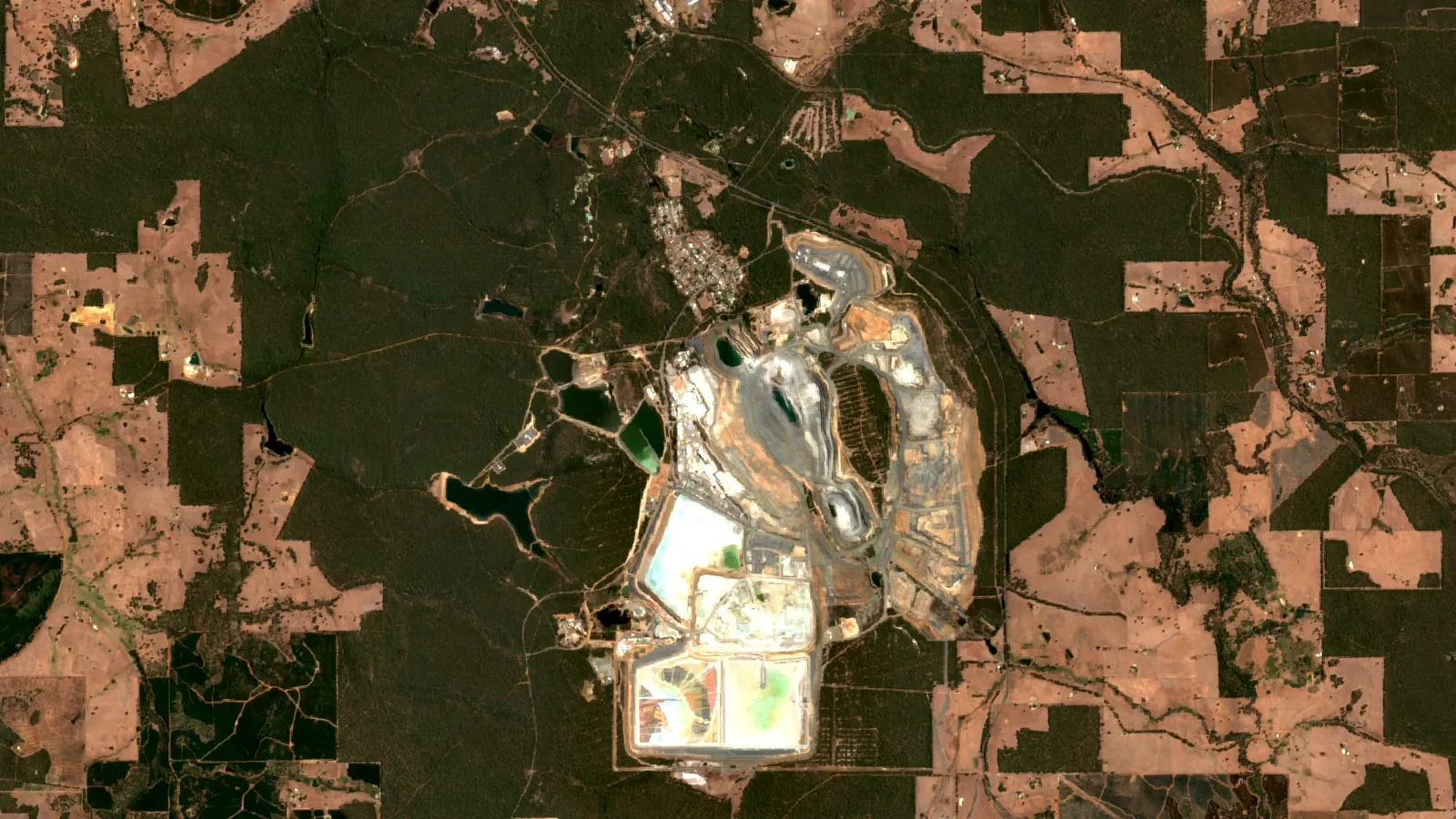
A pegmatite deposit is a body of very coarse-grained granitic rock, often only a few hundred metres across, that holds rare metals such as lithium, tantalum, caesium, beryllium and tin in minerals big enough to see by eye. The USGS lithium chapter notes that even a large example such as Greenbushes in Western Australia is only about 3 km long and a few hundred metres wide, yet pegmatites hold about 26 percent of the world’s identified lithium resources (a 2012 estimate), including lithium-enriched granites (USGS Professional Paper 1802-K). This guide covers the two pegmatite families, the minerals worth mining, six well-known mines compared, and the steps explorers use to find new bodies, including what satellite imagery can and cannot do.
What makes a pegmatite an ore deposit
Most pegmatites are barren: they are just coarse granite veins with quartz, feldspar and mica. A pegmatite becomes a deposit when the last, water-rich melt of a granite crystallises slowly and concentrates elements that do not fit into common minerals. Geologists call these “incompatible” elements. Lithium, caesium, rubidium, tantalum, niobium, beryllium and tin all behave this way. The melt can cool over days to years, which is why crystals grow so large; the USGS lists a 14 m spodumene crystal from South Dakota and an 18 m beryl crystal as record finds.
Three features decide whether a body can be mined:
- Size and shape. Sheet-like dykes and sills are common. Thick, steeply dipping bodies such as the Central Lode at Greenbushes can be mined in open pits and underground.
- Grade. Grade is the concentration of the valuable element in the rock. For lithium it is quoted as percent Li2O (lithium oxide); for tantalum as ppm or percent Ta2O5.
- Mineral form. Lithium in spodumene can be concentrated by crushing and flotation; lithium locked in other minerals may need different processing.
Pegmatites are also mined for feldspar, mica, ultrapure quartz and gemstones, so a body can pay for itself through more than one product (USGS Professional Paper 1802-K). If you are comparing pegmatite lithium with brine and clay sources, our guide to lithium deposit types covers all three; this page stays with the pegmatites.
LCT vs NYF pegmatites: the two families
The standard classification, from Černý and Ercit (2005), splits rare-element pegmatites into families named after the elements they are enriched in. The British Geological Survey summarises it this way: NYF pegmatites are enriched in niobium, titanium, yttrium, rare earth elements, zirconium, uranium, thorium and fluorine and are linked to metaluminous to alkaline granites, while LCT pegmatites are enriched in lithium, caesium and tantalum and are the source of most pegmatite-hosted ore (Goodenough and others, British Geological Survey, 2019). The same abstract notes that NYF bodies may be enriched in rare earths and niobium but rarely hold economic amounts of them.
| Feature | LCT family | NYF family |
|---|---|---|
| Name stands for | Lithium, caesium, tantalum | Niobium, yttrium, fluorine |
| Typical enrichment | Li, Cs, Rb, Be, Ta, Sn | Nb, Ti, Y, REE, Zr, U, Th, F |
| Parent granite | Peraluminous, aluminium-rich granites | Metaluminous to alkaline granites |
| Main ore minerals | Spodumene, lepidolite, petalite, columbite-tantalite, pollucite, beryl, cassiterite | Niobium and rare-earth minerals, zirconium silicates |
| Economic importance | Hosts many of the world’s lithium, tantalum, caesium and beryllium resources | Rarely hold economic resources of the same metals |
| Examples | Greenbushes, Pilgangoora, Tanco, Bikita, Kings Mountain, Manono | Khan Bogd (Mongolia), Strange Lake (Canada), Amis Complex (Namibia) |
The scheme has limits. Some rare-element pegmatites lack the typical fluorine or lithium signature, and a few mix both families, so newer work proposes classifying by measured mineral chemistry instead of by name alone (Goodenough and others, 2019). For an explorer, the practical point is simple: if the target is lithium or tantalum, the search is for LCT pegmatites. If the target is niobium or rare earths, NYF-type settings around alkaline granites matter, but the pegmatites themselves are usually a small part of the resource.
Pegmatite minerals and what each is mined for
Lithium is the best known product today, but a single body can carry several saleable minerals. Table K1 of the USGS lithium chapter lists the main lithium minerals by lithium content, shown in the chart below. Spodumene dominates mining because it is common, coarse and easy to separate from the rest of the rock. A grade of 3.73 percent Li (about 8 percent Li2O) in pure spodumene means that a plant can make a concentrate near 6 percent Li2O by removing quartz, feldspar and mica.
Chart
Lithium content of pegmatite minerals
Weight percent lithium in the pure mineral
| Mineral | Main element | Notes for explorers |
|---|---|---|
| Spodumene | Lithium | Main hard-rock lithium ore. Gem forms are kunzite (pink), hiddenite (green) and triphane (yellow). |
| Lepidolite | Lithium | Lithium mica, mined in lithium-enriched granites such as Yichun in Jiangxi, China, together with tantalum. |
| Petalite | Lithium | Lower lithium content but low in iron, so used in glass and ceramics. Bikita in Zimbabwe has petalite among its lithium minerals. |
| Columbite-tantalite (coltan) | Tantalum, niobium | Dense and durable, so it can be panned from stream sediment. |
| Cassiterite | Tin | Also dense and panned; many pegmatite districts began as tin fields. |
| Pollucite | Caesium | Rare caesium ore found in the most evolved LCT bodies. |
| Beryl | Beryllium | Ore of beryllium; gem varieties are aquamarine, emerald and heliodor. |
| Elbaite | Lithium (minor) | Lithium tourmaline, including the gem “watermelon” variety. |
The gem side is real but small compared with industrial minerals. Pegmatite pockets produce aquamarine, kunzite and tourmaline for collectors, and the USGS notes museum-grade specimens as a by-product. Gem sales rarely carry a mine on their own; they are a bonus for a body already mined for something else.
How a pegmatite forms: fertile granites and zoning
LCT pegmatites do not appear at random. The USGS states that all of them were emplaced into orogenic belts, the mountain-building zones formed when continents collide, and that most intruded metamorphosed sedimentary rocks at medium pressure and medium to high temperature (Černý, 1992, cited in USGS Professional Paper 1802-K). They form around a “fertile” granite, a parent pluton that is rich in the rare elements. The USGS notes that the pegmatites further from that granite are generally the ones most enriched in lithium, so a district shows a pattern: barren-looking granite in the centre, then beryl-bearing bodies, then lithium and tantalum bodies on the outer edge.
Chart
Where the world’s lithium resources sit
Share of identified resources by deposit type
Inside a single large body, minerals often sit in shells, from a coarse outer border zone inward to a quartz core, with the rarest minerals in intermediate zones or replacement units. Mapping this zoning is how mine geologists decide where to put drill holes: a thick spodumene-rich zone can be a mining target, while the same body’s feldspar-quartz shell may be waste.
Age also matters. Lithium pegmatites cluster in time, with peaks at about 2,638, 1,809, 962, 485, 309, 274 and 97 million years ago, matching the assembly of supercontinents (USGS Professional Paper 1802-K). The USGS suggests the potential for giant deposits is greatest in Archean (older than 2,500 million years) collision zones, which matches the sizes of Greenbushes, Tanco and Bikita.
Six well-known pegmatite deposits compared
The table sets out six pegmatite districts, each with company or government figures and the date of the report. Resource figures are not directly comparable: companies use different cut-off grades and reporting codes, and some figures are at a different date. Read them as sizes, not rankings.
| Deposit | Place | Products | Reported figure (source and date) |
|---|---|---|---|
| Greenbushes | Western Australia | Spodumene, tantalum, historic tin | 457 Mt at 1.6% Li2O total resource, 100% basis (IGO, calendar 2025) |
| Pilgangoora | Western Australia | Spodumene, tantalum | 430 Mt in situ at 1.29% Li2O (PLS, 30 June 2026) |
| Tanco | Manitoba, Canada | Lithium, caesium, tantalum | Large lithium-caesium-tantalum body with 105 mineral species identified; no tonnage or grade quoted here (USGS, Manitoba Geological Survey) |
| Bikita | Zimbabwe | Petalite, spodumene, lepidolite, caesium, tantalum, beryllium, tin | 15 pegmatites in the mining lease; mining since about 1911 (University of the Witwatersrand, 2021) |
| Kings Mountain | North Carolina, USA | Spodumene (historic), tin (historic) | Planned 3.25 million short tons of ore a year for 420,000 to 440,000 short tons of concentrate (US DOE, 2026) |
| Manono | Democratic Republic of the Congo | Spodumene, historic tin | Roche Dure: 400 Mt at 1.65% Li2O (AVZ Minerals, May 2019) |
Greenbushes, Western Australia
Greenbushes began in about 1888 as an alluvial and weathered-rock tin and tantalum operation. Tin was the main product until the 1980s, when lithium and tantalum became the principal commodities. IGO Limited reported that in 2025 the mine processed 6.16 Mt of ore at 1.9% Li2O and produced 1.35 Mt of spodumene concentrate, and that the total resource was 457 Mt at 1.6% Li2O (IGO, Greenbushes resource and reserve estimate, calendar 2025). The major lithium body, the Central Lode, is an Archean pegmatite emplaced in a shear zone. A tailings retreatment plant now recovers concentrate from old tin-tantalum waste, which shows how a mine’s history of by-products can matter later.
Pilgangoora, Western Australia
For the other spodumene mines in the same state, see our list of lithium mines in Western Australia.
PLS reports the Pilgangoora Mineral Resource at 430 Mt of in-situ material at 1.29% Li2O with 122 ppm Ta2O5 as at 30 June 2026, at a 0.2% Li2O cut-off, and an in-situ Ore Reserve of 192.3 Mt at 1.17% Li2O (PLS annual report, 2026). The change since the previous year was due to mining depletion only. Tantalum is reported as a by-product in the same resource table.
Tanco, Manitoba
The Manitoba Geological Survey describes Tanco as a world-class lithium-caesium-tantalum deposit in the Bird River greenstone belt, and the Winnipeg River-Cat Lake pegmatite field around it as the most prolific lithium region in the province (Manitoba Geological Survey, Lithium in Manitoba). The USGS uses Tanco as its example of mineral diversity, with 105 mineral species identified. It is a useful reminder that one body can contain caesium, tantalum, lithium and beryllium at once.
Bikita, Zimbabwe
A University of the Witwatersrand review describes the Bikita pegmatites as Archean bodies hosting lithium, caesium, tantalum, beryllium and tin, enclosed by the Masvingo Greenstone Belt. There are 15 named pegmatites in the mining lease, and the main one has been worked since mining began around 1911. Lithium minerals present include petalite, spodumene, lepidolite, amblygonite and eucryptite (Gogodo, University of the Witwatersrand, 2021). The same study used satellite imagery and geophysical data to interpret the faults that controlled where the pegmatites were emplaced.
Kings Mountain, North Carolina
Kings Mountain sits in the Tin-Spodumene Belt. According to the US Department of Energy’s environmental assessment, tin was mined first, a lithium plant then ran on the outcropping pegmatites, and mining and exploration ceased in 1993. Albemarle proposes to resume open-pit mining, processing an average of 3.25 million short tons of ore a year to make 420,000 to 440,000 short tons of spodumene concentrate (US Department of Energy, environmental assessment, March 2026). For brine and clay projects in the same country, see the Nevada lithium mines comparison. The USGS notes that the district holds large reserves and that the United States is not producing lithium from pegmatites (USGS Professional Paper 1802-K).
Manono, Democratic Republic of the Congo
Manono was a tin mine from 1919 to 1982, working eluvial and weathered pegmatite and yielding 185,000 tonnes of cassiterite concentrate, according to AVZ Minerals. AVZ’s drilling in 2017 returned intervals such as 235 m at 1.66% Li2O, and in May 2019 it reported a Roche Dure resource of 400 Mt at 1.65% Li2O with 715 ppm tin and 34 ppm tantalum (AVZ Minerals, Manono project). The company also mapped pegmatite lithium over more than 13 km of strike. The case shows the usual pattern: a historic tin district that turned out to hold lithium. Zijin Mining’s Manono project began producing lithium concentrate in May 2026 and started exporting in June, while AVZ disputes the revocation of its permit (Mining.com, July 2026). The 2019 figure above is AVZ’s historical estimate, not a current reserve. Our guide to cassiterite and tin deposits covers the tin side of such districts.
Where pegmatite lithium is produced
The USGS Mineral Commodity Summaries 2026 report world lithium mine production of about 222,000 tonnes of contained lithium in 2024 and an estimated 290,000 tonnes in 2025. Australia led with 92,000 tonnes in 2025, mostly from spodumene pegmatite mines such as Greenbushes and Pilgangoora. China, Zimbabwe, Brazil, Canada and Mali also grew, as the chart shows (USGS Mineral Commodity Summaries, 2026). Chile and Argentina are large producers too, but their lithium comes from brine, not rock. The USGS lists Mali at 9,400 tonnes in 2025 against 770 tonnes in 2024, after two new operations started.
Chart
Lithium mine output in pegmatite countries
Tonnes of contained lithium, selected countries with pegmatite mines (China’s total also includes brine)
Tantalum and tin from pegmatites
Tantalum is used in capacitors, and the United States has not mined it since 1959; all of its supply is imported (USGS Mineral Commodity Summaries, 2026). World mine output was about 2,500 tonnes of contained tantalum in both 2024 and 2025 estimates. The Congo (Kinshasa) is the largest producer at 1,300 tonnes, followed by Rwanda, Nigeria and Brazil (USGS, tantalum, 2026). Much of this comes from artisanal and small-scale miners working weathered pegmatite and the stream gravels shed from it. The USGS gives the annual average tantalite price at US$180 per kilogram of Ta2O5 content in 2025 (estimate), but check a current market quote before using any price.
Chart
Tantalum mine production by country
Tonnes of contained tantalum, 2025 estimate
Greenbushes and Pilgangoora show that tantalum often arrives as a by-product of lithium mining, reported in parts per million in the same resource table. Tin follows the same logic: cassiterite is dense, so weathering concentrates it in streams, which is why prospectors found many pegmatite districts through tin before anyone looked for lithium.

▶ How satellite data was used to look for lithium in Nigeria, a pegmatite country. · 10:49
How explorers find pegmatite deposits
The USGS describes a search that works from the regional scale to the individual body. A practical sequence looks like this:
- Choose the belt. Start with orogenic belts of the right age. Archean collision zones have the best chance of giant bodies (USGS Professional Paper 1802-K).
- Find the fertile granite. Fertile granites are usually several square kilometres in area and often already known from routine geological maps. The USGS lists muscovite, tourmaline and garnet as visible clues, and anomalous caesium, lithium, rubidium, tin and tantalum with low calcium, iron and magnesium as chemical clues.
- Walk outward from the granite. Look within a few kilometres, remembering that the most lithium-rich pegmatites tend to sit furthest from the parent pluton.
- Sample soil and stream sediment. Weathering of the pegmatite leaves soil anomalies and indicator minerals. At Greenbushes, arsenic, beryllium, antimony and tin form a halo 12 by 20 km wide in lateritic soils, and niobium, tantalum and boron form a smaller 1 by 5 km halo (Smith and others, 1987, in USGS Professional Paper 1802-K).
- Pan for heavy minerals. The USGS says cassiterite, tantalite, elbaite and spessartine are dense and durable enough to be found by panning unconsolidated sediment.
- Map and trench. Geologists map outcrops, measure zoning and trench the best targets before any drilling.
- Drill. Core drilling gives grade, thickness and the spodumene to waste ratio. Spodumene intervals such as AVZ’s 235 m at 1.66% Li2O at Manono are the type of result that justifies further drilling.
Do not prospect on private land without the owner’s permission or on claims without the right licence. Do not use mercury to recover heavy minerals; panning with water is enough for cassiterite and tantalite.
Mapping pegmatite outcrops from satellite
Satellites do not see lithium underground. They map the surface: rock types, weathered outcrop, alteration and structures. Peer-reviewed work shows what this adds. In the Fregeneda (Spain) and Almendra (Portugal) region, researchers tested Landsat, Sentinel-2 and ASTER images and proposed colour combinations, band ratios and selective principal component analysis that separate lithium-bearing pegmatites from their host rocks. They also note that results would improve with sensors of higher spatial and spectral resolution (Cardoso-Fernandes and others, 2019). A University of the Witwatersrand study used satellite imagery and geophysical data to interpret the structures that control Bikita pegmatite emplacement.
Three limits apply. Bare rock must be visible, so dense vegetation, soil and cloud reduce the signal. Spodumene does not have a distinctive signature at all resolutions, so the maps usually show pegmatite bodies and alteration, not lithium grade. And any target needs field checks, sampling and drilling before it can be called a resource.
Farmonaut is a satellite data-analytics company: owners send a licence boundary as KML, KMZ or polygon and receive a screened report in 5 to 20 business days, which lets a consultant or licence holder rank ground before spending on field work. The results are exploration targets that sit ahead of any resource estimate, not a JORC or NI 43-101 statement.
▶ Remote sensing for mining explained in about two minutes. · 2:01
Estimate the concentrate a pegmatite could produce
Use the calculator below to turn tonnes of ore, grade and recovery into tonnes of spodumene concentrate and a gross revenue figure. For scale, IGO’s Greenbushes figures of 6.16 Mt of ore at 1.9% Li2O and 1.35 Mt of concentrate imply an overall mass yield of about 22 percent. The concentrate price is an input: use today’s SC6 quote from a market source.
Calculator
How much spodumene concentrate could this ore make?
Enter your own ore tonnes, grade and recovery.
- Contained Li2O in ore (t): 15,000
- Mass yield to concentrate (%): 17.5
- Gross concentrate revenue (US$): $175,000,000
Example values only, not a benchmark. Greenbushes (IGO, calendar 2025) made 1.35 Mt of concentrate from 6.16 Mt of ore at 1.9% Li2O. Price is an example, use today’s price.
Frequently asked questions
What is a pegmatite deposit?
It is a body of very coarse granitic rock that holds concentrated rare metals such as lithium, tantalum, caesium, beryllium or tin. Greenbushes, about 3 km long and a few hundred metres wide, is large for its type (USGS Professional Paper 1802-K).
What is the difference between LCT and NYF pegmatites?
LCT pegmatites are enriched in lithium, caesium and tantalum and come from peraluminous granites. NYF pegmatites are enriched in niobium, yttrium, fluorine and rare earths and come from metaluminous to alkaline granites. Most pegmatite ore is in the LCT family (British Geological Survey, 2019).
Which minerals are mined from pegmatites?
Spodumene, lepidolite and petalite for lithium; columbite-tantalite for tantalum; cassiterite for tin; pollucite for caesium; beryl for beryllium; plus feldspar, mica, quartz and gemstones.
How much of the world’s lithium is in pegmatites?
The USGS puts it at 26 percent of identified resources, including lithium-enriched granites, compared with 58 percent in closed-basin brines (Evans, 2012, in USGS Professional Paper 1802-K).
Which countries mine lithium from pegmatites?
The USGS names Australia, Brazil, China, Portugal and Zimbabwe as main pegmatite producers, and its 2026 summary also lists Mali (9,400 tonnes in 2025) and Canada (5,600 tonnes) among producers.
Is there a pegmatite lithium mine in the United States?
The only commercial-scale lithium production the USGS reports for the United States is from a brine operation in Nevada. Albemarle has proposed resuming mining at Kings Mountain in North Carolina, and the US Department of Energy published an environmental assessment of the project in March 2026.
What are fertile granites?
They are granites rich in lithium, caesium, rubidium, tin and tantalum that act as the parent of LCT pegmatites. Muscovite, tourmaline and garnet are common visible clues (USGS Professional Paper 1802-K).
How do you find a pegmatite?
Explorers start with known fertile granites, follow chemical halos in soil, pan for dense minerals such as cassiterite and tantalite, map outcrops and then drill. Satellite band-ratio maps can help locate pegmatite outcrops before field work.
Where do pegmatite gemstones come from?
Aquamarine, emerald and heliodor (beryl), kunzite and hiddenite (spodumene) and watermelon tourmaline (elbaite) all form in LCT pegmatites, usually in pockets inside larger bodies.
Is tantalum mined from pegmatites?
Yes, from tantalite in primary pegmatites and in weathered rock and gravel derived from them. In 2025 the Congo (Kinshasa) produced an estimated 1,300 tonnes of the world’s roughly 2,500 tonnes (USGS, 2026).
This page is for information only. It is not investment advice. Company resource figures use different reporting dates and cut-off grades.
Farmonaut mining
Screen your licence from space
Send a boundary and get a satellite screening report on lithium or tantalum ground in 5 to 20 business days.

Mining Pro sample view, synthetic data
Keep reading
Sources
- USGS, Critical Mineral Resources of the United States: Lithium (Professional Paper 1802-K): pubs.usgs.gov
- USGS, Mineral Commodity Summaries 2026: Lithium: pubs.usgs.gov
- USGS, Mineral Commodity Summaries 2026: Tantalum: pubs.usgs.gov
- IGO, Greenbushes resource and reserve estimates (calendar 2025): igo.com.au
- PLS, Annual Report (2026): pls.com
- Manitoba Geological Survey, Lithium in Manitoba: manitoba.ca
- Goodenough and others, British Geological Survey, NYF and LCT pegmatites (PEG 2019): nora.nerc.ac.uk
- AVZ Minerals, Manono project: avzminerals.com.au
- US Department of Energy, Albemarle Kings Mountain environmental assessment (March 2026): energy.gov
- Gogodo, University of the Witwatersrand, Bikita LCT pegmatites review (2021): wiredspace.wits.ac.za
- Cardoso-Fernandes and others, Remote sensing data in lithium exploration (2019): repositorio-aberto.up.pt
- Mining.com, Zijin starts Congo lithium exports to China (July 2026): mining.com
Discussion
Questions, corrections or field experience? Share them below. First-time comments are reviewed before they appear, and your email is never published.
No comments yet. Be the first to add a question or your experience.

 Sania Corporation
 Sean Mining Limited
 NTS Group (Pty) Ltd
 Mine4Africa
 Lithspo Minerals Limited
 Tintina Mining Group
 Dalgety Minerals Pty Ltd
 Vortex Minerals Pty Ltd
 Faith At Work (Pty) Ltd
 Geotech Mining Solutions plc
 Vulcan International Limited
 Kidepo Associates
 GKY Mining
 Alkimy SARL
 Double A Trading
 GemSprout Metals Limited
 Qader Group
 Ileys General Trading
 SG Gold Mining LLC
 VRV Global Pte Ltd
 Omsri International FZE
 G.I.T.T.
 Jaunita Erss Ltd
 SRK Consulting











