

Tantalum · Producers, mines and sourcing rules
Tantalum Mines: Top Producers, Owners and Rules
Congo (Kinshasa) mined an estimated 1,300 of the world’s 2,500 tonnes of tantalum in 2025 (USGS). This guide names the mines and owners, the conflict-minerals rules and the price drivers.
Key takeaways
- World mine output was about 2,500 tonnes of contained tantalum in 2025; Congo (Kinshasa) 1,300, Rwanda 400, Nigeria 390, Brazil 190 (USGS, 2026).
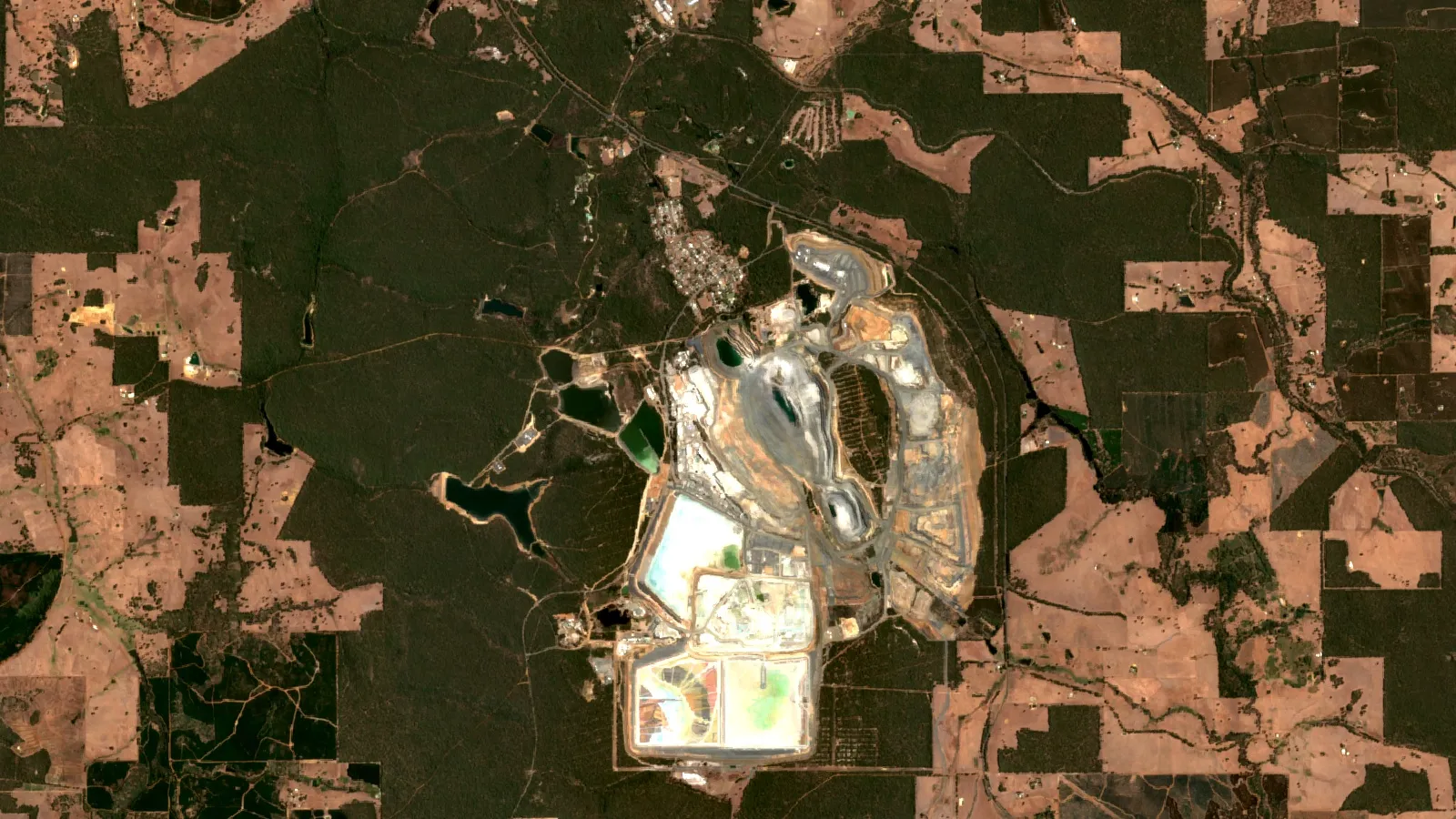
- Australia’s 50 tonnes comes mainly as a by-product of lithium mines such as Greenbushes and Wodgina, where GAM holds the tantalum rights.
- Rubaya in North Kivu supplies about 15 percent of world coltan; a collapse there on 28 January 2026 killed more than 200 people (Argus, Reuters).
- Tantalite rose from just over US$100 per lb Ta2O5 at the end of 2025 to US$280 per lb FOB Kigali by late March 2026 (MMTA).
- Buyers follow Dodd-Frank section 1502 in the U.S., EU Regulation 2017/821 and OECD-based schemes such as ITSCI.
In this article
- Which countries mine the most tantalum
- Coltan, tantalite and what the ore actually is
- Named tantalum mines and who owns them
- Africa's artisanal coltan: Rubaya, Rwanda and Nigeria
- What the Rubaya collapse did to tantalite prices
- Conflict minerals rules: Dodd-Frank 1502, the EU regulation and ITSCI
- How to value a tantalite lot
- How explorers find tantalum pegmatites
- Frequently asked questions
Most of the world’s tantalum comes from Central and East Africa and from a handful of pegmatite mines in Australia and Brazil. The U.S. Geological Survey estimates world mine output at about 2,500 tonnes of contained tantalum in 2025, and puts Congo (Kinshasa) at 1,300 tonnes of that, more than the next five producers combined (USGS Mineral Commodity Summaries, February 2026). The United States has not mined tantalum since 1959 and relies on imports for all of its apparent consumption.
This page lists the producing countries, names the mines and owners that matter, explains the ore (coltan, tantalite and the lithium by-product), sets out the conflict-minerals rules that decide who may buy it, and shows how a buyer or explorer can value a tantalite lot.
Which countries mine the most tantalum
The USGS table below is the standard reference for country output. Figures are tonnes of contained tantalum, and 2025 values are estimates. The 2024 figure for Congo (Kinshasa) was revised sharply upward in the 2026 edition, using a government report, so older rankings that show Rwanda or Brazil close to the top are out of date.
Chart
Tantalum mine output, selected countries
Tonnes of contained tantalum, 2025 estimate
| Country | 2024 (t Ta) | 2025 estimate (t Ta) | Share of world, 2025 estimate |
|---|---|---|---|
| Congo (Kinshasa) | 1,270 | 1,300 | 52.0% |
| Rwanda | 374 | 400 | 16.0% |
| Nigeria | 390 | 390 | 15.6% |
| Brazil | 210 | 190 | 7.6% |
| China | 76 | 80 | 3.2% |
| Australia | 52 | 50 | 2.0% |
| Ethiopia | 40 | 40 | 1.6% |
| Russia | 29 | 30 | 1.2% |
The world total is 2,500 tonnes in both years (USGS, 2026). Congo, Rwanda and Nigeria together supply roughly four-fifths of it, and most of that material comes from small-scale and artisanal mining (Reuters says Rubaya, at least, is all dug manually). Brazil’s output comes from industrial mines, and Australia’s is a by-product of lithium operations, so both are far more traceable than the African supply.
The USGS notes that identified world resources are mostly in Australia, Brazil, Canada and China and are adequate for projected needs, so the supply question is about access, safety and trade rules rather than geology. The United States holds about 55,000 tons of identified tantalum resources, but most were subeconomic at 2025 prices.
If you are comparing tantalum with its geological twin, tin, the guide to cassiterite and tin deposits covers the same African and Brazilian belts from the tin side, and the ranking of copper mines in the DRC shows the industrial side of Congo’s mining sector.
Coltan, tantalite and what the ore actually is
Coltan is a trade name for columbite-tantalite, a family of oxide minerals that carry both niobium (formerly called columbium) and tantalum. Where tantalum dominates, the mineral is called tantalite. Miners wash, crush and gravity-separate the heavy grains, then sell a concentrate that is priced by its tantalum pentoxide (Ta2O5) content. The USGS assumes that traded tantalum concentrates carry 32 percent Ta2O5 and that Ta2O5 itself is 81.897 percent tantalum metal, which is how it converts ore trade into the contained-metal tonnes in the table above.
Chart
Average tantalite price
US$ per kilogram of Ta2O5 content, annual average
Grades vary a great deal. Reuters reported, from a Congolese government document, that Rubaya holds several thousand tonnes of coltan with tantalum concentrations of 20 to 40 percent (The EastAfrican, citing Reuters). Concentrate quoted at 25 or 30 percent Ta2O5 is the common trading basis in price assessments.
Geologically, the main hard-rock source is the lithium-cesium-tantalum (LCT) pegmatite, a coarse-grained granite-derived intrusion that can hold spodumene, pollucite, beryl, cassiterite and columbite-tantalite together. The USGS describes columbite-tantalite as the tantalum ore mineral of these deposits in its lithium deposit chapter (USGS Professional Paper 1802-K). Our own guide to pegmatite deposits explains the zoning, the types and the exploration signs in detail.
Why the price moves so much
Tantalum goes into capacitors for phones, laptops and data-centre boards, into semiconductors and optical components, and into superalloys for gas turbines. The USGS lists some substitutes, but with performance loss or higher cost. Because the market is small, a single mine can move it. The USGS puts the annual average tantalite price at US$158 per kilogram of Ta2O5 in 2021 and US$180 in 2025 (USGS, 2026). Those are yearly averages, and 2026 has been far more volatile, as the price section below shows.
Named tantalum mines and who owns them
The list below covers the mines and projects that appear in recent trade and company reports, grouped by how the tantalum is produced. Ownership and status are taken from the sources linked in each row, dated where the source is dated; check the company’s latest filing before relying on a name or stake.
| Mine or project | Place | Owner or operator | How tantalum is produced |
|---|---|---|---|
| Rubaya | North Kivu, DRC | Held by AFC/M23 rebels since April 2024 (Argus, February 2026); a private party holds the title (Reuters, 2026) | Artisanal coltan; about 15 percent of world coltan output |
| Greenbushes | Western Australia | Talison Lithium operates; Global Advanced Metals (GAM) holds the tin-tantalum rights (IGO, CY25 resource statement) | Tin-tantalum concentrate from the lithium plants, plus stockpiled tantalum-rich material |
| Wodgina | Pilbara, Western Australia | Mineral Resources and Albemarle joint venture, operated by MinRes; POSCO Holdings agreed in November 2025 to buy 30% of MinRes’s holding vehicle for its Wodgina and Mt Marion stakes; GAM has exclusive rights to the tantalum co-product (2022 report) | Co-product of lithium processing |
| Pilgangoora | Pilbara, Western Australia | PLS (formerly Pilbara Minerals), wholly owned | Designed to recover tantalite alongside spodumene |
| Mibra | Minas Gerais, Brazil | AMG; tantalum pre-concentrate sold to Taniobis under a 2022 agreement | Tantalum and spodumene from one pegmatite operation |
| Pitinga | Brazil | Mineracao Taboca, bought by China Non-Ferrous Metal Mining (CNMC) from Minsur in November 2024 | Ferro-niobium-tantalum and tin |
| Tanco | Manitoba, Canada | Sinomine (Hong Kong) Rare Metals | Historic tantalum and cesium pegmatite, restarted for spodumene |
Australia: tantalum as a lithium by-product
Greenbushes began as a tin and tantalum oxide working around 1888, and tantalum mining began in the 1940s. In the 1990s the Cornwall Pit became a major tantalum source, and an underground mine started in 2001, but a price collapse in the mid-2000s led to the underground workings being abandoned and the pit flooding. Today Talison produces a tin-tantalum concentrate for GAM as a by-product from most of its main processing plants and stockpiles tantalum-rich material separately (IGO, Greenbushes resources and reserves statement for CY25).
At Wodgina, GAM owns tantalum recovery plants at each lithium processing train and holds the exclusive rights to the tantalum co-product, according to a May 2022 industry report on the Wodgina restart. Argus reports that GAM, a major U.S. smelter, has a well-established supply of concentrate from Greenbushes and Wodgina, and that Liontown Resources raised its tantalite production to 591 dry tonnes in the first half of its 2026 financial year from 246 tonnes a year earlier (Argus Media, 12 February 2026).
Pilgangoora lies about 120 km south of Port Hedland and its concentrator was designed to make tantalite as well as spodumene; the project profile cited a target of about 274,000 lb of tantalite a year (Mining Technology project profile). Bald Hill, near Kalgoorlie, was designed for 155,000 tonnes of spodumene and 260,000 lb of tantalum pentoxide a year, with probable reserves of 1.4 million lb of Ta2O5 (Mining Technology). Other Western Australian lithium operations are listed in the full list of lithium mines in Western Australia.
The USGS shows Australian output of 50 tonnes of contained tantalum in 2025. That is small beside Congo, but it is traceable material that Western refiners can buy without conflict-minerals risk, which is why the by-product from lithium mines draws so much attention.
Brazil, Canada and China
AMG’s Mibra mine in Minas Gerais sells all its tantalum pre-concentrate to Taniobis GmbH under a December 2022 agreement with JX Nippon Mining and Metals, which also agreed to fund an expansion of tantalum concentrate production (AMG press release, 22 December 2022).
The MMTA, the UK minor metals trade association, notes that CNMC’s purchase of Taboca gives Chinese firms control of the Pitinga tin-niobium-tantalum resource, and that tantalum supply from Taboca is set to rise by up to 150 percent (MMTA, April 2026). Argus adds that CNMC has announced a US$100 million investment aimed at doubling Taboca’s capacity by 2028.
Tanco, at Bernic Lake in Manitoba, is a historic pegmatite mine known for tantalum and cesium. Sinomine Resources bought it from Cabot in 2019 and restarted spodumene concentrate output in December 2021, after the earlier lithium operation closed in 2009, according to The Northern Miner.
▶ Explains how exports, jobs and energy-transition minerals tie mining to national economies. · 5:03
Africa’s artisanal coltan: Rubaya, Rwanda and Nigeria
Rubaya, in Masisi territory of North Kivu, is the best-known coltan field in the world. Reuters reports that it accounts for around 15 percent of world coltan output and that all of it is dug manually. Argus reports that the AFC/M23 group took Rubaya in late April 2024 and that a UN Group of Experts estimated the group could raise as much as US$800,000 a month by taxing and selling the material, which is smuggled to Rwanda and mixed with local supply.
On 28 January 2026 a landslide and collapse at Rubaya killed more than 200 people, according to Argus. The MMTA, writing in April 2026, said the dead included about 70 children. These deaths are part of why buyers separate Central African supply into monitored and unmonitored sources.
Rwanda is the main export route. Argus reports that China’s tantalite imports from Rwanda rose to 2,865 tonnes in 2025, up 82 percent from 1,571 tonnes in 2023, which made China the largest importer of tantalite, while U.S. concentrate imports from the DRC and Rwanda fell to zero over the past two years.
Nigeria produced an estimated 390 tonnes of contained tantalum in both 2024 and 2025 (USGS, 2026), mostly from small-scale columbite-tantalite mining in pegmatite fields. Ethiopia produced an estimated 40 tonnes in each year.
The DRC government put Rubaya on a shortlist of strategic assets offered to the United States under a minerals framework in February 2026, and estimated that US$50 million to US$150 million would be needed to restart and ramp up commercial output, according to Reuters. M23 and its political arm AFC are not parties to the DRC-Rwanda peace agreement signed in Washington on 5 December 2025 (Argus). Rights to the site, and the legality of any purchase, therefore remain open questions for any buyer.
What the Rubaya collapse did to tantalite prices
The MMTA says tantalite ended 2025 a little above US$100 per lb of Ta2O5 after a tight second half, jumped past US$120 in the immediate aftermath of the collapse, and by late March 2026 had more than doubled to US$280 per lb FOB Kigali. That is the highest since the 2000-2001 bubble, when prices rose to about US$350 per lb before falling to roughly US$15 by mid-2002. Argus assessed US$128-132 per lb on 5 February 2026 (cif main airport) and US$149-156 on 19 February (cif main port), up 43 percent from the start of the year.
Chart
Tantalite price milestones, 2025 to 2026
US$ per lb Ta2O5; grade, port and assessor differ by point
Argus names AI data-centre capital spending as a demand driver, since many tantalum and tantalum-polymer capacitors sit on the boards that carry AI chips (Argus Media, 20 February 2026). The MMTA adds two other forces: Chinese processors run low ore inventories and buy fast when supply drops, and the Chinese government continues to stockpile tantalum. Prices on different bases are not directly comparable (grade, port and date differ), which is why the chart below labels each point.
An ASX release from the explorer Arcadia Minerals on 27 April 2026 cited European tantalite at about US$200-210 per lb for 25 percent concentrate in March, against US$91.87 per lb assumed in a 2023 feasibility study for its Swanson project. That gap shows why developers are revisiting old tantalum projects (Arcadia Minerals ASX release).
Prices change daily. Check a current assessment from Argus, Fastmarkets or a producer before pricing any lot, and use the calculator on this page with your own quote.
Conflict minerals rules: Dodd-Frank 1502, the EU regulation and ITSCI
Tantalum, tin, tungsten and gold are the “3TG” conflict minerals. Three systems sit behind almost every purchase decision.
| Rule or scheme | Who it applies to | What it requires |
|---|---|---|
| Dodd-Frank Act section 1502 (U.S.) | U.S. listed companies whose products need 3TG | A Form SD each year by 31 May, covering the prior calendar year, on whether the minerals came from the DRC or an adjoining country, with due diligence on the chain of custody |
| EU Conflict Minerals Regulation 2017/821 | EU importers of tin, tantalum, tungsten and gold ores and metals above set volume thresholds, and EU smelters and refiners | Responsible-sourcing due diligence; fully applicable since 1 January 2021 |
| ITSCI | Mine sites and exporters in the Great Lakes region (DRC, Rwanda, Burundi) | Bag tagging at the mine, a data centre that records each shipment, and incident follow-up by field teams |
Dodd-Frank section 1502
The U.S. Securities and Exchange Commission’s rule applies to companies for which tantalum, tin, tungsten or gold is necessary to the functionality or production of a product. They file Form SD by 31 May each year for the previous calendar year, and report on whether the minerals originated in the DRC or an adjoining country (SEC press release on the conflict minerals rule). The rule sets a disclosure duty, not a ban.
EU regulation and the OECD framework
The European Commission describes Regulation (EU) 2017/821 as requiring EU companies to import these minerals and metals from responsible sources only, applying since 1 January 2021 (European Commission, Conflict Minerals Regulation). On 16 October 2025 the Commission recognised the Responsible Minerals Initiative’s Responsible Minerals Assurance Process as an equivalent due diligence scheme, and in June 2026 it opened a tender to review the regulation. Argus notes that tantalum is subject to OECD due diligence requirements and that material from occupied parts of the DRC is not eligible for international trade.
ITSCI and its critics
ITSCI is the traceability and due diligence programme for tin, tantalum and tungsten from the Great Lakes region, run by the International Tin Association. Pact led its field implementation in Burundi, the DRC and Rwanda and conducted baseline studies to decide when mine sites could enter the system (Pact, ITSCI project page). Global Witness published a report in April 2022, The ITSCI laundromat, arguing that the scheme appears to launder conflict minerals, and said that ITSCI’s public response did not address the problems raised (Global Witness, 2022). The MMTA states that Rubaya, a conflict zone, remains a place where traceability schemes cannot operate.
The practical effect is a two-tier market. Lithium by-product tantalite from Australia, Brazilian concentrate and recycled tantalum sell without conflict-minerals risk. Central African material sells through monitored sites, or into buyers that accept the risk. The MMTA reports that GAM has announced a line of certified 100 percent recycled tantalum products for electronics.
How to value a tantalite lot
A tantalite lot is priced by contained Ta2O5. Multiply the concentrate weight by its Ta2O5 grade, convert to pounds (1 tonne is about 2,204.6 lb) and apply the price per pound. A buyer then deducts payable-percentage terms, freight and treatment. For example, 10 tonnes at 30 percent Ta2O5 holds about 3 tonnes of Ta2O5, which is roughly 6,614 lb; at an example price of US$120 per lb and a 70 percent payable share, the lot is worth about US$556,000 at the mine gate before costs.
These inputs vary by contract. Use a recent quote for price and the buyer’s own terms for payables.
Calculator
What is my tantalite concentrate worth?
Enter your own tonnage, grade, price and payable share.
- Tantalum metal content (kg): 2,457
- Gross value at your price (US$): $793,663
- Payable value (US$): $555,564
Example values only, not a benchmark or a quote. Price is an input; use a current quote. Conversion: 1 tonne = 2,204.62 lb; Ta2O5 is 81.897 percent tantalum (USGS, 2026). Money in US$.
How explorers find tantalum pegmatites
Hard-rock tantalum sits in zoned pegmatites, so the search starts with granite belts. The USGS says fertile granites show muscovite, tourmaline and garnet and high trace cesium, lithium, rubidium, tin and tantalum. Weathering of LCT pegmatites leaves soil anomalies: around Greenbushes, arsenic, beryllium, antimony and tin form a 12-by-20-km halo in lateritic soils, and niobium, tantalum and boron form a smaller 1-by-5-km halo. Tantalite is also dense and durable enough to serve as a heavy indicator mineral found by panning sediments (USGS Professional Paper 1802-K).
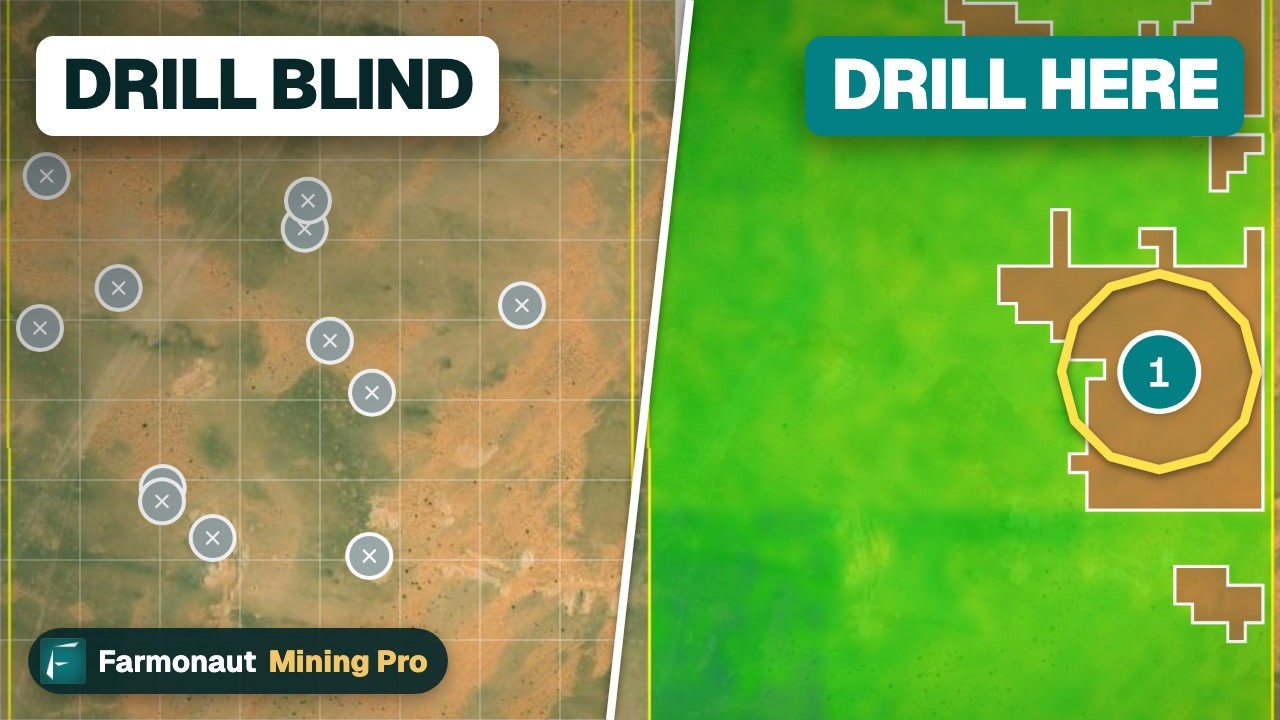
Satellite imagery cannot see tantalum, but it does map pegmatite outcrops, bare rock, artisanal pits, tailings and access tracks across a licence in days. Farmonaut runs this kind of screen on licence polygons, and the results are exploration targets, not resource estimates, so they sit ahead of any drilling or sampling programme.
For a consultant or licence owner the useful checks before spending on fieldwork are: who holds the title (check the national cadastre), whether the ground is inside a protected or conflict-affected area, what rights apply to by-products such as tin and lithium, and which refiners will buy the concentrate under the rules above.
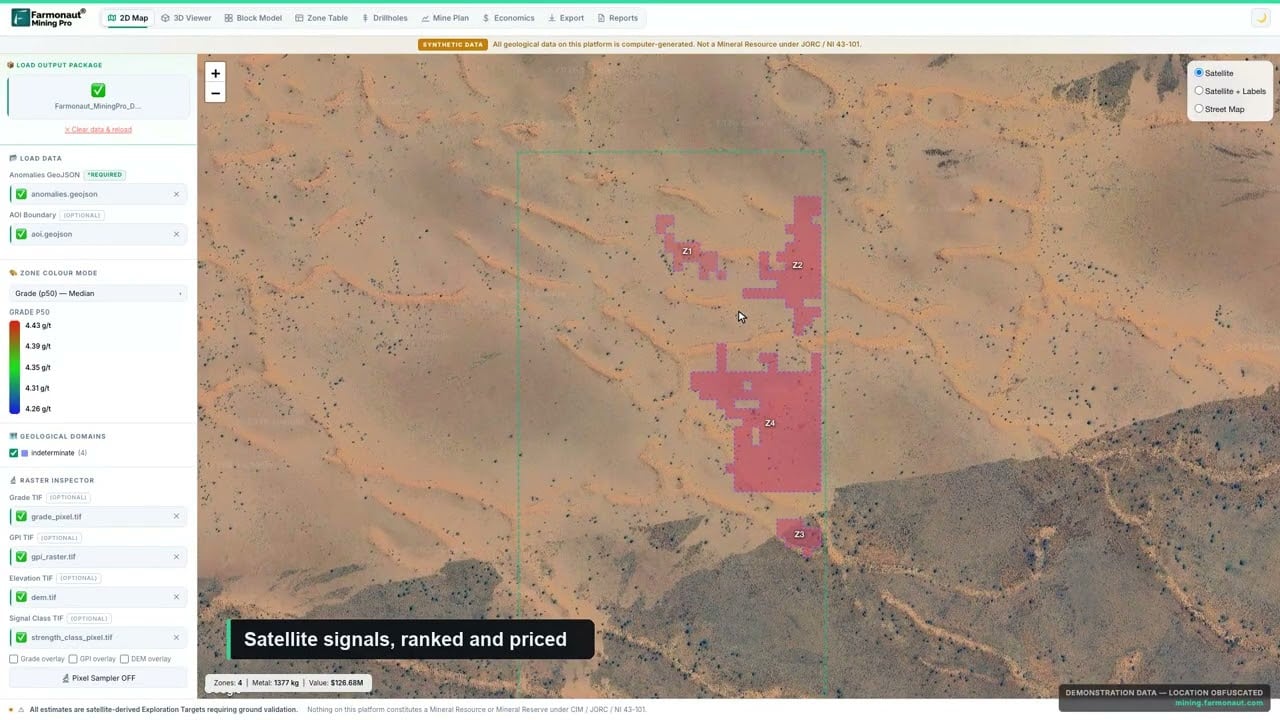
▶ Shows how a licence boundary becomes a satellite-based geological and economic screen. · 4:56
Frequently asked questions
Where does most of the world’s tantalum come from?
Congo (Kinshasa) mined an estimated 1,300 of the world’s 2,500 tonnes of contained tantalum in 2025, followed by Rwanda (400), Nigeria (390) and Brazil (190) (USGS, 2026).
What is the largest tantalum mine in the world?
Rubaya in North Kivu is usually described as the largest single coltan source, at about 15 percent of world coltan output according to Reuters. It is an artisanal field under rebel control, not an industrial mine. The largest industrial sources are in Brazil (Mibra and Pitinga) and Australia (lithium-tantalum pegmatites such as Greenbushes and Wodgina), though USGS puts Brazil at 190 tonnes and Australia at 50 tonnes in 2025.
What is the difference between coltan and tantalite?
Coltan is the trade name for the columbite-tantalite mineral series, which holds both niobium and tantalum. Tantalite is the tantalum-rich end of that series. Concentrates are sold by their Ta2O5 content.
Does the United States mine tantalum?
No. The USGS reports no U.S. tantalum mine production since 1959 and 100 percent net import reliance, with the value of tantalum consumed in 2025 estimated at US$190 million, measured by import value.
Which mines produce tantalum as a by-product of lithium?
Greenbushes and Wodgina in Western Australia feed GAM, and Argus names Liontown Resources as another Australian lithium producer with tantalite output. Pilgangoora and Bald Hill were designed to recover tantalum alongside spodumene. Mibra in Brazil and Tanco in Canada are also pegmatite operations.
What are conflict minerals and is tantalum one?
Tin, tantalum, tungsten and gold are the conflict minerals named in the EU and U.S. rules, because armed groups have used revenue from them in eastern Congo and neighbouring countries (European Commission).
What is Dodd-Frank section 1502?
It is the U.S. law behind the SEC’s conflict minerals rule. Companies that use tantalum, tin, tungsten or gold in their products file Form SD by 31 May each year, covering the prior calendar year.
Does the EU ban tantalum from Congo?
No. Regulation 2017/821 requires importers, smelters and refiners to carry out due diligence and source responsibly; it does not ban a country. Argus notes that material from occupied parts of the DRC cannot be traded internationally under OECD due diligence rules.
What is ITSCI?
ITSCI is a tagging and due diligence programme for tin, tantalum and tungsten from the DRC, Rwanda and Burundi. Government agents tag bags at registered mines, and the data goes to a central data centre. Global Witness has criticised its effectiveness.
Why did tantalum prices rise so sharply?
Argus and the MMTA point to the Rubaya collapse on 28 January 2026, AI data-centre capacitor demand, low Chinese ore inventories and Chinese government stockpiling.
Can tantalum be recycled?
Yes. Scrap is a significant source, and the MMTA expects buyers worried about brand risk to lean on recycling. U.S. consumption data in the USGS summary includes tantalum recovered from foreign and domestic scrap.
How is tantalum different from tungsten and niobium?
Niobium usually occurs with tantalum in the same ore minerals and can replace it in some uses, while tungsten is a separate ore (wolframite or scheelite) that is also a conflict mineral. Tantalum is chosen for capacitors and corrosion-resistant equipment.
This page is for information only. It is not investment advice or legal advice. Prices and ownership change; confirm the rules with the regulator and get a current quote before trading.
Farmonaut mining
Map your pegmatite licence from space
Consultants can screen a licence area for exploration targets before sampling and drilling.

Mining Pro sample view, synthetic data
Keep reading
Sources
- USGS, Mineral Commodity Summaries 2026: Tantalum: pubs.usgs.gov
- USGS Professional Paper 1802-K, Lithium (LCT pegmatite exploration): pubs.usgs.gov
- Argus Media, DRC’s Rubaya mine collapse (12 Feb 2026): argusmedia.com
- Argus Media, Ta prices surge on capacitor demand (20 Feb 2026): argusmedia.com
- MMTA, Rubaya and the tantalum market (Apr 2026): mmta.co.uk
- The EastAfrican / Reuters, Congo offers Rubaya to US: theeastafrican.co.ke
- European Commission, Conflict Minerals Regulation: policy.trade.ec.europa.eu
- SEC, conflict minerals rule press release: sec.gov
- Pact, International Tin Supply Chain Initiative: pactworld.org
- Global Witness, ITSCI press release (2022): globalwitness.org
- IGO, Greenbushes resources and reserves CY25: igo.com.au
- Passive Components, Wodgina restart (May 2022): passive-components.eu
- AMG, tantalum partnership with JX Nippon Mining and Metals (Dec 2022): amg-nv.com
- Mining Technology, Pilgangoora project profile: mining-technology.com
- Mining Technology, Bald Hill project profile: mining-technology.com
- The Northern Miner, Tanco under Sinomine: northernminer.com
- Arcadia Minerals, ASX release on tantalum prices (27 Apr 2026): cdn-api.markitdigital.com
Discussion
Questions, corrections or field experience? Share them below. First-time comments are reviewed before they appear, and your email is never published.
No comments yet. Be the first to add a question or your experience.

 Mine4Africa
 Lithspo Minerals Limited
 Tintina Mining Group
 Dalgety Minerals Pty Ltd
 Vortex Minerals Pty Ltd
 Faith At Work (Pty) Ltd
 Geotech Mining Solutions plc
 Vulcan International Limited
 Kidepo Associates
 GKY Mining
 Alkimy SARL
 Double A Trading
 GemSprout Metals Limited
 Qader Group
 Ileys General Trading
 SG Gold Mining LLC
 VRV Global Pte Ltd
 Omsri International FZE
 G.I.T.T.
 Jaunita Erss Ltd
 Almosi SARL
 SRK Consulting
 Berks Gold Limited
 Mwerezi Minerals Company Limited

 Exploration consultancy · South Africa · Gold










