

Customer case study · Areca nut
Areca Nut Irrigation: A Karnataka Satellite Case Study
A weekly satellite advisory told areca nut grower Blesson Thomas to drip-irrigate on 4 days out of 7 and to hold fertilizer on his ripening palms. He reports saving 2 irrigations and more than 3 bags of fertilizer, and estimates both irrigation and fertilizer use were optimised by 30–50%.
Key takeaways
- Blesson Thomas grows 8.5 acres of areca nut in three gardens near Kusur, Uttara Kannada, Karnataka, and got his first satellite advisories on 10 November 2026.
- The drip plan for his 1.69-acre Raspan garden watered 3 mm on 4 days and skipped 3, because radar soil moisture (0.84) and canopy water (NDWI 0.34) read high.
- That is 43% less water than the same dose every day and about 38% less than ICAR-CPCRI’s 20 litres per palm per day, inside the 30–50% he reported.
- The two ripening gardens were told to apply no N, P, K, S or Zn this period; one standard CPCRI post-monsoon round for Raspan is close to 8 bags of 50 kg.
- The pest list tracked the season: spindle bug was flagged in all three gardens, the pest CPCRI’s November calendar says to control.
In this article
- The areca nut gardens at a glance
- How the areca nut irrigation plan was set
- Skip days: where the water saving came from
- Areca nut fertilizer: why the advisory said hold
- Building soil, not just applying fertilizer
- Pest and disease watch for November
- What Blesson reported
- How to use the same method on your own garden
- FAQ
Areca nut irrigation after the monsoon is a balancing act. The palms are filling and ripening nuts, so they still need steady water, but the soil often stays wet for days after the rains stop. This case study follows areca nut grower Blesson Thomas through his first weekly satellite advisory and shows where the water and fertilizer savings he reported came from.
Blesson grows areca nut on three gardens, 8.5 acres in all, near Kusur in Mundgod taluk, Uttara Kannada district, Karnataka, India. He drew the three gardens in the Farmonaut Satellite + AI Farm Monitoring System on 10 November 2026. Within the hour each garden had its own advisory, built from the satellite passes of 7 and 9 November, with a seven-day drip plan, a nutrient-by-nutrient fertilizer plan, a pest and disease watch list and a yield estimate.
On 14 November 2026, Blesson filled in our in-app feedback form for his 1.69-acre garden, Raspan. He said the advice helped with irrigation, fertilizer and pest control, that he acted on it in time, that he saved 2 irrigations and more than 3 bags of fertilizer, and that he estimates both his irrigation and his fertilizer use were optimised by 30–50%. He also agreed that we could share his story. We went back through the advisory to show how a single week of advice can produce savings of that size.
The areca nut gardens at a glance
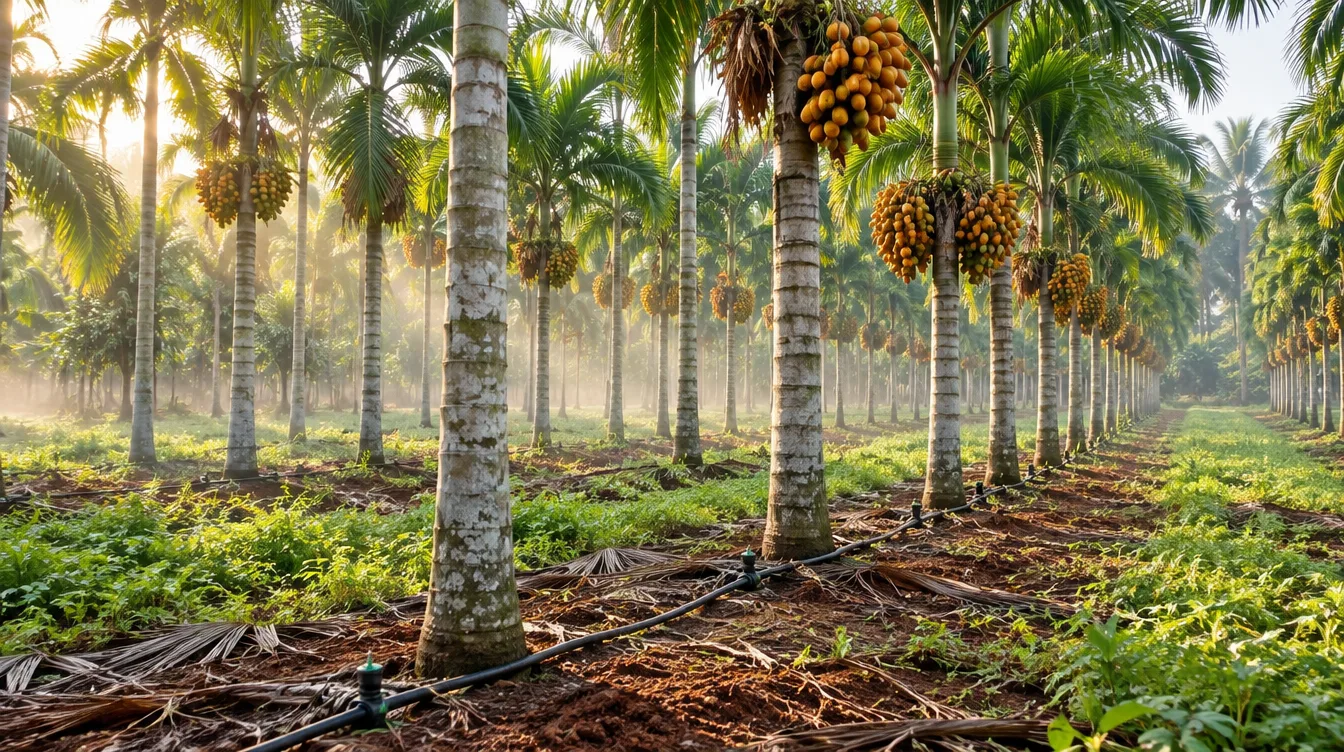
All three gardens are drip-irrigated areca nut on acidic soil. Two are bearing gardens at the nut ripening stage. The third is a younger garden still building its stem before it comes into full bearing. That difference matters, because it changes what the palms need in November.
| Garden | Size | Stage on 9 Nov | Drip plan, 10–16 Nov | Fertilizer this period |
|---|---|---|---|---|
| Raspan | 1.69 acres | Nut maturation and ripening | 3 mm on 4 days, 3 skip days | Hold: no N, P, K, S or Zn |
| Farm 1 | 2.48 acres | Nut maturity and harvest | 3 mm on 4 days, 3 skip days | Hold: no N, P, K, S or Zn |
| Farm 2 | 4.37 acres | Stem elongation, pre-bearing | 3.5 mm on 4 days, 3 skip days | Full nutrient plan |
The feedback, and most of the numbers below, are for Raspan, the garden Blesson rated. Farm 1 and Farm 2 show how the same system gave a different answer to a garden at a different stage.
How the areca nut irrigation plan was set
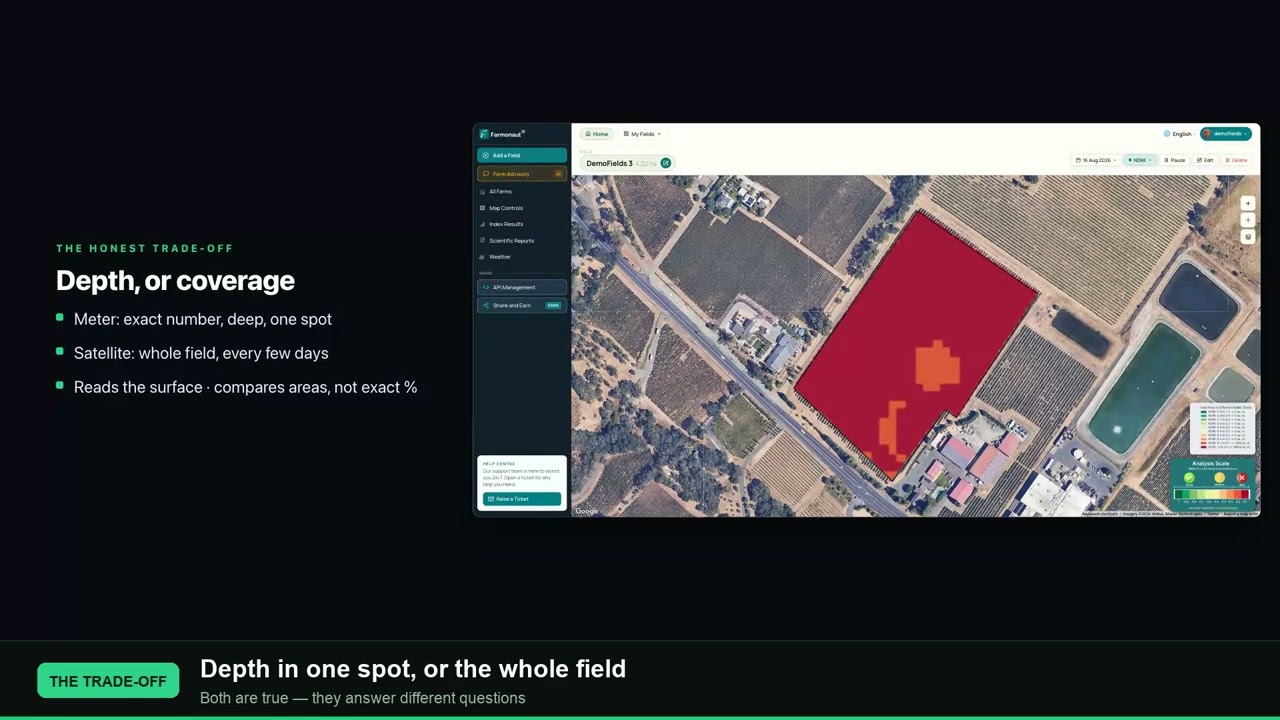
Each advisory starts from satellite images of the field. Sentinel-2 photographs the same spot about every five days with two satellites, and Sentinel-1 adds a radar image that is not blocked by cloud. That mattered here. The optical image of 9 November was cloudy, so the advisory leaned on the radar pass of 7 November, which works day and night through cloud, together with the leaf-water and soil-moisture readings that came through.

▶ Why radar satellites can still see a field on a cloudy day · 2:37
Infographic
How each weekly drip plan is built in 5 steps
- 1Satellite passSentinel-2 and Sentinel-1 image each garden every few days.
- 2Read the gardenNDWI and radar soil moisture show canopy water and soil wetness.
- 3Crop water useReference evaporation times the crop coefficient for the stage.
- 4Skip rulesWet soil, a wet canopy or expected rain set that day to 0 mm.
- 5Dose and timingA drip amount in mm and an early-morning window for each day.
For Raspan, the readings were clear. The water index NDWI was 0.34, a signal that responds to the liquid water held in the canopy, and the radar soil-moisture score was 0.84, which the advisory rates as high. The canopy itself read as dense. The palms were not short of water when the plan was written.
The daily amount came from crop water use. With no local weather feed for the week, the advisory estimated reference evaporation with the Hargreaves temperature method, the fallback FAO’s irrigation guide gives when full weather data are missing. At about 15° N in mid-November that came to roughly 3.5–4 mm a day. A crop coefficient of about 0.9 for ripening palms gave a need of about 3.2–3.6 mm, and the plan capped the dose at 3 mm.
Then the skip rule. Because both the canopy and the soil read wet, the advisory kept a gap of at least two days between drip events. The plan for 10–16 November was 3 mm on the 10th, 12th, 14th and 16th, and nothing on the 11th, 13th and 15th. Each watering was set for 05:30–07:30, before the heat of the day.
Chart
Raspan’s drip plan for the week
mm of drip water per day, 10–16 November 2026, 1.69 acres
Skip days: where the water saving came from
Most of the saving in an areca nut drip schedule like this one comes from the days the plan sets to zero, not from smaller doses. Raspan’s 3 mm on a watering day is close to the standard rate. ICAR-CPCRI, India’s plantation crops research institute, advises that 20 litres of water per palm per day may be given through drip. At CPCRI’s recommended spacing of 2.7 m by 2.7 m, each palm has 7.29 m² of ground, so 20 litres is 2.7 mm and the advisory’s 3 mm is about 22 litres per palm.
What changed was how often. Over the week, Raspan was told to drip on 4 days out of 7. Against the same 3 mm every day, that is 43% less water. Against CPCRI’s 20 litres per palm every day, it is about 38% less. Both numbers sit inside the 30–50% Blesson reported, and the 3 skip days in the plan line up with the 2 irrigations he said he saved by the time he filled in the form just after midnight on the 14th.
In volume, Raspan’s 1.69 acres needed about 82,000 litres of drip water for the week instead of about 144,000 litres on a daily routine, a saving of roughly 61,500 litres, or about 16,200 US gallons. Across all three gardens, the same skip days kept about 338,000 litres out of the drip lines in one week.
The palms did not go short. On a skip day the soil was already holding water from the monsoon tail, and every watering day still delivered a full dose. CPCRI’s own calendar moves areca gardens to one irrigation a week from December, at 175 litres per palm, so the advisory’s every-other-day drip in mid-November is a step along the same path from monsoon to dry season, with the timing set by what the satellites saw in each garden.
Chart
One week of drip water: daily routine vs the advisory
Thousand litres per garden, 10–16 November 2026; daily routine = the same dose every day
Try the numbers for your own farm below.
Calculator
How much water and fertilizer could skip days and a held round save?
Enter your own garden size, spacing, drip rate and skip days.
- Palms in the garden: 1,110 palms
- Water saved: 70,399 US gal
- Urea in one held round: 156.9 kg
- Muriate of potash in one held round: 166.5 kg
- All three products, 50 kg bags: 9.2 bags
Example values only, not a benchmark or forecast. Palms = area ÷ (spacing × spacing). Fertilizer lines use one ICAR-CPCRI post-monsoon round of 65 g N, 25 g P2O5 and 90 g K2O per adult palm, with urea at 46% N, superphosphate at 20% P2O5 and muriate of potash at 60% K2O (Mississippi State University Extension P2500). 1 acre = 4,046.86 m², 1 US gallon = 3.785 L.
Areca nut fertilizer: why the advisory said hold
The fertilizer side of the advisory was even simpler for Raspan: apply nothing this period. For each of nitrogen, phosphorus, potassium, sulphur and zinc, the rate was 0 kg per acre, with the note that the palms were at a stage where extra fertilizer would not pay. Farm 1, also ripening nuts, got the same answer.
That is where Blesson’s bags came from. CPCRI’s standard programme for adult palms has a second fertilizer round as the south-west monsoon recedes, 65 g of N, 25 g of P₂O₅ and 90 g of K₂O per palm, and the calendar says that if it was not applied in September it can still go on in October. A grower who had not finished that round would naturally reach for the bags in November.
At 2.7 m spacing, Raspan’s 1.69 acres holds about 940 palms. Using the usual grades of straight fertilizer, urea at 46% N, ordinary superphosphate at 20% P₂O₅ and muriate of potash at 60% K₂O, one such round for the garden is about 133 kg of urea, 117 kg of superphosphate and 141 kg of muriate of potash. That is close to 8 bags of 50 kg. Blesson’s “more than 3 bags” saved sits comfortably inside one round.
The advisory did not tell every garden to stop. Farm 2, the younger garden still building its stem, received a full nutrient plan for nitrogen, phosphorus, potassium, sulphur and zinc in the same week. One farm, three gardens, two different fertilizer answers, set by the stage each garden was at rather than by the calendar alone.
Chart
One post-monsoon fertilizer round for Raspan
kg of product for about 940 palms at 2.7 m spacing, CPCRI rates per adult palm
Building soil, not just applying fertilizer
The advisory also read the soil. Raspan came out at pH 5.6, which is acidic but inside the roughly 5.5–7 range the advisory uses for areca nut, with low salinity and low organic carbon at 0.12%. The other two gardens read the same pH and similar carbon.
Those two numbers point to soil care rather than more fertilizer. For acid soils, CPCRI suggests lime at 1 kg per palm, forked in 15 days before fertilizer, and 12 kg of green-leaf compost or farmyard manure per palm to feed soil life. Holding back mineral fertilizer while the palms cannot use it, and putting organic matter back when the next round is due, is the kind of plan that keeps a garden productive over many seasons.
▶ What a satellite measures about soil moisture compared with a probe in the ground · 2:11
Pest and disease watch for November
Each advisory listed the pests, diseases and weeds most likely in that garden that week, with a probability score and an organic and a chemical option for each. For Raspan the list was fruit rot (koleroga) at 70%, spindle bug at 40%, foot rot at 35% and red spider mite at 25%. Siam weed and purple nutsedge were the weeds to watch in the wet inter-rows.
Chart
What the Raspan advisory said to watch
Modelled probability for the week of 10 November 2026, %
The list tracks the season. CPCRI’s November calendar for areca gardens says to control spindle bug and root grub. Spindle bug appeared in the advisory for all three of Blesson’s gardens, and root grub in the advisory for the young garden. Fruit rot, the disease CPCRI calls the most dreaded disease of areca nut in high-rainfall areas, sat at the top of the list while the soil and canopy were still wet from the monsoon.
Blesson answered yes to the question on whether the report helped him act on pest, disease or weed issues. The scores are modelled risks, not confirmed outbreaks, so they work as a checklist for walking the garden. For any spray, follow the product label and local rules.
What Blesson reported
Here are the questions from the in-app form for Raspan and Blesson’s answers, word for word.
| Question | His answer |
|---|---|
| Did this week’s advice help your farm? | Yes |
| Did you act in time? | Yes |
| What did you do because of the advice? | Changed watering, Changed fertilizer |
| Helped optimise irrigation? | Yes |
| How many irrigations did you save? | 2 |
| By how much was irrigation optimised? | 30–50% |
| Helped optimise fertilizer? | Yes |
| How much fertilizer did you save? | More than 3 bags |
| By how much was fertilizer use optimised? | 30–50% |
| Helped act on pests, disease or weeds? | Yes |
The percentages are Blesson’s own estimates, not metered readings. The advisory numbers in this case study show the mechanism behind them: three skip days in the drip plan and a fertilizer round that the ripening palms did not need.

▶ How to read a Farmonaut satellite farm advisory, section by section · 9:13
How to use the same method on your own garden
The approach is not specific to areca nut. Any drip-irrigated tree crop, from oil palm and coconut to citrus and avocado, goes through the same post-rain window when the soil is wetter than a fixed schedule assumes. Three habits carry over.
- Let soil and canopy moisture decide the gap between waterings, and keep a full dose on the days you do water.
- Match fertilizer to the stage of each block, not to the calendar for the whole farm.
- Read the pest list each week as a short checklist for a field walk, not as a spray order.
For more on the crop itself, see our guide to technology in areca nut plantations, and an earlier plantation advisory case study covering oil palm and areca.
FAQ
How much water does an areca nut palm need per day?
ICAR-CPCRI advises about 20 litres per palm per day through drip in the dry season. At the standard 2.7 m by 2.7 m spacing that is about 2.7 mm of water a day. After the monsoon, when the soil is still wet, many days need no water at all.
How often should areca nut be irrigated after the monsoon?
It depends on how wet the soil stays. In this case study the satellite readings showed high soil moisture in mid-November, so the advisory watered every other day. CPCRI’s calendar moves to once a week, at 175 litres per palm, from December.
When should areca nut fertilizer be applied?
CPCRI’s programme for irrigated adult palms splits fertilizer into a first round around April or May and a second round as the south-west monsoon recedes in September or October. Outside those windows, and at stages where the palms do not respond, a stage-based advisory may set the rate to zero.
Can satellites see an areca nut garden on a cloudy day?
Optical satellites cannot see through cloud, but radar satellites such as Sentinel-1 can. In this case the cloudy optical image of 9 November was backed up by the radar pass of 7 November, which gave the soil-moisture reading the drip plan was built on.
Are the savings in this case study measured?
No. The 30–50%, the 2 irrigations and the more than 3 bags are the grower’s own estimates from our feedback form. The litres and kilograms in this article are calculated from the advisory and from CPCRI’s published rates.
Farmonaut crop monitoring
Get a weekly drip and fertilizer plan for your own garden
Draw your field once, and Farmonaut sends a satellite-based irrigation, fertilizer and pest plan for it every few days on web, Android or iOS.




Keep reading


Sources
- ICAR-CPCRI, Farmers’ corner: crop advice, arecanut (month-wise operations): cpcri.gov.in
- ICAR-CPCRI, Arecanut cultivation pamphlet (spacing 2.7 m × 2.7 m) (1989): cpcri.gov.in
- ICAR-CPCRI, Extension folder: Koleroga (fruit rot) of arecanut and Bordeaux mixture: cpcri.gov.in
- Mississippi State University Extension, Inorganic Fertilizers for Crop Production (P2500): extension.msstate.edu
- FAO, Irrigation and Drainage Paper 56, Chapter 3: Meteorological data, Hargreaves ETo equation (1998): fao.org
- FAO, Crop Evapotranspiration (Irrigation and Drainage Paper 56), Table 12: single crop coefficients (1998): fao.org
- European Space Agency, Sentinel-2 facts and figures: esa.int
- Copernicus SentiWiki, Sentinel-1 mission: sentiwiki.copernicus.eu
- NASA MODIS Science Team, Gao (1996): NDWI, a normalized difference water index for remote sensing of vegetation liquid water: modis.gsfc.nasa.gov
- Farmonaut advisory records for the three gardens (9 November 2026) and the grower’s feedback form (14 November 2026): sat.farmonaut.com
Discussion
Questions, corrections or field experience? Share them below. First-time comments are reviewed before they appear, and your email is never published.
No comments yet. Be the first to add a question or your experience.

 Agreeta Solutions
 Agricultural Credit Policy Council
 BayWa
 MCSOD
 Marei Nursery
 eKGIS
 Mostas Tech
 Native Seeds
 Andex
 FCF India
 Unifrutti Gulf
 Deluxe Conseil
 TVS Electronics
 WICO
 Chimera Innovation
 SkyHarvest

 Licence holder · Niger · Gold
 Licence holder · Nigeria · Gold + lithium
 Client · Tanzania · Gold
 Client · Somalia · Gold
 Client & affiliate partner · Ghana · Gold










