

Farm connectivity · South Africa buyer guide
Rural Internet for Farms in South Africa: Costs Compared
Farms can choose fixed-LTE or 5G, fixed wireless from a local tower, or geostationary satellite. Uncapped list prices on providers’ own pages started at R275, R579 and R764 a month on 16 October 2026. Starlink is not licensed; ICASA’s notice of 29 June 2026 sets out the licences any constellation needs.
Key takeaways
- Cheapest uncapped list prices on 16 October 2026: fixed-LTE R275 a month (Afrihost, slowed after 100 GB), fixed wireless R579 plus R2,500 installation (Herotel), GEO satellite R764 plus R999 installation (Vox Konnect).
- Only 2.7% of rural households had internet at home in 2025, against 76.4% online through mobile devices (Stats SA General Household Survey 2025).
- Rural 4G population coverage was 89% or more in every province in 2025, but rural 5G ranged from 7% to 74% (ICASA, March 2026).
- ICASA Notice 3992 (29 June 2026) does not name Starlink: it says a constellation needs I-ECS, I-ECNS and spectrum licences, and new I-ECNS licences need a ministerial policy direction and an Invitation to Apply.
- Amazon Leo plans to launch through Herotel in 2027; no LEO service had a licensed consumer offer we could find in October 2026.
In this article
- Rural internet for farms in South Africa at a glance
- How many rural homes are online today
- Option 1: Fixed-LTE and 5G home internet
- Option 2: Fixed wireless from a local tower
- Option 3: Geostationary satellite (VSAT)
- Price against speed for each option
- Option 4: Low Earth orbit satellite
- What ICASA's June notice says about Starlink and other constellations
- What farms use rural internet for
- How to choose rural internet for your farm in five checks
- Compare the monthly cost of two rural internet options
- How we checked the prices and rules
- FAQ
Rural internet for farms in South Africa comes in four forms: fixed-LTE or 5G from a cellphone tower, fixed wireless from a local tower, geostationary satellite, and low Earth orbit (LEO) satellite. On providers’ own price pages on 16 October 2026, uncapped fixed-LTE started at R275 a month, fixed wireless at R579 and geostationary satellite at R764. Starlink is not licensed to sell service in the country, and the regulator ICASA set out on 29 June 2026 which licences any satellite constellation would need.
This guide compares the options with dated list prices, explains what the ICASA notice actually says, and lists what farms use the connection for. A calculator at the end turns installation fees and monthly fees into one cost per month in rand, so you can compare two quotes side by side.
Rural internet for farms in South Africa at a glance
The table shows the cheapest plan we found for each option on the provider’s own page. These are list prices on 16 October 2026, not quotes for your farm. Every option depends on coverage at your exact GPS point.
| Option | How it reaches the farm | Example list price | Once-off cost | Best for |
|---|---|---|---|---|
| Fixed-LTE / 5G | SIM router on a cellphone tower signal | Afrihost, 25 Mbps, R275 a month (100 GB, then 4 Mbps) | Router from R1,499, or SIM only | Farmhouses with a good 4G or 5G signal |
| Fixed wireless | Antenna on your roof aimed at a provider’s tower | Herotel, 10/2 Mbps uncapped, R579 a month | R2,500 installation | Farms within sight of a provider tower |
| GEO satellite | Dish aimed at a satellite about 36,000 km up | Vox Konnect, 5/2 Mbps, R764 a month | R999 installation | Farms with no usable tower signal |
| LEO satellite | Flat dish linked to a fleet of low satellites | No licensed consumer service found | Not applicable | Business quotes only (Q-Kon LEO via Vox); Amazon Leo planned for 2027 |
Prices change often and most packages carry fair-use limits. Always read the provider’s terms and check coverage at your address before you sign.
How many rural homes are online today
Most rural households reach the internet mainly by phone. In the Stats SA General Household Survey 2025, released on 26 May 2026, 76.4% of rural households could get online on mobile devices, but only 2.7% had internet at home. In metro areas the home figure was 33.5%. Across all households, 85.6% had at least one member with some form of internet access.
Chart
Internet at home vs on mobile devices, by area
Percent of households, 2025
Mobile signal is wide but thin. The ICASA State of the ICT Sector Report (March 2026) puts 4G/LTE population coverage at 99.5% and 5G at 58.0% for 2025. Rural 4G coverage was 89% or more in every province, but rural 5G ranged from 7% in the Eastern Cape to 74% in Gauteng. Geographic broadband coverage was 82.08% of the country’s land, so about 18% of the land was outside broadband coverage.
Population coverage counts people, not hectares. A farmhouse may sit inside a covered area while far camps, pump stations and packsheds do not. That gap is why many farms end up with two links: one at the house and a second for remote sites.
Chart
Rural 5G population coverage by province
Percent of rural population within 5G signal, 2025; eight of nine provinces shown (Free State 25%)
Option 1: Fixed-LTE and 5G home internet
Fixed-LTE uses the same towers as your cellphone. A router with a SIM card sits in the farmhouse and turns the signal into Wi-Fi. There is no installer visit for most plans, and the SIM is usually locked to the address you give.
On Afrihost’s wireless page (16 October 2026), uncapped plans ran from R275 a month for up to 25 Mbps, slowing to 4 Mbps after 100 GB in a month, to R549 for up to 75 Mbps (slowed after 270 GB) and R875 for its Wireless Plus plan (slowed after 440 GB). A 5G router was listed at R1,499, down from R2,499. Afrihost says SIM-only plans can be cancelled before the 15th of any month. On rain’s home page the same day, unlimited home Wi-Fi started at R679 a month, month to month.
- Best for: farmhouses where your phone already shows a steady 4G or 5G signal indoors.
- Watch out for: fair-use thresholds that cut speed late in the month, and towers that slow down when many users share them.
- Tip: an outdoor LTE antenna on a mast can turn a weak signal into a usable one. Ask the provider which antennas it supports.
Option 2: Fixed wireless from a local tower
Fixed wireless providers run their own towers in farming towns and on high points. An installer fits a small antenna on your roof or a mast and points it at the nearest tower. It needs a clear line of sight, so hills and tall trees matter.
Herotel’s wireless page (16 October 2026) listed three uncapped, unshaped plans: 10/2 Mbps at R579 a month, 10/5 Mbps at R789 and 15/5 Mbps at R1,049. Installation is R2,500 once-off, and a R1,500 clawback applies if you cancel in the first 12 months. Herotel says its tower sites run on backup power, so the link stays up during power cuts if your own router has a UPS.
- Best for: farms within a few kilometres of a provider tower with no hill in between.
- Watch out for: upload speeds of 2 to 5 Mbps on standard plans, which can slow camera feeds and large file uploads.
- Tip: ask for a site survey before you pay the installation fee.
▶ What farm technology means for rural towns, including money, jobs and internet access. · 3:50
Option 3: Geostationary satellite (VSAT)
A geostationary (GEO) satellite stays over one spot on the equator. NASA’s catalogue of Earth orbits puts this orbit at about 36,000 km above the surface. Because of that distance, a request and its reply travel up and down twice, about 144,000 km. At the speed of light that takes close to half a second before any network delay is added. Video calls work, but they feel slower, and fast-reaction tasks suffer.
The upside is coverage. A GEO dish works almost anywhere with a clear view of the northern sky. On the Vox satellite page (16 October 2026), uncapped Eutelsat Konnect plans cost:
- 5/2 Mbps: R764 a month (74 cm dish)
- 10/3 Mbps: R1,261 a month (74 cm dish)
- 20/3 Mbps: R1,831 a month (74 cm dish)
- 30/5 Mbps: R2,931 a month (98 cm dish)
- 50/5 Mbps: R3,807 a month (98 cm dish)
Installation is R999, contracts run 12 or 24 months, and a fair-use policy applies. Vox also lists YahClick plans with voice from R2,033 a month. Prices depend on the dish size that suits your site.
- Best for: farms beyond any tower signal, and as a backup link for farms that cannot afford to be offline.
- Watch out for: fixed-term contracts, fair-use limits, delay on calls, and heavy rain, which can weaken the signal.
Price against speed for each option
The chart below plots each plan’s advertised download speed against its list price. Faster plans cost more on every network, but the price for each extra megabit differs a lot between options. Fixed-LTE is cheapest where the signal is good. Satellite costs more per megabit but works where nothing else does.
Chart
Monthly list price against advertised speed
Uncapped plans on providers’ own pages, 16 October 2026; Afrihost speeds are ‘up to’; once-off fees not included
Option 4: Low Earth orbit satellite
LEO satellites fly much closer to Earth than GEO satellites, so the delay is far shorter and speeds can be higher. The catch is the licence. On 16 October 2026 we found no LEO service with a licensed consumer offer that a farm could order. For business sites, Vox’s satellite page does list Q-Kon LEO, a low-latency LEO service with an uptime SLA and national installation; it shows no public price, so ask for a quote.
- Starlink: not licensed. In June 2025 Starlink cut off South African users who had connected through roaming plans, telling them the country is “not an approved territory”, after ICASA warned that unlicensed use was illegal (TechCabal, June 2025). AP reported in July 2026 that Starlink had more than 10,000 satellites in orbit and service in about two dozen other African countries.
- Amazon Leo: Amazon said on 15 July 2026 that it will launch in South Africa in 2027 through the local provider Herotel, with more than 390 satellites in operation at the time (AP, July 2026).
- Eutelsat OneWeb: Paratus signed a multi-year agreement with Eutelsat in November 2025 to deploy OneWeb LEO service in South Africa, Angola, Namibia, Botswana and Zambia, and launched in Namibia in October 2026 (TechCentral, October 2026). We found no South African consumer price.
What ICASA’s June notice says about Starlink and other constellations
ICASA Notice 3992 of 2026, in Government Gazette 54915 of 29 June 2026, does not name Starlink or any company. It answers questions from “prospective satellite operators” and sets out these points:
- Three licences. A firm that sells service to users from a satellite constellation needs an Individual Electronic Communications Service (I-ECS) licence, an Individual Electronic Communications Network Service (I-ECNS) licence and radio frequency spectrum licences.
- No open door for new network licences yet. Under section 5(6) of the Electronic Communications Act, ICASA can accept I-ECNS applications only under a policy direction from the Minister. The process starts when ICASA publishes an Invitation to Apply. The notice says a direction of 22 August 2025 asked ICASA to hold an inquiry into the need for new I-ECNS licences, and that this work is under way.
- Licence transfer is the other route. Without an Invitation to Apply, a firm may negotiate with an existing licensee to take over its licence. ICASA is not a party to those talks, and the licensee must lodge the transfer application.
- Wholesale and resale. A firm that sells only to other licensed providers needs an I-ECNS and spectrum licences. A reseller of service bought from a licensed provider needs a licence exemption.
- Gateways and equipment. Running a gateway earth station in the country needs an I-ECNS and spectrum licences. If the gateway is abroad, the applicant must show how lawful interception will work. All equipment and radio apparatus used to provide the service must be approved by ICASA.
The notice does not deal with ownership rules. That issue sits elsewhere. In a statement on 13 May 2026, ICASA said that full use of equity-equivalent investment programmes, an alternative to selling local shares, would need a change to the Electronic Communications Act (Advanced Television, May 2026). A lawyer quoted by TechCabal in 2025 said telecoms law requires licence applicants to have at least 30% ownership by historically disadvantaged groups. ICASA also held hearings on 19 and 20 August 2026 on draft spectrum rules, published on 15 May 2026, that cover a registration system for satellite operators and blanket licences for user dishes (Tech Africa, August 2026). SpaceX made a submission at those hearings.
For a farm, the practical point is simple. Using equipment that is not approved, or service from a provider without the right licences, breaks the law. Get legal advice before you rely on any grey-market connection, and check ICASA’s current notices before you buy hardware.
What farms use rural internet for
The Census of Commercial Agriculture 2017, the latest one, counted 40,122 commercial farming units. For a farm business, the connection carries much more than email. Common uses include:
- Machine data. Tractors, planters and combines send yield and as-applied maps to the cloud. A USDA Economic Research Service report (2023) notes that field work needs data uploads, while home internet plans are tuned for downloads. Check upload speed, not only download speed.
- Yield maps and records. In a national survey of 83 grain producers, published in 2025 by Stellenbosch University and BFAP, 82% had access to yield maps and 87% of those used them for decisions, yet 45% still kept records on paper (SA Grain, August 2025). The authors say the sample may lean towards early adopters.
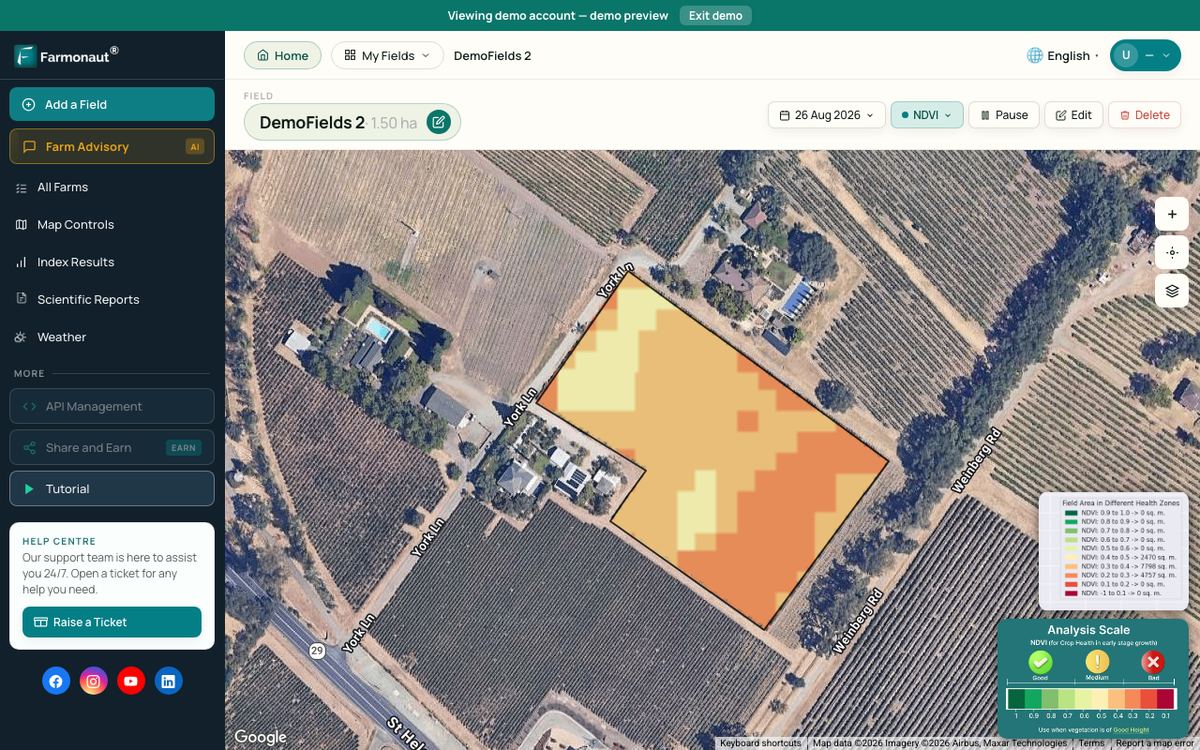
- Satellite crop monitoring. Services such as the Farmonaut Satellite + AI Farm Monitoring System show field vegetation maps on a phone or computer once each field is mapped.
- Security and cameras. Camera feeds use far more upload capacity than browsing. Plan for this if you want live video from gates, stores or livestock camps.
- Payments, staff and markets. Banking, payroll, buyer messages, weather forecasts and online input orders all need a steady link.
The FAO State of Food and Agriculture 2022 names limited connectivity, digital skills and electricity as frequent obstacles to farm automation. All three apply on many farms here.

▶ Six plain steps to start precision farming, from field maps to satellite monitoring. · 4:18
How to choose rural internet for your farm in five checks
- Check coverage by GPS point. Use each provider’s coverage tool with the coordinates of the farmhouse, not the town address. Herotel and Vox both ask for a location check before sale.
- Test the signal on site. Walk around the yard with a phone on each network. A steady 4G signal indoors points to fixed-LTE. A clear view to a tower points to fixed wireless. No signal points to satellite.
- Size the plan to real use. Count users, cameras and machine uploads. Compare that with each plan’s fair-use threshold and upload speed.
- Plan for power. A small UPS on the router keeps the link up through short outages. Ask whether the provider’s own tower has backup power.
- Read the contract. Note the term (month to month, 12 or 24 months), installation and router costs, clawback fees and what happens when you pass the data threshold.
Compare the monthly cost of two rural internet options
A low monthly fee can hide a high installation fee, and the other way round. The calculator spreads the once-off costs over the months you expect to keep the service, then compares two options. Enter your own quotes. The defaults are round example numbers set close to break-even, not real prices or a recommendation.
Try the numbers for your own farm below.
Calculator
Which connection costs less per month over its life?
Enter the monthly fee, once-off costs and speed from two quotes.
- Option A, all-in cost per month: 804 rand
- Option B, all-in cost per month: 804 rand
- Option A, total over the period: 19,300 rand
- Option B, total over the period: 19,300 rand
- Option A, cost per Mbps per month: 80 rand
- Option B, cost per Mbps per month: 80 rand
Example values only, set near break-even; they are not real prices, a benchmark or a recommendation. Once-off costs means installation, router or dish fees. Every number is your input; no constants are fixed in the formulas. The result ignores fair-use limits, cancellation fees and price rises.
How we checked the prices and rules
We opened each provider’s own price page on 16 October 2026 and recorded the cheapest uncapped plan plus the fees shown. These are advertised list prices, not quotes. They may exclude promotions, and some depend on your location and dish size. We read ICASA Notice 3992 in full in the Government Gazette and quote only what it says. Household and coverage figures come from the Stats SA General Household Survey 2025 and ICASA’s State of the ICT Sector Report of March 2026. We removed the price table, speed claims and market-share figures from the older version of this page because we could not find a source for them.
FAQ
Is Starlink legal to use on a farm in South Africa?
No licensed Starlink service was on sale on 16 October 2026. ICASA’s notice of 29 June 2026 says a constellation operator needs I-ECS, I-ECNS and spectrum licences, and that user equipment must be approved. Starlink cut off roaming users in the country in June 2025. Get legal advice before using any unlicensed service.
What is the cheapest rural internet for a farm?
Where a 4G or 5G signal is strong, fixed-LTE was the cheapest monthly option we found. The lowest uncapped plan we found was R275 a month at Afrihost on 16 October 2026, with speed cut to 4 Mbps after 100 GB. Where there is no signal, the lowest satellite plan we found was R764 a month plus R999 installation at Vox.
Is satellite broadband fast enough for farm work?
Geostationary plans of 5 to 50 Mbps handle email, banking, crop monitoring maps and most video calls. The roughly half-second delay makes calls feel slow. Upload speeds of 2 to 5 Mbps limit live camera feeds and large machine data uploads.
When will LEO satellite internet be available?
Amazon said in July 2026 that Amazon Leo will launch through Herotel in 2027. Paratus plans Eutelsat OneWeb LEO service under a 2025 agreement. Starlink depends on licensing. Check ICASA’s latest notices for changes.
Can one farm combine two connections?
Yes. Many farms run fixed-LTE or fixed wireless as the main link and satellite as a backup, or use a second link for a remote packshed. A dual-WAN router can switch between them automatically.
Related pages on our site: satellite and weather API developer docs, Farmonaut web and mobile app, partner programme, mining equipment guide, how lithium mining affects land and water, mining stocks overview.
Farmonaut farm advisory
Check your fields from space
Map each field once and Farmonaut shows satellite vegetation maps and field advisories through the season, on web, Android or iOS.



Keep reading
Sources
- ICASA, Notice 3992 of 2026: Notice regarding licensing requirements to operate satellite services, Government Gazette 54915 (29 June 2026): gov.za
- Statistics South Africa, General Household Survey 2025 (P0318, released 26 May 2026): statssa.gov.za
- ICASA, The State of the ICT Sector Report of South Africa (March 2026): icasa.org.za
- Afrihost, Wireless (fixed-LTE and 5G) packages and terms (accessed 16 October 2026): afrihost.com
- rain, home page plan prices (accessed 16 October 2026): rain.co.za
- Herotel, Wireless internet packages and FAQ (accessed 16 October 2026): herotel.com
- Vox, Satellite internet packages (Eutelsat Konnect and YahClick) (accessed 16 October 2026): vox.co.za
- NASA Earth Observatory, Catalog of Earth Satellite Orbits: earthobservatory.nasa.gov
- TechCabal, After service suspension, Starlink faces high-stakes push for South Africa licence (5 June 2025): techcabal.com
- Associated Press via NY1, Amazon to launch its satellite internet in South Africa (15 July 2026): ny1.com
- TechCentral, Paratus Namibia launches Eutelsat’s OneWeb LEO connectivity (7 October 2026): techcentral.co.za
- Advanced Television, Icasa says South Africa needs new legislation for Starlink (14 May 2026): advanced-television.com
- Tech Africa, ICASA satellite spectrum hearings set for 19-20 August (9 August 2026): tech.africa
- FurtherAfrica, Starlink South Africa edges closer to a licence (27 August 2026): furtherafrica.com
- Statistics South Africa, Census of Commercial Agriculture 2017 (Report 11-02-01): statssa.gov.za
- USDA Economic Research Service, Precision Agriculture in the Digital Era: Recent Adoption on U.S. Farms, EIB-248 (February 2023): ers.usda.gov
- SA Grain (Truter et al., Stellenbosch University and BFAP), Adoption of precision agriculture in SA: insights from a national survey (29 August 2025): sagrainmag.co.za
- FAO, The State of Food and Agriculture 2022, executive summary: openknowledge.fao.org
Discussion
Questions, corrections or field experience? Share them below. First-time comments are reviewed before they appear, and your email is never published.
No comments yet. Be the first to add a question or your experience.

 AdBio
AdBio MISE Maroc
 Drift-Sense
 NWNS
NWNS Hydenmet
 Red August Group
 Farm Inc
 WeMe Global
 Agrotoken
 Blue BearX
 Insignito
 Croptimum
 DnCubed
 Field Capacity
 Indosistim Teknologi
 Liquify Digital
 CU Foods
 BeyondTech Global
