

Precision farming · Comparison with data
Precision Farming vs Traditional Farming: Costs and Yields
Precision farming manages zones inside a field; traditional farming applies one rate to the whole field. US surveys show small average profit gains (1.1% to 1.8% by tool, USDA ERS), fewer labour hours among adopters and tool costs of about $2,600 to $25,000, so the answer depends on your acres and field variability.
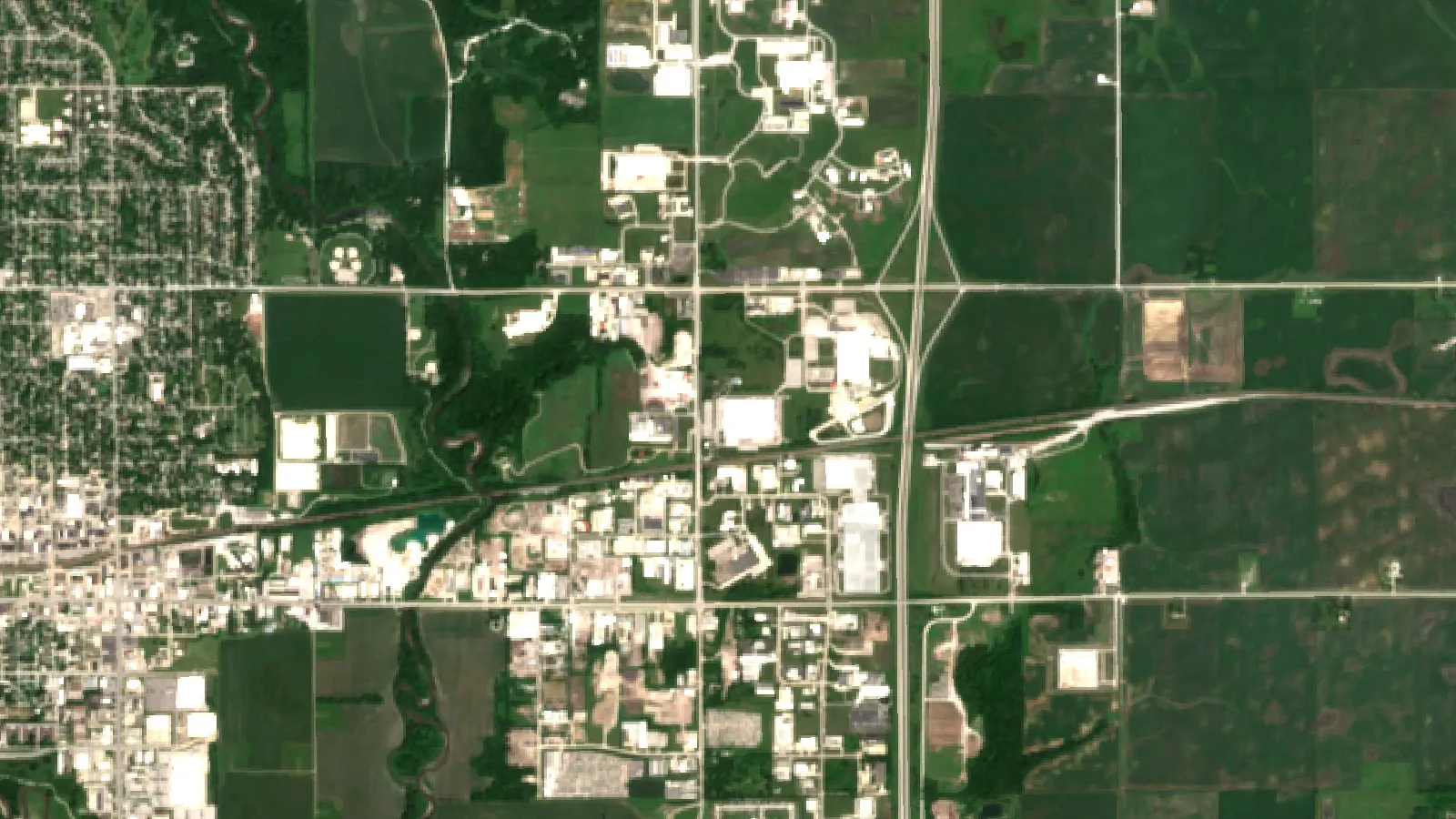
Key takeaways
- USDA ERS cites net return gains of 1.1% (VRT), 1.5% (guidance) and 1.8% (soil and yield mapping) from 2010 US corn data.
- Corn growers using yield maps averaged 183 bu/acre vs 139 for non-users in 2016, but USDA says this gap is a correlation, not the effect of the tool.
- Replacing a guidance system cost soybean farms $20,165 in 2018; hiring variable-rate fertilizer cost Nebraska farmers $1.52 to $1.91 more per acre than uniform rates.
- Only 22% of US farms used precision practices in 2025 (USDA NASS); 73% of the largest corn farms used guidance in 2016 vs 10% of the smallest.
- In England (2019), 48% of farms not using a precision technique said it was too expensive or not cost-effective (Defra).
In this article
- Precision farming vs traditional farming at a glance
- How the two systems work in the field
- Yields: what US farm surveys show
- Profit and labour: the measured returns
- What precision tools cost compared with traditional methods
- Who uses precision farming and who does not
- Outside the US: England and South Africa
- Where traditional farming still holds up
- Questions to ask before you buy
- Which approach fits your farm
- How to move from traditional to precision farming in steps
- Limits and risks of precision management
- How we checked the numbers
- FAQ
Precision farming vs traditional farming comes down to one choice: do you manage each field as one uniform block, or by the zones inside it? US survey data show the gap is real but smaller than many sales claims. USDA economists found net returns 1.1% to 1.8% higher for corn farms using variable-rate technology, guidance or mapping in 2010 data, as reported in Precision Agriculture in the Digital Era (USDA ERS, 2023), and only 22% of US farms used any precision practice in 2025.
This page compares the two systems on the things a farm manager, agronomist or agtech team has to decide on: yields, costs, labour, returns and who is adopting. You get five charts built from USDA and UK government surveys, a cost table, and a payback calculator where you enter your own acres and prices. If you want the basic definition first, read our short guide to what precision agriculture means; this page is about the comparison.
Precision farming vs traditional farming at a glance
Traditional (uniform) management applies one rate of seed, fertilizer, lime and crop protection across a whole field, based on soil tests, past yields and experience. Precision management splits the field into zones and adjusts rates and passes to what each zone needs. Many large row-crop farms sit somewhere in between: they run auto-steer but still spread fertilizer at one rate.
| Factor | Traditional (uniform) | Precision (site-specific) | What the evidence says |
|---|---|---|---|
| Unit managed | The whole field | Zones within the field | Soil and yield vary inside fields; mapping shows where |
| Input rates | One rate per field | Variable rate by zone | VRT used on 37.4% of US corn acres (2016) |
| Steering | Driver steers by eye or markers | GNSS guidance or auto-steer | Guidance on 58% of US corn acres (2016) |
| Records | Notebooks, memory, scale tickets | Yield maps, soil maps, imagery | Yield maps used by 7% of small vs 50% of large corn farms (2016) |
| Up-front cost | Low; uses existing machines | About $2,600 to $25,000 per tool | USDA ERS survey, 2018 to 2019 (table below) |
| Net return | Baseline | Small gains on average | +1.1% to +1.8% by tool (ERS, 2010 corn data) |
| Labour | More hours per acre | Fewer hours per acre | VRT users worked 41% less per acre (Midwest corn, 2010 and 2016) |
| Main barrier | Waste and missed variability | Cost, skills, connectivity, data | 48% of English farms not using a tool said too costly (2019) |
The rest of the page shows where each number comes from and what it does and does not prove.
How the two systems work in the field
Under traditional management, a farmer takes composite soil samples, picks one fertilizer and seeding rate per field, and checks crops by walking or driving the field. It is simple, cheap and needs no software. The weak point is that a single rate is too much for some parts of the field and too little for others.
Precision management adds a data loop. The steps are:
- Collect data: yield monitors on the combine, grid or zone soil sampling, soil sensors, and drone or satellite images of crop vigor (for example NDVI).
- Analyse: farm management software combines soil maps, yield history, imagery, topography and weather into management zones.
- Write a prescription: a map that says how much seed, fertilizer or lime each zone should get.
- Apply at variable rate: a VRT controller on the planter, spreader or sprayer changes the rate as the machine crosses zones, using GNSS position. Section control switches rows or boom sections off over areas already covered.
- Check the result: imagery and the next yield map show whether the change paid, and the zones are refined for the next season.
Guidance and auto-steer have spread much faster than the other tools. These systems, which mainly cut overlap and driver fatigue, were used on 5.3% of US corn acres in 2001 and 58% in 2016. Yield maps, soil maps and VRT were each used on between 5% and 25% of planted acres for winter wheat, cotton, sorghum and rice, according to USDA ERS (2023). Across the four crops surveyed in 2016 to 2019, only 2% to 5% of planted acres used all four technology groups together: maps, VRT, guidance, and drone, aircraft or satellite imagery. In practice, “precision farming” on most US row-crop acres still means guidance first and zone management later, if at all.
Satellite imagery is often the cheapest first step because it needs no new machine. You can see how crop vigour varies across a field before buying a VRT controller. Our web app tutorial walks through reading these maps, and managers who run many fields or field teams can use the Agro Admin app.
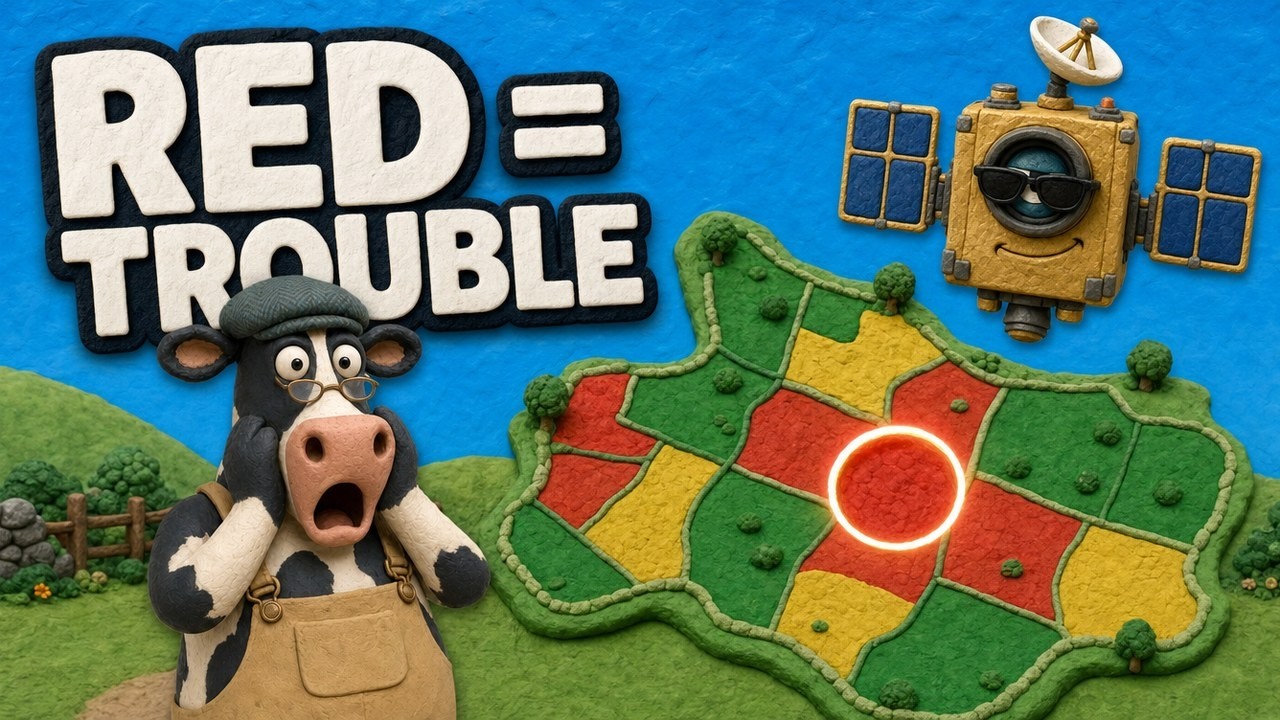
▶ How satellite NDVI maps show crop stress across a field before it is visible from the ground. · 4:09
Yields: what US farm surveys show
Farmers who use precision tools report higher yields than those who do not. USDA’s Agricultural Resource Management Survey (ARMS) found that corn growers using yield maps averaged 183 bushels per acre in 2016, against 139 for non-users. Soybean growers using VRT for fertilizer or lime averaged 60 bushels per acre in 2018, against 53 for non-users.
Read these numbers with care. USDA ERS states plainly that they are correlations, not the effect of the technology. Adopters tend to farm larger, better-equipped operations, and the comparison does not control for fertilizer rates, weather, irrigation or soil quality. For cotton and sorghum, most differences were not statistically significant.
So what does the technology itself add? Studies that do control for these factors find smaller effects. A field-level study of corn in 10 Midwestern states (McFadden and others, 2022, as summarised by ERS) found farms using yield or soil maps were more efficient than non-users, but the effects were small. That is the honest answer for a farm manager: precision tools can lift output, but do not expect the 40-bushel gap in the chart below.
Chart
Corn yields of users and non-users of each precision tool
Average US corn yield, bushels per acre, 2016 ARMS survey
Profit and labour: the measured returns
A widely cited US estimate of what precision tools add to profit comes from Schimmelpfennig (2016), using 2010 ARMS corn data. Net returns were 1.8% higher for soil and yield mapping, 1.5% higher for guidance and 1.1% higher for VRT, as cited in the USDA ERS report (2023). Those are averages across many farms. A field with large soil differences can gain more from VRT, and a uniform field may gain little.
Labour hours show a bigger gap between users and non-users, though ERS doubts the tools cause most of it. In the same 2010 data, corn growers using yield and soil maps used 35% fewer labour hours per bushel than non-users, and VRT users 28% fewer. In a sample of corn fields from 2010 and 2016 across 10 Midwestern states (McFadden and others, 2022), guidance users worked 49% fewer hours per acre and VRT users 41% fewer. ERS warns that these reductions are unlikely to be mainly due to the tools: larger farms adopt them more often and also use other labour-saving practices and wider machines.
The US Government Accountability Office reached a similar view in its 2024 technology assessment of precision agriculture: the tools can raise yields with the same inputs or hold yields with fewer inputs, and can cut runoff. GAO also found that high up-front costs, unclear data ownership and a lack of common standards between brands hold adoption back.
For agronomists and consultants, this means the case for precision management is field by field. The value comes from variability you can measure and act on, not from the equipment alone.
What precision tools cost compared with traditional methods
Traditional management has almost no technology cost beyond the machines a farm already owns. Precision tools add equipment, annual subscription fees and time to learn the software. USDA ERS published national US figures on these costs from ARMS surveys of soybean (2018) and cotton (2019) farms.
Chart
What precision tools cost US soybean farms
Average dollars per farm, 2018 ARMS soybean survey (replacement cost, premium or annual fee)
| Tool | Cost type | Soybean farms (2018) | Cotton farms (2019) |
|---|---|---|---|
| Guidance | Replacement | $20,165 | $25,168 |
| Guidance | Annual fee | $1,154 | Not surveyed |
| Yield monitor | Replacement | $8,051 | $13,775 |
| Yield monitor | Annual fee | $1,041 | $1,772 |
| VRT equipment | Premium paid | $5,630 | $10,319 |
| Drones | Replacement | $2,610 | Sample too small |
These are farm-level totals, not per-acre costs, from the USDA ERS report, table 3. Prices have changed since the survey years, so use them as a guide to scale, not as quotes. ERS notes that the drone figure is likely lower than the new list price because some farmers buy used drones.
Hiring the work out is a cheaper way to test the idea. ERS cites Great Plains custom-rate surveys in which Nebraska farmers paid on average $1.52 more per acre for variable-rate dry fertilizer and $1.91 more for liquid fertilizer than for a uniform-rate application. That upcharge is about 20% above the uniform rate, which ERS calls low next to gross crop revenue on similar farms.
Most US adopters own rather than lease these tools. Of soybean growers using guidance in 2018, 97% owned the equipment, and 80% to 97% of VRT users owned their applicators, depending on the job (USDA ERS, 2023). That makes the buy-or-hire decision important: owning only makes sense if the tool will be used across enough acres for enough years.
Use the calculator below to see how many acres it takes for a tool to pay for itself on your farm. Enter your own costs and your best estimate of savings and yield gains.
Try the numbers for your own farm below.
Calculator
Will a precision tool pay for itself on your farm?
Enter your own acres, costs and expected gains to compare against staying with uniform rates.
- Benefit per year: $4,250
- Tool cost per year (cost spread over its life, plus fees): $5,000
- Benefit per acre: $4
- Break-even area: 1,176 acres
Example values only, not a benchmark or forecast. The default tool cost ($20,000) and annual fee ($1,000) are rounded from USDA ERS soybean-farm figures for guidance ($20,165 replacement, $1,154 annual fee, 2018). Input spend, revenue, savings and yield gain are round examples; USDA ERS cites average net return gains of only 1.1% to 1.8% by tool (2010 corn data); those are percentages of net returns, not of yield or revenue, so do not enter them as the yield gain. Test your own field numbers.
Who uses precision farming and who does not
Precision farming is far from universal. According to the USDA NASS Technology Use report (August 2025), 22% of US farms used precision agriculture practices to manage crops or livestock in 2025. The share was 25% in 2021 and 27% in 2023, according to the NASS 2023 edition. NASS first asked the question in its August 2021 farm computer usage report, so there is no earlier national series on the same basis. NASS counts GPS guidance, yield monitoring, soil mapping, VRT, drones, electronic tagging, precision feeding and robotic milking. Most US farms are small, so a farm-count share is much lower than an acreage share.
Chart
US farms using precision agriculture practices
Percent of all US farms (excl. AK and HI), survey years 2021, 2023 and 2025
Farm size is the biggest divide. In a USDA ERS Amber Waves analysis of auto-steer and guidance, 73% of the largest corn farms (1,725 acres or more) used guidance in 2016, against 10% of the smallest (200 acres or fewer). The same pattern held for winter wheat and soybeans. Cotton was the exception: half of even the smallest cotton farms (1,150 acres or fewer) used guidance in 2019.
For yield maps the gap is similar: 7% of corn farms under 200 acres used them in 2016, against 50% of farms over 1,725 acres (USDA ERS, 2023). On large farms, the fixed cost of a tool is spread over many acres, which is why the calculator above asks for your area.
Connectivity matters too. NASS reported that 85% of US farms had internet access in 2025. Many precision tools need a mobile signal or broadband to send data, so farms in the remaining 15% face an extra hurdle.
Chart
Guidance use on the smallest vs largest farms
Percent of farms using auto-steer or guidance, by crop and survey year
Outside the US: England and South Africa
England’s Defra Farm Practices Survey (autumn 2019) asked farms which precision techniques they used, counting only farms where each technique applied. Soil mapping was used on 29% of these farms, variable rate application on 25%, yield mapping on 17%, telemetry on 10% and controlled traffic farming on 8%. Regular weighing of livestock was the most common technique, at 42%.
Chart
Precision techniques used on English farms
Percent of farms where each technique applied, autumn 2019 (selected techniques)
The reasons English farmers gave are useful for anyone selling or advising on these tools:
- Why they used them: to raise productivity (78%), improve accuracy (59%) and cut input costs (55%). Only 38% named lower environmental impact.
- Why they did not: not relevant to the farm (63%), too expensive or not cost-effective (48%), too complicated (16%). Only 4% said the tools were not accurate enough.
- By farm size: 57% of large farms that did not use a technique named cost as a reason, against 43% of small farms.
In South Africa, a national survey of field-crop farmers by Stellenbosch University and BFAP researchers, reported in SA Grain magazine (August 2025), found 43% reported full adoption of precision agriculture, 51% partial adoption and 6% none. 82% had access to yield maps, and 87% of those used them in decisions. The sample was small (83 respondents), voluntary and likely skewed towards keen adopters, and nearly two-thirds farmed 1,000 hectares or more, so it describes large commercial grain farms, not all farmers. The authors also found many respondents still relied on paper records.
Where traditional farming still holds up
Uniform management is not out of date on every field. It is often the better choice in four situations.
- Even fields: if yield maps and imagery show little variation, one rate is already close to right, and a variable-rate prescription has little to change.
- Small fields and small areas: the fixed cost of a tool is spread over few acres, so the break-even point in the calculator above is hard to reach.
- Crops without national data: USDA ERS notes there are no national adoption data for fruits, vegetables, tree nuts or livestock, so the returns shown on this page come from row crops only.
- Farms without data skills or time: a prescription is only as good as the soil samples and maps behind it. Bad data can make a variable rate worse than a careful uniform rate.
Traditional knowledge also carries into precision farming. A farmer who knows which corner of a field floods or which slope erodes already has a rough management zone in mind. Maps mostly make that knowledge measurable, easier to share with an agronomist, and easier to test from year to year.
Questions to ask before you buy
Before spending money on a precision tool, farm managers and their advisers can work through a short checklist:
- How much do my fields vary? Look at two or three years of yield maps or satellite images. If the same areas are weak every year, zones are worth testing.
- Which input is my biggest cost? Variable rates matter most where spending per acre is high, such as nitrogen on corn or seed on high-value crops.
- Can I hire it first? Custom variable-rate application lets you test the idea for a small per-acre charge before buying.
- Will the tool work with my machines and software? GAO found that a lack of common standards between brands is a real barrier, so ask the dealer to show data moving between systems.
- Who owns the data? Read the terms. GAO reports that farmers worry about losing control of their field data.
- Who will run it? Name the person who will clean the data and build prescriptions, whether that is you, an employee or a consultant.
Which approach fits your farm
There is no single winner in the precision farming vs traditional farming question. The right mix depends on field variability, farm size and who will use the data. Here is how the evidence above applies to each reader.
1. Farm managers of large row-crop farms
Best for: large farms of corn, soybeans, wheat or cotton (in USDA data, the largest corn farms start at about 1,725 acres). Guidance is close to standard here, and the fixed cost spreads over many acres. The next step is usually yield and soil mapping, then VRT on the fields that show real variation. Test VRT on strips before you change a whole farm.
2. Small and mid-size farms
Best for: farms under a few hundred acres, mixed farms and specialty crops. Owning a full precision kit rarely pays at this size. Hire variable-rate application from a dealer, use satellite imagery to find problem areas, and keep traditional uniform rates where fields are even. Our page on the advantages and disadvantages of precision agriculture covers the trade-offs in more detail.
3. Agronomists and farm consultants
Best for: advisers who write fertilizer and seeding plans. Your value is turning maps into prescriptions and checking them against the next yield map. In England, farms using these tools named productivity (78%) and accuracy (59%) far more often than environmental impact (38%) (Defra, 2019), so lead with those.
4. Agtech startups
Best for: teams building tools for farmers. The data show the market is not saturated: only 22% of US farms used precision practices in 2025, and English non-users cited relevance and cost more than accuracy. Products that are cheap to try, work with existing machines and handle data ownership clearly answer the barriers GAO found. A good list of options is in our review of agriculture data collection tools, and developers can use the satellite and weather API documentation or the API sign-up page.
How to move from traditional to precision farming in steps
You do not have to switch a whole farm at once. A staged move keeps costs low and shows whether each step pays.
- Map the variation you already have. Pull old yield monitor files, soil tests and free or low-cost satellite images. If your fields look even, uniform rates may already be close to right.
- Start with guidance or section control. These cut overlap, and guidance is the most widely used precision tool on US row-crop acres. They also give you the GNSS base that VRT needs.
- Sample soil by zone. Use the yield and image maps to pick two to four zones per field instead of one composite sample.
- Run a strip trial. Apply a variable rate on half a field and your usual rate on the other half. Compare yield maps at harvest.
- Count costs and labour. Record fees, custom-hire charges and hours. Use the calculator on this page with your real numbers.
- Scale what paid. Expand to fields with similar variation and drop what did not pay.
Satellite monitoring fits into steps 1, 4 and 6 because it shows crop vigour across every field each time a cloud-free image is taken, on the web or in a mobile app. Related pages on our site cover fleet management, carbon footprinting, product traceability and crop loan and insurance.

▶ Six plain steps to start precision agriculture without buying a robot. · 4:18
Limits and risks of precision management
Precision farming is not automatically better than traditional farming. These are the problems that come up most in the sources above:
- Up-front cost: guidance alone cost soybean farms about $20,000 to replace in 2018 (USDA ERS). Small farms take much longer to recover this.
- Skills and time: 16% of English non-users said the tools were too complicated (Defra, 2019). Someone has to clean data and build prescriptions.
- Data and standards: GAO (2024) found farmers worry about who owns and sees their data, and that equipment from different brands often does not work together.
- Connectivity: 15% of US farms reported no internet access in 2025 (NASS).
- Small average gains: net return gains of 1.1% to 1.8% (ERS) can be wiped out by a bad purchase or by fields with little variation.
Traditional uniform management also has costs that are easy to miss: fertilizer applied where the crop cannot use it, overlap on headlands, and no record of which part of a field loses money. FAO estimates world farm output must rise about 60% by 2050 to meet food and feed demand, according to its Climate-Smart Agriculture Sourcebook (2013), which is one reason governments fund research into tools that raise output per acre.
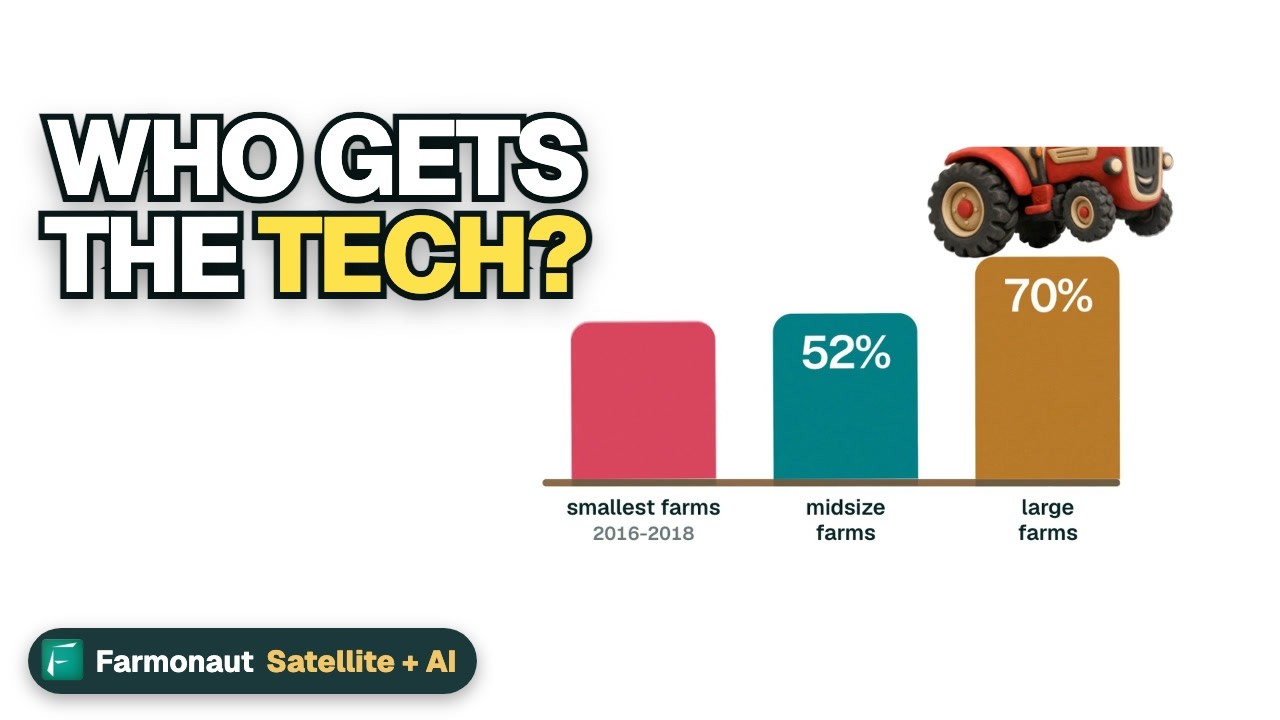
▶ What farm technology means for rural towns: money, jobs and internet access. · 3:50
How we checked the numbers
We used national surveys rather than vendor claims. US adoption, cost, yield and labour figures come from USDA ERS and USDA NASS reports based on ARMS and NASS farm surveys. UK figures come from Defra’s 2019 Farm Practices Survey for England. The South African survey is a smaller university study and is labelled as such. Each figure carries the year the data were collected. Earlier versions of this page gave round numbers such as “up to 20% lower input costs” and “up to 25% less water” without a source; we removed them because no survey we found supports them as general averages.
FAQ
Is precision farming more profitable than traditional farming?
On average, a little. USDA ERS cites net return gains of 1.1% for VRT, 1.5% for guidance and 1.8% for soil and yield mapping in 2010 US corn data. Gains can be larger on fields with strong soil differences and on large farms that spread the fixed cost.
How much does precision farming equipment cost?
In USDA surveys, replacing a guidance system cost about $20,165 on soybean farms (2018) and $25,168 on cotton farms (2019). A yield monitor cost $8,051 and $13,775, and annual fees ran about $1,000 to $1,800. Hiring variable-rate application cost Nebraska farmers about $1.52 to $1.91 more per acre than uniform application.
What share of farms use precision agriculture?
22% of US farms in 2025, down from 27% in 2023 (USDA NASS). In England in 2019, 29% of farms where it applied used soil mapping and 25% used variable rate application (Defra).
Do precision farming tools raise yields?
Adopters report higher yields, for example 183 vs 139 bushels of corn per acre for yield-map users in 2016. USDA says these gaps are correlations, because adopters differ in other ways. Controlled studies find smaller, positive effects.
What is the main difference between precision and traditional farming?
Traditional farming applies one rate of seed, fertilizer and crop protection across a whole field. Precision farming uses maps, sensors and GNSS-guided machines to change rates and passes by zone inside the field.
Is precision farming only for large farms?
No, but large farms adopt it far more. 73% of the largest US corn farms used guidance in 2016, against 10% of the smallest. Small farms can hire variable-rate services and use satellite imagery instead of buying equipment.
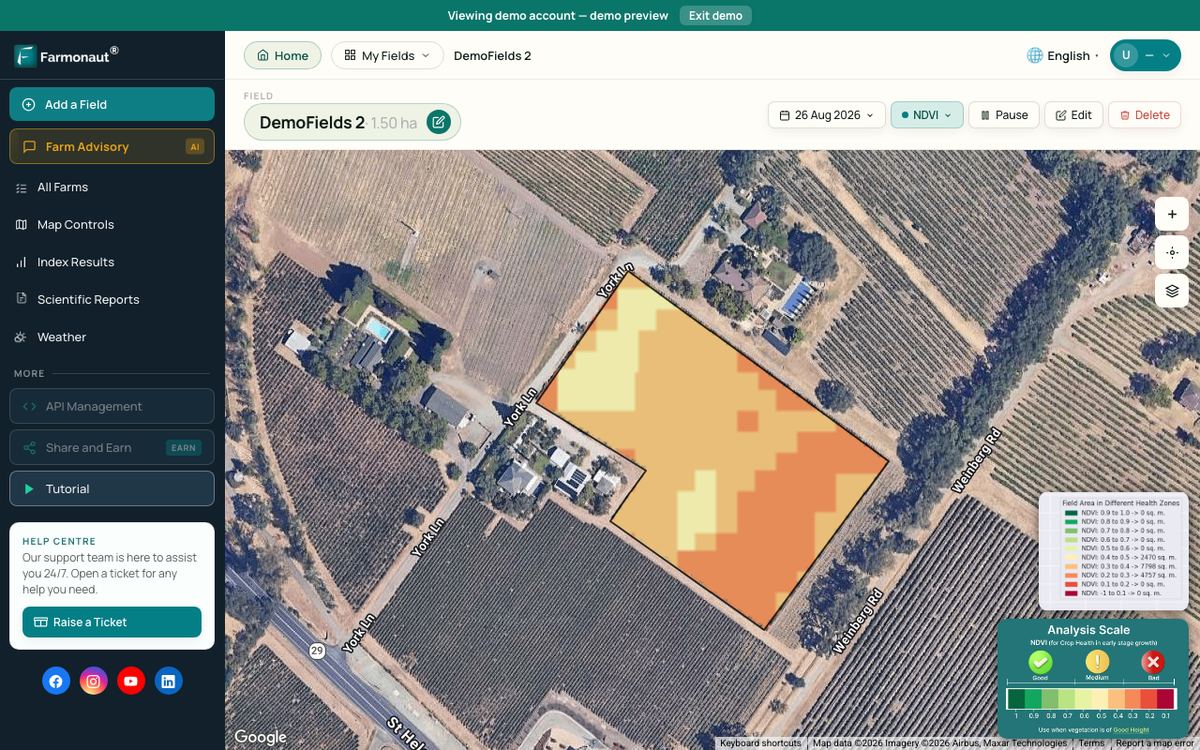
Farmonaut crop monitoring
See the variation in your own fields
Check crop vigour across every field from satellite images before you decide where variable rates are worth it.



Keep reading
Sources
- USDA ERS, Precision Agriculture in the Digital Era: Recent Adoption on U.S. Farms, EIB-248 (2023): ers.usda.gov
- USDA ERS, Precision Agriculture in the Digital Era, report summary page (2023): ers.usda.gov
- USDA ERS Amber Waves, Most Row Crop Acreage Managed Using Auto-steer and Guidance Systems (April 2023): ers.usda.gov
- USDA NASS, Technology Use (Farm Computer Usage and Ownership), August 2025: esmis.nal.usda.gov
- USDA NASS, Farm Computer Usage and Ownership, August 2023: esmis.nal.usda.gov
- US GAO, Precision Agriculture: Benefits and Challenges for Technology Adoption and Use, GAO-24-105962 (January 2024): gao.gov
- Defra, Farm Practices Survey Autumn 2019 – England (March 2020): assets.publishing.service.gov.uk
- SA Grain (Stellenbosch University and BFAP researchers), Adoption of precision agriculture in SA: insights from a national survey (August 2025): sagrainmag.co.za
- FAO, Climate-Smart Agriculture Sourcebook, executive summary (2013): openknowledge.fao.org
- USDA NASS, Farm Computer Usage and Ownership, August 2021: esmis.nal.usda.gov
Discussion
Questions, corrections or field experience? Share them below. First-time comments are reviewed before they appear, and your email is never published.
No comments yet. Be the first to add a question or your experience.

 WICO
WICO Gen Chayat
 Chimera Innovation
 Hiteshi Infotech
 Clubhouse OS
 SkyHarvest
 Polaris Digitech
 Teledarbas
 Wild Oak Farm
 SFX
SFX BACF Africa
 Doodlakine
 Exurbia Geospatial
 FieldZero
 Indico Company
 Licence holder · Niger · Gold










