

Farm machinery · South Africa buyer guide
Farming Equipment in South Africa: Sales, Brands, Finance
SAAMA member dealers sold 7,668 new tractors in 2025 and 5,263 from January to September 2026, 8.8% fewer than a year earlier (SAAMA). This guide covers what farms buy, the main brands, Land Bank and bank finance terms, smart equipment use and an own-or-hire calculator in rand.
Key takeaways
- New tractor sales: 9,181 (2022), 8,380 (2023), 6,463 (2024) and 7,668 (2025); SAAMA expects 2026 to be about 10% below 2025 after five monthly declines from May.
- Stats SA’s 2017 census counted 74,665 tractors and 12,381 harvesters on 40,122 commercial farming units, with the most tractors in the Western Cape and Free State.
- Land Bank’s 2026 brochure lists instalment sale finance for tractors over up to 12 years and medium-term equipment loans over up to 15 years, with repayments matched to cash flow.
- In a 2025 national survey of 83 mostly large grain farms, 43% had fully and 51% partly adopted precision agriculture; cost was the most common barrier among those who had not fully adopted.
- Owning beats hiring only once a machine covers enough hectares to spread its fixed cost; the calculator finds that break-even for your farm.
In this article
- What farms buy: tractor and combine sales
- Where the machines work: tractors by province
- Main types of farming equipment and what each is for
- Main brands and dealer networks
- How to finance farming equipment in South Africa
- Smart farming equipment in South Africa: who uses it
- Hire, contractors and second-hand machines
- Buying checklist for farm equipment
- Own or hire: cost calculator in rand
- Equipment for key South African crops
- How we checked the numbers
- FAQ
Farming equipment in South Africa is led by tractors: dealers sold 7,668 new tractors and 207 combine harvesters in 2025 (Agbiz, from SAAMA data), and 5,263 tractors from January to September 2026, 8.8% fewer than a year earlier, according to the SAAMA press release of 7 October 2026. The main brands are John Deere, the CNH brands (New Holland and Case IH), the AGCO brands (Massey Ferguson, Fendt and Valtra), CLAAS and Kubota, and buyers usually pay through the Land Bank, a commercial bank or a dealer’s own finance partner.
This guide shows what South African farms buy, how sales have moved since 2022, where the country’s tractors work, how the finance options compare and how far smart equipment has spread on grain farms. It ends with a buying checklist and a calculator that compares the yearly cost of owning a machine with paying a contractor, in rand.
What farms buy: tractor and combine sales
The South African Agricultural Machinery Association (SAAMA) is the body that represents manufacturers, importers and builders of new farm machinery. It was founded in 1985 and collects monthly retail sales from its members. Its figures cover new machines only, so private sales of used tractors and auction sales are not in them.
Chart
New tractor sales in South Africa by year
Units sold by SAAMA members, calendar years
New tractor sales peaked in 2022. Agbiz chief economist Wandile Sihlobo reported 9,181 units for that year, the highest annual total in 40 years. Sales fell 9% to 8,380 in 2023, then to 6,463 in 2024, a figure the SAAMA chair gave in May 2025. They recovered by 19% to 7,668 units in 2025 on the back of a strong 2024-25 harvest.
The 2026 picture changed halfway through the year. January (517 units, +13%) and February (669 units, +5%) were above 2025. March was the first year-on-year drop in 14 months. From May, sales fell for five months in a row, and September was 18% down at 623 units. SAAMA chair Arthur Bezuidenhout said farmers were putting cash into the coming crop rather than into new machines, called it “a buyers’ market”, and now expects 2026 tractor sales to be about 10% below 2025.
The reasons are costs and weather, not a poor crop. Sihlobo points to higher fuel and fertiliser prices tied to the war in the Middle East and to the El Niño drought risk for the 2026-27 season. At the same time, the Crop Estimates Committee puts the 2025-26 summer grain and oilseed crop at 21.7 million tonnes, 6% more than the season before. The Agbiz market viewpoint of 14 September 2026 also flags high and volatile input costs for the new season.
Combines tell a slightly different story. SAAMA counted 182 combine harvesters sold in the first nine months of 2026, about 1% more than a year earlier, with 12 sold in September. Combine sales are small and lumpy, so one good or bad month moves the percentage a lot.
The wider farm economy grew fast in 2025. Stats SA’s GDP release shows agriculture, forestry and fishing grew 17.4% in 2025 and added 0.4 of a percentage point to national growth of 1.1%. The sector is still small in the economy as a whole: World Bank data put agriculture, forestry and fishing at 2.8% of GDP in 2025.
Chart
Monthly tractor sales: 2025 vs 2026
Units sold by SAAMA members in selected months with both years published
Where the machines work: tractors by province
The best count of machines already on farms is the Census of Commercial Agriculture 2017, the latest one Stats SA has published. It counted 40,122 commercial farming units, of which 33.9% were in animal farming, 31.1% in mixed farming and 21.3% in field crops. Those farms reported 74,665 tractors and 12,381 harvesters in use.
The Western Cape and the Free State had the most tractors. The Western Cape’s fruit, wine and wheat farms use many smaller tractors. The Free State and North West carry the maize and sunflower belt, where large tractors pull wide planters and sprayers. The census is now nine years old, so treat these as the shape of the fleet, not today’s exact numbers.
Mechanisation in the country goes back a long way. An FAO and African Union framework on farm mechanisation in Africa notes that tractor numbers in South Africa grew from 48,000 in 1950 to 148,000 in 1960, while the rest of sub-Saharan Africa together had about 47,000 in 1960.
Chart
Tractors on commercial farms by province
Number of tractors used, 2017 census (South Africa total 74,665; Gauteng, 2,222, not shown)
Main types of farming equipment and what each is for
Most farms need a core set of machines and then add crop-specific gear. The list below runs from the machines nearly every crop farm owns to the ones that are often hired.
Machines do not replace farm workers one for one. Stats SA’s Quarterly Labour Force Survey put farm employment at about 944,000 people in the second quarter of 2026, 39,000 more than a year earlier, even as tractor sales slowed. On most farms the case for a new machine rests on getting work done on time and cutting fuel or input waste, not only on saving wages.
1. Tractors
Tractors are the power unit for tillage, planting, spraying and haulage. Narrow orchard and vineyard tractors suit the Western Cape and Eastern Cape fruit regions, mid-size utility tractors suit mixed and livestock farms, and high-horsepower four-wheel-drive tractors suit large grain farms. Best for: every farm that cultivates land or moves feed, water or produce.
2. Tillage and planting implements
Disc harrows, rippers, chisel ploughs and row planters prepare the seedbed and place seed. No-till planters are common on grain farms that keep crop residue on the soil to hold moisture. Best for: maize, soybean, sunflower, wheat and canola growers who plant their own land on time.
3. Sprayers and spreaders
Boom sprayers cover field crops, while air-blast (mist-blower) sprayers cover orchards and vineyards. Fertiliser spreaders range from simple spinning-disc units to section-controlled machines that switch off over areas already covered. Always follow the product label and local rules on chemical use, calibration and buffer zones. Best for: any farm that applies crop protection or fertiliser more than a few times a season.
4. Combine harvesters
A combine cuts, threshes and cleans grain in one pass. Headers are swapped for maize, wheat, sunflower and soybean. Combines are expensive and work only a few weeks a year, which is one reason SAAMA members sold only 207 in 2025. Smaller farms often use harvest contractors instead. Best for: large grain farms and contractors.
5. Sugarcane harvesters and loaders
Cane in KwaZulu-Natal and Mpumalanga is cut by hand or by chopper harvesters such as the Case IH Austoft range shown on the brand’s South African site. Grab loaders and haulage tractors move cut cane to the mill. Best for: large cane growers and cane-haulage contractors.
6. Hay and forage machines
Mowers, rakes, round balers and square balers turn grass, lucerne and crop residue into feed. Best for: livestock and mixed farms, which made up close to two-thirds of commercial farming units in the 2017 census.
7. Irrigation equipment
Centre pivots water large field-crop circles, and drip and micro-sprinklers water orchards, vineyards and vegetables. Pumps, filters and controllers matter as much as the pipes. Check your water use licence or registration with the Department of Water and Sanitation before you expand. Best for: high-value crops and farms with an assured water right.
8. Precision and smart equipment
Auto-steer, yield monitors, section control and variable-rate controllers sit on top of the machines above. They are covered in their own section below. Best for: farms large enough for small savings per hectare to add up.
| Equipment | Main use | Typical crops | Own or hire? |
|---|---|---|---|
| Tractor | Power for all field work and haulage | All | Usually owned |
| Planter | Seeding at set spacing and depth | Maize, soybean, sunflower, wheat | Owned on most grain farms |
| Boom sprayer | Herbicide, fungicide and insecticide | Field crops | Owned or hired |
| Air-blast sprayer | Orchard and vineyard spraying | Apples, pears, citrus, grapes | Usually owned |
| Combine harvester | Grain harvest | Maize, wheat, sunflower, soybean | Often hired by smaller farms |
| Cane harvester | Cutting and chopping cane | Sugarcane | Large growers and contractors |
| Baler | Hay, silage and straw bales | Pasture, lucerne, residues | Owned or hired |
| Centre pivot | Irrigating large fields | Maize, wheat, potatoes, vegetables | Owned (fixed asset) |
We left out price ranges. Prices change with the rand exchange rate, model and options, so ask two or three dealers for a written quote on the same specification.
Main brands and dealer networks
SAAMA’s member register lists the companies that sell new machines, and each brand’s South African website has a dealer locator. The brands below are widely sold in South Africa and show at the NAMPO Harvest Day near Bothaville, which ran from 12 to 15 May 2026.
| Brand | Parent group | What to know |
|---|---|---|
| John Deere | Deere and Company | A finance alliance with Absa began in August 2005 (ask if it still runs) |
| New Holland | CNH | Tractors, balers and combines; finance through CNH Capital |
| Case IH | CNH | Large tractors and the Austoft sugarcane harvester |
| Massey Ferguson | AGCO | AGCO announced a retail finance alliance with Standard Bank in 2014 |
| Fendt and Valtra | AGCO | Tractors from the AGCO group |
| CLAAS | CLAAS Group | Combines, balers and forage machines; dealer locator on its site |
| Kubota | Kubota | Compact and utility tractors; the kubota.co.za site is run by Smith Power Equipment |
The brand matters less than the dealer behind it. A tractor that waits two weeks for a part in the middle of planting can cost more than any price difference. Before you buy, ask how far the nearest workshop is, whether it has a field-service vehicle and which parts it keeps in stock for your model.
How to finance farming equipment in South Africa
There are three main routes: the state-owned Land Bank, the agricultural desks of the big commercial banks, and finance partners linked to the machinery brands. Terms below come from each lender’s own published material; your rate and deposit depend on your credit record, security and cash flow.
| Lender | Product | Published terms |
|---|---|---|
| Land Bank | Instalment sale finance | Tractors, vehicles and other moveable assets; term up to 12 years |
| Land Bank | Medium-term loan | Buying and installing equipment; term up to 15 years |
| Nedbank | Agri instalment sale | Tractors and implements; annual payments possible; up to 10 years |
| Absa | Asset finance with John Deere | Alliance announced 2005; check it is still offered |
| Standard Bank | AGCO retail finance | Finance leases, rental and instalment sale agreements (announced 2014) |
| CNH Capital | New Holland finance | Finance and extended protection through dealers |
The Land Bank 2026 product brochure says repayments on its instalment sale and medium-term products can be monthly, quarterly, half-yearly or yearly, linked to the farm’s cash flow. That matters for grain farms that earn most of their income once a year. Security is a notarial bond over the asset or a bond over fixed property, or other security agreed with the bank.
The Land Bank is still rebuilding after its 2020 default. In May 2026 its acting CEO told Parliament the bank was in the “consolidation” phase of a three-stage recovery plan, with a non-performing loan ratio of 51.2% that it aims to cut to 44%. Its blended-finance scheme, which mixes grant and loan money for emerging farmers, disbursed about R1 billion in the last financial year.
Most loans are priced off the prime lending rate. News reports said prime rose to 10.75% in late September 2026, after the Reserve Bank raised the repo rate by 0.25 percentage points to 7.25%. Each rise adds to the cost of every rand borrowed for a machine, so check whether a quote is fixed or linked to prime.
Emerging and smaller farmers can ask about blended finance. The Land Bank’s own investor credit pack (September 2024) reported about R580 million lent through the scheme since it began, and the bank said in May 2026 that it was also open to restructuring loans for farmers in financial distress. Dealers sometimes run seasonal finance offers with lower rates or annual repayments; ask for the end date and the full cost before you sign.
This section is general information, not financial advice. Get written quotes from at least two lenders, compare the total cost over the full term (not just the instalment), and speak to your accountant or a financial adviser before you sign.
Smart farming equipment in South Africa: who uses it
Smart or precision equipment uses satellite positioning and sensors to place seed, fertiliser and spray more exactly. The common tools are auto-steer, yield monitors, section control on planters and sprayers, and variable-rate application of lime, seed and fertiliser.
A national survey of field-crop producers by Stellenbosch University and the Bureau for Food and Agricultural Policy (BFAP), published in the South African Journal of Plant and Soil in 2025, gives the best recent picture. Of 83 respondents, 43% said they had fully adopted precision agriculture, 51% had partly adopted it and 6% had not adopted it. 87% used yield maps to make decisions. The authors warn that the sample leans towards large, progressive farms: nearly two-thirds farmed 1,000 hectares or more, and the survey went out through Grain SA channels.
Better accuracy of application was the most common reason to adopt, ahead of productivity, soil condition and input savings. More than half of those who had not fully adopted said the kit was too expensive or not cost-effective. A gap remains between machines and data: 82% collected farm data, but 45% still kept paper records.
An older North-West University study (2011) found that 52% of summer grain farmers surveyed in North West and the Free State used precision agriculture as the study defined it. The two studies used different samples and definitions, so they show direction, not a precise trend.
Field trials are adding local evidence. BFAP and Stellenbosch University have run more than 50 on-farm precision trials with eight commercial farmers since 2019, testing seeding and fertiliser rates on maize, soybean, cotton, wheat and canola, as reported at NAMPO 2026 by Farmer’s Weekly.
Drones are the newest addition. SA Grain reported in 2023 that operators who spray pesticides by drone need a commercial remote pilot licence from the South African Civil Aviation Authority (SACAA) and registration as a pest control operator with the national agriculture department. Check the current SACAA rules and the product label before you hire a drone service.
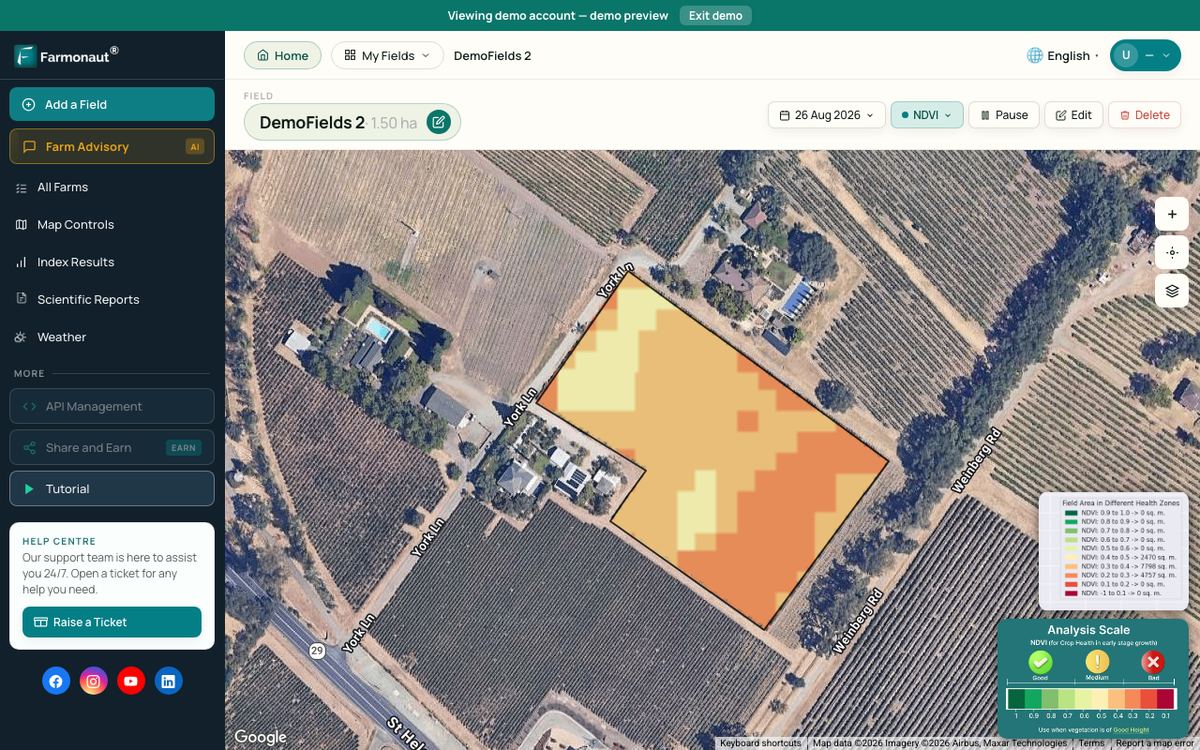
Variable-rate kit needs a map that tells it where to put more or less. Satellite crop maps from services such as Farmonaut show which parts of a field are growing more slowly, which helps you set zones and decide where to check first on foot. They show where plants differ, not why; a soil test or a field visit finds the cause.
Chart
Why grain farmers adopt precision agriculture
Share of 83 survey respondents naming each reason (more than one allowed)
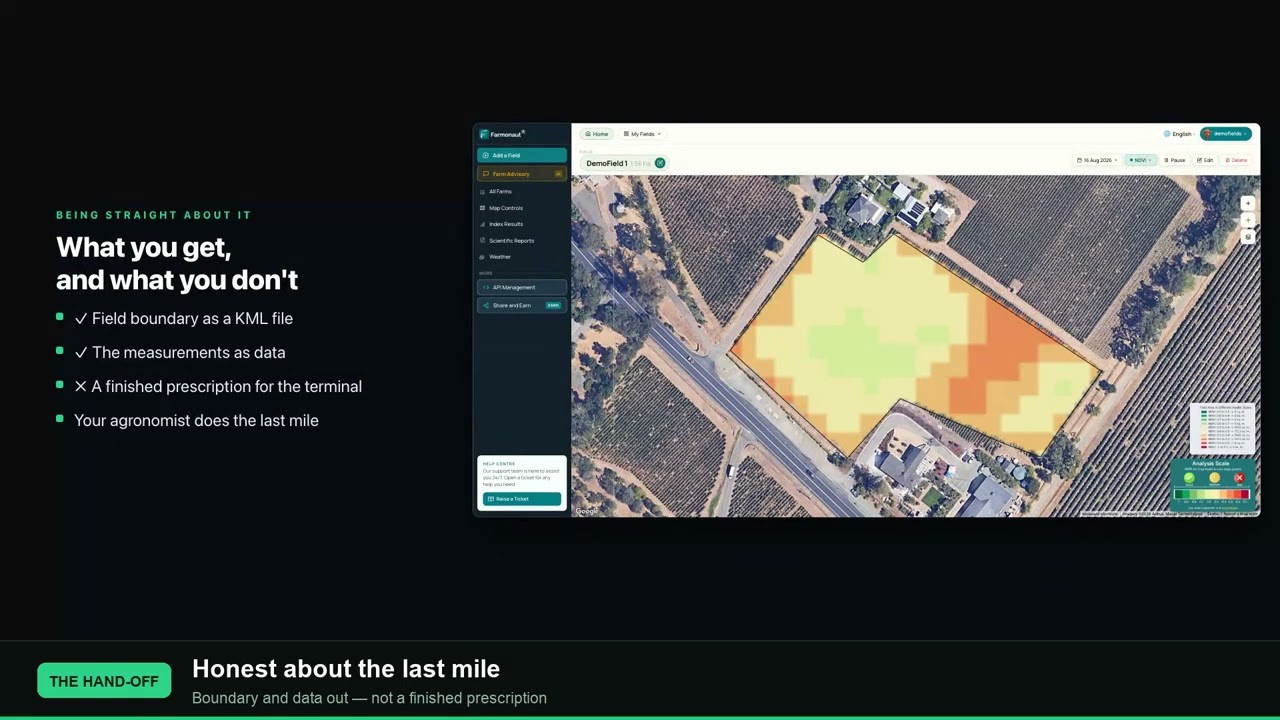
▶ How satellite crop maps produce the zones that variable-rate equipment acts on. · 2:12
Hire, contractors and second-hand machines
Not every machine needs to be owned. Harvest, baling, lime spreading and drone spraying are often done by contractors, and some farmers buy one larger machine and earn back part of its cost by working for neighbours. The Stats SA census records leasing and hiring of machinery as its own farm expense line.
A written agreement protects both sides. The Manitoba government’s farm machinery cost guide lists what a custom-hire agreement should cover: a schedule of operations, the exact work and who supplies fuel, labour and materials, the rate per hectare, hour or job, management standards, and payment terms. Timeliness is the main risk: if the contractor arrives a week late at planting or harvest, the yield loss can be larger than the saving.
Used tractors and implements are sold by dealers, private sellers and auction houses. Before you buy, check the hour meter against service records, look for oil leaks, worn tyres and cracked welds, test the hydraulics and power take-off under load, and confirm that the seller owns the machine outright and that no finance house holds it as security.
▶ Small farm business ideas, including renting out a tractor to other farmers. · 6:03
Buying checklist for farm equipment
- Work out the hectares and hours. Write down how many hectares the machine will cover each year and in how many working days. This drives every other choice.
- Match power to the implement. Ask the implement maker for the power and lift capacity it needs on your soil and slope, then size the tractor to that.
- Check the dealer, not just the brand. Distance to the workshop, parts in stock and a field-service vehicle matter most at planting and harvest.
- Compare total cost, not price. Add fuel use, tyres, services, insurance and finance cost over the years you plan to keep it.
- Ask about resale value. Ask dealers what trade-in they would offer on a three-year-old unit of the same model.
- Line up finance before you shop. Pre-approval from the Land Bank or a bank lets you compare a dealer’s own finance offer on equal terms.
- Fit the term to the machine’s life. Do not finance a machine over a longer period than you expect to keep it.
- Plan for precision later. Check whether the tractor and implements can take auto-steer, section control and ISOBUS connections, even if you add them later.
- Train the operator. Ask what training the dealer gives on safety, calibration and daily checks, and keep records.
- Test own against hire. Use the calculator below with your own numbers before you commit.
▶ Six plain steps to start precision farming before buying new hardware. · 4:18
Own or hire: cost calculator in rand
The calculator uses the standard method in farm machinery cost guides such as the Manitoba guide: yearly ownership cost is depreciation plus interest on the money tied up plus insurance and housing. It adds your running cost per hectare (fuel, repairs, tyres and labour) and compares the total with a contractor’s rate per hectare.
Try the numbers for your own farm below.
Calculator
Is it cheaper to own a machine or hire a contractor?
Enter your own machine price, finance rate, hectares and contractor rate.
- Fixed ownership cost per year: 234,750 rand
- Owning cost per hectare: 820 rand/ha
- Hiring cost per hectare: 800 rand/ha
- Break-even area for owning: 522 ha per year
Example values only, not a benchmark, a quote or a forecast; replace every number with your own. Method: yearly ownership cost = (price minus resale value) / years kept + interest on the average money tied up, (price + resale value) / 2 x rate, + insurance and housing as a % of price, following the cost-of-ownership approach in Manitoba Agriculture’s Cost of Production: Farm Machinery guide (2026/27). Running cost covers your own fuel, repairs, tyres and labour per hectare. A positive headline means owning costs more than hiring at your hectares. The break-even line needs a contractor rate above your running cost. Timeliness and tax effects are not priced. This is not financial advice.
If owning comes out higher, the gap shrinks as you work more hectares, because the fixed cost is spread wider. The break-even line shows how many hectares a year you need before owning costs the same as hiring. Remember the parts the calculator cannot price: the value of planting on time with your own machine, and the cash you keep free if you hire.
Equipment for key South African crops
Each farming region in the country leans on a different set of machines.
- Maize and oilseeds (Free State, North West, Mpumalanga): high-horsepower tractors, wide no-till planters, self-propelled or trailed boom sprayers and combines. Precision tools are most common here, according to the 2025 survey, which found the highest adoption among maize, soybean, sunflower, wheat and canola growers.
- Winter wheat and canola (Western Cape): tractors and planters suited to sloping, stony ground, plus combines, owned or hired at harvest.
- Sugarcane (KwaZulu-Natal and Mpumalanga): cane harvesters or hand cutting crews, grab loaders, haulage tractors and trailers.
- Apples, pears and stone fruit (Western Cape and Eastern Cape): narrow orchard tractors, air-blast sprayers, platforms for pruning and picking, frost-protection systems and drip irrigation.
- Wine and table grapes: vineyard tractors, canopy sprayers, mechanical pruners and, on larger farms, grape harvesters.
- Livestock and mixed farms: utility tractors, mowers, rakes, balers, feed mixers and loaders.
Farms of every type also need a way to plan the work. Fleet and equipment tracking, field records and crop maps help decide which block gets the sprayer or the harvester first; for more on the farming conditions behind these choices, see our overview of South African farming problems and grants.
How we checked the numbers
Sales figures come from SAAMA’s monthly releases, quoted by SAAMA’s chair or by Agbiz chief economist Wandile Sihlobo, and we give the month each figure refers to. Annual totals for 2022 and 2023 come from Sihlobo’s year-end notes; the 2024 total comes from the SAAMA chair. Farm and tractor counts come from the Stats SA Census of Commercial Agriculture 2017. Finance terms come from the Land Bank 2026 brochure, a Nedbank agriculture brochure and the brands’ own websites; the prime rate comes from news reports of the September 2026 Reserve Bank decision. We did not list machine prices because no current, comparable rand price list was available.
We cover a connected topic in Black Soldier Fly Farm: Price per Kg in South Africa.
FAQ
How many tractors are sold in South Africa each year?
SAAMA members sold 7,668 new tractors in 2025, after 6,463 in 2024 and a 40-year high of 9,181 in 2022. In the first nine months of 2026 they sold 5,263, and SAAMA expects the full year to be about 10% below 2025.
Which tractor brands are sold in South Africa?
The main brands include John Deere, New Holland and Case IH (CNH), Massey Ferguson, Fendt and Valtra (AGCO), CLAAS and Kubota. Choose the brand with the best-run dealer near your farm, since parts and service speed matter more than small price differences.
Can I finance a tractor through the Land Bank?
Yes. The Land Bank’s 2026 brochure lists instalment sale finance for tractors and other moveable assets over up to 12 years, and medium-term loans for buying and installing equipment over up to 15 years, with repayments that can follow your cash flow. Approval and pricing depend on your security and credit record.
What is smart farming equipment?
It is machinery that uses satellite positioning, sensors and software to apply inputs more exactly: auto-steer, yield monitors, section control and variable-rate controllers. In a 2025 national survey of mostly large grain farms, 43% of respondents had fully adopted these tools and 51% had partly adopted them.
When is a good time to buy farm equipment?
Demand is weak in late 2026. SAAMA described the market in its 7 October 2026 release as a buyers’ market, as many farmers put money into the new crop instead of machines. Dealers often show new models and offers at the NAMPO Harvest Day in May, so compare quotes then, and order well before planting or harvest so the machine is ready in time.
Is it cheaper to own or hire farm equipment?
It depends on how many hectares the machine covers each year. Owning has a large fixed cost (depreciation, interest, insurance) that falls per hectare as use rises; hiring has no fixed cost but carries the risk of late work. Use the calculator on this page with your own price, rate and hectares.
Related pages on our site: fleet and equipment tracking, satellite checks for crop loans and insurance, large-farm admin app, product traceability, carbon footprinting, satellite and weather API documentation and the web and mobile app.
Farmonaut crop monitoring
See your own fields from space
Draw your fields once and Farmonaut shows satellite vegetation maps for them through the season, on web, Android or iOS.



Keep reading
Sources
- SAAMA, press release on September 2026 tractor and combine sales (7 Oct 2026): assets.lightstoneauto.co.za
- Farmer’s Weekly, Agri machinery sales set to remain flat in 2025 (Dec 2024): farmersweekly.co.za
- BusinessDay, Farming machine sales continue to plough ahead (12 May 2025): businessday.co.za
- Business Report, Agricultural machinery sales show strong growth in February (9 Mar 2026): businessreport.co.za
- Business Report, Agricultural machinery sales start 2026 strong (9 Feb 2026): businessreport.co.za
- Business Report, Agricultural machinery sales decline in June (9 Jul 2026): businessreport.co.za
- Bizcommunity, W. Sihlobo: Agricultural outlook stays positive despite machinery sales slump (14 Apr 2026): bizcommunity.com
- W. Sihlobo, A brief note on the slowing South African tractor sales (9 Sep 2026): wandile.substack.com
- W. Sihlobo, Tractor sales remain sluggish (12 Oct 2026): wandile.substack.com
- Agbiz, SA agri market viewpoint (14 Sep 2026): agbiz.co.za
- Stats SA, GDP fourth quarter 2025 press release (2026): statssa.gov.za
- World Bank, Agriculture, forestry and fishing value added (% of GDP), South Africa (2025): api.worldbank.org
- Stats SA, Census of Commercial Agriculture 2017, Report 11-02-01: statssa.gov.za
- FAO and African Union, Sustainable Agricultural Mechanization: A Framework for Africa (2018): fao.org
- SAAMA, About the association (website, 2026): saama.co.za
- Case IH South Africa website (2026): caseih.com
- New Holland South Africa website: CNH Capital finance and NAMPO 2026 (2026): newholland.com
- CLAAS South Africa website (2026): claas.co.za
- Kubota equipment, Smith Power Equipment (kubota.co.za, 2026): kubota.co.za
- Farmer’s Weekly, Absa and John Deere alliance reaches R1bn mark: farmersweekly.co.za
- African Farming, AGCO enters retail finance agreement with Standard Bank of South Africa: africanfarming.net
- Land Bank, product brochure (2026): landbank.co.za
- Nedbank, Agriculture brochure (undated): nedbank.co.za
- Business Report / Personal Finance, Land Bank targets sharp reduction in bad loans (7 May 2026): persfin.co.za
- Briefly News, SARB raises repo rate to 7.25% (Sep 2026): briefly.co.za
- Truter et al., Adoption of precision agriculture practices in South African field crop production systems: a national survey, South African Journal of Plant and Soil 42 (2025): doi.org
- NISC abstract page for Truter et al. (2025): nisc.com
- SA Grain, Adoption of precision agriculture in SA: insights from a national survey (29 Aug 2025): sagrainmag.co.za
- Hendriks, An analysis of precision agriculture in the South African summer grain producing areas, North-West University (2011): repository.nwu.ac.za
- Farmer’s Weekly, Precision agriculture pays off when backed by data and sound agronomy (2026): farmersweekly.co.za
- SA Grain, Precision farming drones are not just about flying (31 Jul 2023): sagrainmag.co.za
- Manitoba Agriculture, Cost of Production: Farm Machinery 2026/2027: manitoba.ca
- EWN, SA farming defies job market slump (Stats SA QLFS Q2 2026, 12 Aug 2026): ewn.co.za
- Land Bank, investor credit pack, September 2024: landbank.co.za
Discussion
Questions, corrections or field experience? Share them below. First-time comments are reviewed before they appear, and your email is never published.
No comments yet. Be the first to add a question or your experience.

 SkyHarvest
 Sarvome
 Polaris Digitech
 Teledarbas
 Wild Oak Farm
 SFX
SFX BACF Africa
 Doodlakine
 Exurbia Geospatial
 FieldZero
 Indico Company
 Kubota
 FFBS
FFBS Jontra
 Licence holder · Niger · Gold










