

Crop pests · Locusts and grasshoppers
Locust Control: When to Spray and What It Costs
A square kilometre of desert locust swarm can eat as much food in a day as about 35,000 people (FAO). Hit wingless hopper bands early, above a set density, and treat only part of rangeland with reduced area sprays.
Key takeaways
- Target hopper bands: second and third stage nymphs, before they can fly (Cesar Australia).
- Australian pasture thresholds: more than 20 hoppers or 10 adults per square metre (APLC/GRDC 2010, cited by Cesar Australia).
- Carbaryl sprayed on half of an infestation gave 80 to 90% grasshopper control, the same as a blanket spray (University of Wyoming RAATs trials).
- Metarhizium biopesticide takes 10 to 14 days to kill, so it suits organic and sensitive land (CSIRO).
- FAO estimates its 2020-2021 response treated about 2.3 million ha and averted 4.5 million tonnes of crop losses.
In this article
- What locust control means and why timing matters
- How big the threat is
- Locust control methods compared
- 1. Scout early and report outbreaks
- 2. Spray hopper bands at the right threshold
- 3. Treat less area with reduced agent area treatments
- 4. Use Metarhizium biopesticide on sensitive land
- 5. Cultivate egg beds and manage green feed
- 6. Protect high-value crops from swarms
- Is locust control worth the cost?
- A step-by-step locust management plan
- FAQ
Locust control works best when you find young, wingless hoppers in bands and treat them before they fly. Once adults form swarms, the damage is fast: one square kilometre of desert locust swarm can hold 40 to 80 million adults, and a swarm of that size with 40 million locusts can eat as much food in a day as about 35,000 people, says the FAO Desert Locust FAQ. Treating early, treating only part of the infested area and using a fungal biopesticide on sensitive land are the methods with field results.
This guide covers locusts and their close cousins, rangeland grasshoppers, for farmers in Australia, North America and Europe. It gives treatment thresholds, a cost table, three charts and a calculator to check whether spraying pays on your block.
What locust control means and why timing matters
A locust is a grasshopper that can switch into a crowded, swarming phase. In that phase young hoppers march in dense bands and adults fly in swarms. The main pest species differ by region. The desert locust ranges over about 16 million square kilometres in some 30 countries in quiet years, and in a plague it can spread into 60 countries, according to the FAO Desert Locust FAQ. In Australia, the Australian plague locust is the main species. In the western United States and Canada, outbreaks of native grasshoppers cause the same kind of damage on rangeland and crop edges.
Timing matters because of the life cycle. The FAO Locust Watch page says a desert locust lives about three months: eggs hatch after two weeks, hoppers take about six weeks to grow wings, and adults need at least a month more before they lay eggs. For the Australian plague locust, Cesar Australia’s pest note says eggs laid in summer can hatch in 2 to 4 weeks, and nymphs pass through five stages in 4 to 6 weeks. That gives a window of several weeks when the pest cannot fly and sits in dense, visible bands.
The window to act
- Eggs: laid in pods in the soil. Cesar Australia gives 30 to 50 eggs per pod for the plague locust, laid 3 to 10 cm deep, often on hard bare ground such as tracks and clay pans.
- Hopper bands: second and third stage nymphs bunch up and march. This is the main target for chemical control.
- Swarms: winged adults travel on the wind. Desert locusts fly up to 150 km a day, says FAO. Control is harder and costlier at this stage.
How big the threat is
Swarm size drives the risk. FAO notes that swarms range from under one square kilometre to several hundred. The chart scales FAO’s per-square-kilometre figure to show what larger swarms could eat in a single day.
Chart
What a desert locust swarm can eat in one day
People whose daily food equals the swarm’s daily intake, by swarm area (km²)
In southern Australia, Cesar Australia reports that high density swarms can devastate a crop overnight, and maturing cereals can lose grain heads as locusts chew through the last green stem. In pastures, 20 hoppers per square metre eat about the same as 3 to 5 dry sheep equivalents per hectare.
The 2020 to 2021 desert locust upsurge in the Horn of Africa and Yemen shows what a large, coordinated response can do. According to the FAO desert locust emergency page, about 2.3 million hectares were treated by ground and air between January 2020 and December 2021. FAO estimates this averted 4.5 million tonnes of crop losses and saved 900 million litres of milk. The FAO analysis of disaster impacts puts the value of averted cereal and milk losses at about US$1.77 billion. These are modelled estimates, based on assumptions about how much green matter locusts would have eaten.
Locust control methods compared
The table sums up the main tools. Each one has its own section below.
| Method | Best stage | Speed | Main limit |
|---|---|---|---|
| Scouting and reports | Eggs, early hoppers | Not a kill method | Needs regular field checks |
| Band spraying | Hopper bands | Fast | Chemical residues and withholding periods |
| Reduced area (RAATs) | Hoppers, rangeland | Fast to moderate | Needs more coverage at high density |
| Metarhizium fungus | Hoppers and adults | 10 to 14 days | Slow, so used early |
| Cultivation and grazing | Eggs, before arrival | Preventive | Only where egg beds are known |
| Swarm spraying | Adults | Fast | Hard to target, high cost |
1. Scout early and report outbreaks
Best for: every farm in a locust or grasshopper area.
Landholders in Australia are responsible for controlling locusts on their own property, Cesar Australia notes. It advises checking for hatching in spring, using the hatching dates in the Australian Plague Locust Commission bulletins, and focusing on known egg beds. Report suspected plague locusts on the Emergency Plant Pest Hotline, 1800 084 881. In the US, USDA APHIS and state agencies run rangeland grasshopper surveys, and in Canada provincial agriculture departments do; your local extension office can tell you about current counts.
A simple count is enough to start. Walk a straight line across the field edge and the pasture, count insects that jump from an imagined square in front of you, and repeat at about 20 spots. Record the stage too, because a band of small hoppers needs a different response than a swarm of adults.
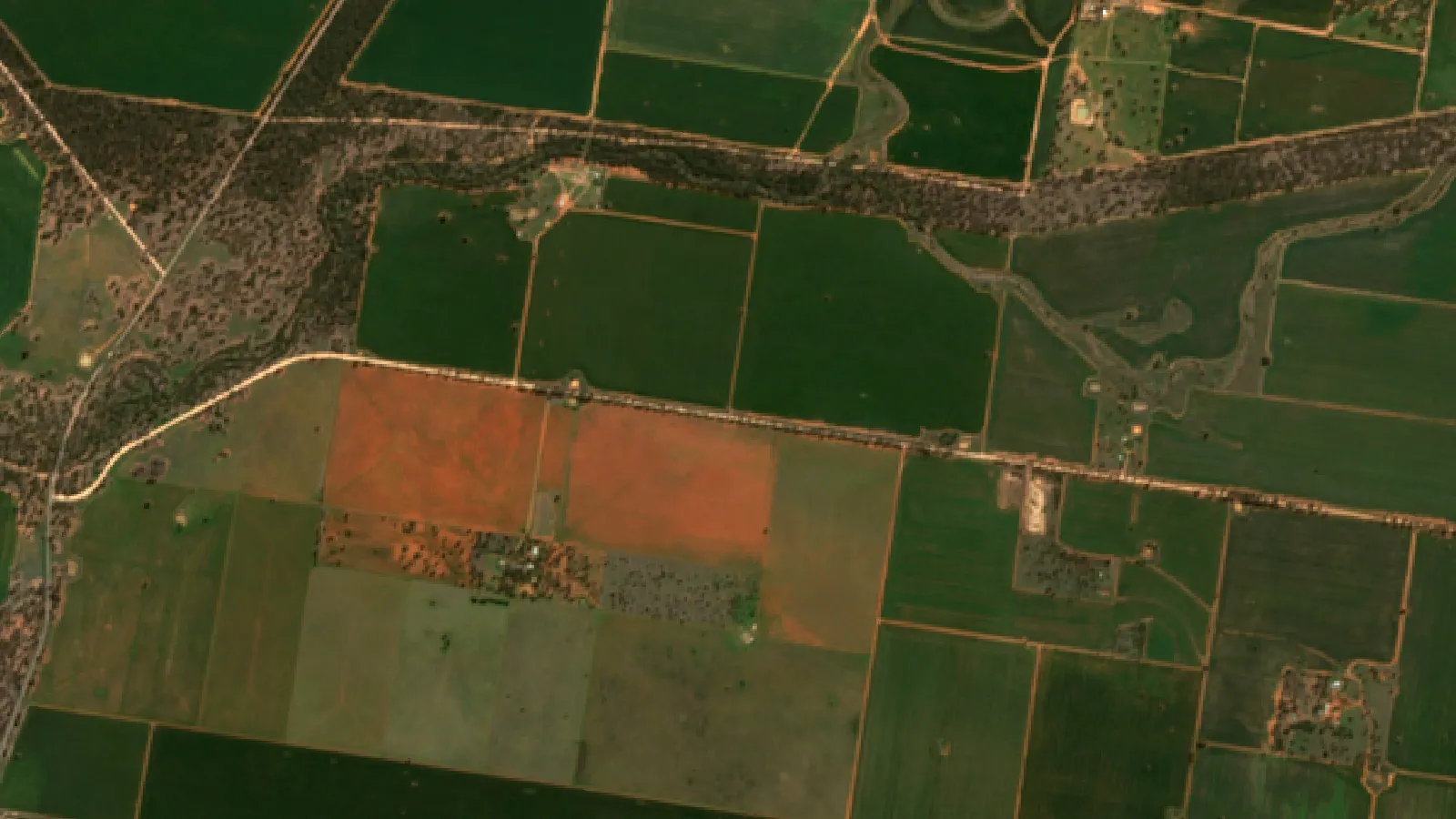
Satellite crop maps can help you choose where to walk. Green areas that suddenly lose vigour on a vegetation index map, often along a field edge, are worth checking on foot. Farmonaut Satellite + AI Farm Monitoring System shows such maps for your own fields, and developers can pull the same layers and forecasts through the satellite and weather API documentation. A map does not identify the insect; it tells you where to look.

▶ Can AI spot crop pests before they eat the harvest? A light look at four ways to detect pests early. · 6:32
2. Spray hopper bands at the right threshold
Best for: dense bands on pasture or crop margins.
Spraying pays only above a certain density. For Australian pastures, Cesar Australia cites economic thresholds of more than 20 hoppers per square metre, or more than 10 adult locusts per square metre (APLC and GRDC, 2010). Chemical control should target dense bands of second and third stage hoppers.
Cesar Australia lists organophosphates, synthetic pyrethroids, carbamates and Metarhizium-based products among those registered or under permit for plague locust control. Products and rates vary by state, crop and grazing use, so check the label, the withholding period and your state department’s advice before any spray, and get professional advice if you are unsure. Livestock and export markets also have residue rules.
Hoppers versus swarms
Bands move slowly and stay together, so a boom spray or aerial swath covers them well. Swarms move with the wind, roost at night and take off again in the morning; FAO notes desert locust swarms take off about two hours after sunrise and settle before sunset. That makes swarm spraying a job for coordinated, often aerial, programmes rather than a single farm.
3. Treat less area with reduced agent area treatments
Best for: rangeland grasshoppers in the western US and Canada.
Chart
Grasshopper control by treatment in RAAT trials
Mid-point of reported % control; product oz/acre – % of area treated
Reduced agent area treatments, or RAATs, spray alternating swaths and leave untreated strips. Grasshoppers move from untreated into treated strips, and natural enemies survive in the gaps. The University of Wyoming RAATs research page reports field trials where carbaryl at 8 oz per acre on half of the infested area gave 80 to 90% control, matching the full blanket rate. Applying the same product to only a third of the area gave just 40 to 60% control, so there is a lower limit.
The cost savings are large. The University of Wyoming aerial RAATs guide gives an example: if a standard spray costs US$2.50 per acre, the RAAT version should cost about US$1.15 per acre. Its ground ATV-RAAT guide suggests about US$0.50 to US$0.75 per acre for the same job, and says the percent of area covered should equal the average number of grasshoppers per square yard, with at least 20% coverage. These are example costs from older trials, not current prices, so use your own quotes.
Chart
Example cost per acre: blanket spray vs RAATs
US$ per acre protected, worked example from University of Wyoming guides (not current prices)
4. Use Metarhizium biopesticide on sensitive land
Best for: organic farms, land near water and areas with grazing stock.
Metarhizium is a fungus that infects locusts and grasshoppers. Spores are mixed in oil and sprayed from the air onto bands and swarms. CSIRO’s Green Guard page says Australia was the first country to use Metarhizium against locusts, and over 23,000 hectares were treated with it in the 2000 to 2001 season. It takes 10 to 14 days to kill a locust, so it suits early, preventive control on organic properties and in sensitive areas rather than a crop under attack today.
The locust strain, Metarhizium acridum, is a specialist that infects only locusts and grasshoppers, notes a 2017 review in the Journal of Fungi. Formulations and registrations change, so check what is currently approved in your state or country, and follow the label.
5. Cultivate egg beds and manage green feed
Best for: farms with known egg-laying sites.
Where heavy egg-laying has been found, Cesar Australia notes that deep cultivation can reduce egg survival. It also suggests grazing pastures or cutting them for fodder in late winter and early spring, before locusts arrive, so there is less green feed to attract them. Lucerne, long-season annual pastures and newly sown pastures are at most risk later in the season because they stay green longer.
Cultivation has trade-offs. It can harm soil structure and raise erosion risk, which is why many growers keep tillage to a minimum; our guide to no-till farming benefits explains what is lost when soil is worked. Use targeted cultivation only on the egg beds you have mapped.
6. Protect high-value crops from swarms
Best for: small plots, gardens and orchards.
On a small scale, physical cover can save a crop. Fine netting over vegetable beds or young trees keeps adults off for a short time. This is not practical for broadacre crops. For larger areas, early harvest of a maturing crop or cutting hay before a swarm arrives can save more than a late spray. Keep in contact with neighbours and local groups, because locusts do not stop at fences, and joint action across properties works better than one farm acting alone.
Is locust control worth the cost?
Treatment pays when the crop or forage it saves is worth more than the spray. The calculator below compares the value you protect with the cost of a blanket spray or a reduced area treatment. All defaults are examples near break-even, not benchmarks. Enter your own crop value, expected loss and spray quote.
The FAO analysis gives one large-scale reference point: for every hectare of desert locust land surveyed and controlled in the Horn of Africa, about 2 tonnes of grain were protected, worth an average of US$600. Your own figures will differ, so test them.
Try the numbers for your own farm below.
Calculator
Does spraying pay on your block?
Compare the value you protect with the spray cost.
- Value protected: 1,500 US$
- Spray cost at your coverage: 625 US$
- Blanket spray cost: 1,250 US$
Example values only, set near break-even; they are not benchmarks. Enter your own crop or forage value (example, use today’s price), the share you expect to lose without control, and your contractor quote. Coverage of 100% is a blanket spray; lower coverage models a reduced area treatment, which in University of Wyoming trials matched a blanket spray on a quarter to two-thirds of the area, depending on product and rate; lower coverage can mean lower control. Check the label and local rules before spraying.
A step-by-step locust management plan
- Before the season: map egg beds from the previous autumn and read the latest locust or grasshopper bulletin.
- At hatch: check known egg beds and field edges every few days.
- Count: estimate hoppers per square metre or per square yard at 20 or more spots.
- Decide: compare counts with your local threshold and run the calculator.
- Treat: spray bands early, use RAATs on rangeland and Metarhizium on sensitive land. Follow the label.
- Follow up: recheck treated areas after a week and report new swarms.
Locusts are one of many field problems a farm faces; for a wider view of fixes, see our list of solutions for agricultural problems.

▶ How to draw your fields and read satellite crop health maps in the Farmonaut web app. · 8:43
FAQ
How do you kill locusts fast?
The fastest results come from a registered contact insecticide sprayed onto dense hopper bands, before the insects can fly. Check the label and local rules first. Fungal products such as Metarhizium take 10 to 14 days to work, according to CSIRO.
How do they stop locust swarms?
Large swarms are tracked by national and international agencies and sprayed from the ground and air. FAO reports that about 2.3 million hectares were treated in the Horn of Africa and Yemen during the 2020 to 2021 upsurge.
How do I prevent a locust attack on my crops?
Watch known egg beds in spring, cultivate heavy egg-laying sites, graze or cut green pasture early, and treat hopper bands as soon as they pass your local threshold.
What is the difference between locust management and grasshopper control?
Locusts are grasshopper species that can form swarms. Methods overlap, but locust management usually involves regional surveys and coordinated spraying, while grasshopper control on one ranch often uses reduced area treatments.
When is spraying not worth it?
When density is below the threshold. Cesar Australia cites 20 hoppers or 10 adults per square metre for pastures. Below that, the cost and residue risk can outweigh the feed you save.
Farmonaut crop monitoring
See where your fields lose green
Draw your paddocks once and Farmonaut shows satellite vegetation maps through the season, so you know which edges to scout first.




Keep reading

Sources
- FAO, Desert Locust FAQ (Locust Watch): fao.org
- FAO, Desert Locust frequently asked questions: fao.org
- FAO, Locust Watch: Desert Locust: fao.org
- FAO, Desert locust crisis emergency response page (2020-2021 appeal results): fao.org
- FAO, The Impact of Disasters on Agriculture and Food Security 2023: desert locusts in the Horn of Africa: openknowledge.fao.org
- Cesar Australia, Australian plague locust pest note: cesaraustralia.com
- CSIRO Entomology, Metarhizium, Green Guard: ento.csiro.au
- University of Wyoming, RAATs results (Grasshoppers of Wyoming and the West): uwyo.edu
- University of Wyoming, Aerial RAATs guide: uwyo.edu
- University of Wyoming, ATV-RAATs guide: uwyo.edu
- Aw and Hue, Mode of Infection of Metarhizium spp. Fungus and Their Potential as Biological Control Agents, Journal of Fungi (2017): pmc.ncbi.nlm.nih.gov
Discussion
Questions, corrections or field experience? Share them below. First-time comments are reviewed before they appear, and your email is never published.
No comments yet. Be the first to add a question or your experience.

 BeyondTech Global
 Rouge VC
 Yutz Automation
 AgroGreen Dynamics
 AgroRisk
 Oath Inc
 Reddane Farming
 Esri North East Africa
 Cresol
 Atur Kuliner
 MDCV UK
 Zerella Group
 Etech Consulting Madagascar
 Vestlandsforsking
 Delicio
 WB Dev
 Sama Premium
 Prochecker
 Tres Valles
 LACOS Geoinformation
 Magrifly
 LatConnect 60
 Blickwinkel
 Agricultural Credit Policy Council
 eKGIS
 Mostas Tech
 Andex
 FCF India
 Unifrutti Gulf
 Deluxe Conseil

 Licence holder · Niger · Gold
 Client · Tanzania · Gold
 Client · Somalia · Gold
 Client & affiliate partner · Ghana · Gold










