

Dryland farming · How-to guide
Zai Farming Technique: How to Dig Pits That Catch Rain
Zai is a Sahel planting-pit method: dig small pits in crusted soil, add manure or compost, plant in the pit. Burkina Faso trials used pits 20 to 40 cm wide and 10 to 15 cm deep, and hand digging took over 300 hours per hectare (Barro et al.).
Key takeaways
- Zai pits catch runoff and hold manure at the roots; trial pits were 10 to 15 cm deep and 20 to 40 cm wide (Barro et al., Burkina Faso).
- In Niger, zai versus flat planting, both without manure or straw, gave a 3- to 4-fold increase in millet grain on farm and roughly doubled water use efficiency (Fatondji et al., 2006).
- Manual pits took more than 300 hours per hectare; an animal-drawn tool cut that to 22 to 36 hours.
- For watermelon, FAO-56 crop coefficients run 0.4 early, 1.00 mid-season and 0.75 at the end, so plan irrigation around the high mid-season demand; pits do not replace it.
- In high-wage countries zai suits market gardens, orchard rows and patch repair, dug by machine.
In this article
- What the zai farming technique is and where it comes from
- Why planting pits work in dry, crusted soil
- How to dig zai pits: 7 steps
- How much work zai pits take
- Calculator: pits, labour and rain caught
- What the research shows on yields
- Zai pits for watermelon in dry climates
- Where zai fits in North American, European and Australian farming
- Zai compared with other dryland methods
- Common mistakes with pit planting
- Checking pit fields from space
- FAQ
The zai farming technique is a way to grow crops on hard, crusted, dry soil by digging small pits, adding a handful of manure or compost to each, and planting into the pit. In Burkina Faso trials, pits were 20 to 40 cm wide and 10 to 15 cm deep, and manual digging took more than 300 hours per hectare (Barro et al., Cahiers Agricultures). This guide shows how to dig the pits, what the research measured, how to adapt zai for watermelon and other dryland crops in North America, Europe and Australia, and gives a calculator for pits, labour and rain caught.
What the zai farming technique is and where it comes from
Zai (also written zaï) is a planting-pit method from the Sahel, the dry belt south of the Sahara. Farmers in Burkina Faso and Niger used it to bring sealed, bare ground back into production.
The best-known modern innovator was Yacouba Sawadogo, a farmer in northern Burkina Faso. According to the Right Livelihood Foundation, he began experimenting with traditional pits around 1980, during severe drought, and grew an almost 40-hectare forest on land that had been barren. The foundation says tens of thousands of hectares of degraded land in Burkina Faso and Niger have since been restored with his methods.
The idea is simple. Instead of tilling a whole field, you work only the small spots where plants will grow. Each pit catches runoff from the bare ground around it and holds organic matter right at the roots. That makes the method a form of micro-catchment water harvesting.
Zai is not a West African curiosity with no use elsewhere. The same physics apply to any crusting, low-organic-matter soil where rain arrives in short bursts and runs off. That describes parts of the US Southwest and Southern Plains, inland Spain and Portugal, and large areas of inland Australia.
Why planting pits work in dry, crusted soil
Crusted soil sheds water. A short storm runs across the surface instead of soaking in. A pit breaks the crust, slows the water and pools it where the roots are.
- Water harvesting. Each pit collects rain from the area around it, not just the rain that falls on the pit itself.
- Nutrients where roots are. Manure or compost goes only into the pit, so a small amount feeds the crop directly.
- Soil life.
- Shelter for seedlings. The pit wall blocks wind and blowing sand during the first weeks.
A study at ICRISAT’s station in Niger and two degraded farm sites measured these effects. Zai pits roughly doubled water use efficiency compared with flat planting, and zai raised the crop’s uptake of nitrogen by 43 to 64% and potassium by 58 to 66% (Fatondji et al., Nutrient Cycling in Agroecosystems, 2006).
Organic matter also holds water. SARE’s guide Building Soils for Better Crops covers how adding compost and manure improves soil structure and water infiltration over time, which is the slow benefit zai adds to its fast water-harvesting effect.
▶ Seven simple ways to protect soil and water, from cover crops to mulch. · 4:34
How to dig zai pits: 7 steps
- Pick the right ground. Zai suits sealed, crusted or degraded soil on flat to gentle slopes. On loose sandy soil that already soaks up rain, pits add work without much gain.
- Dig in the dry season. Burkina Faso farmers dig before the rains, when there is less other farm work. Pits must be ready before the first storm.
- Size the pits. In the Barro et al. trials, manual pits averaged 10 to 15 cm deep and 20 to 40 cm wide. Put the dug soil on the downhill side as a small crescent to trap more water.
- Space them out. At the drier northern site, local practice spaced sorghum 0.8 m by 0.6 m; the Saria plots used 0.8 m by 0.4 m. For watermelon and other vining crops, space pits to match the crop’s normal in-row and between-row spacing.
- Add organic matter. A handful of manure or compost goes in each pit. The Niger study used cattle manure at 300 g per plant (Fatondji et al., 2006). Cover it with a little soil.
- Plant after the first good rain. Sow seed or set transplants into the pit once the soil is moist.
- Maintain the pits. Weed inside and around them, re-open pits that silt up, and add fresh organic matter each season.
In irrigated fields, run drip lines along the pit rows so water and nutrients land in the same spot. Check local rules before applying manure near watercourses, and follow any nutrient-management plan your state, province or council requires.
How much work zai pits take
Labour is the main cost. Barro and colleagues at Burkina Faso’s research institute INERA put manual zai at more than 300 hours per hectare. They tested an animal-drawn tool that made pits of the same size in 36 hours per hectare at Saria and 22 hours per hectare at Pougyango, two research sites (Cahiers Agricultures).
Chart
Hours to make zai pits on one hectare
hours per hectare, manual digging vs an animal-drawn tool, two Burkina Faso sites
For a grower in Texas, New South Wales or Andalusia, that maps to a simple choice. Hand-dig pits for a garden, orchard row or small market plot. For anything larger, use a tractor auger, a small excavator with a bucket, or a tined implement that makes basins. The water-harvesting idea stays the same; only the digging tool changes.
Calculator: pits, labour and rain caught
Enter your own field size, spacing and costs. The calculator counts pits, estimates digging hours and manure, and shows how much water one storm sends into each pit from the ground around it.
Try the numbers for your own farm below.
Calculator
How many pits, how many hours, how much water?
Enter your own field size, spacing, digging speed and costs.
- Digging hours: 90.8 h
- Labour cost: $1,634
- Compost or manure needed: 0.91 tons
- Water into each pit per storm: 2.2 gallons
Example values only, not a benchmark or a forecast; every number is your input. Water per pit assumes each pit drains the ground of its own spacing rectangle; the runoff share depends on soil, slope and storm, so enter your own. Fixed conversions: 43,560 sq ft per acre, 7.48 gallons per cubic foot, 2,000 lb per ton.
What the research shows on yields
Zai results come from Sahel trials on very poor land, so treat them as a guide to direction, not a forecast for your farm.
- Niger, pearl millet. Zai versus flat planting, both without amendment, gave a 3- to 4-fold increase in grain yield on farm, and 19-fold in one case. Cattle manure gave 2 to 7 times more grain than millet straw (Fatondji et al., 2006).
- Burkina Faso, sorghum. Manual zai yields about 1 tonne of grain per hectare in a normal year in the north of the country. Mechanised pits gave 34% more grain than manual pits in the same trials (Barro et al.).
- Burkina Faso, agroecology programme. A UNCCD profile of on-farm trials concluded that crop rotation, mixed cropping and improved zai, combined with compost and drought-tolerant varieties, favour the intensification and diversification of farming systems at the studied sites (UNCCD, Profiles on Agroecology).
The nutrient numbers explain part of the gain. In the Niger study, each kilogram of nitrogen taken up produced 8 kg of grain under zai against 5 kg on flat land. For potassium it was 10 kg against 6 kg.
Chart
Grain per kg of nutrient taken up
kg of millet grain per kg of N or K taken up, Niger trials
Zai pits for watermelon in dry climates
Watermelon has a high water demand at mid-season and a long vine that covers bare ground. That makes it a good fit for pit planting with drip: you water and feed a small root zone, and the vines spread over the gaps.
The FAO’s crop water guide FAO-56 lists watermelon crop coefficients (Kc) of 0.4 at the start, 1.00 at mid-season and 0.75 at the end. Multiply Kc by the local reference evapotranspiration (ETo) to get the crop’s water use.
The University of Georgia gives the timing. Use Kc 0.4 from transplanting until roots establish, about two weeks. Use 1.0 from about three to eight weeks, and through flowering and fruiting for another three to four weeks. Switch to 0.75 near fruit maturity, around 12 weeks after planting (UGA Extension, Circular 1183). UGA’s season totals for Georgia ranged from about 8.5 to 13.6 inches of water, depending on region and planting date.
How zai helps watermelon growers:
- Early weeks. At Kc 0.4 the plant needs little water. A pit with compost holds that water close to young roots.
- Mid-season. At Kc 1.0, pits catch more of each storm, so you may irrigate less after rain. You still need irrigation in most dry climates.
- Fruit set. Even moisture during fruiting reduces stress. Organic matter in the pit buffers swings between waterings.
Practical tips: plant one or two transplants per pit, mulch between pits once vines run, and keep pits clear of standing water in heavy soils to avoid root diseases. For crop protection products, follow the product label and local rules.
Chart
Watermelon crop coefficient by week
Kc by week after transplanting (multiply by local ETo for water use)
Where zai fits in North American, European and Australian farming
Zai is labour-heavy, so in high-wage countries it suits specific cases rather than whole broadacre fields.
| Situation | Fit | Notes |
|---|---|---|
| Market gardens | Good | Small plots in dry regions; pits plus drip for melons, squash and tomatoes. |
| New orchard rows | Good | Larger pits around young trees; same idea as tree basins. |
| Crusted, eroded spots | Good | Patch repair on bare, sealed ground inside a field. |
| Rangeland restoration | Fair | Machine-made pits for reseeding grasses and shrubs. |
| Broadacre grain | Poor | No-till, stubble retention and controlled traffic do this job at scale. |
Timing matters. Drought can develop over weeks. Drought.gov explains how flash drought builds quickly as heat and wind raise evapotranspiration and dry out soil. In the US, the US Drought Monitor map comes out every Thursday. In Australia, the Bureau of Meteorology publishes rainfall deficiency maps. Use these to decide whether to dig pits before the season starts.
Zai compared with other dryland methods
| Method | How it works | Best for |
|---|---|---|
| Zai pits | Small pits with organic matter catch runoff at each plant. | Crusted soil, spaced crops, small plots. |
| Half-moons | Larger crescent basins open uphill. | Slopes, trees and shrubs. |
| Contour bunds | Lines of stone or soil along the contour slow runoff. | Sloping fields of any size. |
| Mulching | Cover keeps soil cool and cuts evaporation. | Any crop; pairs well with pits. |
| Drip irrigation | Delivers water to the root zone. | Watermelon, vegetables, orchards. |
| No-till | Residue on the surface protects soil and stores rain. | Broadacre grain. |
Half-moons and zai are often used together in Burkina Faso; the UNCCD profile describes both as water-collection techniques for bare, crusted soil.
Common mistakes with pit planting
- Pits too shallow or too wide. Shallow pits fill with silt fast; wide pits waste labour and organic matter.
- No organic matter. Pits alone catch water, but in the Niger study manure gave far higher yields than straw or nothing.
- Raw manure near harvest. For produce like watermelon, follow your food-safety rules on manure timing, and prefer finished compost.
- Waterlogging. On clay soil in a wet spell, pits can hold water too long. Plant on the pit rim or improve drainage.
- Digging too late. Pits dug after the first storms miss the water they were built to catch.
- Spacing too tight. Each pit needs enough bare catchment around it to collect water.
▶ How mixing crops and livestock supplies manure for fields like zai plots. · 2:55
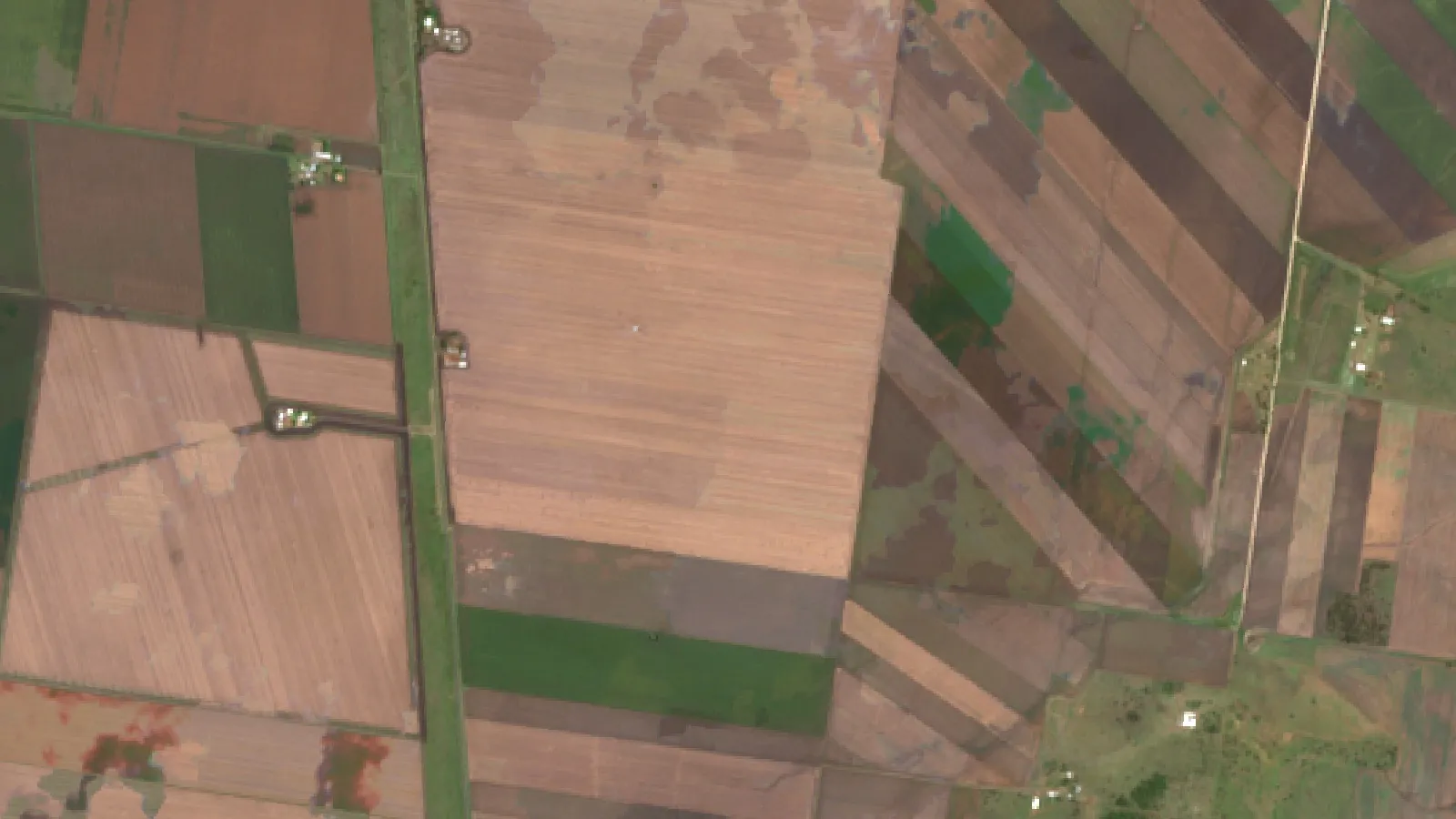
Checking pit fields from space
Pits change how a field greens up. Satellite vegetation maps can show which blocks are greening and which lag after a dry spell, so you know where to walk first. The Farmonaut Satellite + AI Farm Monitoring System shows these maps for fields you draw, through the web and mobile apps. Larger operations can use the agribusiness admin app, and developers can pull weather and crop data through the satellite and weather API. Satellites show a change in plant cover, not its cause, so check the field before you act.
Related pages on our site: carbon footprinting, crop loan and insurance verification, product traceability.
▶ Six plain steps to start precision farming, from field maps to satellite monitoring. · 4:18
FAQ
What is the zai farming technique in simple words?
It is digging small pits in hard, dry ground, putting manure or compost in each, and planting in the pit. The pit catches runoff and holds nutrients at the roots.
How deep and wide should zai pits be?
Burkina Faso trials used pits 10 to 15 cm deep and 20 to 40 cm wide (Barro et al.).
Can I use zai pits for watermelon?
Yes, especially with drip irrigation. Plant one or two transplants per pit, mulch between pits and plan irrigation with watermelon crop coefficients from FAO-56 or your extension service.
Does zai work outside Africa?
The physics work on any crusted, low-organic-matter soil with short, heavy rains. In high-wage countries, it fits small plots, orchards and patch repair best, using machines to dig.
How long does it take to dig zai pits by hand?
Manual zai took more than 300 hours per hectare in Burkina Faso; an animal-drawn tool cut that to 22 to 36 hours (Barro et al.).
Is “uprawa typu zai” the same thing?
Yes. It is Polish for zai-type cultivation, the same planting-pit method described here.
Farmonaut crop monitoring
See your own fields from space
Draw your fields once and Farmonaut shows satellite vegetation maps for them through the season, on web, Android or iOS.




Keep reading



Sources
- Barro, Zougmoré and Taonda, Mécanisation de la technique du zaï manuel en zone semi-aride, Cahiers Agricultures: revues.cirad.fr
- Fatondji et al., Effect of planting technique and amendment type on pearl millet yield, Nutrient Cycling in Agroecosystems (2006): research.dial.uclouvain.be
- Right Livelihood Foundation, Yacouba Sawadogo laureate profile: rightlivelihood.org
- UNCCD, Profiles on Agroecology: impact of agroecological techniques in Burkina Faso: droughtclp.unccd.int
- FAO, Crop Evapotranspiration (FAO-56), Chapter 6, single crop coefficient: fao.org
- University of Georgia Extension, Circular 1183, Water use and irrigation management for watermelon: fieldreport.caes.uga.edu
- SARE, Building Soils for Better Crops: sare.org
- Drought.gov (NIDIS), What is drought: drought.gov
- U.S. Drought Monitor, What is the USDM: droughtmonitor.unl.edu
- Australian Bureau of Meteorology, Drought: rainfall deficiencies and water availability: bom.gov.au
- Texas A&M AgriLife Extension, Watermelon vegetable resources: aggie-horticulture.tamu.edu
Discussion
Questions, corrections or field experience? Share them below. First-time comments are reviewed before they appear, and your email is never published.
No comments yet. Be the first to add a question or your experience.

 Farmo
 Kubota
 FFBS
 Jontra
 Kalustyan
 Tucor
 Geno
 Hayleys Agriculture
 Linx Agritech
 Adinet
 Save Your Soils
 Grandstream Algérie
 XOS Realty
 Geospatial Lab Africa
 Agro La Gándara
 HIPSAC

 Licence holder · Niger · Gold










