

Agricultural Schemes in India & Tamil Nadu: 2025 Guide
Introduction: The Landscape of Agriculture in India
Agriculture remains the foundation of India’s economy, employing nearly half the country’s workforce and contributing significantly to the national GDP. As we look forward to 2025 and beyond, agricultural schemes in India play a pivotal role in catalyzing growth, enhancing productivity, and fostering sustainability across diverse regions—including the progressive state of Tamil Nadu. This article explores the broad landscape of agricultural schemes in India, zooming into the agricultural land area in India, prevailing agriculture systems and agriculture practices in India, and specially highlighting sustainable, eco-friendly initiatives and how policy frameworks are shaping the sector’s future.
Focus Keywords: agricultural schemes in india, agricultural schemes in tamil nadu, agricultural land area in india, agriculture system in india, agriculture practice in india, sustainable, 2025, farmers, irrigation, land, development, government, environmentally, growth, sustainability.
Agricultural Land Area in India: Defining the Backbone
India boasts one of the largest cultivable land areas globally, with approximately 159 million hectares under agriculture according to recent estimates. Despite mounting pressures from urbanization and industrialization, the agricultural land area in India has been maintained through government interventions that focus on efficient land use, diversification, and protection of valuable agricultural landowners’ rights.
- Regions like Punjab and Haryana: Characterized by intensive cereal production (such as wheat and rice)
- Tamil Nadu: Focuses on diversified farming with a mix of cereals, pulses, horticulture, and floriculture
- Other States: Exhibit variable patterns including rainfed farming, plantations, and shifting cultivation in hilly terrains
Pattern of land utilization: The agricultural land area in India supports a range of crop-growing conditions—allowing crop rotation, mixed farming, and intercropping—thanks to the country’s diverse climatic zones. The distribution of land also impacts the formulation and reach of agricultural schemes in India and development initiatives, especially when addressing sustainability and efficiency challenges.

Agriculture System and Practices in India (2025 & Beyond)
The agriculture system in India is highly diverse and adaptive, mirroring the nation’s varied climatic conditions and rich cultural heritage. As the sector strides towards 2025, several distinctive features and emerging agriculture practices in India play crucial roles:
- Subsistence Farming: Smallholder and marginal farmers produce primarily for self-consumption; common in states with limited market access and infrastructure
- Commercial Farming: Increasingly prevalent in well-irrigated and market-linked zones, with cultivation of cash crops and high-yield varieties
- Horticultural and Floricultural Systems: Especially important in Tamil Nadu, Maharashtra, and Northeastern states—cater to both domestic and export demand
- Organic and Sustainable Practices: Promoted under schemes like PKVY, more farmers are adopting environmentally-sound, organic systems, including crop rotation and integrated pest management
- Mechanization & Precision Agriculture: Enhanced by governmental subsidies for machinery and increasing use of sensors, drones, and satellite-based solutions (See Farmonaut’s role)
Innovations continue to evolve rapidly, powered by advanced technologies—such as AI-driven analysis, satellite monitoring, and blockchain-based traceability—making agriculture more productive, market-oriented, and resource-efficient.

Top Agricultural Schemes in India (2025): A Path Towards Sustainable Growth
By 2025, agricultural schemes in India have evolved to address challenges of income disparity, environmental degradation, and the need for sustainable intensification.
The central government has prioritized eco-friendly initiatives, resource-efficiency, and farmer welfare under landmark schemes.
1. Pradhan Mantri Krishi Sinchayee Yojana (PMKSY)
- Objective: Enhance irrigation coverage, promote water-use efficiency, and convert more cultivable area under assured irrigation
- Key Features: Focus on micro-irrigation (drip, sprinkler systems), per drop more crop philosophy, and convergence of various water resource initiatives
- Benefits: Increased productivity, reduced water wastage, support for climate-resilient farming
2. Pradhan Mantri Kisan Samman Nidhi (PM-KISAN)
- Objective: Provide direct income support to all farmer families, especially small and marginal ones
- Benefits: Annual cash transfer into beneficiaries’ accounts to improve credit access, timely purchase of farm inputs, reduce dependency on informal lending
- Sustainability Angle: Enables smallholders to invest in sustainable inputs and diversify crops
3. Soil Health Card Scheme
- Objective: Inform farmers about the status of their soil, encourage judicious fertilizer use, and improve soil health
- Key Actions: Distribution of personalized soil health cards, promoting organic manure, bio-fertilizers, and balanced nutrient management
- Sustainability: Reduced fertilizer misuse and environmental pollution, improved soil fertility for long-term productivity
4. Paramparagat Krishi Vikas Yojana (PKVY)
- Objective: Promote organic farming using local resources, cluster approach (groups of 20+ farmers), and certification support for organic produce
- Impact: Increasing India’s organic acreage, reducing chemical inputs, restoring soil and ecosystem health
5. National Agriculture Market (e-NAM)
- Objective: An online trading platform (e-NAM) for farmers, traders, and buyers to enhance market access and transparency
- Benefit: Remunerative prices for farmers, reduced role of intermediaries, real-time market data

These agricultural schemes in India work in a synergistic manner, with central funding augmented by state-level customization (as seen in Tamil Nadu). Their focus sharply aligns with the larger vision of sustainable agricultural development, resource optimization, and increased farmer resilience.
Looking for trusted, blockchain-based transparency and traceability solutions? Farmonaut’s Product Traceability enables end-to-end verification of agricultural products. This helps ensure supply chain authenticity, fosters consumer trust, and drives greater transparency – all from a secure, user-friendly platform.
Key Agricultural Schemes in India & Tamil Nadu (2025): Focus on Sustainability
| Scheme Name | Launch Year | State/ Central | Main Objective | Eligibility Criteria | Estimated Benefits | Sustainability Impact | Application Process |
|---|---|---|---|---|---|---|---|
| Pradhan Mantri Krishi Sinchayee Yojana (PMKSY) | 2015 (revamped 2025) | Central, State Implemented | Enhance irrigation coverage, water-use efficiency | All farmers, priority to water-scarce/dryland areas | Subsidy up to 70% for micro-irrigation, 20M+ ha covered | Estimated saving of 25–40% irrigation water | Apply via state agri dept/online PMKSY portal |
| Pradhan Mantri Kisan Samman Nidhi (PM-KISAN) | 2019 | Central | Direct income support to small/marginal farmers | Landholding farmers up to 2 hectares | ₹6,000/year in 3 instalments | Enables eco-friendly input adoption, reduces distress | Self-registration on PM-KISAN portal or CSCs |
| Soil Health Card Scheme | 2015 | Central, State Executed | Promote balanced fertilizer use | All cultivators, rural and peri-urban | Free soil testing, distributed every 2 years | Reduced overuse of chemicals, improved soil health | Apply via agri department or block-level office |
| Paramparagat Krishi Vikas Yojana (PKVY) | 2015 (ongoing) | Central | Promote organic farming & clusters | Groups of 20+ farmers willing for organic farming | Up to ₹50,000/ha for 3 years, training | Reduced chemical usage on >2M ha till 2025 | Apply via block/district agri office or PKVY portal |
| National Agriculture Market (e-NAM) | 2016, expanded 2025 | Central | Online agri trading, fair market prices | Agricultural producers, FPOs, traders | Access to 1,000+ regulated markets (mandis) | Reduces food miles, improves price realization | Online registration, submit KYC docs |
| Tamil Nadu Micro Irrigation Project | 2014, expanded 2025 | Tamil Nadu (State) | Promote drip/sprinkler systems, water efficiency | All Tamil Nadu farmers (priority: dryland) | Subsidy up to 85%, covers ~4 lakh ha (est.) | Significant water savings, drought resilience | Apply through Dept. of Horticulture (state portal) |
| Farm Mechanization Subsidy Program (TN) | 2011, updated 2025 | Tamil Nadu (State) | Affordable access to farm machinery | Small & marginal TN farmers, FPOs | 40–75% subsidy, thousands of units distributed | Reduced labor & time, lower emissions | Apply via agri office, agri engineering dept |
| Integrated Pest Management Programs (TN) | Ongoing | Tamil Nadu (State) | Eco-friendly pest & disease control | Open to all cultivators, especially vegetable/fruit growers | Input subsidy/training, extension services | Low pesticide residue, improved environment | Contact block extension office |

Agricultural Schemes in Tamil Nadu: Localizing Growth and Sustainability
Agricultural schemes in Tamil Nadu are exemplars of localized innovation, uniquely tailored to meet the region’s specific climatic and soil challenges. By harmonizing central government support with state-focused adaptation, Tamil Nadu is accelerating progress towards sustainable agriculture as part of India’s broader goal for 2025.
Major State-Level Initiatives and Their Impact
- Tamil Nadu Micro Irrigation Project:
- Drip/sprinkler irrigation brought to water-scarce districts
- Farmers benefit from up to 85% subsidy, increased area under irrigation, and improved crop yields
- Focal role in drought resilience, especially for smallholders
- Farm Mechanization Subsidy Program:
- Subsidized distribution of tractors, harvesters, weeders, and drones
- Mechanization increases productivity, reduces drudgery, and enables climate-smart farming practices
- Integrated Pest Management (IPM):
- Reduction in chemical pesticide usage via eco-friendly biological control agents
- Regular farmer training, field demonstrations, and extension service support
- Horticulture, Floriculture, and Crop Diversification Schemes:
- Income risk reduction for farmers through promotion of fruits, vegetables, and flowers
- Market development for value-added products, agro-processing, and agri-export clusters
- Crop Insurance Schemes:
- Adapted to regional climatic and crop-specific risks, protecting farmers’ incomes against natural calamities
Are you a farmer seeking satellite-enhanced crop loan or insurance verification? Farmonaut’s Crop Loan & Insurance Solution offers credible, satellite-based reports for banks and insurers, reducing fraud risk and speeding up loan disbursal for Indian agriculture.

The focus of agricultural schemes in Tamil Nadu for 2025 is unmistakably on sustainable land use, building waste-efficient irrigation systems, encouraging small and marginal farmers to adopt organic practices, and supporting a resilient, market-ready farming sector.
Farm Mechanization, Technological Innovation & Digital Agriculture
With India’s labor force increasingly urbanizing, mechanization—through tractors, power tillers, harvesters, and drones—is critical for the agriculture sector. Government schemes now provide substantial capital subsidies for small and marginal farmers, with special incentives for women and youth. In Tamil Nadu and other progressive states, digital tools and mechanization are driving the push for sustainable development.
- Digital Agriculture: Expansion of nationwide data collection, digital land records (PM Kisan Samman Nidhi integration), and farm advisory apps
- AI & Satellite Monitoring: Platforms like Farmonaut provide real-time data on vegetation health and soil moisture, accessible through mobile and web applications
- Blockchain Traceability: Tech-enabled solutions to verify authenticity of produce and monitor sustainability compliance
- Climate-Smart Advisory: Weather forecasts, crop health alerts, and pest risk assessments delivered stand-alone, or integrated with government extension services
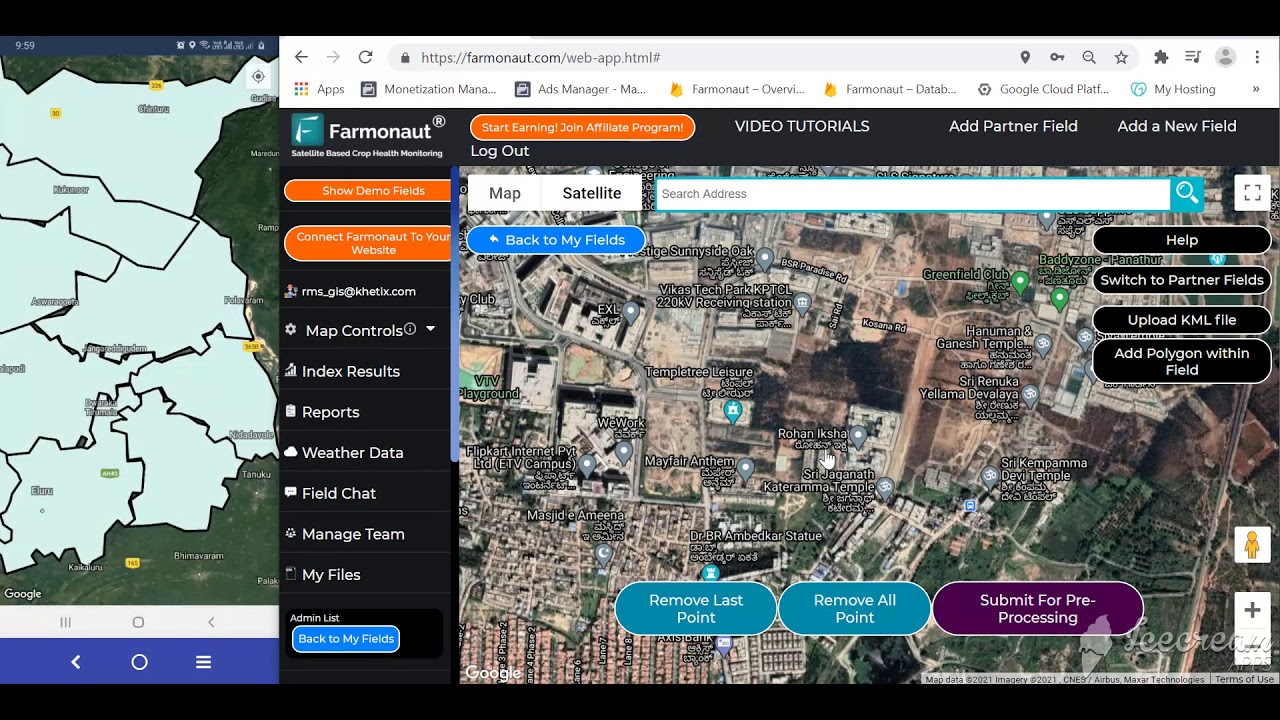
For progressive organizations and government officials, our Large Scale Farm Management System enables the remote, satellite-based supervision of vast plot portfolios—optimizing field operations, monitoring compliance with sustainability mandates, and supporting real-time decision-making.
Satellite Technology & Eco-Friendly Farming: How Farmonaut Empowers 2025 Agriculture
Farmonaut is at the forefront of integrating satellite technology, AI, and blockchain to transform agricultural monitoring and sustainability in India. By offering real-time, cost-effective tools for large and small-scale farmers, government decision-makers, and agribusinesses, we are bridging the technology gap in the Indian agriculture sector.
- Crop Health & Soil Monitoring: Leverage Farmonaut’s web and mobile apps or our API (learn more) for high-frequency, multispectral satellite imagery, detailed NDVI maps, and precise soil condition reports—enabling data-driven interventions.
- Jeevn AI Advisory System: Get real-time crop and resource advisory, weather forecasts, and recommendations to minimize risk and maximize sustainable productivity.
- Environmental Impact Tracking: Monitor and calculate carbon footprint, optimize water and fertilizer use, and measure progress towards sustainability goals.
- Blockchain-Based Traceability: Enhance trust in your product and resource supply chain by leveraging our integrated blockchain-backed traceability systems.
- Fleet & Resource Management: Use Fleet Management tools for optimizing agri-logistics—reducing fuel use, ensuring equipment safety, and enhancing operational transparency.




Our API and developer documentation provides developers and agritech companies with everything needed to integrate satellite-driven agri-insights into their web or mobile applications.
Future Perspectives & Opportunities in Indian Agriculture
Looking to 2025 and beyond, the future of agricultural schemes in India and agricultural schemes in Tamil Nadu is underpinned by a resolute shift towards sustainability, climate resilience, and economic empowerment. Several priorities will define this era:
- Scaling Renewable Energy: Government incentives for solar pumps, bioenergy, and decentralized power grids for rural/agricultural use.
- Market Access: Expansion of e-NAM, logistics infrastructure, and cold storage facilities to minimize post-harvest losses and enhance revenue.
- Rural Infrastructure: Improved rural roads, internet connectivity, and agri-processing clusters as part of India’s rural transformation.
- Inclusive Welfare: Dedicated schemes for women, youth, and marginalized farmers, supporting entrepreneurial and cooperative farming models.
- Integration of Traditional & Modern Knowledge: Reviving indigenous systems and encouraging research-led innovation for high-quality, sustainable yield.
- Data-Driven Extension: Enhanced outreach—via mobile, web, satellite, and AI—ensuring smallholders access modern advisory, credit, and insurance products.
The concerted focus, especially visible in agricultural schemes in Tamil Nadu, on increasing sustainable land use by 30% illustrates just how pivotal regional innovation is to India’s agricultural future.
Planning new plantations or reforestation? Farmonaut’s Crop Plantation & Forest Advisory supports custom planning and monitoring for diverse land areas, enabling better land utilization and success of long-term sustainable ventures.
Frequently Asked Questions About Agricultural Schemes in India
-
Q: What is the primary focus of agricultural schemes in India for 2025?
A: The key focus in 2025 is shifting towards sustainability, water-use efficiency, soil health, farmer income support, digital market access, and climate resilience—paving the way for environmentally-sound and inclusive growth. -
Q: How can Tamil Nadu farmers benefit from state-specific schemes?
A: Tamil Nadu farmers can avail themselves of high-subsidy micro irrigation, mechanization grants, integrated pest management, and customized insurance solutions through state portals or agriculture offices—enhancing productivity and sustainability. -
Q: What are the main eligibility criteria for most central government schemes?
A: Criteria vary. Most require proof of landholding (often up to 2 hectares for income support), group formation (for organic clusters), or proof of farming activity. Many are open to all, with priority for smallholders, tribal farmers, or those in vulnerable zones. -
Q: How does satellite technology contribute to sustainable farming?
A: Satellite technology offers real-time monitoring of crop and soil health, water usage, weather risks, and helps identify areas for intervention. This improves input use, lowers costs, reduces emissions, and boosts yield sustainably. -
Q: What documentation is required to apply for these schemes?
A: Common documents include land ownership/lease records, Aadhaar card, bank passbook, and identification proof. Scheme-specific forms are available on government portals or at local agriculture offices. -
Q: Can advanced technology and traditional farming coexist in India?
A: Yes, both are increasingly being integrated. Government policies encourage blending traditional knowledge like crop rotation and mixed farming with precision agriculture, sensors, AI, and satellite technologies. -
Q: Where can developers access satellite-based agriculture data?
A: Farmonaut provides accessible APIs (check here) and detailed developer documentation for seamless integration. -
Q: Are there any dedicated schemes for promoting organic farming in India?
A: Yes, the Paramparagat Krishi Vikas Yojana (PKVY) incentivizes organic farming through cluster formation, training, certification, and financial support.
Conclusion: Catalyzing Growth and Sustainability in 2025
As summarized, agricultural schemes in India and in focus states like Tamil Nadu are catalyzing sustainable growth and resilience across the agriculture sector. Policy frameworks are evolving to blend traditional wisdom with modern technology, ensuring that farmers not only produce more efficiently but also embrace eco-friendly and climate-smart practices.
With the agricultural land area in India remaining a vital national asset, continued government support and innovation are imperative for food security, rural prosperity, and resilient ecosystems. As we move through 2025 and beyond, synergistic collaboration between the government, agri-businesses, technology facilitators like Farmonaut, and the farmer community will usher in a new era of sustainability and progress for Indian agriculture.
Discussion
Questions, corrections or field experience? Share them below. First-time comments are reviewed before they appear, and your email is never published.
No comments yet. Be the first to add a question or your experience.

 Unifrutti Gulf
 Deluxe Conseil
 Krishify
 TVS Electronics
 BW Pipelines
 WICO
WICO Gen Chayat
 Chimera Innovation
 SkyHarvest
 Polaris Digitech
 Teledarbas
 Wild Oak Farm
 SFX
SFX Doodlakine
 Exurbia Geospatial
