

Indonesia farmland · Cost and rules guide
Farm Land Price in Indonesia: Lease Costs and Rules
Indonesia has no official farm land price per acre. In a 2019 survey of 100 rice farms in Demak, Central Java, land valued at the local rent averaged about Rp8.1 million per hectare per season (IPB University, 2021). Only Indonesian citizens, and a few bodies named by the government, may hold freehold title.
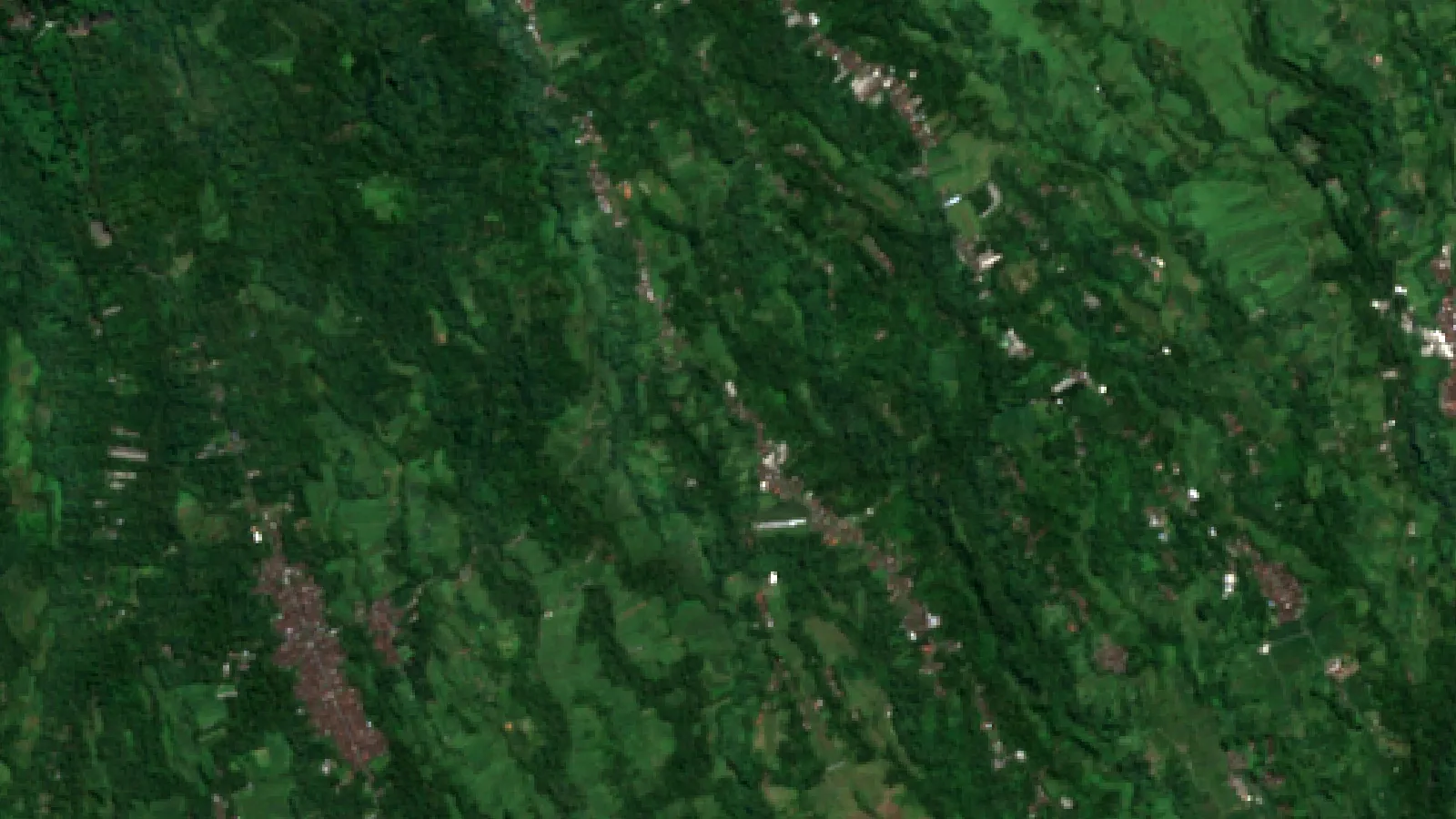
Key takeaways
- No national farmland sale price is published for Indonesia; official cost surveys list land rent only as a cost item, so local surveys are the best dated guide.
- Demak, Central Java (2019 season): land valued at local rent averaged Rp8,128,175 per hectare per season, about 36% of the cost of growing rice (IPB University, 2021).
- One acre is about 0.4047 hectares (NIST); the World Bank annual average rate was 16,478 rupiah per US dollar in 2025.
- Only Indonesian citizens (and a few bodies named by the government) may hold freehold (Hak Milik); a Hak Guna Usaha runs up to 35 years, plus up to 25 years of extension and 35 years of renewal (Government Regulation 18 of 2021).
- Foreigners can hold a right to use (Hak Pakai); check any land deal with a local notary or lawyer.
In this article
- What does farm land cost in Indonesia?
- Why there is no single land price in Indonesia per acre
- Rice land rent: what the surveys show
- Convert rupiah per hectare to dollars per acre
- Who can own or lease farm land in Indonesia?
- What pushes farm land rents up or down
- Agriculture in Indonesia: the bigger picture
- How to check a farm land lease in Indonesia step by step
- How satellite monitoring helps when you lease land
- How we checked the numbers
- FAQ
There is no official farm land price in Indonesia per acre. Statistics Indonesia (BPS) does not publish a national sale price for farmland. Its farm cost surveys list land rent only as one cost item, per hectare per planting season, so any single “price per acre” you see online is an estimate. The best dated figures come from farm surveys: in one 2019 survey of 100 rice farmers in Demak, Central Java, land valued at the local rent averaged about Rp8.1 million per hectare for one growing season, or roughly Rp3.3 million per acre.
This guide explains what those survey numbers mean, how to convert rupiah per hectare into dollars per acre with a dated exchange rate, and who may own or lease farm land under Indonesian law. It also has a lease cost calculator for your own quotes, four charts built from official and peer-reviewed data, and a short checklist for checking a lease. It is general information, not legal or financial advice. Land rights in Indonesia are registered with the land office, and transfers of land rights are made by deed before a land deed official (PPAT), so always confirm the details with a local notary or lawyer before you sign or pay.
What does farm land cost in Indonesia?
The honest answer is that it depends on the plot, and no public dataset covers the whole country. What exists is a set of local studies. Each one measures something slightly different, so read the basis before you compare numbers:
- Rent per hectare per season. The farm cost studies on this page report land cost per hectare for one planting season, not per year. Irrigated rice land can carry two or more seasons a year, so the yearly figure can be two or three times the seasonal one.
- Cash rent versus imputed rent. Some studies count only the rent that tenants pay in cash. Others give owner-farmed land the same value as the local rent, so all farms are compared on one basis.
- Economic land rent. Some researchers report “land rent” as the money the land earns after all other costs. That is what a tenant could afford to pay at most, not what a landlord actually charges.
- Sale price. We found no official or peer-reviewed series of farmland sale prices per hectare for Indonesia. Sale prices are set plot by plot and depend heavily on title type, location and zoning.
The sections below use only dated numbers we could open and check.
Why there is no single land price in Indonesia per acre
Three things make one national figure hard to give.
First, Indonesia measures land in hectares and square metres, not acres. One acre is 4,046.873 square metres in the NIST table of conversion factors, so one acre is about 0.4047 hectares. To turn a price per hectare into a price per acre, multiply by 0.4047.
Second, the type of land title changes what is being sold or leased. A private freehold title (Hak Milik) on irrigated rice land in Java is a very different asset from a time-limited cultivation right (Hak Guna Usaha) on state land in Kalimantan. We explain these titles further down.
Third, land markets differ sharply between islands. A 2022 study in Regional Statistics on land availability in Java, citing official statistics, says Java holds 40.81% of Indonesia’s agricultural land and produces 53.53% of its rice. Java is also crowded: the same study puts its population density at 1,171 people per square kilometre in 2019. It estimates that 1.63% of Java’s agricultural land, about 52,904 hectares, was converted to non-farm use over the five years before the study. The study links this conversion to population growth and expanding towns, which compete with farming for land.
Rice land rent: what the surveys show
The clearest published breakdown we found is a cost survey of 100 rice farmers in five production areas of Demak Regency, Central Java, for the second planting season of 2019. It was published by IPB University’s Forum Agribisnis journal in September 2021. In that sample, 75 farmers farmed their own land, 22 rented and 3 were sharecroppers. The authors valued owner-farmed land at the average rent in each village.
Chart
Where the money goes on one hectare of rice
Demak Regency, Central Java, second season of 2019, largest cost items, million rupiah per hectare per season (100 farmers)
On that basis, the land cost averaged Rp8,128,175 per hectare for the season. That is about Rp3.29 million per acre. The total cost of growing one hectare of rice was Rp22,518,315, so land was the largest single cost, at about 36% of the total. At the 2019 average rate of 14,148 rupiah per US dollar (World Bank), the land figure equals about US$575 per hectare, or about US$233 per acre, for one season.
Keep the limits in mind. This is one regency, one season and one crop. It is a useful reference point for irrigated rice land in Central Java, not a national average.
A second study gives a ceiling rather than a rent. Researchers writing in IPB University’s Journal of Agricultural, Resource and Environmental Economics (2019) estimated the economic land rent of organic rice in Tasikmalaya, West Java, at Rp14,974,224 per hectare per planting season. That is what the land earned after costs. A tenant would struggle to pay more than that and still make a profit.
Cash rent, sharecropping and village land
Not every tenant pays cash. Some Javanese farmers work land under share contracts, where the landowner takes part of the harvest instead of a fixed rent. How you hold the land affects what you earn. A 2026 study of 90 rice farmers in Karanganyar, Central Java, published in IOP Conference Series: Earth and Environmental Science, found a significant income difference between owner farmers, cash tenants and share tenants. Owner farmers earned the most, an average of IDR 20,789,262 per hectare.
Some rice land belongs to the village itself. In Java, village heads have traditionally farmed or rented out village land (tanah bengkok) instead of receiving a salary. A 2021 IZA discussion paper based on a 2018 household survey across 130 villages in Central and East Java looked at how this land is let on fixed-rent or sharecropping contracts. If you are offered village land, ask who has the right to lease it and for how long.
Convert rupiah per hectare to dollars per acre
Exchange rates move, so a dollar price is only meaningful with a date. The rupiah weakened against the US dollar over recent years. The World Bank’s official exchange rate series for Indonesia shows an annual average of 14,148 rupiah per dollar in 2019 and 16,478 in 2025. A rent of Rp8 million per hectare was worth about US$565 at the 2019 rate and about US$486 at the 2025 rate, with no change in rupiah.
Chart
Rupiah per US dollar, annual average
Official exchange rate, Indonesia, 2019 to 2025
To convert a quote yourself:
- Check the unit: per hectare or per square metre, per season or per year.
- Turn it into rupiah per hectare per year (multiply a seasonal rent by the number of seasons the land really carries).
- Multiply by 0.4047 to get rupiah per acre per year.
- Divide by the exchange rate on the date of the quote, and write that date next to the dollar figure.
The calculator below does these steps for you.
Try the numbers for your own farm below.
Calculator
What will a farm land lease in Indonesia cost per acre?
Enter the rent you were quoted, the seasons the land carries, your area and today’s exchange rate.
- Rent per hectare per year: 10,000,000 Rp
- Rent per acre per year: 4,047,000 Rp
- Rent per acre per year in dollars: $246
- Yearly rent for your area: 40,470,000 Rp
Example values only, not a benchmark or a price forecast: the default rent and area are round example numbers. The default exchange rate is the World Bank 2025 annual average (16,478 rupiah per US dollar); replace it with the rate on the date of your quote. The formula uses a fixed 0.4047 hectares per acre (NIST conversion factors). It does not include land tax, notary fees or deposits. Not legal or financial advice.
Who can own or lease farm land in Indonesia?
Indonesia’s land rules start with the Basic Agrarian Law (Law No. 5 of 1960). Its English text is on FAOLEX, the FAO legal database. Article 21 says that only an Indonesian citizen may hold the right of ownership. Article 26 says that a sale or gift that transfers ownership to a foreigner is not valid. Article 10 also says that anyone with rights over farmland should in principle work it actively themselves.
Chart
How long Indonesian land rights can last
Maximum years on state land under Government Regulation 18 of 2021
The detailed rules on time-limited land rights are in Government Regulation No. 18 of 2021 on Right to Manage, Land Right, Apartment Unit and Land Registration. FAOLEX hosts an English translation of Government Regulation 18 of 2021, and the ECOLEX record summarises its scope. The main titles for farming are below.
| Title | Who can hold it | Time limit |
|---|---|---|
| Hak Milik | Indonesian citizens only (some bodies set by the government) | No time limit |
| Hak Guna Usaha | Indonesian citizens and companies set up under Indonesian law and located in Indonesia | Up to 35 years, extension up to 25, renewal up to 35 |
| Hak Guna Bangunan | Indonesian citizens and Indonesian-law companies | Up to 30 years, extension up to 20, renewal up to 30 (on state land) |
| Hak Pakai | Also open to foreigners and foreign legal entities with a representative in Indonesia | Up to 30 years, extension up to 20, renewal up to 30 (time-limited type) |
Hak Guna Usaha: the right to cultivate
Hak Guna Usaha (HGU) is the title used for plantations and large farms. Under the Basic Agrarian Law it is granted on land controlled by the state, for farming, fisheries or livestock, on at least 5 hectares. Plots of 25 hectares or more need proper capital investment and good management. Under Government Regulation 18 of 2021, an HGU can be held by Indonesian citizens and by legal entities set up under Indonesian law and located in Indonesia. It lasts up to 35 years, can be extended for up to 25 years and renewed for up to 35 years. An extension or renewal needs, among other things, the land to still be farmed properly and to fit the regional spatial plan. When the full term ends, the land goes back to the state (or to the holder of a right to manage), although the former holder may be given priority for a new grant.
A foreign investor cannot hold an HGU as a person. The law only allows a company set up under Indonesian law. Whether a foreign-owned company may hold one depends on Indonesia’s investment rules, which change. Check the current position with a local lawyer and the investment ministry before you plan a farm project.
Hak Pakai and building rights
Hak Pakai (right to use) is the main land title that foreigners can hold directly; the 1960 law also lets resident foreigners lease land for building (Hak Sewa). The 1960 law allows it for foreigners living in Indonesia and for foreign companies with a representative there. Government Regulation 18 of 2021 sets the time-limited type at up to 30 years, plus up to 20 years of extension and up to 30 years of renewal. Hak Guna Bangunan (right to build) covers buildings rather than cropping, with the same 30, 20 and 30 year limits on state land.
Protected rice land
Some irrigated rice land can only be converted under strict conditions. Law No. 41 of 2009 protects designated sustainable food farmland. The FFTC Agricultural Policy Platform summary of Ministerial Regulation 81 of 2013 explains that, under the 2013 rules, protected land could only be converted by central or local government for public purposes or disaster response, and only with replacement land and other conditions. These rules have since been amended. A legal study in Jurnal Hukum UNISSULA notes that Article 44 of Law 41 of 2009, as amended by the Job Creation Law (Law No. 6 of 2023), opens protected food farmland to conversion, especially for National Strategic Projects treated as public interest. Check the current position with the regional land office. If you plan to buy rice land to build on, check its zoning first.
What pushes farm land rents up or down
We could not find a dataset that measures each factor’s effect on Indonesian rents, so treat this as a checklist rather than a ranking. These are the points that change the value of a plot:
- Irrigation and seasons per year. Land that carries two or three rice crops a year earns more each year than rain-fed land with one crop.
- Location. Plots near growing towns in Java face competing demand from housing and industry, which the Regional Statistics study links to Java’s land conversion.
- Title type and remaining term. A Hak Milik certificate, an HGU with 30 years left and an HGU with 3 years left are not worth the same.
- Zoning. Land inside protected food farmland zones is hard to convert, which limits its building value.
- Contract type. Cash rent, share rent and village land contracts move risk between landlord and tenant in different ways.
- Exchange rate. For a foreign reader, a weaker rupiah lowers the dollar cost of the same rupiah rent.
Agriculture in Indonesia: the bigger picture
Farming is still a large employer in Indonesia, but its share is falling. World Bank data based on ILO estimates show that employment in agriculture fell from 32.8% of all jobs in 2015 to 27.3% in 2025. Over the same years, agriculture, forestry and fishing produced between about 12% and 14% of GDP, according to the World Bank’s value added series.
Chart
Farming’s share of jobs and of the economy
Indonesia, percent, 2015 to 2025
The World Bank’s agricultural land series puts Indonesia’s agricultural land at about 547,500 square kilometres in 2024, or about 54.8 million hectares. Arable land was about 17.7 million hectares in the same year. Main crops include rice, oil palm, rubber, coffee, cocoa and spices, and more than half of the rice comes from Java, as noted above.
For a land buyer or tenant, these trends matter in two ways. Fewer people working on farms means labour costs and machinery rental matter more. And the steady loss of farmland in Java may keep pressure on land near towns.

▶ Plantation vs farm: how estates such as oil palm differ from family farms in size, crops and risk. · 4:29
How to check a farm land lease in Indonesia step by step
- Get the certificate. Ask for a copy of the land title certificate and check the title type, holder name, area and, for HGU, HGB or Hak Pakai, the expiry date.
- Check it at the land office. Ask a land deed official (PPAT) or notary to check the certificate with the local land office for disputes, mortgages or blocks.
- Check the zoning. Ask the regional government whether the plot is inside protected food farmland or another restricted zone.
- Compare the rent basis. Turn every quote into rupiah per hectare per year, using the real number of seasons, before you compare.
- Look at the field history. Satellite images from past seasons show whether the land was cropped, flooded or left fallow.
- Sign with a notary. Have a local notary or lawyer draft or review the lease, and make sure it states the rent, term, payment dates and who pays land tax.
How satellite monitoring helps when you lease land
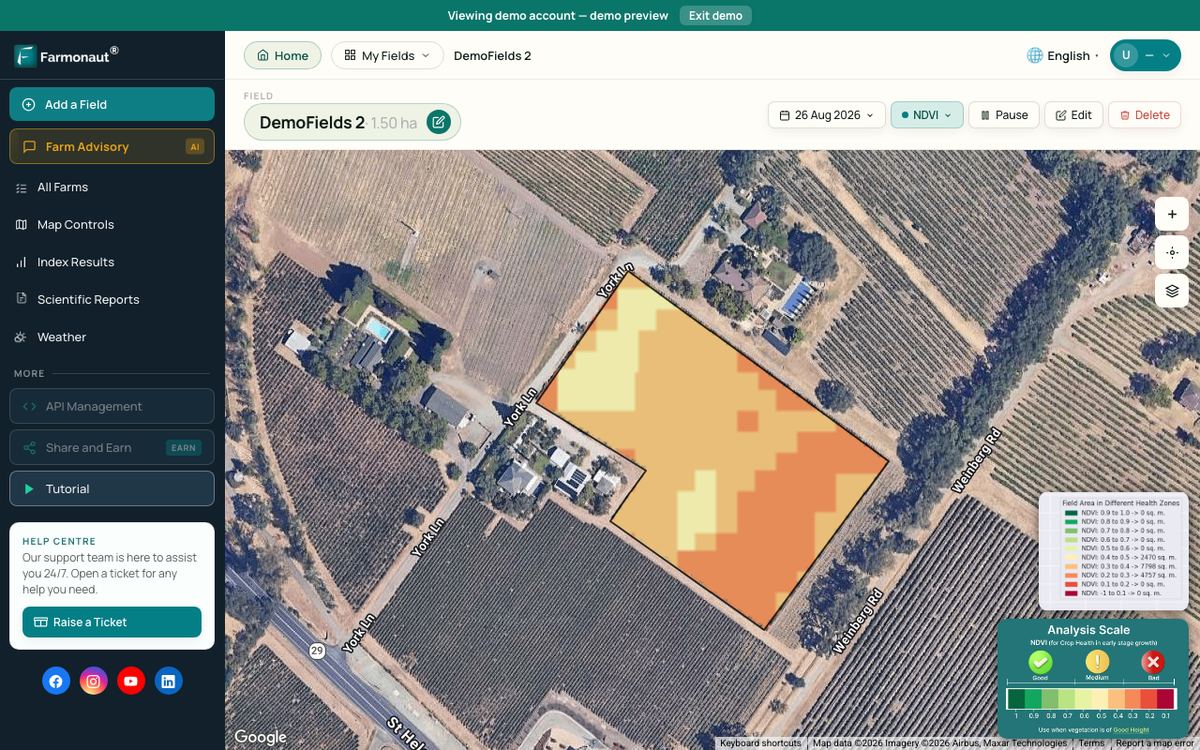
Before you lease, you can look at a field’s crop history from satellite images. After you sign, you can watch crop growth through the season. The Farmonaut Satellite + AI Farm Monitoring System shows vegetation index maps for a field you draw in the Farmonaut app. A vegetation index shows where plants are growing well or poorly. It does not show the cause, so check the field in person.
Larger operations and lenders can also use an admin dashboard for large-scale farm management, satellite data for crop loan and insurance checks, product traceability, carbon footprinting and fleet management. Developers can use the satellite and weather API with the API developer documentation.

▶ Tutorial: drawing a field and viewing crop health maps in the Farmonaut web app · 8:43
How we checked the numbers
We used only figures we could open and read on the publisher’s own page. Rent figures come from peer-reviewed or university-published studies, each with its place, year and basis stated. Economic and land-area data come from the World Bank. The exchange rate is the World Bank’s annual average official rate, read in October 2026. Land law comes from the FAOLEX English texts of the 1960 Basic Agrarian Law and Government Regulation 18 of 2021. Statistics Indonesia (BPS) publishes farm cost surveys, but we could not open the latest one to check its land rent figures, so we have not quoted it. We will add official figures if they become accessible.
FAQ
What is the price of 1 acre of farm land in Indonesia?
There is no official national price per acre. In a 2019 survey of rice farms in Demak, Central Java, land valued at the local rent cost about Rp8.1 million per hectare for one season, or about Rp3.3 million per acre. Sale prices are set plot by plot, so ask a local notary or land valuer for recent sales near the plot.
Can a foreigner buy farm land in Indonesia?
A foreigner cannot hold freehold ownership (Hak Milik). The 1960 Basic Agrarian Law limits it to Indonesian citizens. Foreigners can hold a right to use (Hak Pakai). Large farms usually use a cultivation right (HGU), which only citizens and companies set up under Indonesian law can hold. Consult a local notary or lawyer before you invest.
How long does a Hak Guna Usaha last?
Under Government Regulation 18 of 2021, an HGU is granted for up to 35 years, extended for up to 25 years and renewed for up to 35 years, if the land is still used properly and the holder still qualifies.
Is land rent in Indonesia paid per season or per year?
Both are used. Many studies and village deals quote rent per hectare per planting season. Always confirm the basis and the number of seasons before you compare quotes.
Which rupiah to dollar rate should I use?
Use the rate on the date of the quote and state it. As a reference, the World Bank’s annual average official rate was 16,478 rupiah per US dollar in 2025.
Farmonaut crop monitoring
Check a field's crop history before you lease
Draw a field in the Farmonaut app to see satellite crop health maps from past and current seasons.



Keep reading
Sources
- IPB University, Forum Agribisnis 11(2): Aktivitas dan biaya produksi usahatani padi, Demak (September 2021): journal.ipb.ac.id
- Istiqomah, Nindyantoro and Novindra, Land rent and competitiveness of organic rice in Tasikmalaya, JAREE, IPB University (2019): ideas.repec.org
- Aisiyah et al., Rice farmers’ income by land tenure status, Karanganyar, IOP Conf. Ser. Earth Environ. Sci. 1584 (2026): iopscience.iop.org
- Kurosaki, Paul and Witoelar, Out of Communal Land, IZA Discussion Paper 14263 (April 2021): docs.iza.org
- Prasada, Dhamira and Nugroho, Agricultural land availability and farmer’s income in Java, Regional Statistics 12(3) (2022): ksh.hu
- FAOLEX, Indonesia Act No. 5 of 1960 on Basic Agrarian Principles (English text): faolex.fao.org
- FAOLEX, Government Regulation No. 18 of 2021 on Right to Manage, Land Right, Apartment Unit and Land Registration (English text): faolex.fao.org
- ECOLEX, record of Government Regulation No. 18 of 2021: ecolex.org
- FFTC Agricultural Policy Platform, Ministerial Regulation 81/2013 on conversion of sustainable agricultural land: ap.fftc.org.tw
- World Bank, Official exchange rate (LCU per US$), Indonesia (WDI, updated October 2026): data.worldbank.org
- World Bank, Employment in agriculture (% of total employment, ILO modelled estimate), Indonesia (WDI, updated October 2026): data.worldbank.org
- World Bank, Agriculture, forestry and fishing value added (% of GDP), Indonesia (WDI, updated October 2026): data.worldbank.org
- World Bank, Agricultural land (sq. km), Indonesia (WDI, updated October 2026): data.worldbank.org
- World Bank, Arable land (hectares), Indonesia (WDI, updated October 2026): data.worldbank.org
- NIST, Guide to the SI, Appendix B.8: factors for units listed alphabetically: nist.gov
- Mashdurohatun et al., The Conserving Agrarian Land for Future Generations: A Policy Blueprint for Indonesia, Jurnal Hukum UNISSULA 41(1): jurnal.unissula.ac.id
Discussion
Questions, corrections or field experience? Share them below. First-time comments are reviewed before they appear, and your email is never published.
No comments yet. Be the first to add a question or your experience.

 Mera Farmhouse
 GalaxEye Space
 Sun Palm Australia
 Grandstream Algérie
 XOS Realty
 Geospatial Lab Africa
 Agro La Gándara
 HIPSAC
 ZOL Zimbabwe
 Juligerm
 AdBio
AdBio MISE Maroc
 NWNS
NWNS Red August Group
 Farm Inc
 WeMe Global
 Agrotoken
 Blue BearX
 Insignito
 DnCubed
 Licence holder · Niger · Gold
 Licence holder · Nigeria · Gold + lithium










