

AI farm chatbots · Status explainer
CHAG (Chat Ag): What the UAE Farm Chatbot Is Now
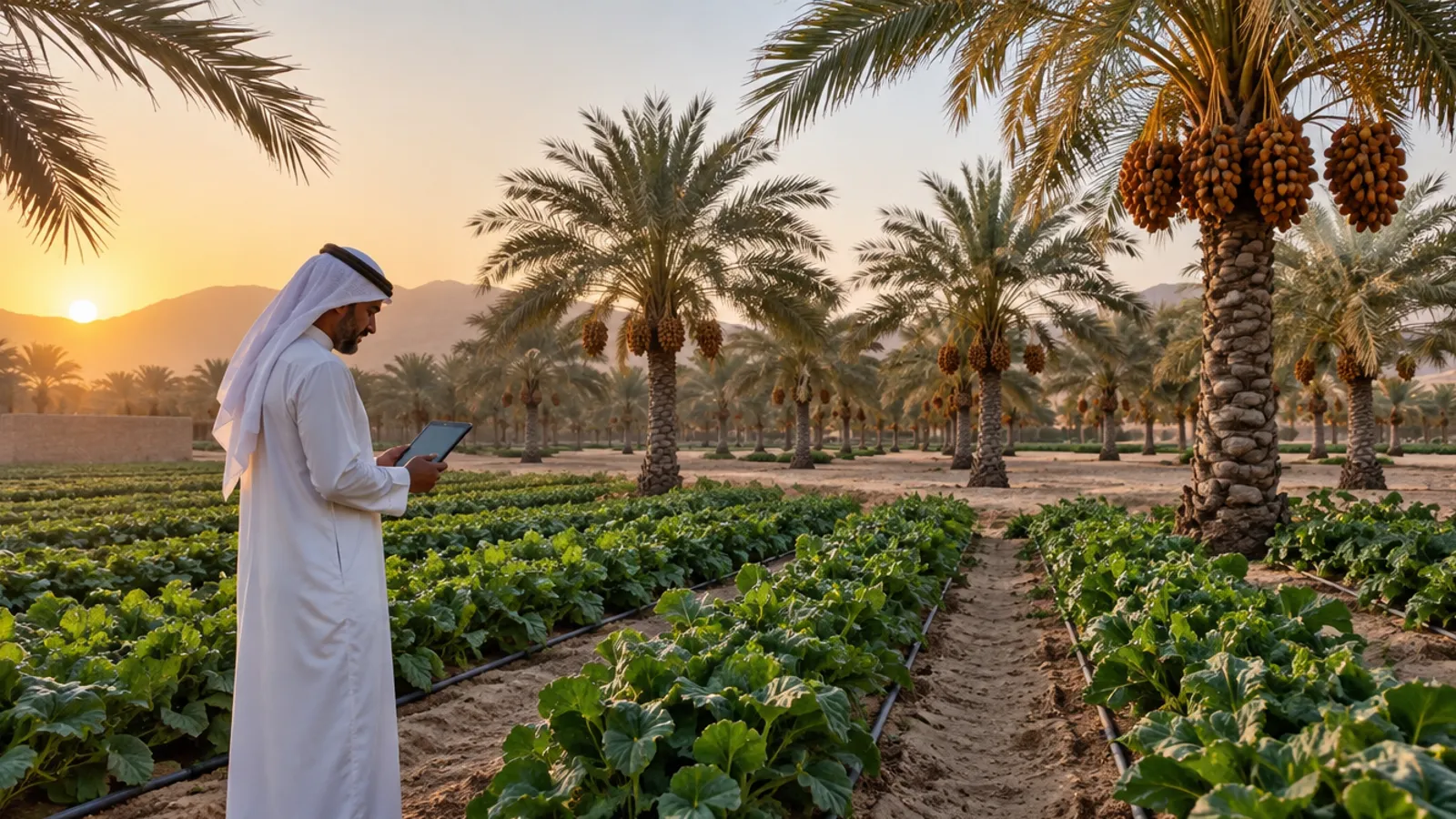
CHAG (Chat + Ag) was unveiled at COP29 on 16 November 2024 as a plan. By December 2025 Abu Dhabi’s AI ecosystem, which includes AgriLLM, was the live farm-AI effort, and no CHAG sign-up exists in the official releases we read.
Key takeaways
- CHAG was announced as a plan at COP29 on Saturday 16 November 2024 (Economy Middle East, Aletihad).
- The Abu Dhabi Media Office release of 8 December 2025 names four initiatives, including AgriLLM, with four agents in partner testing.
- AgriLLM is described as an open-source model, not a consumer app (CGIAR, December 2025).
- Of 400 US farmers surveyed in June 2026, 52% saw no meaningful benefit from AI tools (Purdue).
- Guidance autosteer was used on 70% of large-scale US crop farms in 2023 (USDA ERS).
In this article
- What is CHAG, and can you use it?
- From CHAG to AgriLLM: the Abu Dhabi ecosystem
- The Abu Dhabi institute for agriculture and AI
- Where CHAG fits among ag chat tools
- CHAG timeline: announcements and status
- Do farmers think AI tools are worth adopting?
- How to judge any farm chatbot before you trust it
- How many US farms use precision tools
- What feeds an AI farm advisor, beyond the chat window
- Building climate resilience beyond the chat window
- Is an AI chatbot worth paying for? Run your own numbers
- FAQ
- How we checked the numbers
CHAG (short for Chat + Ag) is the farm-advice chatbot the United Arab Emirates announced at the COP29 climate summit in Baku on Saturday 16 November 2024, and as of the Abu Dhabi Media Office release of 8 December 2025 it is not a product you can sign up for. The release does not name CHAG, but its AI farm-advice work now sits in a bigger programme, Abu Dhabi’s AI Ecosystem for Global Agricultural Development, whose farm-facing model is called AgriLLM.
This page sorts what was announced from what has shipped, shows what AgriLLM was trained on, and then looks at how US farmers rate AI tools and which precision tools they really use. It ends with a calculator to test whether any AI farm advisor pays for itself on your farm.
What is CHAG, and can you use it?
The UAE’s International Affairs Office first announced a US$200 million partnership with the Gates Foundation at COP28 in Dubai in December 2023, as the Abu Dhabi Media Office release later recalled. Eleven months later, at COP29, the office’s head, Mariam Almheiri, unveiled CHAG. Economy Middle East, citing the UAE news agency WAM, reported that the tool would use more than 50 years of research data. It was announced in a session on AI-based public goods for smallholder farmers.
The wording at the time was about plans. Aletihad, on 17 November 2024, wrote that the UAE “revealed on Saturday” its plans to develop CHAG, and the experts it quoted spoke of its potential. None of the official releases we read lists a download, a sign-up page or a launch date for a tool named CHAG.
What exists is AgriLLM, the closest related project; no source calls it CHAG’s successor. The CGIAR news item of 10 December 2025 describes AgriLLM as an open-source AI model giving multilingual digital advice to farmers, advisors and policymakers. The Abu Dhabi release says four AgriLLM agents were being tested with partners and that the model will be released as a public good. So, for a farmer wanting to type a question today, CHAG by that name is not available, and AgriLLM is a model for developers and partner programmes rather than a consumer app. A model named Llama-agrillm-3.3-70B from AI71ai is listed publicly and ungated on Hugging Face (last modified 8 December 2025, Llama 3.3 licence), built on Meta’s Llama-3.3-70B-Instruct.
From CHAG to AgriLLM: the Abu Dhabi ecosystem
On 8 December 2025 the International Affairs Office and the Gates Foundation launched the ecosystem, which the release says builds on the US$200 million partnership. It names four core initiatives. The partners are the International Affairs Office, MBZUAI, NYU Abu Dhabi and ai71, together with the Gates Foundation, CGIAR and the World Bank.
| Initiative | What it is | Where | Stated target |
|---|---|---|---|
| CGIAR AI Hub | Shared digital workspace built on CGIAR’s 50-plus years of data | Hosted by ai71, Abu Dhabi | None given |
| IAAI | Advisory tools, training and technical help for governments and NGOs | MBZUAI, Abu Dhabi | More than 43 million smallholder farmers |
| AgriLLM | Open-source language model for farming questions | Built by ai71 | Public release planned |
| AIM for Scale | AI weather forecasts and advice for smallholders | NYU Abu Dhabi | 100 million farmers by 2030 |
All four rows come from the Abu Dhabi Media Office release of 8 December 2025. The 43 million and 100 million figures are stated goals, not counts of farmers served.
The Abu Dhabi institute for agriculture and AI
If your search was for the AI institute for agriculture in Abu Dhabi, it is the Institute for Agriculture and Artificial Intelligence (IAAI), based at the Mohamed bin Zayed University of Artificial Intelligence (MBZUAI). The release calls it a new digital advisory hub that offers tools, training programmes and technical help to governments, NGOs and partners, with the aim of improving the lives of more than 43 million smallholder farmers.
Smallholders are the focus. CGIAR’s executive managing director, Ismahane Elouafi, also said the work could help farmers in the Global North who face similar challenges, so the research may reach US, Canadian and European growers later, but no such product is announced.
Where CHAG fits among ag chat tools
Anyone looking for a farm chatbot wants a tool that answers a question with real research behind it. The Abu Dhabi route is to fine-tune a language model on farm material instead of using a general chatbot.
Chart
What AgriLLM was trained on (official count)
Items in the training data as listed by the Abu Dhabi Media Office
The Abu Dhabi release says AgriLLM is trained on 150,000 agricultural documents, 50,000 research papers and 120,000 real farming questions and answers. Khaleej Times reported the document count as 350,000 in December 2025. We use the official figure and note the difference.
The same Khaleej Times article quotes ai71 saying that, in its own tests, AgriLLM gives factually correct answers about 30 per cent more often than GPT-4o on farming questions. That is the company’s internal result, not an independent test. A CGIAR presentation from 2025 says the project pairs fine-tuned models with retrieval from verified knowledge bases and stresses local validation, which is how such tools try to cut made-up answers.
Farmonaut takes a narrower route: it builds crop-health maps from satellite data and offers its AI and big-data platform for advice, so a chat window is optional. You can also look at the mobile and web apps.
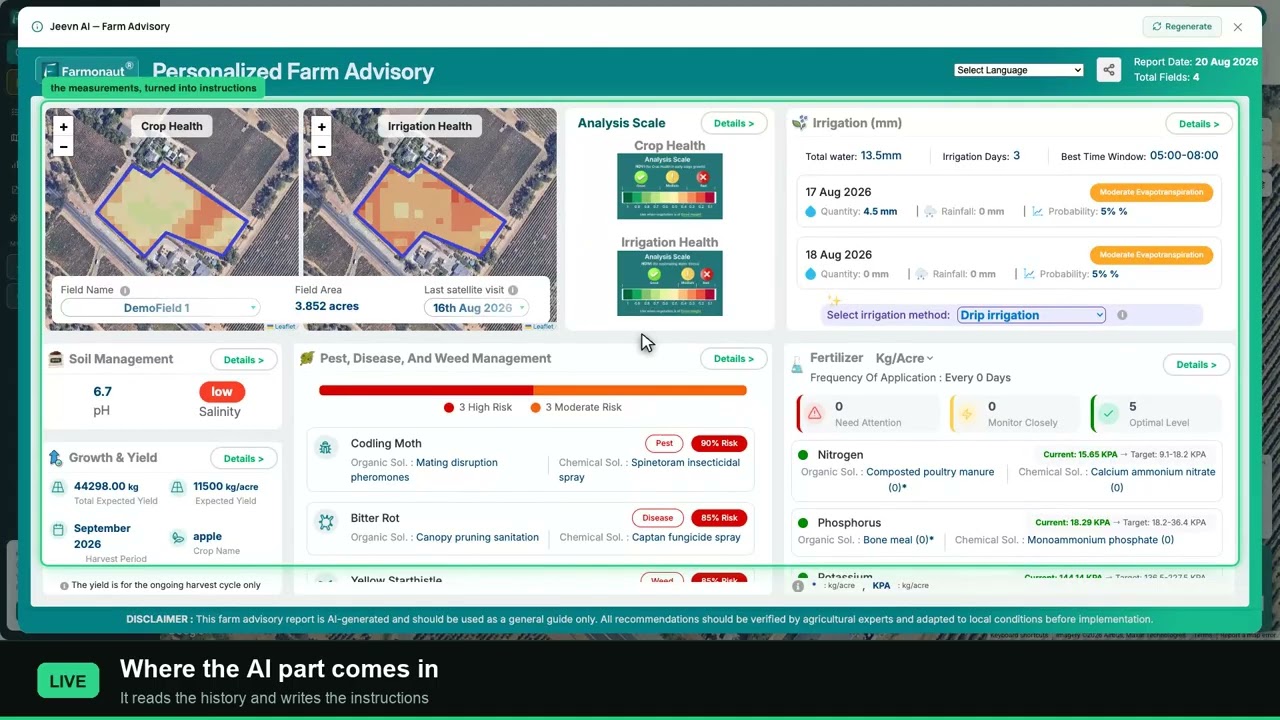
▶ Our video on the real advantages and disadvantages of precision agriculture, and what AI-driven means. · 2:39
CHAG timeline: announcements and status
The dates below make it easy to see how far each step went. Each row cites the page that gives the date.
| Date | Event | Status shown |
|---|---|---|
| Dec 2023 | US$200 million UAE-Gates partnership announced at COP28 | Funding pledge |
| 16 Nov 2024 | CHAG unveiled at COP29 in Baku | Plan to develop |
| 8 Dec 2025 | Abu Dhabi AI ecosystem launched with four initiatives | AgriLLM agents in testing |
| 10 Dec 2025 | CGIAR describes AgriLLM as an open-source model | Model, not a consumer app |
| 20 Dec 2025 | Khaleej Times reports ai71’s internal accuracy test | Company-reported result |
Read the table as a record of announcements. A pledge, a plan and a model in testing are different stages, and none of them is a tool a farmer can log into under the name CHAG.
Do farmers think AI tools are worth adopting?
Mostly not yet. In the Purdue University/CME Group Ag Economy Barometer, fielded 15-19 June 2026 among 400 US farmers, 52% said they saw no meaningful benefit from AI and other data-driven tools. The others named a main benefit: 23% increased production, 14% reduced labor needs and 11% reduced risk or uncertainty. Those four shares add up to 100% of the 400 farmers.
Chart
Main benefit US farmers see from AI and data tools
Share of 400 US farmers surveyed, 15-19 June 2026
Usability was a second worry. About 63% said AI-generated recommendations would sometimes be difficult to follow, and 22% said they would often be. The chart shows the benefit split.
The practical point is that the data behind a recommendation matters more than the chat window around it. A tool that cannot show where its advice comes from will be hard to trust. An advisory layer built on a satellite and weather API can tie each recommendation to field readings.
How to judge any farm chatbot before you trust it
CHAG, AgriLLM and the many commercial chatbots all face the same test. These questions help you decide whether an answer is worth acting on.
- Does it show its source? The CGIAR presentation says AgriLLM draws on verified knowledge bases, which only helps if the answer points to the paper or guide it used.
- Does it know your place? A frost date or a pest threshold in one region can be wrong in another. Ask which region and crop the answer assumes.
- Who measured the accuracy? A company’s own test, such as ai71’s 30 per cent result against GPT-4o, is a starting point. An outside test on questions from your crop is better.
- Can you check it against the field? Imagery and weather records let you confirm a claim. Our developer docs show what such data layers look like.
- Is the advice safe to act on? For chemical rates, labels and local rules come first. Always follow the product label and local rules, and ask an adviser when unsure.
Purdue’s finding that about 63% of farmers expect AI recommendations to be sometimes hard to follow (and 22% often) is a reminder that clear, checkable advice matters more than a clever interface.
How many US farms use precision tools
Precision tools that do not need a chatbot, such as autosteer, are widely used on larger US farms. The sections below use USDA Economic Research Service (ERS) data.

▶ Our tutorial on monitoring crops with satellite imagery and AI in the Farmonaut web system. · 8:43
Guidance and autosteer
The USDA ERS chart of note reports that guidance autosteering was used by 52% of midsize farms and 70% of large-scale crop-producing farms in 2023, up from single digits in the early 2000s. Yield monitors, yield maps and soil maps were used on 68% of large-scale crop farms. ERS says adoption rises sharply with farm size, and small family farms (gross cash farm income under US$350,000) have the lowest rates in every technology group.
Variable-rate technology
Variable-rate technology (VRT) changes seed, fertilizer or chemical rates across a field. The ERS chart on VRT shows corn rising from 11.5% of planted acres in 2005 to 37.4% in 2016, and cotton from 5.4% in 2007 to 22.7% in 2019. Other crops: soybeans 25.3% (2018), winter wheat 18.8% (2017) and sorghum 13.9% (2019).
Yield maps feed most of these systems after harvest. Our guide to yield mapping shows how that data is used.
Chart
Variable-rate technology on US planted acres
Share of planted acres using VRT; corn 2005 to 2016, cotton 2007 to 2019
What feeds an AI farm advisor, beyond the chat window
Whether it is called CHAG, AgriLLM or a plain dashboard, an advisor is only as good as the layers underneath: weather data, field-level data and a place to act on both. A chatbot answering from thin data is a confident guess.
Developers who want to build such a layer can read the satellite and weather API developer docs, which list endpoints for forecasts, soil moisture and vegetation indices. On top of that, agricultural data analytics turns imagery, station data and sensor feeds into yield and soil estimates, and farm management software keeps the field records and costs.
Satellites show change in crop vegetation, not its cause, so a scouting visit stays part of any decision.
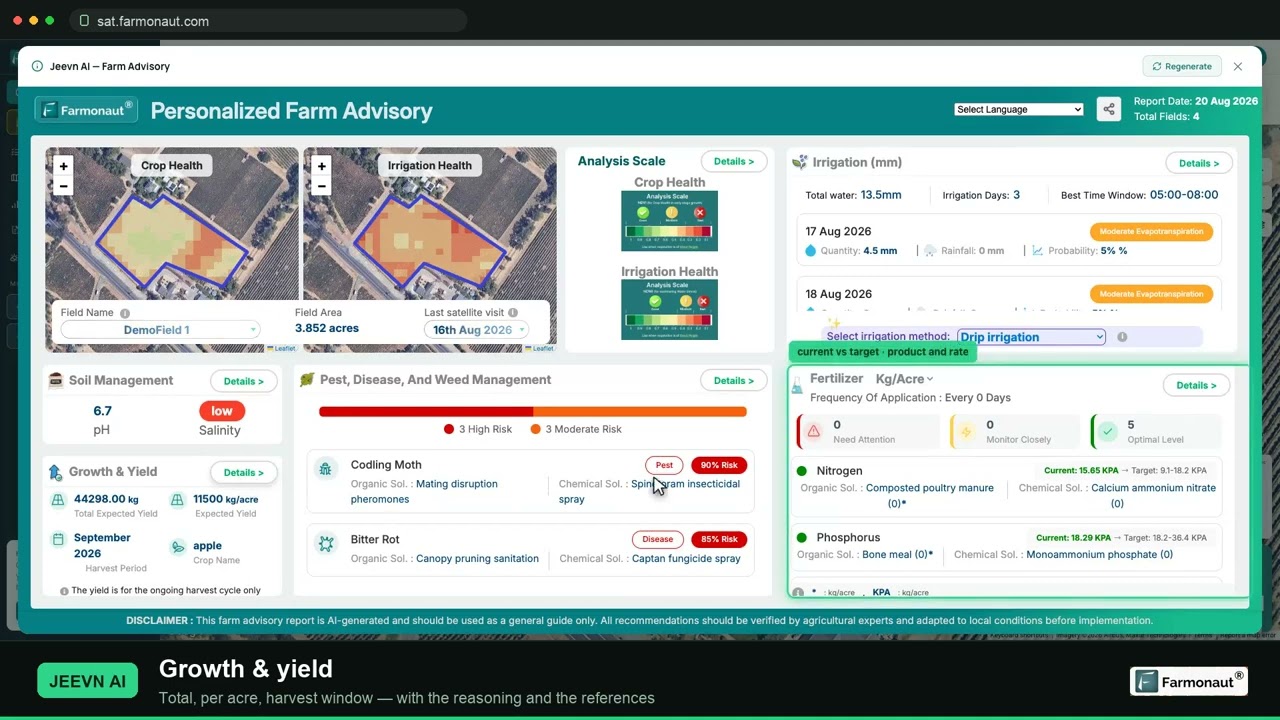
▶ A 20-minute walkthrough of satellite crop monitoring, NDVI and the farm advisory report. · 19:36
Building climate resilience beyond the chat window
No chatbot replaces the shift to climate-adapted farming. We cover urban agriculture’s growth in cities and seven climate-resilient farming practices in separate pieces.
Is an AI chatbot worth paying for? Run your own numbers
CHAG is not for sale, so the useful test is whether any paid AI advisor earns back its cost on your farm. The calculator below counts only the time you save, valued at an hourly rate you enter. For a reference point, the USDA NASS Farm Labor report of 21 May 2025 put the combined gross wage for field and livestock workers at US$18.43 an hour in April 2025. Yield, input savings and lower risk are left out because, per the Purdue survey above, only 23% of farmers named higher production as their main benefit.
Try the numbers for your own farm below.
Calculator
Does an AI farm advisor pay for itself?
Enter your own hours, labor value and tool price.
- Value of time saved per year: $2,160
- Tool cost per year: $2,160
- Hours per week needed to break even: 3.2 hours
Example values only, not a benchmark or a forecast. Hourly labor value is an example, use today’s price; for reference USDA NASS reported US$18.43 an hour combined field and livestock gross wage in April 2025. Only time saved is counted: no yield, input or risk effects, and setup time is valued at the same hourly rate. Not financial advice; ask a qualified adviser.
FAQ
Is “Chag” the same as “Chat Ag”?
Yes. CHAG stands for Chat + Ag, the name the UAE gave its planned farm chatbot at COP29 in November 2024.
Can I sign up for CHAG now?
No sign-up page, download or launch date for a product called CHAG appears in the official releases we read. The December 2025 programme names AgriLLM as the open-source model, with four agents in partner testing.
What is the AI institute for agriculture in Abu Dhabi?
The Institute for Agriculture and Artificial Intelligence (IAAI) at MBZUAI. Per the Abu Dhabi Media Office release of 8 December 2025, it offers advisory tools, training and technical help to governments and NGOs, aiming to improve the lives of more than 43 million smallholder farmers.
Who built AgriLLM, and what is it trained on?
The release says ai71 in Abu Dhabi developed it, trained on 150,000 agricultural documents, 50,000 research papers and 120,000 real farming questions and answers. Khaleej Times reported 350,000 documents. Ask the maintainers for current numbers before you rely on either.
How does CHAG compare with what US farmers use?
US adoption runs through precision tools tracked by USDA: guidance was used on 70% of large-scale crop farms and 52% of midsize farms in 2023 (ERS). Of 400 farmers surveyed by Purdue in June 2026, 52% saw no meaningful benefit from AI tools yet.
How we checked the numbers
Every figure above comes from a page we opened: the Abu Dhabi Media Office, CGIAR, Aletihad (17 November 2024), Economy Middle East, Khaleej Times, Purdue University, USDA ERS and USDA NASS. Where two sources disagree we say so and prefer the official one. Government plans can change, so check the Abu Dhabi Media Office and ERS pages for updates. For farm finance decisions, get advice from a qualified adviser.
Related pages on our site: farm management software, yield mapping, climate-resilient practices.
Farmonaut agriculture API
Build field-level advice on satellite data
Developers can call satellite, weather and vegetation-index endpoints to give a chatbot field readings to answer from.




Keep reading
Sources
- Abu Dhabi Media Office, AI Ecosystem for Global Agricultural Development (8 Dec 2025): mediaoffice.abudhabi
- Economy Middle East, COP29 UAE ChatGPT tool for agriculture (18 Nov 2024): economymiddleeast.com
- CGIAR, Partnerships Powering AI Advances in Agriculture (10 Dec 2025): cgiar.org
- CGIAR/CGSpace, Introducing AgriLLM (2025): cgspace.cgiar.org
- Khaleej Times, UAE builds tool for crop-specific issues (20 Dec 2025): khaleejtimes.com
- Purdue University, Ag Economy Barometer, June 2026: ag.purdue.edu
- USDA ERS, Precision agriculture use increases with farm size (2024): ers.usda.gov
- USDA ERS, Variable rate technology adoption is on the rise (2023): ers.usda.gov
- USDA NASS, Farm Labor report (21 May 2025): esmis.nal.usda.gov
- Khaleej Times, UAE-Gates $200 million partnership at COP28 (2023): khaleejtimes.com
- Aletihad, UAE’s AI-powered agriculture initiative (17 Nov 2024): en.aletihad.ae
- Hugging Face, AI71ai/Llama-agrillm-3.3-70B model page (8 Dec 2025): huggingface.co
Discussion
Questions, corrections or field experience? Share them below. First-time comments are reviewed before they appear, and your email is never published.
No comments yet. Be the first to add a question or your experience.

 TVS Electronics
 BW Pipelines
 WICO
 Gen Chayat
 Chimera Innovation
 Hiteshi Infotech
 SkyHarvest
 Polaris Digitech
 Teledarbas
 Wild Oak Farm
 SFX
 BACF Africa
 Doodlakine
 Exurbia Geospatial
 FieldZero
 Indico Company

 Licence holder · Niger · Gold










