

Reviewed August 2026 against USDA’s Economic Research Service farm income data, the PitchBook-NVCA Venture Monitor, and AgFunder’s Global AgriFoodTech Investment Report.
Try it: Agtech Fundraising Runway & Dilution Calculator →
Agriculture Venture Capital: Top Firms and Real Deal Data
Agriculture venture capital is shrinking, not booming. Global agrifoodtech startups raised $16 billion in 2024, a 4% drop from roughly $16.7 billion in 2023, and US agtech-focused venture firms closed just 263 deals worth $2.4 billion in the first half of 2026 — the slowest pace in the PitchBook-NVCA Venture Monitor’s data series. The firms still writing checks range from growth-stage generalists like S2G Ventures to Asia-specific investors such as Sequoia Capital India & Southeast Asia and Temasek, and which one counts as “best” depends on your stage, geography, and whether you’re building AI agriculture hardware, biologicals, or farm-management software.



Table of Contents
- The Current State of Agriculture Venture Capital
- Top Agriculture Venture Capital Firms Writing Checks
- Calculator: Runway and Dilution on Your Own Round
- Venture Capital Options for Agritech Startups in Asia
- AI Agriculture Startup Ideas Attracting Investment
- How Selective Agtech VCs Have Become
- Why Farm Economics Still Justify the Bet
- Farmonaut: A Satellite Data Platform Agritech Startups Build On
- FAQ: Agriculture Venture Capital
- Conclusion
The Current State of Agriculture Venture Capital
The headline number to know: global agrifoodtech investment came in at $16 billion for full-year 2024, down 4% from an implied $16.7 billion in 2023 — a smaller decline than the 39% drop in 2022 or the roughly 51% drop reported for 2023, according to AgFunder’s Global AgriFoodTech Investment Report as summarized by Green Queen. The US told a different story: American agrifoodtech startups raised $6.6 billion in 2024, up 14% from an implied $5.8 billion in 2023, and captured more than two-fifths of global agrifoodtech dollars.
Zoom into agtech specifically — the upstream slice covering farm production technology, not consumer food brands — and the PitchBook-NVCA Venture Monitor counted 875 US agtech deals across 2025, falling to just 263 in the first half of 2026 (107 of them in Q2 2026 alone, the lowest quarterly count in the series), for a combined $2.4 billion, per IndexBox’s July 2026 summary of the report. Doubling that six-month count gives an annualized pace of about 526 deals for 2026 — roughly 40% below 2025’s full-year total. Divide $2.4 billion by 263 deals and the average agtech check size in H1 2026 works out to $9.13 million. Precision-agriculture startups took close to a third of all agtech venture dollars in Q2 2026 and three of the ten largest rounds, including Tomorrow.io’s $210 million Series F and Oishii’s $151.6 million Series C.
That contraction is happening against a US venture market that is otherwise breaking records: the National Venture Capital Association reports that US startups raised more than $400 billion in the first half of 2026 alone, already exceeding all of 2025. Agriculture venture capital isn’t following the AI-driven mega-round wave — it’s being priced and sized on its own, narrower terms.
Top Agriculture Venture Capital Firms Writing Checks
There is no single “best” agriculture venture capital firm — the top agricultural venture capital funds split by stage, geography, and whether they touch hardware, biology, or software. The table below covers firms with an active, publicly documented agriculture or agrifoodtech mandate as of August 2026. Confirm current fund status and check sizes directly on each firm’s site before pitching, since funds close and reopen on their own schedules.
Investors who prefer listed, income-paying exposure to farmland rather than startup equity can compare farmland REITs and their yields instead.
| Venture Capital Firm | Headquarters | Stage Focus | Sector Emphasis |
|---|---|---|---|
| S2G Ventures | Chicago, IL | Seed through growth | Food, agriculture, energy, and ocean systems |
| Finistere Ventures | San Diego, CA | Seed to Series C | Agtech and ag-biotech across the full value chain |
| Anterra Capital | Amsterdam / New York | Early to growth | Food and agriculture technology, US and Europe |
| Cavallo Ventures | Walnut Creek, CA | Seed to Series B | Ag-biotech, crop inputs, farm-management software |
| AgFunder | San Francisco, CA | Pre-seed to Series A | Global agrifoodtech; also publishes the investment report cited above |
| Rabo Investments | Utrecht, Netherlands | Growth | Food and agriculture, part of Rabobank’s balance sheet |
A durable way to shortlist beyond any single list: pull the “Notable Rounds” section of each new PitchBook-NVCA Venture Monitor and the AgFunder report when they publish, filter for your sub-sector (precision ag, biologicals, ag-fintech), and note which investors show up on the cap table more than once. That filter stays useful long after the specific 2024-2026 numbers above are out of date.
Beyond private funds, USDA runs a government-backed venture channel worth knowing: the Rural Business Investment Program licenses private fund managers as Rural Business Investment Companies (RBICs) to raise venture and equity capital for rural and agriculture-related businesses, with rules requiring most of the capital go to smaller enterprises in rural areas. It won’t replace a Series A lead, but it’s a real, standing option that doesn’t depend on any single fund’s current appetite.
Calculator: Runway and Dilution on Your Own Round
Plug in your own numbers against the $9.13 million average H1 2026 agtech deal size cited above to see what a similar round would actually do to your cap table and runway.
Agtech Fundraising Runway & Dilution Calculator
Assumes the round fully primes cash on hand (no existing cash counted toward runway), no new option-pool top-up, and a simple pro-rata dilution model. It excludes convertible notes, SAFEs, liquidation preferences, and any bridge financing already on the balance sheet.
Venture Capital Options for Agritech Startups in Asia
If your agritech startup is based in or expanding into Asia specifically, the fund list looks different from the US-focused table above. These are active, named investors with a documented Asia agrifoodtech mandate:
| Venture Capital Firm | Region/Hub | Primary Focus | Website |
|---|---|---|---|
| Sequoia Capital India & Southeast Asia | India, Singapore | Precision farming, AI-driven crop management, supply chain digitization | Website |
| Temasek | Singapore | Sustainability and data-driven agriculture platforms | Website |
| Alpha JWC Ventures | Indonesia | Vertical farming, soil IoT, sensor-driven monitoring | Website |
| Emerald Technology Ventures | Singapore / Switzerland | Cleantech and predictive analytics for agriculture | Website |
| IDG Capital | China | AI robotics, drone technology, sustainable inputs | Website |
| BEENEXT | Singapore, India, Indonesia | AI crop analytics, supply chain, farm management | Website |
Treat each firm's own site as the source of truth on current fund size and check range — mandates and stage focus shift between fund vintages, and a table like this one is a starting shortlist, not a live cap table.
AI Agriculture Startup Ideas Attracting Investment
Investors sizing agriculture venture capital deals in 2026 are concentrating on categories that map directly to the deal data above: precision agriculture (about a third of Q2 2026 agtech venture value), farm-management software, and traceability. Here's where the capital is concentrating, and the agtech startup categories behind it:
- AI-enabled crop health and pest monitoring: satellite imagery, drones, and IoT sensors feeding AI models that flag disease or nutrient stress before visible symptoms appear, cutting unnecessary pesticide applications.
- Smart irrigation: AI systems that adjust water delivery in real time against soil moisture and weather data — directly relevant to water-stressed growing regions across the western US.
- Autonomous farm equipment: AI-vision tractors, sprayers, and harvesters addressing rural labor shortages; see our breakdown of autonomous tractor deployments for what's shipping versus what's still pilot-stage.
- Supply chain and traceability platforms: blockchain and satellite-verified traceability tools that cut post-harvest waste and give buyers provenance data. Farmonaut's own blockchain-based traceability platform is one example of the category.
- Soil health and input recommendation platforms: multispectral soil analysis paired with AI fertilizer recommendations to cut input overuse.
- Ag-fintech: satellite- and data-verified crop loan and insurance verification, reducing fraud and speeding underwriting.
- Carbon accounting: farm-level carbon footprint monitoring for operations reporting against voluntary or regulatory ESG standards.
- Try it: Agtech Fundraising Runway & Dilution Calculator


How Selective Agtech VCs Have Become
The clearest signal that agriculture venture capital has tightened isn't the dollar total — it's the deal count. Investors are writing fewer, larger checks to later-stage companies with proven unit economics rather than spreading capital across early bets.
For a founder, that shift changes the pitch calculus: a clean unit-economics story and a credible path to profitability now matter more than growth velocity alone. Funds that specialize in agriculture — rather than generalist VCs dabbling in the sector — are the ones still closing deals in this environment, because they can underwrite agronomic and regulatory risk that a generalist can't price confidently.
Why Farm Economics Still Justify the Bet
Investors underwriting agriculture venture capital deals are betting against a squeezed backdrop, not a booming one. USDA's Economic Research Service, in its forecast updated May 19, 2026, projects 2026 net farm income at $153.4 billion — down $1.2 billion (0.7%) from 2025's $154.6 billion, and adjusted for inflation, down $4.1 billion (2.6%). Production expenses are forecast to climb to a record $477.7 billion in 2026, up $4.6 billion. Direct government payments are forecast to jump to $44.3 billion, a $13.8 billion increase from 2025, now accounting for close to 29% of producer income. Net farm income in 2026 is projected to sit about $48 billion (24%) below the record set in 2022.
That gap is exactly the case investors make for AI agriculture startups: if government payments and commodity prices can't restore 2022-level margins, the only lever left on many farms is cutting input waste and labor cost per acre — which is precisely what precision agriculture, smart irrigation, and autonomous equipment startups sell. It's also why VCs increasingly ask for AI agent integration and provable per-acre savings, not just a satellite dashboard.
Farmonaut: A Satellite Data Platform Agritech Startups Build On
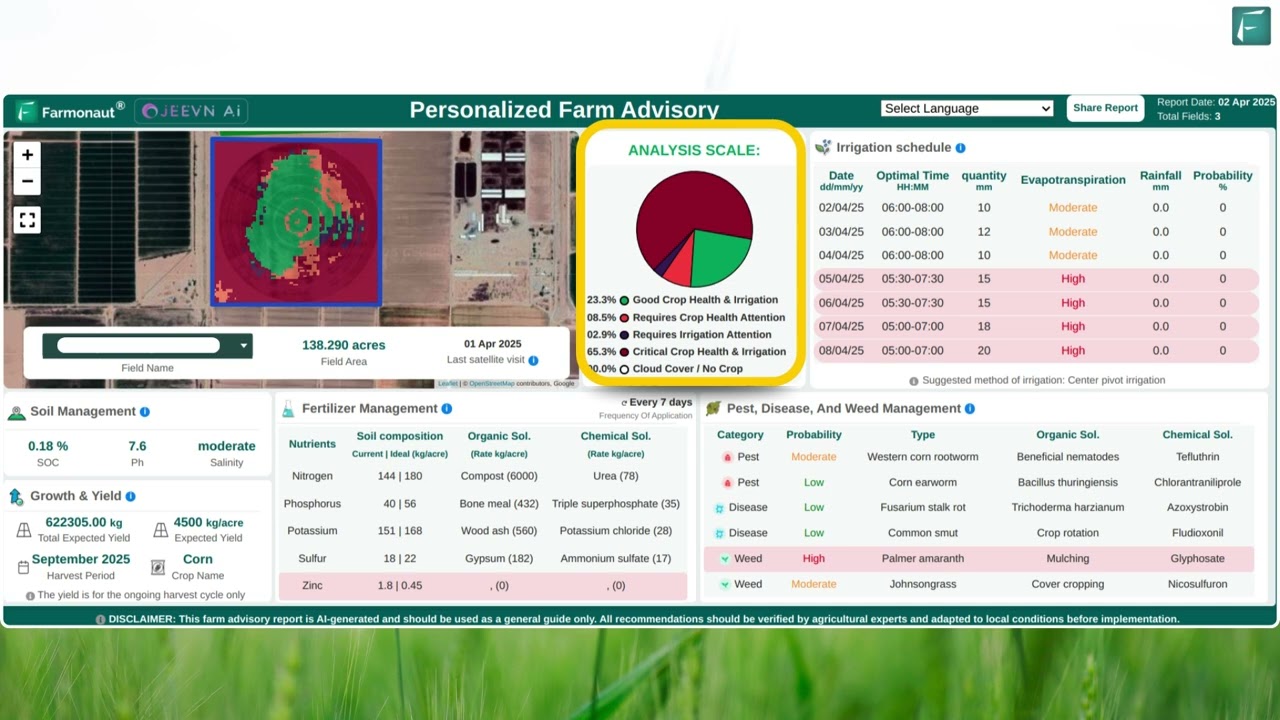
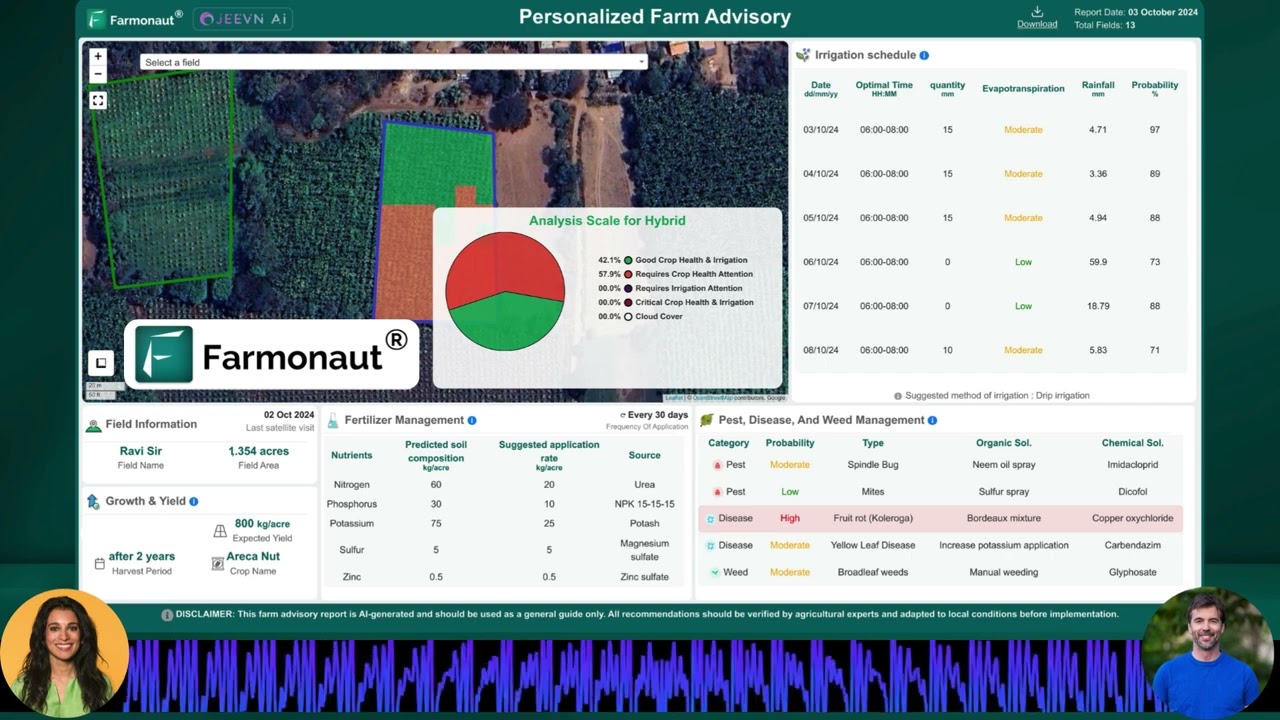
Any AI agriculture startup pitching venture capital eventually has to answer where its underlying field data comes from. Farmonaut is a satellite technology platform built for exactly that layer — multispectral crop and soil monitoring that startups, farmers, and lenders can build products on top of rather than launching their own satellite program.
How Farmonaut Supports Agritech Startups and Farm Operations
- Satellite-based crop and soil monitoring: regular NDVI (Normalized Difference Vegetation Index) and soil-moisture updates from multispectral imagery.
- Jeevn AI advisory system: automated recommendations and weather forecasts generated from real-time satellite data.
- Blockchain-based traceability: the traceability platform referenced above, for supply chains that need to prove provenance.
- Environmental impact tracking: ongoing carbon footprint monitoring for climate-reporting requirements.
- Fleet and resource management: satellite-enabled vehicle and resource tracking through Fleet Management.
- Large-scale farm administration: enterprise tools via the Agro Admin App.

Access runs through web, Android, and iOS apps, plus a developer API documented in the API developer docs — the layer most agritech startups actually need when they're building a product, not a satellite constellation.


Farmonaut Subscriptions for Agritech Startups and Businesses
Flexible, cost-effective subscription packages for solo operations through large enterprises.
FAQ: Agriculture Venture Capital
Which firms count as the best agriculture venture capital investors right now?
There's no single ranking — it depends on stage and geography. For US-based agtech, funds like S2G Ventures, Finistere Ventures, Anterra Capital, and Cavallo Ventures have an active, documented mandate. For Asia-based agritech, Sequoia Capital India & Southeast Asia, Temasek, Alpha JWC Ventures, and IDG Capital are the most visible. See the two comparison tables above for the full breakdown.
How much venture capital is actually flowing into agriculture?
Global agrifoodtech investment totaled $16 billion in 2024 (AgFunder). US agtech-specific deals totaled $2.4 billion across 263 deals in the first half of 2026, the slowest pace in the PitchBook-NVCA Venture Monitor's series. Both figures are trending down from 2022-2023 peaks, not up.
What are the best venture capital options for agritech startups in Asia specifically?
Sequoia Capital India & Southeast Asia, Temasek, Alpha JWC Ventures (Indonesia), Emerald Technology Ventures, IDG Capital (China), and BEENEXT are the most active named funds with an Asia agrifoodtech mandate. Check each fund's own site for current fund status before pitching.
What AI agriculture startup ideas are attracting the most capital?
Precision agriculture led Q2 2026 agtech deal value at close to a third of the total, followed by farm-management software, supply chain traceability, smart irrigation, and autonomous farm equipment.
Are there non-VC venture funding options for agriculture businesses?
Yes. USDA's Rural Business Investment Program licenses private fund managers to raise venture capital for rural and agriculture-related businesses, with most capital required to go to smaller enterprises in rural areas. It runs alongside, not instead of, private VC.
Individual investors have different routes from funds, and our overview of investing in farmland and agtech covers them alongside other options.
How do I access Farmonaut's satellite data for a startup I'm building?
Through the web, Android, and iOS apps, or directly via the developer API, documented in the API developer docs.




Further reading:
Conclusion: Fewer, Sharper Agriculture Venture Capital Bets
The story in the data isn't growth — it's selectivity. Global agrifoodtech funding sits at $16 billion (2024), US agtech deal counts have fallen to their lowest recorded pace (263 in H1 2026), and net farm income is forecast to stay roughly a quarter below its 2022 peak through 2026. Inside that contraction, capital is concentrating on precision agriculture, traceability, and farm-management software — categories where a startup can point to a measurable per-acre or per-input saving, not just a satellite map.
Whichever list of firms you're pitching — the US-focused table or the Asia-focused one above — the underlying diligence question is the same: can you prove the saving with real field data. Farmonaut's satellite and AI infrastructure is one way to get that proof without building your own remote-sensing stack from scratch.
For technical integration details, see the Farmonaut Developer Documentation.

 Deepak Fertilisers & Petrochemicals
 Sapoznick Farms
 Agrotoken
 Blue BearX
 Insignito
 Croptimum
 DnCubed
 Field Capacity
 Indosistim Teknologi
 Liquify Digital
 CU Foods
 BeyondTech Global
 Rouge VC
 AgroGreen Dynamics
 AgroRisk
 Oath Inc
 Reddane Farming
 Esri North East Africa
