

“Hydroponics uses up to 90% less water than traditional soil farming methods in India.”
Table of Contents
- Introduction
- Project Scope & Site Selection
- Hydroponic Technology Options & Crop Choices
- Hydroponics Farming Project Cost in India 2026 & Financing
- Hydroponics Project Cost Breakdown Table
- Economic Viability, Productivity & Market Opportunities
- Water, Energy, Resource & Climate Integration
- Forestry, Agroforestry & Sectoral Integration
- Step-by-Step Implementation Guide (2026)
- Harnessing Technology: Farmonaut Platforms & Satellite Tools
- Frequently Asked Questions (FAQ)
- Conclusion
Hydroponics Farming Project Cost in India: 2026 Guide
Hydroponics—the soilless cultivation method relying on nutrient-rich water—has steadily emerged as a revolutionary option in Indian agriculture, especially surprising considering its ancient origins. By detaching farming from erratic monsoons and rapidly depleting groundwater tables, hydroponic systems are now increasingly adopted by innovative farmers, agribusinesses, and forestry-related ventures. This comprehensive guide explores hydroponics farming project cost in India (2026), benefits such as superior yields and profound water savings, choices of technology, key steps for project success, and how to leverage platforms like Farmonaut for digital and data-driven efficiency.
As India’s agricultural sector pivots toward technology and climate resilience in 2026 and beyond, understanding how to plan, cost, and operate scalable hydroponics projects is paramount. Whether your objective is to supply leafy greens, herbs, tomatoes, strawberries, or specialty crops—or to power nursery propagation for forestry/agroforestry sectors—the practical insights below will guide your journey to success.
Let’s dive in!
Thanks to advances in environmental sensors, AI monitoring, and efficient climate control systems, a hydroponic farming project in India can generate consistent revenues and reduce input costs—regardless of monsoon unpredictability.
Project Scope & Site Selection in Indian Context
Planning a hydroponics farming project starts by defining its full scope and choosing an ideal site location—both critical for minimizing ongoing expenditures and maximizing crop productivity. Let’s break down the most critical factors:
Scope: What Does a Complete Hydroponic Project Encompass?
- Controlled Environment: Greenhouse (polyhouse, plastic shed) or climate-controlled building with managed light, temperature, humidity, and airflow.
- Nutrient Delivery System: Drip irrigation, Nutrient Film Technique (NFT), Deep Water Culture (DWC), or Aeroponics, tuned to crop choice.
- Media & Fill Materials: Coco coir, rockwool, perlite, or hydroton for soilless plant support.
- Environmental Sensors & Controls: Temperature, humidity, light, CO2, and root zone monitoring for adaptive irrigation, fertigation, and ventilation.
- Post-Harvest Handling Facilities: Cleaning, sorting, packaging, and sometimes cold storage for value addition.
- Support Infrastructure: Backup electricity, water treatment, rainwater harvesting, and access roads.
Consider investment in climate control upgrades—smart ventilation, cooling, and lighting—for stable year-round yields, especially vital for hydroponic farming in climates with extreme summer or winter temperatures.
Strategic Site Selection (India, 2026): Top Priorities
- Climate Stability: Areas with moderate, predictable climates reduce the energy needed for heating/cooling.
- Proximity to Markets: Nearness to urban clusters (Delhi-NCR, Bengaluru, Mumbai, Pune, Hyderabad, Chennai) cuts delivery time and logistics cost for perishable produce (lettuce, spinach, basil, strawberries).
- Infrastructure Access: Reliable electricity (grid/generator or solar backup), water supply, and local labor pools.
- Supportive Zoning: Land classified for agricultural or commercial use, with necessary permissions for polyhouse or plastic structures.
- Potential for Rainwater Harvesting: Integrate systems for rainwater collection to address dry spells and minimize groundwater dependency.

Hydroponic Technology Options & Crop Choices
The technology selected for a hydroponics farming project directly affects costs, resource use, yields, and ongoing management. Here are the top technology systems and how they align with Indian market needs in 2026:
System Choices
- Nutrient Film Technique (NFT): Water-nutrient solution flows as a thin film over plant roots—ideal for leafy greens (lettuce, spinach), microgreens, and herbs (basil, coriander). High efficiency, easy monitoring, and minimal medium usage.
- Drip Irrigation Hydroponics: Watered and fed directly to the root zone via drippers, usually with substrates like coco coir or rockwool; best for heavier crops such as tomatoes, cucumbers, peppers, and strawberries.
- Deep Water Culture (DWC): Plant roots suspended directly in aerated, nutrient-rich water. Rapid growth cycles for spinach and lettuce; efficient for high density, but needs stable power for air pumps.
- Aeroponics: Roots misted with nutrient solution in air, allowing high-density setups and precise control. Suits high-value specialty crops, nursery propagation, and certain ornamentals; advanced, higher capital expenditure.
Failing to match system type to crop selection can result in wasted resources and disappointing yields. NFT excels for greens, but tomatoes and strawberries require drip or Dutch-bucket systems with media support.
Top Crops for Hydroponic Projects (2026 & Beyond)
- Leafy Greens: Lettuce, spinach, arugula—high turnover, premium demand.
- Herbs: Basil, coriander, mint, parsley—favored for quick cycles and institutional contracts.
- Tomatoes, Cucumbers, Peppers: Require more space and structural support.
- Strawberries, Microgreens: High-value niche crops, suitable for tiered hydroponic setups and specialty retail supply.
- Ornamentals/Nurserying: For forestry affiliates—propagation of saplings, medicinal/ornamental plants for landscaping or reforestation supply contracts.
- ✔ Efficient Water Use: Uses a fraction of irrigation water compared to field farming
- 📊 Predictable Yields: Year-round cropping, weather independence
- ⚠ Lower Chemical Runoff: Precise nutrient delivery minimizes environmental impact
- ★ Urban Proximity: Grow produce near cities—freshness and low logistics costs
- 🌱 Premium Market: Access to institutional buyers, hotels, and health-focused customers

Hydroponics Farming Project Cost in India 2026 & Financing
The cost of a hydroponics farming project in India depends heavily on system design, climate control, local input costs, scale, and crop choice. Below, we detail all major expense categories, typical ranges, and cost optimization techniques.
Capital Expenditures (CapEx):
- Greenhouse or Polyhouse Structure: Framing, covers, insulation, ventilation, base preparation.
- Hydroponic System Equipment: PVC channels, tanks, nutrient reservoirs, pumps, drip/NFT lines, automation hardware.
- Climate Control Systems: Cooling pads, exhaust fans, heating modules (where necessary), misting units, blackout screens, dehumidifiers, automatic vent controls.
- Lighting Systems: LEDs for insufficient daylight zones/cultivation at night.
- Media Substrates: Coco coir, rockwool, perlite, expanded clay balls, as per crop.
- Environmental Sensors & Control Hardware: Real-time monitoring of temperature, humidity, root zone pH, EC (electrical conductivity), and automatic nutrient dosing.
- Post-Harvest Handling & Packaging Equipment: Sorting tables, packaging stations, cold storage or cool rooms.
Operating Expenditures (OpEx):
- Electricity: For pumps, lights, HVAC, sensors, computers, and general climate control.
- Water: Quality maintenance (RO/filtration if borewell), nutrient mixing, and ongoing makeup supply.
- Nutrient Solutions: Macro/micro-nutrient blends, chelates; replaced per cycle and monitored for precision.
- Labor: Skilled/technical staff, general maintenance, harvesting, post-harvest sorting.
- Pest/Disease Management: Integrated Pest Management (IPM), biocontrols, and rare chemical interventions.
- Replacement Parts: Pumps, valves, sensors, and media, with periodic scheduled replacement.
Hydroponic project capital investments can start from ₹15–40 lakhs for small greenhouse retrofits and exceed ₹2–3 crores for large-scale, climate-controlled commercial units with automation, reflecting significant ROI potential in premium produce markets.
Financing Options (2026):
- Government Subsidies: Look for central/state horticultural and technology modernization schemes.
- Bank Loans: Many agri-cooperative banks and rural development banks offer project finance and credit lines for hydroponics.
- Pilot Project Grants: Leverage pilot funding for innovative agri-tech, controlled environment farming, and water conservation pilots.
- Private Sector: Agri-tech service providers may offer turnkey hydroponic kits with service contracts and deferred payments.
For detailed monitoring and analytics—essential for project success in 2026—consider platforms like Farmonaut, which offer satellite-based real-time monitoring, precision advisory (via Jeevn AI), and blockchain-driven traceability for hydroponic agriculture projects. This substantially reduces management risk and enables resource optimization.




Hydroponic farms in India can achieve crop yields up to 3 times higher per square meter than conventional farms, with far less water and minimal fertilizer runoff.
Hydroponics Farming Project Cost Breakdown (2026, India)
| Expense Category | Estimated Cost (INR, per acre/unit) | Potential Annual Savings (%) |
|---|---|---|
| Hydroponic System Setup (NFT/Drip/Aeroponics/Reservoirs) | 10 – 40 lakhs | 30 – 45% |
| Climate Control Equipment (HVAC, humidifiers, fans) | 8 – 18 lakhs | 20 – 25% |
| Seeds & Nutrients | 1 – 2 lakhs/year | 15 – 35% |
| Labor | 2 – 5 lakhs/year | 10 – 20% |
| Water Consumption (incl. treatment/RO) | 0.4 – 1 lakh/year | 70 – 90% |
| Electricity (pumps, lights, sensors) | 1.2 – 3 lakhs/year | 20 – 30% |
| Maintenance & Replacement | 1 – 2.5 lakhs/year | 15 – 22% |
| Total (1st Year, 1-acre exemplary unit) | ₹23–71 lakhs* | 35–70% |
*Varies by location, system type, and automation level
Popular Hydroponics Systems at a Glance

Hydroponics Farming Project: Economic Viability and Productivity
One of the chief appeals of hydroponic agriculture projects in India is the simultaneous boost in productivity and resource efficiency—making them far more lucrative and sustainable than many traditional farming methods.
Why Hydroponics is Financially Attractive (2026 India):
- ⏳ Shorter Crop Cycles: High turnover—with crops like spinach or lettuce grown in as little as 25–30 days, allowing up to 10–12 cycles/year.
- 🚚 Market Proximity: Supply directly to city supermarkets/hotels or via branded boxes, earning premium pricing for fresh, clean, pesticide-free greens and herbs.
- 🔄 Predictable Payback: Typical payback periods are 2–5 years, depending on system scale, market access, and cost optimization.
- 💧 Operational Savings: Substantial savings on water, fertilizer, and crop protection inputs compared to field farming.
- 📈 Higher Productivity: 3x the yield per square meter compared to open farms.
Underestimating post-harvest handling costs and market logistics can erode profit margins. Always budget for on-site packaging, cleaning, cold-chain, and delivery expenses.
Hydroponics-Enabled Value Chains
Modern hydroponics farming projects create integrated value chains from farm to consumer:
- Branded, cleaned, ready-to-sell packaged greens and herbs
- Direct-supply contracts with supermarkets, hospitals, and hotels
- Institutional kitchens (schools, corporates)
- Post-harvest cold-chain logistics for extended shelf-life
Mitigating losses through leak-proof logistics and consistent quality opens the door to premium markets, especially in Indian metros and Tier-II cities in 2026.
Critical Cost Drivers
Water, Energy & Resource Efficiency in Hydroponic Farming
In a water-scarce, energy-sensitive environment like much of India, the sustainability of hydroponic projects is unmatched. Here’s how hydroponics delivers on resource efficiency and climate-smart agriculture:
Water Use and Treatment:
- Water Efficiency: Closed-loop delivery systems recirculate water—using 70–90% less irrigation than conventional soil farming.
- Quality Control: Pre-treatment (RO, filtration, pH/EC balancing) protects systems and crops from contaminants or mineral overloads.
- Rainwater Harvesting: Design sheds/greenhouses for maximum rainwater collection and storage, ensuring a backup during dry periods.
- Wastewater Management: Recover nutrients from drainage/wastewater for secondary crops or biomass feed.
Energy Management:
- Electrical Demands: Major loads are pumps, climate control, and lighting—choose energy-efficient models and invest in solar backups when feasible.
- Climate Adaptation: Integrate smart HVAC, ventilation, and shade/insulating solutions to slash heat/cool energy needs, especially for climate extremes (e.g., Rajasthan summers, Himalayan winters).
- Seizing Biomass Streams: In colder areas, convert waste biomass into heat, reducing fossil fuel dependence and qualifying for carbon credits. (Learn how Farmonaut’s Carbon Footprinting service supports sustainable energy management in agriculture.)
Additionally, for rapid decision-making about irrigation or nutrient scheduling, remote monitoring solutions like those on Farmonaut platforms are extremely valuable. Farmonaut’s satellite-based monitoring integrates NDVI, soil moisture, and weather data—empowering hydroponics operators with AI-advised action plans and minimizing wastage. See our Farmonaut Large-Scale Farm Management App for details.

Hydroponics is a front-runner for sustainability certifications—with minimal runoff and efficient use of water/nutrients, it’s a strong fit for climate-adaptive agriculture.
“Hydroponic farms in India can achieve crop yields up to 3 times higher per square meter than conventional farms.”
Integration with Forestry, Agroforestry & Related Sectors
The hydroponics farming project model isn’t limited to vegetables or herbs—it seamlessly links with agroforestry, afforestation, and plantation sectors for more sustainable, profitable rural businesses:
- Nursery Propagation: Hydroponic nurseries excel at producing healthy, uniform saplings for reforestation, landscaping, and institution contracts. Automation boosts plantlet output while conserving space and water.
- Shade-house Hydroponics: Under agroforestry canopies (tree rows, shade-nets), hydroponics can support medicinal herbs, ornamental plants, or microgreens as high-value understorey crops.
- Wastewater Streams: Recover spent nutrient solution for secondary low-input crops, ornamental grasses, or as feed for biodigesters (for green energy/biomass).
Farmonaut’s Crop Plantation & Forest Advisory tools can help monitor and manage forested landscapes, integrated nursery blocks, and multi-use agroforestry setups. These services enable real-time tracking of reforestation, canopy health, and resource allocation via satellite technology. (Explore Farmonaut Crop Plantation & Forest Advisory here.)

Traceability is becoming mandatory for premium buyers. Farmonaut’s blockchain-based traceability system lets you assure clients of pesticide-free, authentic hydroponic produce from seed to supermarket shelf.
Why Integration Matters?
- Reduces input waste and increases land-use efficiency
- Captures additional revenue streams from nurserying and reforestation contracts
- Prepares projects for emerging carbon and environmental markets in India
Looking to scale hydroponic produce delivery and handling? Check out Farmonaut’s Fleet Management tools to streamline logistics, minimize downtime, and optimize costs with satellite-aided tracking and resource allocation.

Step-by-Step Practical Guide for Hydroponics Farming Project (India, 2026)
- Conduct Market Analysis: Identify top-demand crops (e.g., spinach, lettuce, basil, coriander, and strawberries) in your regional urban cluster. Secure local buyer contracts for assured sales.
- Choose Technology & Scale: Match hydroponic system (NFT, drip, DWC, aeroponics) to crops and land area. Adjust climate control solutions to match local energy and weather conditions.
- Prepare Comprehensive Budget: Factor in all possible hydroponics farming costs—system setup, greenhouse, climate systems, operating costs, market logistics, and ongoing replacements. Add 10–15% contingency for unexpected cost fluctuations.
- Engage Reliable Service Providers: Select build partners for installation, environmental sensors, system calibration, training, and remote monitoring platforms (e.g., Farmonaut).
- Develop Standard Operating Procedures: Implement schedule and logs for planting, nutrient management, environmental control, and quality checks.
- Plan for Compliance & Sustainability: Integrate water treatment, waste management (reuse of nutrient and biomass streams), and food safety certification.
- Leverage Digital Tools: Utilize monitoring, advisory, and traceability tools (Farmonaut) for real-time analysis, record-keeping, and optimizing resource use.
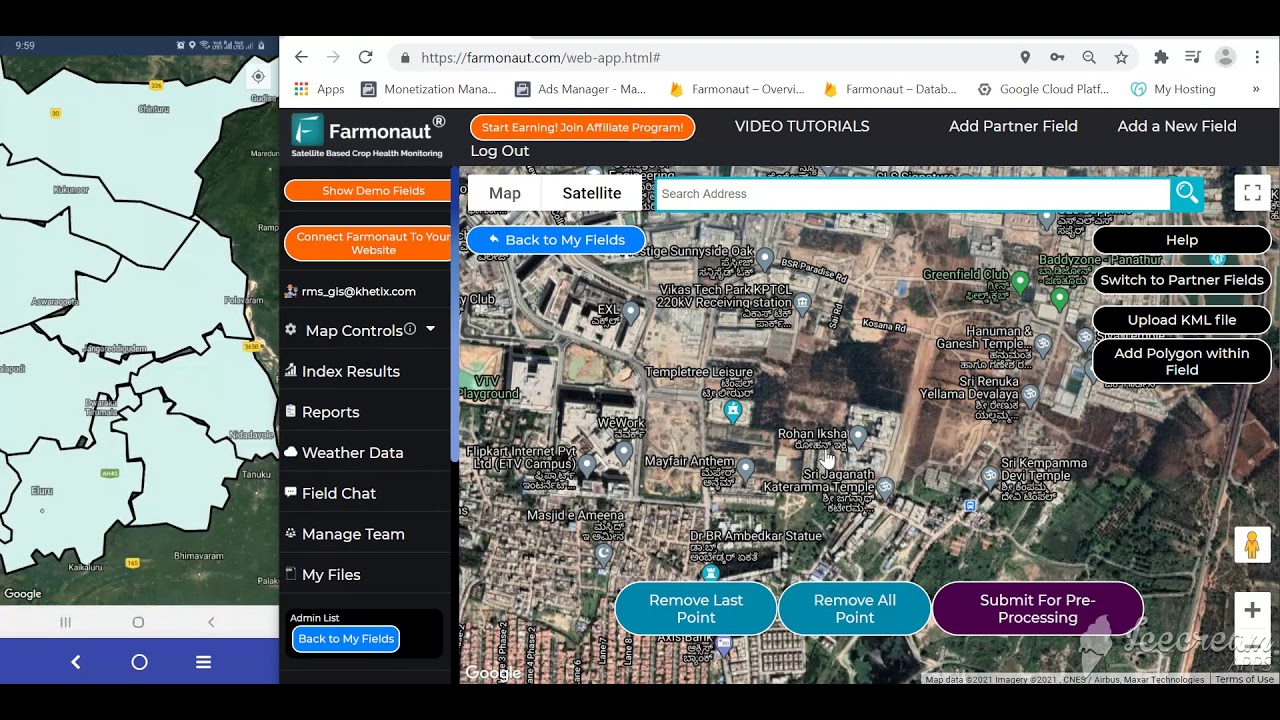
Satellite-driven services from Farmonaut offer real-time monitoring, predictive analytics, and AI-based advisory for your hydroponics project—directly via mobile or web browser app. API documentation available here.
Harnessing Technology & Innovation with Farmonaut (2026 & Beyond)
For modern hydroponic agriculture projects in India, precision, transparency, and scalability are non-negotiable. This is where Farmonaut brings vital value:
- Satellite Monitoring: Multispectral images for plant stress, vigor, pest infestation, and climate adaptation—allowing micro-level interventions within your greenhouse or open hydroponic fields.
- Jeevn AI Advisory: Real-time, AI-powered insights on weather, irrigation, nutrient management, and disease risk for optimal management.
- Blockchain-Driven Traceability: End-to-end tracking for certification, export, and premium retail contracts—see Farmonaut Traceability.
- Resource Management Tools: Optimize fleets for produce delivery, manage operator tasks, and reduce wastage via Farmonaut Fleet Management.
- Carbon Footprint Monitoring: Track, report, and optimize climate impact. This is critical for certifications and compliance—explore Farmonaut’s Carbon Footprinting solutions.
All of these tools are accessible via Android, iOS, and web platforms, with API access for integrating Farmonaut’s actionable insights into your own project software (API link here).
Frequently Asked Questions (FAQ) on Hydroponics Farming Project Cost in India (2026)
Q1. What is the first-year cost range for a small hydroponic farming project in India in 2026?
For a 1-acre commercial setup, total costs typically range from ₹23–71 lakhs, depending on system choice, climate control level, and regional infrastructure.
Q2. Which Indian states are best for hydroponics farming projects?
States with proximity to urban centers and moderate climates—like Maharashtra, Karnataka, Telangana, Tamil Nadu, Delhi-NCR, Punjab, and Gujarat—are ideal due to market access and infrastructure support.
Q3. How much water does hydroponic farming save?
Hydroponics uses 70–90% less water than conventional farming, making it highly advantageous for states with groundwater depletion and erratic rainfall.
Q4. How can I monitor and optimize my hydroponics project remotely?
Platforms like Farmonaut allow you to monitor temperature, humidity, crop health, and schedule irrigation/nutrient delivery remotely via satellite-driven tools, AI advisory, and mobile/web dashboards.
Q5. Is there financial assistance or subsidies for starting hydroponics in India?
Yes—various central and state schemes, agri-tech pilot grants, and agricultural banking credit lines are available to support technology adoption, especially for sustainable and water-conserving agriculture.
Conclusion: India’s Future-Ready Hydroponic Farms (2025 & Beyond)
The hydroponic farming project cost in India reflects a bold investment in food security, urban nutrition, water conservation, and climate adaptation. With soilless cultivation methods, advanced sensors, and digital monitoring, Indian farms in 2026 can surmount the constraints of erratic monsoons, declining groundwater, and limited arable land—delivering bountiful, clean, and market-ready crops year-round.
Success relies on precise project design, strategic site selection, technology system alignment, and prudent financial management—including leveraging real-time data and actionable insights for ongoing decision support. With robust platforms like Farmonaut, farmers and agripreneurs can access end-to-end solutions—remote AI-advice, satellite crop monitoring, carbon and traceability tracking, and cost-saving logistics optimization.
By integrating hydroponics with forestry and related sectors, and by harnessing every drop of water and joule of energy, your hydroponics farming project becomes a model for resilient, sustainable, and profitable agriculture in the new Indian context.
Ready to power your hydroponics journey with data-driven confidence? Get started with
Farmonaut’s real-time monitoring and advisory suite, and elevate your farming into India’s agricultural future.

 ASQI
ASQI Teledarbas
 Wild Oak Farm
 SFX
SFX BACF Africa
 Doodlakine
 Exurbia Geospatial
 FieldZero
 Indico Company
 Kubota
 FFBS
FFBS Jontra
 Tucor
Tucor
