

Autonomous Agriculture: Trimble Loans & Equipment ROI Guide
Reviewed September 2026 against USDA Economic Research Service, USDA Farm Service Agency, and Markets and Markets industry research.
Try it: Run your own numbers →
Autonomous agriculture equipment — driverless tractors, GPS-guided sprayers, and robotic harvesters — now costs between $120,000 and $500,000 per unit in the United States, roughly 2.5 times the price of a comparable conventional tractor by horsepower class. Only 27% of US farms had adopted any precision agriculture technology as of the 2023 USDA Census of Agriculture, and 49% of farmers cite capital and financing as the primary barrier to going further. This article covers what autonomous equipment actually costs, how USDA and private financing (including Trimble equipment loans) work, and how to evaluate whether the investment pencils out for your operation.
Where Autonomous Agriculture Adoption Actually Stands
The gap between interest in autonomous agriculture and actual adoption is wide, and it’s driven almost entirely by cost. According to the USDA Economic Research Service, 27% of US farms were using some form of precision agriculture technology as of the 2023 Census of Agriculture (USDA ERS, Chart of Note 110550). That figure covers the broad category — GPS guidance, variable-rate application, yield monitoring — not fully autonomous, driverless machinery specifically. A separate, narrower figure for fully autonomous equipment (no operator in the cab at all) is not published by USDA as of this review; the Census of Agriculture is updated every five years, with the next comprehensive release due in 2028, and the interim USDA NASS QuickStats database (nass.usda.gov) is the place to check for updated adoption figures between census years.
What USDA does break out clearly is auto-steer guidance adoption by farm size, which is the entry point most farms take before moving toward full autonomy. In 2023, 52% of midsize crop farms and 70% of large-scale crop farms used auto-steer guidance systems (USDA ERS, Chart of Note 105914). That 18-point gap between midsize and large operations tracks almost exactly with access to capital — larger farms can spread equipment cost over more acres and qualify more easily for larger loan facilities.

The 49% of farmers who name financing as their top barrier to autonomous equipment adoption (Markets and Markets industry research, cited below) is the reason this article exists. Autonomous agriculture is not primarily a technology-readiness problem at this point — the machines work, and companies including Trimble, John Deere, and AGCO all ship commercial autonomous or near-autonomous systems. It is a capital-access problem, and that is a solvable one if you understand how the loan products are structured.
How Autonomous Farm Equipment Operates
Autonomous agricultural machinery combines GPS positioning, onboard AI processing, IoT sensors, and — in Trimble-equipped systems — centimeter-level correction signals to complete field tasks with reduced or no operator input. Three categories dominate current deployment:
- Driverless tractors: Navigate fields autonomously for tillage, planting, and spraying passes, using pre-mapped boundaries and real-time obstacle detection.
- Robotic harvesters: Use machine vision and AI to assess crop maturity, execute the harvest pass, and optimize field routing to reduce overlap and fuel burn.
- Precision planters: Perform variable-rate seeding and fertilizer placement based on field mapping data, cutting input waste on a per-acre basis.
The operational case for these systems rests on three things: extended working hours (autonomous units can run overnight and in conditions that fatigue human operators), reduced input overlap from GPS accuracy, and lower dependence on hired labor during planting and harvest windows when labor markets are tightest. None of that changes the up-front economics, though — which is where financing decisions actually get made.
Autonomous Equipment Pricing: What It Actually Costs
Full autonomous tractors sell in the United States for $120,000 to $500,000 depending on horsepower class and the sensor/AI package installed, according to a 2026 equipment pricing analysis (Tractor Hubs, US tractor price comparison). That same analysis puts the autonomous cost premium at roughly 2.5 times the price of a conventional tractor at equivalent horsepower — separate 2026 market analysis of tractor cost structures confirms the multiplier is driven primarily by the sensor suite, onboard compute, and software licensing stack rather than the base drivetrain (Gengjia Agri, tractor cost guide).
That 2.5x multiplier is the number to run against your own conventional-equipment quote before financing anything. If your current tractor replacement cost is $160,000, a comparable autonomous unit should price near $400,000 before add-ons — and if a quote comes in far outside that band, ask what’s driving the difference (extended warranty, subscription bundling, or dealer markup) before signing.
Manufacturer list prices change with each model year and with software subscription bundling, so treat the figures above as a starting range rather than a quote. To get a current number for a specific machine, check the manufacturer directly — Deere.com and AGCOEquipment.com both publish configurator pricing — or consult trade publication Precision Farming Dealer, which tracks pricing changes across the major manufacturers on a quarterly basis.
What Isn’t Published Yet
Two figures farmers frequently ask for are not currently published in a form that supports a specific number here, and it would be worse to invent one than to say so plainly:
- Payback period: No standardized ROI or payback-period study for autonomous equipment under typical US farm conditions (accounting for yield impact, fuel savings, and labor cost displacement together) is publicly available as of this review. To estimate your own, use the calculator in this article with your actual fuel, labor, and yield figures.
- Retrofit-kit financing: Whether standard farm equipment loans cover autonomous retrofit kits (as opposed to factory-built autonomous units) varies by lender and is not standardized across USDA programs. Confirm directly with your lender or local USDA Farm Service Agency office before assuming a kit purchase qualifies under the same terms as a full unit.
Financing Autonomous Equipment: USDA Loans and Private Lenders
The USDA Farm Service Agency runs the largest direct federal lending program for US farm equipment purchases, and its rates are published monthly. As of the August 2026 update, the Direct Farm Operating Loan rate was 5.250% and the Direct Farm Ownership Loan rate was 6.000% (USDA Farm Service Agency, August 2026 lending rates). These rates reset on the first of each month, so check the FSA news page directly for the current rate before you apply — the August figures above will be out of date by the time you read this if more than a few weeks have passed.
USDA Farm Operating Loans cap out at $400,000 per borrower, while the guaranteed farm loan program (where USDA backs a loan issued through a commercial lender) carries a combined program limit of $2,343,000 (USDA Farmers.gov, loan programs overview). For context against the equipment pricing above: a $400,000 direct operating loan cap sits at the very top of the autonomous tractor price range, meaning a single high-end autonomous unit could consume your entire direct-loan borrowing capacity for the year. The guaranteed loan program’s higher ceiling is the more realistic path for farms financing autonomous equipment alongside other operating needs.
How USDA and Private Financing Differ
- USDA Direct Loans: Fixed government rates (5.250% operating / 6.000% ownership as of August 2026), capped at $400,000 per borrower for operating loans, administered through local FSA county offices.
- USDA Guaranteed Loans: Issued by a commercial bank or credit union with USDA backing reducing the lender’s risk; combined program limit of $2,343,000, market-set interest rates that vary by lender.
- Dealer and manufacturer financing: Often bundled with the equipment purchase itself — Trimble, John Deere Financial, and AGCO Finance all offer in-house programs; rates are set by the manufacturer’s finance arm and are not published by USDA.
- Private bank and credit union equipment loans: Rates vary by lender and borrower credit profile; ask specifically whether autonomous or precision-technology equipment qualifies for any rate discount, since some regional lenders now price these separately from conventional equipment loans.
For a full breakdown of eligibility, application steps, and how operating loans differ from ownership loans, USDA’s Farmers.gov loans page is the authoritative starting point (USDA Farmers.gov). Loans can also be paired with a satellite-verified crop loan and insurance product to reduce lender risk exposure on the underlying operation.
Trimble Agriculture: Precision Systems and Loan-Backed Access
Trimble is one of the two dominant precision agriculture technology providers in the North American market, alongside John Deere, according to Markets and Markets industry research on precision farming company leadership (Markets and Markets, North American precision farming companies). That same research identifies financing access — specifically the 49% of farmers citing capital as their primary adoption barrier — as the leading constraint on Trimble and competing systems reaching a larger share of US farms.
Trimble-enabled systems typically bundle three cost layers that a straightforward equipment loan needs to account for:
- Hardware: GPS receivers, guidance displays, and correction-signal antennas installed on the tractor or implement.
- Software licensing: Field mapping, variable-rate application, and fleet coordination software, usually billed as an annual subscription separate from the hardware purchase.
- Correction signal subscription: RTK or similar centimeter-accuracy correction services, billed recurring and not always included in an equipment loan’s covered costs.
When financing a Trimble-equipped autonomous or GPS-guided system, confirm with your lender in writing whether the loan covers only the hardware or the full stack including software and correction-signal subscriptions — this is one of the most common gaps between what a farmer expects a loan to cover and what it actually finances. Satellite-based fleet management tools can supplement Trimble’s guidance data with independent crop and field condition monitoring, which is useful when a lender wants operational verification beyond the equipment vendor’s own telemetry.

Where Trimble Fits by Farm Size
Given that 70% of large-scale crop farms already run auto-steer guidance versus 52% of midsize farms (USDA ERS, 2023 data cited above), Trimble’s core guidance products are closer to standard equipment on large operations than on midsize ones. If you operate a midsize farm and are evaluating a first Trimble system, that adoption gap is worth raising directly with your lender — some regional agricultural lenders treat guidance-system financing as a lower-risk category specifically because large-farm adoption data shows the technology is proven at scale, which can affect the terms you’re offered.
Comparison Table: Conventional vs. Autonomous Equipment Financing
The table below lines up what is actually documented in USDA and market data for conventional versus autonomous equipment financing. Figures without a specific source are marked as not published rather than estimated.
| Factor | Conventional Equipment | Autonomous Equipment | Source / Date |
|---|---|---|---|
| Typical purchase price | Baseline (1.0x) | $120,000–$500,000 (~2.5x conventional) | Tractor Hubs / Gengjia Agri, 2026 |
| US farm adoption rate | N/A (majority baseline) | 27% (any precision ag technology) | USDA ERS, 2023 Census |
| Auto-steer adoption, midsize farms | — | 52% | USDA ERS Chart 105914, 2023 |
| Auto-steer adoption, large-scale farms | — | 70% | USDA ERS Chart 105914, 2023 |
| USDA Direct Operating Loan rate | 5.250% (Aug 2026, resets monthly) | USDA FSA, Aug 2026 | |
| USDA Direct Ownership Loan rate | 6.000% (Aug 2026, resets monthly) | USDA FSA, Aug 2026 | |
| USDA Operating Loan cap | $400,000 per borrower | USDA Farmers.gov, 2026 | |
| USDA Guaranteed Loan limit | $2,343,000 program total | USDA FSA Guaranteed Loans, 2026 | |
| Top adoption barrier cited by farmers | 49% cite capital/financing | Markets and Markets, 2026 | |
| Payback period under typical US conditions | Not published — calculate using your own fuel/labor/yield figures | See calculator below | |
Calculator: Autonomous Equipment Loan Payment Estimator
Enter your own equipment price, down payment, loan term, and interest rate — start from the USDA August 2026 rates above or your lender’s quote — to see the estimated monthly payment and total interest over the loan term.
Run your own numbers
Assumptions: standard amortizing loan with fixed rate, no balloon payment, no fees or insurance included. Excludes software/subscription costs, trade-in value, and tax effects (such as Section 179 depreciation). Use your own lender’s quoted rate — the default above is illustrative, not a live USDA rate.

Farmonaut: Satellite Data for Smarter Equipment Financing Decisions
Whichever financing path you take — USDA direct, USDA guaranteed, dealer, or private bank — lenders increasingly want independent verification of the operation backing the loan, separate from equipment-vendor telemetry. Farmonaut provides that layer:
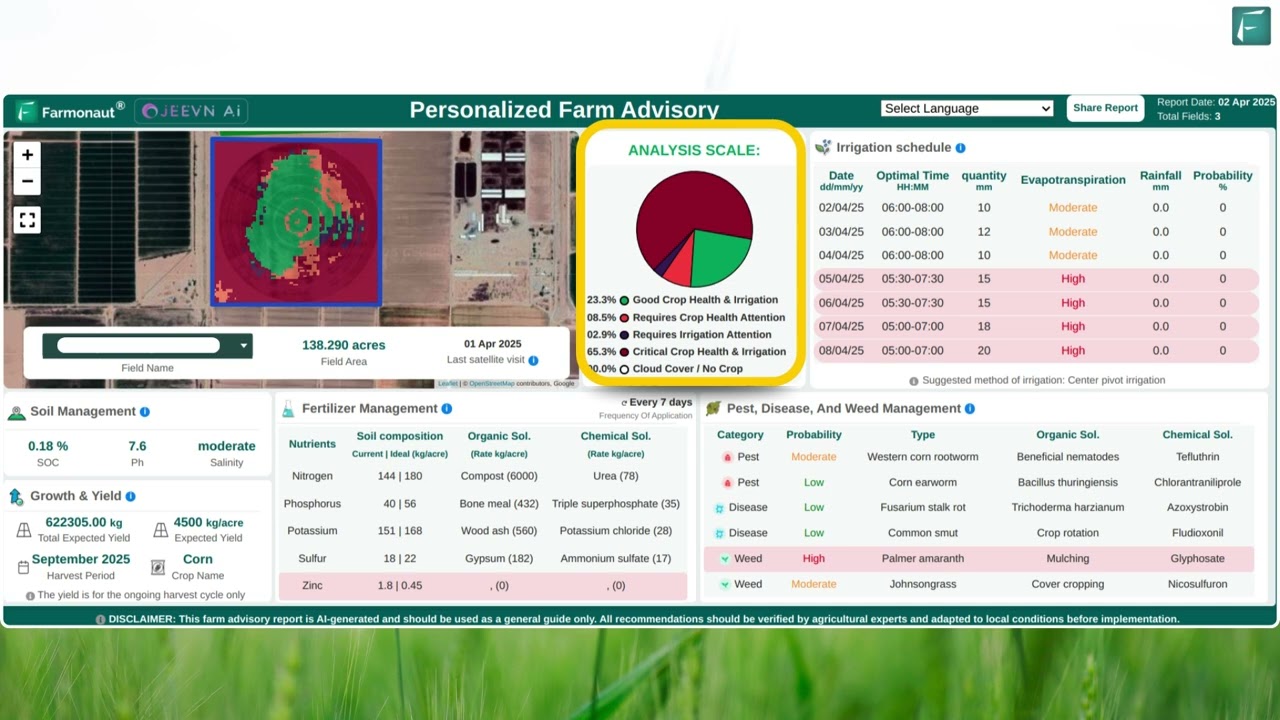
- Real-time remote monitoring: Multispectral satellite imagery tracks crop health, soil conditions, and water distribution, giving lenders independent data to support loan underwriting decisions.
- AI-based advisory: The Jeevn AI system provides fertilization scheduling and weather-driven operational recommendations, reducing the operational risk that lenders price into equipment loan terms.
- Blockchain-based traceability: Full supply-chain transparency for tracked commodities, relevant where product traceability affects buyer contracts or premium pricing.
- Fleet and resource management: Satellite-linked fleet management works alongside Trimble guidance data, useful when reconciling autonomous equipment utilization against loan repayment projections.
- Environmental impact tracking: Monitor CO₂ and resource use for lenders or buyers requiring sustainability documentation — see Farmonaut’s carbon footprinting tools.
Access is available via Android, iOS, browser app, and API integration for developers building custom decision-support tools, with full endpoint documentation at the Farmonaut satellite weather API developer docs.

Access satellite crop insights to support your equipment financing application.



What Changes Next in Autonomous Equipment Financing
Three specific things determine whether this picture improves for farmers seeking autonomous equipment financing, and each has a defined way to check it going forward:
- USDA rate resets: FSA direct loan rates change on the first of every month. Check the FSA news releases page (filtering for the current month) rather than relying on the August 2026 figures cited in this article.
- Adoption data refresh: The Census of Agriculture updates every five years; the next full release lands in 2028. Between census years, USDA NASS QuickStats is the interim source for adoption figures.
- Equipment pricing shifts: As autonomous hardware and AI compute costs continue to shift and software subscription models mature, check manufacturer configurators (Deere.com, AGCOEquipment.com) and Precision Farming Dealer’s quarterly pricing coverage for current figures rather than the ranges cited here.
Large operations (running the 70% auto-steer adoption rate) will keep pulling ahead of midsize operations (52%) unless financing terms specifically close that gap — which is the trend to watch in USDA guaranteed loan program data and in manufacturer financing arm announcements over the next several loan cycles. If you operate at the midsize scale, that gap is the strongest argument for pairing a USDA-backed loan with independent monitoring data (like the tools above) that gives your lender confidence beyond your farm’s size alone. Larger-scale digital workflow tools, including farm administration platforms, are also increasingly part of how lenders assess an operation’s readiness to manage autonomous equipment responsibly.
Frequently Asked Questions
1. What does autonomous farm equipment actually cost?
Full autonomous tractors in the US range from $120,000 to $500,000, roughly 2.5 times the cost of a comparable conventional tractor by horsepower class (Tractor Hubs / Gengjia Agri, 2026 analysis). Exact pricing depends on horsepower, sensor package, and bundled software.
2. What is the current USDA interest rate for farm equipment loans?
As of August 2026, USDA’s Direct Farm Operating Loan rate was 5.250% and the Direct Farm Ownership Loan rate was 6.000%. These reset monthly — check the USDA FSA rates page for the current figure before applying.
3. How many US farms actually use autonomous or precision equipment?
27% of US farms used some form of precision agriculture technology per the 2023 USDA Census of Agriculture. Auto-steer guidance specifically was used by 52% of midsize crop farms and 70% of large-scale crop farms in 2023 (USDA ERS). A separate figure isolating fully driverless equipment is not currently published.
4. Does Trimble financing cover software and subscriptions, or just hardware?
This varies by lender and financing program — confirm in writing before signing. Trimble systems typically bundle hardware, field-mapping software licensing, and correction-signal subscriptions as separate cost layers, and not every equipment loan covers all three.
5. What’s the maximum USDA loan amount for equipment financing?
USDA Direct Farm Operating Loans cap at $400,000 per borrower. The USDA Guaranteed Farm Loan program, issued through a commercial lender with USDA backing, has a combined program limit of $2,343,000.
6. Why is financing the biggest barrier to autonomous equipment adoption?
49% of farmers cite capital and financing as their primary barrier to autonomous equipment adoption, according to Markets and Markets industry research. At a 2.5x price premium over conventional equipment, the up-front capital requirement — not technology performance — is the limiting factor for most operations.
7. What solutions does Farmonaut offer alongside equipment financing?
Real-time satellite monitoring, AI-based crop advisory, blockchain traceability, fleet/resource management, and environmental impact tracking — all usable as independent data supporting a lender’s underwriting decision. Access the platform here.
Farmonaut Subscriptions
Further reading:
Summary
Autonomous agriculture in the United States is gated by financing access more than by technology: at $120,000-$500,000 per unit and roughly 2.5x conventional equipment cost, a single autonomous tractor can consume a farm’s entire USDA Direct Operating Loan capacity ($400,000 cap) for a season. USDA rates (5.250% operating / 6.000% ownership as of August 2026, resetting monthly), the guaranteed loan program’s $2,343,000 ceiling, and dealer or manufacturer financing through Trimble and its competitors are the concrete levers available today. With auto-steer adoption already at 70% among large-scale crop farms versus 52% for midsize operations, closing that financing gap — not waiting for cheaper hardware — is what will move the needle on broader adoption.
Ready to strengthen your equipment financing application with independent satellite verification? Explore Farmonaut’s smart advisory services for crop, plantation, and forest management.
Discussion
Questions, corrections or field experience? Share them below. First-time comments are reviewed before they appear, and your email is never published.
No comments yet. Be the first to add a question or your experience.

 FieldZero
 Indico Company
 Byju’s
 Kubota
 FFBS
FFBS Jontra
 Kalustyan
 Tucor
Tucor Geno
Geno Hayleys Agriculture
 Linx Agritech
 Adinet
 Save Your Soils
 Grandstream Algérie
 Licence holder · Niger · Gold










