

Soil pH · Amendment guide
Alkaline Soil Amendments and Acid Soil Fixes, With Rates
Elemental sulfur is the main amendment for alkaline soil, and Oregon State University uses 10 to 50 lb per 1,000 sq ft, by texture, to acidify beds for blueberries. Acid soil needs lime, and sodic alkali soil needs gypsum plus leaching (FAO).
Key takeaways
- Oregon State suggests 10-20 lb of elemental sulfur per 1,000 sq ft on sandy soil and 40-50 lb on clay to acidify beds for blueberries and other acid-loving plants.
- Most agronomic crops grow best at pH 6.0-6.5 (University of Maryland); blueberries need 4.5-5.5.
- Lime strength is its calcium carbonate equivalent: 100% for calcitic limestone, 109% dolomitic, 136% hydrated, 179% quicklime (Penn State).
- Alkali (sodic) soil needs calcium from gypsum and leaching, not just sulfur; FAO estimated 434 million ha of sodic soils worldwide.
- Iron chlorosis on soils above pH 7.5 is a sign of locked-up iron, not a lack of iron in the soil (University of Arizona).
In this article
- What makes soil acidic or alkaline
- How to test soil pH before you add anything
- Best alkaline soil amendments, ranked by how they work
- How much sulfur lowers soil pH
- Iron chlorosis: a common alkaline soil symptom
- Alkali soil: sodic soils and how to fix them
- Acid soil: lime types and rates
- Lime cost calculator: does liming pay on your field?
- Target pH for common crops
- A step-by-step soil pH plan for one season
- Sustainable soil amendment choices
- FAQ
Alkaline soil amendments lower soil pH: elemental sulfur is the main one. To acidify garden beds for blueberries and other acid-loving plants, Oregon State University suggests 10 to 20 lb of sulfur per 1,000 sq ft on sandy soil and 40 to 50 lb on clay. Acid soil needs the opposite fix, agricultural lime, and Penn State Extension puts the best range for most field crops at pH 6.0 to 7.0. Targets differ by source and crop: the University of Maryland figure used in the lime section below is 6.0 to 6.5. This guide covers both, plus sodic “alkali soil”, iron chlorosis, rates, a lime cost calculator and three charts.
What makes soil acidic or alkaline
Soil pH runs from 0 to 14. A pH of 7 is neutral. Below 7 is acidic and above 7 is alkaline. Each whole step is a tenfold change in acidity, so pH 5 is ten times more acidic than pH 6.
Rain makes soil acidic over time. In wet regions, winter rain washes calcium and magnesium out of the topsoil, and the soil becomes more acidic, as Oregon State University Extension explains for western Oregon. Ammonium and urea fertilizers add acidity too. Crop harvests remove calcium and magnesium every year.
Dry climates make soil alkaline. Little rain falls, so calcium carbonate (free lime) stays in the soil. That free lime is why many dry-region soils test alkaline, and it makes them hard to acidify. Irrigation water rich in bicarbonate can push pH up further.
Some soils are alkaline because of sodium. These are sodic soils, often called alkali soils. They often have a high pH, crust at the surface and drain poorly. They need a different fix from calcareous soils, covered below.
Alkaline vs acidic soil at a glance
| Feature | Acidic soil | Alkaline soil |
|---|---|---|
| pH range | Below 6.0 for most crops | Above 7.5 |
| Common cause | Rain, leaching, ammonium fertilizer | Dry climate, free lime, sodium |
| Nutrient problems | Low calcium, magnesium; aluminum and manganese can reach toxic levels | Iron, zinc and manganese lock up |
| Main amendment | Agricultural lime | Elemental sulfur; gypsum for sodic soil |

▶ Why soil organic matter matters for structure, water and nutrients. · 7:33
How to test soil pH before you add anything
Never guess. A lab soil test gives pH, buffer pH (for lime rates) and often sodium and salts. A home kit gives a rough pH only.
- Sample at the right depth. For gardens, University of Wisconsin Extension in La Crosse County suggests about 2 to 2.5 cups from the top 5 to 7 inches, mixed from several spots.
- Split the field by soil type. Hilltops, low spots and old fence lines often test differently.
- Ask for the right tests. On alkaline ground ask for free lime (carbonate) and sodium. On acid ground ask for buffer pH.
- Test again after treatment. Allow several months for lime or sulfur to react before you judge the result.
For no-till fields, Penn State suggests checking the top layer on its own. If the surface pH is below 6.2 but the standard sample shows no lime need, it suggests about 2,000 lb of calcium carbonate equivalent per acre to fix the surface.
Best alkaline soil amendments, ranked by how they work
These are the main ways to lower pH or work around high pH. They are ranked from the most lasting to the most short-term. Rates are examples from extension guides; follow the product label, your soil test and local rules.
1. Elemental sulfur
Best for: lowering pH on soils without much free lime, such as blueberry beds and orchards.
Soil bacteria turn elemental sulfur into sulfuric acid. That acid lowers pH. The bacteria need warm, moist soil, so the change takes months. Sulfur must be mixed into the soil to work well.
In an Oregon trial, one dose of 45 lb of sulfur per 1,000 sq ft on a loam at pH 5.7 brought pH down to 5.1 after two years, where it stayed (OSU EC 1560). Clay and high organic matter soils need more sulfur than sandy soils for the same drop.
2. Ammonium-based fertilizer
Best for: small, slow drops in pH as part of normal feeding.
Ammonium sulfate and urea acidify soil as they convert to nitrate. Oregon State says yearly ammonium sulfate at about 3.5 lb of nitrogen per 1,000 sq ft lowered lawn pH by only 0.1 to 0.2 units each year. Use it when you need a drop of 0.2 or 0.3 units, not a full point.
3. Iron sulfate with sulfur
Best for: trees and shrubs with yellow leaves and green veins (iron chlorosis).
Utah State University Extension describes a mix of equal parts ferrous sulfate and elemental sulfur placed in holes or trenches near the roots. It can last for years and costs little, but it acts slowly and is too costly to spread over large areas of low-value crops.
4. Iron chelates and foliar iron
Best for: fast green-up while the soil fix works.
Chelates keep iron soluble at high pH. Utah State notes that soil chelates are simple to use but costly and may last less than a season. Foliar sprays act fast but give an incomplete response and may need repeat sprays.
5. Gypsum for sodic (alkali) soil
Best for: soils high in sodium, with crusting and poor drainage.
Gypsum is calcium sulfate. Its calcium replaces sodium on clay, and water then flushes the sodium out. The FAO Soils Portal lists gypsum, sulfur and sulfuric acid as the usual chemical amendments for sodic soil, followed by leaching. Gypsum does not lower the pH of a calcareous soil much, and it is not a liming material.
6. Compost, manure and crop residue
Best for: better structure and water entry on any problem soil.
FAO notes that organic manure improves permeability in saline and sodic soils and releases carbon dioxide and organic acids as it breaks down. It also feeds the soil. It will not move pH far on its own, but it makes every other amendment work better.
7. Choose crops that fit the soil
Best for: high-lime soils where acidifying the whole field costs too much.
On soil with lots of free lime, the lime neutralizes the acid from sulfur until it is used up. Large fields of such soil are often better managed by growing tolerant crops and varieties, and treating only high-value beds or tree rows.
How much sulfur lowers soil pH
Soil texture sets the rate. Sandy soil changes with less sulfur, and clay or high organic matter soil needs more. The chart shows the ranges Oregon State gives for home and garden beds.
Chart
Elemental sulfur rates by soil texture
lb of elemental sulfur per 1,000 sq ft, acidifying garden beds for acid-loving plants, Oregon State guidance for western Oregon
Oregon State suggests applying sulfur in fall, mixing it in, and testing pH again in spring. If the target pH is not reached, repeat the process, and allow several months for each dose to react.
Before you buy sulfur, check for free lime. A drop of dilute acid that fizzes on the soil is a quick sign. If the soil fizzes strongly, the sulfur rate needed can be very large, and spot treatment around plants may be the better choice. The Oregon State rates are for garden beds. This guide gives no field rate for calcareous soil, because the sulfur needed depends on how much free lime your soil holds. Ask your soil lab or extension office for a rate based on a free-lime test.
Iron chlorosis: a common alkaline soil symptom
Iron chlorosis shows as yellow young leaves with green veins. University of Arizona Extension says it often appears on alkaline soils above pH 7.5 where lime is plentiful. The soil holds plenty of iron, but at high pH it forms compounds plants cannot take up.
Compacted or poorly drained soil can make it worse. Arizona notes mild cases often fade as soils warm in summer, while severe cases can lead to long decline unless treated.
Iron can be a problem in acid soil too. In waterlogged, acidic ground, iron can become very soluble. There the fix is better drainage and lime, not more iron.
- Quick fix: foliar iron or iron chelate.
- Lasting fix: iron sulfate with sulfur near the roots, better drainage, less compaction.
- Check first: nitrogen and sulfur deficiency also yellow leaves, but without green veins, as Oregon State notes.
Alkali soil: sodic soils and how to fix them
Alkali soil is the older name for sodic soil. Sodium makes clay swell and disperse. The surface seals, water sits on top and roots lack air. FAO notes that high pH and sodium salts in sodic soils cut water entry and raise runoff in storms.
These soils are widespread. Using the FAO/UNESCO soil map, FAO estimated 434 million ha of sodic soils and 397 million ha of saline soils worldwide. The chart shows the regional split of sodic soils from that estimate.
- Confirm sodium. Ask the lab for exchangeable sodium or the sodium adsorption ratio (SAR).
- Add calcium. Gypsum is the usual choice. On high-lime soil, sulfur can free calcium from the soil’s own lime.
- Leach. Apply enough good-quality water to move sodium below the root zone. Drainage must work.
- Keep it fixed. Check irrigation water for sodium and bicarbonate. Add organic matter. Grow tolerant crops while the soil recovers.
Salts and sodium are not the same problem. Saline soil has too much soluble salt but often normal structure. North Dakota State University Extension notes that many soluble salts there are sulfates of calcium, magnesium and sodium. Gypsum adds salt, so it helps sodic soil but not a purely saline one.
Chart
Sodic soils by world region
million hectares, FAO estimate from the FAO/UNESCO Soil Map of the World (1970-1980)
Acid soil: lime types and rates
Lime raises pH. Most agronomic crops grow best between pH 6.0 and 6.5, according to the University of Maryland. The soil test gives a lime rate as pure calcium carbonate. You then adjust for the product you buy.
Each product’s strength is its calcium carbonate equivalent (CCE). Penn State lists pure calcitic limestone at 100%, dolomitic limestone at 109%, hydrated lime at 136% and quicklime (burnt lime) at 179%. Dolomitic lime also adds magnesium. Gypsum and Epsom salts contain calcium or magnesium but do not neutralize acidity.
Fineness matters too. Fine particles react within months. Coarse grit can take years. Mix lime into the plow layer where you can; on no-till, lime acts mostly near the surface.
When lime is not the answer
If the problem is a crop that needs acid soil, like blueberries, do not lime. The Royal Horticultural Society suggests pH 4.5 to 5.5 for blueberries and pots of ericaceous compost where garden soil is not acidic enough.
Chart
Neutralizing value of liming materials
calcium carbonate equivalent (CCE), % of pure calcitic limestone
Lime cost calculator: does liming pay on your field?
Enter your soil test rate, your product’s CCE and your local price. The calculator converts the rate to tons of product and compares the cost with the extra crop value you expect. The default numbers are examples only, set near break-even.
Try the numbers for your own farm below.
Calculator
Does liming pay on your field?
Enter your soil test lime rate, product CCE, price and expected gain.
- Product needed per acre: 1.11 tons
- Product needed for the field: 44.4 tons
- Cost per acre: $44
- Total cost: $1,778
Example values only, set near break-even; they are not benchmarks, prices or forecasts. Every number is your input. Tons of product = recommended rate of pure calcium carbonate divided by the product’s CCE (Penn State Extension and University of Maryland method). The yield gain is your own estimate. Lime acts over several years, so this one-year view is conservative. Follow your soil test and get local advice.
Target pH for common crops
Pick the amendment from the crop’s needs, not from a single “ideal” pH. Oregon State gives these ranges for western Oregon and Washington gardens. Field crop ranges come from your state or provincial lab.
| Crop or plant | Suggested pH |
|---|---|
| Blueberry | 4.5 to 5.5 |
| Azalea | 4.5 to 5.5 |
| Grapes | 5.5 to 6.5 |
| Fruit trees | 6.0 to 7.0 |
| Vegetables | 6.0 to 7.0 |
| Muskmelons, garlic, cauliflower | 6.5 to 7.5 |
| Lawns | 5.5 to 8.0 |
Source: Oregon State University Extension, EC 1560.
A step-by-step soil pH plan for one season
- Late summer or fall: sample each soil zone. Ask for pH, buffer pH, free lime and sodium.
- Fall: spread lime on acid zones, or mix sulfur into small alkaline beds. Lime needs time, so fall works well.
- Winter: plan crops by zone. Put tolerant crops on the hardest ground.
- Spring: use foliar iron or chelates on chlorotic trees while the soil fix works. Apply gypsum to sodic patches before irrigation season.
- Summer: watch crop color and growth. Compare treated and untreated strips.
- Next year: test again and adjust the rate.
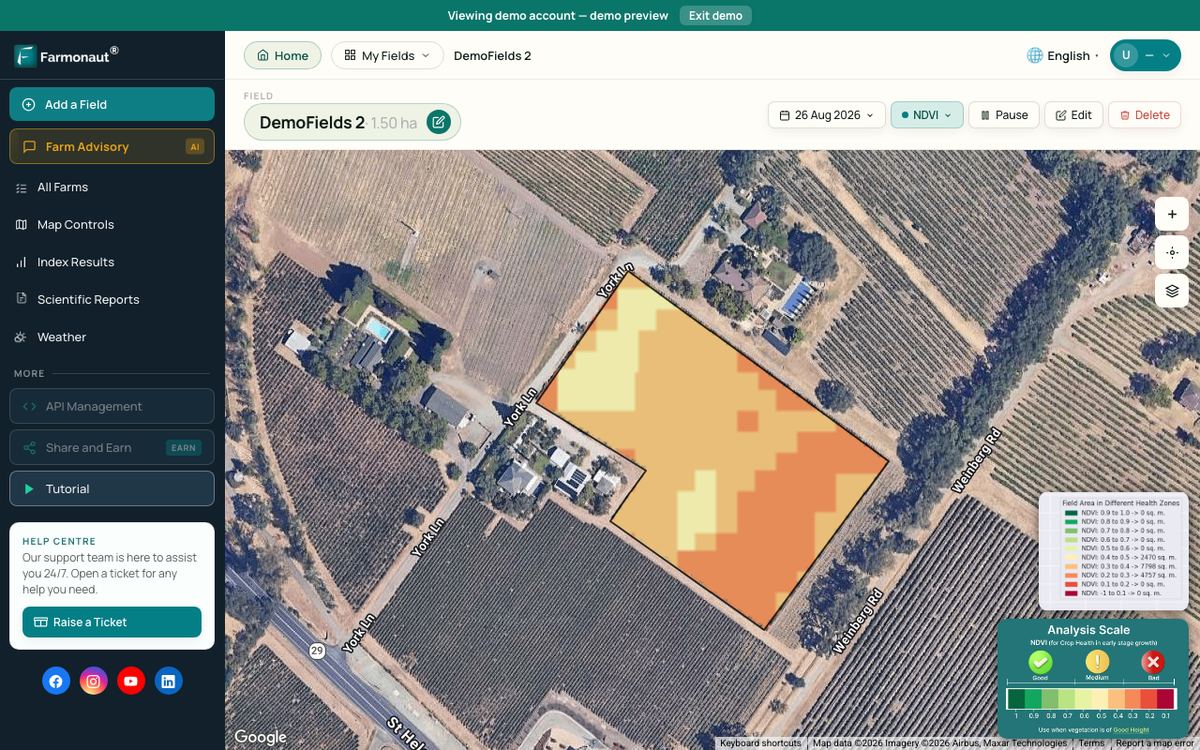
Satellite maps can help with step 5. Farmonaut shows vegetation index maps of each field through the season, which makes weak zones easy to spot and compare with your soil test zones. A map shows where plants are stressed, not the cause, so confirm with a soil test or a field visit.
▶ How satellite NDVI maps show crop stress across a large farm. · 4:09
Sustainable soil amendment choices
A sustainable plan uses the least material that fixes the problem. It starts with a test, treats zones rather than whole fields, and builds organic matter so the soil buffers pH swings.
- Match the product to the problem. Lime for acid soil, sulfur for high pH in low-lime soil, gypsum for sodium.
- Use local by-products with care. Penn State lists marl and shells at 70 to 90% CCE and slags at 60 to 90%. Check the label for CCE and any metals.
- Watch salt. FAO’s irrigation guide lists a salt index for common fertilizers: gypsum at 8.1 and limestone at 4.7, against 69.0 for ammonium sulfate.
- Protect water. Oregon State warns against fall nitrogen on bare ground because nitrate can leach to groundwater.
- Build organic matter. Compost, cover crops and residue improve structure on both acid and alkaline ground.
Old fixes to avoid: aluminum sulfate on acid-loving plants (Oregon State warns of aluminum harm to roots), and quicklime by hand without protection, since it burns skin. Always follow the label and local rules, and get professional advice for large fields.
Related pages on our site: farm admin app, carbon footprinting, crop loan and insurance tools, satellite and weather API, fleet management, product traceability and our apps.
▶ Seven simple farm practices that protect soil and water, explained with humor. · 4:34
We cover a connected topic in Grain Moth: 7 Strategies for Effective Grain Farming & Storage.
FAQ
What is alkali soil?
Alkali soil is an older name for sodic soil. It has so much sodium that clay disperses, the surface crusts and water drains slowly. pH is usually high. Gypsum plus leaching is the usual fix, per FAO.
What is the best fertilizer for alkaline soil?
Ammonium-based nitrogen, such as ammonium sulfate, lowers pH slightly as it works. For iron-hungry crops add chelated iron. Check the label and your soil test for rates.
How do I lower alkaline soil pH naturally?
Elemental sulfur is a natural mineral, and soil bacteria turn it into acid. Compost and manure help structure but move pH only a little. On soil full of free lime, change is slow and costly.
How do I make soil more alkaline?
Add agricultural lime at the rate on your soil test, adjusted for the product’s CCE. Dolomitic lime also adds magnesium.
How long does it take to change soil pH?
Lime and sulfur both take months to a year or more. Oregon State’s sulfur trial took two years to reach a stable pH. Fine products and good mixing speed things up.
Is gypsum good for alkaline soil?
Gypsum helps sodic soil by replacing sodium with calcium. It does not lower pH much on calcareous soil, and it does not raise pH on acid soil.
Farmonaut crop monitoring
See your own fields from space
Draw your fields once and Farmonaut shows satellite vegetation maps for them through the season, on web, Android or iOS.



Sources
- Penn State Extension, Soil Acidity and Aglime: extension.psu.edu
- Oregon State University Extension, EC 1560: Acidifying soil for blueberries and ornamental plants: catalog.extension.oregonstate.edu
- FAO Soils Portal, More information on salt-affected soils: fao.org
- University of Arizona Extension, Backyard Gardener: Iron Deficiency: extension.arizona.edu
- Utah State University Extension, Control of Iron Chlorosis in Ornamental and Crop Plants (1996): extension.usu.edu
- University of Maryland, SFM-5 Soil pH Management and Determining Liming Rates (1997): extension.umd.edu
- FAO, Water quality for agriculture (Irrigation and Drainage Paper 29): fao.org
- Royal Horticultural Society, How to grow blueberries: rhs.org.uk
- North Dakota State University Extension, Managing Saline Soils in North Dakota (SF1087, reviewed 2024): ndsu.edu
- University of Wisconsin Extension La Crosse County, Soil Sampling: lacrosse.extension.wisc.edu
- Oregon State University Extension, EC 1304: Growing blueberries in your home garden: catalog.extension.oregonstate.edu
Discussion
Questions, corrections or field experience? Share them below. First-time comments are reviewed before they appear, and your email is never published.
No comments yet. Be the first to add a question or your experience.

 Indosistim Teknologi
 Suminter India Organics
 Crossprod
 Liquify Digital
 CU Foods
 BeyondTech Global
 Rouge VC
 AgroGreen Dynamics
 AgroRisk
 Oath Inc
 Reddane Farming
 Esri North East Africa
 Cresol
 MDCV UK
 Zerella Group
 Etech Consulting Madagascar
 Vestlandsforsking
 Delicio
 WB Dev
