

Ag-Tech, Ag-Tech ETFs: Top 7 Powerful Investment Trends 2026
Table of Contents
- The Rise of Ag-Tech: Transforming Agriculture Investment in 2025
- Market Trivia & Insights
- Understanding Ag-Tech: Innovation at the Forefront
- Factors Driving the Growth of Ag-Tech in 2025–2026
- Ag-Tech Solutions in Action: Videos
- Ag-Tech ETFs and Mutual Funds: Investing in the Future
- Comparative Overview Table of Top Ag-Tech ETFs and Mutual Funds (2025 Estimates)
- Top 7 Powerful Investment Trends for Ag-Tech 2026
- The Farmonaut Edge in Ag-Tech and Sustainability
- Pro Investment Practices & Common Pitfalls
- FAQ: Ag-Tech, Ag-Tech ETFs, and Sustainable Investment
- Conclusion: The Future of Investing in Ag-Tech
“The global ag-tech market is projected to surpass $30 billion by 2026, revolutionizing sustainable farming investments.”
The Rise of Ag-Tech: Transforming Agriculture Investment in 2025
As our global population continues to reach nearly 10 billion by 2050, the pressure on agricultural systems to produce more food sustainably and efficiently—and do so with a reduced environmental impact—has never been greater. In 2025, ag-tech stands at the forefront of this vital transformation, driving a wave of innovations in farming, advanced data systems, and investment vehicles like ag-tech ETFs and mutual funds. These investment options are rapidly gaining prominence as investors seek diversified exposure to one of the fastest-growing and most critical sectors globally.
“Ag-tech ETFs have grown over 40% in assets since 2022, reflecting surging investor interest in agricultural innovation.”
Understanding Ag-Tech: Innovation at the Forefront
Ag-tech—a blend of “agriculture” and “technology”—broadly encompasses technologies applied to improve agricultural productivity and sustainability. Its significance lies in its ability to address critical challenges facing agriculture, from climate volatility and soil degradation to water scarcity and carbon emissions. These innovations include:
- Precision farming utilizing IoT sensors and drones
- AI-powered predictive analytics for crop management
- Advanced farm machinery and automated robots
- Biotechnology for crop enhancement and resilience
- Smart irrigation systems, real-time monitoring, and sustainability-focused water & soil management solutions
By 2025, ag-tech innovations will be essential for modern farming practices worldwide, enabling agricultural systems to increase yield, optimize resource use, and reduce environmental impact—all while meeting the demand for affordable and sustainable food production.
- ✔️ Precision agriculture: Advanced data for targeted management
- 📊 Predictive analytics: Real-time insights enhance crop yield and farm practices
- 🚀 Automated machinery: Boosts efficiency and addresses labor shortages
- 🌱 Biotechnology: Develops resilient crops, cutting losses from drought and pests
- 💧 Smart irrigation: Conserves water and reduces input waste globally
Factors Driving the Growth of Ag-Tech in 2025–2026
1. Technological Innovation & Smart Systems
- ⚡ Data analytics and AI-driven platforms offer real-time crop monitoring and predictive yield forecasting.
- 🛰️ Satellites, drones, and IoT sensors deliver unprecedented visibility into soil health, water use, and weather-driven risks.
- Learn about Farmonaut’s real-time monitoring & AI advisory for agriculture, infrastructure, and resource management via web, Android, and iOS.
- 🔄 Automated tractors and harvesting robotics reduce labor dependency and increase efficiency.
- 🧬 Gene-edited, disease-resistant crops enhance food security amid climate volatility and rising populations.
- ♻️ Circular agriculture and sustainability analytics help reduce carbon footprints and optimize input use.
2. Investment Vehicles and Capital Flows
The rise of ag-tech ETFs and mutual funds has democratized access to the sector, allowing a broader range of investors to participate through diversified exposure.
- 📈 Growth in ag-tech funds has outpaced broader agriculture investments over the past five years.
- 🌍 Global capital is increasingly directed at emerging markets in Africa, Asia, and Latin America—regions poised for outsized growth via ag-tech solutions.
- 💡 Retail investors now have access to sector-specific investment choices once reserved for private equity or venture capital.
3. Environmental and Societal Imperatives
- 🌦️ Climate change and resource scarcity are driving demand for carbon footprint monitoring and sustainable practices in farming.
- 🌡️ Farmonaut’s Carbon Footprinting platform helps users track and manage environmental impact, aiding compliance and climate-smart agriculture for both individual and institutional stakeholders.
- 🌾 Blockchain-based traceability is gaining traction for supply chain transparency and trust in agricultural products.
- Read more about how blockchain is transforming agri-traceability with Farmonaut Product Traceability.
Ag-Tech Solutions in Action: Videos
Experience the diversity and potential of ag-tech through these must-watch videos. Discover investment ideas, the power of AI drone technology, the impact of satellites, and the next wave of climate-smart agriculture:







Ag-Tech ETFs and Mutual Funds: Investing in the Future
With technological advancements rapidly evolving in agriculture, the sector is attracting diverse investment vehicles. Ag-tech ETFs and mutual funds pool capital from multiple investors to buy shares in companies focused on ag-tech innovation—including software firms, machinery developers, biotech manufacturers, and data analytics platforms. These investment options are increasingly attractive in 2025 and beyond due to the sector’s enormous growth potential and its critical societal role.
Why Ag-Tech ETFs & Mutual Funds Stand Out
- 🔄 Diversification: Spreads risk by investing in a broad range of ag-tech firms.
- 📈 Growth Potential: Sector estimated to exceed 15% CAGR through the late 2020s.
- 🌱 Sustainability Focus: Many funds prioritize companies using climate-smart, low-carbon, and precision technologies.
- 🟩 Accessibility: Lower entry thresholds democratize investment, especially for retail investors.
- ⏳ Mitigated Risk: Funds reduce company, technology, or regulatory risk exposure.



Comparative Overview Table of Top Ag-Tech ETFs and Mutual Funds (2025 Estimates)
This comparative table highlights key metrics for the leading Ag-Tech ETFs and mutual funds, helping investors identify standout options for diversified exposure to technology-driven agriculture in 2025–2026. All data points are estimates for informational purposes only.
| Fund/ETF Name | Estimated 2025 Return (%) | Assets Under Management (USD) | Main Technology Focus | Sustainability Rating (Est.) | Top Holdings | Growth Outlook (2025–2026 Est. CAGR %) |
|---|---|---|---|---|---|---|
| AgTech Global Innovators ETF | 18–21% | $1.5B | IoT, Drones, AI Analytics | A (9.2/10) | Deere & Co, Raven, Trimble | 15.6–17.2% |
| Sustainable Farming Leaders Fund | 15–19% | $820M | Biotechnology, Water Efficiency | A+ (9.5/10) | Corteva, Netafim, Bayer CropScience | 15–16% |
| Precision AgTech ETF | 14–16% | $490M | Sensors, Robotics, Automated Machinery | B+ (8.7/10) | AGCO, CNH Industrial, Hexagon | 13.7% |
| AgriBioTech Mutual | 12–17% | $675M | Genomics, Crop Genetics | A (9/10) | BASF, Syngenta, Benson Hill | 14.2–15.1% |
| Emerging Markets SmartAg ETF | 16–20% | $540M | Digitization, IoT, Farm Platforms | A (9/10) | CropIn, FarmLogs, Netafim | 16.8–18.5% |
| NextGen Ag Robotics Fund | 17–22% | $900M | Automation, Robotics | A- (8.9/10) | Blue River, John Deere, Bosch | 15.7–17.5% |
| Sustainable Crop Yield ETF | 13–16% | $380M | Smart Irrigation, Sustainability | A (9.1/10) | Lindsay, Valmont, Jain Irrigation | 12.7–14.8% |
- 🌎 Diversified exposure to top technologies and global firms
- 💡 Automated and biotech-focused investments offer resilient growth
- ✔ High sustainability ratings attract ESG investors
- 📊 Data-driven performance across multiple continents
- 📈 Robust estimated growth through 2026
Top 7 Powerful Investment Trends for Ag-Tech 2026
1. Mainstreaming of Precision Agriculture and Data Analytics
The use of AI, drones, and IoT sensors in precision agriculture is moving from early adoption to industry standard. Data-driven decision-making now underpins everything from seeding and irrigation to harvest forecasting and logistics.
Farmonaut offers real-time satellite monitoring, NDVI analytics, and AI-driven advisory systems via Android, iOS, and web for optimal resource management and yield enhancement.
- Yield optimization, input reduction, pest alerts powered by real-time data
- Increased profitability for tech-enabled farmers and agribusinesses
2. Rise of Robotics and Autonomous Machinery
Automated tractors, harvesters, and drones are mainstream, delivering cost savings, higher efficiency, and bridging labor shortages.
Emerging ETFs and mutual funds focused on automation offer strong returns.
- Robotic solutions reduce reliance on seasonal labor
- Lower operating costs and faster ROI for modern farms
3. Expansion of Sustainable and Circular Agriculture
Funds specializing in biofertilizers, resource optimization, carbon management, and circular economy models now lead in attracting ESG capital.
See how Farmonaut Carbon Footprinting unlocks sustainability monitoring for farms and agribusinesses.
- Funds offering exposure to sustainable agri-solutions outpace traditional agribusiness
- Investment strategies align with climate targets and global sustainability goals
4. Growth in Digital Platforms and Blockchain Traceability
Secure tracking, digital payments, and chip-enabled tagging are driving a new era of transparency from farm to shelf. Blockchain-based agri-funds are increasingly popular.
Farmonaut’s traceability solution helps companies and governments ensure product authenticity across complex supply chains.
- Reduces fraud and ensures marketplace integrity
- Attracts value-driven consumers and investors
5. Targeting High-Growth Emerging Markets
Funds with exposure to emerging economies in Asia, Africa, and Latin America benefit from rapid modernization, urbanization, and technology leapfrogging.
These markets offer the highest growth rates in digital agri-platform adoption and sustainable agriculture transition.
- Ag-tech penetration still under 25% in most emerging markets—high upside
- Digital credit, weather insurance, and marketplace investments on the rise
6. Integration of Environmental Impact and Carbon Analytics
New platforms specialize in environmental monitoring, carbon accounting, and resource efficiency management.
For advanced carbon analytics and sustainability reporting, Farmonaut’s platform leads the charge, enabling farms, enterprises, and institutions to track and reduce emissions.
- Funds with carbon analysis offerings are attractive to ESG investors
- Increasingly required for regulatory compliance and global trade
7. Adapting to Regulatory & Climate Risk
Smart crop insurance and farm loan verification are being powered by satellite analytics and AI models. Investment funds specializing in risk mitigation and resource management appeal to both retail and institutional investors.
- 📑 Explore how Farmonaut Crop Loan & Insurance leverages satellite-based verification to streamline access to credit and reduce lending risk.
- Funds in this segment offer strong downside protection and steady returns
The Farmonaut Edge in Ag-Tech and Sustainability
As a pioneering satellite technology company, we at Farmonaut are committed to making advanced satellite-driven insights affordable and accessible for businesses, users, and governments worldwide.
Our platform delivers:
- 🛰️ Satellite-Based Monitoring: Multispectral analytics for vegetation, soil, and farm health—enabling better yield, water use, and environmental performance.
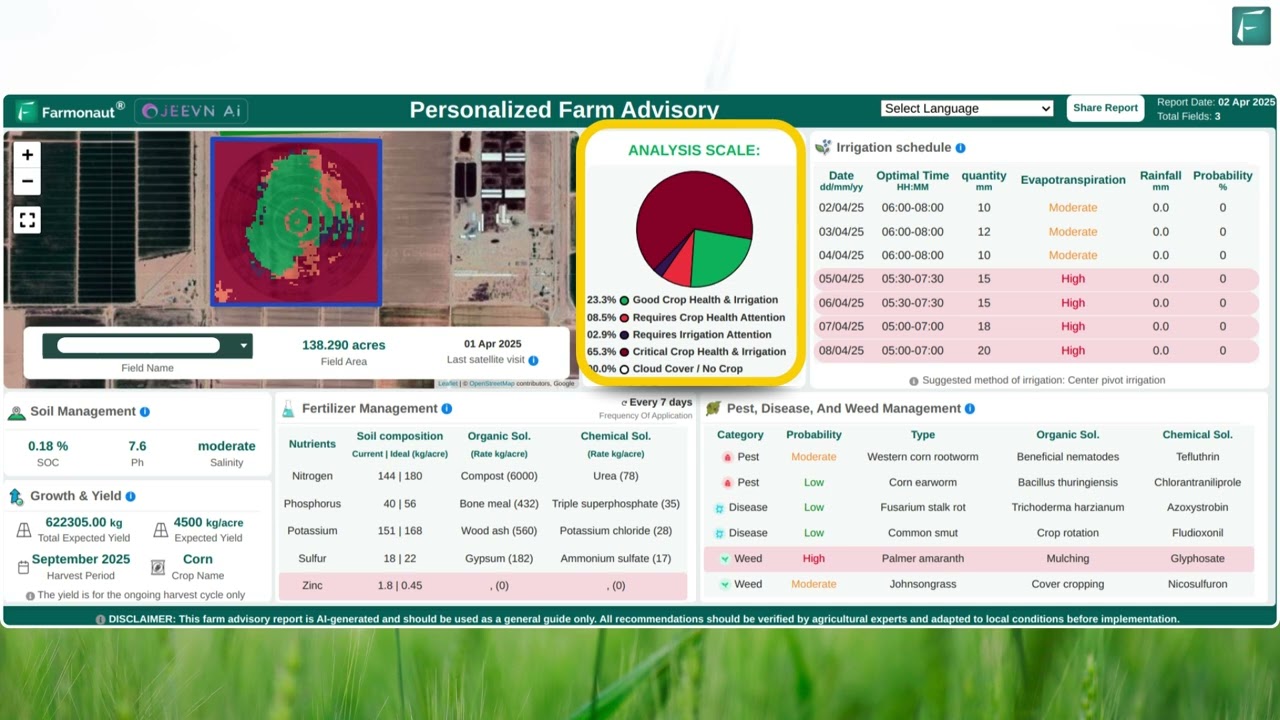
- 🤖 AI and ML-Driven Advisory (Jeevn AI): Data-powered strategies to boost productivity in agriculture, mining, and more.
See Jeevn AI in action:
- 🔗 Blockchain Traceability: Ensures fraud-resistant, transparent agri supply chains for corporate and institutional stakeholders.
- 🕵️♂️ Fleet and Resource Management: Reduce costs and improve operational efficiency with remote vehicle and equipment monitoring. Check our fleet management tools for agriculture, mining, and infrastructure.
- 🌍 Environmental Impact Tracking: Compliance-ready, real-time carbon/greenhouse gas analysis—empowering sustainable farm operations and investor reporting needs.
Our value proposition enables both small-scale and large-scale operations to:
- ➡ Scale rapidly and cost-effectively
- ➡ Enhance transparency, trust, and regulatory compliance
- ➡ Optimize resource allocation and input management
- ➡ Increase yields while reducing environmental and operational risk
- ➡ Access crucial satellite-based verification for loans, insurance, and investor due diligence
Pro Investment Practices & Common Pitfalls
- ✔ Key Benefit: Ag-tech ETFs enable participation in sustainable agriculture growth sectors without direct exposure to weather, climate, or regulatory volatility of any single company.
- 📊 Data Insight: Multi-region, multi-technology exposure outperforms narrowly focused ETFs, especially amid technological disruption.
- ⚠ Risk or Limitation: Technological obsolescence and shifting regulation (e.g., GMOs, privacy) can impact returns. Opt for actively managed funds with a proactive approach to sector transitions.
- ☝️ Pro Tip: Use API data integrations for advanced agricultural analytics. Get started with Farmonaut’s Satellite API and consult comprehensive developer guides at Farmonaut API Docs.
- 💡 Common Mistake: Ignoring the sustainability focus of funds—ESG momentum will define fund flows in ag-tech through 2026!
Try Farmonaut Solutions
Interested in advanced, satellite-driven insights for your farming, mining, or infrastructure needs? Discover our affordable and scalable subscription plans.
Available for individuals, businesses, and government institutions worldwide!
FAQ: Ag-Tech, Ag-Tech ETFs, and Sustainable Investment
1. What is ag-tech and why is it important for investors?
Ag-tech refers to the application of modern technologies—AI, IoT, satellite analytics, robotics, and biotechnology—to optimize and sustain global agriculture. For investors, ag-tech offers significant growth potential, exposure to sustainability, and resilience to food system pressure as the world’s population increases.
2. What are ag-tech ETFs and mutual funds?
Ag-tech ETFs and mutual funds are pooled investment vehicles specializing in shares of companies that lead in farming innovations, digital agriculture, farm machinery, and biotech. They provide diversified, lower-risk exposure to the sector.
3. How do ag-tech investments help with sustainability?
Investment in ag-tech funds drives capital to companies focused on smarter resource use, carbon footprint reduction, climate-resilient crops, and regenerative agriculture. Many leading ETFs screen for high sustainability scores.
4. What are the main risks in ag-tech investing?
Risks include technological obsolescence, regulatory changes (e.g., data privacy, GMOs), and short-term volatility in agriculture markets. Diversified funds and ESG screening help mitigate these risks.
5. How does Farmonaut support ag-tech advancements?
We at Farmonaut provide real-time satellite, AI, and blockchain-backed insights for crop, resource, and environmental management. Our tools help farms and agribusinesses increase yields, reduce input waste, improve sustainability, and meet evolving investor and regulatory standards.
Conclusion: The Future of Investing in Ag-Tech
The rise of ag-tech investment—through specialized ETFs and mutual funds—is transforming agriculture at the intersection of advanced technology and sustainability. In 2025 and beyond, these funds empower investors to back the next generation of food systems, climate solutions, and resource management technologies—with potential for sustained returns and meaningful impact.
Whether you’re seeking diversified growth, ESG investing, or future-proof portfolios, ag-tech stands out as a sector of critical importance, robust innovation, and resilient opportunity. By leveraging solutions like Farmonaut’s satellite analytics, blockchain traceability, and AI-powered resource management, stakeholders can drive both profitability and positive environmental outcomes at scale.
The future of agriculture investment is digital, data-driven, and sustainable—join the transformation today!

 Godrej Agrovet
 Hayleys Agriculture
 Linx Agritech
 Adinet
 Save Your Soils
 GalaxEye Space
 Grandstream Algérie
 XOS Realty
 Geospatial Lab Africa
 Agro La Gándara
 HIPSAC
 ZOL Zimbabwe
 Juligerm
 AdBio
AdBio MISE Maroc
 NWNS
NWNS Red August Group
 Farm Inc
 WeMe Global
 Agrotoken
 Blue BearX
 Insignito
 DnCubed
 Indosistim Teknologi
 Liquify Digital
 CU Foods
 BeyondTech Global
 Rouge VC
 AgroRisk
 Oath Inc
 Esri North East Africa
 MDCV UK
 Etech Consulting Madagascar
 Vestlandsforsking
 WB Dev
 Sama Premium
 Tres Valles
 Blickwinkel
 Agricultural Credit Policy Council
 eKGIS
eKGIS Mostas Tech
 Andex
Andex Deluxe Conseil
 WICO
WICO Chimera Innovation
 SkyHarvest
 Teledarbas
 Exurbia Geospatial
 FieldZero
