

Reviewed August 2026 against USDA’s National Agricultural Statistics Service and Economic Research Service, the U.S. Bureau of Labor Statistics (via O*NET OnLine), and SEAK, Inc.’s expert witness fee survey.
Try it: Expert Witness Engagement Cost Estimator →
In This Guide
Agricultural Engineering Expert Witness: Roles, Fit, Fees
An agricultural engineering expert witness is a licensed or credentialed engineer retained to review machinery, irrigation, structural, or environmental-compliance evidence in a farm-related dispute and testify on causation, design adequacy, or standards compliance. If you actually need someone focused on crop, soil, and yield questions rather than equipment or structures, that’s an agronomy expert witness — a related but distinct specialty covered below. If you searched “farms expert witness” or “agricultural engineering expert witness near me”, this page routes you to the right specialist and tells you what a properly scoped engagement costs, in dollars, before you call anyone.
Agricultural engineering blends mechanical, civil, electrical, and environmental engineering to design and evaluate the machinery, structures, and systems that modern agribusiness runs on — irrigation networks, grain storage, autonomous equipment, drainage, and on-farm energy systems. When one of those systems fails, the resulting claim usually needs someone who can state, under oath, whether the failure traces to design, installation, maintenance, or operator error.

What Agricultural Engineering Covers
The discipline sits at the intersection of engineering and production agriculture:
- Machinery and automation: tractors, combines, sprayers, autonomous and telematics-equipped equipment.
- Water and structures: irrigation and drainage design, grain and feed storage, livestock and greenhouse buildings.
- Environmental systems: nutrient management, erosion control, on-farm renewable energy, waste and byproduct handling — including compost operations.
- Post-harvest and data systems: storage, processing, traceability, and the sensor and remote-sensing platforms feeding precision-agriculture decisions.
- Try it: Expert Witness Engagement Cost Estimator
There were 1,700 people employed as agricultural engineers in the United States as of 2024, per Bureau of Labor Statistics data reported through O*NET OnLine, with a median annual wage of $98,590 ($47.40/hour) in the most recent BLS wage update cited there. The occupation is projected to grow 5% to 6% between 2024 and 2034 — “faster than average” — with roughly 100 openings a year nationally. Seventy-five percent of respondents to O*NET’s job-requirements survey said the role requires a bachelor’s degree; 10% said a master’s, and 10% said a doctorate. That small, credentialed labor pool is exactly why sourcing a qualified expert witness takes more than a web search — see the vetting checklist under Finding one near you.
Why Courts and Insurers Call These Witnesses
Agribusiness disputes are getting fewer but bigger. The U.S. had 1,900,487 farms in 2022, down 7% from 2,042,220 in 2017, according to USDA’s Economic Research Service. Total land in farms fell only 2.2%, to 880 million acres, over the same period — so the average farm grew 5%, to 463 acres. Fewer, larger operations mean each piece of equipment, each irrigation system, and each stored crop represents a bigger dollar exposure when something fails, which is the practical reason expert-witness demand in this niche keeps rising even as farm counts fall.
That consolidation is precisely the backdrop for the disputes agricultural engineering expert witnesses handle: mechanical failures on larger, more automated equipment; irrigation or drainage systems sized for expanded acreage; environmental compliance on operations that now cross regulatory thresholds; and contractual disputes on the infrastructure investments that go with scaling up. An expert evaluates whether a system was designed, installed, and operated to accepted engineering standards, and whether an external factor — weather, a manufacturing defect, a maintenance gap, or operator error — actually caused the loss.

Agricultural Engineering vs. Agronomy vs. “Farms” vs. Compost Expert Witnesses
These four searches land on overlapping but different specialists. Use the table below to route your engagement to the right one the first time — hiring the wrong specialty is the single most common reason opposing counsel gets an expert excluded under Daubert or Frye for lack of fit.
| Search term | What the specialist actually covers | Typical trigger | Not this specialist |
|---|---|---|---|
| Agricultural engineering expert witness | Machinery, structures, irrigation, drainage, automation, on-farm systems design | Equipment failure, structural collapse, system-design defect claims | Crop yield, soil fertility, agronomic practice questions |
| Agronomy expert witness | Crop science, soil chemistry, fertility, pesticide/herbicide application, yield-loss causation | Crop-loss disputes, seed or chemical performance claims, land-value/yield litigation | Mechanical or structural failure, equipment design |
| Farms expert witness | Non-specific search term; routes to whichever specialist fits the underlying claim | Litigants unsure which discipline their case needs | N/A — clarify the failure type first, then pick from this table |
| Compost expert witness | Facility siting, odor and setback compliance, nutrient-loading calculations, feedstock contamination | Nuisance/odor complaints, composting-permit disputes, land-application nutrient claims | Equipment breakdowns unrelated to composting operations |
The compost cases are narrower than they sound: they turn on three recurring fact patterns — setback distance from the facility to the nearest residence measured against the state or county composting-facility rule, odor-complaint frequency logs, and nutrient-loading math for land-applied compost against a state environmental agency’s permitted rate. An agricultural or environmental engineering expert witness who has actually permitted a composting facility, not a generalist, is the right fit here.

The Roles You’re Actually Hiring
“Agricultural engineering expert witness” covers several distinct specialties in practice. None of these percentages are published anywhere reliable — treat the list below as a menu of who to ask for, not a market-share chart:
| Role | What they analyze | Typical case type | Standards/data they cite |
|---|---|---|---|
| Precision agriculture / data systems expert | Yield-monitor data, remote-sensing outputs, IoT sensor logs | Yield-based contract or crop-insurance disputes | ASABE standards, sensor manufacturer specs, satellite/field data |
| Agri-robotics / equipment specialist | Autonomous tractor, drone, and smart-machinery failures | Product liability, operator-injury claims | ANSI/ASABE machinery safety standards, OEM service records |
| Water and irrigation analyst | Irrigation and drainage design, installation, maintenance | Crop loss following system failure or under-design | NRCS conservation practice standards, local water-district rules |
| Environmental / sustainability consultant | Carbon and GHG reporting, nutrient management, compost siting | Compliance hearings, permit disputes | EPA and state environmental agency thresholds |
| Post-harvest / storage expert | Grain bin, cold storage, traceability system integrity | Spoilage, contamination, warehouse claims | FGIS/FDA storage and handling guidance |
| Insurance and risk technical advisor | Loss-cause analysis for claims and reinsurance disputes | Crop and property damage claims, force-majeure disputes | Adjuster reports, weather-station and satellite records |

What It Costs
This is the number most search results skip. According to SEAK, Inc.’s 2024 Survey of Expert Witness Fees — nearly 1,600 experts across more than 250 specialties — the median hourly rate for file review and preparation was $450, rising to $475 for depositions and $500 for in-court testimony. Sixty-eight percent of surveyed experts had raised their rates within the preceding five years, and only 1% reported that a rate increase cost them work. Agricultural engineering isn’t broken out separately in that survey, so use these general-engineering medians as your starting benchmark and ask each candidate for their own written fee schedule, including any retainer.
Those hourly rates compound quickly across a real engagement. The illustrative build-up below assumes 25 hours of file review, 5 hours of deposition, and 8 hours of trial testimony at the SEAK 2024 medians — a hypothetical scenario, not a reported statistic, meant to show how the pieces stack:
Run your own hours and rates through the calculator below — every field is editable, and nothing here is fixed to the illustration above.
Expert Witness Engagement Cost Estimator

Finding One Near You — Including in Lisle
“Near me” matters for this specialty because local knowledge of soils, climate, crop patterns, and regional code affects how credible testimony reads to a jury or arbitrator. If your search is anchored to a specific place — Lisle, Illinois is a common example, given the ag-engineering programs and equipment manufacturers clustered around the greater Chicago area — the same vetting steps apply, plus a check of that state’s Professional Engineer licensing board and the nearest land-grant university’s agricultural or biological engineering department (the University of Illinois Urbana-Champaign runs one of the country’s oldest such programs). This is a durable method, not a one-time list, so it holds even as individual firms and personnel change:
- Confirm licensure. Check the relevant state Professional Engineer board for an active PE license, or confirm the specific engineering discipline that applies if the case doesn’t require a PE.
- Verify professional-society standing. Membership in the American Society of Agricultural and Biological Engineers (ASABE) signals active engagement with current standards; ASABE also runs a “Find a Technical Expert” lookup and a member directory for locating specialists by discipline.
- Match the sub-specialty to the failure type, using the roles table above — a robotics specialist is the wrong witness for an irrigation-design dispute, and vice versa.
- Ask for prior Daubert/Frye history. Has this expert’s testimony ever been excluded, and on what grounds? A clean record on methodology challenges is worth more than a long CV.
- Get the fee schedule in writing before engagement, benchmarked against the SEAK medians above, including any retainer, minimum-hour billing, and travel terms.
- Check for conflicts — prior work for the opposing party, the equipment manufacturer named in the suit, or the insurer on the other side of the claim.
- Confirm calendar availability for deposition and trial dates before you file anything that depends on the expert appearing.
Engaging early in the dispute-resolution process, before positions harden, is what most consistently shortens the path to settlement — an expert who reviews the evidence while it’s still fresh, rather than after depositions are locked in, has more room to shape the case theory.

Technology, Sustainability, and Compliance Work
A growing share of engagements now hinge on data the expert didn’t generate personally — satellite imagery, telematics logs, and sensor records that need independent interpretation before they can support testimony. Expert witnesses in this field are increasingly called on to:
- Interpret carbon and GHG monitoring output from platforms such as Farmonaut’s Carbon Footprinting tool, translating raw emissions data into testimony a non-technical fact-finder can follow.
- Audit water and soil conservation practices against irrigation and drainage system design, often citing the same remote-sensing and precision-farming data the operation used to make its original decisions.
- Assess autonomous and telematics-equipped machinery for programming errors or design flaws following an accident or breakdown.
- Review traceability and supply-chain records in contamination, crop-identity, or quality-consistency disputes.
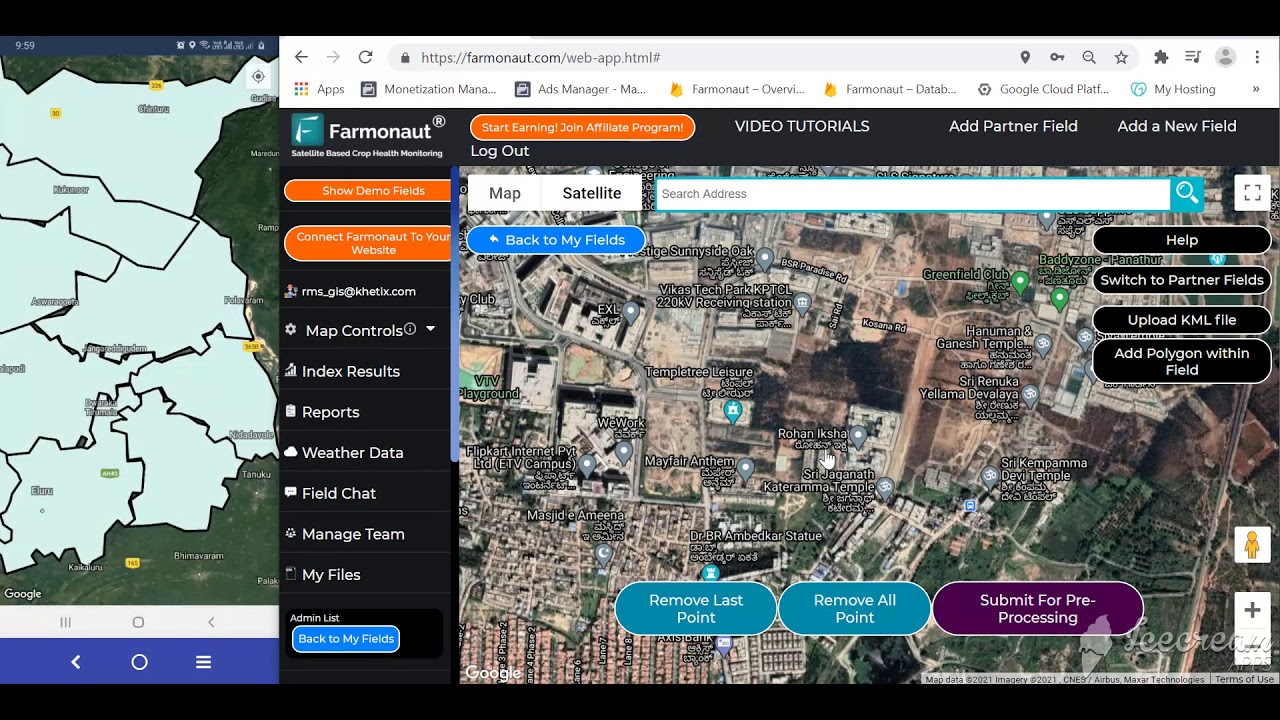
Data an Expert Witness Can Pull From Farmonaut
Farmonaut supplies satellite and AI-based monitoring that agricultural engineering expert witnesses use as independent, timestamped evidence rather than relying solely on the parties’ own records:
- Carbon Footprinting: emissions and GHG tracking for sustainability-compliance testimony.
- Product Traceability: blockchain-backed tracking for crop-identity and contamination disputes.
- Fleet & Resource Management: equipment usage and maintenance logs relevant to breakdown claims.
- Large Scale Farm Management: field-level records for boundary and land-use disputes.
- Crop Loan & Insurance verification: satellite-verified data supporting or contesting claims.
Developers and firms building their own analysis pipeline can pull the same underlying data through the Farmonaut API and its developer documentation. The platform itself is available on web, Android, and iOS.



FAQ
What does an agricultural engineering expert witness do?
They review machinery, structural, irrigation, or environmental-compliance evidence and provide independent technical opinions and testimony on causation, design adequacy, or standards compliance in litigation, arbitration, or insurance disputes.
How is an agronomy expert witness different?
Agronomy experts address crop science, soil fertility, and yield-loss causation; agricultural engineering experts address machinery, structures, and system design. Match the specialist to whether your dispute is about a system failing or a crop underperforming.
What does “farms expert witness” usually mean?
It’s a non-specific search term. Identify the underlying failure — mechanical, agronomic, environmental, or compost/waste-related — then use the terminology table above to pick the right specialist.
What do compost expert witness engagements involve?
Most turn on facility setback distance, odor-complaint frequency, and nutrient-loading calculations against a state environmental agency’s permitted rate for land-applied compost.
How do I find an agricultural engineering expert witness near me?
Check the relevant state Professional Engineer licensing board, search the ASABE member directory or “Find a Technical Expert” tool, and confirm the candidate’s sub-specialty matches your failure type using the seven-step checklist above.
What does it cost to hire one?
Per SEAK’s 2024 fee survey, general engineering-specialty medians run $450/hour for file review, $475/hour for depositions, and $500/hour for trial testimony. Get each candidate’s own written fee schedule — agricultural engineering wasn’t broken out separately in that survey.
What technologies must these experts understand now?
Precision agriculture and remote sensing, autonomous equipment and telematics, blockchain traceability, and satellite-based environmental monitoring all now generate the data underlying modern disputes.
Conclusion
The market for agricultural engineering expert witnesses tracks two durable trends rather than a single year’s headlines: farm consolidation raising the dollar value of each equipment or infrastructure failure, and the shift of farm operations onto data platforms that generate evidence someone still has to interpret under oath. Both trends are structural, not seasonal, so the roles, terminology distinctions, and vetting checklist above should hold regardless of when you’re reading this.
What won’t hold indefinitely are the numbers. USDA’s Census of Agriculture updates every five years (next due in 2027); BLS wage and employment data refresh annually through O*NET OnLine; and SEAK republishes its fee survey on its own multi-year cycle. Before you rely on a dollar figure from this page in an actual engagement, pull the current version from the linked source and use the calculator above with the candidate’s real, written rates.

 Consulthink Global
 Rouge VC
 Yutz Automation
 AgroGreen Dynamics
 AgroRisk
 Oath Inc
 Reddane Farming
 Esri North East Africa
 Cresol
 Atur Kuliner
 MDCV UK
 Zerella Group
 Etech Consulting Madagascar
 Vestlandsforsking
 Delicio
 WB Dev
 Sama Premium
 Prochecker
 Tres Valles
 LACOS Geoinformation
 Magrifly
 LatConnect 60
 Blickwinkel
