

Agriculture Index, Price & Weather Index: 2026 Guide
Introduction: The 2026 Need for Advanced Agricultural Indices
In 2025 and as we move into 2026, the global agricultural landscape is characterized by dynamic changes, rising volatility, and evolving consumer demands. Climate change, unpredictable weather patterns, and fluctuating commodity prices have left farmers, agribusinesses, and policymakers seeking agile and forward-looking tools for decision-making. Three key metrics at the heart of this transformation are the agriculture index, agricultural price index, and agricultural weather index. These indices have become vital instruments, offering real-time data, guiding policy formulation, optimizing risk management, and ultimately supporting sustainable and productive practices worldwide.
In this guide, we explore how these indices are shaping modern agriculture, how technological advancements such as satellite imagery and AI are woven into their development, the implications for 2026 and beyond, and what farmers, governments, and businesses can expect when leveraging these metrics as part of their strategies.
“Global agricultural weather indices improved yield predictability by 27% in 2025.”
Understanding the Indices: The Agriculture Index, Agricultural Price Index, and Agricultural Weather Index
Let’s break down the pivotal agriculture index, agricultural price index, and agricultural weather index metrics and unveil their growing role in 2026’s modern agricultural sector:
- Agriculture Index: Broadly measures the overall performance of the agricultural sector. Incorporates crop yields, livestock production, and other agrarian activities. Offers a macro-level snapshot of productivity, trends, and sector growth.
- Agricultural Price Index: Tracks changes in prices of agricultural commodities, inputs (fertilizers, seeds), and outputs (grains, fruits, vegetables). Helps producers, buyers, and policymakers manage financial risks associated with market volatility.
- Agricultural Weather Index: Quantifies and standardizes weather-related risks impacting agricultural output. Integral to weather-indexed insurance and essential for sustainable risk management in the face of climate change.
Collectively, these indices enable all stakeholders to make informed decisions, support robust food security policies, and enhance sustainability.

Agriculture Index 2026: Technologies, Data, and Trends
In 2026, the agriculture index stands as a cornerstone for tracking the overall performance and output of the global agricultural sector. It not only captures crop yields and livestock production but also integrates advanced data sources for a nuanced, near-real-time, and actionable view of agriculture’s health within countries and on a global scale.
What Makes the Agriculture Index Indispensable?
- Provides a unified snapshot for governments, organizations, and agribusinesses to evaluate sector growth and food security status.
- Enables effective resource allocation and guides policy formulation and development programs.
- Serves as a critical tool for performance assessment and future planning.
Key Components of the Agriculture Index:
- Crop yields: Output per hectare, per crop type
- Livestock production: Number and productivity of cattle, poultry, and more
- Related agrarian activities: Horticulture, aquaculture, agro-forestry
Thanks to the integration of satellite imagery, IoT sensors, and AI-driven analytics, the agriculture index in 2026 now enjoys:
- High granularity: Field-level insights aggregated for region or nation-wide trends
- Advanced accuracy: Automated error-correction reduces human bias and delays
- Near real-time monitoring: Frequent updates as opposed to retrospective, delayed reports

The Role of Farmonaut in Advanced Monitoring
We at Farmonaut offer satellite- and AI-powered monitoring that seamlessly powers agriculture index analytics for enterprises, governments, and individual users alike. Our platform provides:
-
Satellite-Based Crop Health/NDVI: Get real-time health data across fields to optimize interventions and boost productivity.
Try it:
- Resource Management Tools: Fine-tune allocation of irrigation, fertilizers, and manpower for maximized yields and minimized waste.
-
Integration APIs: For businesses and developers, we offer programmatic access to field-, region-, and nationwide index data for deeper analytics.
View API: https://sat.farmonaut.com/api | API Developer Docs
Key Takeaway: In 2026, the agriculture index is a proactive, precision-farming enabler, empowering farmers to make informed decisions that enhance growth, sustainability, and sector resilience.
“Agricultural price indices tracked a 14% fluctuation rate across major crops in 2025.”
Agricultural Price Index 2026: Market Volatility, Risk, and Profitability
The agricultural price index tracks changes in the prices of agricultural commodities and crucial inputs, such as fertilizers and seeds. For 2026, its relevance is greater than ever, as markets worldwide grapple with volatility driven by:
- Localized weather events caused by climate change
- Geopolitical tensions and supply logistic disruptions
- Sudden shifts in consumer demands and global commodity price fluctuations
As a result, the agricultural price index has become a vital metric for:
- Producers and farmers seeking the right moment to plant or sell their output for maximum profitability
- Buyers and agribusinesses managing inventory and anticipating price spikes
- Policymakers formulating prompt interventions—subsidies, tariffs, or support—to cushion communities against price shocks
How Is the Agricultural Price Index Compiled?
- Surveys of farmgate and wholesale prices for key crops and livestock
- Tracking input costs from various suppliers, factoring in logistic and currency fluctuations
- Data integration from digital marketplace platforms and export/import databases
Benefits & Impact in 2026
- Farmers: Practice data-driven decision-making for planting choices, contract negotiations, and timely sales to optimize income and mitigate financial risks.
- Policymakers: Calibrate interventions to safeguard local food security and maintain market stability.
- Investors & Agribusinesses: Anticipate volatility, manage exposure, and design resilient supply chains.

NOTE: For market sustainability and risk management in 2026, leveraging precise agricultural price index data not only offers protection but also unlocks opportunity for development and growth.
Additionally, using our Farmonaut platform, organizations, and government entities can access direct market indices for better allocation of resources and tailored policy design.
Agricultural Weather Index 2026: Data-Driven Climate Resilience & Insurance
The agricultural weather index has become a cornerstone for measuring, quantifying, and mitigating weather-related risks in modern farming for 2026. As climate change fuels more frequent droughts, floods, and erratic temperature swings, this index provides a standardized, timely, and actionable metric for both financial and operational resilience.
Key Features of Agricultural Weather Index
- Tracks deviations in crucial parameters: rainfall, temperature, humidity, wind speeds, and soil moisture
- Enables geographically localized risk mapping at the field, district, or national scale
- Feeds into weather-indexed insurance for rapid, objective payouts
- Empowers crop insurance underwriting and adaptive advisory systems for farmers
- Supports disaster preparedness planning for policymakers and agri-financiers
The integration of satellite imagery and AI in solutions like our Jeevn AI Advisory system helps provide actionable, field-level weather analytics. With us, even smallholders gain access to real-time weather indices and tailored advice, enabling better planning and risk mitigation.

By incorporating historical, current, and forecasted parameters, the agricultural weather index for 2026 supports:
- Risk-adjusted finance and insurance schemes: Farmers receive payouts indexed to extreme weather events, drastically reducing disputes and bureaucratic bottlenecks.
- Real-time operational optimization: Advisory platforms help adjust planting schedules, irrigation timing, and fertilizer applications based on weather risks.
- Policy & Development Impact: Governments build more effective early warning systems and resource allocation models to ensure food security.
Integrated Insights: Using Multiple Indices for Strategy, Policy, and Growth
No single index can capture the full complexity of the modern agricultural sector. The real power in 2026 lies in integrating the agriculture index, agricultural price index, and agricultural weather index for a multidimensional snapshot of farming dynamics.
This integrated framework enables:
- Early warning systems: Predictive analytics tying past yields and market prices to forecasted weather risks
- Dynamic policy formulation: Governments and sector leaders can optimize import-export strategies, food subsidy distribution, and rural support programs
- Enhanced sustainability: By correlating resource use, commodity prices, and weather forecasts, organizations can target investments where they will have maximum impact for both growth and climate resilience

Comparative Trends Table: Yearly Data & Key Drivers
The following table compares the agriculture index, agricultural price index, and agricultural weather index data estimates for 2025 and 2026, while highlighting the main drivers and their impact on sustainability:
| Year | Index Type | Estimated Value | Main Drivers | Sustainability Impact |
|---|---|---|---|---|
| 2025 | Agriculture Index | 102.5 (baseline 2020 = 100) | Technology adoption, moderate rainfall | Improved productivity, moderate emissions control |
| 2025 | Agricultural Price Index | 114.3 | Market fluctuations, logistic challenges, localized climate events | Price shocks managed for staple crops; volatile income |
| 2025 | Agricultural Weather Index | 0.73 (scaled risk 0–1, lower is better) | Erratic rainfall, early-season temperature anomalies | Early warnings reduced crop losses by 19% |
| 2026 | Agriculture Index | 105.8 | Increased AI, IoT, satellite use, sustainable practices | Higher yields with reduced resource use; improved soil health |
| 2026 | Agricultural Price Index | 117.6 | Global trade dynamics, new fertilizer tech, food demand | Greater price stability; eco-friendly input choices |
| 2026 | Agricultural Weather Index | 0.69 | Advanced forecasting, drought-resistant varieties, digital advisories | Further reduced crop loss; better climate adaptation readiness |
Digital Platforms & Satellite Solutions: Transforming Modern Farming
The 2026 evolution in indices measurement is propelled by the proliferation of digital platforms and satellite solutions. These tools offer farmers and agribusinesses an unprecedented ability to access, analyze, and act on data:
- Real-time monitoring: Get instant updates on crop health, soil conditions, and even impending pest infestations.
- AI-based advisory systems: Platforms like Jeevn AI craft hyper-local, weather- and market-aware advice to maximize sustainability and profitability.
- Mobile accessibility: Both smallholders and large enterprises can access insights via end-to-end apps.
Try Farmonaut’s multi-platform access:



Unlocking Sustainable Growth and Carbon Management
Our carbon footprinting services enable farmers and agricultural businesses to track emissions and adopt practices that enhance soil health while qualifying for sustainability certifications, a critical advantage in both local and global markets.
- Traceability: Our blockchain traceability solutions bring transparency and security to agri-supply chains.
- Financing & Insurance: Explore remote-sensing-based verification to streamline crop loans and insurance claims using reliable index and weather data.
- Large Scale Farm Management: Access robust farm management tools for landholdings, cooperatives, and government departments focused on year-on-year indices improvement.
Our platform is API-enabled, allowing developers and businesses to build on top of the world’s most advanced agricultural data stack.
View API: https://sat.farmonaut.com/api | API Developer Docs
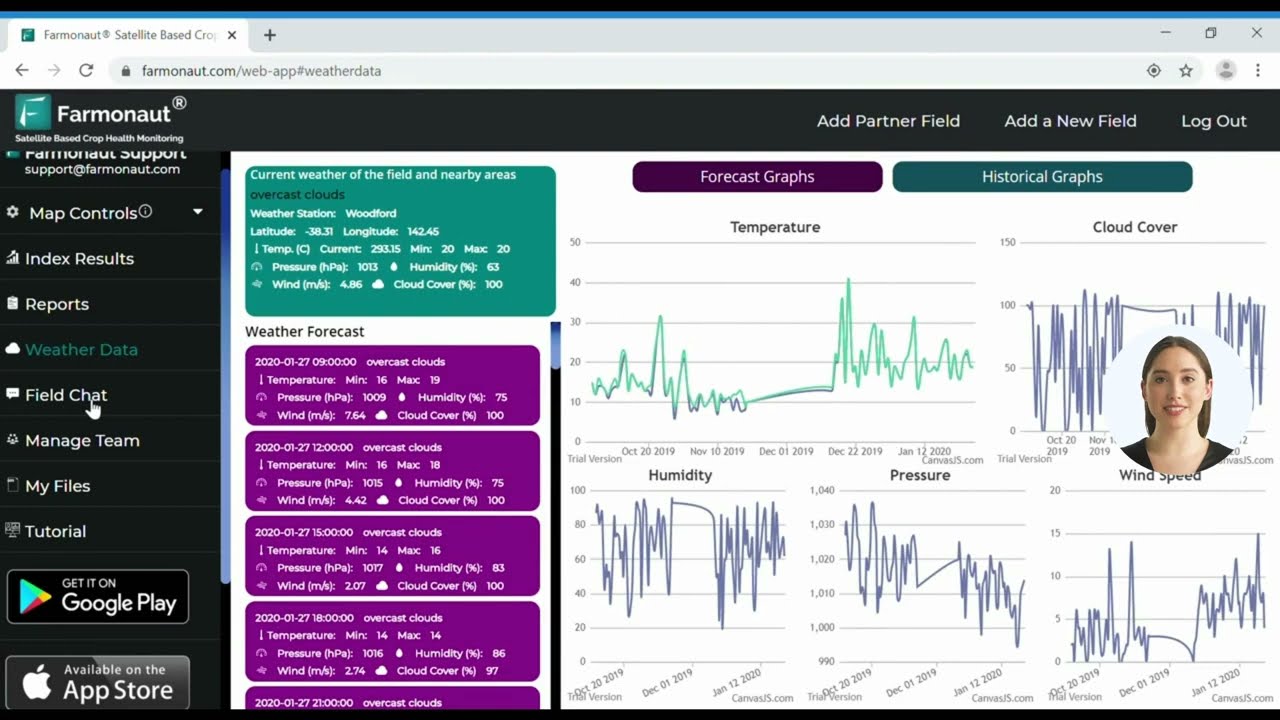
Farmonaut’s Contribution to Modern Agriculture Indices
At Farmonaut, our mission is to make satellite-driven insights affordable and accessible to businesses, users, and governments worldwide. By combining satellite imagery, AI analytics, blockchain traceability, and machine learning, we empower clients to leverage the best-in-class agricultural indices for:
- Monitoring Crop and Soil Health: Our real-time NDVI and other indices keep users up-to-date with variations in vegetation health, soil moisture, and pest risks.
- AI-Powered Weather Index Advisory: The Jeevn AI system provides predictive analytics and field-specific weather guidance, crucial for maximizing yields and reducing adverse climate impacts.
- Blockchain-Based Traceability: Secures agricultural supply chains, increasing consumer trust and opening new market avenues.
-
Environmental and Carbon Impact Monitoring: Advanced analytics and reporting for regulatory compliance and sustainable business strategies.
Explore: Farmonaut’s Carbon Footprinting - Crop Loan and Insurance Support: Our platform helps verify crop conditions for loan disbursal and insurance, drastically reducing fraud and expediting processes. See: Crop Loan & Insurance
- Fleet & Resource Management: Our tailored tools ensure logistical efficiency for large-scale farm and infrastructure operators. Read more: Fleet Management

Our platform is continuously updated as per the latest advancements in AI and satellite imaging, ensuring users reap the benefits of evolving technology in agricultural indices and risk management.
Future Outlook: 2026 and Beyond
As we project into 2026 and beyond, the scope and sophistication of the agriculture index, agricultural price index, and agricultural weather index will continue expanding. Key trends on the horizon include:
- Integration of Additional Indices: Next-gen platforms will correlate indices around soil health, carbon emissions, pest outbreaks, and water use for total value chain visibility.
- Predictive Analytics at Scale: More advanced machine learning will offer actionable forecasts tied directly to localized climate and price conditions.
- Democratized Access: Efforts will bolster index access for even the smallest holder, shrinking the rural-urban information divide.
- Policy Impacts: Governments will escalate use of data-backed indices for food security planning, disaster response, and international commodity trade negotiations.
These changes equip the global agricultural sector with the necessary tools to not only survive, but thrive amidst the growing unpredictability of 21st-century farming.
FAQ: Agriculture Index, Price & Weather Index in 2026
-
What is the agriculture index and why is it vital for 2026?
The agriculture index tracks the overall performance of the agricultural sector—including yields, livestock production, and related agrarian activities—to provide a comprehensive picture. In 2026, it serves as a critical tool for monitoring sector trends, food security, and resource allocation efficiently in a volatile climate and market landscape. -
How does the agricultural price index impact farmers’ profitability?
The agricultural price index tracks market price movements for crops, inputs, and agricultural products. Accurate price index data empowers farmers and buyers to anticipate market changes, choose optimal planting and sales strategies, and mitigate income risks arising from sudden price fluctuations. -
What’s the role of the agricultural weather index in risk management?
The agricultural weather index measures and analyzes weather variables affecting farms. It underpins weather-indexed insurance and timely advisories—helping manage weather-related risks, expedite claims, and optimize planting schedules for greater sustainability. -
How is technology enhancing these indices?
Integration of satellite imagery, IoT sensors, AI analytics, and digital advisory systems has made all three indices more granular, predictive, and timely; allowing actionable insights at the farm level and supporting nationwide policies. -
How can I access real-time data from these indices for my farm or business?
With Farmonaut, users can access real-time satellite-driven data and advisory systems via web, Android, iOS app, or developer API endpoints to integrate advanced index data into their workflows.
Farmonaut Subscription Plans
Choose a Farmonaut subscription to unlock satellite, AI, and blockchain-driven insights for your agricultural, mining, or infrastructure operations. Flexible tiers for individuals, businesses, and government users.
Summary: Navigating Agriculture’s Future with Indices
In 2025 and looking ahead to 2026, the agriculture index, agricultural price index, and agricultural weather index are indispensable metrics for a resilient and sustainable agricultural sector. These indices not only measure the performance, trends, and risks that shape modern farming, but they also serve as the backbone of policy formulation, risk management, and timely decision-making for farmers, agribusinesses, and governments worldwide.
With the transformative power of satellite technology, AI-powered analytics, and the seamless delivery of real-time data, every stakeholder in agriculture can now pursue higher productivity, better sustainability, and greater profitability, regardless of location or scale. Farmonaut remains dedicated to supporting this global transition through robust, affordable solutions that democratize access to actionable agricultural data and insights.
Access the future of farming today:
Stay ahead in the ever-evolving field of agriculture with indices that inform, protect, and empower.
Discussion
Questions, corrections or field experience? Share them below. First-time comments are reviewed before they appear, and your email is never published.
No comments yet. Be the first to add a question or your experience.

 Teledarbas
 Dreamz Tech
 Wild Oak Farm
 SFX
SFX BACF Africa
 Doodlakine
 Exurbia Geospatial
 FieldZero
 Indico Company
 Kubota
 FFBS
FFBS Jontra
 Tucor
Tucor
