

Agriculture Investor: 7 Key Trends for 2026
Meta Description: Discover how agriculture investors drive innovation, sustainability, and growth in farming. Explore the 7 agri-investment trends shaping 2026, their impact, and the future of agri-tech.
URL: yoursite.com/agriculture-investor-7-key-trends-2026
“Over 60% of agriculture investors plan to increase funding in agri-tech innovations by 2026.”
Table of Contents
- Summary: The Role of Agriculture Investors in Shaping the Future of Farming in 2025-2026
- Understanding Agriculture Investors
- Key Drivers Attracting Agriculture Investments in 2025-2026
- Trend Impact Comparison Table: Top 7 Investment Trends for 2026
- The Top 7 Key Investment Trends for 2026
- Farmonaut’s Role: Innovation & Sustainability Through Satellite Tech
- Economic, Social, and Environmental Impact of Agriculture Investors
- Major Challenges for Agriculture Investors
- Strategic Investment Approaches for 2026
- FAQ: Agriculture Investor Landscape 2026
- Conclusion
Summary: The Role of Agriculture Investors in Shaping the Future of Farming in 2025-2026
In 2025, agriculture investors remain pivotal in driving innovation, sustainability, and profitability within the farming sector. As global populations grow and climate challenges intensify, the importance of strategic agriculture investment has never been greater. Agriculture investors—ranging from venture capitalists, private equity funds, institutional investors, to impact investors—play a critical role in transforming traditional farming practices into resilient, tech-enabled, and sustainable systems.
With investments spanning precision agriculture, supply chain infrastructure, and climate-resilient farming, these actors enhance food security, rural development, and the advancement of agri-tech worldwide. Our detailed analysis for 2026 explores the key trends shaping this evolution, supported by satellite-driven data, real-time analytics, and sustainability-focused approaches.
By 2025, sustainable farming practices are expected to attract 40% more investment compared to traditional methods.
Understanding the Agriculture Investor Landscape
An agriculture investor allocates capital toward agricultural ventures with an expectation of financial returns, social impact, or both. This encompasses a spectrum of activity:
- Direct farm investment (crop production, livestock, organic farming)
- Backing agri-tech startups for technological developments
- Infrastructure (irrigation, cold storage, logistics, transportation)
- Sustainable methods and environmental enhancements
- Supply chain digitization for greater efficiency
Unlike conventional investment fields, agriculture requires a nuanced understanding of biological cycles, climate factors, regional infrastructure, market fluctuations, regulatory frameworks, and emerging ESG criteria.
Agriculture investors not only provide financial capital—they help reduce risk exposure for farmers and accelerate the adoption of sustainable, climate-smart practices across the global sector.
Key Drivers Attracting Agriculture Investments in 2025-2026
The investment landscape in agriculture is changing fast due to technological breakthroughs, the urgency of sustainability, and the demand for secured food systems worldwide. Here’s what’s driving the surge:
- Technological Innovation & Precision Agriculture:
- Drones, soil sensors, satellite imagery, AI-powered analytics, and IoT devices are revolutionizing how farms operate, monitor crops, and optimize yields.
- Investors are rapidly channeling funds into established companies and startups deploying these cutting-edge technologies for efficient resource management and reduced input waste.
- Climate-Resilient & Regenerative Farming:
- With climate change causing increasingly unpredictable weather patterns, investments are shifting toward climate-smart practices—including drought-resistant crops, carbon sequestration, and resource-efficient management systems.
- Sustainability and ESG Goals:
- Environmental, Social, and Governance (ESG) criteria now heavily influence investment decisions.
- Funds prioritize ventures that actively reduce carbon emissions, enhance biodiversity, and foster food security.
- Supply Chain and Infrastructure Improvements:
- Investments that improve cold storage, transport, and digital marketplaces minimize post-harvest losses and support farm-to-consumer efficiency.

Trend Impact Comparison Table: Top 7 Investment Trends for 2026
Curious about which trends offer the best balance of innovation, sustainability, and ROI? Consult our comparison table below for a data-driven overview of the seven most pivotal trends for agriculture investors in 2026.
| Trend Name | Est. Market Value / Growth Rate (2026) | Major Technology / Innovation | Sustainability Impact | Investor Opportunity Level |
|---|---|---|---|---|
| Precision Agriculture | $15B+ / CAGR 13.5% | AI, Drones, Sensors, IoT, Satellite | High (reduced input, water, emissions) | Excellent |
| Vertical Farming & Controlled Environment | $12B / CAGR 22% | Urban automation, Hydroponics, LED, Sensors | High (urban yield, less land & water) | Strong |
| Agri-Biotech & Alternative Proteins | $18B+ / CAGR 15% | Gene editing, Bioplastics, Biostimulants | Very High (low emissions, biodiversity) | Excellent |
| Carbon Farming & Sequestration | $2.5B / CAGR 42% | Carbon credit platforms, AI soil monitoring, Satellite | Very High (GHG reduction, revenue) | Emerging |
| Farm Supply Chain Digitization | $6.7B / CAGR 17.5% | Blockchain, Traceability, SaaS, IoT logistics | High (food waste, transparency) | Strong |
| Smart Irrigation and Resource Management | $4.3B / CAGR 14% | Remote sensors, Climate data, Efficiency AI | Medium-High (resource & water savings) | Strong |
| Farm Data Ecosystems & Real-Time Analytics | $8.1B / CAGR 21% | Big Data, Cloud, SaaS Platforms, APIs | High (data-driven impact, traceability, prediction) | Excellent |
Focused investments in precision agriculture and agri-biotech are projected to yield the strongest financial and sustainability returns by 2026, while carbon farming offers long-term potential as regulations and voluntary markets mature.
The Top 7 Key Investment Trends for Agriculture Investors in 2026
1. Precision Agriculture: AI, Drones, and Satellite Insights
The precision agriculture segment is experiencing rapid growth as investors deploy capital toward technologies that increase yield, reduce waste, and promote sustainability. Smart machines, drone-based field analytics, and IoT sensor networks collect granular data for real-time decisions.
- ✔ Yield Maximization: Advanced analytics optimize planting schedules, irrigation, and nutrient application for higher output per acre.
- 📊 Data Insight: Satellite imagery and AI models provide farm-wide oversight, detecting early signs of stress or disease.
- ⚠ Risk or Limitation: Initial technology investments can be high for traditional or smallholder farmers, but cloud-based solutions are reducing barriers.
- ✔ Environmental Benefit: Reduced fertilizer and pesticide run-off decreases negative environmental impact.
- ✔ Investor ROI: Proven cost and input savings make precision ag a top choice for strategic long-term investment.

Look for emerging API providers and remote farm management apps that amplify precision agriculture’s reach. Tools like Farmonaut’s satellite weather API enable seamless integration of real-time crop data into management platforms—ideal for tech-forward investors.
2. Vertical Farming & Controlled Environment Agriculture
Urbanization and land scarcity drive vertical farming and controlled environment agriculture (CEA) as standout investment trends. These systems rely on hydroponics, LED lighting, and full climate/irrigation automation to maximize output in small, urban footprints.
- ✔ Key Benefit: Closely monitored environments enable year-round production, reducing supply chain vulnerabilities tied to weather or seasonal fluctuations.
- ✔ Sustainability: Reduced need for chemical inputs and up to 90% less water use.
- ⚠ Limitation: High initial infrastructure costs, but strong returns in densely populated or food-insecure regions.
- 📊 Data Insight: Consumer demand for pesticide-free, local food is growing—a major plus for vertical farm operators.
3. Agri-Biotech & Alternative Proteins
From climate-resilient crops to alternative proteins and bio-based inputs, agri-biotech is reshaping agriculture at the molecular level. Investors are targeting startups and established players leveraging gene editing, biofertilizers, and lab-grown proteins to reduce greenhouse gas emissions, drive biodiversity, and address shifting consumer demand.
- ✔ Key Benefit: Engineered crops that withstand drought and pests cut costs and improve food security.
- 🧬 Innovation Highlight: CRISPR and other gene editing are accelerating product innovation cycles.
- ✔ Sustainability: Biofertilizers and stimulants reduce soil degradation and reliance on synthetic chemicals.
- ⚠ Risk: Regulatory and consumer acceptance hurdles persist—investors need to monitor policy trends.

Ignoring the consumer sentiment and local regulatory frameworks around genetic modification can result in slow adoption or failed product launches. Conduct country-specific due diligence before investing.
4. Carbon Farming and Sequestration Initiatives
As climate change intensifies, carbon farming and soil carbon sequestration are becoming prime investment targets. Investors support farms and companies developing platforms for measuring, verifying, and trading soil carbon credits, with remote sensing and satellite data serving as the backbone for transparency.
- ✔ Key Benefit: Enables additional revenue streams for farmers via carbon credit marketplaces.
- 📊 Data Insight: Demand for voluntary carbon credits is surging as corporate ESG targets tighten.
- ⚠ Limitation: Methodologies for carbon measurement and verification are evolving—adopt robust, science-driven tools such as satellite-based platforms.
Farmonaut’s carbon footprint monitoring solution offers agri-investors and farming businesses real-time data on GHG emissions, enabling both compliance and the adoption of sustainable practices.
5. Farm Supply Chain Digitization & Traceability
With increasing consumer demand for food transparency and traceable supply chains, investors flock to blockchain-enabled platforms and digital marketplaces that improve food safety, reduce loss, and unlock efficiency across the agri-food value chain.
- ✔ Key Benefit: Blockchain-backed traceability reduces fraud and recalls, ensuring food safety.
- 📊 Data Insight: Platforms that digitize logistics, post-harvest storage, and compliance generate valuable operational data.
- ✔ Sustainability: End-to-end traceability verifies authentic sustainable practices, building consumer trust.
Learn more about Farmonaut’s traceability solutions—enabling agri-sector actors to track and validate their produce journey from farm to shelf, with actionable insights from blockchain and satellite monitoring.

6. Smart Irrigation & Resource Management
As water scarcity looms in multiple regions, smart irrigation systems and resource management platforms are capturing more investor attention. AI and sensor-based solutions optimize watering cycles, monitor soil moisture, and prevent costly over- or under-irrigation.
- ✔ Key Benefit: Considerable input savings, improved yields, and sustainable water use.
- ⚠ Risk: Dependence on data connectivity or power infrastructure in developing regions can be a barrier; solar-powered IoT solutions offer a workaround.
Explore Farmonaut’s large scale farm management system for integrated irrigation insights and comprehensive resource planning.
7. Farm Data Ecosystems & Real-Time Analytics
The future of agriculture investment is data-driven. Modern farms now leverage SaaS platforms, APIs, and cross-platform integration for 360-degree visibility and rapid response. Investment in these digital ecosystems powers innovation, growth, and risk reduction at scale.
- ✔ Key Benefit: Real-time, actionable insights help farmers and investors alike make informed decisions.
- 📊 Data Insight: Cloud-based and mobile-first apps are expanding accessibility for smallholders, bridging digital divides.
- ✔ Investor ROI: Subscription-based models provide recurring revenue and scalable growth.
“By 2025, sustainable farming practices are expected to attract 40% more investment compared to traditional methods.”
Farmonaut’s Role: Innovation & Sustainability with Satellite Technology
As agriculture investors increasingly seek data-driven, scalable solutions for impacts across the supply chain, Farmonaut is at the forefront of this evolution with a robust satellite-driven platform—delivered over web, Android, and iOS.
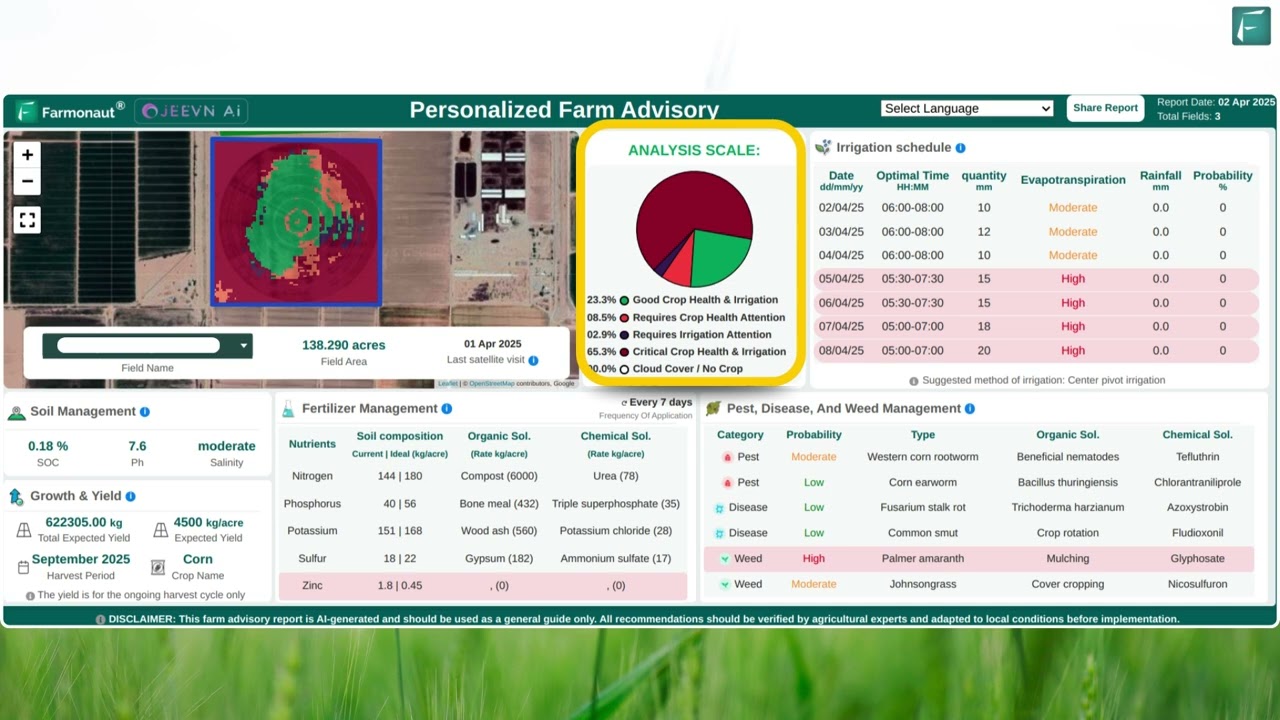
- ✔ Real-time Crop Monitoring: Multispectral satellite images help farmers and investors assess vegetation health, soil, and water status for estates, cooperatives, and rural businesses.
- ✔ AI-Driven Advisory (Jeevn AI): Customized, dynamic advisory for weather, yield prediction, and resource allocation improves on-farm decision-making and mitigates climate risks.
- ✔ Blockchain-Based Traceability: Ensures the authenticity of produce on its journey from farm to consumer—crucial for meeting ESG and governance criteria.
- ✔ Resource & Fleet Management: Optimize agri-logistics, vehicle usage, and reduce fuel and labor costs, improving profitability for growers and agri-businesses.
- ✔ Environmental Impact Reports: Satellite-powered GHG tracking helps reduce emissions and supports claims of sustainable practices, helping users meet regulatory and ESG reporting requirements.
Discover our fleet management services for smarter vehicle and machinery usage, or explore satellite-based crop loan and insurance verification for de-risking agriculture financing.



Looking to build or extend agri-tech directly into your internal systems? Access our API Developer Docs and Farmonaut API for next-gen farm data integration.
- ✔ Affordability: Satellite insights democratize advanced monitoring without expensive hardware investments.
- 🌐 Scalability: Solutions extend from individual smallholders to large commercial farms and government projects.
- 🔒 Security: Blockchain ensures trust and reduces fraud across agricultural supply chains.
- 🌱 Sustainability: Environmental tracking and resource optimization help achieve climate and ESG goals.
- 💡 Innovation: Farmonaut integrates AI, satellite, and blockchain—driving the future of farming intelligence.
Start your journey with crop plantation and forest advisory for custom strategies, monitoring, and forecasting vital for rural and large-scale agri-investments.
Economic, Social, and Environmental Impact of Agriculture Investors
The impact that agriculture investors have on the global farming system goes far beyond mere capital deployment. Their investments shape economic outcomes, social progress, and environmental sustainability for farmers, rural communities, and markets worldwide.
- Economic Growth and Job Creation
- Investments in technology, farm modernization, and value-added infrastructure stimulate job creation and rural development.
- Digital platforms for farm management (such as Farmonaut’s large-scale management tools) create employment in ICT, logistics, and agri-services sectors.
- Food Security and Availability
- Yields are increased while post-harvest losses are reduced, ensuring food security for an expanding population.
- Access to premium-quality seeds, fertilizers, and management tools supports global nutritional goals.
- Innovation Ecosystems
- Venture funds nurture agri-tech startups, accelerating the adoption of promising technologies, from vertical farms to alternative proteins and beyond.
- Social and ESG Outcomes
- Investors increasingly evaluate returns not only in financial terms but also in ESG goals: lowering greenhouse gas emissions, supporting rural livelihoods, and building climate resilience.

Satellite-powered monitoring isn’t limited to agriculture. Similar data ecosystems help mining and infrastructure investors track resource extraction, structural health, and environmental compliance—making geospatial tools a cross-industry investment staple.
Major Challenges and Risks for Agriculture Investors
Agriculture investment offers attractive long-term returns, but the sector also presents unique and sometimes formidable challenges:
- ⚠ Weather Variability: Unpredictable climate patterns, drought, floods, and storms continue to affect harvests and returns.
- ⚠ Pest and Disease Outbreaks: Sudden biological cycles can cause losses if not rapidly identified.
- ⚠ Commodity Price Fluctuations: Market swings impact revenue predictability for both direct growers and agri-investors.
- ⚠ Regulatory Changes: National and local legislation around land, biotech, trading, and ESG can add to uncertainty.
- ⚠ Liquidity Constraints: Returns may take longer to materialize than in some other industries—patience and sector expertise are required.
Many investors underestimate the importance of region-specific risks—especially in developing rural markets. Factor in local climate, regulatory context, and farm-level operational realities for robust due diligence.
Strategic Investment Approaches for Agriculture Investors in 2026
Given the sector’s unique challenges and the fast pace of technological innovation, successful farming investments in 2026 require a blend of sector knowledge and strategic flexibility. Consider the following approaches:
- ✔ Adopt Data-Driven Due Diligence: Use real-time satellite, environmental, and supply chain data for investment evaluation and risk assessment.
- ✔ Prioritize Sustainable Ventures: Focus on companies and projects that embed ESG and climate resilience in their business models.
- ✔ Diversify Portfolios: Invest across regions, crop types, technology providers, and supply chain stages to spread risk.
- ✔ Leverage FinTech Integration: Modern agriculture-financing platforms use satellite verification and blockchain to streamline crop loans and insurance, minimizing credit risk.
- ✔ Engage with Digital Ecosystems: APIs and data platforms such as those offered by Farmonaut allow investors and agri-businesses to scale, monitor, and benchmark performance.
Visual Checklist for Investment Success
- 🥇 Evaluate tech scalability & farmer adoption rates.
- 📉 Track climate and regulatory trends for emerging risks.
- 📈 Quantify ESG returns and contribution to SDGs.
- 🔄 Monitor post-investment milestones and recalibrate KPIs.
- 👩🌾 Assess grower/joint-venture strength for field-level execution.
Integrating digital due diligence and ESG impact scoring with traditional financial analysis results in stronger, more resilient investment portfolios for agriculture investors.
FAQ: Agriculture Investor Landscape 2026
Q1: Who qualifies as an agriculture investor in 2026?
A: Any individual, institutional, venture, or impact-focused entity allocating funds to agricultural production, technology, infrastructure, value chain upgrades, or sustainability enhancements, with expectations of financial, social, or environmental returns.
Q2: What is the most promising agri-tech trend for 2026?
A: While multiple trends are gaining momentum, precision agriculture and agri-biotech (particularly climate-resilient crops and biological inputs) offer the highest growth rates for agriculture investors. Vertical farming and blockchain traceability are also top opportunities.
Q3: How can digital solutions help reduce investment risk in agriculture?
A: Platforms like Farmonaut deliver satellite monitoring, AI-driven risk assessment, and smart advisory, giving investors greater transparency and real-time response to climate/market changes.
Q4: What role does ESG play in agricultural investments?
A: ESG (Environmental, Social, Governance) frameworks increasingly dictate allocation criteria, reporting requirements, and even pricing/valuation for agriculture sector investments. Projects with high sustainability and social impact indices tend to attract more capital and government incentives.
Q5: How do I start using Farmonaut’s solutions as an investor or agri-business?
A: Get started by registering on our web, Android, or iOS platforms, or review our API Developer Docs for integration into custom tools and dashboards.
Conclusion: Agriculture Investors Remain Pivotal to the Future of Farming
As we look beyond 2025 and approach 2026, agriculture investors remain the engine powering the transformation of farming into a resilient, sustainable, and technology-first industry. By channeling investment into precision agriculture, climate solutions, ESG-driven business models, and next-gen supply chains, these visionaries help ensure robust food security and sustainable rural growth for a purposefully evolving population.
The future of agriculture investment is undeniably digital, transparent, and impact-oriented. Our commitment at Farmonaut is to empower this journey with cutting-edge satellite, AI, and blockchain technologies—supporting both investors and farmers alike to build resilient, profitable, and sustainable food systems for decades to come.
Ready to join the revolution? Try Farmonaut’s platform for affordable, scalable, and high-impact farm intelligence and management.
Discussion
Questions, corrections or field experience? Share them below. First-time comments are reviewed before they appear, and your email is never published.
No comments yet. Be the first to add a question or your experience.

 Red Dog Management
 Liquify Digital
 Ascentya
 CU Foods
 BeyondTech Global
 Rouge VC
 AgroGreen Dynamics
 AgroRisk
 Oath Inc
 Reddane Farming
 Esri North East Africa
 Cresol
 Atur Kuliner
 MDCV UK
 Zerella Group
 Etech Consulting Madagascar
 Vestlandsforsking
 Delicio
 WB Dev
 Sama Premium
 Prochecker
 Tres Valles
 LACOS Geoinformation
 Exploration consultancy · South Africa · Gold
 Licence holder · Niger · Gold










