

Farm history · Tools guide
Traditional Farming Tools and Their Cultural Significance
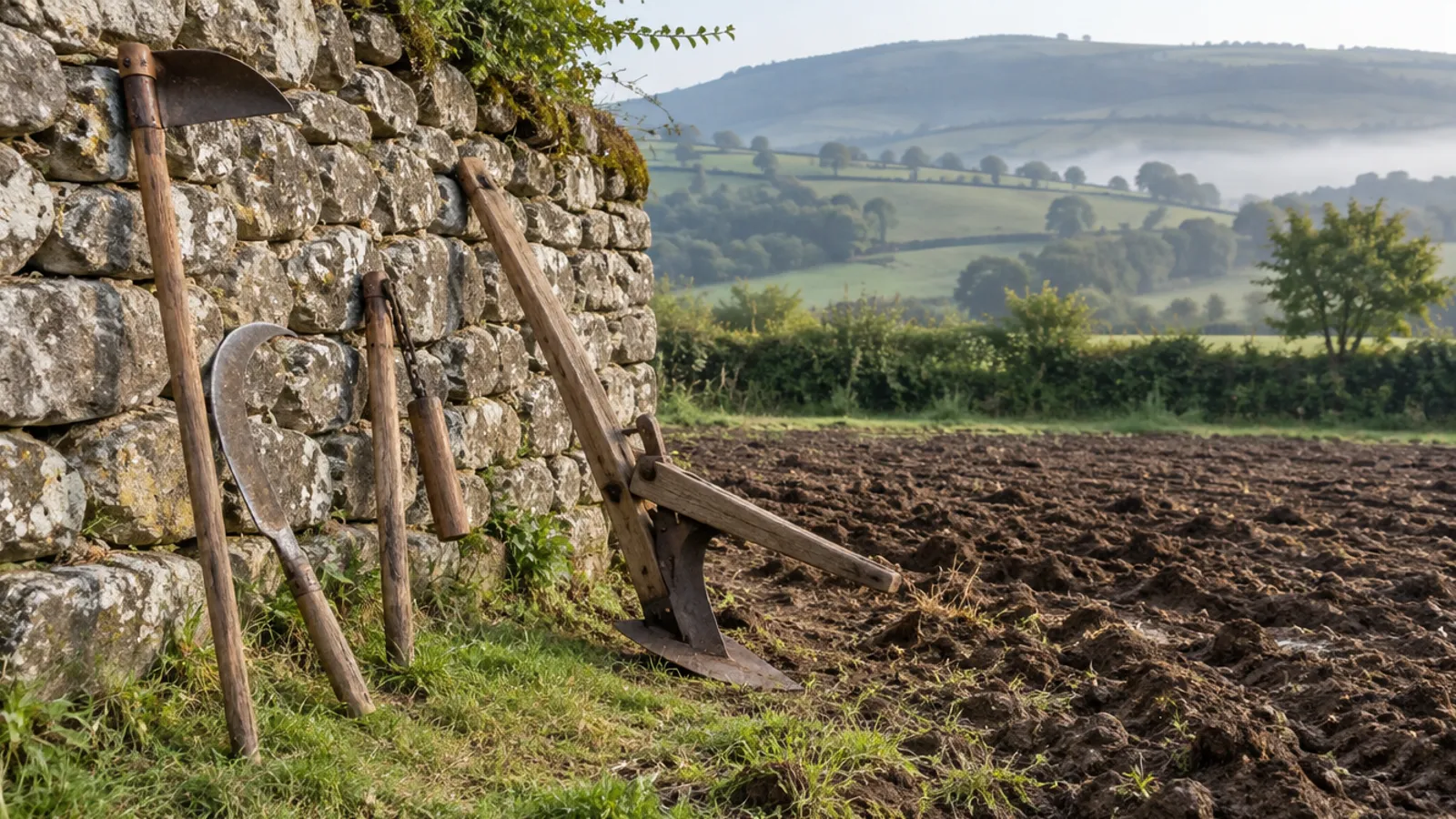
Traditional farming tools such as the hoe, sickle, foot plough and flail set the farming calendar, carried religious meaning and decided who did which job. They are still in use: in sub-Saharan Africa, human muscle supplies 65% of land-preparation power (FAO).
Key takeaways
- The oldest farming tools include the digging stick and the sickle: flint sickle blades from the Levant, about 15,000 to 11,700 years old, carry wear from cutting cereals (Scientific Reports, 2026).
- Tools carry culture: England’s Plough Monday, which opens the farming year, dates back to at least the 1400s, and Japan’s Mibu rice-planting ritual has been on UNESCO’s heritage list since 2011.
- The heavy plough opened northern Europe’s clay soils and explains around 10% of the rise in urbanization in the High Middle Ages (University of Southern Denmark, 2013).
- Hand tools are still the main power source on many small farms: human muscle provides 65% of land-preparation power in sub-Saharan Africa vs 25% in Latin America (FAO).
- FAO’s heritage programme listed 104 traditional agricultural systems in 29 countries when checked in October 2026.
In this article
- Traditional farming tools at a glance
- What is traditional agriculture?
- 14 traditional farming tools and what each one does
- What is the cultural significance of farming tools?
- Who still farms with traditional tools?
- Hand tools or a hired machine: how to choose for a small plot
- From hand tools to satellite maps
- FAQ
Traditional farming tools are the hand and animal-powered implements people used to dig, sow, water, harvest and thresh before engines: the digging stick, hoe, foot plough, ard, heavy plough, sickle, scythe and flail, among others. Their cultural significance is that they did more than move soil. They set the farming calendar, carried religious meaning and decided who did which job. England’s Plough Monday, which marks the start of the farming year, has roots going back to at least the fifteenth century, according to the Weald & Downland Living Museum, and FAO’s heritage programme lists 104 systems in 29 countries (October 2026) where traditional farming knowledge is still in use.
This guide lists 14 agriculture traditional tools with what each did, what it was made of, and where it was used, from the ancient Near East to Europe, the Americas, Africa and East Asia. It then covers six ways tools shaped culture, FAO data on who still farms by hand, and a hand-versus-machine calculator.
Traditional farming tools at a glance
Dates refer to the examples named, not the first use of each tool everywhere.
| Tool | Main job | Traditional materials | Example of where and when |
|---|---|---|---|
| Digging stick | Breaking ground, planting holes | Pointed wooden stick | Hidatsa gardens, North Dakota, 1800s |
| Hoe | Tilling, weeding, levelling | Wood, bone, stone, later iron | Ancient Egypt; Great Plains |
| Spade and mattock | Digging, lifting tubers | Wooden handle, iron blade | Andes, Europe, worldwide |
| Foot plough | Turning sod on steep land | Wooden shaft, metal tip, leather ties | Peru and Bolivia, Inca times to today |
| Ard | Scratching a shallow furrow | Wood, later metal share | Egypt, Mediterranean |
| Heavy plough | Cutting and turning clay soil | Wood frame, iron coulter and share | Northern Europe, from about AD 1000 |
| Yoke | Linking draught animals to a plough | Wood, leather, rope | Sumer, Egypt, Japan, Africa |
| Seeder plough, dibber | Placing seed at a set depth | Wood, with a seed funnel | Sumer, southern Mesopotamia |
| Shaduf | Lifting water for gardens | Pole, bucket, clay counterweight | Egypt, New Kingdom |
| Rake and leveller | Clearing, smoothing paddies | Antler, wood | Hidatsa gardens; Japanese rice fields |
| Sickle | Cutting cereal stems | Flint in bone or wood, later iron | Levant 15,000 years ago; England 1800s |
| Scythe | Mowing hay and cereals | Long iron blade, wooden snath | England, 1800s |
| Flail | Beating grain from the ear | Two wooden poles, leather hinge | England; one used in WWII |
| Sledge, winnowing basket | Threshing and cleaning grain | Toothed board; woven basket | Sumer; Cambridgeshire |
What is traditional agriculture?
Traditional agriculture is farming built on local knowledge passed down over generations. It uses hand tools or animal power, saved seed and few bought inputs. Fertility comes from manure, compost, fallows and legumes; pests are kept down with crop mixes, rotations and timing. Examples include the Three Sisters of corn, beans and squash grown by many Native American nations; the chinampas of Mexico City, raised fields in shallow lakes farmed since Aztec times and listed by FAO in 2017; and the Hani rice terraces of Yunnan, China, listed in 2010. These systems use little fuel or cash but a lot of labour.
14 traditional farming tools and what each one does
The tools follow the farming year: preparing soil, sowing and watering, then harvest and threshing.
1. Digging stick
Used for: breaking ground, planting holes, digging roots. Made from: a sturdy pointed wooden stick. Among the Hidatsa of the upper Missouri, the stick broke ground, made seed holes, pulled tough weeds and set fence posts, says the US National Park Service at Knife River.
2. Hoe
Used for: tilling small plots, weeding, levelling. Made from: wood, bone or stone, later iron. In ancient Egypt the first hoes were cut from a forked branch, and Egypt’s old name Ta-meri is explained as the beloved land cultivated by the hoe, notes a Purdue University lecture on ancient Egyptian agriculture. Hidatsa and Mandan women tied a bison shoulder blade to a stout stick, and switched to metal hoes after contact with Europeans, says the State Historical Society of North Dakota.
3. Spade and mattock
Used for: digging beds and ditches, lifting potatoes and other tubers. Made from: a wooden handle with an iron blade. In the Andes a native mattock is still used to break clods and harvest potatoes.
4. Foot plough (chaki taklla)
Used for: turning tough sod on steep or high land, building potato ridges. Made from: a 1 to 1.5 m wooden shaft, a footrest and a metal or fire-hardened tip, with the handle tied to the shaft with llama or cow leather. The Museum for Old Techniques in Belgium describes it as typical of southern Peru and northern Bolivia, where men turn the clods and women place the seed potatoes. A study by Daniel Gade and Roberto Rios in Tools & Tillage (1970s) found it still in use above about 3,600 m and on steep slopes where ox ploughs cannot turn the turf.
5. Ard (scratch plough)
Used for: scratching a shallow furrow in light soil. Made from: wood, later with a metal share. It cuts a groove but does not turn the soil. In Egypt the plough began as a hoe dragged through the ground, and by the Old Kingdom a pair of oxen pulled it. It struggled on the wet clays of northern Europe.
6. Heavy mouldboard plough
Used for: cutting and turning heavy clay. Made from: a wooden frame, an iron coulter, an asymmetric share and a mouldboard. In a University of Southern Denmark discussion paper (2013), regions with more fertile clay grew faster after the plough spread around AD 1000, and the plough explains around 10% of the rise in urbanization and population density in the High Middle Ages.
7. Yoke and draught animals
Used for: harnessing oxen, cattle, horses or donkeys to a plough, sledge or cart. Made from: a shaped wooden beam with leather or rope ties. A Sumerian text, the Farmer’s Instructions, tells a son to keep his yoke assembled and to have back-up oxen and a back-up plough, in the University of Oxford’s Sumerian text corpus. In sub-Saharan Africa, households owning draught animals typically cultivate 3 to 4 ha a year against 1 to 2 ha for hoe households, according to an FAO study of farm power.
8. Seeder plough and dibber
Used for: placing seed at an even depth. Made from: a plough with a seed funnel, or a pointed wooden peg. The Sumerian instructions ask for eight furrows to about 6 m of width and seed about two fingers (3.5 cm) deep. The dibber is the hand version.
9. Shaduf
Used for: lifting water from a canal into garden channels. Made from: a pivoted pole with a bucket at one end and a clay counterweight at the other. By Egypt’s New Kingdom it watered gardens, while fields relied on the Nile flood.
10. Rake and leveller
Used for: clearing trash, breaking clods, smoothing a seedbed or flooded paddy. Made from: deer antler or a bent ash stick (Hidatsa); a flat board on a pole (Japan).
11. Sickle
Used for: cutting cereal stems by hand. Made from: flint blades in a bone or wooden haft, later a curved iron blade. A study of 158 flint sickle blades from two Natufian sites in the southern Levant, about 15,000 to 11,700 years old, found cereal-harvesting wear on every blade (Scientific Reports, 2026). The Pitt Rivers Museum at Oxford holds an English reaping sickle used at Littlemore, Oxfordshire, until about 1840.
12. Scythe and fagging hook
Used for: mowing hay and cutting cereals with a swinging stroke. Made from: a long iron blade on a wooden shaft, or a short heavy hook. The Pitt Rivers Museum notes that the scythe replaced the sickle in England in the nineteenth century, and, quoting the Museum of English Rural Life, that the smooth hook took over from the serrated sickle in many places around 1860 to 1870.
13. Flail
Used for: beating grain from the ears on a barn floor. Made from: a wooden handle joined to a swinging club by a leather thong. One flail in the Pitt Rivers collection, from Wigginton in Oxfordshire, was used in an emergency during the Second World War.
14. Threshing sledge and winnowing basket
Used for: separating grain from straw and chaff. Made from: a toothed wooden board pulled by animals; a shallow woven basket. The Sumerian instructions say the sledge’s teeth and straps should be fixed with bitumen.

▶ Why farms mix crops and animals: manure as fertilizer, crop leftovers as feed and spread risk. · 2:55
What is the cultural significance of farming tools?
Communities used tools to keep time, pray, share work and tell their own story. Six examples show how.
1. Tools set the start of the farming year
On Plough Sunday, English villagers brought decorated ploughs into church to be blessed. On Plough Monday, the first Monday after Epiphany, Plough Boys dragged a plough through the village collecting money, with dances and plays. The Reformation ended the church Plough Light, industrialisation and the Second World War left the custom in only a few places, and a twentieth-century folk revival brought it back.
2. Tools carry religious meaning
UNESCO lists Mibu no Hana Taue, a rice-planting ritual in Hiroshima, Japan, as Intangible Cultural Heritage (2011). Decorated cattle plough a reserved field, girls transplant seedlings to drums and flutes, and the eburi leveller, said to contain the deity of rice fields, is placed upside down in the water at the end. In ancient Sumer, the Farmer’s Instructions close by naming them the instructions of the god Ninurta.
3. Tools decide who does which job
Among the Hidatsa, women were the main gardeners, and they kept using bison-bone hoes for a while after contact with Europeans, before metal hoes spread. In the Andes, Gade and Rios describe the foot plough as a man’s tool, with women or children turning the clods aside, traditionally in reciprocal work teams (ayni or minca).
4. Tools become symbols of peace and politics
A bronze statue of a man beating a sword into a ploughshare, after the Book of Isaiah, was given to the UN by the Soviet Union on 4 December 1959, records the UN gifts catalogue. The hoe has the opposite meaning in modern Africa: in 2015 African Union Commission chair Nkosazana Dlamini Zuma launched a campaign to confine the hand hoe to the museum, linking it with drudgery, as the FAO and African Union Commission framework (2018) describes.
5. Tools shape where people live
By opening clay soils, the heavy plough helped shift people and towns in medieval northern Europe. Terraces and chinampas, built with spades, hoes and baskets, still shape their landscapes.
6. Tools keep heritage alive
Museums keep the objects; living systems keep the skills. FAO’s heritage programme began in 2002, and in October 2025 FAO honoured 28 systems in 14 countries that it had designated over the previous two years.
Who still farms with traditional tools?
Hand tools are not only museum pieces. In sub-Saharan Africa, human muscle provides 65% of the power used for land preparation, against 40% in East Asia and 25% in Latin America and the Caribbean, according to FAO’s mechanization partnership page.
Chart
Human muscle as a share of land-preparation power
Percent of power used for land preparation, selected regions
The share varies within Africa. In FAO’s estimate, land prepared by hand alone was 85% in Central Africa and 50% in Eastern Africa; South Africa’s large farms and Ethiopia’s ox ploughs pull the Southern and Eastern shares down. In 1961 Africa had more tractors than Asia or the Near East; by 2000 Asia had about 6 million and Africa about 221,000. Farm size matters too: five in six farms worldwide are smaller than 2 ha, according to FAO’s 2021 release on small family farmers.
Chart
Land prepared by hand alone, by African subregion
Percent of harvested area where primary land preparation uses hand tools only (FAO 2008 data)
Hand tools or a hired machine: how to choose for a small plot
On a market garden, allotment or homestead, the real choice is hand tools versus renting a tiller or hiring a contractor.
- Size of the job. Hand work has no hire fee; machines win as the area grows.
- Ground. Steep, stony or tiny beds suit hand tools; Andean farmers chose the foot plough where fields were too small or rocky for oxen.
- Your time. Put a real hourly value on your own labour.
- Soil. Less tillage keeps more structure; a hoe or broadfork can loosen beds without turning them.
For scale, Gade and Rios report that a pair of oxen ploughed an average of about 700 m² in four hours, while a three-person foot-plough team prepared about half that.
Try the numbers for your own farm below.
Calculator
Is hand work or a hired machine cheaper for your plot?
Enter your own plot size, work rates, hourly value of your time and hire cost.
- Hours by hand: 25.0 h
- Hours with the machine: 4.0 h
- Cost of hand work: $300
- Cost with the machine: $298
Example values only, not a benchmark or a forecast; every number is your input. Defaults are set near break-even on purpose. For scale only: Gade and Rios (Tools & Tillage) report a three-person Andean foot-plough team preparing about 350 m² in four hours, about 29 m² per person-hour, and a pair of oxen about 700 m² in four hours. Your soil, tool and fitness will differ. The machine cost counts the hire fee plus your hours running it; it leaves out travel and fuel unless you add them to the hire fee.
From hand tools to satellite maps
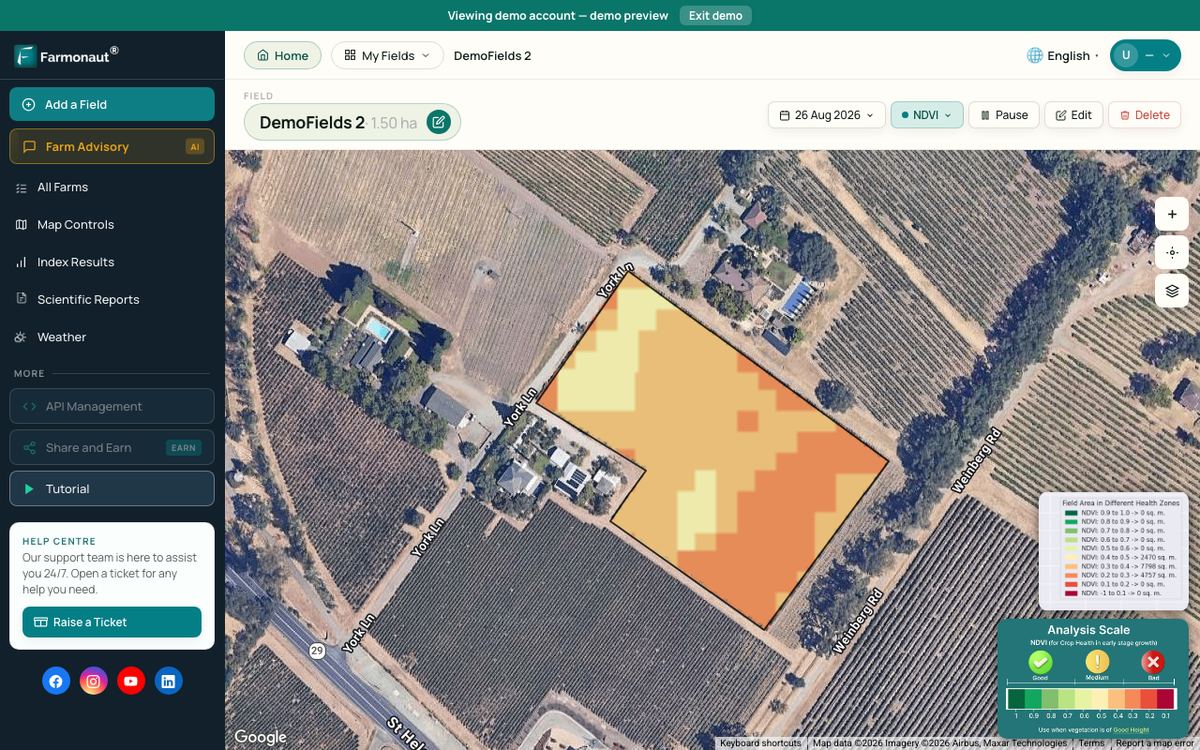
About 27% of US farms used precision agriculture practices such as GPS guidance, yield mapping or drones in 2023, and 22% in 2025, according to the USDA Technology Use report (August 2025). The Farmonaut Satellite + AI Farm Monitoring System adds satellite vegetation maps of each field through the season, which helps a grower decide where to walk first; it does not replace checking crops on foot.
Chart
Tractors in use, 1961 vs 2000
Thousands of four-wheel tractors in use, selected regions
Related pages on our site: web app, Farmonaut API, developer docs, product traceability, carbon footprinting, large-scale farm management and fleet management.

▶ Six plain steps to start precision farming, from field maps to satellite monitoring. · 4:18
FAQ
What is the cultural significance of farming tools?
Farming tools set the farming calendar, appear in rituals, decide who does which job and act as symbols of peace or hard labour. Examples are England’s Plough Monday, Japan’s Mibu rice-planting ritual (UNESCO, 2011) and the UN’s swords-into-ploughshares statue (1959).
What tools were used for planting, cultivating and harvesting?
Planting: digging sticks, dibbers, seeder ploughs. Cultivating: hoes, spades, foot ploughs, ards, heavy ploughs. Harvesting: sickles and scythes, then flails, sledges and winnowing baskets.
What is the oldest farming tool?
The digging stick and the sickle are among the oldest. Flint sickle blades from the Levant, about 15,000 to 11,700 years old, carry wear from cutting cereals.
Are traditional farming tools still used today?
Yes. Human muscle supplies 65% of land-preparation power in sub-Saharan Africa (FAO), Andean farmers still use the foot plough on high, steep land, and gardeners everywhere use hoes, spades and dibbers.
Farmonaut crop monitoring
See your own fields from space
Draw your fields once and Farmonaut shows satellite vegetation maps for them through the season, on web, Android or iOS.



Keep reading
Sources
- FAO, Globally Important Agricultural Heritage Systems (GIAHS) programme page (accessed October 2026): fao.org
- FAO, FAO honours 28 Globally Important Agricultural Heritage Systems across 14 countries (31 October 2025): fao.org
- FAO GIAHS, Chinampas Agricultural System in Mexico City (GIAHS since 2017): fao.org
- FAO GIAHS, Hani Rice Terraces, China (GIAHS since 2010): fao.org
- FAO, Sustainable Agricultural Mechanization: FAO-CEMA partnership (accessed October 2026): fao.org
- FAO and African Union Commission, Sustainable Agricultural Mechanization: A Framework for Africa (2018): fao.org
- FAO, Contribution of farm power to smallholder livelihoods in sub-Saharan Africa (executive summary): fao.org
- FAO, Small family farmers produce a third of the world’s food (23 April 2021): fao.org
- US National Park Service, The Gardens (Knife River historic site, North Dakota): nps.gov
- State Historical Society of North Dakota, Native gardening online exhibit: history.nd.gov
- Janick, Ancient Egyptian Agriculture and the Origins of Horticulture, Purdue University: hort.purdue.edu
- Museum for Old Techniques (MOT), Chaquitaclla (tool record ID 870): mot.be
- Gade and Rios, Chaquitaclla: the native footplough and its persistence in Central Andean agriculture, Tools & Tillage (1970s; MOT copy): mot.be
- Andersen, Jensen and Skovsgaard, The Heavy Plough and the Agricultural Revolution in Medieval Europe, University of Southern Denmark discussion paper (2013): sdu.dk
- University of Oxford, Electronic Text Corpus of Sumerian Literature, The farmer’s instructions: translation: etcsl.orinst.ox.ac.uk
- Groman-Yaroslavski et al., Natufian sickle blades reveal cereal cultivation ca. 4.5 millennia before domestication, Scientific Reports (2026): pmc.ncbi.nlm.nih.gov
- Pitt Rivers Museum, University of Oxford, Agricultural tools used for harvesting cereal crops: england.prm.ox.ac.uk
- Weald & Downland Living Museum, Plough Monday: Welcoming in the Agricultural Year (12 January 2026): wealddown.co.uk
- UNESCO, Mibu no Hana Taue, ritual of transplanting rice in Mibu, Hiroshima (inscribed 2011): ich.unesco.org
- United Nations Gifts, Let Us Beat Swords Into Ploughshares (gift UNNY013G, 1959): un.org
- USDA NASS, Technology Use (Farm Computer Usage and Ownership), August 2025: esmis.nal.usda.gov
Discussion
Questions, corrections or field experience? Share them below. First-time comments are reviewed before they appear, and your email is never published.
No comments yet. Be the first to add a question or your experience.

 Red Dog Management
 Liquify Digital
 Ascentya
 CU Foods
 BeyondTech Global
 Rouge VC
 AgroGreen Dynamics
 AgroRisk
 Oath Inc
 Reddane Farming
 Esri North East Africa
 Cresol
 Atur Kuliner
 MDCV UK
 Zerella Group
 Etech Consulting Madagascar
 Vestlandsforsking
 Delicio
 WB Dev
 Sama Premium
 Prochecker
 Tres Valles
 LACOS Geoinformation
 Exploration consultancy · South Africa · Gold
 Licence holder · Niger · Gold










