

Beekeeping · Buyer guide
Beekeeping Suits for Sale: Prices and Fabrics Compared
Dealer list prices on 16 October 2026 ran from about $75 for a cotton coverall to $289 for a premium vented jumpsuit. Fabric drives the gap: mesh suits are cooler and harder to sting through.
Key takeaways
- US dealer list prices on 16 October 2026: about $75 for a cotton suit, $110 to $139.95 for mesh suits and $289 for a premium vented jumpsuit.
- Jackets in the mesh and premium lines listed $10 to $110 below the matching suit.
- Dealers say three-layer mesh keeps stingers off the skin; single-layer cloth can let stings through where it is pulled tight.
- Canada had 15,430 beekeepers in 2024, the most since 1988 (Statistics Canada).
- People with a severe venom allergy should carry two epinephrine devices and see an allergist (AAAAI).
In this article
- Beekeeping suits for sale at a glance
- How we chose and checked the prices
- Beekeeping suit prices by fabric
- Suit or jacket: which one to buy
- What to check before you buy a beekeeping suit
- Gloves, boots and other protective gear
- Sting allergy and when to see a doctor
- Who is buying bee suits
- What a suit costs you per season
- How to care for a beekeeping suit
- Bees, pollination and the wider farm
- FAQ
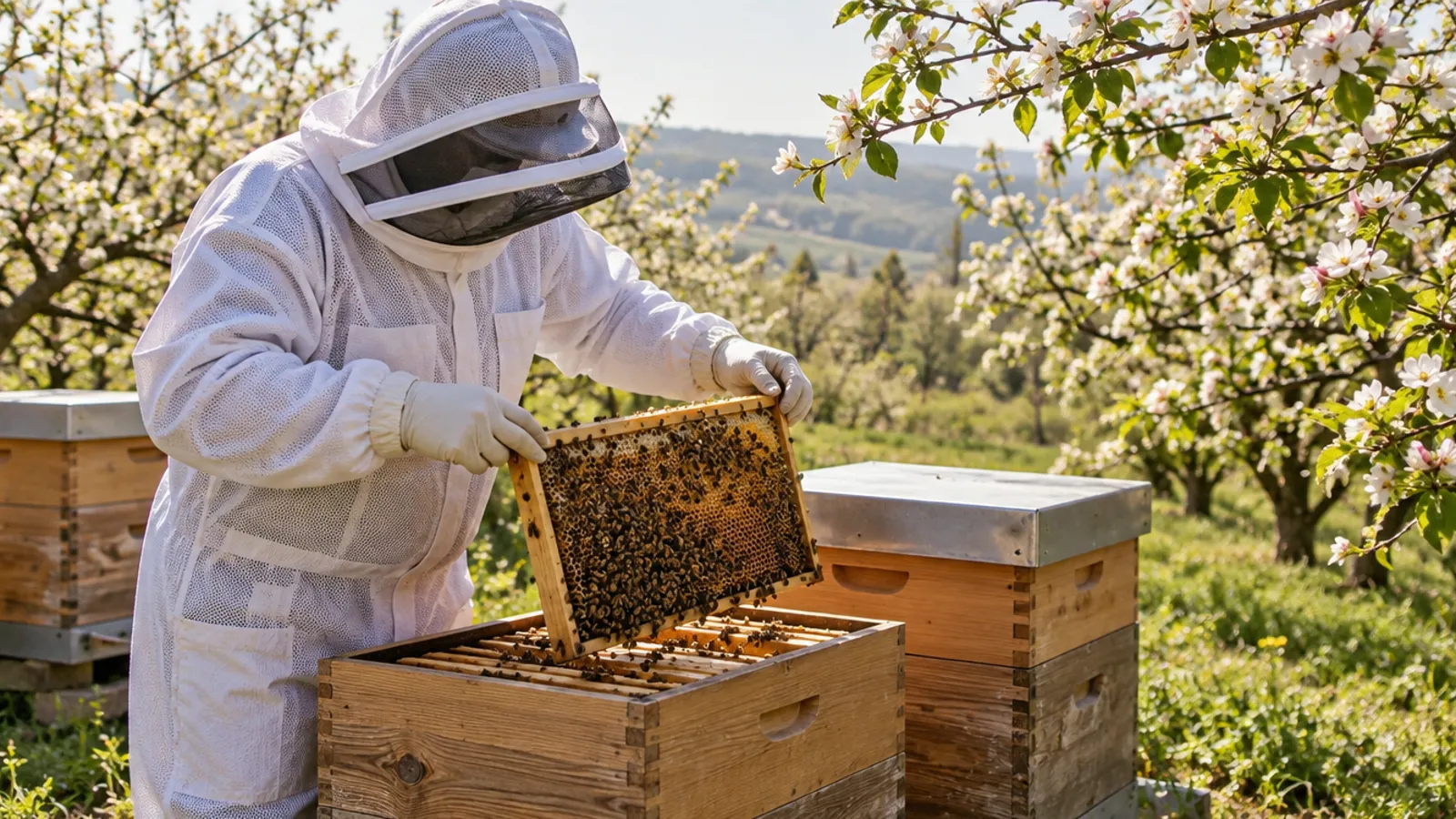
A beekeeping suit for sale in the US costs from about $75 for a plain cotton coverall to $289 for a premium ventilated jumpsuit, based on dealer list prices we checked on 16 October 2026 (for example the Swarm Commander cloth suit at Blythewood Bee Company). Price follows fabric. Cotton is cheap and tough but hot. Three-layer mesh lets air through, and dealers say the spaced layers keep stingers off the skin. Jackets cost a little less than full suits of the same fabric.
This buyer guide compares the main suit types, shows the list prices in a chart, and gives a calculator that works out what each suit costs you per season. It also covers fit, veils, gloves and care, plus what to do if a sting turns serious.
Beekeeping suits for sale at a glance
The table sums up the four suit types you will see at most bee supply dealers. Prices are US dealer list prices on 16 October 2026, before tax and shipping, for adult sizes. Sales and size surcharges change them.
| Suit type | Best for | Pros | Cons | List price seen |
|---|---|---|---|---|
| Cotton coverall | Cool climates, tight budgets | Cheap, tough, easy to wash | Hot; stings can pass where cloth is pulled tight | About $75 (suit) |
| Three-layer mesh | Warm summers, hobby yards | Air flows through; light | Mesh can snag on hive corners | $110 (suit), $95 (jacket) |
| Ultra-mesh | Hot, humid regions | Very cool; thick sting gap | Bulkier; costs more | $139.95 (suit), $129.95 (jacket) |
| Premium vented | Commercial or daily use | Light, cool, replaceable parts | Highest price | $289 (suit), $179 (jacket) |
| Vented jacket | Quick checks, calm colonies | Easy on and off | Legs not covered | $109 (jacket) |
How we chose and checked the prices
We looked for suits sold by named US bee supply dealers that publish prices online. We took the price shown for a standard adult size on 16 October 2026. These are dealer asking prices (list prices), not auction results or average transaction prices. We did not test the suits ourselves, so the pros and cons come from the dealers’ own fabric descriptions and from extension guidance on protective gear.
The dealers were Blythewood Bee Company (Swarm Commander range), Ultra Breeze and BackYardHive. Prices in Canada, the UK, Europe and Australia differ because of import costs and tax, so use the chart as a guide to the gaps between fabric types, not as a local quote.
Beekeeping suit prices by fabric
Fabric drives most of the price gap. A plain cloth suit is one layer of cotton or poly-cotton. Mesh suits use two or three layers of open foam or mesh, which keeps the skin further from a bee’s stinger and lets air move. Premium suits add lighter fabrics, sewn-in hoods and parts you can replace, such as a zipper or hood.
Chart
Bee suit and jacket list prices
US dealer list prices in USD for a standard adult size, 16 October 2026
In the mesh and premium lines we checked, a jacket listed $10 to $110 below the matching suit (for example the Swarm Commander three-layer jacket at $95 and the ultra-mesh jacket at $129.95). Always check the price for your size: some dealers charge more for large sizes, though the Swarm Commander and Ultra Breeze suits we checked cost the same in every size.
Cotton and poly-cotton coveralls
These are the classic white suits. They suit cool springs and autumns and beekeepers who open hives for short spells. Cloth can let a sting through where it is stretched tight over a knee or shoulder, so buy one size up. White or light colors are the norm; the Penn State Extension beekeeping basics guide outlines the equipment beginners need.
Three-layer and ultra-mesh suits
Many beekeepers choose mesh suits for summer work. Dealers say the three layers leave an air gap that keeps stingers off the skin. The Swarm Commander triple-layer suit lists at $110 and the ultra-mesh version at $139.95. The thicker the mesh, the cooler and safer it tends to be, but the bulkier it feels in tight spaces.
Premium vented suits
At the top end, the Ultra Breeze jumpsuit lists at $289 with hood, the matching jacket at $179, and a replacement hood at $40. Brands at this price sell spare parts so you can repair rather than replace. That matters for people who work bees most days of the season.
Suit or jacket: which one to buy
A jacket covers your head, arms and body. A suit covers you from neck to ankles. New beekeepers and anyone working large or defensive colonies should start with a full suit. Bees that land on trousers can crawl up a leg, and a sting near the ankle is common when people kneel by a hive.
A jacket is fine for quick checks on calm colonies, feeding, or work in hot weather when you want to move fast. Many beekeepers own both: a suit for full inspections and honey harvest, and a jacket for short visits. If you buy a jacket, wear thick trousers and tuck them into boots.
The University of New Hampshire Extension tells growers who rent hives to put on a protective veil before a beekeeper opens a hive for them, and to push or scrape a stinger out rather than pinch it, because pinching pushes more venom out of the sac.
What to check before you buy a beekeeping suit
- Veil type. A fencing veil sits away from the face and gives a wide view. A round hat veil gives more shade. Check that the veil zips onto the suit all round, with no gap at the neck.
- Zippers. Heavy two-way zippers with a cover flap stop bees getting in. BackYardHive says its suits use coated YKK zippers with metal pulls.
- Cuffs. Elastic at wrists and ankles, or thumb loops and ankle straps, close the main entry points.
- Sizing. Buy one size up so the fabric does not stretch tight when you bend. Try it on over the clothes you will wear.
- Color. Light colors are standard; bees react more to dark, moving objects.
- Washing. Check whether the veil comes off. A removable veil makes machine washing easy.
- Spare parts. A suit you can repair lasts longer and lowers your cost per season.
Gloves, boots and other protective gear
A suit is only part of the kit. Leather gloves with long gauntlets protect hands and wrists; some beekeepers move to thinner nitrile gloves as they gain confidence, because they give more feel and reduce crushed bees. Boots that close at the top, or ankle straps, stop bees from walking up a leg. A smoker, a hive tool and a bee brush finish the basic set.
Keep a simple sting kit by the apiary: a card to scrape stingers, cold packs, and any medicine your doctor has prescribed. If you hire helpers, check that each one has gear that fits.
Sting allergy and when to see a doctor
Most stings cause local redness, swelling and itching. The American Academy of Allergy, Asthma and Immunology says that for a small number of people with venom allergy a sting can be life-threatening, and that anaphylaxis is a medical emergency. Signs include hives, swelling of the throat or tongue, trouble breathing and dizziness.
The same group advises people with a severe allergy to carry two epinephrine devices, because about one time in three a second dose is needed. This is general information, not medical advice: if you react strongly to a sting, see a doctor or allergist before you keep bees, and follow their plan. A good suit lowers the number of stings but never makes them impossible.
Who is buying bee suits
More people keep bees in Canada. Statistics Canada counted 15,430 beekeepers in 2024, up from 10,523 in 2019 and the most since 1988, with 829,120 colonies. New beekeepers are the main buyers of first suits.
Existing beekeepers also replace and add gear. Winter losses are high, so many split and rebuild colonies each spring, which means more hours in a suit. The Canadian Association of Professional Apiculturists reported a national winter loss of 34.6% for 2023-2024, above the 2007-2023 average of 27.7%.

▶ Ten small farm business ideas, including keeping bees, that need little land to start. · 6:03
What a suit costs you per season
A cheaper suit that wears out fast can cost as much per year as a dearer suit that lasts. Mesh tears on hive corners, and cloth suits stain and thin with washing. Use the calculator below with your own prices and how long you expect each suit to last. The default numbers are only examples, set close to break-even.
Try the numbers for your own farm below.
Calculator
Which suit costs less per season?
Enter the prices you are quoted and how long you expect each suit to last.
- Suit A cost per season: $38
- Suit B cost per season: $35
- Seasons suit B must last to break even: 3.7 seasons
Example values only, set close to break-even; they are not a forecast of how long any brand lasts. Every number is your input. Add repairs or spare parts to the price if you expect to buy them.
How to care for a beekeeping suit
Wash suits often. Bees leave alarm scent on fabric where they sting, and a smelly suit can make the next visit worse. Take off the veil first and wash it by hand. Wash the suit in cool water with a mild detergent, close all zippers, and hang it to dry out of strong sun.
Check seams and zippers before each season. Patch small tears in mesh at once; a bee will find any gap. Store the suit dry, away from wax moths and mice, in a sealed bag or box.
Bees, pollination and the wider farm
Many farmers keep hives for pollination as well as honey. Orchards, berries, canola and many seed crops do better with bees nearby. The FAO has published guidance on bees and their role in farm livelihoods. If you place hives next to crops, agree spray timing with your neighbors and follow the pesticide label; check local rules on hive registration too.
Chart
Canadian honey bee winter losses
National winter loss, percent of colonies, including non-viable colonies
Honey is the other income from hives, and it can swing a lot from year to year. The USDA NASS Honey report put 2025 US production at 116 million pounds, down 14% from 2024, from 2.41 million honey-producing colonies with an average yield of 48.0 pounds per colony. A poor honey year is a good reason to keep gear costs low and make each suit last.
Farmers who track crop health across many fields can use the Farmonaut Satellite + AI Farm Monitoring System to see vegetation maps for each field through the season, which helps time field work around flowering.
Related pages on our site: Farmonaut home, large-farm admin app, web app, satellite and weather API docs, carbon footprinting, product traceability and fleet management.
Chart
US honey output, 2024 vs 2025
Production in million pounds and yield in pounds per colony, honey-producing colonies

▶ Seven simple sustainable farming practices that protect soil, water and pollinators. · 4:34
FAQ
How much does a beekeeping suit cost?
US dealer list prices on 16 October 2026 ran from about $75 for a cotton suit to $289 for a premium vented jumpsuit. Mesh suits sat between $110 and $140.
Can bees sting through a beekeeping suit?
Yes, sometimes. Stings get through single-layer cloth where it is pulled tight. Thick three-layer mesh keeps the fabric further from the skin, so fewer stings get through, but no suit is fully sting-proof.
Is a jacket enough for a beginner?
A full suit is the safer start. Bees can crawl up trouser legs, and beginners spend longer with the hive open. A jacket suits short checks on calm colonies.
What color should a bee suit be?
White or another light color. Bees react more to dark, moving shapes, and light fabric also stays cooler in the sun.
How often should I wash my suit?
After any visit with many stings, and regularly through the season. Take off the veil first, wash in cool water and hang to dry.
Farmonaut crop monitoring
See your own fields from space
Draw your fields once and Farmonaut shows satellite vegetation maps for them through the season, on web, Android or iOS.




Sources
- Blythewood Bee Company, Swarm Commander Regular Cloth Beekeeping Suit (list price, checked 16 Oct 2026): blythewoodbeecompany.com
- Blythewood Bee Company, Swarm Commander Triple Layer Ventilated Bee Suit (list price, checked 16 Oct 2026): blythewoodbeecompany.com
- Blythewood Bee Company, Swarm Commander Ultra-Mesh Beekeeping Suit (list price, checked 16 Oct 2026): blythewoodbeecompany.com
- Blythewood Bee Company, Swarm Commander Triple Layer Mesh Beekeeping Jacket (list price, checked 16 Oct 2026): blythewoodbeecompany.com
- Blythewood Bee Company, Swarm Commander Ultra-Mesh Beekeeping Jacket (list price, checked 16 Oct 2026): blythewoodbeecompany.com
- Ultra Breeze, Jumpsuit with hood (list price, checked 16 Oct 2026): ultrabreeze.com
- Ultra Breeze, Jacket with hood (list price, checked 16 Oct 2026): ultrabreeze.com
- Ultra Breeze, Replacement hood (list price, checked 16 Oct 2026): ultrabreeze.com
- BackYardHive, Ventilated Beekeeping Jacket (list price, checked 16 Oct 2026): backyardhive.com
- Penn State Extension, Beekeeping Basics: extension.psu.edu
- University of New Hampshire Extension, guidance on bees and stings for growers: extension.unh.edu
- American Academy of Allergy, Asthma and Immunology, Stinging Insect Allergy: aaaai.org
- Statistics Canada, More beekeepers and more bee colonies in 2024, but less honey and less money: statcan.gc.ca
- USDA NASS, Honey (March 2026): esmis.nal.usda.gov
- Canadian Association of Professional Apiculturists, Statement on Honey Bee Wintering Losses in Canada 2023-2024: capabees.com
- FAO, Bees and their role in forest livelihoods: fao.org
Discussion
Questions, corrections or field experience? Share them below. First-time comments are reviewed before they appear, and your email is never published.
No comments yet. Be the first to add a question or your experience.

 IRE Soil
 Blickwinkel
 Agricultural Credit Policy Council
 BayWa
 MCSOD
 Marei Nursery
 eKGIS
 Mostas Tech
 Native Seeds
 Andex
 FCF India
 Unifrutti Gulf
 Deluxe Conseil
 TVS Electronics
 WICO
 Chimera Innovation

 Licence holder · Niger · Gold
 Licence holder · Nigeria · Gold + lithium










