

Blueberries · Soil pH guide
Acidic Soil for Blueberries: pH Targets and Sulfur Rates
Blueberries grow best at soil pH 4.5 to 5.5 (Oregon State, Ohio State and RHS). Lower a higher pH with elemental sulfur, mixed in months before planting, or build raised beds and pots with an acidic mix of peat or pine bark.
Key takeaways
- Target soil pH 4.5 to 5.5 for blueberries; Ohio State calls 4.5 ideal, and Clemson suggests staying above 5.0 on high-manganese soils.
- Test in a lab a year before planting; OSU says color kits are often not accurate enough to guide acidification.
- Ohio State’s table: about 3.5 lb of sulfur per 100 sq ft takes a loam from pH 6.0 to 4.5; sand needs 1.2 lb and clay 3.7 lb.
- Apply sulfur in steps a year apart and re-test; too much can push pH so low that some elements become toxic.
- For heavy or alkaline soil, use raised beds or pots with peat, composted pine bark or ericaceous compost; skip lime, ash and manure.
In this article
- What pH do blueberries need?
- Why acidity matters for blueberry roots
- Test your soil before you change it
- How to make soil acidic for blueberries with sulfur
- The best acidic soil mix for blueberries in beds and pots
- A step-by-step plan for new plantings
- Keeping soil acidity right after planting
- Where blueberries are grown
- How we checked the numbers
- FAQ
Blueberries need acidic soil with a pH of about 4.5 to 5.5, according to Oregon State University Extension and the Royal Horticultural Society. If your soil test reads higher, you lower it with elemental sulfur, add acidic organic matter such as peat moss or pine bark, or grow the bushes in raised beds or pots filled with an acidic soil mix for blueberries. This guide gives the pH targets, the sulfur rates by soil type, a sulfur calculator and the mixes that extension services describe.
What pH do blueberries need?
Blueberries belong to the heath family, like azaleas and rhododendrons. They are adapted to sour, open, organic soils. Three sources used for this guide agree on a working range:
- Oregon State University (OSU) Extension: pH 4.5 to 5.5 for blueberry and cranberry.
- Ohio State University Extension: pH 4.5 to 5.5, with 4.5 as the ideal and 4 to 7 percent organic matter or more.
- The Royal Horticultural Society (UK): pH 4.5 to 5.5 in the ground, or ericaceous (lime-free) compost in pots.
Most garden plants sit higher. OSU suggests pH 6.0 to 7.0 for vegetable gardens and fruit trees, and 5.5 to 6.5 for grapes. That is why a bed that grows good tomatoes can still be too sweet for blueberries. The chart below shows the gap.
Clemson University adds a warning for the southern US. In its blueberry fact sheet for South Carolina, it says to pick another site if the pH is above 6.0. On Piedmont soils that are high in manganese, Clemson suggests keeping the pH above 5.0 to avoid problems. So lower is not always better.
Chart
Suggested soil pH: blueberries vs other plants
pH range, selected plants, Western Oregon and Washington guidance
Why acidity matters for blueberry roots
Blueberry roots are fine and shallow. When the soil pH is too high, the plant cannot take up enough iron. OSU describes the result: small, pale or yellow leaves with green veins, starting on new growth. Brown leaf edges can follow. Over time, iron-starved plants grow poorly and can die.
OSU also notes that zinc and iron have limited availability when soil pH is above 7.5. Penn State Extension explains the other side of the scale: as pH falls below 5.5, aluminum and manganese become more available and can reach toxic levels for many crops (Penn State Extension, soil acidity and aglime). Blueberries tolerate acid soil better than most crops, but very low pH from too much sulfur can still harm them, as Clemson points out.
Yellow leaves do not always mean high pH. OSU lists nitrogen shortage, sulfur shortage, too much sun and dry soil as other causes. Nitrogen shortage shows first on older leaves, while iron shortage shows on new leaves with green veins. OSU advises a soil test before you start any acidifying program.
Lowbush, highbush and rabbiteye
Wild lowbush blueberries grow on naturally acidic land in Maine and eastern Canada. Northern highbush types are grown in cooler regions such as Oregon. Southern highbush types were bred for mild winters, and UF/IFAS describes their spread across Florida. The University of Florida notes that wild blueberries grow nearly everywhere in Florida except where the soil pH is above 6.0 (UF/IFAS, Southern Highbush Blueberry Cultivars). All types want acid soil; rabbiteye is described by Clemson as the most adaptable of the three in South Carolina.

▶ A look at blueberry growing in Niğde, Turkey, from greenhouse methods to market demand. · 2:31
Test your soil before you change it
Start with a lab test, not a guess. OSU says color-based kits from garden centers can give an estimate, but they are often not accurate enough to guide acidification. A lab pH test is usually a small fee; OSU’s guide (first published in 2003) put it at under $10, so check current lab prices. Ohio State recommends testing pH, buffer pH, nutrients and organic matter before you prepare the soil, then testing again after you add sulfur and fertilizer.
Clemson’s soil testing guide explains how to sample. Take several cores from one area, mix them in a clean plastic bucket, and send about 2 cups of soil per sample. Keep areas that were limed or fed differently as separate samples. Clean tools matter, because fertilizer residues can skew results.
Plan ahead. OSU suggests testing a year before planting so there is time to fix the pH. If you already have plants, test at the same time each year, because soil pH varies through the seasons.
How to make soil acidic for blueberries with sulfur
Elemental sulfur is the main tool extension services recommend for lowering soil pH. Soil bacteria turn it into sulfuric acid, which lowers the pH. Ohio State notes that this happens in warm, moist soil during the growing season, not in winter. That is why results take months, not days.
The amount depends on two things: how far you need to go and how much clay is in the soil. Clay and organic matter buffer pH, so they need more sulfur than sand for the same change. The rates below come from Ohio State’s table for a target of pH 4.5, in pounds of sulfur per 100 square feet.
| Starting pH | Sand | Loam | Clay |
|---|---|---|---|
| 5.0 | 0.4 lb | 1.2 lb | 1.4 lb |
| 5.5 | 0.8 lb | 2.4 lb | 2.6 lb |
| 6.0 | 1.2 lb | 3.5 lb | 3.7 lb |
| 6.5 | 1.5 lb | 4.6 lb | 4.8 lb |
| 7.0 | 1.9 lb | 5.8 lb | 6.0 lb |
| 7.5 | 2.3 lb | 6.9 lb | 7.1 lb |
Source: Ohio State University Extension, Growing Blueberries in the Home Garden (HYG-1422), Table 2. Rates to reach pH 5.0 are lower; see the original table.
OSU gives similar advice in its blueberry growing guide (EC 1304). For a clay loam starting at pH 5.7 to 6.5, it suggests 2 to 5 pounds of sulfur per 100 square feet. For sandy soils, it suggests about 1 to 3 pounds. Its goal is pH 5.5, the top of the suitable range. If the pH is only 5.5 to 5.7, OSU says sulfur is not needed, because fertilizer will lower the pH over time.
Rules for applying sulfur
- Mix it in. Ohio State says to work sulfur through the top 4 inches of soil about three months before planting. If the pH is above 6 and calcium is high, apply it the year before.
- Go in steps. OSU recommends two smaller applications a year apart rather than one large one. Re-test each year.
- Do not overdo it. OSU warns that too much sulfur can push the pH so low that some elements become toxic to plants.
- Keep the soil moist, not wet. Water helps the reaction, but saturated soil slows it.
- Wear gloves. Ohio State advises gloves when you handle any form of elemental sulfur.
Follow the product label and local rules for any soil amendment or fertilizer, and ask your local extension office if your soil is unusual.
What about aluminum sulfate and acid fertilizers?
Aluminum sulfate also lowers pH, but OSU does not recommend it because aluminum can harm roots. Fertilizers with ammonium nitrogen, such as ammonium sulfate and urea, lower pH slowly. OSU says ammonium sulfate is the most acidifying of the common forms, and that nitrogen fertilizer suits a drop of only 0.2 to 0.3 units, not big changes. OSU also says not to apply nitrogen fertilizer to blueberries in fall, because winter rain can carry nitrate down to groundwater.
Chart
Sulfur needed to reach pH 4.5, by soil type
lb of elemental sulfur per 100 sq ft, by starting soil pH
The best acidic soil mix for blueberries in beds and pots
If your native soil is heavy, alkaline or near concrete, it is often easier to build a new root zone than to fix the old one. OSU notes that lime leaching from sidewalks and foundations can raise soil pH over time. Ohio State suggests raised beds about 4 feet wide and 9 inches high on loam, clay loam or clay soils, for better drainage.
Here are the main ingredients that extension services and the RHS describe, with what each is best for.
1. Peat moss (sphagnum)
Best for: planting holes and quick acidity. Ohio State suggests about one gallon of peat or sphagnum moss in each planting hole, mixed with the native soil. Clemson suggests a 1:1 mix of peat moss and sand for gardeners who plant without a soil test. Peat is acidic and holds water. The RHS asks UK gardeners to choose peat-free products, so check your local guidance.
2. Composted pine or conifer bark
Best for: raised beds and peat-free mixes. The RHS lists composted conifer bark, pine needles, leafmould and bracken as low-pH organic matter to add when you backfill. UF/IFAS notes that Florida farms use large amounts of pine bark to improve pH and organic matter, and that this is a real cost of starting a planting.
3. Sand without lime
Best for: drainage in a peat mix. Clemson says to use sand that has not been limed. It notes that builder’s “sharp” sand does not usually contain liming materials, but check the bag.
4. Aged wood chips, sawdust and leaf mold
Best for: building organic matter and mulch. Ohio State lists aged wood chips and leaf mold as ways to raise organic matter, worked into the top 4 to 6 inches a year before planting. As a mulch, it suggests 2 to 4 inches of sawdust, wood chips or peat. When you mulch with wood, Ohio State suggests adding one pound of actual nitrogen per 1,000 square feet, because the wood ties up nitrogen as it breaks down.
5. Ericaceous potting compost
Best for: containers. For pots, the RHS suggests peat-free ericaceous compost. It warns against well-rotted farmyard manure and mushroom compost, which can raise pH.
What to leave out
Skip lime, wood ash, mushroom compost and manure in a blueberry mix. Each can raise pH. Also avoid planting next to concrete paths, as noted above.

▶ Why organic matter matters in soil and how it supports roots, water and nutrients. · 7:33
A step-by-step plan for new plantings
- Test the soil a year ahead. Ask for pH, buffer pH, organic matter and nutrients.
- Pick the site. Full sun (6 to 8 hours a day, per Ohio State), good drainage, away from concrete.
- Decide: amend or build. If the pH is under about 6.0 and drainage is good, amend in place. If not, build raised beds with an acidic mix.
- Add sulfur and organic matter. Use the table above or the calculator at the end of this section. Mix it in and wait.
- Re-test. Check the pH again before planting, then each year at the same time.
- Plant and mulch. Ohio State suggests highbush spacing of 3 to 4 feet in rows 10 feet apart, and a 2 to 4 inch mulch.
Try the numbers for your own farm below.
Calculator
How much sulfur does your blueberry bed need?
Enter your bed area, the rate from the table for your soil and pH, and your bag size and price.
- Per application if split in two: 3.5 lb
- Bags needed (round up): 1.4 bags
- Approximate cost: $21
Example values only, not a recommendation: 200 sq ft, 3.5 lb per 100 sq ft (Ohio State HYG-1422 table rate for loam from pH 6.0 to 4.5), a 5 lb bag at $15. Bag size and price are your inputs. The split line follows OSU EC 1560 advice to apply in two smaller doses a year apart. Your soil lab’s rate comes first; follow the product label.
Keeping soil acidity right after planting
Blueberry plantings can produce for more than 50 years, according to OSU. Over that time, the pH can creep up, especially with hard irrigation water or lime from nearby concrete. Re-test every year.
For plants that already show iron chlorosis, OSU describes a spot treatment: dig at least 4 holes (preferably 8 to 12) around the drip line, at least a foot deep, and mix about a quarter cup of sulfur into the soil from each hole. Foliar iron sprays can help in severe cases while the soil pH drops, but OSU notes their effect is short and needs repeating. Follow the product label for any iron or fertilizer product.
If your irrigation water is alkaline, our guide to acidifying water for plants covers that side. For farm-scale checks between lab tests, see our article on soil pH sensors for farmers. A pH probe gives a quick reading, but a lab test remains the benchmark for decisions about sulfur.
Watching large blocks
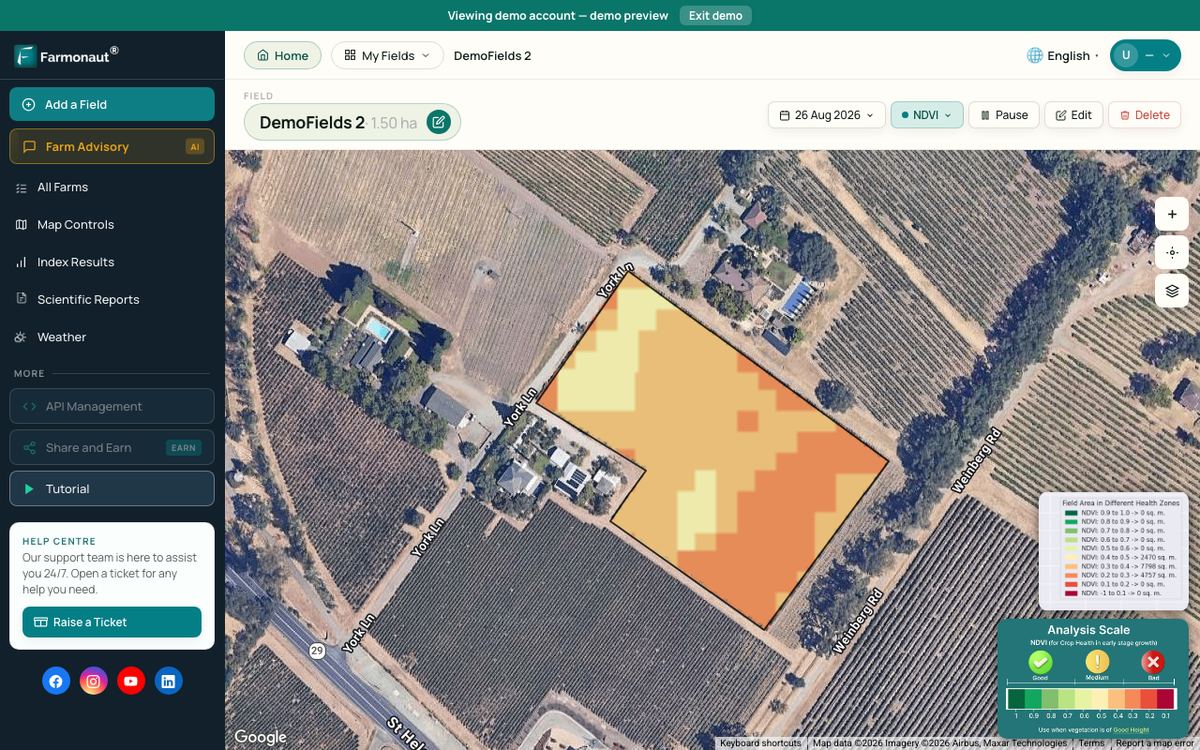
On a commercial farm, it is hard to walk every row. Satellite vegetation maps can show where a block is greener or paler than the rest, which tells you where to take soil and leaf samples. They do not measure pH. Farmonaut offers this kind of field-level crop monitoring on web, Android and iOS, which some growers use to decide where to sample first.

▶ How satellite NDVI maps show crop stress across a farm before it is easy to see on foot. · 4:09
Where blueberries are grown
Commercial blueberry areas cluster where soils are naturally acidic or where growers build beds. In the US, cultivated blueberry production reached about 795 million pounds in 2024 on 104,800 harvested acres, according to USDA NASS Noncitrus Fruits and Nuts 2024 Summary. Washington and Oregon led, followed by Georgia, Michigan and California. The average price for cultivated blueberries in 2024 was $1.45 per pound, a NASS season-average grower price across fresh and processing fruit.
In Canada, blueberry production reached 165,608 metric tons in 2024, according to Agriculture and Agri-Food Canada. Lowbush (wild) types made up 94,111 metric tons and highbush 71,497 metric tons, and British Columbia grew 94% of the highbush crop. These regions share cool, acid soils that suit the plant.
Chart
US cultivated blueberry production by state
million lb, total production, 2024, eight states listed by NASS
How we checked the numbers
We used extension guides from Oregon State, Ohio State, Clemson, Penn State and the University of Florida, the RHS guide for UK readers, and official crop statistics from USDA NASS and Agriculture and Agri-Food Canada. Sulfur rates are general guides for home and small plots. Your lab’s recommendation for your soil comes first. Related pages on our site: agribusiness dashboard, crop loan and insurance data, carbon footprinting, product traceability, satellite and weather API docs and the Farmonaut app.
FAQ
What is the best soil pH for blueberries?
OSU, Ohio State and the RHS all give 4.5 to 5.5. Ohio State calls 4.5 ideal. Clemson suggests staying above 5.0 on soils high in manganese.
Are blueberries acidic fruits?
That is a question about the fruit’s taste, not the soil. Searches for blueberry acidity often mean soil pH, and the plant needs acid soil (pH 4.5 to 5.5) to take up enough iron, whatever the fruit tastes like.
How long does sulfur take to lower soil pH?
Months to a year or more. Ohio State says to mix it in about three months before planting, or a year ahead on high-pH, high-calcium soils. OSU says reactions may take a year or more, so re-test yearly.
Can I use coffee grounds or vinegar to acidify blueberry soil?
None of the extension guides we used recommend them for lowering soil pH. They recommend elemental sulfur, acidic organic matter and, for small changes, ammonium-based fertilizer.
What is acidic soil made of?
Acidic soil has more hydrogen ions in the soil water. Penn State notes that rain leaching calcium and magnesium, crop removal, decaying residues and ammonium fertilizers all add acidity over time. Peat, pine bark and conifer needles add acidic organic matter.
Should I grow blueberries in pots if my soil is alkaline?
The RHS suggests large pots or raised beds filled with ericaceous compost when soil is heavy clay, alkaline or only slightly acid. That avoids years of trying to change a high-pH soil.
Farmonaut crop monitoring
See your blueberry blocks from space
Draw your fields once and Farmonaut shows satellite vegetation maps through the season, so you can see where to take soil and leaf samples first.



Keep reading

Sources
- Oregon State University Extension, Acidifying soil for blueberries and ornamental plants in the yard (EC 1560): catalog.extension.oregonstate.edu
- Oregon State University Extension, Growing blueberries in your home garden (EC 1304): catalog.extension.oregonstate.edu
- Ohio State University Extension, Growing Blueberries in the Home Garden (HYG-1422): ohioline.osu.edu
- Clemson University HGIC, Blueberry fact sheet: hgic.clemson.edu
- Clemson University HGIC, Soil Testing: hgic.clemson.edu
- Penn State Extension, Soil Acidity and Aglime: extension.psu.edu
- UF/IFAS, Southern Highbush Blueberry Cultivars from the University of Florida (HS1245): edis.ifas.ufl.edu
- Royal Horticultural Society, How to grow blueberries: rhs.org.uk
- USDA NASS, Noncitrus Fruits and Nuts 2024 Summary (May 2025): esmis.nal.usda.gov
- Agriculture and Agri-Food Canada, Statistical overview of the Canadian fruit industry, 2024: agriculture.canada.ca
Discussion
Questions, corrections or field experience? Share them below. First-time comments are reviewed before they appear, and your email is never published.
No comments yet. Be the first to add a question or your experience.

 Raketla
 Polaris Digitech
 Teledarbas
 Wild Oak Farm
 SFX
SFX BACF Africa
 Doodlakine
 Exurbia Geospatial
 FieldZero
 Indico Company
 Kubota
 FFBS
FFBS Jontra
 Tucor
Tucor
 Licence holder · Niger · Gold










