

Reviewed August 2026 against USDA NASS, USDA ARS, and UF IFAS Extension data.
Try it: Run your own numbers →
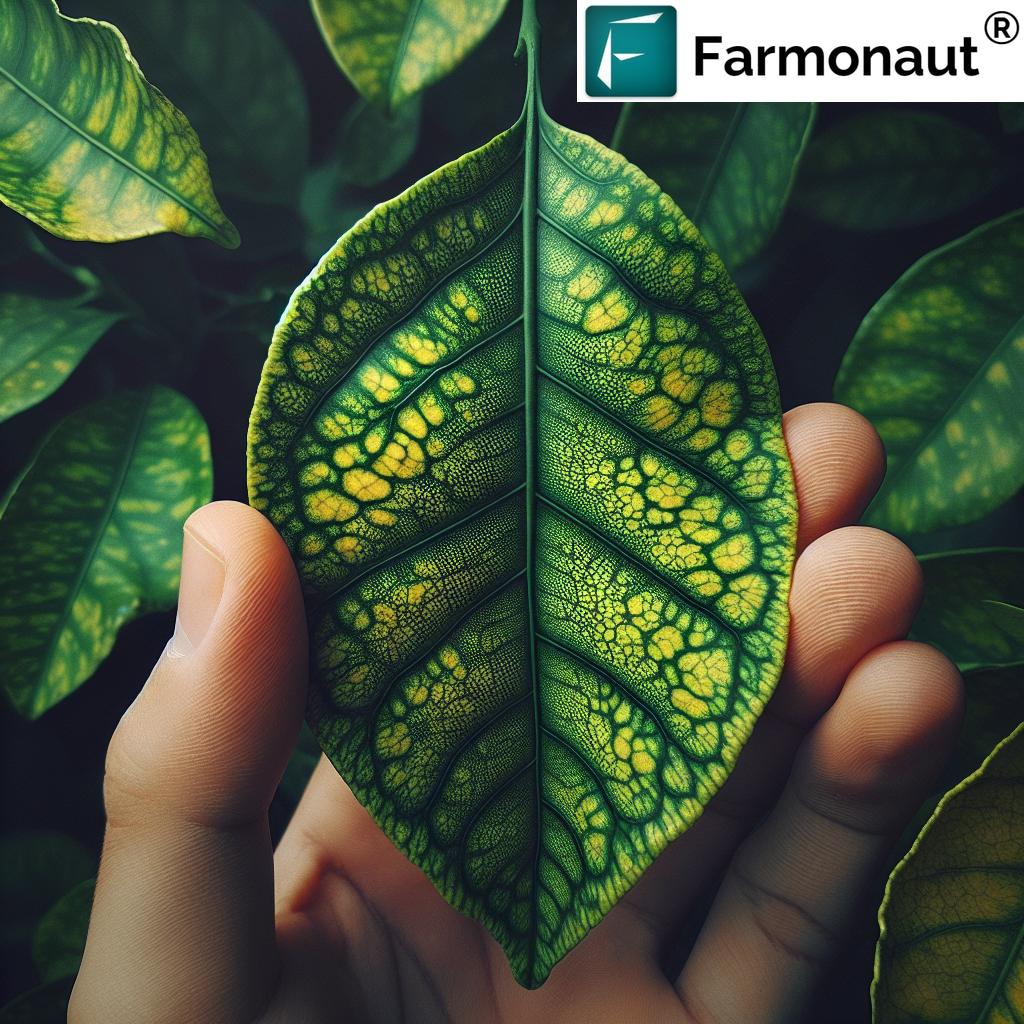
There is no cure for citrus greening disease, also called Huanglongbing (HLB) — no spray, injection, or organic remedy reverses an infection once Candidatus Liberibacter asiaticus establishes in a tree’s vascular system. Treatment means managing the disease, not curing it: controlling the Asian citrus psyllid that spreads it, removing infected trees before they become inoculum sources, and supporting remaining trees nutritionally so they stay productive longer. Growers who do this well can hold a tree in production for years past when an untreated tree would decline into an unmarketable state.
That distinction — control versus cure — is why Florida’s citrus industry has kept shrinking for two decades despite intensive research funding. This guide covers what “treatment” actually accomplishes, what the current data says about the disease’s toll, and the specific control methods — chemical, organic, and cultural — used against it in the United States today.
What Is Citrus Greening Disease?
Citrus greening disease (HLB) is a bacterial infection of citrus trees, transmitted by the Asian citrus psyllid (Diaphorina citri), a mottled-brown insect roughly 3-4 mm long. The psyllid picks up the bacterium Candidatus Liberibacter asiaticus from an infected tree while feeding and injects it into the next tree it visits. Once inside, the bacterium colonizes the phloem — the tree’s nutrient-transport tissue — and progressively starves the tree of the sugars and nutrients it needs to hold fruit and grow new wood.
There is no citrus greening cure available to growers as of this review. Almost every commercially available response — insecticides, nutritional programs, biological control, tolerant rootstock — targets the vector or supports the tree. The exception is trunk-injected oxytetracycline, registered in Florida since 2022, which suppresses the bacterium but does not eliminate it (Citrus Industry). Genetic approaches (discussed below) are the closest thing to a long-term fix, but none has cleared regulatory approval for commercial planting.
How Much Damage Has Greening Actually Done?
The clearest evidence that citrus greening disease is a production-ending threat, not a cosmetic one, is Florida’s harvest data. Florida’s final 2024-25 forecast was 12.15 million boxes of oranges, 1.3 million boxes of grapefruit and 400,000 boxes of tangerines and tangelos (Citrus Industry), the season, the lowest in over a century of USDA record-keeping, according to USDA data reported by CBS Miami. Within that season, orange production dropped 32.7% and grapefruit production dropped 27.4% year-over-year — in a single season, not over a decade.
Zoom out further and the scale is starker: Florida produced 12.15 million boxes of oranges in 2024-25, against 244 million boxes in 1998, before HLB reached the state. That’s a decline of more than 95% in orange output over roughly 27 years, per the same USDA figures.
USDA’s Agricultural Research Service puts a cumulative figure on the land itself: Florida has lost 162,200 acres of citrus plantings since HLB was first detected in the state in 2005, tallied through 2026 (USDA ARS). NASS’s parallel tracking shows Florida orange acreage down 26% and orange yield per acre down 42% over that same 2005-2026 span (USDA NASS Florida Citrus Forecast). Acreage and yield are falling together — growers are losing both the land and the productivity of what’s left.
At the operation level, UF IFAS Extension surveyed growers and found an average HLB-attributed yield loss of 41% on infected blocks (UF IFAS Extension, FE983). That figure is what makes treatment an economic question, not just a horticultural one: a grower isn’t deciding whether to spend money on a tree that will otherwise be fine — they’re deciding how much of that 41% loss they can claw back, and at what cost per acre.
For context on total US supply, NASS recorded 811,000 tons of Florida citrus production against 4.9 million tons nationally in the 2022-23 season — meaning Florida, historically the dominant US citrus state, now supplies well under a fifth of the national total. NASS updates its Florida citrus forecast monthly during the growing season, with final annual counts released each July-August; check the NASS Florida Citrus Forecast page directly for the current season’s numbers rather than relying on any single year cited here.
The latest Florida harvest figures
The newest full season shows a small recovery from a very low base. USDA’s final forecast for the 2025-26 Florida season, released on 10 July 2026, put orange production at 12.92 million boxes, grapefruit at 1.35 million boxes and tangerines and tangelos at 460,000 boxes (Citrus Industry).
That compares with a final 2024-25 forecast of 12.15 million boxes of oranges, 1.3 million boxes of grapefruit and 400,000 boxes of tangerines and tangelos (Citrus Industry). Weather, including hurricanes, moves these numbers from year to year, so a single better season does not mean HLB is under control. The long-run gap is the point: Florida still grows only a small fraction of the oranges it produced before greening arrived.
Across the whole country, US citrus output in 2022-23 was 4.90 million tons, the lowest in at least 50 years, with California supplying 79% and Florida 17% (USDA NASS).
Recognizing Citrus Greening: Symptoms and Stages
Diagnosis matters because HLB symptoms overlap with nutrient deficiencies and other citrus diseases — lab testing (PCR) is the only definitive confirmation. But field symptoms are the first trigger for testing.
Leaf Symptoms
- Blotchy mottling: Irregular green-and-yellow patches on the leaf, asymmetrical across the midrib — this asymmetry is what distinguishes HLB mottling from a zinc or manganese deficiency, which mottles symmetrically.
- Vein corking: Thickened, cork-like veins visible on the leaf underside.
- Premature leaf drop in more advanced infections.
Fruit Symptoms
- Lopsided, small fruit that fails to size normally.
- Color inversion: the stem end colors while the blossom end stays green — the reverse of normal ripening.
- Bitter, medicinal-tasting juice and aborted or discolored seeds.
Tree-Level Progression
| Stage | Leaf symptoms | Fruit impact | Typical grower response |
|---|---|---|---|
| 1. Early infection | Slight, isolated mottling on one or two limbs | Minimal; often undetected without testing | PCR test suspect limbs; increase scouting frequency |
| 2. Moderate infection | Clear mottling across multiple limbs; some dieback | Some lopsided or color-inverted fruit | Begin intensive nutritional program; step up psyllid control |
| 3. Severe infection | Widespread chlorosis, leaf drop | Sharp yield and quality decline | Evaluate removal vs. continued management |
| 4. Tree decline | Extensive defoliation, branch death | Fruit mostly unmarketable | Remove tree to cut inoculum source; replant with certified stock |
Progression speed depends on tree age, variety, and psyllid pressure in the area — a young tree infected soon after planting can decline within a few years, while a mature tree with aggressive management can hold in stage 2 for much longer. There’s no published fixed timeline because the variables are grower-specific; the way to track it for a given block is the same PCR testing and yield monitoring used for initial diagnosis, repeated on a schedule.
The Asian Citrus Psyllid: Why Vector Control Is the Real Fight
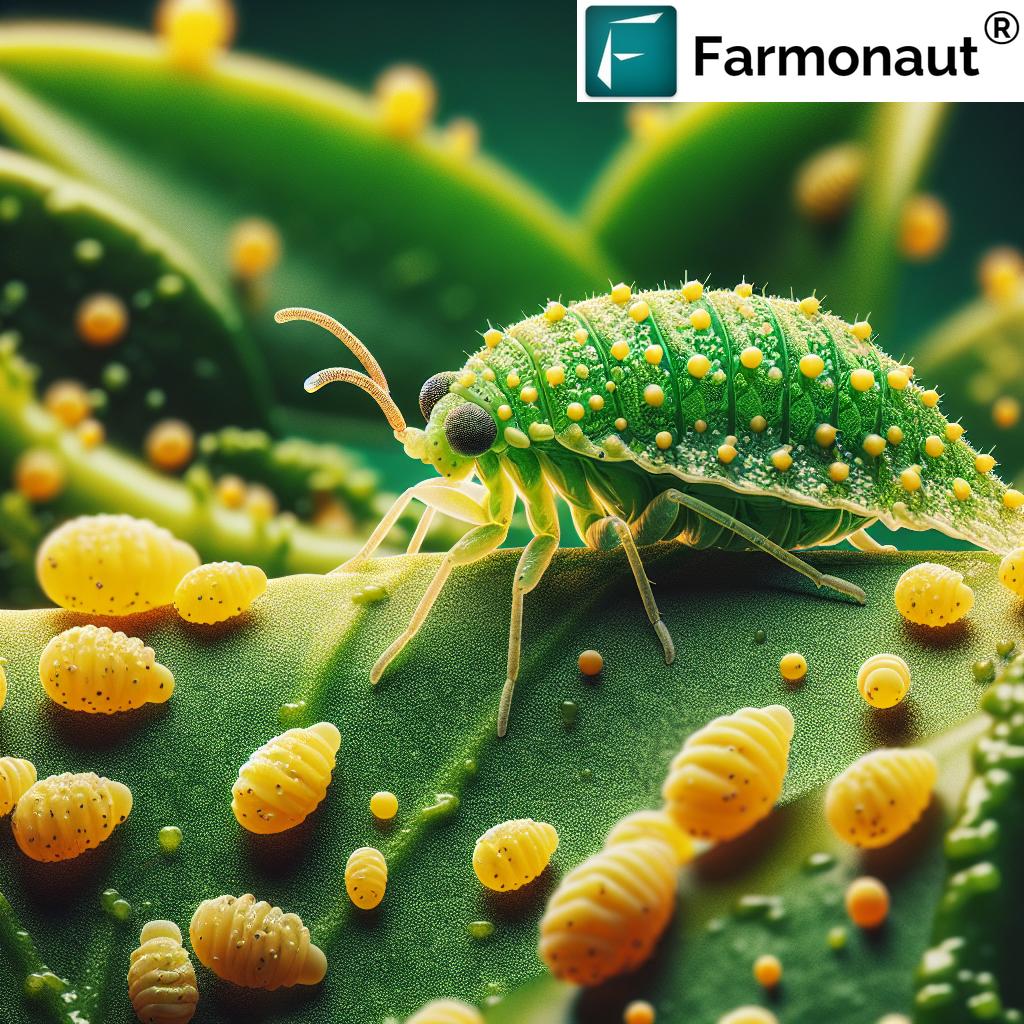
Because there’s no cure for the bacterium itself, every treatment strategy for citrus greening disease control is really a psyllid-management strategy. The insect is small — 3-4 mm as an adult — with mottled brown wings held roof-like over its body. Females lay yellow-orange, almond-shaped eggs on new leaf flush; nymphs are yellowish-orange and produce distinctive waxy tubules. Both nymphs and adults feed on phloem sap and can pick up or transmit the bacterium while doing so.
This is also why “how to prevent citrus greening” and “psyllid control” are the same question. A tree can’t be vaccinated against HLB — the only prevention is keeping infected psyllids away from healthy trees, which is a physical and chemical exclusion problem, not a treatment applied to the tree itself.
Physical exclusion
UC IPM’s current specification for psyllid-proof screening calls for 50-mesh netting at a minimum height of 12 feet (UC IPM, Asian Citrus Psyllid). That mesh size is fine enough to physically stop the insect from crossing, while coarser netting lets adults through. This spec is the closest thing to a durable, checkable standard in this article — it doesn’t change with the season, so it’s worth confirming against the UC IPM page directly if you’re speccing a new screen house or nursery structure, since guidance can be revised.
Chemical control
- Foliar insecticide sprays timed to psyllid life cycles and new-growth flush periods, when nymphs are most exposed and adults are actively feeding.
- Systemic soil drenches for longer-residual protection, typically used on young trees or during high-pressure periods.
Exact labeled products, application rates, and seasonal cost per acre are not published in a form this article can cite reliably, because label approvals and pricing shift by state and by year. Check your state Extension service (UF IFAS for Florida, UC ANR for California) for the current approved-product list before planning a spray program — do not rely on a product name from an older article, since labels are periodically withdrawn or updated.
Biological control
The parasitic wasp Tamarixia radiata attacks psyllid nymphs and has been released across US citrus regions as a biological control agent. The percentage of US citrus acreage where this program is actively sustaining measurable psyllid suppression isn’t published in a citable current figure — if you need an adoption rate for a specific region, your state Extension or county agricultural commissioner’s office tracks local release and establishment data.
Organic and Cultural Control Methods
For growers avoiding conventional insecticides, several organic-compatible tools reduce psyllid pressure, though none reaches the residual kill rate of a systemic chemical program:
- Neem oil: disrupts psyllid feeding and reproduction on contact; needs repeat application since it has no residual systemic activity.
- Pyrethrin-based sprays: derived from chrysanthemum, effective against adult psyllids on contact.
- Horticultural oils: smother eggs and nymphs when coverage is thorough — missed undersides of leaves reduce effectiveness sharply.
- Reflective mulches: disorient psyllids searching for host foliage, reducing landing rates.
- Trap cropping: planting attractive host material away from the main block to divert psyllid pressure.
- Pruning: removes infected limbs and reduces the inoculum available for psyllids to pick up and spread within the same tree or block.
Organic methods generally require more frequent reapplication and tighter timing against flush cycles than systemic chemical programs, since they lack residual activity — but “requires more frequent application” is a real operational tradeoff, not a reason to dismiss them; combined with aggressive scouting and pruning, they’re a legitimate strategy for organic-certified operations that can’t use systemic insecticides at all.
Nutritional Support
Neither nutrition nor compost teas treat the infection, but they measurably extend a tree’s productive life once infected, by supporting the root and canopy systems the bacterium is degrading:
- Enhanced fertilization programs, often with added zinc and manganese foliar applications, to offset the nutrient-transport damage HLB causes.
- Compost teas to support soil and root-zone microbiome health.
- Consistent irrigation to avoid compounding water stress on an already-compromised vascular system.
Trunk injection with oxytetracycline: the one treatment aimed at the bacterium
The only registered HLB treatment that acts on the bacterium itself, rather than the psyllid, is trunk injection of the antibiotic oxytetracycline (OTC). It does not cure a tree. It lowers the amount of bacteria in the tree for a period, which can slow decline.
On 28 October 2022 the Florida Department of Agriculture and Consumer Services granted a special local need registration for TJ BioTech’s ReMedium TI, an OTC product injected with a device called FlexInject (Citrus Industry). The label allows one injection a year on bearing trees and two on non-bearing trees. The registration has since been renewed each season (Citrus Industry, Nov 2025).
What the research shows so far:
- Foliar OTC sprays did little, because the antibiotic barely enters the phloem. Injection delivered it to leaves and roots (UF/IFAS).
- UF/IFAS trials found all tested OTC injection products cut bacterial levels in the phloem. First-year injections did not raise yield significantly, though treated trees showed better flush and canopy (Citrus Industry, Nov 2024).
- OTC levels in the tree fell sharply within 30 days and were barely detectable after 90, which is why injection is repeated each year.
Injection works best alongside psyllid control and nutrition, not as a replacement. Ask your county Extension agent about current labels, timing and pre-harvest intervals before buying equipment.
Conventional vs. Organic: A Side-by-Side Comparison
| Factor | Conventional (chemical) | Organic |
|---|---|---|
| Primary tools | Foliar insecticide sprays, systemic soil drenches | Neem oil, pyrethrin, horticultural oil, biological control |
| Residual activity | Systemic drenches can protect for weeks | Contact-only; no systemic residual |
| Application frequency | Coordinated with flush cycles, less frequent | More frequent reapplication needed |
| Physical exclusion compatibility | Used alongside 50-mesh, 12-ft netting (UC IPM spec) | Same netting spec applies equally |
| Certification impact | May disqualify organic certification | Certification-compatible |
| Cure for infected tree | None | None |
The one row that doesn’t change between columns is the last one: neither approach cures an already-infected tree. Both are vector- and health-management strategies, and the choice between them is driven by certification status, labor availability for repeat applications, and grove-specific psyllid pressure rather than by which one “cures” greening — because neither does.
What Satellite Monitoring Adds to a Treatment Program
Because HLB symptoms can take time to become visible while the bacterium is already established internally, early detection is the highest-leverage part of any treatment program — a limb removed at stage 1 protects the rest of the block far more cheaply than one removed at stage 3. Farmonaut’s satellite-based multispectral monitoring is built for exactly this gap between infection and visible symptom.
| Aspect | Traditional ground scouting | Farmonaut satellite monitoring |
|---|---|---|
| Early symptom detection | Visual inspection; easy to miss subtle early mottling | Multispectral imaging flags vegetative stress before symptoms are visible to the eye |
| Large-scale coverage | Labor-intensive per acre; slows down on large groves | Monitors large orchard areas in a single pass |
| Locating affected trees | Risk of missing early-stage trees between scouting rounds | Provides location data for stressed trees between visits |
| Cost per acre scouted | Recurring labor cost for every pass | Reduces the frequency of labor-intensive ground passes needed |
This doesn’t replace ground scouting or lab confirmation — a satellite flag still needs a PCR test to confirm HLB versus a nutrient deficiency — but it changes how often and how precisely you send crews into the field. Explore Farmonaut’s platform via the application page or review the API for integrating satellite data into an existing farm management system.
Calculator: Estimated Yield Loss and Recovery Window for an Infected Block
Use UF IFAS Extension’s average 41% HLB yield-loss figure as a starting point, then adjust it against your own block’s acreage and per-acre box yield to see what an infected block is actually costing you in boxes per season.
Run your own numbers
Assumptions: uses UF IFAS Extension’s average reported 41% HLB yield-loss figure as the default, but every field is editable to your own block’s data. Excludes treatment costs, replanting costs, and any yield recovery from active management — this is a loss estimate only, not a net-cost or ROI model.
Integrated Management: Putting It Together
No single method controls citrus greening disease on its own. UF IFAS Extension and USDA-funded research both point toward integrated programs combining these elements:
- Scouting and early detection — monthly minimum, more frequent during spring and fall flush when psyllid populations peak; satellite monitoring supplements but doesn’t replace this.
- Area-wide psyllid control — coordinated spraying with neighboring growers, since psyllids don’t respect property lines; isolated single-grove spraying underperforms coordinated regional programs.
- Prompt removal of severely infected trees — cutting inoculum sources before they seed the rest of the block.
- Certified disease-free replanting stock — avoiding reintroduction of infected material.
- Nutritional and irrigation support — extending productive life of infected-but-still-bearing trees.
The Future: Genetic Resistance and What’s Actually Approved
Longer-term research is aimed at rootstocks and scion varieties genetically resistant to HLB, including CRISPR gene-editing approaches. As of this review, no genetically modified or CRISPR-edited citrus rootstock has cleared full commercial regulatory approval for planting in US groves — this is active research, not an available product. If a resistant variety is approved during your planting cycle, USDA APHIS’s regulatory database and your state Extension service are the two places that would carry the approval status; check both before assuming a “resistant variety” marketed to you has cleared full deregulation.
Other active research areas include improved biopesticides targeting the psyllid or the bacterium directly, nanoparticle-based delivery systems for more targeted treatment application, and AI-assisted image recognition for automated symptom detection in the field — an area where satellite and drone-based monitoring platforms, including Farmonaut’s, continue to develop.
FAQs
- Q: Is there a cure for citrus greening?
A: No. As of this review, there is no cure for citrus greening disease (HLB) once a tree is infected. Available treatments manage the vector, support tree health, or, in the case of oxytetracycline trunk injection, suppress the bacterium without eliminating it. - Q: What is citrus greening disease, exactly?
A: It’s a bacterial infection of citrus trees caused by Candidatus Liberibacter asiaticus, spread by the Asian citrus psyllid, that colonizes the tree’s phloem and progressively cuts off nutrient transport, reducing yield and eventually killing the tree. - Q: How do you prevent citrus greening from spreading to healthy trees?
A: Physical exclusion (50-mesh netting at 12 feet minimum height, per UC IPM), coordinated area-wide psyllid spraying, prompt removal of infected trees, and certified disease-free nursery stock for new plantings. - Q: How fast does citrus greening spread within an orchard?
A: Speed depends on psyllid population pressure, tree age, and control measures in place; there’s no single published timeline. Regular PCR testing and yield tracking on your own block is the reliable way to monitor progression rather than relying on a general estimate. - Q: Are some citrus varieties resistant to greening?
A: All commercial citrus varieties are susceptible to some degree, though some mandarins and relatives like kumquats show more tolerance. Fully resistant commercial rootstocks are still in development and not yet commercially approved as of this review. - Q: Can eating fruit from an infected tree make you sick?
A: No. The bacterium does not affect humans. Fruit from infected trees is safe to eat, though often smaller, lopsided, and bitter-tasting. - Q: How effective are organic controls compared to conventional insecticides?
A: Organic options (neem oil, pyrethrin, horticultural oil) lack the residual systemic activity of chemical soil drenches and need more frequent reapplication, but are effective as part of an integrated program, especially combined with biological control and pruning. - Q: Can satellite monitoring replace ground scouting for greening?
A: No — it supplements it. Satellite multispectral imaging flags stressed trees before visible symptoms appear, but a lab (PCR) test is still needed to confirm HLB versus a nutrient deficiency. - Q: How often should citrus trees be inspected for greening symptoms?
A: At least monthly, with increased frequency during spring and fall flush periods when psyllid populations peak, per standard Extension guidance. - Q: Is research ongoing toward an actual cure?
A: Yes — genetic resistance (including CRISPR-based rootstock research), improved biopesticides, and nanoparticle delivery systems are all active research areas, though none has produced a commercially approved cure as of this review.
For a deeper look at the specific fixes growers use and their tradeoffs, see our related coverage: Citrus Greening: 7 Fixes Florida Won’t Tell You. For technical integration details, visit the developer documentation page.
Get Farmonaut’s satellite monitoring on your device:

 Raintree Computing
 Agricultural Credit Policy Council
 BayWa
BayWa MCSOD
MCSOD Marei Nursery
 eKGIS
eKGIS Mostas Tech
 Native Seeds
 Andex
Andex FCF India
 Unifrutti Gulf
 Deluxe Conseil
 TVS Electronics
 WICO
WICO Chimera Innovation
 SkyHarvest
