

Farm technology · Evidence guide
How 3D Printing Benefits Agriculture: Costs and Limits
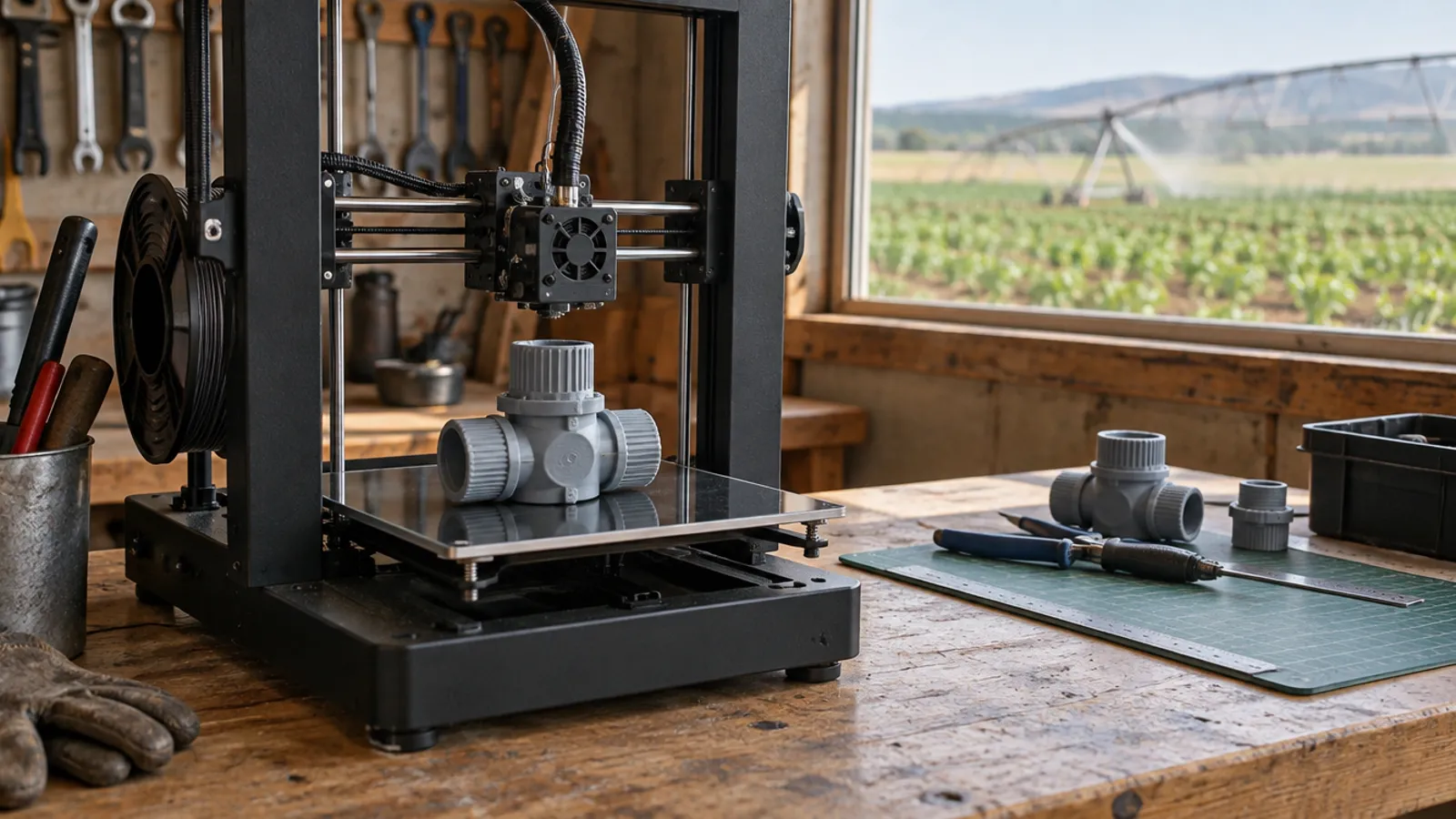
3D printing lets a farm make small plastic parts in hours: in a 2026 Athens study, nine farm parts cost €0.06 to €1.48 each in plastic and power. Strength and sunlight limit what you should print.
Key takeaways
- Nine printed farm parts cost €0.06 to €1.48 each in plastic and power, at 2025 Greek prices; the figure leaves out labour and the printer (AgriEngineering, 2026).
- CNH Industrial printed spare parts to order within 24 to 36 hours (UTS for AgriFutures Australia, 2021).
- After 24 hours of UV-B, PLA lost 5.3% of its tensile strength and PETG 36% (Polymers, 2021).
- Farmers in a 199-person Greek survey scored durability of printed parts about 2.68 out of 5 (Table 3, 2026).
- Print light-duty parts first, ventilate the printer and keep printed plastic away from food and load-bearing jobs.
In this article
- How does 3D printing benefit agriculture? Six benefits and their limits
- What a printed farm part costs
- Faster repairs when a part is hard to get
- Printed parts for irrigation and greenhouses
- Sensor cases, mounts and small fixtures
- Which plastic holds up in sunlight
- What farmers and students think
- Safety: fumes, food contact and load
- Printers and plastics in common use
- Waste, recycling and energy
- Patents, warranties and design files
- What printing does not fix
- Does printing a part pay off? A calculator
- How to start with one small part
How does 3D printing benefit agriculture? Mainly by turning small plastic parts into a job you can do in your own shop. A 2026 study from the Agricultural University of Athens printed pump covers, sensor cases, greenhouse joints and valve parts for between €0.06 and €1.48 each in plastic and power, using 2025 Greek prices (AgriEngineering, March 2026). The catch is strength: the same study and others find that plastic parts suit light-duty jobs, not hard-working steel parts.
This guide shows what printed farm parts cost, where they help, which plastic survives sunlight, what the safety rules are and a calculator that tells you when printing beats buying. It stays with sourced numbers. Where no good figure exists, we say so.
How does 3D printing benefit agriculture? Six benefits and their limits
The table sums up what the research supports. Each row has a section below with the numbers behind it.
| Benefit | What the evidence shows | Limit to know |
|---|---|---|
| Low part cost | €0.06 to €1.48 per part in materials and power (Athens, 2026) | Excludes your time, the printer and failed prints |
| Faster repairs | CNH printed parts to order within 24 to 36 hours (UTS, 2021) | Needs a design file and a printer that can run the right plastic |
| Custom fit | Pump covers, valve drives and grippers were designed to match existing kit | Fit takes tries: the Athens team needed up to 3 first attempts per part |
| Parts for old kit | Parts for equipment whose maker no longer trades can be rebuilt (Athens, 2026) | Check patents and warranty first |
| Less stock on the shelf | Parts are made when needed (AgriFutures, 2021) | Safety-critical and high-load parts still need proper parts |
| Local prototypes | Test a bracket or gripper before you pay for a metal version | Plastic tests do not prove metal strength |
What a printed farm part costs
The best recent price list comes from the Athens team. They printed nine parts for a farm lab and logged print time, plastic weight, power use and cost. The material price was €25 per kilogram of filament and electricity was €0.14 per kWh, both Greek averages for 2025 (AgriEngineering, 2026).
The most expensive item was a water pump cover at €1.48. It weighed 56.7 grams and took 1.47 hours. A sensor enclosure cost €0.06 and printed in 11 minutes. After the settings were fixed, the parts printed successfully 19 times out of 20 on average.
Read these as materials-and-power costs only. They leave out the printer, your design time and cleaning up. For a first part, your time will cost more than the plastic, which is why the calculator below has a labour line.
Chart
Cost of printing eight farm parts
Euros per part, plastic and electricity only, 2025 Greek prices (€25/kg filament, €0.14/kWh)
Faster repairs when a part is hard to get
A broken part in a busy week costs more than the part. A 2021 scoping study by the University of Technology Sydney for AgriFutures Australia says breakdowns can stop production for weeks while producers wait for parts or make temporary repairs (UTS, 2021). The AgriFutures release says farmers will benefit from quick and easy access to items like replacement parts.
The AgriFutures release also describes CNH Industrial, the owner of Case IH and New Holland, which began printing parts in 2019. Parts were printed locally to order within 24 to 36 hours, which cut warehousing and, the release says, costs for the producer (AgriFutures Australia, 2021).
Repair rules are changing too. In July 2026 the US Federal Trade Commission reached a settlement with John Deere, then awaiting court approval, that would require the company to make diagnostic and repair tools available to owners and independent shops, as reported by the University of Illinois Farm Policy News (Farm Policy News, July 2026). The settlement is about software and tools, not printed parts. It does show that regulators are backing farmers who fix their own kit. Printed brackets, covers and clips are one way to do that, but a printed part is not a licence to ignore a warranty or a patent, so read the terms for your machine.
Savings are not only a farm story. A Michigan Technological University study priced 20 printable household items. Even if a household made only those 20 items a year, the avoided purchase cost was about $300 to $2,000 a year, with a printer payback of 4 months to 2 years on 2013 prices (Wittbrodt et al., 2013). Treat that as a house-level result. The same group’s review of small-farm designs found hundreds of open designs fit for small organic farms (Pearce, Organic Farming).
Printed parts for irrigation and greenhouses
Water systems are full of small plastic parts, which is where printing fits best. The Athens work included an adjustable valve at €0.74 and a servo-driven valve actuator. The first version, printed in PLA, deformed in direct sunlight. The team reprinted the same design in ABS, and that version worked outdoors for 8 months in extreme conditions (AgriEngineering, 2026).
Other printed items in the same paper: greenhouse structure joints at €0.44, ventilation louvers driven by a small motor and a fruit gripper that held up through nearly 250 test cycles over 3 months. The paper notes that larger runs would need testing and compliance work, and its authors frame the results as a feasibility study for small farm facilities.
If a part touches fertilizer or other chemicals, check that your plastic suits the product. Follow the product label and local rules, and ask the supplier if you are unsure. Printed parts that carry water for drinking or food washing are a separate case, covered in the safety section.
For a plain-language look at water-saving kit that does not need a printer, see our video on green farming technologies.
▶ Seven green farming technologies for saving water, fuel and fertilizer, ranked by a cow. · 2:24
Sensor cases, mounts and small fixtures
Sensor housings are a good first project because they carry almost no load. The Athens team printed a sensor enclosure in about 11 minutes for €0.06 and a base for a satellite-positioning antenna for €0.25. A case can be redrawn to fit a new sensor, and a damaged one can be replaced without ordering anything.
The weak point is the sun. Printed cases need a UV-stable plastic, or a cover or paint that shields them. The next section shows why the choice of plastic matters.
Which plastic holds up in sunlight
Two peer-reviewed tests give hard numbers. In a Romanian study, parts printed in PLA and PETG sat under UV-B light for 24 hours in a dry chamber. PLA lost 5.3% of its tensile strength and 6.3% of its compressive strength. PETG lost 36% and 38.3%. Stiffness barely changed in either plastic (Amza et al., Polymers, 2021). This was accelerated lab ageing on clear PETG and blue PLA, so it does not tell you how many months a part lasts in the field.
A second study ran PLA, PETG, ASA and ABS through UV lamps, heat and 98 days outdoors under cover. After 20 hours under the lamp the lighter ABS samples yellowed slightly and PLA turned sticky. PETG and ASA showed no visible change (Materials, 2023). That paper describes ASA as keeping its colour better under UV than ABS. It also notes that ABS and ASA give off a smell when printed, so print them in a ventilated place.
The two studies measured different things (strength loss in one, visible change in the other), so they are not a like-for-like comparison. So test a printed part on your own machine before you rely on it, and use the Athens approach: print in an easy plastic, see how it fails, then change the material or the design.
Chart
Strength lost after 24 hours of UV-B light
Percent lower than unexposed control parts; dry accelerated ageing, one PLA and one PETG colour
What farmers and students think
The Athens team also surveyed 199 people in November 2025 on a 1 to 5 agreement scale: 46% were active farmers, the rest were agriculture students and university staff. People had little experience with printing, with a mean of 2.10 (Table 3). Even so, the average agreed that printing can help agriculture (4.06) and that they would design their own part (4.15).
Farmers were more careful than the group as a whole. Their mean was about 3.89 on whether printing can help agriculture, about 3.51 on using a printed part to replace a broken one and about 2.68 on whether printed parts are durable enough for farm use. The paper calls the durability worry justified given harsh field conditions and heavy forces (AgriEngineering, 2026). All survey figures are the means in Table 3 of the paper. The survey shows opinion, not field results, and it was a single Greek sample.
Chart
How 199 people rated 3D printing in agriculture
Mean agreement, 1 (strongly disagree) to 5 (strongly agree); 46% farmers; Greece, November 2025
Safety: fumes, food contact and load
Fumes. NIOSH, the US workplace health institute, found that a desktop printer released high numbers of particles in a test chamber, peaking a few minutes after printing began and taking about 100 minutes after printing ended to return to baseline. A manufacturer cover halved the particle count but the count stayed high. NIOSH advises enclosing and ventilating the printer, keeping your distance and using low-emitting filament (NIOSH Research Rounds, June 2016). Do not run a printer in a room where you sleep or eat.
Food and drinking water. A filament may be made from a food-grade polymer, but that does not make a printed part food safe. The US Food and Drug Administration says a component used in line with its food-contact rules (21 CFR 174 to 179) needs no further review, and other substances need another route such as a notification (FDA). That page does not address printed parts, so for anything that touches food or drinking water, ask your regulator or a food-safety adviser first.
Load. Do not print parts whose failure could hurt someone, such as brakes, hitches, guards or lifting points. The AgriFutures report names strength and durability in tough conditions as the main barrier to adoption (AgriFutures, 2021). This is general information. Get professional advice for safety-critical or regulated parts.
Printers and plastics in common use
The most common 3D printing method is fused filament fabrication, also called FDM: a heated nozzle lays down a thin plastic thread layer by layer. The Athens paper says PLA and ABS are the most common materials for printed agricultural implements and equipment, and it ran its parts on desktop machines that drew 0.11 to 0.33 kW while printing (AgriEngineering, 2026). At that draw, a 1.5-hour print uses roughly 0.2 to 0.5 kilowatt-hours, which is why power is a small part of the cost.
PLA is easy to print, and PLA or PLA+ made eight of the nine Athens parts. NIOSH found particle emissions from both oil-based and corn-based filaments, so ventilate for PLA too. ABS and ASA resist heat and sunlight better but need more heat to print and a ventilated space. The same paper lists fibre-reinforced plastics as a direction for more durable future field parts.
Waste, recycling and energy
On-demand printing makes only what you need, which cuts the stock that sits unused. It does not make plastic waste vanish. Each Athens part came with a carbon estimate using the 2025 Greek grid factor of 0.239 kg CO2e per kWh, which put the pump cover at 0.102 kg CO2e (AgriEngineering, 2026). Your figure depends on your local grid. The authors list recycling failed prints into new filament as a technical direction, not a finished farm routine.
A practical rule is to print small, use the least plastic that works and keep failed prints for recycling if your area collects them. Our carbon footprint page, linked below, has more on farm emissions.
Patents, warranties and design files
Many parts you might copy are covered by a maker’s design rights or patents, and some machine warranties require original parts. AgriFutures Australia says the sector is grappling with right-to-repair rules and with intellectual property in manufactured products, and that business models will need to deal with both (AgriFutures, 2021). In plain terms: use open-licensed designs or your own drawings, read your warranty and ask a lawyer if you plan to sell printed parts. This is general information, not legal advice.
What printing does not fix
A printer does not replace a mechanic, a parts dealer or a stock of wear parts such as blades, bearings and belts. Printed plastic is a poor match for hot, heavily loaded or fast-wearing jobs. It also needs someone on the farm who can learn basic design software and printer care. The Athens survey scored previous experience at only 2.10 out of 5 (Table 3), so plan for training time. A neighbour, a farm co-op or a local college lab can help in the first season.
Does printing a part pay off? A calculator
Enter the dealer price of the part, then your own plastic, power and time. The calculator compares the delivered price with the printed cost. It adds a line for downtime you avoid by not waiting for delivery.
Try the numbers for your own farm below.
Calculator
Is printing this part cheaper than buying it?
Enter the dealer price and your own print numbers.
- Printed cost per part: $14
- Plastic and power only: $2
- Printed cost per equal service life: $14
- Dealer price plus downtime avoided: $15
Example values only, near break-even; they are not benchmarks or forecasts. Price inputs are examples, so use today’s prices. Printer draw is fixed at 0.29 kW, the power the Athens team measured on one printer while printing PLA (AgriEngineering, 2026). Failed prints are fixed at 5%, based on their 19 successes in 20 trials once settings were fixed (first attempts, up to 3 per part, are not counted). Life share is how long the printed part lasts compared with the bought part. Printer cost and your design time are not included except through the labour line.
How to start with one small part
- Pick a low-load part. A sensor case, a hose clip, a vent flap or a cover. Skip anything that carries weight.
- Search for an open design first. Others may have drawn it. The Pearce review found hundreds of open designs for small farms.
- Choose the plastic for the place. PLA is easy for indoor trials. For sun, test ASA or a coated part.
- Print one and test it. Leave it in the real spot for a few weeks. Check for warping, cracks and sticky surfaces.
- Log the cost. Plastic, power and your time. Use the calculator to compare against the dealer price.
- Share the print. A neighbour or farm group with a printer cuts your cost; the AgriFutures report lists the lack of market routes to the technology as a gap.
If you want a plain-English guide to starting digital farming before you buy any hardware, see our short video on precision farming for beginners.

▶ Six plain steps to start precision agriculture on your farm without buying a robot. · 4:18
Remote sites: forestry and shared printers
Remote crews can wait a long time for parts. The UTS study covers farming, forestry and fishing, where breakdowns can stop work for weeks while producers wait for spare parts (UTS, 2021). Printing a part on site is one way to shorten that wait. Light brackets, covers and tool handles are the right targets; load-bearing parts are not. One printer shared between several farms or crews can serve all of them.
Where satellite data fits next to printing
Printing makes the part. It does not tell you where the field problem is. Satellite images can show where a crop is under stress so you know which irrigation block or sensor to visit first. Farmonaut Satellite + AI Farm Monitoring System is one tool for that, and it does not make or sell printers or parts. A satellite picture shows changes in plant cover, not the cause, so walk the field before you act.
▶ How satellite NDVI maps show crop stress across a large farm before you can see it. · 4:09
FAQ
How does 3D printing benefit agriculture in practice?
It lets a farm make small plastic parts, such as covers, clips, sensor cases and valve parts, in hours instead of waiting for delivery. The Athens study logged material and power costs of €0.06 to €1.48 per part (2026).
Are 3D printed parts strong enough for farm machinery?
Some are, for light duty. Farmers in the Athens survey scored durability at about 2.68 out of 5 (Table 3), and the AgriFutures report names strength as a main barrier. Keep printed parts out of load-bearing and safety jobs.
Which filament is best for outdoor farm use?
No single answer fits every part. In a 2021 test PLA lost 5.3% of tensile strength and PETG 36% after 24 hours of UV-B, and a 2023 test saw no visible change in PETG and ASA after 20 hours under a UV lamp. ASA is described as more UV-resistant than ABS. Test on your own part.
Is a printed part food safe?
Not by default. The FDA page we cite covers the components of food packaging materials and does not mention printed parts. Ask your food-safety regulator before a printed part touches food or drinking water.
Is it cheaper to print a part than to buy it?
Often the plastic costs little, but your time and downtime decide the result. Use the calculator with your own numbers. It starts with a near break-even example.
Related pages on our site: fleet management, product traceability, crop loan and insurance, carbon footprint tracking, large-farm admin app, weather API documentation, satellite data API and the farm monitoring app.
Farmonaut crop monitoring
See your own fields from space
Check which parts of a field need a visit with satellite images, then decide what to repair or print.




Keep reading
Sources
- Kyrtopoulos et al., 3D Printing Technology as Facilitator for Agricultural Automation, AgriEngineering (2026): mdpi-res.com
- Clemon et al., Additive manufacturing opportunities for Australia’s agriculture, fisheries and forestry sectors, UTS (2021): opus.lib.uts.edu.au
- AgriFutures Australia, Additive manufacturing opportunities (news release, 2021): agrifutures.com.au
- Wittbrodt et al., Life-Cycle Economic Analysis of Distributed Manufacturing with Open-Source 3-D Printers, Michigan Tech (2013): digitalcommons.mtu.edu
- Pearce, Applications of Open Source 3-D Printing on Small Farms, Organic Farming: orgprints.org
- Amza et al., Accelerated Aging Effect on Mechanical Properties of Common 3D-Printing Polymers, Polymers (2021): pmc.ncbi.nlm.nih.gov
- Analysis of the Mechanical Properties of 3D-Printed Plastic Samples Subjected to Selected Degradation Effects, Materials (2023): ncbi.nlm.nih.gov
- NIOSH Research Rounds, Control Measures Critical for 3D Printers (June 2016): archive.cdc.gov
- University of Illinois Farm Policy News, FTC Settlement Secures Right to Repair for Farmers (July 2026): farmpolicynews.illinois.edu
- US FDA, Determining the Regulatory Status of Components of a Food Contact Material: fda.gov
Discussion
Questions, corrections or field experience? Share them below. First-time comments are reviewed before they appear, and your email is never published.
No comments yet. Be the first to add a question or your experience.

 Agro La Gándara
 Global Agrifood
 Cazlv
 HIPSAC
 ZOL Zimbabwe
 Juligerm
 AdBio
 MISE Maroc
 NWNS
 Red August Group
 Farm Inc
 WeMe Global
 Agrotoken
 Blue BearX
 Insignito
 Croptimum
 DnCubed
 Field Capacity
 Indosistim Teknologi

 Licence holder · Niger · Gold
 Licence holder · Nigeria · Gold + lithium










