

Farm land · Cost guide
Land Clearing Cost Per Acre: Prices by Brush and Region
A contractor guide from OWNR OPS puts full land clearing at about $1,500 to $6,000 or more an acre in the US, with light brush from $500 and very heavy growth past $10,000. We found no national price from a US agency, so test local bids with the calculator here.
Key takeaways
- OWNR OPS (March 2026) lists US brush clearing from $500 to $2,000 an acre for light growth and $5,000 to $10,000+ for very heavy growth.
- Bear Claw Land Clearing (January 2026) lists Texas clearing at $1,500 to $8,000 an acre, with no single state average.
- Small jobs pay more per acre, because the $500 to $1,500 machine trip is spread over fewer acres (Bear Claw).
- US pasture averaged $2,000 an acre and cropland $6,020 in 2026 (USDA NASS), so compare any bid with the value it adds.
- Disturbing 1 acre or more for construction needs stormwater permit cover (EPA); check wetland rules before work starts.
In this article
- Land clearing cost per acre at a glance
- 7 key drivers of land clearing prices
- Land clearing cost per acre by US region
- Land clearing cost per acre in Texas
- Land clearing methods and what they cost
- What a low bid may leave out
- What USDA conservation cost lists show
- Land clearing cost estimator
- How to calculate your own machinery cost
- Will clearing pay? Compare the cost with land value
- Cost drivers by type of project
- Starting a land clearing business: what it costs
- Regulatory and environmental costs
- How to get a fair land clearing quote
Land clearing cost per acre runs from about $1,500 to $6,000 or more across the United States for removing all vegetation, stumps and roots, according to a contractor guide from OWNR OPS updated in March 2026. Light brush can cost as little as $500 an acre, and very heavy growth with large trees can pass $10,000. These are contractor estimates, because we found no national price from a US agency.
This guide breaks the price down by vegetation, region, method and project size. It also has a calculator for your own quote, USDA machinery math to test a bid, and land value data to help you decide if the work pays.
Land clearing cost per acre at a glance
Start with what is growing on the land. OWNR OPS calls it the single biggest factor in brush clearing cost. The OWNR OPS national figures below are for brush clearing, and it notes that some operators class the very heavy row as land clearing.
| Growth on the land | What it looks like | Range per acre | Guide average |
|---|---|---|---|
| Light brush | Grass, weeds, small saplings | $500 to $2,000 | $1,250 |
| Medium brush | Mixed shrubs, trees under 4 inches | $1,500 to $4,000 | $2,750 |
| Heavy brush | Dense undergrowth, vines, trees 4 to 8 inches | $3,000 to $6,500 | $4,750 |
| Very heavy | Mature brush, large trees, dense canopy | $5,000 to $10,000+ | $7,500 |
Prices are contractor estimates from the OWNR OPS guide of March 2026, not transaction records. The words matter when you compare quotes. Brush clearing takes out undergrowth and may leave large trees. Land clearing takes out trees, stumps and roots and leaves bare ground. Forestry mulching grinds growth in place, and that guide prices it at $1,500 to $4,500 an acre.
Chart
Average brush clearing price by density
US$ per acre, guide averages for 2026; contractor estimates, not transaction records
7 key drivers of land clearing prices
Two sites of the same size can get very different quotes. These seven drivers explain why. Some are facts about the site. Others are choices you can change.
1. Site assessment and permits
A site check looks at soil, slope, rock, drainage, wetlands and protected species before any machine moves. Permit costs depend on the county, the state and the size of the job, so ask your local office for the current fee. A wetland mistake can cost far more than the check itself, as the rules section below explains.
2. Labor and equipment
Machines and operators sit behind every line of a bid. The mix is chosen to suit the site: a dozer or excavator for trees and stumps, a mulcher for brush, a skidder where heavy logs must move. Denser or rockier ground slows the work, and slower work means more paid hours. A bigger machine costs more per hour but can cut the number of days.
3. Vegetation and residue
Type, density and size of the growth drive the swing shown in the table above. What happens to the debris comes next. You can mulch it on site, push it into windrows and burn it where allowed, or haul it away. Bear Claw Land Clearing, a Texas contractor, lists debris hauling at $500 to $1,500 an acre in its January 2026 guide, and says that charge applies to traditional clearing, not mulching.
4. Soil and terrain
Steep or uneven ground may need slope work, erosion control and regrading after the first pass. It also needs machines that can work safely on a slope. Bear Claw lists grading at $1,000 to $3,000 an acre. Wet or flood-prone parcels may need more water control, and that shows up in the bid.
5. Rocks, roots and stumps
Below-ground work is where budgets often slip. Bear Claw prices stump removal at $100 to $500 a stump, or $500 to $1,500 an acre for heavy removal, and root raking at $800 to $2,000 an acre. Trees over 24 inches across are priced separately in that guide, at $500 to $2,000 a tree. Ask whether your quote includes these or lists them as extras.
6. Drainage and water protection
Silt fence, sediment barriers and temporary drainage have their own material and labor costs. Near streams and wetlands they can be a legal requirement. Ask the contractor who supplies and maintains them, and who removes them when the ground has recovered.
7. Aftercare
Bare soil erodes, and brush grows back. Seeding, mulch and follow-up weed control are easy to leave out of a budget, yet they decide whether the land stays usable. If you plan crops or pasture next, get these costs before you sign. Your local extension office can advise on seed mixes for your soil.
Land clearing cost per acre by US region
The OWNR OPS guide says the Southeast tends to run 10% to 20% below its national ranges, and the Northeast and West Coast can run 20% to 40% higher. It links the low Southeast prices to more mulching operators, a year-round season and flatter ground. It links the high West prices to fewer operators, stricter rules, seasonal fire-clearing demand and mountain terrain.
Chart
Medium brush clearing price range by US region
US$ per acre, low and high of each guide range, 2026; contractor estimates
Project size also changes the rate, because the cost of bringing machines to the site is spread over the acres. Bear Claw puts that trip at $500 to $1,500 whatever the job size, while OWNR OPS says $300 to $800 is typical. On half an acre, that adds $1,000 to $3,000 per acre. On 50 acres, it adds $10 to $30.
| Project size | Texas rate per acre | Total job |
|---|---|---|
| Under 1 acre | $3,500 to $5,000 | $1,500 to $5,000 |
| 1 to 5 acres | $2,500 to $4,000 | $2,500 to $20,000 |
| 5 to 20 acres | $2,000 to $3,500 | $10,000 to $70,000 |
| 20 to 50 acres | $1,800 to $3,000 | $36,000 to $150,000 |
| 50+ acres | $1,500 to $2,500 | $75,000+ |
The table shows Bear Claw’s estimates from January 2026. Treat them as one contractor’s published pricing, not a survey of the market. They still show the pattern to look for: small lots pay more per acre, so neighbors who book together may be able to share a machine trip.
Land clearing cost per acre in Texas
Bear Claw puts Texas land clearing at $1,500 to $8,000 an acre in its January 2026 guide, which it says is based on more than 500 Texas projects. It lists light vegetation at $1,500 to $3,000, medium at $3,000 to $5,000 and heavy woods at $5,000 to $8,000 or more. It gives no single state average, so be wary of any one-number claim.
| Texas area | Range per acre | Reason given |
|---|---|---|
| Dallas-Fort Worth | $2,500 to $5,500 | Urban demand, rules, logistics |
| Hill Country | $3,000 to $6,000 | Rock, heavy cedar, slopes |
| West Texas | $1,800 to $4,000 | Flatter ground, mesquite and brush |
| East Texas | $3,500 to $7,000 | Dense pine and hardwood |
Burning rules can change the plan in Texas. Ask your county office about any burn ban and the state burning rules before you price a windrow-and-burn job. If burning is not allowed when the crew is ready, you may need to haul or mulch. Fuel can move bids too. The US retail diesel price averaged $4.99 a gallon in 2022 and $3.66 in 2025 (EIA annual data), so an old quote is a weak guide. Get two or more local bids dated within the same few weeks.
Land clearing methods and what they cost
The method can also move the price a lot. Use this list to decide what to ask for, then ask contractors to quote that exact scope.
- Forestry mulching. One machine grinds brush and small to medium trees where they stand. Bear Claw lists $1,500 to $5,000 an acre in Texas. Best for: pasture recovery and fence lines, where stumps can stay low in the ground.
- Traditional clearing with dozers and excavators. This removes trees, stumps and roots, then deals with the debris. Bear Claw lists $2,500 to $8,000 or more an acre. Best for: cropland, orchards and building sites that need clean ground.
- Chemical control. Herbicide kills brush over a wide area and leaves dead stems for a time. Best for: slow control where the land is not needed right away. Follow the product label and local rules, and ask a licensed applicator about drift near crops and water.
- Hand clearing. Crews with saws work where machines cannot go. OWNR OPS lists $2,000 to $5,000 an acre. Best for: small plots and sensitive areas.
- Burning and windrowing. Debris is pushed into rows and burned under a permit where that is legal. Best for: large jobs with heavy debris in places that allow it. Fire risk, smoke and burn bans are the drawbacks.
- Bush hog or brush mower. OWNR OPS lists $500 to $1,500 an acre for light material, at two to four hours an acre. Best for: grass and saplings, often as a do-it-yourself job with rented gear.
Keep each machine in good order if you do some of the work yourself; a farm tool maintenance routine helps avoid lost days. Safety matters more than savings with saws and tractors on rough ground. Hire trained crews for large trees.
What a low bid may leave out
The lowest number on the table is not always the lowest final bill. Two bids can use the same words and promise different work, so line up the extras before you compare totals. These are Bear Claw’s January 2026 Texas estimates. Your local prices may differ, but the list works as a checklist anywhere.
| Extra | Listed price | When it applies |
|---|---|---|
| Machine trip | $500 to $1,500 a job | Every job, whatever the size |
| Stump removal | $100 to $500 a stump | Or $500 to $1,500 an acre if heavy |
| Root raking | $800 to $2,000 an acre | Ground that will be tilled or built on |
| Grading | $1,000 to $3,000 an acre | Depends on terrain and finish |
| Debris hauling | $500 to $1,500 an acre | Traditional clearing |
| Large trees | $500 to $2,000 a tree | Trees over 24 inches across |
Here is a simple way to read that list. Say a contractor quotes $2,750 an acre for a mulching pass on 10 acres, and you then decide that you want crops on that land. The stumps, roots and leveling now matter, and the low end of the listed extras adds $500, $800 and $1,000 an acre. That one change of plan takes the rate to $5,050 an acre before any machine trip. This is an illustration of the sums, not a forecast.
So decide the end use first. Then ask each contractor the same questions. Will stumps be cut low, ground down or pulled out? How deep will the grinding go? Who deals with buried wire, old fence and rubbish? What happens if the crew finds rock? What is the charge if rain stops the work for a week? A contractor who answers these clearly in writing gives you a bid you can compare.
What USDA conservation cost lists show
We found no national USDA land clearing price, but its Natural Resources Conservation Service (NRCS) sets state cost lists for conservation contracts. The Pennsylvania cost list for fiscal 2026 gives a useful public reference for lighter work, such as controlling shrubs in place or preparing a planting site.
Chart
Selected USDA practice costs, Pennsylvania
US$ per acre, FY 2026 NRCS published cost list, standard rates; selected scenarios
These numbers look low next to contractor prices because they describe narrower jobs. The brush management rows (practice 314) price control scenarios such as mechanical or chemical treatment of shrubs, not stumping out a forest to make a field. Other state lists differ, and each list has an end date; the Pennsylvania one expired on 30 September 2026. Do not treat them as a quote or as the sum a program will pay.
That list also caps practice 314 at $30,000 for EQIP and CSP contracts in the state. Cost-share rules change with each program year, and clearing to make new cropland may not fit a conservation practice at all. Ask your local NRCS office before you start work, and use the USDA financial assistance dashboards to see how programs are used in your state.
Land clearing cost estimator
Enter a quote or a rate from the tables above, then add the extras that your site needs. Add the likely rise in land value too, so you can see whether the job covers its own cost. The starting numbers are examples only.
Try the numbers for your own farm below.
Calculator
What will your clearing job cost, and does it pay?
Enter your own acres, quote and extras.
- Total per acre: $3,600
- Added land value: $36,000
- Value gain minus total cost: $0
Example values only, not a benchmark or a forecast; the defaults sit near break-even by design. Every number is your input, including the land value gain, which an appraiser or broker can help you estimate. Use US$ or your own currency throughout. Blasting, wetland mitigation and taxes are not included unless you enter them under one-off costs. Get a site-specific quote and professional advice before you commit.
How to calculate your own machinery cost
A bid bundles machines, labor and overhead into one number. Mississippi State University Extension sets out the method to separate them in its publication Farm Machinery Cost Calculations. The formula is short: add annual ownership costs and annual operating costs, then divide by the hours of use each year.
The publication’s worked examples show the scale. A 130 hp tractor with a total annual cost of $27,420 and 400 hours of use costs $68.55 an hour. A 190 hp tractor with a field cultivator costs a combined $142.30 an hour, or $6.17 an acre for that tillage pass.
Those are farm tractor examples, not dozer or mulcher rates, and you should not use them as clearing prices. The value is in the method. Put in a machine’s purchase price, salvage value, yearly hours, fuel, repairs and labor, and you get an hourly rate to set beside a bid. Then divide the bid by the contractor’s estimate of hours. If the two are far apart, ask why. There may be a good reason, such as a long haul, insurance or a hard site.
Will clearing pay? Compare the cost with land value
A farmer’s question is rarely just what the job costs. It is whether the land is worth more afterward. USDA’s Land Values 2026 Summary gives a benchmark. The US pasture value averaged $2,000 an acre in 2026, and cropland averaged $6,020. Texas pasture averaged $2,420, Georgia pasture $5,100 and Oklahoma pasture $2,200.
Chart
Average pasture value per acre
US$ per acre, USDA NASS land values, 2022 to 2026
Set those next to a clearing bid and a clear point appears. At the national and Texas pasture averages, a medium-brush job at the OWNR OPS guide average of $2,750 costs more than the average value of the pasture itself. That does not mean the job is a bad idea. Your land may be worth less while overgrown, and the gain may come from grazing, access, fire risk or a planned sale. But it does mean you should run the numbers on your own parcel first.
Ask a local appraiser or farm broker for two figures: what the parcel sells for as it stands, and what it would sell for once cleared. The gap is the number to compare with your bid. Add yearly income from grazing or crops if you plan to keep the land. For help naming what the land could become, see our guide to agricultural land use types.
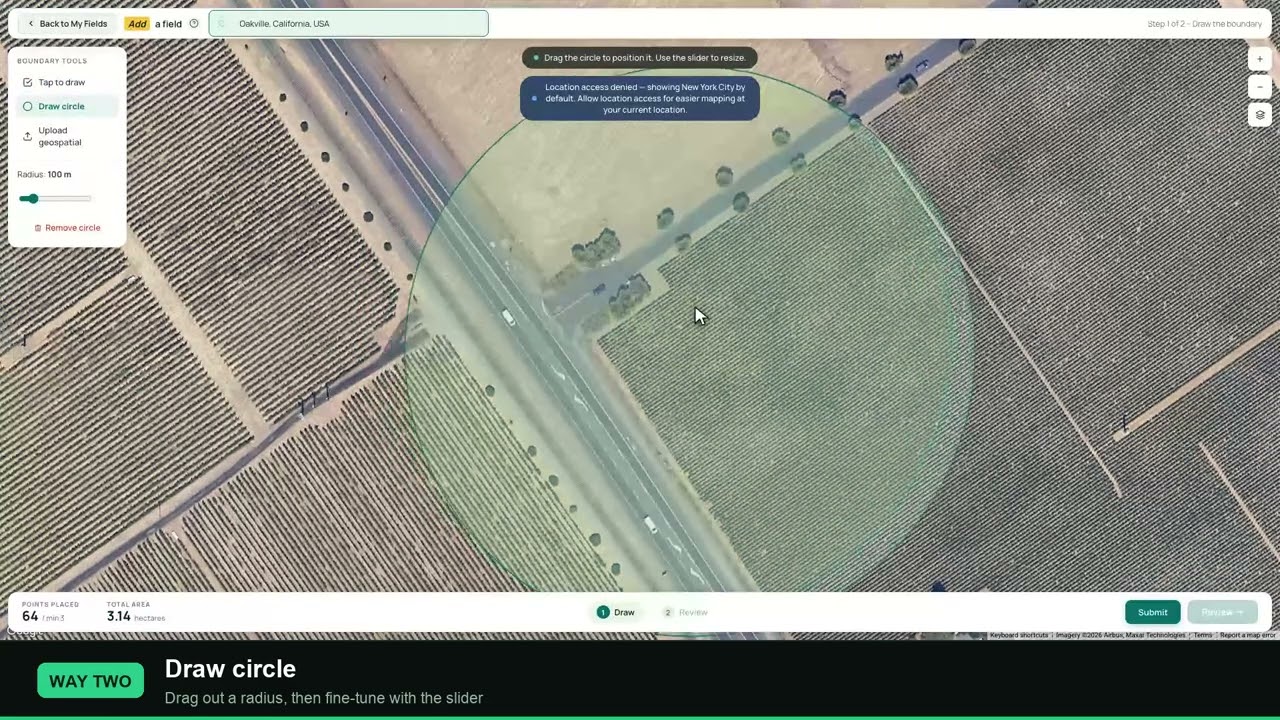
▶ How to map a field boundary in Farmonaut, which lets you track a parcel by satellite. · 3:50
Cost drivers by type of project
Farming and grazing
Site size, tree density, stump count and the planned use matter most here. Pasture can often live with low-cut stumps and mulch. Row crops and orchards need the stumps and roots out, and they need the soil structure kept in good shape. Avoid pushing topsoil into the debris piles, because that is the soil you are paying to farm. Composting cleared material can reduce disposal needs on some farms.
Forestry
Heavy wood volume and residue handling set the cost. Selling usable timber before clearing can offset part of the bill, so ask a forester to look before any machine arrives. Steep sites may need erosion work. The NRCS list above also shows site preparation for tree planting as its own practice, with separate rates for light, moderate and heavy mechanical work.
Mining and infrastructure
Roads, utility corridors and mine pads need stable, clear ground. Rock tends to be the main problem, and it may need ripping or blasting under separate rules. Geotechnical studies often come first, and drainage must be in place early. Bids for this work are not a fair guide to farm prices. Exploration teams can narrow the area they need to disturb by screening it first, and our satellite mineral detection page describes that approach.

▶ Six plain steps to start precision farming, useful once cleared land goes into production. · 4:18
Starting a land clearing business: what it costs
Some readers are pricing a business, not a job. No government body publishes a startup figure for this trade, so build your own budget from parts:
- Price each machine you would buy or lease, such as a skid steer with a mulching head, an excavator or a dozer.
- Run the Mississippi State formula on each one, using a cautious estimate of paid hours per year.
- Add a truck and trailer for moving machines.
- Add state contractor licensing, general liability cover and equipment insurance. Get written quotes and ask an accountant to review the plan.
- Set your rate from the result, then compare it with local bids.
Hours matter most. The same annual cost spread over 400 hours gives a much higher hourly rate than over 1,000 hours. A machine that sits idle through a wet season still has to be paid for.
Regulatory and environmental costs
Rules vary a lot by place, so treat this as a starting list and check with local agencies or a lawyer before work begins.
United States
- Stormwater. The EPA says a Clean Water Act permit is required for construction stormwater from activity that disturbs 1 acre or more, or less if part of a larger plan. Clearing counts as an earth-disturbing activity in that rule.
- Wetlands. Section 404 requires a permit to discharge dredged or fill material into waters of the United States. The EPA’s list of exemptions covers established, ongoing farming, ranching and forestry, such as plowing and harvesting. Do not assume that a new clearing job fits. Ask the Army Corps of Engineers.
- USDA benefits. Under federal rules at 7 CFR Part 12, converting a wetland, or planting a commodity crop on a converted wetland, can make a person ineligible for certain USDA benefits. Highly erodible land has its own conditions. Speak with NRCS first.
United Kingdom
In England, the government’s felling licence guidance says you need a licence to fell more than 5 cubic metres of trees of qualifying size in a calendar quarter, with some exceptions. Check it before you price tree removal. The other UK nations run their own systems.
Australia
In New South Wales, Local Land Services guidance on native vegetation explains which clearing needs approval and which does not. Other states have their own laws. In Canada, start with your provincial and municipal offices, as rules differ by province.
Keep records
Keep permits, dated photos, contractor agreements and erosion plans. They help if a neighbor or an agency asks questions, and a buyer may want them later.
How to get a fair land clearing quote
- Mark the area. Measure the acres and flag what stays, such as shade trees, fence lines and water.
- Check the rules. Call the county, NRCS or your local authority about wetlands, burning and permits.
- Write one scope. State whether stumps and roots come out, where debris goes and how level the ground must be.
- Get at least two bids. Ask for separate lines for clearing, stumps, debris, grading, erosion control and the machine trip.
- Test the numbers. Put each bid in the calculator and use the machinery method on any that look odd.
- Check cover. Ask for proof of insurance and a written payment schedule tied to finished work.
- Plan the follow-up. Budget seeding and regrowth control, then check the result over the next seasons.
After the work, regrowth and bare patches can be hard to see on foot across a large parcel. Farmonaut Satellite + AI Farm Monitoring System shows vegetation maps of a mapped field over time, which can help you decide where to walk first. A ground check still confirms what is there and why.
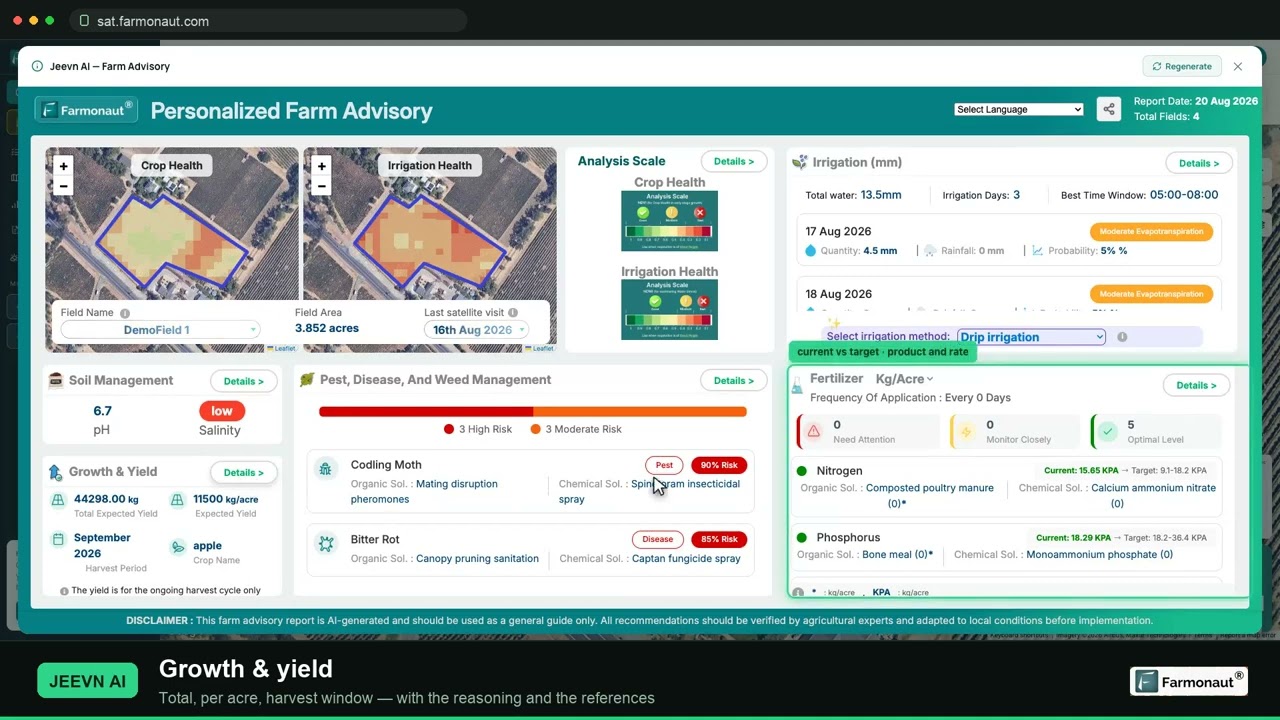
▶ A full walkthrough of reading satellite vegetation maps for your own field. · 19:36
FAQ
How much does it cost to clear 1 acre of land?
In the OWNR OPS national ranges of March 2026, one acre costs $500 to $2,000 for light brush and $5,000 to $10,000 or more for very heavy growth. Bear Claw lists $3,500 to $5,000 an acre in Texas for lots under an acre and $2,500 to $4,000 for 1 to 5 acres. Small jobs pay more per acre because the machine trip is spread over less land.
How much does it cost to clear 2 acres?
Doubling the OWNR OPS per-acre ranges gives about $1,000 to $4,000 for light brush, $3,000 to $8,000 for medium brush and $10,000 to $20,000 or more for very heavy growth. Add stumps, hauling and grading if your quote lists them apart. The calculator above handles these extras.
What is the cheapest way to clear land?
It depends on the growth. For grass and saplings, OWNR OPS lists a bush hog at $500 to $1,500 an acre. For brush and small trees, mulching avoids hauling costs, though it leaves stumps and mulch in place. Do not choose by price alone if you need clean ground for crops.
Do I need a permit to clear my land?
Often it depends on the size, location and purpose. In the US, disturbing 1 acre or more for construction needs stormwater cover under EPA rules, and work in wetlands can need a Section 404 permit. County rules may apply too. Call your local office first and get legal advice when wetlands are involved.
Will USDA help pay for clearing?
USDA conservation programs can support brush management and other listed practices that meet program rules, but they are not general land clearing grants. Rates vary by state and year. Ask your local NRCS office before you start work, and do not assume a payment when you budget.
Summary
For most budgets, start with the growth on your land, then adjust for region, project size, method and extras. Get written local bids with separate lines, test them with the calculator and the Mississippi State formula, and check the rules before work begins. Then compare the total with what the land will be worth to you afterward.
Related pages on our site: mining platform; mining query form; contact page.
Farmonaut crop monitoring
See your own fields from space
Draw your fields once and Farmonaut shows satellite vegetation maps for them through the season, on web, Android or iOS.




Keep reading


Sources
- OWNR OPS, Brush Clearing Cost Per Acre pricing guide (updated March 2026; contractor estimates): ownrops.com
- Bear Claw Land Clearing, Land Clearing Cost Per Acre in Texas (updated January 2026; contractor estimates): bearclawclearing.com
- Mississippi State University Extension, Farm Machinery Cost Calculations (P3543): extension.msstate.edu
- USDA NRCS Pennsylvania, Bulletin PA 440-26-06, published cost list and payment caps for FY 2026 EQIP and CSP (11 March 2026): nrcs-prod.azureedge.us
- USDA NRCS, Financial Assistance Program Dashboards: farmers.gov
- USDA NASS, Land Values 2026 Summary: release.nass.usda.gov
- US EIA, U.S. No 2 Diesel Retail Prices, annual: eia.gov
- US EPA, Stormwater Discharges from Construction Activities: epa.gov
- US EPA, Exemptions to Permit Requirements under CWA Section 404: epa.gov
- eCFR, 7 CFR Part 12, Highly Erodible Land and Wetland Conservation: ecfr.gov
- GOV.UK, Tree felling licence: when you need to apply: gov.uk
- NSW Local Land Services, Native vegetation land management in NSW: lls.nsw.gov.au
Discussion
Questions, corrections or field experience? Share them below. First-time comments are reviewed before they appear, and your email is never published.
No comments yet. Be the first to add a question or your experience.

 Consulthink Global
 Rouge VC
 Yutz Automation
 AgroGreen Dynamics
 AgroRisk
 Oath Inc
 Reddane Farming
 Esri North East Africa
 Cresol
 Atur Kuliner
 MDCV UK
 Zerella Group
 Etech Consulting Madagascar
 Vestlandsforsking
 Delicio
 WB Dev
 Sama Premium
 Prochecker
 Tres Valles
 LACOS Geoinformation
 Magrifly
 LatConnect 60
 Blickwinkel

 Exploration consultancy · South Africa · Gold
 Licence holder · Niger · Gold
 Client · Tanzania · Gold










