

Self Sustaining Farm: Sustainable Food & Livestock in 2025 and Beyond
Introduction: Food, Farms & the 2025 Imperative
In 2025, the concept of the self sustaining farm has become more crucial than ever before. Global challenges—from climate change, resource depletion, to mounting population growth—apply extraordinary pressure on agricultural systems worldwide. With food production needing to meet rising demands while preserving natural resources, our focus on sustainable farming and livestock systems expands beyond just yields—it’s about ensuring the ability of future generations to thrive.
This comprehensive article will explore the current state, key models (such as the coco san sustainable farm), challenges, integrated technologies, and foundational principles that define sustainable food in 2025 and beyond. We will demonstrate how innovative agricultural practices and new technologies allow food production, livestock management, and resource utilization to coexist with true environmental stewardship.
Defining Sustainable Farming & Self Sustaining Farm Systems
Sustainable farming refers to agricultural practices designed to meet current food needs without compromising the ability of future generations to meet their own. This approach emphasizes maintaining soil health, conserving water, reducing chemical inputs, and promoting biodiversity.
- ✔ Soil Health: Rotating crops, using cover-crops, and composting for regenerative soil management.
- ✔ Water Conservation: Prioritizing rainwater harvesting, precision irrigation, and water recycling.
- ✔ Reducing Chemicals: Integrated pest management (IPM) and minimized synthetic fertilizer use.
- ✔ Biodiversity: Growing complementary crops, maintaining hedgerows, and supporting pollinator habitats.
A self sustaining farm (also known as self sufficient farming) goes a step further. Here, much of the energy, feed, water, and fertilizer needs are generated on-farm, minimizing reliance on external inputs. This supports eco-friendly agriculture by significantly reducing operational costs, emissions, and the farm’s environmental footprint.

- 🌱 Sustainable livestock farming is integrated.
- 💧 Resource cycles are closed wherever possible.
- 🔄 Outputs (waste/manure) become valuable inputs.
- 🌾 Organic waste enriches soil, feeds livestock, or generates energy.

Foundations of Self Sufficient Farming: Resource Circularity & Innovation
The heart of every self sustaining farm is its deliberate design for resource circularity. This involves rethinking the entire utilization of inputs and outputs for the lowest possible external dependence and maximum resilience.
- ♻ Crop rotations and cover crops fix nitrogen, reduce disease pressure, and enrich soil health.
- 💧 Rainwater harvesting & drip irrigation minimize water usage and boost crop yields.
- 🐄 Livestock manure returns nutrients to fields, reducing synthetic fertilizer needs.
- 🌳 Agroforestry (e.g., coconut plantations like coco san sustainable farm) combine trees + crops + livestock for greater overall yield and resilience.
- 🔋 On-farm renewable energy (biogas, solar, wind) reduces long-term energy costs.

Self sustaining farm systems are not “set and forget.” Even the best-designed sustainable models require ongoing management, skill-building, and adaptation as environmental conditions and technology evolve.
Key Principles of Self Sustaining Farm Systems
- Closed-Loop Nutrient Cycles: Recycle all possible farm waste (e.g., manure compost, crop residue biochar).
- Water Self-Sufficiency: Leverage local rainfall—maximize storage, minimize runoff, and reuse whenever possible.
- Integrated Crop-Livestock Systems: Use rotational grazing and multi-species systems for mutually reinforcing benefits.
- Energy Efficiency: Solar, wind, and biogas integration reduce fossil fuel needs for irrigation, cooling, and on-farm equipment.
- Biodiversity at Every Level: Maintain wildlife corridors, diverse planting schedules, and perennial crops for long-term sustainability.



The Rise of Sustainable Farming Companies & 2025 Models
Sustainable farming companies are at the forefront of reshaping agriculture in 2025. By combining modern technology with traditional knowledge (like the systems seen in coco san sustainable farm with coconut plantations), they are enabling farms to optimize outputs while preserving natural resources.
- ✔ Precision Agriculture: Sensors, AI analysis, and satellite imagery guide field-level decisions, lowering inputs and costs.
- ✔ Agroforestry Integrations: Trees, crops, and livestock form interdependent systems that maximize yields and biodiversity.
- ✔ Integrated Pest Management: Smart detection replaces blanket pesticide spraying—helping farms stay productive while minimizing harm to the ecosystem.
- ✔ Organic Waste Recycling: Manure digestion for biogas and compost for soil enrichment are increasingly standard.
- ✔ Water Optimization: Systems like drip irrigation and rainwater harvesting are prerequisites for drought and climate resilience.


Sustainable Livestock Farming: Transformations & Trends
Sustainable livestock farming is undergoing radical transformation by 2025. Previously, livestock was traditionally associated with high greenhouse gas emissions and immense resource consumption. But emerging models—especially within self sustaining farms—are redefining the role of livestock in the food system.

Key Strategies for Sustainable Livestock Farming
- 🐄 Rotational Grazing: Pastures are rested for periods, regenerating soil and reducing disease outbreaks.
- 🐐 Native/Local Breeds: Selecting animals adapted to the local ecosystem minimizes feed needs and health risks.
- 🌾 On-Farm Feed Production: Animals are primarily fed farm-grown fodder, reducing external dependencies and deforestation from imported feed crops.
- 🌱 Manure Management: Recovered manure enriches crop fields and supports circularity within the farming system.
- 👩🌾 Multispecies Approaches: Poultry, grazers, and foragers rotate, each playing a different ecological role.
By re-integrating livestock with crop systems, nutrients are recycled naturally, reducing the need for chemical fertilizers and minimizing pollution.
Environmental & Economic Benefits of Self Sustaining Farms
The benefits of sustainable, self-sufficient farming extend far beyond individual farm gates. These systems have a profound impact on both the environment and rural economies:

- 🌳 Carbon Sequestration: More trees, healthier soil, and managed grazing lock away atmospheric carbon.
- 🐝 Biodiversity Recovery: Native plants and animals return as monoculture and chemicals recede.
- 💸 Economic Resilience: Farms become less vulnerable to sudden input price spikes or supply shocks.
- 📈 Diversified Incomes: New streams from agro-forestry, energy, and ecosystem services.
- 🚜 Reduced Input Costs: Lower fertilizer, pesticide, water, and feed bills over time.
- 🏡 Rural Vitality: Local job creation and community strengthening as farms support more complex enterprises.

Satellite, AI & Tech Integration for Sustainable Food Production
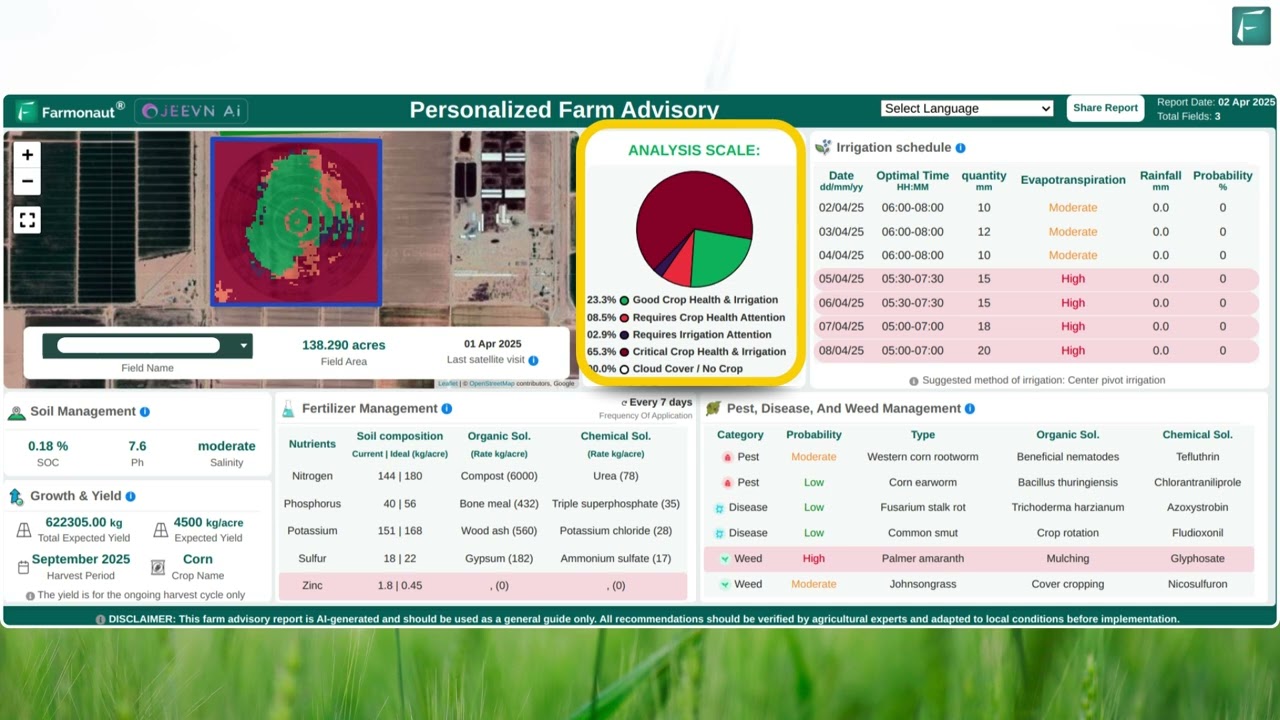
Modern sustainable farming companies are embracing a wave of technological innovations that amplify both farm resilience and ecosystem health. Farmonaut leads the charge in satellite-based farm monitoring, AI-driven advisories, blockchain traceability, and environmental footprinting—making data-driven decisions accessible even to small farms.
- 🛰 Satellite Crop Health Monitoring: Detect crop stress, disease risk, and growth variations in real-time (Large Scale Farm Management).
- 🤖 AI Advisory Systems (like Jeevn AI): Personalized, scalable advice on irrigation, fertilization, and input optimization.
- 🔗 Blockchain-Based Traceability: Transparent supply chains build consumer trust (see Traceability).
- 🌱 Environmental Impact Monitoring: Real-time carbon and resource use tracking for farm improvement or sustainability reporting.
- 🚜 Fleet Management Tools: Track tractors, logistics, and fuel usage to reduce costs (Fleet Management).

Key Components of a Self-Sustaining Farm and Their Estimated Benefits
| Component | Description | Estimated Resource Savings (%) in 2025 | Biodiversity Impact | Example Practice |
|---|---|---|---|---|
| Crop Rotation | Alternating crops to improve soil health and disrupt pests | 10-25% | High | Corn-Soybean-Wheat-Rotation |
| Water Conservation | Capturing, storing, and reusing water efficiently | 20-40% | Medium | Rainwater Harvesting & Drip Irrigation |
| Organic Livestock Integration | Raising animals alongside crops for mutual benefit | 15-30% feed & input reduction | High | Rotational Grazing & Manure Composting |
| Renewable Energy Generation | Solar, wind, and biogas power for farm needs | 25-50% fossil energy savings | Medium | Solar Panels, Biogas Digesters |
| Integrated Pest Management (IPM) | Eco-friendly pest control combining monitoring & biological methods | 30-80% pesticide reduction | High | Beneficial Insects, Crop Scouting |
| Agroforestry | Combining trees, crops, and livestock for synergy | 10-35% water & fertilizer savings | High | Coconut Plantations w/ Cattle (e.g., Coco San Sustainable Farm) |
| Organic Waste Management | Turning manure, crop residues, and food waste into fertilizer/energy | 15-40% reduction in bought inputs | Medium | On-Farm Composting, Biogas Tanks |
| Precision Technology Use | Targeted, data-driven application of water, nutrients, and pest solutions | 10-35% resource saving | Medium | Satellite Crop Mapping, Soil Sensors |
Practical Steps: Implementing Sustainable Farm Practices
- Assess current resource flows and pinpoint key inefficiencies.
- Map available natural resources (soil, water, biodiversity hot-spots).
- Design closed-loops for nutrients, water, and energy where possible.
- Pilot a rotational grazing plan for livestock, measuring forage and soil impact.
- Leverage technology (satellite, sensors, AI) to monitor, adapt, and optimize.
- Choose multi-purpose crops and livestock breeds suited to your region.
- Minimize tillage and avoid monocultures to restore soil microbe life.
- Install solar panels or biogas units to cut energy costs long-term.
- Adopt traceability for sustainable certification and premium markets.
- Engage local communities in resource management and knowledge-sharing.
Visual Guide: Sustainable Livestock Systems on Diverse Farms

- Begin with soil mapping (satellite/AI tools for field variation)
- Introduce multi-paddock systems for pasture regrowth
- Feed livestock mainly with on-farm fodder; track feed conversion
- Rotate animal species to optimize forage and break pest cycles
- Compost all manure and spread it to build organic matter
Challenges, Solutions & The Future of Sustainable Farming
While the benefits of self sustaining farm systems are undeniable, challenges to widescale adoption remain, especially for smallholder and first-time sustainable livestock farming operations:
- ⚠ Initial Investment: Infrastructure such as rainwater tanks, renewable energy systems, and fencing demand capital outlays.
- ⚠ Complex System Knowledge: Integrated management of diverse crops, livestock, and technology requires new skills.
- ⚠ Policy & Market Gaps: Inconsistent government support, uncertainty in carbon or biodiversity credits, and price pressures pose hurdles.
- ⚠ Scaling Technology Access: IoT, satellite, and AI tools can be cost-prohibitive without affordable solutions.
Despite these issues, prospects for 2026 and beyond are promising. Governments, companies, and international organizations are prioritizing climate adaptation, resource efficiency, and rural revitalization—resulting in more robust support, subsidies, and technical assistance for sustainable farms.
- 📊 Data Insight: Digital platforms now make it easier to tap into satellite crop monitoring, climate forecasts, and traceability (Crop Loan & Insurance solutions validate claims reliably).
- 🧩 Enhancements: AI and blockchain integration reduce risks and increase loan/insurance access for sustainable operators.
How Farmonaut Enables Sustainable, Self Sustaining Farms
We at Farmonaut are dedicated to empowering the next generation of sustainable farming companies, self sufficient farms, and livestock operations with cutting-edge satellite intelligence, AI analysis, resource management tools, and affordable traceability. Our solutions help farmers:
- ✔️ Monitor crop health, soil variability, and irrigation needs in real-time for data-driven action.
- ✔️ Optimize input use, water cycles, and manure recycling for maximum circularity.
- ✔️ Track environmental impacts (carbon emissions, biodiversity indices) to meet sustainability goals.
- ✔️ Build transparent supply chains (traceability solutions) and secure premium, sustainability-driven market access.
- ✔️ Leverage field-to-fleet asset management (Fleet Management) to reduce operational costs and emissions.
Our platform supports every scale of operation—from smallholders transitioning to closed-loop systems to multi-site agricultural businesses deploying IoT and blockchain throughout their supply chains.
FAQ: Self Sustaining Farm Systems
What is the meaning of a self sustaining farm?
A self sustaining farm is an agricultural system designed to generate most or all of its own resources—including energy, fertilizers, water, and animal feed. These farms minimize reliance on external inputs, close nutrient loops, and restore ecosystem health as an integral part of their operation.
How does sustainable livestock farming contribute to sustainability?
Sustainable livestock farming includes practices like rotational grazing, integrating livestock with crops, using farm-grown feed, and composting manure. These methods promote nutrient recycling, improve soil health, and help reduce greenhouse gas emissions associated with traditional animal husbandry.
What role do technology and satellite solutions play in self sustaining farms?
Technologies—such as satellite imaging, AI advisory, environmental tracking, and blockchain traceability—empower sustainable farms to make more precise decisions about planting, irrigation, input use, fleet management, and supply chain transparency. These help reduce resource use, cut costs, and verify sustainability for premium markets.
What are the main challenges in adopting self sufficient farming models in 2025?
The primary challenges are: initial investment in infrastructure; requirement for new knowledge and skills (especially for integrated systems); access to affordable modern technologies; uncertainty in markets/policies for sustainable products. However, these are rapidly being addressed through policy, technology, and increased demand for sustainable food.
How do I start transitioning to a self sustaining farm?
Begin by mapping current resources and inefficiencies. Target quick wins (like composting and water harvesting), integrate livestock if possible, diversify crops, and leverage monitoring tools such as Farmonaut’s large scale farm management solutions to guide decision-making and track improvements.
Conclusion: Charting a Sustainable Future in Agriculture
Self sustaining farm models are more than just a trend; they are the cornerstone of future food production. Sustainable farming and sustainable livestock farming integrate innovative technology and regenerative practices—making it possible to meet growing food demands while stewarding the planet.
As technology continues to evolve—including satellite-based diagnostics, AI-driven resource optimization, and blockchain traceability—the opportunities to build, scale, and profit from self-sufficient farm systems will only grow in 2026 and beyond. The work of sustainable farming companies and innovators will define whether agriculture remains a source of depletion or transforms into a force for ecosystem restoration, economic vitality, and global food security.
Let us all, whether producers, technologists, or consumers, support the journey toward food systems that coexist with nature, reduce resource use, and ensure that our farming benefits communities for generations to come.

 AgroStar
 Native Seeds
 Andex
Andex FCF India
 Unifrutti Gulf
 Deluxe Conseil
 TVS Electronics
 BW Pipelines
 WICO
WICO Gen Chayat
 Chimera Innovation
 SkyHarvest
 Polaris Digitech
 Teledarbas
 Wild Oak Farm
