

Soil · Liming costs
Agricultural Lime Price: What You Pay and Why
Dealer asks for lime delivered and applied ran US$40 to US$75 per ton in Alabama in early November 2026 (USDA). The stone is cheap; freight, spreading and lime quality set what you really pay per acre.
Key takeaways
- USDA’s Alabama Production Cost Report (week ending 6 November 2026) shows dealer asks of US$40-75 per ton for lime delivered and applied, averaging US$59.17.
- US crushed stone averaged an estimated US$18.50 per metric ton at the quarry in 2025, and only about 1% of crushed stone went to agricultural uses (USGS).
- Quicklime and hydrated lime are far dearer: about US$260 and US$280 per metric ton at the plant in 2025 (USGS).
- Compare quotes on cost per ton of effective neutralizing power: CCE times fineness, not price per ton alone.
- Base the rate on a soil test; most agronomic crops do best at pH 6.0-7.0 (Penn State Extension).
In this article
- Agricultural lime price: what you pay and why it varies
- What agricultural lime is and how it works
- Comparing agricultural lime products by type
- Finding agricultural lime suppliers near you
- How to vet an agricultural lime supplier or manufacturer
- From quarry to field: how the supply chain works
- Lime cost and coverage calculator
- Precision agriculture and soil testing before you order
- How Farmonaut fits into the liming decision
- FAQ
- The bottom line on choosing an agricultural lime supplier
Agricultural lime price in the US starts low at the quarry and climbs with every mile of haul. In Alabama, dealers were asking US$40 to US$75 per ton for lime delivered and applied, an average of US$59.17, in the USDA Alabama Production Cost Report for the week ending 6 November 2026. These are dealer asks, not final sale prices. The stone itself is cheap: US crushed stone had an estimated average value of US$18.50 per metric ton at the quarry in 2025, according to the USGS Mineral Commodity Summary for crushed stone. Trucking, spreading and the quality of the lime make up the rest of what you pay.
This guide shows what drives the price, how to compare quotes on the same basis, how to find and vet an agricultural lime supplier near you, and how the supply chain from quarry to field works. A calculator lets you compare two quotes by cost per ton of real neutralizing power, not just cost per ton of material.
Agricultural lime price: what you pay and why it varies
There are three common ways a lime price is quoted, and they are not the same thing:
Chart
Where US crushed stone goes
Share of US crushed stone by end use, 2025 estimate
- At the quarry or yard (F.O.B.): you collect the material or pay a hauler separately.
- Delivered: the supplier trucks it to your farm and tips it in a pile.
- Delivered and spread (applied): the supplier or a custom applicator spreads it on the field.
The Alabama report quotes the third kind. Its range of US$40 to US$75 per ton shows how much the same service can vary inside one state. A farm close to a quarry with a large customer base sits near the low end. A farm far from any quarry that grinds farm-grade stone sits near the high end.
Ag lime is a small part of a very large stone industry. The USGS estimates that 1.5 billion metric tons of crushed stone valued at US$27 billion was produced in 2025 by about 1,400 companies at 3,500 quarries. Of that, only about 1% went to agricultural uses. Most of it went into roads and buildings. That is why availability differs so much by county: a nearby quarry may sell road stone but not bother to grind and screen material fine enough for farm use.
The quarry value of crushed stone has risen each year since 2021. The chart below shows the USGS average unit value. Ag lime is a finer, screened product and often sells above this average, but the trend shows the direction of the base cost.
Burned and hydrated lime cost far more
Quicklime (burned lime) and hydrated lime are made by heating limestone in a kiln. They react much faster than ground limestone, but they cost much more. The USGS Mineral Commodity Summary for lime put the average plant value of quicklime at about US$260 per metric ton in 2025 and hydrated lime at about US$280. That is more than ten times the quarry value of crushed stone. In 2025, the five leading US lime companies accounted for about 80% of US lime production, and the industry ran 70 quicklime plants in 30 states. Most farms use ground limestone instead. Burned and hydrated lime are caustic, so follow the product label and wear the protective gear it lists.
Chart
US crushed stone: average value at the quarry
US$ per metric ton, all crushed stone, 2021-2025 (2024 and 2025 estimated)
Chart
US quicklime and hydrated lime: value at the plant
US$ per metric ton, 2021-2025 (2025 estimated)
What agricultural lime is and how it works
Agricultural lime (aglime) is a material that neutralizes soil acidity and raises soil pH. Most aglime is ground calcitic limestone (calcium carbonate) or dolomitic limestone (calcium magnesium carbonate). Penn State Extension’s guide to soil acidity and aglime says that about 99 percent of the aglime used in Pennsylvania is ground calcitic or dolomitic limestone.
It is the carbonate, oxide or hydroxide part of the material that neutralizes acid, not the calcium itself. Penn State notes that gypsum (calcium sulfate) and Epsom salts (magnesium sulfate) are not liming materials, even though they contain calcium and magnesium. A supplier who offers gypsum as a “lime” product is selling something else.
Why soil acidity matters
Penn State says that for most agronomic crops the soil pH should be between 6.0 and 7.0. Below pH 5.5, aluminum and manganese become more available and can reach levels that harm roots. Acid soil also locks up phosphorus with aluminum and iron, slows the bacteria that fix nitrogen in legumes, and reduces the activity of some herbicides. Nitrogen fertilizers that contain ammonium make soil more acid over time, so fields under steady corn or wheat often need lime every few years.
A soil test is the only reliable way to know how much lime a field needs. The test reports pH and a buffer pH (or exchangeable acidity), and the lab turns these into a lime rate. The Ontario Ministry of Agriculture’s agronomy guide (chapter 9) bases its lime rates on both soil pH and buffer pH, because two soils at the same pH can hold very different amounts of reserve acidity.
Comparing agricultural lime products by type
The key number on any aglime label is the calcium carbonate equivalent (CCE). It tells you how much acid the material can neutralize compared with pure calcium carbonate, which is set at 100. The University of Maryland Extension’s liming fact sheet lists typical CCE values and the amount of each product needed to equal one ton of pure limestone.
Chart
Neutralizing power of common liming materials
Typical calcium carbonate equivalent (CCE), % of pure calcium carbonate; midpoint where a range is given
| Liming material | Typical CCE (%) | Pounds to equal 1 ton of pure limestone | Notes |
|---|---|---|---|
| Calcitic limestone | 100 | 2,000 | Most common; supplies calcium |
| Dolomitic limestone | 95-109 | 1,830-2,100 | Supplies calcium and magnesium |
| Hydrated lime | 134 | 1,490 | Fast acting, caustic, costly |
| Burned lime (quicklime) | 178 | 1,120 | Fastest, caustic, costly |
| Ground shells | 80-90 | 2,200-2,500 | Regional by-product |
| Calcium silicate slag | 70-80 | 2,500-2,860 | Industrial by-product |
| Wood ashes | 40 | 5,000 | Variable quality |
Source: University of Maryland Extension, fact sheet SFM-5, Table 1. Values are typical; always use the CCE on the product label.
Calcitic or dolomitic?
Choose dolomitic limestone when your soil test shows low magnesium. If magnesium is already high, calcitic limestone is usually the better pick. In a quote, the type matters less than the CCE and the fineness, which together set how much product you need.
Fineness: the second half of quality
Fine particles react fast. Coarse particles react slowly or hardly at all. Labs grade fineness by passing the lime through a series of sieves. The University of Maryland fact sheet describes the share retained by an 8-mesh sieve, the share retained by a 60-mesh sieve, and the share that passes through a 60-mesh sieve. Material that passes 60 mesh reacts within months. Material held on an 8-mesh sieve does little in the first few years. Many states combine CCE and fineness into one figure, such as an effective neutralizing value (ENV), effective calcium carbonate (ECC) or, in Ontario, an agricultural index. Ask the supplier for that figure.
Penn State bases aglime quality on neutralizing power (CCE) and fineness, and also counts calcium and magnesium content and moisture. Moisture matters because you pay for water by the ton. A load at 10% moisture carries 200 pounds of water in every ton.
Finding agricultural lime suppliers near you
A search for “agricultural lime near me” works better once you know where lime actually comes from. Good starting points:
- Your state department of agriculture. Many states license or register liming materials and test samples. Some publish lists of registered products with their CCE and fineness results. This is the closest thing to an official supplier list.
- Your county extension office. Extension agents know which quarries grind farm-grade stone and which custom applicators work the county.
- Farm supply co-ops and fertilizer dealers. Many sell lime delivered and spread with the same trucks they use for fertilizer.
- Quarries and aggregate yards. Ask whether they produce agricultural grade material, not just road stone, and whether they hold a lab analysis.
- Custom applicators. They can often source from more than one quarry and quote a single delivered-and-spread price.
Outside the US the routes are similar. In the UK, the Agricultural Lime Association represents lime producers, runs an online liming-rate calculator and publishes the AgLime Quality Standard. AHDB’s Nutrient Management Guide (RB209) sets out how UK growers should test soil and decide lime rates. In Canada, Ontario’s agronomy guide explains how to read the agricultural index on lime sold in the province.
How to vet an agricultural lime supplier or manufacturer
Before you order a truckload, ask each supplier the same questions. Then you can compare quotes fairly.
- What is the CCE and the fineness, and when was the sample tested? A recent lab analysis from an independent or state lab is best.
- Is the product registered with the state, where registration is required?
- Is the price at the yard, delivered, or delivered and spread? Get it in writing, per ton, with any fuel surcharge.
- Is the ton a wet ton or a dry ton? If the price is per wet ton, ask the typical moisture.
- What is the minimum order and the haul distance used in the price?
- What spreader do they use, and can they spread at your exact rate? Ask how they handle field edges and headlands.
- When can they spread? Lime trucks are heavy. Fall after harvest and early spring on firm ground are common windows.
- Do they provide a weight ticket for each load?
Rules on lime labeling and registration vary by state and country. Check your local rules and ask your agronomist or extension office if you are unsure.
From quarry to field: how the supply chain works
Ag lime moves through a short chain, but each link adds cost.
- Quarry: limestone or dolomite is blasted and crushed. Most output becomes road and building stone.
- Grinding and screening: stone meant for farms is ground finer and screened to meet a fineness grade. Some plants also make pelletized lime from very fine material.
- Testing: producers or state labs test CCE, fineness and moisture.
- Hauling: bulk lime moves by truck from the quarry to a dealer yard or straight to the field. Diesel prices feed into the delivered price. Diesel for farms averaged US$5.76 per gallon in Illinois in mid-October 2026, according to the USDA Illinois Production Cost Report for the week ending 16 October 2026.
- Spreading: a spinner or belt spreader applies the lime to the field.
The base stone is a small share of the delivered price. Freight distance and spreading usually decide which supplier is cheapest. A supplier 40 miles away can beat one 10 miles away if their stone has a higher CCE, a finer grind or a lower yard price.

▶ Six plain steps to start precision farming, from field maps to satellite monitoring. · 4:18
Lime cost and coverage calculator
A low price per ton can still cost more per acre if the lime is weak or coarse. The calculator below converts each quote into a cost per ton of effective neutralizing power, then works out the product needed and the cost per acre for your field. Your soil test recommendation goes in as tons of pure calcium carbonate (100% CCE) per acre. “Fineness efficiency” is the share of the lime that reacts in the first few years; use your state’s ENV, ECC or fineness factor if you have one.
Try the numbers for your own farm below.
Calculator
Compare two lime quotes by cost per acre
Enter your soil test rate, field size and two delivered-and-spread quotes.
- Quote A cost per effective ton: $77 US$
- Quote B cost per effective ton: $76 US$
- Quote A product needed: 2.6 tons/acre
- Quote B product needed: 2.9 tons/acre
- Quote A cost per acre: $154 US$
- Quote B cost per acre: $153 US$
Example values only, not a benchmark or a price forecast; replace every number with your own. Prices are examples, use today’s price from your suppliers. Fineness efficiency is the share of the lime expected to react in the first few years; use your state’s ENV, ECC or fineness factor if available. Check the product label and your local rules, and ask your agronomist about rates.
Precision agriculture and soil testing before you order
Lime rates should come from a soil test, not a guess. Penn State recommends that, for fields in no-till for two years or more, you also check the pH of the top two inches. Surface nitrogen and manure can acidify that layer even when a standard sample looks fine. If the surface pH is below 6.2 and the standard test shows no need for lime, Penn State suggests applying 2,000 pounds of calcium carbonate equivalent per acre.
Grid or zone soil sampling can show where a field is acid and where it is not. Variable-rate spreaders then put lime only where it is needed. On fields with mixed soils, this can cut the total tons bought. It also avoids raising pH too high on parts of the field that are already near neutral. Penn State warns that soil pH above 7.0 can cause carryover problems with some herbicides.
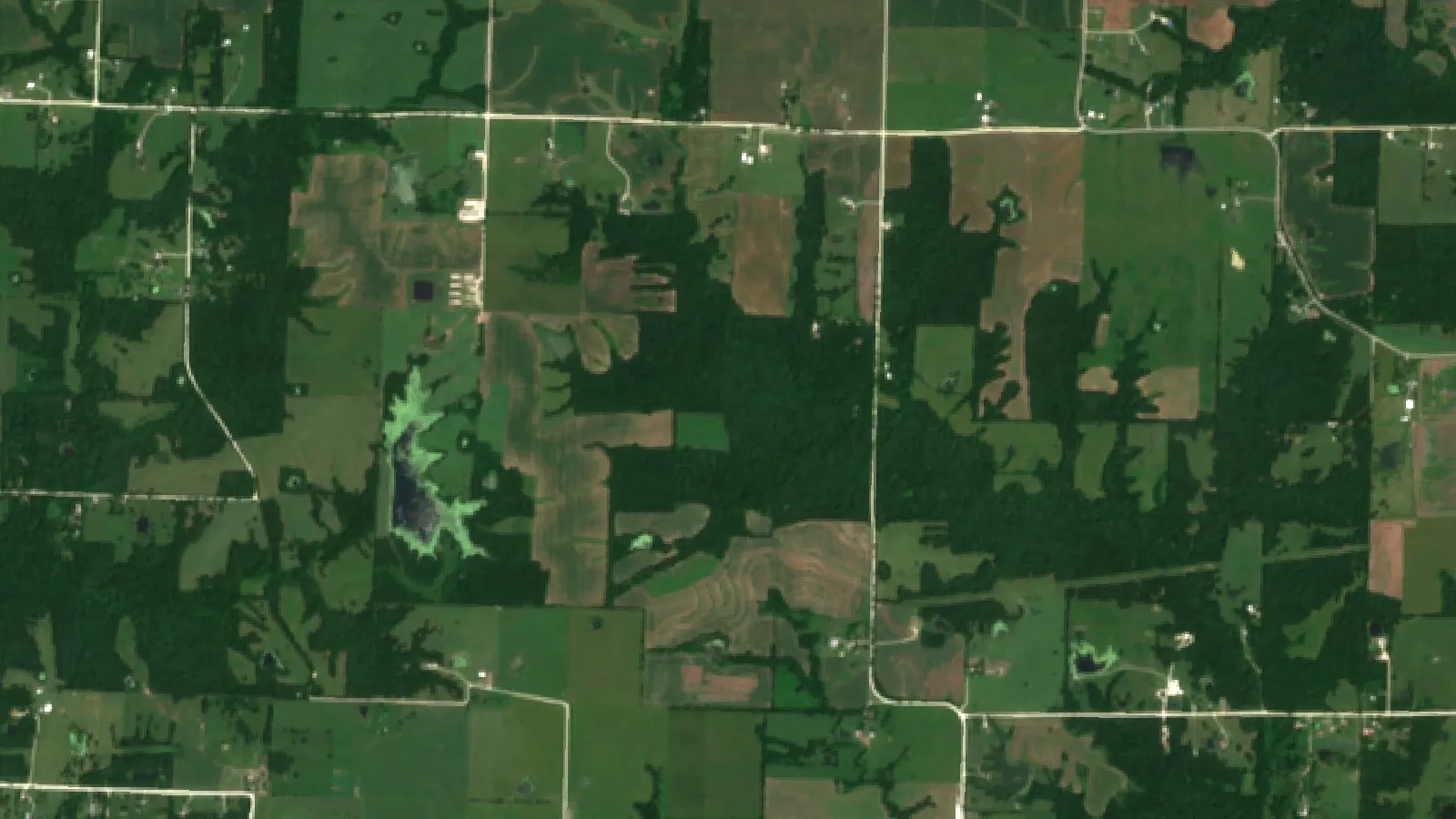
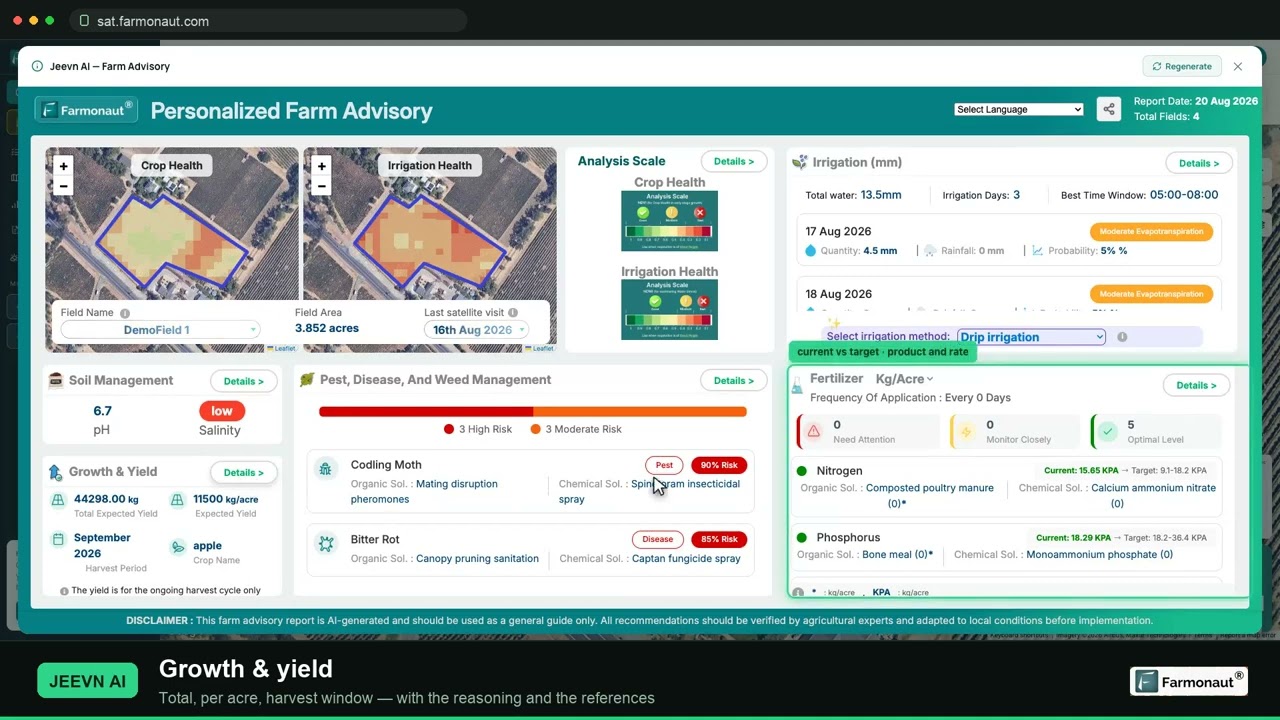
Satellite maps can help you decide where to sample. Areas that stay weak season after season in vegetation maps are good places to pull extra cores, because low pH is one of several causes of poor growth. The maps cannot measure pH, so a soil test is still needed before you order lime.
▶ How to read NDVI maps and spot crop stress early, a useful guide to where to pull extra soil samples. · 19:36
How Farmonaut fits into the liming decision
The Farmonaut Satellite + AI Farm Monitoring System shows vegetation index maps for each field through the season, on the web and in the mobile app. Growers can use these maps to mark weak zones, plan soil sampling there, and later check whether the limed areas are catching up. Developers can bring the same field data into their own tools through the satellite data API and its developer documentation. Agribusinesses that manage many growers can use the agro admin app, and lime and fertilizer haulers can look at fleet management. For records of inputs and their origin, see product traceability and carbon footprinting.

▶ A walkthrough of the Farmonaut web system for monitoring crops by satellite. · 8:43
FAQ
What is the agricultural lime price per ton?
It depends on how it is quoted. In the USDA Alabama Production Cost Report for the week ending 6 November 2026, dealer asks for lime delivered and applied ranged from US$40 to US$75 per ton, averaging US$59.17. Yard prices without trucking or spreading are lower. Get local quotes on the same basis.
How do I compare two lime quotes?
Divide each delivered-and-spread price by the share of the lime that will actually work: CCE times fineness efficiency. The quote with the lower cost per effective ton is the better buy, even if its price per ton is higher.
How much lime do I need per acre?
Your soil test report gives the rate. It depends on current pH, buffer pH, the target pH for your crop and the depth of tillage. Adjust the rate for the CCE and fineness of the product you buy.
Is dolomitic lime better than calcitic lime?
Only when the soil is low in magnesium. Dolomitic lime supplies magnesium as well as calcium. Where magnesium is already adequate or high, calcitic lime is usually the better choice.
How long does agricultural lime take to work?
Fine particles start to react within months. Coarser particles take a year or more. Lime spread in the fall has time to react before spring planting, which is why fall is a common window.
Can I use gypsum instead of lime?
No. Gypsum adds calcium and sulfur but does not neutralize acidity, so it does not raise soil pH. Penn State Extension lists it as not a liming material.
The bottom line on choosing an agricultural lime supplier
The cheapest ton is not always the cheapest acre. Start with a soil test. Ask every supplier for the CCE, the fineness, the moisture and a delivered-and-spread price in writing. Then compare quotes on cost per effective ton, using the calculator above. Lime lasts several years, so a careful choice now pays off over many seasons. Prices, product rules and recommended rates differ by region; check the product label, your local rules and your extension office before you buy.
Related pages on our site: ag lime near me · agricultural limestone cost per ton · liquid lime
Farmonaut crop monitoring
See which parts of your fields lag behind
Draw your fields once and Farmonaut shows satellite vegetation maps for them through the season, on web, Android or iOS, so you can plan soil sampling where it matters.




Sources
- USDA AMS, Alabama Production Cost Report (Weekly), week ending 6 November 2026: ams.usda.gov
- USDA AMS, Illinois Production Cost Report (Bi-weekly), week ending 16 October 2026: ams.usda.gov
- USGS, Mineral Commodity Summaries 2026: Crushed Stone: pubs.usgs.gov
- USGS, Mineral Commodity Summaries 2026: Lime: pubs.usgs.gov
- Penn State Extension, Soil Acidity and Aglime: extension.psu.edu
- University of Maryland Extension, Soil Fertility Management SFM-5: Liming: extension.umd.edu
- Ontario Ministry of Agriculture, Food and Agribusiness, Agronomy Guide for Field Crops, Chapter 9 (2022): ontario.ca
- Agricultural Lime Association (UK): aglime.org.uk
- AHDB, Nutrient Management Guide (RB209): ahdb.org.uk
- Clemson University HGIC, How to Change Soil pH in South Carolina: hgic.clemson.edu
Discussion
Questions, corrections or field experience? Share them below. First-time comments are reviewed before they appear, and your email is never published.
No comments yet. Be the first to add a question or your experience.

 Raintree Computing
 Agricultural Credit Policy Council
 BayWa
 MCSOD
 Marei Nursery
 eKGIS
 Mostas Tech
 Native Seeds
 Andex
 FCF India
 Unifrutti Gulf
 Deluxe Conseil
 TVS Electronics
 WICO
 Chimera Innovation
 SkyHarvest

 Licence holder · Niger · Gold
 Licence holder · Nigeria · Gold + lithium
 Client · Tanzania · Gold
 Client · Somalia · Gold
 Client & affiliate partner · Ghana · Gold










