

Soil pH · Lime buyer guide
Agricultural Lime: Cost per Ton, Rates and Types
Agricultural lime is ground calcitic or dolomitic limestone used to raise soil pH. Lime plus spreading averaged $43.41 a ton in the 2025 Maryland and Delaware custom-rate survey, and the rate per acre is set by a soil test.
Key takeaways
- Ag lime is ground limestone; gypsum is not a liming material because it does not raise pH (Penn State).
- Lime plus application averaged $43.41 a ton in Maryland and Delaware (2025 rates); Wisconsin’s 2025 survey put lime application at $31.71 a ton (7 responses); Mississippi State’s 2026 budget uses $63.67 a ton spread (2025 input prices).
- Compare lime on CCE and fineness (ECCE), not tons: quicklime is 179% CCE, dolomite 109%, marl 70-90% (Penn State).
- Most field crops do best at pH 6.0 to 7.0; lime needs months to react, so spread in fall for spring crops.
- Follow your soil-test lab, the product label and local rules.
In this article
- What is agricultural lime?
- Why acid soil needs lime
- How to read an agricultural lime label
- Agricultural lime price per ton
- How much agricultural lime per acre
- When and how to spread ag lime
- Bulk, pelletized and liquid lime compared
- Buying agricultural lime: a checklist
- Is liming worth it?
- Lime, soil health and the environment
- How we checked the numbers
- FAQ
Agricultural lime is finely ground limestone, either calcitic (calcium carbonate) or dolomitic (calcium magnesium carbonate), spread on fields to raise the pH of acid soil. In the Maryland and Delaware custom-rate survey for 2025, lime bought and spread by a contractor averaged $43.41 per ton, and the Mississippi State 2026 cotton budget uses $63.67 per ton spread (priced at 2025 input costs); the rate per acre is set by a soil test.
This guide explains what ag lime is, how to read a lime label, how much to apply and what it costs. It includes a price chart from extension surveys, a chart of how strong each liming material is, and a calculator that turns a soil-test rate into tons, dollars and a break-even yield gain. It is about the lime itself. Spreader choice and machine prices are covered on a separate page.
What is agricultural lime?
Agricultural lime, often written “aglime” or “ag lime”, is any material that can neutralize soil acidity. In practice it is almost always ground limestone. Penn State Extension says about 99 percent of the aglime used in Pennsylvania is ground calcitic and dolomitic limestone. The calcium and magnesium are useful nutrients, but it is the carbonate part that does the work: it reacts with acid in the soil and lifts the pH.
Not everything with calcium in it is lime. Gypsum (calcium sulfate) and Epsom salts (magnesium sulfate) supply calcium or magnesium but do not neutralize acidity, so they do not raise pH. That point matters when a supplier offers gypsum as a cheaper “lime”.
Ag lime vs quicklime and hydrated lime
The word “lime” also covers burnt products. Quicklime (calcium oxide) is made by heating limestone in a kiln, and hydrated lime (calcium hydroxide) is quicklime mixed with water. The US Geological Survey lime summary for 2026 notes that limestone can replace lime in agriculture and is considerably less expensive, though it reacts more slowly. Most farm liming uses ground limestone for that reason. Burnt products are stronger per ton, react fast and are harder to handle, so Clemson’s Home and Garden Information Center advises using hydrated lime with caution.
Calcitic or dolomitic?
- Calcitic lime: mostly calcium carbonate. It raises pH a little faster than dolomite.
- Dolomitic lime: calcium plus magnesium carbonate. Use it when the soil test shows low magnesium.
- Either: when magnesium is adequate, either type corrects acidity.
University of Wisconsin guidance says that at normal agricultural fineness and with the typical reaction times of two to three years, there is relatively little difference between the two. UF/IFAS Extension adds that the choice should rest mainly on the cost of the material to the producer, unless magnesium is also needed.
Why acid soil needs lime
Soil turns acid over time. Rain leaches calcium, magnesium and potassium out of the root zone, crops remove them at harvest, and residues break down. Nitrogen fertilizer speeds this up. Penn State gives the pounds of calcium carbonate needed to cancel the acid from one pound of nitrogen, and the figures differ a lot by fertilizer.
Chart
Lime needed to offset nitrogen acidity
Pounds of calcium carbonate per pound of N applied
The chart shows why a farm on ammonium sulfate or MAP will need lime more often than one on urea or UAN at the same nitrogen rate.
When pH falls, several problems appear at once:
- Aluminum and manganese: below about pH 5.5 they become more soluble and can reach toxic levels that stunt roots.
- Phosphorus: in acid soil it binds with aluminum and iron. Penn State suggests keeping pH between 5.5 and 6.8 to limit this.
- Nitrogen fixation: Rhizobia bacteria on legume roots work less well below pH 6.0.
- Herbicides: triazine activity drops below pH 6.0, while pH above 7.0 can cause carryover of some other products.
For most field crops, Penn State puts the ideal soil pH between 6.0 and 7.0. Legumes and barley do better at 6.5 to 7.0, while oats tolerate 5.5. Crops differ. North Carolina’s 2026 cotton guide uses a target pH of 6.2 for mineral soils, and it reports that about 58 percent of cotton soil samples on mineral soils in fiscal 2020 required lime. Clemson notes that South Carolina soils are often acidic, in the 4.5 to 6.0 range, but says this should not be assumed without a test.
Blueberries, azaleas and other acid-loving plants are the exception. They prefer pH 5.0 to 5.5, so do not lime them to field-crop targets.
How to read an agricultural lime label
Two numbers decide how much a load of lime is worth: its strength and its fineness.
Strength: calcium carbonate equivalent (CCE)
CCE compares a material with pure calcium carbonate, which is set at 100 percent. A lime with 90 percent CCE neutralizes 90 percent as much acid per ton. Dolomite can score above 100 because magnesium carbonate is lighter per unit of neutralizing power. Burnt lime scores much higher still.
Penn State’s table shows how far materials differ. The University of Maryland gives the matching weights: to equal one ton (2,000 pounds) of pure limestone you need about 1,120 pounds of quicklime, 1,490 pounds of hydrated lime, or 2,200 to 2,500 pounds of ground shells, according to its fact sheet on liming materials.
Speed: fineness
Finer particles react faster because more surface touches the soil. Penn State says a material with at least 95 percent passing a 20-mesh sieve, 60 percent passing 60-mesh and 50 percent passing 100-mesh is generally adequate, and that aglime should react fully within about three years. Paying extra for very fine lime makes sense mainly when you need a quick fix.
Putting both together: ECCE
Many states combine strength and fineness into one figure, often called effective calcium carbonate equivalent (ECCE) or effective neutralizing value. Arkansas defines ECCE as the fineness factor multiplied by CCE. Lime sold in Arkansas averaged 91.4 percent CCE but only 58 percent ECCE once fineness was counted, according to the University of Arkansas wheat handbook. Ask your supplier for the label or a recent analysis, and compare quotes on that basis, not on tons alone.
Chart
Neutralizing strength of liming materials
Calcium carbonate equivalent (CCE), %; top of range where a range is given
Agricultural lime price per ton
Prices below are survey averages and budget figures, not live quotes. Each source measures something slightly different, so read the basis before comparing.
| Source | What is included | Price per ton |
|---|---|---|
| MD and DE survey | Lime plus application, 2025 rates (surveyed fall 2024, 61 respondents) | Average $43.41; median $48.70; range $8.50 to $75 |
| Wisconsin survey | Lime application, 2025 season (7 responses) | Average $31.71; median $22; range $10 to $75 |
| Mississippi budget | Lime, spread; 2026 cotton budget (2025 input prices) | $63.67 |
The Maryland and Delaware custom work charges for 2025 come from a survey of custom operators and farmers in the fall of 2024. The same publication lists earlier averages for lime plus application, which makes a short price history. The Wisconsin custom rates for 2025 are based on few lime responses, so treat that figure as a rough guide.
The line moved up and down rather than in one direction. Haul distance, diesel and how many contractors work your area all affect the local price.
What drives the price
- Distance from the quarry: lime is heavy and cheap per ton, so trucking can be a large part of the delivered price.
- Quality: a cheap ton with low ECCE can cost more per unit of neutralizing power than a dearer, stronger ton.
- Form: bulk ground limestone is the cheapest form per unit of CCE. Pelletized and liquid products cost more per ton and are usually used on small areas.
- Spreading: some quotes are material only, some are delivered, and some are spread. Ask which before you compare.
- Job size: small loads and small fields often carry a minimum charge.
Cost per acre and per year
Mississippi State’s budget shows a simple way to think about it. It applies lime at $63.67 per ton (2025 input prices), about 2 tons per acre once every three years, and charges 0.666 tons per acre to each year. That works out at $42.40 per acre per year. Use the calculator below with your own soil-test rate, lime analysis and quote.
Chart
Lime plus application, Maryland and Delaware
Average $ per ton, custom-rate survey years
How much agricultural lime per acre
The only reliable way to set a rate is a soil test that reports both pH and buffer pH (or exchangeable acidity). The lab uses these to work out how much neutralizing value your soil needs to reach the target pH for your crop.
- Sample well. Clemson suggests sampling in the fall for the next year’s planting. In no-till fields, Penn State advises also checking the top 2 inches, because surface nitrogen and manure acidify that layer first.
- Read the unit. Penn State says recommendations are usually given as pounds or tons of CCE per acre. Maryland notes that some lime labels also state total oxide content (calcium oxide plus magnesium oxide).
- Adjust for your lime. Divide the recommendation by your product’s CCE or ECCE. A 2-ton recommendation with a lime of 80 percent ECCE needs 2.5 tons of product.
- Adjust for depth. Rates usually assume mixing into a plow layer. Maryland’s fact sheet assumes 8 inches deep.
- Round to the spreader. Set a rate your equipment can spread evenly.
Penn State gives one example for no-till fields: if the surface pH is below 6.2 and the standard sample shows no need, apply 2,000 pounds of CCE per acre to correct surface acidity. Rules and rates differ by state, so follow your own lab’s recommendation and local advice.
Setting the rate
The right rate depends on your soil’s starting pH, its buffer pH and the crop. Very acid or clay-rich soils need more lime, so follow the lab figure rather than a rule of thumb. Do not go above your lab’s figure: liming past pH 7.0 can tie up phosphorus with calcium and reduce micronutrient availability. Clemson notes that above pH 6.5, phosphorus and most micronutrients become less available in its state’s soils.
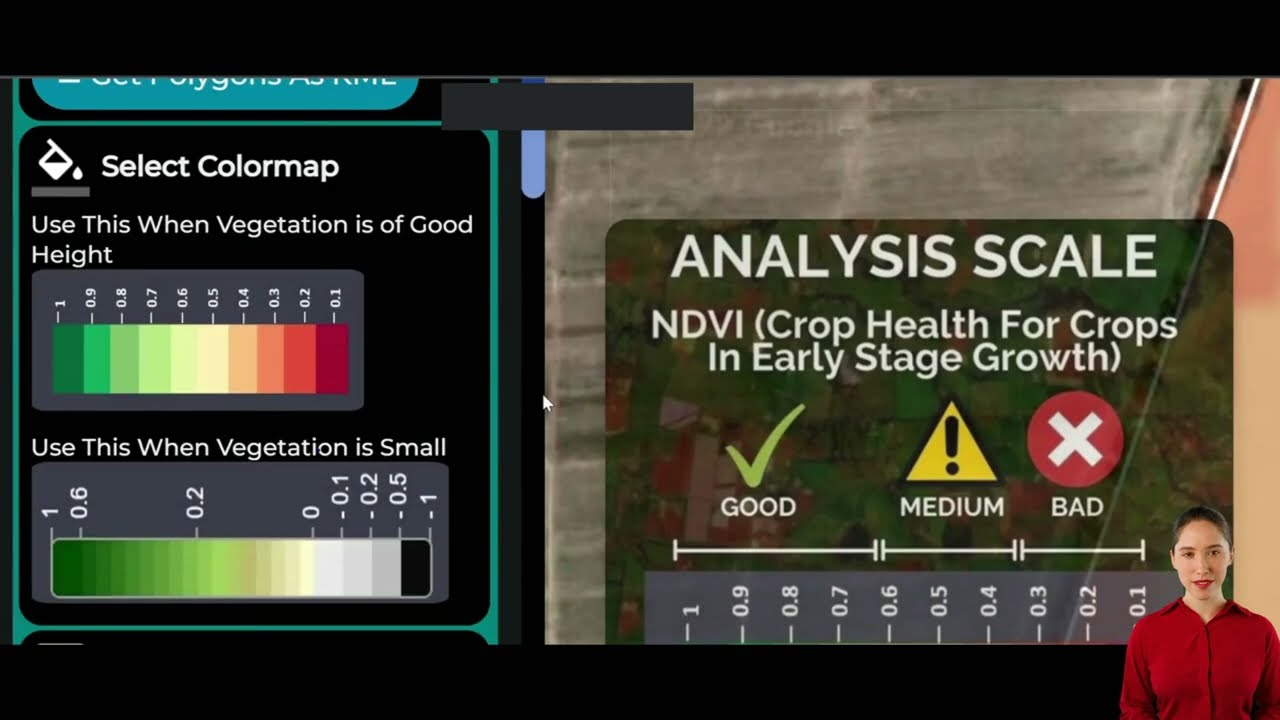
▶ A walk-through of reading satellite crop maps in the Farmonaut web app. · 10:16
When and how to spread ag lime
Lime is slow. Penn State says even finely ground material needs several months to react, and Clemson suggests applying it two to three months before planting. That makes fall the common window for spring crops.
- Before acid-sensitive crops: apply well ahead of alfalfa and other legumes, which respond to higher pH.
- Tilled fields: incorporation mixes lime through the root zone and speeds up the effect.
- No-till and pasture: surface lime works, but slowly. The Arkansas wheat handbook cites estimates that surface-applied lime moves down only about 0.25 to 1.0 inch per year, so it mainly corrects the top inch or two.
- Even spreading: uneven spreading leaves acid strips. Check the spread pattern with your contractor.
- Zones: if grid or zone soil tests show different needs, a variable-rate map can save lime on fields with mixed soils.
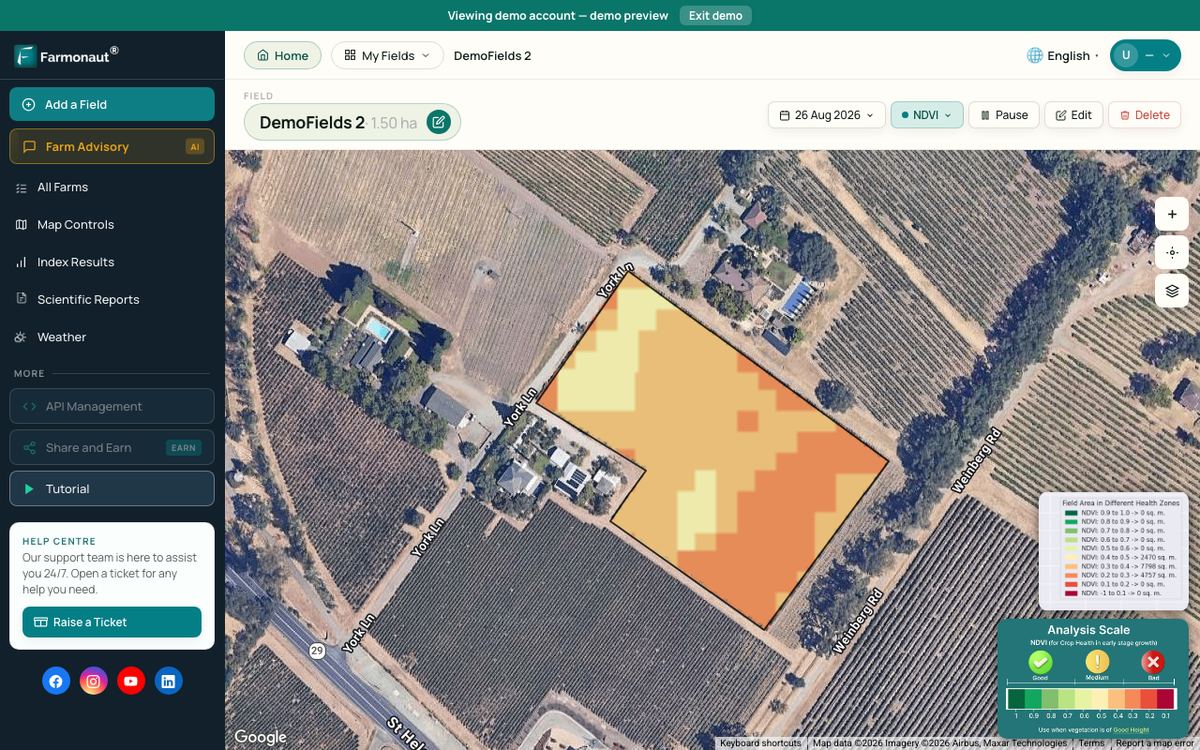
Satellite crop maps can help here. Areas that stay weak across seasons are good places to take extra soil samples, though the image cannot show pH by itself; only a soil test can. The Farmonaut Satellite + AI Farm Monitoring System maps crop vigor across each field, and larger operations can use the large-scale farm management app to track fields and input timing.

▶ Six plain steps to start precision farming, from field maps to zone management. · 4:18
Bulk, pelletized and liquid lime compared
| Form | Best for | Notes |
|---|---|---|
| Bulk ground lime | Fields and pasture | Lowest cost per unit of CCE; spread by truck or contractor |
| Pelletized lime | Small areas, gardens | Fine lime bound into pellets; spreads with a normal fertilizer spreader; higher price per ton |
| Liquid lime | Turf, spot correction | Very fine lime in suspension; low rates per acre; check the neutralizing value per acre |
| Hydrated lime | Fast correction | Strong and fast; handle with care; easy to overshoot pH |
Pelletized and liquid lime are not stronger per pound of lime. They are fine lime in an easier form. Arkansas shows how to convert between sources: divide the ECCE of the ag lime by the ECCE of the other product and multiply by the ag lime rate. If a product’s label rate gives far less neutralizing value than your soil test asks for, it will not move pH as far, however fine it is.
Buying agricultural lime: a checklist
Local supply depends on where quarries are. Your county extension office, farm supply cooperative and neighbors who lime regularly are the usual starting points. When you call suppliers, ask:
- Is it calcitic or dolomitic, and what are the CCE and the fineness (or ECCE)?
- Is the price material only, delivered, or delivered and spread?
- What is the moisture content? Wet lime weighs more per ton of useful material.
- Is there a minimum load or a small-field charge?
- When can it be spread, and how do they check spread width and evenness?
- Can they spread to a variable-rate map if you have one?
Some states regulate lime labels and minimum quality. Check your state’s rules and ask for the analysis in writing.
Is liming worth it?
Liming pays when soil acidity is limiting yield and the gain over the years the lime lasts is greater than the cost. Penn State notes that the greatest benefit of lime comes from removing the harm of soil acidity, not from the calcium or magnesium it adds. North Carolina’s cotton guide calls excess acidity a major yield-limiting factor in that state. The size of the gain depends on how acid the soil is, the crop and the weather, so there is no single figure that fits every farm.
The calculator lets you test your own case. Enter the gain you think you might see, and it shows the break-even.
Try the numbers for your own farm below.
Calculator
What will liming cost, and what gain pays for it?
Enter your soil-test rate, your lime’s ECCE and your quote.
- Product needed per acre: 2.22 t
- Product for the field: 88.9 t
- Cost per acre: $100
- Cost for the field: $4,000
- Break-even gain per acre per year: $25
Example values only, not a benchmark or forecast. Every number is your input. The default price is a round figure near the 2025 Maryland and Delaware survey average ($43.41 a ton with application, University of Maryland Extension). Product needed = recommendation divided by ECCE. The default gain is an example set close to break-even.
Lime, soil health and the environment
Correct pH helps crops use the nitrogen and phosphorus you apply, which can mean less nutrient left in the soil to wash away. Liming also supports the soil microbes that break down residues and fix nitrogen. These links run through pH, so they only apply where the soil was acid to begin with.
There are also costs. Hauling heavy lime long distances uses diesel, and lime spread where the pH is already right brings no benefit. Testing first and liming only where needed keeps all of these down.
If you report on the climate side of farm inputs, our carbon footprinting page explains how field data can feed that work. For a wider view of the inputs market, see our overview of farm input innovations.

▶ Why soil organic matter matters for fertility and soil structure. · 7:33
How we checked the numbers
Prices come from published extension surveys and budgets, with the survey year and what each price includes. Material strengths come from Penn State and University of Maryland tables. Agronomy points come from Penn State, Clemson, North Carolina State, Arkansas, Wisconsin and Florida extension publications. We did not use dealer price lists or unsourced yield claims. Lime prices are local, so use these as a starting point and get your own quotes.
Follow your soil-test lab’s recommendation, the product label and local rules, and get professional advice before large applications. For more detail on prices, see our page on agricultural limestone and lime cost per ton.
For a closer look at a related question, see our guide: Horse Manure for Sale: Boost Soil & Crop Success.
FAQ
How much does agricultural lime cost per ton?
Lime plus spreading averaged $43.41 per ton in the Maryland and Delaware survey (2025 rates). Wisconsin’s survey put lime application at $31.71 per ton (2025 season, 7 responses), which may not include the lime itself. Mississippi State’s 2026 cotton budget uses $63.67 per ton spread, based on 2025 input prices. Local prices depend on haul distance, quality and job size.
How long does ag lime last?
It depends on the soil, rainfall and nitrogen use. Penn State says aglime should react fully within about three years, and Mississippi State’s budget spreads one application over three years. Retest every few years and lime again when pH drops below your target.
Is dolomitic lime better than calcitic lime?
Only if your soil is low in magnesium. Otherwise either type works, and UF/IFAS suggests choosing mainly on cost. Calcitic lime raises pH a little faster.
Does Farmonaut sell agricultural lime?
No. Farmonaut does not sell or deliver farm inputs. It provides satellite crop monitoring through the web and mobile apps, an API with developer docs, and related tools.
Can I use lime in organic farming?
Organic standards decide which liming products are allowed, and blends or by-products may not qualify. Check with your organic certifier before you buy.
Related pages on our site: product traceability, crop loan and insurance verification, fleet management, app download, Android app, iOS app.
Farmonaut crop monitoring
See weak areas in your fields from space
Satellite crop maps show where to take extra soil samples before you buy lime.



Keep reading
Sources
- Penn State Extension, Soil Acidity and Aglime: extension.psu.edu
- University of Maryland Extension, Soil Fertility Management SFM-5: liming materials (2021): extension.umd.edu
- University of Maryland / Delaware, Custom Work Charges FS-683 (2025 rates): udel.edu
- University of Wisconsin Extension, Custom rates for 2025 Wisconsin farm operations (2026): farms.extension.wisc.edu
- Mississippi State University, 2026 Cotton Planning Budgets: agecon.msstate.edu
- Clemson HGIC, Changing the pH of your soil: hgic.clemson.edu
- NC State Extension, 2026 Cotton Information: Fertilization (2026): content.ces.ncsu.edu
- University of Arkansas, Wheat production handbook MP404, chapter 5: uaex.uada.edu
- University of Wisconsin, A3671 Liming materials: corn.aae.wisc.edu
- UF/IFAS Extension, AA128 soil pH and liming: edis.ifas.ufl.edu
- USGS, Mineral Commodity Summaries 2026: Lime: pubs.usgs.gov
Discussion
Questions, corrections or field experience? Share them below. First-time comments are reviewed before they appear, and your email is never published.
No comments yet. Be the first to add a question or your experience.

 WebsEdge
 IRE Soil
 Blickwinkel
 Agricultural Credit Policy Council
 BayWa
BayWa MCSOD
MCSOD Marei Nursery
 eKGIS
eKGIS Mostas Tech
 Native Seeds
 Andex
Andex FCF India
 Unifrutti Gulf
 Deluxe Conseil
 TVS Electronics
 WICO
WICO Chimera Innovation
 Licence holder · Niger · Gold
 Licence holder · Nigeria · Gold + lithium










