

Urban farming · Project examples and how-to
Urban Agriculture Projects: 6 Real Farms, Yields and Costs
Six urban agriculture projects in the US, Canada, the UK and Germany with no sign of closing in October 2026, with size, output and funding from named sources. Brooklyn Grange grows over 100,000 lb a year on 5.6 acres of roofs (New York State, 2024). Plus failures, start-up steps and costs, and a plot calculator.
Key takeaways
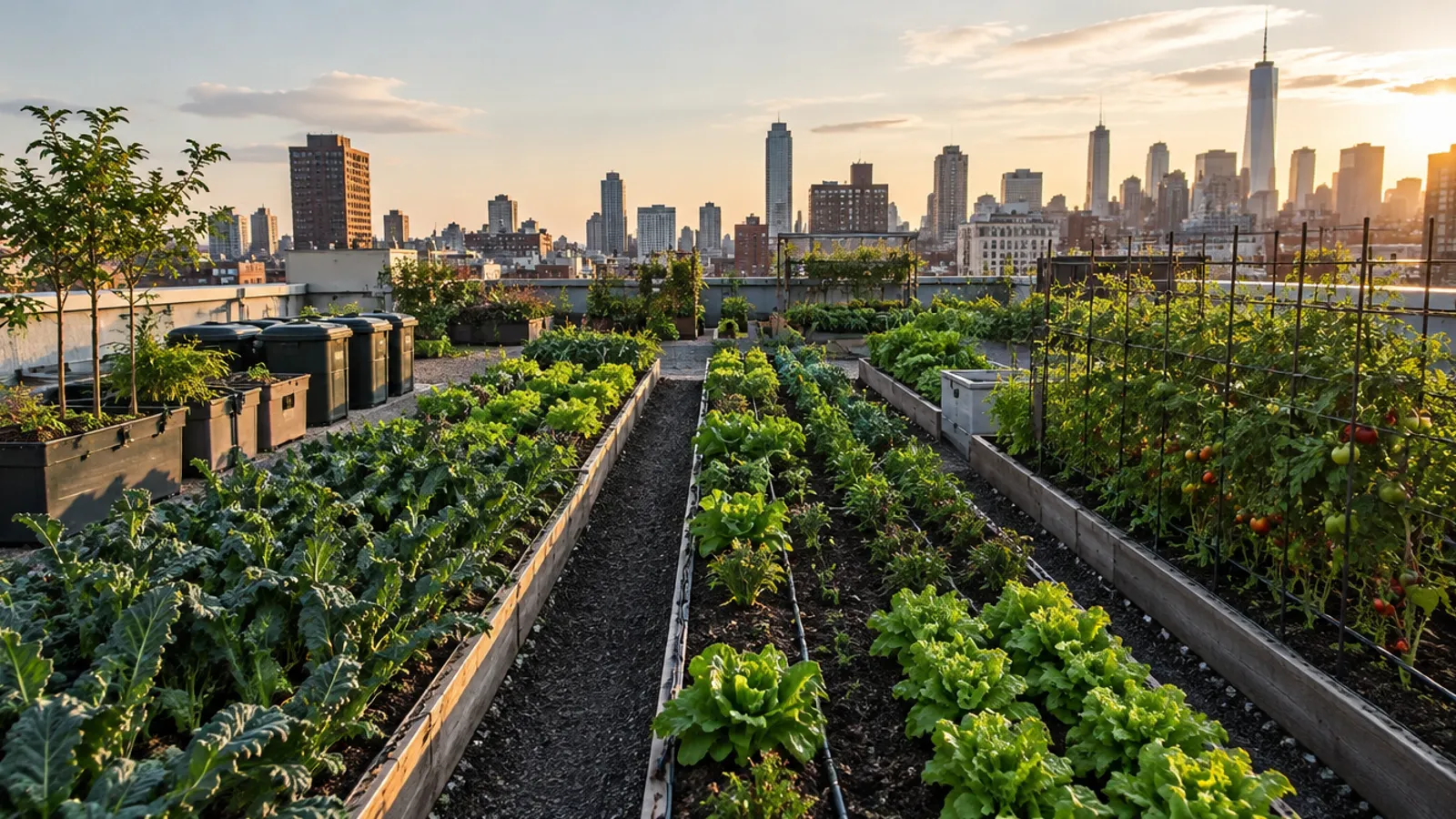
- Brooklyn Grange leases 5.6 acres of New York rooftops and grows over 100,000 lb of produce a year (New York State Climate Impacts Assessment, 2024).
- Lufa Farms’ Montreal greenhouse covers 163,800 sq ft, the largest commercial rooftop greenhouse listed by Guinness World Records (2020); Lufa opened its fifth roof in 2024.
- City networks grow a lot too: Keep Growing Detroit and its gardens grew 484,250 lb in 2020, and Windy City Harvest’s 10 Chicago farms and gardens deliver over 240,000 lb.
- Well-funded indoor farms failed: Bowery closed in 2024 after raising more than $700 million, and AeroFarms and AppHarvest went through bankruptcy (TechCrunch, 2024).
- Small plots can out-yield farms per square metre (5.94 kg/m² in 13 Sydney-area gardens, PNAS 2018) but lost money on average once labour was paid.
In this article
- Urban agriculture projects at a glance
- How we chose and ranked these projects
- Rooftop and single-site urban farms
- City-wide urban agriculture programmes
- Two famous projects we could not confirm
- Urban farm projects that closed or went bankrupt
- What made the working projects succeed
- How much food can a small urban plot grow?
- How to start an urban agriculture project: steps and costs
- Yield and revenue calculator for a small urban plot
- Where satellite monitoring fits
- FAQ
The urban agriculture projects with the best public numbers are rooftop businesses such as Lufa Farms in Montreal and Brooklyn Grange in New York, and city-wide networks such as Keep Growing Detroit, Windy City Harvest in Chicago and Capital Growth in London. Brooklyn Grange alone grows more than 100,000 pounds of produce a year on 5.6 acres of leased roof space, according to the New York State Climate Impacts Assessment. Windy City Harvest says its 10 farms and gardens deliver over 240,000 pounds of produce.
This guide ranks six real projects in the US, Canada, the UK and Germany with no sign of closing when we checked in October 2026 (we list the latest dated evidence for each), with their size, output and funding. It also covers two famous projects whose current status we could not confirm, four well-funded indoor farm firms that failed or filed for bankruptcy, and what the survivors did differently. Then it shows how to start your own project, step by step with dated costs, and gives you a yield and revenue calculator for a small city plot. For a wider look at the topic, see our guide to urban farming and city sustainability.
Urban agriculture projects at a glance
The table sums up the six ranked projects. Each has its own section below with the sources.
| Project | City | Type | Size | Reported output | Funding |
|---|---|---|---|---|---|
| 1. Lufa Farms | Montreal, Canada | Rooftop greenhouses | Largest roof 163,800 sq ft (2020); five rooftop sites | About 30,000 baskets a week (company, 2024) | Private company with building partners |
| 2. Brooklyn Grange | New York, US | Rooftop soil farms | 5.6 acres leased on three sites | Over 100,000 lb a year | Sales, events and design work; $1.38 million city grant for one roof (2019) |
| 3. Keep Growing Detroit | Detroit, US | Garden network and 1.3-acre farm | Network of resident gardens and farms | 484,250 lb with its network (2020 season) | Non-profit; totals not published in our sources |
| 4. Windy City Harvest | Chicago, US | Training farms | 10 farms and gardens | Over 240,000 lb delivered | Chicago Botanic Garden programme |
| 5. Capital Growth | London, UK | Community growing network | More than 2,000 sites | No total harvest published | Run by the charity Sustain; members report funding strain |
| 6. Prinzessinnengarten | Berlin, Germany | Community garden | About 6,000 m² at first; now on a 7.5-ha cemetery section | No harvest figure published | Community collective; totals not published |
How we chose and ranked these projects
We included a project only if three things were true. First, a public source gives its size and either its output or its funding. Second, the project is in a city in the US, Canada, the UK, the EU or Australia. Third, its own website or a recent official page showed it was still active in October 2026, for example with a current event calendar or a 2026 report.
We then ranked the projects by the scale they have published. For single farms that means growing area. For networks it means yearly harvest or number of sites. These are different measures, so read the rank as a rough order of size, not an exact score. Where sources disagree, we use the official or most recent figure and say which year it describes.
Rooftop and single-site urban farms
Rooftop farms are the most visible kind of city farm. They need a roof that can carry the weight and a lease from the owner. The two biggest commercial examples in North America take different routes: Lufa grows in glass greenhouses, while Brooklyn Grange grows in soil in the open air.
Chart
Size of selected urban farm sites
Square feet per single site; metric sizes converted (1 m² = 10.764 sq ft); * status not confirmed in October 2026
1. Lufa Farms, Montreal
Best for: anyone who wants to see a commercial, year-round rooftop model at scale.
Lufa Farms was founded in 2009 by Mohamed Hage and Lauren Rathmell. Its rooftop greenhouse in Ville Saint-Laurent opened in August 2020 and covers 15,217.5 m² (163,800 sq ft). Guinness World Records lists it as the largest commercial rooftop greenhouse. It sits on a former warehouse that now holds the company’s offices and packing space, and it collects rain and meltwater for a closed-loop irrigation system. Tomatoes are its main crop, and an indoor LED farm for herbs and salad leaves was added inside the building in 2023.
In March 2024 Lufa opened its fifth rooftop greenhouse, a 127,000-square-foot site on top of a new Walmart and Decathlon store at Marché Central in Montreal’s Ahuntsic district. It grows cucumbers and peppers. The company told the trade journal Hortidaily that it sends out about 30,000 baskets a week through more than 350 pick-up points. That is a company figure, not an independent count.
2. Brooklyn Grange, New York City
Best for: soil-based rooftop farms that earn money from more than vegetables.
Brooklyn Grange started in 2010. The New York State Climate Impacts Assessment says it leases 5.6 acres across three sites and grows more than 100,000 pounds of organically grown produce each year. It sells through a sliding-scale community supported agriculture (CSA) scheme, at farmers markets and to retailers. High rent, labour and supply costs push its growers toward fast, high-yield crops.
Its largest roof, in Sunset Park, opened in August 2019. The roof is 140,000 square feet, with 55,000 square feet under cultivation and a 4,800-square-foot hydroponic greenhouse for winter crops. At opening it was expected to grow about 30,000 pounds of vegetables a year. A $1.38 million grant from the city’s Department of Environmental Protection helped pay for it, because the farm can manage more than 175,000 gallons of stormwater in one rainfall, according to the DEP’s 2019 announcement. That release also says the same grant scheme had committed over $15 million to 34 partners since 2011.
The farm’s own website now lists two rooftop farms in Brooklyn plus rooftops it runs for clients, such as the Javits Center. The state assessment notes rising weather costs: spider mites, wind damage and a higher insurance premium after Hurricane Ida.
3. Prinzessinnengarten, Berlin
Best for: community gardens on land the group does not own.
The Prinzessinnengarten began in 2009 as a mobile garden on an almost 6,000 m² brownfield at Moritzplatz in Kreuzberg, with raised beds, beehives, a café and a learning kitchen, according to the City of Berlin’s community garden guide. After ten years it moved. Since 2020 a collective has gardened in raised beds on a 7.5-hectare section of the New St. Jacobi Cemetery in Neukölln, which also keeps the old cemetery open as public green space. There are no private beds; everyone works on the whole garden. Gardening also continues at Moritzplatz as an inclusive open garden.
The city page gives no harvest figure or budget. The lesson is the mobile set-up: movable beds let the group garden on land it did not own, then relocate.
City-wide urban agriculture programmes
Some of the largest harvests do not come from one big farm. They come from networks that support many small gardens and farms with seeds, training and places to sell. New York City alone had 2,830 urban agriculture sites, including farms and community, school and learning gardens, according to the Mayor’s Office of Urban Agriculture report for 2024.
4. Keep Growing Detroit
Best for: cities with a lot of vacant land and many small growers.
Keep Growing Detroit runs a 1.3-acre urban farm and a Garden Resource Program for growers in Detroit, Hamtramck and Highland Park. Members get technical help, seeds and Detroit-grown transplants. With its network of residents, gardens and farms it grew 484,250 pounds of produce in the 2020 season and held 43 online classes, according to a 2021 profile by Nebraska Farmers Union for the FDA-funded Local Food Safety Collaborative.
It also runs a Grown in Detroit online farm store for its growers. Its website listed classes and a garlic distribution day for October 2026, so the programme is still active.
5. Windy City Harvest, Chicago
Best for: projects whose main goal is jobs and training.
Windy City Harvest is the urban agriculture programme of the Chicago Botanic Garden, working on the city’s West and South Sides. Its 10 urban farms and gardens deliver over 240,000 pounds of fruit and vegetables, according to the Chicago Botanic Garden. Each year it gives paid, hands-on training to more than 70 people, and about 80% find jobs in the food system afterwards. Since 2013 it has helped start more than 30 small farm businesses. Its VeggieRx programme supplies produce boxes to more than 3,300 people a year.
6. Capital Growth, London
Best for: small community groups that want support, training and a voice with the city.
Capital Growth is a network of more than 2,000 food growing spaces across London, run by the food charity Sustain. Its members include gardens on canal barges, forest gardens on old car parks and beds on Transport for London platforms. In its members survey, published in July 2026, 121 people answered for their projects. Together those projects welcomed 24,897 people onto their sites. Members reported funding and capacity challenges.
▶ Twenty careers in agriculture and what each one pays in the US, useful for training programmes that place people in food-system jobs. · 7:04
Two famous projects we could not confirm
These two projects are often cited online, but we could not find proof that they are open and growing in October 2026. Check with them before you cite them as working examples.
- Nature Urbaine, Paris. A rooftop farm on Pavilion 6 of the Paris Expo exhibition centre at Porte de Versailles, run by Agripolis and Cultures en Ville. The venue operator Viparis described it in January 2022 as a 14,000 m² site producing about 200 kg of fruit and vegetables a day, with visits on Monday and Saturday mornings. The newest report we found on its season was from 2021.
- Melbourne Skyfarm, Australia. A 2,000 m² rooftop farm on a car park in Docklands. The City of Melbourne approved it in 2019 with A$300,000 from its Urban Forest Fund, and the plan was to grow five tonnes of produce a year for a café and for charities, according to Government News. Its website in October 2026 offers tours and masterclasses but still says it is not yet open to the public.
Urban farm projects that closed or went bankrupt
Money alone does not keep a city farm alive. Some of the best-funded indoor farm firms in the US either closed or went through bankruptcy. Bowery Farming, a New York vertical farm company, stopped operating in November 2024 after raising more than $700 million, according to TechCrunch, citing PitchBook. Its last round in 2021 valued it at over $2 billion. AeroFarms raised more than $300 million and filed for bankruptcy, then left bankruptcy protection in September 2023. AppHarvest raised more than $700 million and filed for Chapter 11 in 2023.
Chart
Money raised by indoor farm firms that closed or filed for bankruptcy
US$ million raised before closing or filing; each is a ‘more than’ figure reported by TechCrunch
In Europe, the Berlin vertical farm company Infarm also ran into trouble. The UK Companies House record for Infarm – Indoor Urban Farming GmbH lists its status as insolvency proceedings.
The common thread is cost. Indoor farms pay for electric light, cooling and buildings that outdoor farms get from the sun and the soil. A 2026 study in Frontiers in Sustainable Food Systems modelled what crop yields vertical farms would need to compete on price, and a 2025 paper in Plant Physiology put the minimum energy cost of vertical farming at about $10 per kg of dry plant matter, too high to compete with grains and pulses and with limited competitiveness for tomatoes and lettuce.
What made the working projects succeed
Five habits appear in more than one of the ranked projects. None is a guarantee.
- More than one source of income. Brooklyn Grange earns from produce, events, education and design work. Lufa sells weekly baskets and works with more than 400 partners. Windy City Harvest combines produce with paid job training.
- Public money tied to a city goal. New York paid part of the cost of the Sunset Park roof because it holds stormwater, a problem the city must solve anyway. Melbourne funded Skyfarm through an urban forest budget.
- Cheap or shared space. Rooftop farms rent space owners were not using. Lufa’s Marché Central greenhouse sits on a new store roof built with the landlord as a partner. Berlin’s garden uses cemetery land that the collective helps keep open.
- A clear sales channel. CSAs, weekly baskets, online farm stores and markets turn a harvest into cash. Keep Growing Detroit set up its Grown in Detroit store so small growers have a buyer.
- Simple, low-energy growing. Most of the survivors grow in soil, raised beds or sunlit greenhouses rather than in fully lit indoor rooms.
Carbon is a trade-off to plan for. A study of 73 urban farms and gardens in France, Germany, Poland, the UK and the US, published in Nature Cities in January 2024, found that urban produce had a carbon footprint about six times higher per serving than conventional farm produce: 420 g CO₂e against 70 g. Tomatoes grown outdoors, and about a quarter of individually run gardens, did better than conventional farms. The University of Michigan researchers said most of the extra carbon comes from building materials used for only a few years, so beds, paths and structures that last longer cut the footprint.
▶ Seven simple ways to protect soil and water, the same low-input habits that the longest-running city farms rely on. · 4:34
How much food can a small urban plot grow?
More than many people expect, per square foot. A 2022 meta-analysis in Earth’s Future pulled together 200 studies and 2,062 yield observations. It found urban yields on par with or higher than global average yields on conventional farms for most crop groups. For tomatoes, the urban average was 8.7 kg per square metre per growing cycle against 3.7 kg on conventional farms. The same paper cites an estimate that cities already supply 5% to 10% of the world’s legumes, vegetables and tubers.
Chart
Urban vs conventional crop yields
kg per square metre per growing cycle, selected crop groups, means from 200 studies
Vertical systems did not always win. For the group of other fresh vegetables, vertical farms in the meta-analysis averaged 2.9 kg per square metre per cycle, against 4.7 kg for flat beds.
The best real-world test comes from Sydney. A study in PNAS (2018) tracked 13 small organic farms and gardens in Sydney and Wollongong for a year. They grew a mean 5.94 kg of food per square metre, about 1.2 pounds per square foot, with a range from 1.99 to 15.53 kg. That is about twice the yield of typical Australian commercial vegetable farms. But labour was slow at 1.29 kg per hour on average. When the researchers valued labour at the Australian casual farmhand minimum wage (US$18.14 an hour in 2017), the gardens ran at a financial loss on average. High yield per square foot does not mean profit.
How to start an urban agriculture project: steps and costs
These steps follow the order that extension guides use. Costs are examples from named sources with their dates; your city, crops and site will change them. Zoning, food safety, tax and loan terms vary by place, so check your local rules and get professional advice before you sign a lease or a loan.
Chart
Where the money goes in a small market-stall budget
US$ per year, University of Illinois Extension example; $8,000 of sales against $7,900 of costs
- Decide what the project is for. Income, food access, training or education. University of Illinois Extension advises writing a vision and mission first and working out how much money the farm must bring in each month.
- Find a site and check the rules. Ask the city about zoning, water access and selling on site. Some cities run vacant-lot schemes; New York’s urban agriculture office has mapped more than 95,000 underused city-owned land parcels as part of this work. For a roof, get an engineer to check the load.
- Test the soil before you plant. Lead is the most common metal in urban soil, because paint contained lead until 1978 and petrol until 1996, says Oregon State University Extension. Natural levels are 10 to 50 parts per million (ppm). Illinois Extension says to use raised beds or containers with clean soil for food crops where tests show over 400 ppm of lead, and to test play areas separately. Use a lab that reports total lead.
- Plan water and power. Rooftop and rented sites often need a meter, a tap and a way to collect rain. Lufa and Brooklyn Grange both collect or manage rainwater on their roofs.
- Build a first-year budget. Write an enterprise budget for each sales outlet. The Illinois example below shows how fast small costs add up.
- Line up funding. See the funding notes after the budget chart.
- Pick a sales channel before you plant. A CSA, a market stall, restaurants or a farm store. Your crop plan should follow what that buyer wants.
- Keep records from day one. Track harvest weight, hours and sales by crop. This is what lenders and grant funders will ask for.
The University of Illinois Extension budget for a farmers market stall, revised in October 2025, is a useful reality check. It assumes $500 of sales a week for 16 weeks, or $8,000 in revenue. Costs for seeds, compost, supplies, fuel, utilities, part-time labour, insurance and $250 a month of land rent come to $7,900, leaving an expected net return of $100. The authors say the numbers are only there to show how quickly costs add up, not to describe a real farm.
Utah State University Extension published budgets in 2023 for an urban demonstration garden in Kaysville, Utah. The garden is one eighth of an acre, with 1,500 square feet of actual growing space. Staff logged 340 hours for maintenance and harvest, 40 for planting and 30 for clean-up, and the budgets valued that time at $18 an hour. They add about 10 hours a week of market time for ten weeks.
Funding notes, checked October 2026, US-focused:
- Loans. The USDA Farm Service Agency offers operating microloans of up to $50,000 per loan, with repayment terms of one to seven years. The rate for direct operating and microloans was 5.375%, effective 1 October 2026. Rates change monthly.
- High tunnels. NRCS can share the cost of a high tunnel through EQIP. In Pennsylvania’s FY2026 payment list, an enclosed high tunnel pays a base of $5,524.04 plus $4.89 per square foot, with higher rates for historically underserved producers and a cap of $10,000 per operating unit. Payment rates are set by state, so ask your local office.
- Urban grants. USDA’s Office of Urban Agriculture and Innovative Production had put $53.7 million into its urban agriculture grants since 2020, according to a USDA release of January 2025. The office pulled its 2025 grant round, and we found no new round announced as of October 2026.
- Outside the US. City budgets fund some projects, such as Melbourne’s grant to Skyfarm.
▶ Ten small farm business ideas you can start without owning a farm, from microgreens on a shelf to worms and bees. · 6:03
Yield and revenue calculator for a small urban plot
Test your own plot before you spend money. The calculator shows the harvest, the sales, what each hour earns before wages, and the net result after paying for labour.
The defaults are an example set close to break-even, not a forecast; the note under the calculator says where they come from.
Try the numbers for your own farm below.
Calculator
What could your urban plot grow and earn?
Enter your own plot size, yield, price, costs and hours.
- Total harvest: 1,800 lb
- Sales: $7,650
- Earned per hour before wages: $18 per hour
- Harvest per hour of work: 5.3 lb
Example values only, set near break-even; not a benchmark or a forecast. Every number is your input. The default yield of 1.2 lb per sq ft is close to the mean of 13 Sydney gardens (5.94 kg/m², range 1.99 to 15.53 kg/m²; McDougall et al., PNAS 2018). The default 1,500 sq ft, 340 hours and $18 per hour follow the Utah State University Extension demonstration garden budgets (2023), which also logged 70 more hours for planting and clean-up plus market time. Costs should include seeds, compost, water, rent, insurance and market fees. The result ignores start-up purchases, taxes and unsold produce beyond the share you enter.
Where satellite monitoring fits
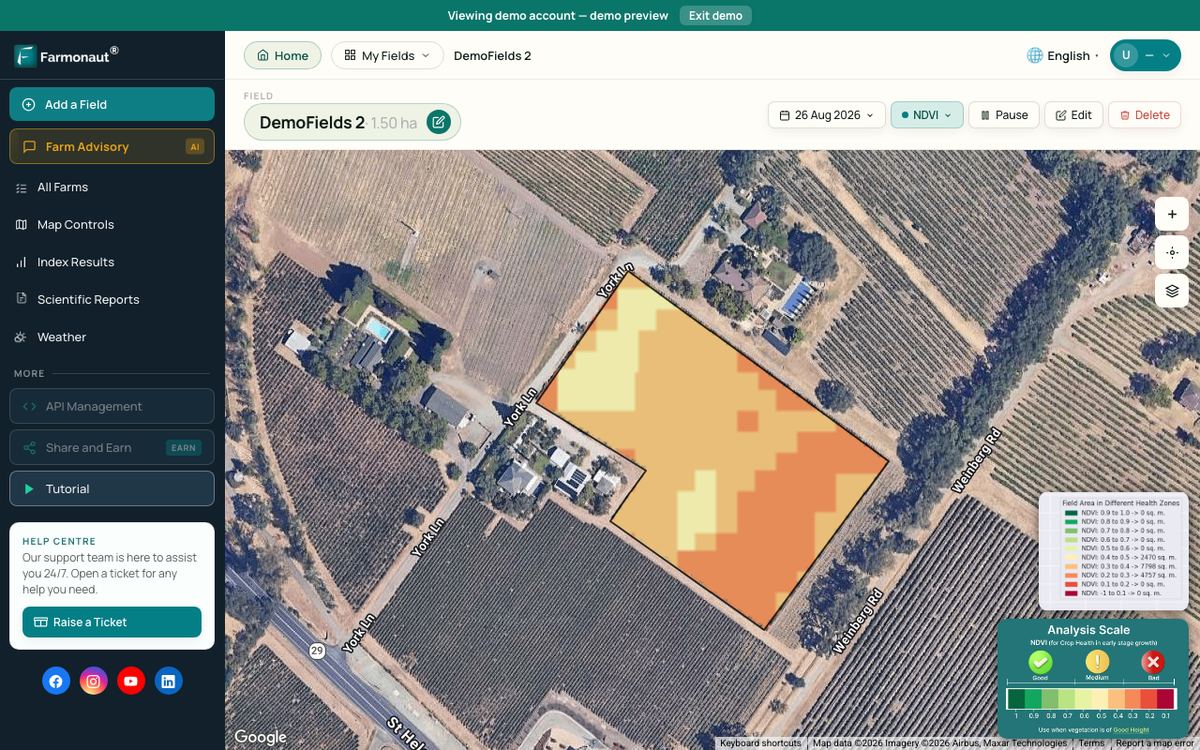
Most rooftop beds and community plots are too small for open public satellite images such as Sentinel-2, which have 10-metre pixels. Satellite crop monitoring is more useful for peri-urban farms of several acres on the edge of a city, and for groups that manage many larger sites. On those farms, the Farmonaut Satellite + AI Farm Monitoring System shows vegetation maps of each field through the season on web, Android and iOS, so growers can see which part of a field is falling behind and check it on foot.
Related pages on our site: AI in agriculture, product traceability, carbon footprinting, fleet management, the agro admin app, crop loan and insurance tools, the satellite and weather API docs and the Farmonaut app.
FAQ
What are some examples of urban agriculture projects?
Working examples include Lufa Farms’ rooftop greenhouses in Montreal, Brooklyn Grange’s rooftop soil farms in New York, Keep Growing Detroit’s garden network, Windy City Harvest’s training farms in Chicago, the Capital Growth network in London and the Prinzessinnengarten in Berlin. None showed signs of closing when we checked in October 2026; the latest dated evidence for each is noted.
How much does it cost to start an urban farm?
It depends on the site. University of Illinois Extension’s example market stall budget has $7,900 of yearly costs, including $3,000 of rent, against $8,000 of sales. A high tunnel, a soil test, water hook-up and roof checks add to that. USDA operating microloans go up to $50,000. Use the calculator above with your own numbers, and get local advice before you commit.
Can a small urban farm make money?
Some do, but many do not once labour is paid. The 13 Sydney gardens studied in PNAS grew about twice the yield of commercial vegetable farms per square metre, yet ran at a loss on average when labour was valued at a minimum wage. The working projects in this guide earn from several sources, such as events, training, grants or design work, as well as produce.
Is urban agriculture better for the climate?
Not by default. The 2024 Nature Cities study of 73 sites found urban produce had about six times the carbon footprint per serving of conventional produce, mainly because of short-lived building materials. Gardens that reuse materials, keep beds for many years and grow crops such as outdoor tomatoes can beat conventional farms.
Farmonaut crop monitoring
Watch larger city-edge fields from space
For peri-urban farms of several acres, Farmonaut shows satellite vegetation maps of each field through the season on web, Android or iOS.



Keep reading


Sources
- New York State Climate Impacts Assessment, Growing on Rooftops: How One Urban Farm Is Adapting to Climate Change (Brooklyn Grange case study, 2024): nysclimateimpacts.org
- Chicago Botanic Garden, Windy City Harvest programme page (accessed October 2026): chicagobotanic.org
- Guinness World Records, Largest commercial rooftop greenhouse: Lufa Farms Ville Saint-Laurent (August 2020): guinnessworldrecords.com
- Hortidaily, Lufa Farms opens its fifth rooftop greenhouse (March 2024): hortidaily.com
- NYC Department of Environmental Protection, Brooklyn Grange opens largest rooftop farm in the city with DEP Green Infrastructure Grant funding (27 August 2019): nyc.gov
- Brooklyn Grange, Our Farms (accessed October 2026): brooklyngrangefarm.com
- City of Berlin, Prinzessinnengarten community garden profile (accessed October 2026): berlin.de
- NYC Mayor’s Office of Urban Agriculture, Progress Report 2024: nyc.gov
- Nebraska Farmers Union / Local Food Safety Collaborative, Food Safety Spotlight: Introducing Keep Growing Detroit (September 2021): nebraskafarmersunion.org
- Keep Growing Detroit, official website and event calendar (accessed October 2026): detroitagriculture.net
- Sustain, Capital Growth: Annual members survey 2024-25 (published 13 July 2026): sustainweb.org
- Viparis, Nature Urbaine (January 2022): viparis.com
- TourMaG, Nature Urbaine rouvre ses portes le 1er avril sur le toit de Paris Expo (March 2021): tourmag.com
- Government News, Melbourne gives green light to city skyfarm (14 May 2019): governmentnews.com.au
- Melbourne Skyfarm, official website (accessed October 2026): melbourneskyfarm.com.au
- TechCrunch, Bowery Farming is ceasing operations (4 November 2024): techcrunch.com
- UK Companies House, Infarm – Indoor Urban Farming GmbH company overview (accessed October 2026): find-and-update.company-information.service.gov.uk
- Frontiers in Sustainable Food Systems, Vertical farming economics: crop performance targets for cost-competitive vertical farming (July 2026): frontiersin.org
- Lovat et al., Vertical farming limitations and potential demonstrated by back-of-the-envelope calculations, Plant Physiology (2025): pmc.ncbi.nlm.nih.gov
- Hawes et al., Comparing the carbon footprints of urban and conventional agriculture, Nature Cities (January 2024): nature.com
- Michigan Public, UM research: Food grown on urban farms has six times the carbon footprint of food grown conventionally (22 January 2024): michiganpublic.org
- Payen et al., How Much Food Can We Grow in Urban Areas? Food Production and Crop Yields of Urban Agriculture: A Meta-Analysis, Earth’s Future (2022): pmc.ncbi.nlm.nih.gov
- McDougall et al., Small-scale urban agriculture results in high yields but requires judicious management of inputs to achieve sustainability, PNAS (2018): pmc.ncbi.nlm.nih.gov
- University of Illinois Extension, Urban Farms: Getting Started with Farm Financial Planning (modified October 2025): extension.illinois.edu
- Oregon State University Extension, Reducing lead hazard in gardens and play areas (EC 1616): extension.oregonstate.edu
- University of Illinois Extension, Lead in Garden Soils fact sheet (2019): extension.illinois.edu
- Utah State University Extension, Assumptions in Budget Examples, Micro Farming Track, Urban and Small Farms Conference (2023): extension.usu.edu
- USDA Farm Service Agency, Operating Microloan (accessed October 2026): fsa.usda.gov
- USDA Farm Service Agency, Current FSA Loan Interest Rates (effective 1 October 2026): fsa.usda.gov
- USDA NRCS Pennsylvania, Bulletin 440-26-06: FY2026 EQIP and CSP published cost list and payment caps (2026): nrcs-prod.azureedge.us
- Ohio State University Urban Extension, USDA announces grants and technical assistance funding for urban agriculture (13 January 2025): urban-extension.cfaes.ohio-state.edu
- Ambrook (Offrange), The Urban Farming Comedown (2025): ambrook.com
- USDA farmers.gov, Urban Grower Resources (accessed October 2026): farmers.gov
Discussion
Questions, corrections or field experience? Share them below. First-time comments are reviewed before they appear, and your email is never published.
No comments yet. Be the first to add a question or your experience.

 Fyllo
Fyllo FieldZero
 Indico Company
 Kubota
 FFBS
FFBS Jontra
 Kalustyan
 Tucor
Tucor Geno
Geno Hayleys Agriculture
 Linx Agritech
 Adinet
 Save Your Soils
 Licence holder · Niger · Gold










