

Reviewed August 2026 against USDA NASS, UF/IFAS Extension and the American Consortium for Small Ruminant Parasite Control.
Try it: Soil drench mixing calculator →
Drenching in Agriculture: Both Meanings, With the Rates That Matter
Drenching in agriculture means two entirely different jobs, and which one you need depends on whether you are treating a plant or an animal. Soil drenching is pouring a measured volume of diluted pesticide, fungicide or nutrient solution onto the ground at a plant’s base so the roots take it up. Oral drenching is dosing a liquid — almost always a dewormer — down a sheep, goat or calf’s throat with a drench gun. Same word, opposite ends of the farm, and the search results for “drenching” mix them together freely.
This page separates them and gives you the numbers each one actually runs on: solution volumes per inch of trunk diameter, the tree sizes where a retail soil drench stops working, and why the dose on a goat’s label is the wrong dose. Where a figure moves, we name its vintage and tell you where the fresher one lives.
Which “Drenching” Do You Mean?
| Soil drenching | Oral (livestock) drenching | |
|---|---|---|
| What gets drenched | The soil around a plant’s root crown | The animal, over the back of the tongue |
| Typical product | Systemic insecticide, fungicide, biostimulant, liquid fertiliser | Anthelmintic (dewormer), mineral or energy drench |
| Dose is set by | Trunk diameter at breast height (DBH), tree height, or bed area | Bodyweight of the individual animal |
| Main failure mode | Tree too large for the label rate; dry soil; runoff | Underdosing, which breeds drug resistance |
| Who regulates the label | US EPA (pesticide label is the law) | US FDA; off-label use needs a veterinarian |
| How you check it worked | Pest/disease scouting and canopy response over one season | Fecal egg count reduction test, 10–14 days after dosing |
The Scale of the Sector That Drenches Soil
Soil drenching is standard practice in container nurseries, greenhouses and landscape tree care, because those are the settings where each plant is worth enough to justify treating it individually. USDA’s National Agricultural Statistics Service released the 2024 Census of Horticultural Specialties on 26 February 2026: 23,060 US horticulture operations sold $18.3 billion of floriculture, nursery and specialty crops in 2024. California, Florida and Oregon alone accounted for 67% of that. The census runs once every five years, so the next release is the place to look for a fresher number.
 Track soil moisture before you drench — Farmonaut web app
 Android app for field-by-field monitoring
 iOS app
- Pull soil and weather data into your own system via API
- Developer documentation
On This Page
Soil Drenching: What It Is and How the Root Zone Takes It Up
UF/IFAS Extension draws the line cleanly in its publication PI274, Pesticide Injection and Drenching. Soil injection means placing chemical 2–4 inches deep with a high-pressure injector, either within 18 inches of the trunk or on a grid inside the canopy dripline. Drenching, by contrast, is the low-tech sibling: “you simply pour chemical mixed in water on the soil near the tree’s root crown.”
The mechanism is systemic uptake. A drenched product dissolves into soil water, moves to the fine roots, crosses into the xylem and is carried upward through the canopy. That is why a drench can control an insect feeding under bark that no spray would ever reach — and why it is useless against a pest the plant cannot translocate the active ingredient to.
Three consequences follow directly, and they explain most drench failures:
- Soil moisture is not optional. Colorado State University Extension’s fact sheet 5.626, Insecticides Used to Control Emerald Ash Borer on Residential Shade Trees (published May 2020, reviewed August 2025) states that soil must be kept moist for two to three weeks after application through supplemental watering. Dry soil strands the product where no root can reach it.
- Dose scales with the plant, not the ground. PI274 notes the amount of chemical is based on inches of trunk diameter at breast height and will be stated on the label. Bigger trunk, more vascular tissue and leaf area to supply.
- Timing is narrow. University of Wisconsin–Madison Horticulture’s Homeowner Guide to Emerald Ash Borer Insecticide Treatments (revised 7 April 2022) gives the imidacloprid window as mid-April to mid-May for the upper Midwest. CSU 5.626 phrases the same idea as “shortly after bud break.” Both are tied to root activity and leaf-out, not to a calendar date, so the window shifts with your latitude and season.

How Much Solution: The Arithmetic, Plus a Mixing Calculator
PI274 works a full example that is worth reproducing, because it shows that two separate numbers govern a drench — one for product, one for water.
UF/IFAS worked example (PI274): a mealybug insecticide labelled at 2 fluid ounces of product per 10 feet of tree height, delivered in a finished solution of 4 pints per inch of trunk diameter (DBH). For a tree that is 25 feet tall and 12 inches DBH, that comes to 5 fluid ounces of product mixed into 6 gallons of solution, poured around the root crown.
The water figure is the one people get wrong. Four pints per inch DBH is half a gallon per inch — an order of magnitude more than the bare minimum some labels permit. The chart below plots that UF/IFAS rate against a one-pint-per-inch floor so you can read off what a given trunk size demands before you start mixing.
Put your own label rates into the calculator below rather than borrowing the example’s numbers.
Soil drench mixing calculator
Assumes 8 pints per gallon and a uniform rate across every tree. It does not check whether your product is labelled for your species or site, does not account for slope, mulch depth, container volume, mixing losses or re-treatment intervals, and does not adjust for soil that is too dry to move the product to the roots. The pesticide label is the legal instruction; this is arithmetic only.

Where a Soil Drench Stops Working
Here is the single most useful thing on this page, and the thing an AI summary is least likely to tell you: published extension sources do not agree on how big a tree a retail soil drench can protect. They are not contradicting each other carelessly — they are describing different products, formulations and regional pest pressures — but the practical spread is wide enough to change your decision.
Reading the three side by side:
- CSU 5.626 is the most conservative: imidacloprid is described as effective on trees under 6 inches DBH, and the fact sheet notes the rate must be doubled for trees over 15 inches diameter — a rate not available in retail formulations at all.
- UW–Madison Horticulture is the most permissive: homeowner imidacloprid products give protection for ash under about 47 inches in circumference, i.e. 15 inches DBH. Above that, hand the job to an arborist.
- UF/IFAS PI274 doesn't set a ceiling — it simply doses a 12-inch DBH tree as its illustration of the method.
The honest reading: below roughly 6 inches DBH, every source expects a drench to work. Between 6 and 15 inches, it depends on the product, the pest and how much canopy the tree has already lost — UW–Madison adds that treatments work best on trees with less than 50% canopy thinning. Above 15 inches, a retail drench is out of its depth and trunk injection becomes the sensible alternative. Extension guidance is revised on its own schedule, so check the fact sheet number and revision date on your state's page before you buy.
Oral Drenching Livestock: The Other Meaning
Ask a sheep producer what drenching means and you will get a completely different answer: administering liquid medication by mouth, using a drench gun placed over the back of the tongue. The medication is nearly always an anthelmintic against gastrointestinal nematodes — above all Haemonchus contortus, the barber pole worm.
The US herd this applies to is small but specific. USDA NASS's Sheep and Goats report released 30 January 2026 put the 1 January 2026 inventory at 4.99 million sheep and lambs (down 1% year on year) and 2.51 million goats and kids (up 1%). Within those totals: 3.61 million breeding sheep (from 3.66 million a year earlier), 2.85 million ewes one year and older, 1.38 million market sheep and lambs, 2.01 million meat and other goats (up 2%), 415,000 milk goats (down 1%) and 89,000 Angora goats — down 11%, the sharpest move in the report. NASS publishes this survey each January, so the 2027 edition will supersede these figures.
Why the dose on the bottle is often the wrong dose
Mississippi State University Extension publication P3722, Sustainable Parasite Control for Sheep and Goats (POD-02-25, February 2025) lays out the three drug families and, critically, which species they are approved for:
| Drug family | Actives (trade names) | FDA-approved for |
|---|---|---|
| Benzimidazoles | Fenbendazole (Safeguard), albendazole (Valbazen) | Both — fenbendazole and albendazole in goats; albendazole in sheep |
| Levamisole / imidazothiazoles | Levamisole HCl (Prohibit, LevaMed), morantel tartrate (Rumatel) | Morantel in goats; levamisole in sheep |
| Macrocyclic lactones | Ivermectin (Ivomec), moxidectin (Cydectin) | Sheep only |
P3722 is clear that anything outside those approvals — most goat deworming, in practice — is extra-label use requiring a veterinary prescription. That is not a formality: goats metabolise these drugs faster than sheep, so a sheep-label dose delivered to a goat is an underdose, and underdosing is the fastest route to resistance. Work the actual dose out with your vet against a weighed animal, not an eyeballed one, and dose to the heaviest animal in a weight group rather than the average.
The American Consortium for Small Ruminant Parasite Control — the researchers, veterinarians and extension educators who have worked on this problem since 2001 — maintains dewormer charts for sheep, goats and camelids (the Kaplan, Williamson and Pesato charts, November 2024 edition) and an infographic on combination treatments. Their standing position is that clinically parasitised animals should receive the most potent drug from each family, at full dose, orally, one after another, without mixing them in the same syringe. Their charts are revised as approvals and resistance data change, so treat the ACSRPC page as the live reference rather than any figure quoted here.
Drench selectively, not on a calendar
The old advice — drench the whole flock every few weeks — is exactly what selected for the resistance now on most farms. FAMACHA replaces it: score each animal's lower eyelid colour against a laminated chart as a proxy for anaemia, and treat only those scoring in the pale range. The LSU AgCenter (article dated 20 April 2020) recommends scoring every two to four weeks depending on season and weather. P3722 describes the same logic under the heading of refugia: leaving part of the worm population unexposed to any dewormer so susceptible genes survive on the farm.
P3722 also documents copper oxide wire particles as a non-chemical adjunct, at 0.5–1.0 grams for lambs and kids and 1–2 grams for adults, given no more than once per grazing season because of copper toxicity risk. The ATTRA publication Sustainable Control of Parasites in Small Ruminant Production by Hale, Coffey and Burke covers the same ground alongside condensed-tannin forages, genetic selection and nematode-trapping fungi.
How to Verify a Drench Worked
This is the part of the page that will still be true when every number above has been superseded. Both kinds of drenching share one weakness: you cannot see whether they worked by looking.
For an oral drench: run a fecal egg count reduction test
- Collect fecal samples from at least 10–15 animals in the group and get egg counts before drenching.
- Drench, recording the exact product, concentration and dose per animal.
- Repeat the counts 10–14 days later on the same animals. The LSU AgCenter describes the same before-and-after approach at roughly a week's interval; confirm the window with your vet for the drug class you used.
- Compare. A reduction below about 95% is the conventional signal that resistance is present in that drug family on your farm.
- If you need a per-class answer without running trials, the DrenchRite larval development assay through the University of Georgia is the standard laboratory route — the LSU AgCenter page cites a cost of approximately $400 as of April 2020. Request a current quote before budgeting, since laboratory pricing changes.
For a soil drench: a five-point pre-flight check
- Is the product labelled for this plant and this site? The label is federal law under EPA registration. Species, setting and method must all appear on it.
- Have you measured the trunk, not guessed it? DBH is measured at 4.5 feet above ground. A two-inch error on a 10-inch trunk is a 20% dosing error.
- Are you inside the size window? Compare your tree against the ceilings above and against your own state extension fact sheet.
- Is the soil moist enough to carry the product? Water first if not, and plan the follow-up irrigation.
- Have you recorded date, product, rate, volume and tree? Without a record, you cannot tell a failed drench from a mistimed one next season.
Soil Drench vs Injection, Spray and Granules
Drenching is one of several ways to get a systemic product into a plant. The choice is usually decided by trunk size, applicator licensing and how much runoff risk the site carries.
| Method | How it is applied | Equipment needed | Best fit | Main limitation |
|---|---|---|---|---|
| Soil drench | Poured on soil at the root crown (UF/IFAS PI274) | Bucket, measuring jug, water | Small to mid-size trees, container nursery stock | Loses efficacy on large trunks; needs moist soil |
| Soil injection | Injected 2–4 inches deep, within 18 in of trunk or on a dripline grid (PI274) | High-pressure soil injector | Sites where surface runoff or turf uptake is a concern | Equipment cost; usually a professional job |
| Trunk injection | Dosed by inches DBH into the vascular tissue (PI274 example: 4 ml per inch DBH across 6 sites) | Injection kit; licensed applicator | Trees above the drench size ceiling | Wounds the tree; higher per-tree cost |
| Foliar spray | Applied to leaves and bark | Sprayer | Surface-feeding pests, contact fungicides | Drift; no reach to root or subcortical pests |
| Granular soil | Spread and watered in | Spreader | Beds and broad areas | Less precise placement per plant |

Timing Drenches With Satellite Data
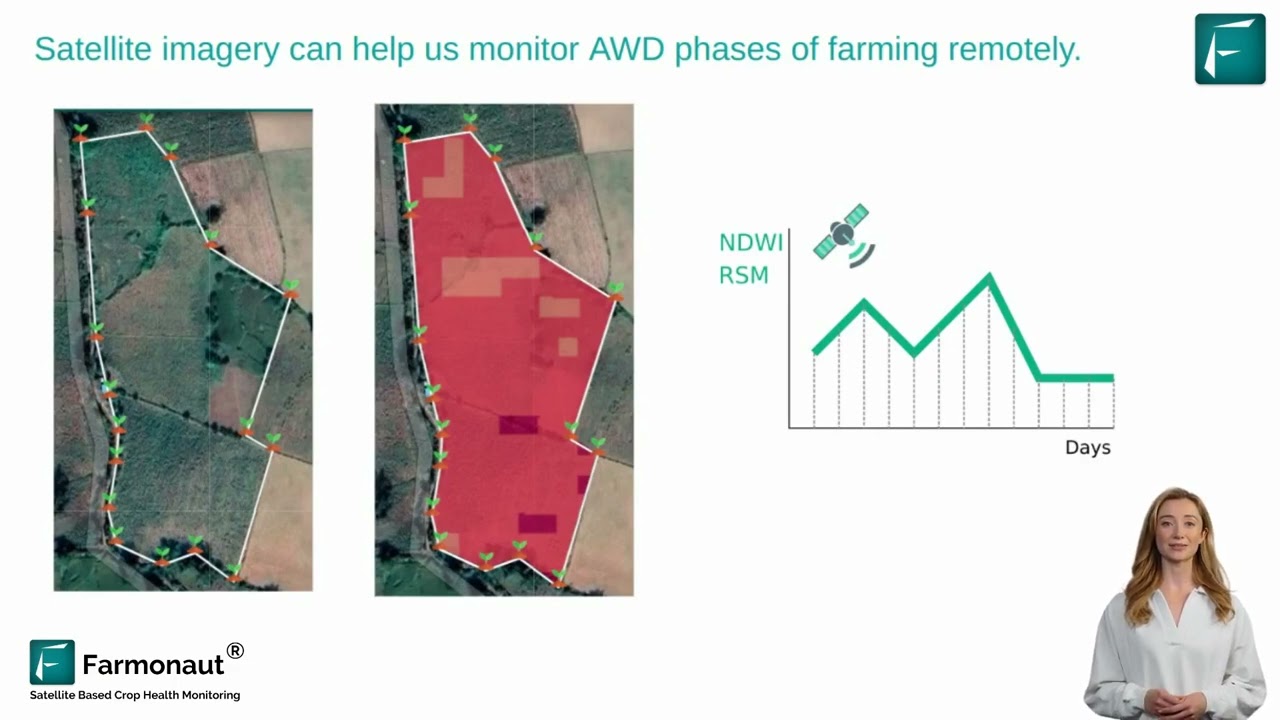
Both kinds of drenching are timing problems more than product problems. A soil drench applied into dry ground is wasted; a pasture drench applied without knowing where worm pressure is building wastes a drug you cannot easily replace. Satellite monitoring narrows both windows.
- Soil moisture before the pour. Multispectral indices and moisture layers show whether the root zone is wet enough to carry a systemic product, and whether the follow-up irrigation actually landed. Open a block in the Farmonaut web app to see it field by field.
- Pasture growth and grazing pressure. Vegetation trends across paddocks help flag where stocking density and regrowth are creating the conditions that push worm burdens up — the input FAMACHA scoring cannot give you.
- Application records that survive an audit. Traceability matters when a buyer asks what was applied and when. Farmonaut's product traceability keeps drench events attached to the block they happened on.
- Machinery and crew routing. Drenching is labour-heavy — labour was 36% of total horticulture costs in 2024 per the USDA census. Fleet management shortens the route between trees.
- Carbon and soil records. Carbon footprinting tracks the soil-side effects of an input programme over seasons.
- Lender and insurer evidence. Satellite-verified crop condition supports crop loan and insurance claims where a treatment programme is part of the file.
- Multi-site operations. Nurseries and ranches running several blocks can consolidate in the large-scale farm management suite.

Frequently Asked Questions
- What is drenching in agriculture, in one sentence?
Applying a liquid in bulk to a target — either poured onto the soil at a plant's root crown so the roots absorb it, or administered by mouth to livestock, usually as a dewormer. - What is soil drenching specifically?
Mixing a pesticide, fungicide or nutrient with water at a label-specified rate and pouring the finished solution onto the ground around a plant's base. UF/IFAS PI274 describes it as pouring chemical mixed in water on the soil near the tree's root crown, as distinct from injecting it under pressure. - How much water does a soil drench need?
It is set by the label, not by eye. The UF/IFAS worked example uses 4 pints of finished solution per inch of trunk diameter — 6 gallons for a 12-inch DBH tree. Use the calculator above with your own label figures. - Is there a tree size where soil drenching stops working?
Yes, and sources differ. CSU 5.626 confines retail imidacloprid to trees under 6 inches DBH; UW–Madison extends homeowner products to about 15 inches DBH (47 inches circumference). Above 15 inches, CSU notes the required rate doubles and is not sold in retail formulations. - When should a soil drench be applied?
For imidacloprid on ash, UW–Madison gives mid-April to mid-May and CSU says shortly after bud break — both tied to root activity rather than a fixed date. Soil must stay moist for two to three weeks afterwards. - What does drenching mean for sheep and goats?
Giving liquid medication orally with a drench gun over the back of the tongue. Dose is by bodyweight, and goats metabolise dewormers faster than sheep, so sheep-label doses underdose them — which selects for resistance. - How do I know if my dewormer still works?
Run a fecal egg count reduction test: counts before drenching, counts 10–14 days after, on the same animals. A reduction below about 95% indicates resistance. The DrenchRite assay through the University of Georgia tests multiple classes at once, cited by the LSU AgCenter at around $400 in April 2020. - Should I drench the whole flock at once?
No. That practice built the resistance problem. FAMACHA-based selective treatment — scoring eyelid colour every two to four weeks and treating only pale-scoring animals — preserves refugia, the unexposed worm population that keeps susceptible genes on the farm. - Can I use the same word for both without confusion?
In writing, say "soil drench" or "oral drench." Bare "drenching" in a mixed crop-and-livestock operation is genuinely ambiguous, and the two have no shared equipment, dosing logic or regulator. - Where do I get numbers for my own situation?
Soil drench rates: the product label, then your state extension service's numbered fact sheet. Livestock dosing: your veterinarian plus the ACSRPC dewormer charts. Herd and sector figures: USDA NASS, which publishes Sheep and Goats each January and the Census of Horticultural Specialties every five years.

The Short Version
Drenching is a delivery method, not a philosophy. On the plant side it means pouring a measured solution at the root crown, dosed by trunk diameter, into soil wet enough to move it — and it has a real size ceiling somewhere between 6 and 15 inches DBH depending on whose fact sheet you read. On the animal side it means an oral dose set by weighed bodyweight, given selectively rather than on a calendar, and verified with a fecal egg count reduction test rather than assumed.
Both fail the same way: an unmeasured input applied at the wrong moment. Measure the trunk, measure the animal, check the moisture, keep the record. The figures on this page carry their dates and their sources so you can go get fresher ones — the method is what stays.

Discussion
Questions, corrections or field experience? Share them below. First-time comments are reviewed before they appear, and your email is never published.
No comments yet. Be the first to add a question or your experience.

 Escorts Kubota
 FieldZero
 Indico Company
 Kubota
 FFBS
FFBS Jontra
 Kalustyan
 Tucor
Tucor Geno
Geno Hayleys Agriculture
 Linx Agritech
 Adinet
 Save Your Soils
 Licence holder · Niger · Gold










