

Ekati mine, Canada · Status and facts
Ekati Diamond Mine Northwest Territories: What Happened
Ekati, Canada’s oldest diamond mine, ended production in 2026. A court put it into receivership on 14 July 2026, and the territorial government now pays for closure from about C$326 million of reclamation security. Facts, owners, grades and oversight below.
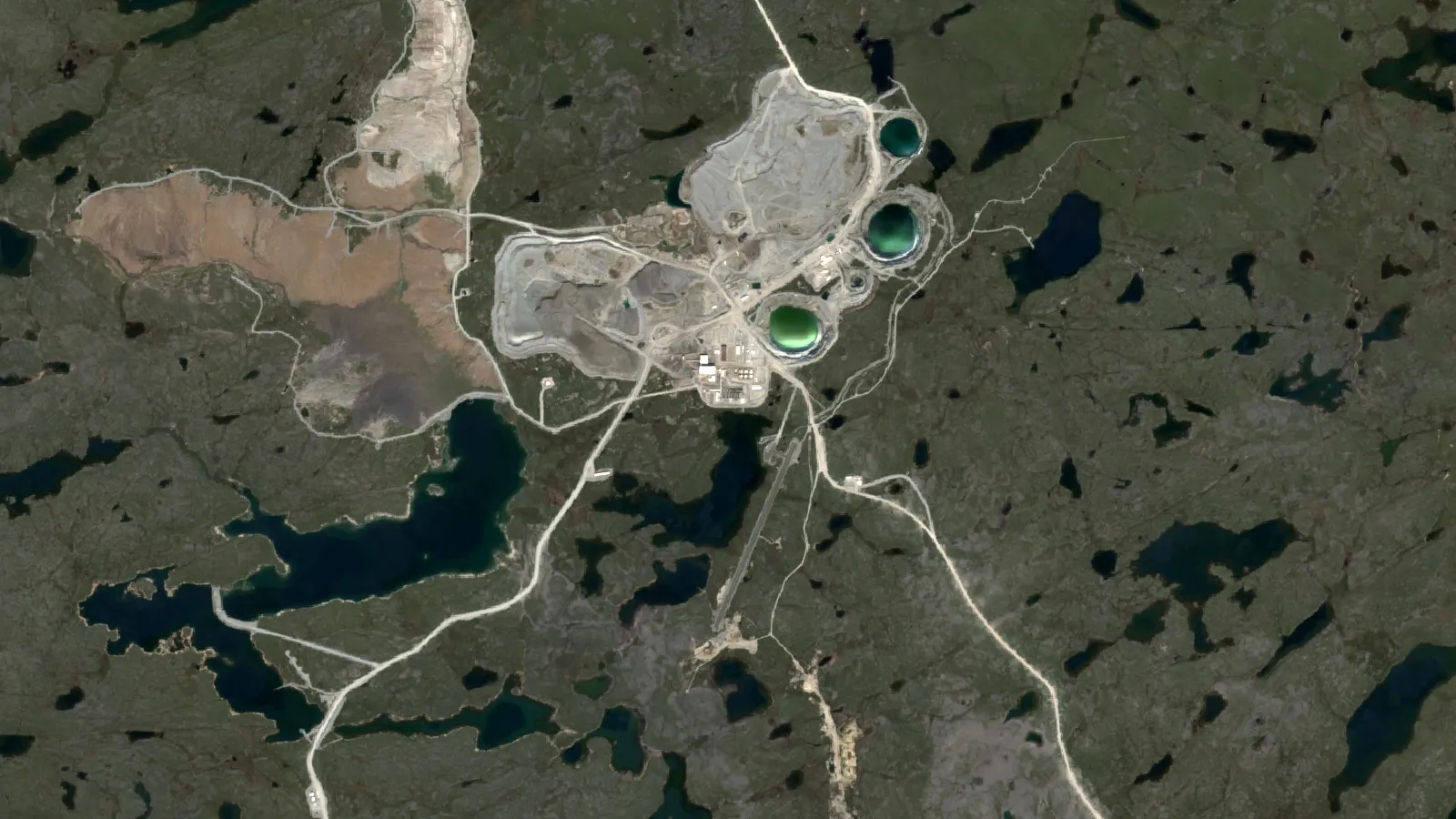
Key takeaways
- Ekati entered receivership on 14 July 2026 with PwC as receiver, after a sale process found no viable buyer (CBC News, GNWT).
- The Government of the Northwest Territories holds about C$326 million of reclamation security; a final closure plan has not been developed (GNWT, 15 July 2026).
- The company said its diamond price fell about 74%, from around $125 to $33 per carat, between end 2024 and December 2025 (CBC News, 4 May 2026).
- Workforce fell from about 700 in 2024 to about 340 on 31 March 2026 (court filings, CBC News).
- Governments proposed on 25 September 2026 to end the Ekati environmental agreement and its independent monitoring agency (IEMA).
In this article
- Ekati diamond mine in the Northwest Territories: where it stands
- Key facts at a glance
- How Ekati ended up in receivership
- Ekati sales and the fall in diamond prices
- Five owners in 27 years: who held the mine
- Geology and grade: what the pipes hold
- What happens to Ekati now: closure, money and oversight
- Environmental oversight and the monitoring agency
- Jobs and Indigenous participation
- Canada's diamond output after the closures
- Diamond price sensitivity calculator
- How to follow a closing mine: documents to read
- Frequently asked questions
Ekati diamond mine in the Northwest Territories: where it stands
Ekati, Canada’s oldest diamond mine, has stopped producing. A court put it into receivership on 14 July 2026 after no buyer came forward, and the Government of the Northwest Territories (GNWT) is paying for closure from about C$326 million of reclamation security. The mine sits near Lac de Gras, about 300 km northeast of Yellowknife, and opened in 1998 (CBC News, 14 July 2026). CBC reported on 7 October 2026 that it ended production earlier this year and is now a public liability, with PricewaterhouseCoopers (PwC) acting as receiver (CBC News, 7 October 2026).
Four terms help with the rest of this page. A carat is 0.2 grams, the unit used to weigh diamonds. Kimberlite is the volcanic rock that carries diamonds up from the deep mantle, and each Ekati orebody is a carrot-shaped kimberlite pipe. A receiver is a court-appointed manager who takes control of a company’s assets when it cannot pay its debts. Reclamation security is a financial guarantee that a mine must provide so that cleanup is paid for if the company cannot do it (GNWT fact sheet, 15 July 2026).
The facts below come from court filings, regulator records and news reports, as of 16 October 2026.
Key facts at a glance
| Item | What the sources show |
|---|---|
| Location | Lac de Gras area, Northwest Territories, about 300 km northeast of Yellowknife (CBC News) |
| Opened | 1998; Canada’s oldest diamond mine (National Jeweler, 16 July 2026) |
| Diamond discovery in the area | 1991, at Lac de Gras (Northwest Territories Geological Survey) |
| Output since opening | More than 100 million carats (Burgundy Diamond Mines, August 2025) |
| Open pits on site | 10 (executive director of the monitoring agency, in CBC News, 7 October 2026) |
| Last operator | Arctic Canadian Diamond Company, a Calgary-based subsidiary of Burgundy Diamond Mines |
| Workforce | About 700 in 2024; about 340 on 31 March 2026 (court filings, CBC News) |
| Status | In receivership since 14 July 2026; PwC is receiver |
| Water licence | W2022L2-0001, expires 17 December 2033; security on the registry C$303 million (Wek’èezhìı Land and Water Board) |
| Reclamation money held | About C$326 million (GNWT) |
| Closure plan | Interim plan approved; no final plan yet (GNWT) |
How Ekati ended up in receivership
The collapse took 10 weeks from court protection to receivership. On 1 May 2026 Arctic Canadian Diamond Company and its sister company Burgundy Diamonds (Canada) asked for creditor protection under Canada’s Companies’ Creditors Arrangement Act, the law that lets a company pause creditors while it restructures. A sale and investment process started on 11 May and ended on 10 July with no viable interest from a buyer (GNWT fact sheet). The court-appointed monitor had contacted 140 potentially interested parties and received no viable bids (JCK, 20 July 2026).
Infographic
From creditor protection to receivership in 5 steps
- 11 May 2026Arctic Canadian and Burgundy Diamonds (Canada) file for creditor protection.
- 211 MayA sale and investment process starts; 140 parties are contacted.
- 310 JulyThe process ends with no viable bids; government lender CEEFC will not fund further.
- 413 JulyThe GNWT applies to the BC Supreme Court for a receiver.
- 514 JulyThe court appoints PwC as receiver; closure planning begins.
Money ran out at the same moment. As of 13 July, Burgundy owed $175 million to the Canada Enterprise Emergency Funding Corporation (CEEFC), a government-owned lender, and $79 million to other lenders, and CEEFC had decided to fund the companies no further (National Jeweler, 16 July 2026). The GNWT applied to the Supreme Court of British Columbia on 13 July, and the court appointed PwC as receiver the next day.
The May court filings gave the company’s own explanation. It said the price of its diamonds fell from around $125 per carat at the end of 2024 to around $33 by December 2025, a drop of about 74%, and listed lab-grown stones, weaker purchases from China and tariff effects as causes. Arctic Canadian reported liabilities of about $343 million, including $107 million to private lenders, $63 million to trade creditors and $175 million to CEEFC (CBC News, 4 May 2026).
Ekati sales and the fall in diamond prices
Ekati’s sales show how quickly the market moved. For 2022, Burgundy said Ekati sold 4.2 million carats at an average of $117 per carat, for revenue of $494 million (JCK, March 2023). In the first quarter of 2025, Burgundy sold 1.2 million carats at an average of US$66, against US$88 a year earlier, and revenue fell 38% to US$73 million (IDEX Online, May 2025). The court filings put diamond sales at more than $600 million in 2024 and about $253 million in 2025 (CBC News, 4 May 2026).
Chart
World average value of rough diamonds
US$ per carat, selected years 2015 to 2024 (2018 and 2019 not shown); 2024 preliminary
Chart
Ekati diamond sales as reported
Dollars million as stated in each source (currency not given); 2024 was ‘more than $600 million’ and is not plotted
The wider market was weak too. Natural Resources Canada, using Kimberley Process data, shows the world average value of rough diamonds at US$132.30 per carat in 2022 and US$88.35 in 2024, a fall of about a third (Natural Resources Canada, diamond facts). Ekati’s own filing describes a steeper fall at the mine. Natural Resources Canada reports that Canadian mines produced 13.3 million carats of rough diamonds worth $1.47 billion in 2024, down 17% in volume and 30% in value from 2023.
Five owners in 27 years: who held the mine
Ekati has changed hands more often than most mines. JCK counts five owners and two bankruptcies since opening (JCK, 20 July 2026).
- BHP, from 1998. Geologist Charles Fipke spent nearly eight years searching the northern wilderness for indicator minerals before the find. He sold part of his company, Dia Met Minerals, to BHP for about $687 million.
- Dominion Diamond Corp., from 2013. BHP sold Ekati to the company then called Harry Winston, which later renamed itself Dominion (JCK, March 2023).
- The Washington Companies, from 2017. They bought Dominion for $1.2 billion and left it with about $550 million of debt (JCK, 2023 and 2026).
- Bondholders, after 2020. COVID-19 forced the mine to close temporarily and Dominion filed for insolvency; a group of bondholders took over and formed Arctic Canadian Diamond Company.
- Burgundy Diamond Mines, from 2023. The Perth-based company (ASX: BDM) agreed in March 2023 to pay $136 million for the assets of Arctic Canadian.
Geology and grade: what the pipes hold
Diamonds were found at Lac de Gras in 1991, a discovery the Northwest Territories Geological Survey says started a C$28 billion industry. In 2015, diamonds made up 97% of the value of the territory’s mineral production (NWT Geological Survey, 2016 overview). Ekati has been mined from several kimberlite pipes, some by open pit and some from underground. Grade here means carats recovered per tonne of ore (cpt), and the pipes differ a lot.
Chart
Grade in Ekati resource and sample reports
Carats per tonne (cpt), figures from Burgundy’s August 2025 announcement
Burgundy’s resource tables of June 2025 show the spread. The Fox pipe held 41.2 million tonnes of Indicated resource at 0.34 cpt, or 13.9 million carats. Indicated means the estimate has enough drilling for mine planning; Inferred means limited evidence. Misery Main, which was mined underground, held only 0.1 million tonnes of Indicated resource but at 4.6 cpt, with a further 1.3 million tonnes of Inferred resource at 3.3 cpt. The Point Lake bulk sample recovered 67,757 carats from 122,291 tonnes, about 0.55 cpt, at an average value of $52 per carat (Burgundy ASX announcement, 14 August 2025). The company reports under the Australian JORC Code because it is listed on the ASX.
The same August 2025 announcement stretched Ekati’s planned life to 2040, with Fox underground development due to start in 2026. Eleven months later the mine was in receivership. A mine plan depends on the price assumed for the diamonds, and a grade table says nothing about that price. For a consultant, this is the main lesson from Ekati: check what price a reserve statement assumes.
What happens to Ekati now: closure, money and oversight
The receiver is on site to keep the mine stable and safe and to protect environmental controls, with a reduced workforce staying for care and maintenance. Care and maintenance means the site is kept secure and its water managed, but nothing is mined. The GNWT remains the regulator with the Wek’èezhìı Land and Water Board, and it advances money to the receiver from the reclamation security. Its stated goal is to stay within that security while costs are reassessed (GNWT news release, 15 July 2026).
Chart
Ekati reclamation: cost estimate and money set aside
Dollars million: company estimate as reported by CBC (currency not stated); GNWT and licence security in Canadian dollars
The amounts depend on who is counting and when. The company’s filing estimated future cash to settle reclamation at $428 million as of 31 December 2025, and counted almost $200 million of its own bonds, trust funds and cash toward that. The GNWT now says it holds about $326 million, and the water licence on the board’s public registry lists C$303 million of security, made up of C$106.9 million in cash and C$196.1 million in surety bonds (Wek’èezhìı Land and Water Board registry). A surety bond is a guarantee from an insurer that pays if the mine owner does not.
Closure plans and filings
The GNWT says an interim closure and reclamation plan is approved but a final plan has not been developed (GNWT fact sheet). The board’s registry lists a care and maintenance plan, with reasons for decision dated 31 August 2026 and a revised version 1.1 dated 30 September 2026, and a board response of 30 July 2026 to a request to permanently close the Misery underground mine.
The Long Lake dispute
Not everything went smoothly. On 18 August 2026 CBC reported a letter in which the board said PwC had disposed of blasting emulsion in the Long Lake containment facility, the mine’s main store for processed kimberlite, after being told not to. The board said it could consider suspending the water licence, which would effectively halt all activity on site, and could call a public hearing. PwC said a government inspector had approved the disposal and that the previous owner had done the same since June 2025, and the environment minister said meetings were being arranged (CBC News, 18 August 2026).
▶ The 7 environmental impacts of mining, explained in clay animation with satellite maps · 2:31
Environmental oversight and the monitoring agency
Ekati has had an independent watchdog for almost three decades. The Independent Environmental Monitoring Agency (IEMA) was set up under the mine’s environmental agreement and is funded by the mine owner. On 25 September 2026 the GNWT and Crown-Indigenous Relations and Northern Affairs Canada proposed to end that agreement and the agency (IEMA website). CBC reported that the governments are weighing whether the money should go straight to reclamation, and are seeking views from the Tłı̨chǫ government, Yellowknives Dene First Nation, Łutsel K’e Dene First Nation, North Slave Métis Alliance and Kitikmeot Inuit Association.
IEMA’s executive director, Mark Casas, argued that the agency gives a second technical review of the closure plan and that its 30 years of site knowledge cannot be rebuilt. A Łutsel K’e manager told CBC that the debate could give Indigenous governments a leading role in cleanup. The Diavik mine’s oversight board was ordered to shut down by March 2027 (CBC News, 7 October 2026).
Jobs and Indigenous participation
Ekati employed about 700 people in 2024. About 28% were northern residents and about 60% of those were Indigenous. By 31 March 2026 the workforce was about 340. The May filings also put at risk millions of dollars in promised payments to Indigenous communities (CBC News, 4 May 2026). The GNWT says it has told the receiver to keep northern and Indigenous workers and businesses involved in site work where it can, and that a reduced crew remains on site (GNWT fact sheet, 15 July 2026).
The wider loss is large for a small territory. Diamonds were 97% of the NWT’s C$1.79 billion of mineral production in 2015, and the NWT industry minister has said that, although the territory is losing its diamond mines, it is seeing new investment in Arctic security and critical minerals (CBC News, 14 July 2026).
▶ What mining does for an economy: exports, jobs, revenue · 5:03
Canada’s diamond output after the closures
Ekati’s end leaves Canada with one producing diamond mine, according to JCK. Rio Tinto’s Diavik mine produced its last diamonds on 26 March 2026 after 23 years and more than 150 million carats (IDEX Online, 29 March 2026). The remaining mine is Gahcho Kué, where Mountain Province agreed on 1 October 2026 to hand its 49% to De Beers; CBC says the mine is on a timeline for planned closure by 2028 (CBC News, 1 October 2026).
The USGS puts Canada’s gem-quality diamond mine output at 13.3 million carats in 2024 and an estimated 13.0 million in 2025, about a fifth of the world total of 68.6 million in 2024 (USGS Mineral Commodity Summaries 2026). Those figures end before the 2026 closures. For the status of every Canadian mine, see our guide to diamond mines in Canada.
Diamond price sensitivity calculator
Ekati’s story is a price story. Revenue is carats sold multiplied by price per carat, so a 74% fall in price removes 74% of revenue even when volumes hold. The calculator below shows what a price fall does to revenue and to the margin over your own cost per carat. Enter your own carats, prices and cost.
Calculator
What does a fall in rough diamond price do to revenue?
Enter your own carats sold, prices and cost per carat.
- Revenue at the old price (US$ million): 200.0
- Revenue lost (US$ million): 140.0
- Price fall (percent): 70.0
- Operating margin at new price (US$ million): -60.0
Example values only, not a benchmark. Prices are inputs: example, use today’s price. A CBC report of Ekati’s court filing gives about $125 falling to about $33 per carat between end 2024 and December 2025; the defaults here are round numbers, not those figures. Margin is before tax, royalties and capital.
How to follow a closing mine: documents to read
A consultant or licence owner can track a closure from public documents. Use this order:
- Open the licence page on the Wek’èezhìı Land and Water Board registry (W2022L2-0001) for security amounts, plans and decisions.
- Read GNWT news releases and fact sheets for who pays and who regulates.
- Check the monitoring agency’s website for its timeline, letters and annual reports.
- Read the owner’s stock-exchange filings for reserve and resource statements and the price assumptions behind them.
- Compare satellite images of the site over several seasons to see pit lakes, waste piles and the footprint of the containment areas change. Imagery shows surface change; it cannot show water chemistry.
For context on how public geoscience data and exploration spending fit together, see our reviews of Ontario and British Columbia geoscience data and mineral exploration spending in Canada. Farmonaut offers a satellite screening of a licence boundary; a licence owner can send one through the mining query form. The result is an exploration target, not a resource estimate.
▶ Remote sensing for mining explained without jargon · 2:01
Frequently asked questions
Is the Ekati diamond mine still open?
No. CBC News reported on 7 October 2026 that it ended production earlier this year. A court placed it in receivership on 14 July 2026, and PwC manages the site for care and maintenance and eventual reclamation.
Where is the Ekati diamond mine?
In the Northwest Territories near Lac de Gras, about 300 km northeast of Yellowknife, according to CBC News.
Who owns Ekati?
Arctic Canadian Diamond Company, a subsidiary of Australian-listed Burgundy Diamond Mines, still exists as a company, but the receiver has taken control of its assets (GNWT, 15 July 2026).
Why did Ekati close?
The company said diamond prices fell about 74% from the end of 2024 to December 2025. It cited lab-grown stones, weaker purchases from China and tariff effects. It filed for creditor protection on 1 May 2026, and the sale process found no viable buyer.
When did Ekati open and how many carats did it produce?
It opened in 1998. Burgundy’s August 2025 announcement says more than 100 million carats had been recovered from the property.
Who pays for the cleanup?
The GNWT is using the reclamation security it holds, about C$326 million, to fund care and maintenance and closure. Its goal is to stay within that amount, and costs are being reassessed.
How many workers did Ekati employ?
About 700 in 2024 and about 340 on 31 March 2026, according to court filings reported by CBC News.
Does Ekati have a final closure plan?
Not yet. The GNWT says an interim plan is approved and a final closure and reclamation plan has not been developed. A care and maintenance plan is before the land and water board.
What is the Independent Environmental Monitoring Agency?
It is the independent watchdog set up under Ekati’s environmental agreement. On 25 September 2026 the governments proposed to end the agreement and the agency, and consultations are under way.
Is Ekati the last diamond mine in Canada?
No. Gahcho Kué, owned by De Beers and Mountain Province, still produces, but CBC says it is on a timeline for closure by 2028.
What was Ekati’s grade?
It varied by pipe. Burgundy’s June 2025 tables show 0.34 carats per tonne for the Fox pipe and 4.6 for the Misery Main pipe.
Can satellites find diamond deposits like Ekati?
Not by themselves. Some kimberlite pipes in the Lac de Gras area lie under lakes and glacial cover, so geophysics, sampling and drilling are needed to confirm one. Satellites help screen terrain and surface clues over a large licence.
This page is for information only. It is not investment or legal advice. Mine status and ownership can change; confirm with the owner’s filings and the regulator.
Farmonaut mining
Map your mining site from space
Send a licence boundary and the minerals you are targeting, and receive a satellite screening you can use to plan fieldwork.

Mining Pro sample view, synthetic data
Keep reading
Sources
- CBC News, Ekati mine set to shut down as it enters receivership (14 July 2026): cbc.ca
- CBC News, Ekati mine’s future in doubt as company files for creditor protection (4 May 2026): cbc.ca
- CBC News, Regulator accuses Ekati mine receiver of dumping waste (18 August 2026): cbc.ca
- CBC News, Consultations on shutdown of Ekati watchdog (7 October 2026): cbc.ca
- CBC News, Mountain Province exit from Gahcho Kué (1 October 2026): cbc.ca
- GNWT, news release on Ekati receivership (15 July 2026): gov.nt.ca
- GNWT, additional information on Ekati receivership (15 July 2026): gov.nt.ca
- Wek’èezhìı Land and Water Board, Ekati licence W2022L2-0001 registry: wlwb.ca
- Independent Environmental Monitoring Agency, Ekati news and timeline: monitoringagency.net
- Burgundy Diamond Mines, Life of Mine Plan Update, ASX announcement (14 August 2025): burgundydiamonds.com
- JCK, Famed Ekati Diamond Mine to Shut After 27 Years (20 July 2026): jckonline.com
- JCK, The Ekati Diamond Mine Has (Another) New Owner (14 March 2023): jckonline.com
- National Jeweler, Ekati to Close, Leaving Canada With One Diamond Mine (16 July 2026): nationaljeweler.com
- IDEX Online, Burgundy’s Q1 revenue down 38% (6 May 2025): idexonline.com
- IDEX Online, Production ends at Diavik (29 March 2026): idexonline.com
- Natural Resources Canada, Diamond facts: natural-resources.canada.ca
- USGS, Mineral Commodity Summaries 2026: Gemstones (February 2026): pubs.usgs.gov
- Northwest Territories Geological Survey, 2016 Mineral Exploration Overview: nwtgeoscience.ca
- GNWT, 2025 population survey results for the Bathurst and Bluenose-East caribou herds (13 November 2025): gov.nt.ca
- GNWT, Bathurst caribou herd: gov.nt.ca
Discussion
Questions, corrections or field experience? Share them below. First-time comments are reviewed before they appear, and your email is never published.
No comments yet. Be the first to add a question or your experience.

 GemSprout Metals Limited
 Qader Group
 Ileys General Trading
 SG Gold Mining LLC
 VRV Global Pte Ltd
 Omsri International FZE
 G.I.T.T.
 Jaunita Erss Ltd
 Almosi SARL
 SRK Consulting
 Berks Gold Limited
 Mwerezi Minerals Company Limited
 Mining SARL
 SenGold Invest SAS
 Sean Mining Limited
 NTS Group (Pty) Ltd
 Mine4Africa
 Lithspo Minerals Limited











