

Ancient Rome · Farming history guide
Ancient Roman Farming Tools and Techniques, With Numbers
Roman farmers planted with an iron-tipped wooden plough, weeded with hoes and cut grain with sickles; Cato’s olive farm of 240 iugera held six ploughs and eight hoes. Columella counted 10.5 days of work per iugerum of wheat.
Key takeaways
- Cato’s 240-iugera olive farm held 13 people, 3 yoke of oxen, 6 ploughs, 8 hoes, 8 forks and 8 scythes.
- Columella counted about 10.5 days of work per iugerum of wheat, 6.5 for barley and 15 for sesame.
- Seed rate for wheat: 4 modii per iugerum on rich land and 5 on medium land (Columella).
- Ancient yield claims range from 4:1 to 15:1 seed to harvest (Columella to Varro), with a hundredfold reported for a few districts.
- The US all-wheat yield was 53.3 bushels per acre in 2025 (USDA NASS).
In this article
- Ancient Rome agriculture at a glance
- Ancient Roman farming tools: what a real farm owned
- The seven main tools: job, material and modern descendant
- The Gallic reaper: Rome's harvesting machine
- Tools and techniques for planting, cultivating and harvesting in ancient Rome
- How Romans ploughed: depth, passes and fallow
- How much work did Roman crops take?
- What did a Roman crop yield?
- Roman irrigation and water management
- Crop rotation and soil fertility
- Vines, olives and animals: the other half of the farm
- Infrastructure, economy and farm planning
- Lessons for farms today
- How we checked the numbers
Roman farmers planted with a wooden plough tipped with iron, cultivated with hoes and harrows, and harvested with sickles, with a reaping cart in Gaul. The tools and techniques used for planting, cultivating and harvesting in ancient Rome are known from farm manuals: Cato (about 160 BC) lists the tools of a 240-iugera olive farm, and Columella (first century AD) counts the days of work per crop. This guide turns those numbers into charts and a labour calculator.
One iugerum, the Roman area unit, was about a quarter of a hectare (0.623 acre), according to the reference entry on the iugerum. We use it throughout.
Ancient Rome agriculture at a glance
Roman farming around the Mediterranean rested on three crops: grain, olives and grapes. Farmers worked the soil with the ard, a simple plough that scratches rather than turns the ground, plus sickles and hoes, according to the overview of agriculture in ancient Rome. Small family plots existed beside large estates. Estates over 500 iugera counted as latifundia and were often worked by enslaved people.
Most of what we know comes from surviving manuals: Cato’s De Agri Cultura (about 160 BC), Varro’s Res Rusticae (about 37 BC), and the twelve books of Columella’s De Re Rustica from the first century AD. Palladius added a month-by-month farm calendar around AD 400.
| Farm job | Main tool | Source |
|---|---|---|
| Planting: breaking ground | Plough (aratrum) | Cato, Columella |
| Planting: covering seed | Harrow, rake | Columella |
| Cultivating: weeding | Hoe, spade | Cato, Columella |
| Cultivating: feeding soil | Manure, cut lupine | Columella |
| Harvest: grain | Sickle, reaping cart | Pliny, Palladius |
| Harvest: hay | Scythe | Cato |
Ancient Roman farming tools: what a real farm owned
The best evidence is an inventory. In his chapter on a 240-iugera olive farm, Cato lists 13 people, 3 yoke of oxen and the tools in the chart below. Six ploughs for three yoke of oxen, and eight hoes and eight forks, suggest that hand work still outweighed animal work. Cato also tells the overseer to keep ploughs and ploughshares in good order.
Chart
Tools on Cato’s 240-iugera olive farm
Number of each tool in Cato’s equipment list (De Agri Cultura, chapter 10)
A practical shortlist of seven tools (our grouping, not an ancient list) is the plough (aratrum), hoe, sickle (falx), rake, millstone (mola), scythe (falx foenaria) and pruning knife (falcula). Cato’s list also has forks, spades, shovels and straw-hooks. Most tools were wood with an iron edge or tip. Oxen, donkeys and horses supplied the pull.
The seven main tools: job, material and modern descendant
The table sets out what each tool did on a Roman farm and the machine or hand tool that took over its job. The modern column is our plain comparison, not a claim from the ancient texts.
| Tool | Roman job | Modern descendant |
|---|---|---|
| Aratrum (plough) | Break and open the soil, oxen-drawn | Tractor plough |
| Sarculum (hoe) | Break clods, weed, make beds | Hoe, cultivator |
| Falx (sickle) | Cut grain by hand | Combine harvester |
| Rastrum (rake) | Level soil, clear debris | Harrow, rake |
| Mola (millstone) | Grind grain into flour | Roller mill |
| Falx foenaria (scythe) | Mow hay and fodder | Mower, baler |
| Falcula (pruning knife) | Prune vines and trees | Pruning shears |
Two points stand out. First, the tools were simple and cheap, so a farm could own many of them, as Cato’s list of eight hoes and eight forks shows. Second, the gain came from how they were used together with animals, good ploughing and careful timing. A sharp iron edge helped, but a late sowing or a skipped strip of ground cost more than any tool could win back.
The Gallic reaper: Rome’s harvesting machine
Hand tools did most of the work, but large estates in Gaul used a machine. The vallus was a two-wheeled cart with a row of teeth at the front, pushed through standing wheat by a draught animal. The teeth tore off the ears and they fell into the box. Pliny the Elder described it in the first century AD, and Palladius gave a fuller account around 400, as the Agricultural Museums network explains.
Palladius says it suited level plains where the straw had no economic value, and that one ox could finish the harvest of a field in a few hours. The straw stayed standing in the field. Mechanical reaping on this scale did not return to European and American farms until the nineteenth century.
Tools and techniques for planting, cultivating and harvesting in ancient Rome
Planting
Columella wrote that an iugerum of rich land took about four modii of wheat, medium land five, and more for emmer. He warned that the right rate changes with place, season and weather. Seed was broadcast by hand after ploughing, then covered by a harrow or by a further ploughing. On wet ground farmers cut ridges and water-furrows so that water ran out of the field.
Chart
Seed per iugerum by soil
modii of seed sown on one iugerum, as Columella gives them
Lupine, beans, lentils and chickpeas were sown too. The chart below compares seed per iugerum for the crops Columella names.
Cultivating
Weeds were fought with hoes (twice for wheat, three times for beans in Columella’s counts) and by hand weeding. Columella counted the days: wheat took about ten and a half days of work per iugerum from ploughing to cutting, barley six and a half, beans seven to eight. Sesame took fifteen. So labour, more than the tool count, set the size of the job.
Soil care was practical. Columella ranked manure from dove-cotes first, then hen dung, human waste mixed with farm refuse, and ass, sheep, goat and other cattle dung, with pig dung the poorest. He gave 24 loads per iugerum for heavy manuring and 18 for light, and said cut lupine plants give the strength of the best manure.
Harvesting and storage
Grain was cut with a sickle, carried to the threshing floor and trodden or beaten out. Columella counts a reaper at one and a half days per iugerum of wheat. Hay was mown with the scythe. Where the vallus was used, the ears were stripped and the straw left. Grain went to a granary, wine and oil to vats and jars, and the ground flour came from a millstone (mola), either turned by hand, by a donkey or, at large sites like Barbegal in Gaul, by water.
How Romans ploughed: depth, passes and fallow
Ploughing was the heaviest job. Columella argued against the writer Celsus, who favoured light ploughing: in Italy, where land carried vines and olives, he wanted the soil worked rather deep, so that the ploughshare cut off the uppermost roots and the deeper roots could reach moisture. He allowed that Celsus’s lighter method could suit the loose, treeless soils of Egypt and Numidia. The point is local fit, which is still sound advice.
Fallow land was ploughed more than once. Columella wrote that fallow ground should be broken up so thoroughly by repeated ploughing that it needs little or no harrowing after the seed goes in, because the old Romans held that a field needing a harrow after sowing was badly prepared. He also told the ploughman to keep the plough upright and at full depth so that no strip of hard, unbroken ground (a scamnum) was left, and to keep oxen calm with the voice rather than the lash. Skipped ground, he noted, shows up later as poor crop.
Our own reading of the day counts: Columella’s four days of ploughing for a wheat plot were the biggest single item in the 10.5-day total (4 of 10.5 days, against 3 for hoeing), which is why oxen, and the men who drove them, mattered so much on grain land.
How much work did Roman crops take?
Columella gives the days of work for the seed that sows one iugerum, from first ploughing to bringing the crop to the threshing floor. Taking his figures per iugerum, the chart shows why barley and vetch were cheaper to grow than sesame or chickpeas. He also concludes that 200 iugera of tree-free land could be worked with two yoke of oxen, two ploughmen and six labourers. Use the calculator to scale his numbers to your own acreage.
Chart
Days of work per iugerum
From first ploughing to the threshing floor, for the seed that sows one iugerum
Try the numbers for your own farm below.
Calculator
How many labour days would a Roman crop plan need?
Enter your own acres and day rate.
- Labour days per acre: 14.0
- Labour cost at your day rate (US$): $280,899
- Ox yokes needed: 3.2
Example values only, not a forecast. Day counts per iugerum are Columella’s (wheat 10.5, barley 6.5, beans 7.5), converted at 1 iugerum = 0.623 acre. Ox yokes use Columella’s 2 yoke per 200 iugera. They cover work up to the threshing floor. Wage is an example; use today’s local rate.
What did a Roman crop yield?
Ancient authors disagree. Varro wrote that the same seed gives tenfold in one district and fifteenfold in another, as in parts of Etruria, and a reported hundredfold near Sybaris. Cicero, prosecuting Verres, said the land of the Leontini district in Sicily gave eightfold in a favourable year and tenfold by special good fortune; that is a courtroom figure for one district, not a measurement. It comes from a prosecution speech, so scholars read it cautiously. Columella, in a passage praising vineyards, wrote that grain in most of Italy hardly ever returned four for one. The historian Paul Erdkamp, quoted in the reference article on Roman agriculture, thinks that figure was biased towards vines.
A rough check with our own arithmetic: five modii of wheat weigh about 30 to 35 kg at 6 to 7 kg a modius, which is 120 to 140 kg per hectare of seed. At 10:1 that is a gross harvest of about 1.2 to 1.4 tonnes per hectare, before setting seed aside. The US all-wheat yield was 53.3 bushels per acre in 2025, about 3.6 tonnes per hectare, per the USDA NASS Crop Production Annual Summary. These are rough figures on different bases, and only a guide.
Roman irrigation and water management
Water work on Roman farms was mostly about getting rid of it. Columella told sowers to cut ridges and water-furrows and to turn all water into drains outside the grain fields. Aqueducts were built mainly for towns, though the reference overview notes that the Romans also irrigated plants using aqueducts in places. Many farms used wells, springs and small channels instead. Cato rated an irrigated garden second only to a vineyard among the parts of a good farm. For modern water planning see our guide to farm water management.
Crop rotation and soil fertility
Romans rested land. Columella advised leaving ground fallow for a year after barley, or soaking it with manure. They also grew beans, lupines and other legumes. Roman writers did not know why legumes helped; modern research does. A study of legume-diversified farming systems proposes legumes as a base for nitrogen fixation, while noting that reliance on them has sometimes cut yields. The SARE manual Managing Cover Crops Profitably explains how legumes fit into modern rotations.
Rotation on Roman farms was simple compared with modern four-year plans: a grain crop, then fallow or a legume, with manure where it could be had. Columella noted that legumes differ in how much they tire the land. Today a farmer can compare field images across seasons to see which blocks lag, but the underlying logic is the same one Columella used, which is to rest, feed and watch the soil.
Soil observation was part of the craft: Roman texts judge land by texture, colour and how crops responded, an early form of the soil monitoring farmers now support with sensors and satellites.

▶ Seven sustainable farming practices for soil and water · 4:34
Vines, olives and animals: the other half of the farm
Grain was only part of a Roman farm. Cato’s olive farm kept 100 sheep beside its oil presses, and his 100-iugera vineyard listed 16 people, 2 oxen and 3 complete presses, as Cato’s inventory chapters show. Cato’s advice for an old vineyard was to sow clover on lean soil and to apply manure, straw or grape dregs around the roots. Varro, writing a little later, quotes Cato and Saserna on how many workers a farm needs. He says Cato’s numbers cannot be scaled up or down in proportion, and sets labour by Saserna’s four days of work per iugerum and by local practice. That is the same labour-budget idea our calculator uses.
Animals did several jobs at once: traction, manure, wool, milk and meat. Columella said that where herds are kept, the stalls and folds should be cleaned out on set days and the manure stored in a pit, turned in summer so that it rots, and spread after a year of resting. He judged farmers lazy who gathered under one load of manure per month from each small animal. Mixed crop and livestock farming, which spreads risk and recycles nutrients, has Roman roots.

▶ Mixed farming, crops and animals on one farm, explained · 2:55
Infrastructure, economy and farm planning
Roman farms were part of a trading system. Roads linked estates to cities and ports. Rome itself relied on grain shipped from Egypt, North Africa and Sicily, and the same overview cites estimates of at least 150,000 to 200,000 tonnes of grain a year. Granaries and storage buildings protected the harvest. Estates were run by wealthy owners, with enslaved and tenant labour, which shaped Roman society and also its unrest.
Lessons for farms today
- Count labour, not only tools. Columella’s day counts per crop are an early labour budget.
- Feed the soil. Manure, fallow and legumes are still core practices.
- Match inputs to the site. Columella changed seed rates for place, season and weather.
- Keep records and inspect fields often.
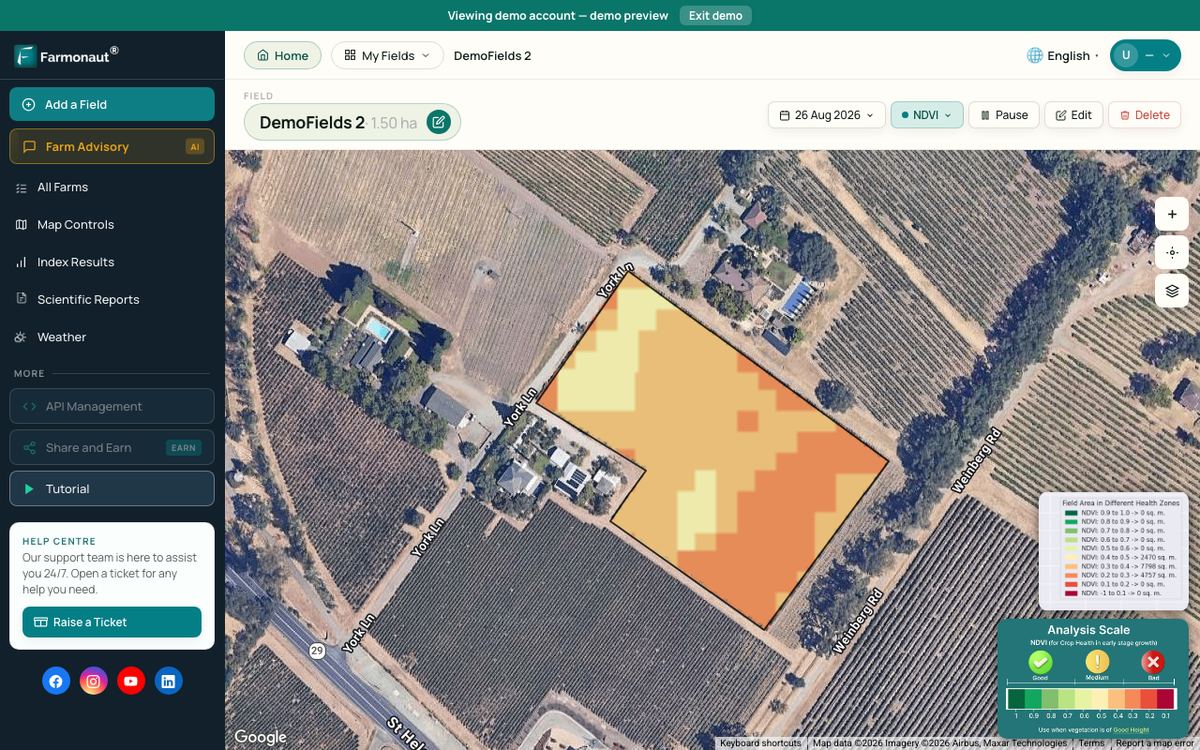
Modern large farms handle the same problems at larger scale. Farmonaut’s large-scale farm management tools use satellite imagery to show where crops are growing well or poorly, as one input to a decision, alongside the satellite monitoring view of each field. Developers can use the Farmonaut API and its API developer docs. Satellites show vegetation change; they do not name the cause.
Related pages on our site: fleet management, product traceability, carbon footprinting, crop loans and insurance.

▶ Seven green farming technologies that save water, fuel and fertilizer · 2:24
How we checked the numbers
Seed rates, labour days, manure rankings and plough advice come straight from the translated texts of Columella, Cato and Varro hosted by the University of Chicago. Modern figures come from USDA NASS. Cicero’s and Columella’s yield ratios are checked against translations of the speeches and treatise; the view that Columella was biased is Paul Erdkamp’s, as quoted in the reference article, and we say so. Ancient numbers are what the authors wrote, not measurements, and each author wrote for his own region and purpose. The labour days are for the seed quantity that sows one iugerum, so they depend on his seed rate.
FAQ
What tools did Roman farmers use?
The plough (aratrum), hoe, sickle, rake, scythe, spade, fork and pruning knife, plus harrows, carts, the millstone and, in Gaul, the reaping cart. Cato’s 240-iugera olive farm held six ploughs, eight hoes and eight scythes.
What is a villa rustica?
A country estate that combined fields, orchards, vineyards, pasture, storage and housing for workers. Some were small family farms and some were large estates run by an overseer.
How did Romans keep soil fertile?
With fallow, manure, cut lupine and legume crops. Columella ranked manures by source and gave an amount per iugerum.
How did the Romans irrigate?
Mostly from wells, springs and small channels, with some use of aqueduct water. Drainage was a bigger concern in wet fields.
How much wheat did a Roman field yield?
Ancient authors give 4:1 (Columella) to 15:1 (Varro), with a hundredfold reported for a few districts. Treat any single figure with caution.
What did animals do on a Roman farm?
Oxen pulled ploughs and carts, donkeys carried manure and turned mills, and all supplied dung. Sheep and goats added wool, milk and meat.
Crop and soil decisions today depend on local rules, labels and professional advice; this history is for background only.
Farmonaut crop monitoring
See your own fields from space
Farmonaut Satellite + AI Farm Monitoring System shows vegetation change across your fields from satellite imagery.



Keep reading

Sources
- Columella, De Re Rustica book 2 (University of Chicago): penelope.uchicago.edu
- Columella, De Re Rustica book 3 (University of Chicago): penelope.uchicago.edu
- Cato, De Agri Cultura (University of Chicago): penelope.uchicago.edu
- Varro, Res Rusticae book 1 (University of Chicago): penelope.uchicago.edu
- Agricultural Museums, Pliny’s vallus and Palladius’ vehiculum (2023): agriculturalmuseums.org
- Agriculture in ancient Rome (Wikipedia): en.wikipedia.org
- Iugerum (Wikipedia): en.wikipedia.org
- Lucius Junius Moderatus Columella (Wikipedia): en.wikipedia.org
- USDA NASS, Crop Production 2025 Summary (January 2026): esmis.nal.usda.gov
- PNAS-style study: Biodiversity can support a greener revolution in Africa (PMC): pmc.ncbi.nlm.nih.gov
- SARE, Managing Cover Crops Profitably: sare.org
- Cicero, Against Verres 2.3.112 (translation, Attalus): attalus.org
Discussion
Questions, corrections or field experience? Share them below. First-time comments are reviewed before they appear, and your email is never published.
No comments yet. Be the first to add a question or your experience.

 Red Dog Management
 Liquify Digital
 Ascentya
 CU Foods
 BeyondTech Global
 Rouge VC
 AgroGreen Dynamics
 AgroRisk
 Oath Inc
 Reddane Farming
 Esri North East Africa
 Cresol
 Atur Kuliner
 MDCV UK
 Zerella Group
 Etech Consulting Madagascar
 Vestlandsforsking
 Delicio
 WB Dev
 Sama Premium
 Prochecker
 Tres Valles
 LACOS Geoinformation
 Exploration consultancy · South Africa · Gold
 Licence holder · Niger · Gold










