

Aggregate Moisture Content Tester: 2026 Test Innovations
Meta Description: Aggregate moisture content tester and aggregate moisture test advances for 2026 are revolutionizing agriculture, infrastructure, and mining with rapid, precise analytics for improved quality, sustainability, and efficiency.
“Over 70% of new infrastructure projects in 2026 will adopt advanced aggregate moisture content testers for precision material analysis.”



Summary: Understanding Aggregate Moisture Content Testing in Agriculture and Infrastructure: A 2025 Perspective
The aggregate moisture content tester has become an essential tool at the intersection of agriculture, infrastructure, and mining sectors. With 2026 on the horizon, advanced moisture testing technologies and analytics are drastically improving quality control, productivity, and sustainability. Modern aggregate moisture content test devices provide accurate, actionable data for efficient resource utilization and yield optimization, vital for future-ready projects in construction, crop management, and mineral processing.
We now witness a transition from traditional, manual routines to real-time, precise, and connected systems. As water scarcity and climate variability challenge our world’s resources, these innovations make moisture content determination a linchpin for sustainable growth across sectors.
Importance of Aggregate Moisture Content Testing
The importance of aggregate moisture content testing stands undiminished as we approach 2026—possibly becoming even more critical for several sectors:
- Agriculture: In agricultural soils, moisture levels directly affect seed germination, nutrient availability, microbial activity, and crop health. Accurate aggregate moisture content tester readings allow precise irrigation—preventing drought stress and optimizing water usage in an era of climate variability and water scarcity.
- Infrastructure: In civil engineering and construction, aggregate forms the backbone of roads, highways, foundations, and large structural projects. Insufficient control over moisture content in aggregates can compromise the strength, compaction, durability, and bonding in concrete and asphalt. Early and accurate testing is integral for quality control and project lifespan.
- Mining: For mineral extraction and ore processing, aggregate moisture content influences key downstream processing steps (crushing, grinding, flotation), storage logistics, and environmental safety—affecting both efficiency and costs.
Precise measurement of moisture in sand, gravel, minerals, and soil aggregates supports:
- Optimized water management
- Enhanced material compaction
- Improved agricultural productivity
- Reduced material waste and project overruns
- Environmental risk mitigation
- Reliable processing and storage of ores and tailings
With moisture testers, infrastructure, agricultural, and mining operations integrate real-time analytics into project workflows, ensuring sustainability and operational efficiency.

Methods of Aggregate Moisture Content Testing (2026)
By 2026, diverse and advanced aggregate moisture content test methods have become mainstream practice—delivering accuracy, speed, and process integration to all major sectors.
1. Gravimetric (Oven Drying) Method
The gravimetric method involves weighing a sample before and after controlled oven drying:
- Process: Aggregate is sampled, weighed (wet), oven dried under controlled temperature for a set duration, then reweighed (dry). The difference yields the moisture content percentage.
- Usage: Benchmark test in agricultural soils, mining aggregates, and construction materials—valued for accuracy in laboratory settings.
- Limitations: Time-consuming (often several hours), less suited for rapid field decision-making.
This method remains a gold standard for calibration and validation, despite technology advancements.
2. Electromagnetic Moisture Testers
- Technology: Utilizes electromagnetic principles such as capacitance, resistance, microwave frequency, or dielectric constant to measure moisture levels.
- Features: Rapid, non-destructive, portable. Delivers real-time results both onsite and remotely, making them integral in dynamic project settings.
- Applications: Infrastructure compaction, construction batch plant control, agricultural field moisture checking.
These aggregate moisture content testers offer a significant advance over manual methods, enabling instant quality control.

3. TDR (Time Domain Reflectometry) Moisture Testers
- Principle: Sends a fast electrical pulse through soil or aggregate particles; the reflected signal is analyzed to deduce moisture content based on dielectric constant changes.
- Advantages: High sensitivity, instant data, multi-depth soil profile analysis.
- Applications: Agriculture (precision farming, irrigation efficiency, root zone mapping), advanced mining operations, smart infrastructure monitoring.
TDR is rapidly growing in popularity, enabling deep insights and integration with cloud databases.

“By 2025, automated moisture testers are expected to cut testing times in mining and agriculture by nearly 40%.”
4. Near-Infrared (NIR) Spectroscopy
- Principle: Evaluates reflected NIR light spectral signatures from aggregate materials, correlating to moisture content by absorption patterns.
- Advantages: Completely non-contact, fast (seconds per test), easily automatable, suited for continuous in-line process control.
- Applications: Bulk mineral processing, agricultural produce quality assurance, high-throughput infrastructure projects.
NIR systems are fast becoming the technology of choice for situations demanding both accuracy and high throughput.

5. AI Analytics, Automation & Cloud Integration (2026+)
- Integration: Cutting-edge aggregate moisture content testers are now tied into IoT (Internet of Things) platforms—enabling AI-driven analytics, cloud storage, automated alerts, and predictive maintenance.
- Benefits: Data can be cross-referenced with weather models, soil and mineral databases, and construction schedules for enhanced decision-making and true sustainability.
- Industry Impact: Platforms like ours at Farmonaut, deliver real-time, satellite-powered moisture mapping and AI-based advisory for actionable field operations in carbon footprinting, blockchain traceability, and more.
The result? Seamless integration with any stage of planning, execution, and evaluation in projects spanning agriculture, mining, and infrastructure.

Applications and Practical Benefits of Aggregate Moisture Content Testers
Whether in a remote agricultural field, a bustling road construction site, or a complex mining operation, the applications and benefits of aggregate moisture content testers continue to expand:
- Agriculture: IoT-enabled aggregate moisture testers & integration with satellite analytics (as enabled by Farmonaut) help farmers achieve:
- Efficient irrigation: Precisely schedule and modulate water usage.
- Resource conservation: Avoid overwatering, curbing costs and preventing water waste.
- Support for crop plantation & forest advisory, enhancing large-scale plantation planning and environmental compliance.
- Mitigation of yield loss due to drought stress or excess water.
- Infrastructure: In construction, real-time moisture analysis ensures:
- Batch material meets compaction and strength specifications.
- Reduced maintenance and extended road and building durability.
- Quick detection of off-spec material or contamination.
- Cost savings by minimizing premature deterioration and maintenance cycles.
- Efficient logistics using resources such as fleet management for aggregate transportation and optimization.
- Mining: Modern aggregate moisture content testers help:
- Prevent equipment clogging and transfer inefficiencies.
- Integrate with environmental reporting (e.g., carbon footprint monitoring for sustainability in mining).
- Predict the performance of tailings and ores in storage, crushing, and downstream processing.
- Reduce risk of environmental hazards (leachate, runoff, landslides) through improved tailings moisture management.

Comparative Table: 2026 Aggregate Moisture Content Testers & Innovations
| Tester Model/Name | Technology Used | Estimated Accuracy (%) | Analysis Speed (min/sample) | Primary Application Area | Year Introduced/Projected | Estimated Efficiency Gain (%) |
|---|---|---|---|---|---|---|
| Gravimetric Oven Drying (Lab Standard) | Convection Oven, Digital Scales | 99+ | 60–180 | All Sectors (Benchmark Calibration) | Pre-2020 (Standard Practice) | Baseline |
| Handheld Electromagnetic Tester | Capacitance, Microwave Sensors | 92–97 | 0.5–2 | Infrastructure, Agriculture | 2021–2023 | 30–45 |
| TDR Probe with IoT & Cloud Analytics | Time Domain Reflectometry, Wireless IoT | 95–99 | 0.1–1 | Agriculture, Mining, Research | 2022–2025 | 40–60 |
| NIR Spectroscopy Analyzer | Near-Infrared Spectrometry, AI Processing | 96–99 | 0.2–1 | Mining, Construction, Crop Quality | 2023–2026 | 50–70 |
| Automated Inline AI Moisture System | Microwave+NIR, Deep Learning, Cloud IoT | 97–99.7 | Continuous/Real-Time | All Sectors—Large-Scale Projects | 2025–2026 | 60–80 |
| Satellite-Assisted Moisture Mapping (Farmonaut) | Multispectral Satellite, AI, Blockchain | 95–99 | Field/Area Level in Minutes | Agriculture, Mining, Infrastructure Oversight | 2024–2026 | Up to 80 |

Farmonaut Satellite Technology and Aggregate Moisture Analytics
At Farmonaut, we empower agriculture, mining, and infrastructure industries with satellite-based, AI-driven aggregate moisture analytics for a technology-enabled future:
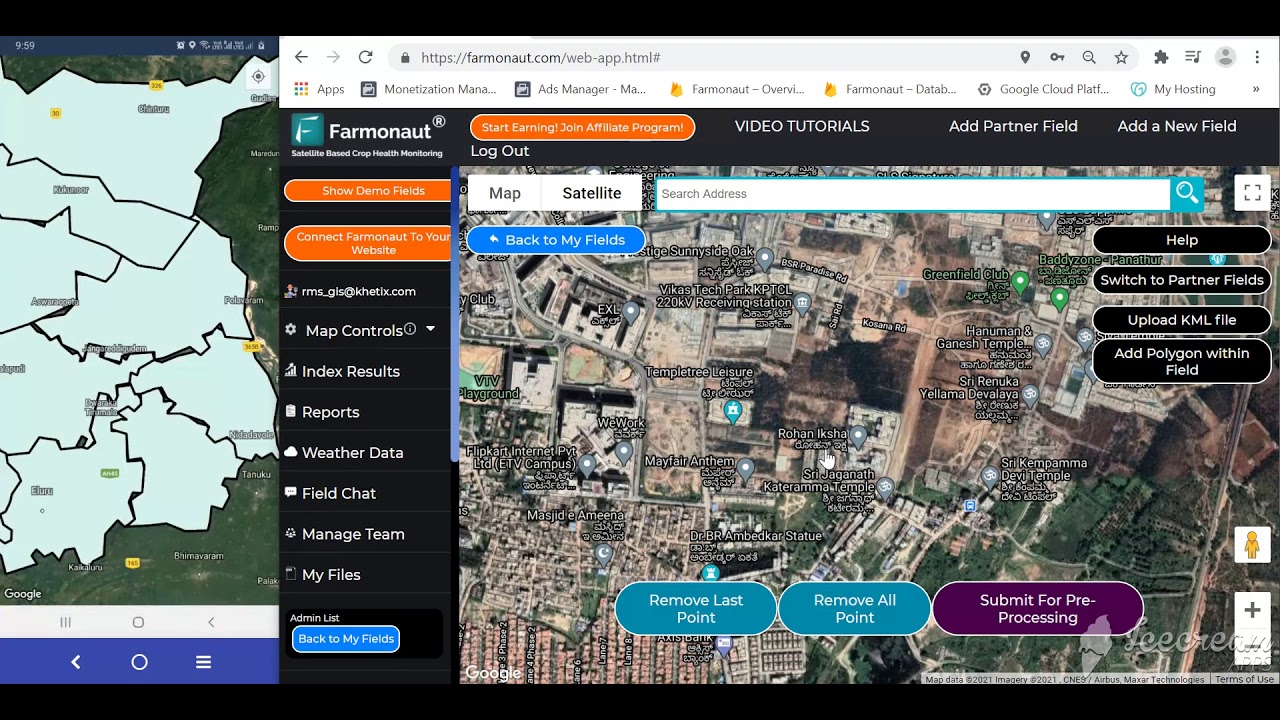
- Real-Time Monitoring: Our platform uses multispectral satellite imagery to deliver soil and crop moisture data, informing precise resource management.
- AI Advisory: The Jeevn AI system gives weather-based irrigation, moisture alerts, and land management recommendations.
- Blockchain Traceability: We offer blockchain-enabled aggregate and crop supply chain visibility to guarantee authenticity in processes like organic farming, specialty mining, and infrastructure sourcing.
- Resource & Fleet Management: Businesses use satellite-driven fleet management to optimize transportation of aggregates and monitor remote resource use, reducing operational costs and environmental footprint.
- Environmental Impact: Our carbon footprinting tools monitor emissions associated with moisture content management in agriculture and mining.
Our goal is to provide actionable, affordable information to farmers, project managers, businesses, and governments worldwide—enabling digital transformation at scale using our web, Android, iOS, and API-based platforms.
To integrate agile satellite and AI analytics for aggregate moisture management into your workflow, you may:
- Access Farmonaut Web, Android, or iOS App (multi-language support)
- Integrate with our API (developer docs here) for automation in enterprise platforms
- Explore large scale farm management and monitoring solutions for broad-acre operations
Future Outlook: Integration, Automation & Sustainable Practices
The future of aggregate moisture content testers is connected, smart, and sustainability-driven. Trends for 2026 onwards include:
- Automated Sensor Networks: Embedded moisture sensors in fields, construction sites, or mining operations, communicating via 5G or satellite for continuous feedback.
- AI-Driven Decision Systems: Advanced analytics autonomously analyze patterns, optimize irrigation or compaction, and trigger alerts to prevent costly mistakes or resource scarcity.
- Integrated Sustainability Reporting: Moisture management becomes a core of carbon reporting, traceability, and environmental monitoring, facilitated by platforms like ours at Farmonaut.
- Portable, Easy-to-Use Tools: Continued miniaturization enables real-time aggregate moisture content testing for field crews, agronomists, and operators—empowering on-the-ground efficiency.
- Blockchain Supply Chain Integration: Expansion of traceability solutions to deliver authenticated, verifiable data for global material, food, and mineral markets.
Cost-Effective Satellite Solutions: Farmonaut Subscription Plans
For organizations seeking scalable, affordable digital transformation in agriculture, mining, and infrastructure (including aggregate moisture analytics), explore our Farmonaut subscription options below. We support individual users, small businesses, enterprises, and governments.
FAQs: Aggregate Moisture Content Tester, Aggregate Moisture Test & Future Analytics
- What is an Aggregate Moisture Content Tester?
- An aggregate moisture content tester is a device or integrated system for determining the water content in aggregates such as sand, gravel, soil, or minerals. They’re used to ensure material quality in agriculture, infrastructure, and mining and to optimize resource use.
- Why is aggregate moisture content testing so essential for agriculture, infrastructure and mining by 2026?
- Moisture levels directly impact crop yields, material compaction, concrete/asphalt strength, and mineral processing. Advanced testing supports sustainability, cost efficiency, and reduced environmental risk as projects grow in complexity and regulatory demands increase.
- What are the standard methods for aggregate moisture content determination?
-
- Gravimetric/Oven Drying: Highly accurate, but slow—ideal for calibration or laboratory verification.
- Electromagnetic sensors: Fast, portable, moderate to high accuracy; best for field or ongoing project monitoring.
- TDR: Accurate, can profile moisture at various depths (especially for soil in farming).
- NIR spectroscopy: Rapid, non-contact, well-suited to high-throughput processing environments.
- AI/Cloud Platforms: Enable remote monitoring, predictive analytics, and smart automation in all sectors.
- How is AI and analytics shaping the future of aggregate moisture testing?
- AI optimizes testing by automating data analysis, identifying moisture trends, correlating with weather/soil/mineral metrics, and giving real-time actionable insights—reducing manual labor and error while speeding decisions. Integration with IoT and blockchain is expected to become standard by 2026.
- Can I integrate Farmonaut’s aggregate moisture analytics into my own project or ERP system?
- Yes. We provide a robust API (developer docs here), supporting data-driven agriculture, mining, and infrastructure operations globally.
- How do satellite-based systems complement on-ground aggregate moisture content testers?
- Satellites can monitor large areas quickly, providing context (climate, vegetation, soil moisture) to supplement high-precision field testers for targeted decision-making and large-scale oversight.
Conclusion
The aggregate moisture content tester and innovative moisture test solutions are reshaping agriculture, infrastructure, and mining heading into 2026. Modern methods, from rapid electromagnetic meters to satellite-augmented analytics, guarantee fast, accurate content determination with unparalleled operational benefits. Automation, AI, and sustainability practices are now integral, fostering data-driven, environmentally conscious, and cost-effective projects.
As technology evolves, integrating cloud analytics, blockchain traceability, and satellite intelligence will become standard, ensuring aggregate moisture is not just a technical metric but a strategic asset for our planet’s food, shelter, and resources.
If you seek to unlock the future of resource and project management, explore our Farmonaut platform to begin your journey in smart, sustainable agricultural, infrastructural, or mining excellence—powered by the most advanced aggregate moisture content analytics available.

 Omsri International FZE
 G.I.T.T.
 Jaunita Erss Ltd
 Almosi SARL
 SRK Consulting
 Berks Gold Limited
 Mwerezi Minerals Company Limited
 Mining SARL
 SenGold Invest SAS
 Sean Mining Limited
 NTS Group (Pty) Ltd
 Mine4Africa
 Lithspo Minerals Limited
 Tintina Mining Group
 Dalgety Minerals Pty Ltd
