
Mine water · Design guide
Acid Mine Drainage Metal Recovery: Modular Plant Design
Acid mine drainage metal recovery treats acidic mine water to permit limits while capturing copper, zinc, cobalt, iron oxides or rare earths as a product. Most plants are built from standard modules sized to the flow (EPA, 2014; NETL).
Key takeaways
- Recovery trains run oxidation, staged pH precipitation, settling and ion exchange or membrane polishing in sequence (EPA reference guide, 2014).
- The Mt. Storm pilot in West Virginia treats up to 1,000 gpm and was designed for about 1 t/yr each of rare earth, cobalt and nickel concentrate (WVU for NETL, 2022).
- US limits for copper, lead, zinc, gold and silver mine drainage under 40 CFR 440.102 are 0.30 mg/L copper, 1.5 mg/L zinc and 0.6 mg/L lead as a one-day maximum, pH 6 to 9.
- EPA case studies put passive and semi-passive systems at about US$130,000 to US$1.4 million capital (2013 dollars).
- Acid-base accounting ratios below 3:1 call for more testing; 1:1 or below suggests acid-forming rock (EPA, 1994).
In this article
- How acid mine drainage forms and why metals end up in the water
- Modular plant design: the building blocks
- Which metals can be recovered from mine water
- Rare earth recovery from mine drainage: the West Virginia pilots
- Passive vs active treatment: 7 acid mine drainage solutions compared
- Acid mine drainage treatment costs
- Discharge limits a recovery plant must meet
- How to prevent acid mine drainage before it starts
- How to design a modular AMD recovery plant: 8 steps
- Monitoring mine drainage with field data and satellite imagery
- Frequently asked questions
Acid mine drainage metal recovery means treating acidic, metal-rich mine water so that it meets discharge limits and, along the way, captures some of its dissolved metals as a product: copper, zinc, cobalt, nickel, iron oxides or rare earth concentrates. Most plants that do this are built from standard modules (equalisation, oxidation, staged pH adjustment, settling, filtering and resin or membrane polishing), so they can be sized to the flow and moved or expanded as the water changes. A West Virginia pilot plant built to treat up to 1,000 gallons per minute (gpm) of acid mine drainage was designed to make about 1 tonne per year each of rare earth, cobalt and nickel concentrate (West Virginia University for NETL, 2022).
This guide is written for mining consultants, site owners and engineers who need to pick a treatment train, estimate the metal load and decide whether recovery can pay for part of the treatment bill. It covers how the water forms, which modules do what, real cost figures from US Environmental Protection Agency (EPA) case studies, the federal discharge limits a hard-rock mine must meet, and a step-by-step design route. A calculator lets you turn your own flow and assay numbers into daily metal and lime loads.
How acid mine drainage forms and why metals end up in the water
acid mine drainage (AMD) forms when sulfide minerals, mainly pyrite (iron sulfide, FeS2), meet air and water in waste rock, tailings, pit walls or underground workings. The US Geological Survey explains that the reaction makes sulfuric acid and dissolved iron, and that the acidic water then dissolves other metals such as copper and lead. Some mine drainage reaches pH 2.5 to 4 (USGS). Bacteria speed up the reaction, which is why a waste dump can produce acid for decades after mining stops.
Chart
Metals in untreated mine water at the Rio Tinto Mine, Nevada
mg/L, influent sample 26 July 2005 (iron 6,890 mg/L not shown)
Virginia Tech’s Powell River Project describes the chain in three steps: pyrite oxidises and releases ferrous iron, sulfate and acid; ferrous iron oxidises to ferric iron; and ferric iron reacts with water to form the orange ferric hydroxide that stains streams, releasing still more acid (Virginia Tech Extension). The same source notes that many ore minerals are sulfides too, such as sphalerite (zinc sulfide), galena (lead sulfide) and copper sulfides, so AMD is a problem at metal mines as well as coal mines.
That chemistry is also the reason recovery is possible. The metals are already dissolved, so nobody has to mine or crush them again. The task is to pull them out of solution one at a time, in a form clean enough to sell or to send to a refinery.
What the water can contain
Mine water chemistry varies a lot. At the Rio Tinto Mine near Mountain City, Nevada, untreated water in July 2005 carried 6,890 mg/L iron, 793 mg/L aluminium, 314 mg/L copper, 96 mg/L manganese and 79 mg/L zinc, with more than 24,000 mg/L sulfate (EPA reference guide, citing Tsukamoto, 2006). Many coal-mine discharges are far weaker. That range is why there is no single standard plant: the first design input is always a set of reliable water samples over several seasons.
The effect downstream is serious. The EPA notes that long periods below pH 5 are likely to be lethal to many stream species, and that eggs of several fish species do not develop properly below about pH 5.5 (EPA CADDIS, pH). Treatment targets are therefore set by permits, not by the value of the metals.
▶ Seven environmental impacts of mining, including acid drainage, explained in clay animation. · 2:31
Modular plant design: the building blocks
A modular plant is a set of skid-mounted or containerised units that each do one job. The EPA’s 2014 reference guide to mining-influenced water describes several such units in use: trailer-mounted reverse osmosis racks leased for an emergency at a former gold mine in California, portable rotating cylinder aerators sized to each site, and a mobile modular ion exchange system installed to treat the full discharge at the Soudan Mine in Minnesota (EPA, Reference Guide to Treatment Technologies for Mining-Influenced Water, 2014). A typical recovery train has the modules below, in this order.
1. Flow equalisation and screening
A pond or tank evens out storm peaks and dry-season lows so the chemical modules see a steady feed. Reagent dosing works best on a stable flow, and mine discharges often rise sharply after storms and snowmelt. Screens and a first settling step remove coarse solids that would foul later units.
2. Oxidation and aeration
Ferrous iron must be oxidised to ferric iron before it will settle at moderate pH. Options include aeration cascades, mechanical aerators, hydrogen peroxide dosing, or a rotating cylinder treatment system (RCTS). The RCTS spreads water as a thin film on a spinning perforated drum, so it needs no compressors or blowers; the EPA guide reports that it was developed for water with 4,000 to 7,000 mg/L ferrous iron at the Rio Tinto Mine and that the units are portable and sized to each site’s oxidation demand.
3. Staged pH adjustment and selective precipitation
This is where recovery happens. Each metal precipitates as a hydroxide in its own pH band. Raising the pH in steps, with a settling tank after each step, separates an iron-rich solid at low pH from an aluminium-rich solid and then a copper, zinc or cobalt-rich solid at higher pH. Lime (calcium hydroxide), limestone (calcium carbonate), caustic soda (sodium hydroxide) or magnesium hydroxide can be used. Lime forms gypsum, which can dilute a metal product, so recovery designs often consider caustic soda or magnesium hydroxide for the metal-bearing stage; bench tests decide.
Sulfide precipitation is the other route. Adding hydrogen sulfide or sodium hydrosulfide, or making sulfide with sulfate-reducing bacteria, drops copper and zinc as metal sulfides, which smelters accept more readily than hydroxides. The EPA guide lists metal sulfide precipitation as one of the processes inside biochemical reactors.
4. Solid and liquid separation
Clarifiers, lamella settlers, filter presses and bag or cartridge filters remove the precipitates. This module often decides whether a plant meets its permit. At the Soudan Mine, an RCTS raised pH and removed dissolved metals, but suspended copper still exceeded permit levels even after 48 hours of settling, which is why the operator added the mobile ion exchange system (EPA, 2014). Ceramic microfiltration is another polishing option covered in the same guide.
5. Ion exchange polishing and selective metal capture
Ion exchange resins swap unwanted metal ions for harmless ones. The EPA guide states that selective metal recovery may be an option with the right resin, that the process works best between pH 4 and 8 with low suspended solids and low iron and aluminium, and that it generally gives more than 90 percent recovery for a target ion. The resin is regenerated with acid or caustic, which produces a small, concentrated stream that holds the metal. That concentrate, rather than the treated water, is the product.
6. Membranes for sulfate and salts
Reverse osmosis forces water through a membrane and leaves a brine that is typically 20 to 30 percent of the feed flow (EPA, 2014). It removes sulfate and total dissolved solids that precipitation cannot touch. At the Kennecott South site near Copperton, Utah, two reverse osmosis racks treat 3,200 gpm of groundwater carrying about 2,000 mg/L dissolved solids and 1,200 mg/L sulfate (EPA, 2014). Membranes need pre-treatment and typically last two to five years.
7. Residual and product handling
Every plant makes sludge. In a recovery design the sludge is split into streams: a metal product, an iron or aluminium solid that may have a use, and a final waste for disposal. The USGS has tested AMD residuals as a filter to remove phosphorus from farm and town wastewater (USGS). The Summitville mine water treatment plant in Colorado shows the scale of the job at a large site: an EPA optimisation review recommended raising its capacity from 500 to 1,000 gpm and automating it to cut labour (EPA Remediation System Evaluation, Summitville, 2002).
Which metals can be recovered from mine water
Recovery only makes sense for metals that are present at a steady, useful concentration and that can be separated into a clean product. The table sets out the common candidates.
| Metal or product | Usual recovery route | What decides the value |
|---|---|---|
| Iron (iron oxide or oxyhydroxide) | Controlled oxidation and settling at low pH | Purity and colour; large tonnage but low unit value |
| Copper | Sulfide precipitation, ion exchange, solvent extraction and electrowinning at strong-acid sites | Copper grade of the product and smelter terms |
| Zinc | Hydroxide or sulfide precipitation at higher pH | Separation from iron, aluminium and cadmium |
| Cobalt and nickel | Ion exchange or selective precipitation after iron and aluminium removal | Concentration in the feed and buyer specifications |
| Aluminium | Precipitation at pH about 4.5 to 5 | Whether a clean aluminium solid can be made |
| Rare earth elements | Co-precipitation with iron and aluminium, then acid leach and solvent extraction | Grade of the pre-concentrate entering the leach |
| Manganese | Oxidation at high pH | Usually treated for compliance, rarely sold |
Two rules of thumb hold across most sites. First, iron and aluminium must come out first and cleanly, or they dilute everything after them. Second, the metal load, not the concentration alone, decides whether recovery is worth studying. A small flow with high copper may carry less metal per day than a large flow with modest copper. The calculator below turns flow and concentration into daily and yearly loads.
Calculator
How much metal and lime does your mine water carry?
Enter your measured flow, metal concentration and acidity to see daily and yearly loads.
- Metal recovered per year (kg): 4,775
- Gross metal value per year (US$): $42,971
- Acidity to neutralise, CaCO3 equivalent (tonnes/year): 99.5
Example values only, not a benchmark. Conversion: 1 US gallon = 3.785 litres; load (kg/day) = gpm x 3.785 x 1,440 x mg/L / 1,000,000. Lime need is shown as calcium carbonate equivalent from acidity. Metal price is an input: example, use today’s price. Recovery is your own bench-test figure.
Rare earth recovery from mine drainage: the West Virginia pilots
The best-documented modular recovery work in the United States is the rare earth programme run by West Virginia University’s Water Research Institute with the Department of Energy’s National Energy Technology Laboratory (NETL). The idea is simple: rare earth elements already settle into AMD sludge along with iron and aluminium, so a treatment plant can be a feed source for a rare earth concentrate.
NETL reports that WVU commissioned a bench and small pilot extraction facility in July 2018, produced a mixed rare earth oxide concentrate of about 80 percent purity by 2019 and about 98 percent purity in 2020, with critical minerals as co-products (NETL, External Partnerships Help Power NETL Progress). A separate NETL update says the facility was partly automated with Rockwell Automation for continuous processing, and that techno-economic studies found the economics depend strongly on the grade of feed entering the acid leach tanks (NETL project update).
The 2022 WVU presentation to NETL describes how the grade climbs through the process: a sludge pre-concentrate at about 0.5 percent total rare earths, a pregnant leach solution of 100 to 1,800 mg/L, and finally a mixed oxide product. It also describes the Mt. Storm pilot plant, which treats up to 1,000 gpm of AMD and was designed to produce about 1 tonne per year each of rare earths, cobalt and nickel, and lists a 500 gpm full-scale demonstration project with about US$6.9 million total budget including cost share (WVU for NETL, 2022). These are pilot figures; they show the design approach, not a proven commercial return.
Passive vs active treatment: 7 acid mine drainage solutions compared
Not every site needs a recovery plant. Many abandoned discharges are treated passively, with no daily dosing. The seven options below are the ones a consultant usually compares first. Recovery is easiest in the active systems; passive systems trap metals in a medium that is rarely worth processing, although the Aluminator system was designed so that aluminium could be flushed out and recovered (EPA, 2014).
| Option | Type | Best for | Main limit |
|---|---|---|---|
| Anoxic limestone drain (ALD) | Passive | Low-oxygen water with little ferric iron or aluminium | Clogs with iron and aluminium hydroxides |
| Successive alkalinity producing system (SAPS) | Passive | Acidic water with some aluminium or ferric iron | Needs area; limestone can plug over time |
| Constructed wetland (aerobic or anaerobic) | Passive | Low to moderate flows with iron | Large footprint; weak on manganese |
| Biochemical reactor | Passive or semi-passive | Copper, zinc, cadmium removal as sulfides | Carbon source and permeability decline |
| Lime or caustic neutralisation with clarifier | Active | High flows and strong acidity | Daily reagent and sludge cost |
| Ion exchange | Active | Polishing and selective metal capture | Pre-treatment needed; regenerant disposal |
| Reverse osmosis | Active | Sulfate and dissolved solids limits | Brine of 20 to 30 percent of feed |
Virginia Tech’s review finds that, per tonne of acid neutralised, anoxic limestone drains are usually the cheapest passive option and open limestone channels are on average cheaper than wetlands or vertical flow systems, while the systems that can handle the most acidic and oxidised waters cost the most. It also notes that passive systems can serve as pre-treatment that lowers the cost of a downstream active plant, which is a common hybrid layout at recovery sites.
When to choose active treatment with recovery
Active treatment fits when the flow is large, the acidity is high, the site has power and staff, and the permit is strict on metals or sulfate. Those are also the sites where the metal load is large enough to study recovery. A practical test: if the plant will run lime dosing every day anyway, splitting the precipitation into two or three pH stages adds tanks and controls but not a new process.
When passive treatment is the better answer
Passive systems fit remote or abandoned sites with modest flow, no power and a long time horizon. The EPA guide reports a Successive Alkalinity Producing System cost of about US$0.03 per gallon at 5 gpm and US$0.003 per gallon at 100 gpm over a 15-year life (2013 US dollars), which is hard for any active plant to match at that scale.
Acid mine drainage treatment costs
Costs depend on flow, acidity, metals, climate and land, so published figures are best read as ranges from real sites. The EPA reference guide (2014) gives capital costs in 2013 US dollars for several systems:
Chart
Capital cost of selected mine water treatment systems
Thousand US$, 2013 dollars, EPA case studies
- An anaerobic wetland in the Copper Basin Mining District at Ducktown, Tennessee: about US$1.4 million in 1998, plus about US$381,000 for two aerobic cells added in 2003.
- A biochemical reactor at the Leviathan Mine, Alpine County, California: about US$1.1 million, with operation and maintenance of US$19.51 per 1,000 gallons at an average 10 gpm.
- A biochemical reactor at the West Fork Mine, Missouri: about US$1 million in 1996 for a 1,200 gpm capacity.
- Two Aluminator cells: about US$218,000 and US$132,000.
- A rotating cylinder system at one California site: US$214,253 capital and US$535,633 operation and maintenance for six months.
- A rotating cylinder system for the Soudan Mine at a peak of 300 gpm: about US$135,000 to install and US$22,500 to US$56,300 a year to run.
For larger active plants the same guide quotes engineering estimates for a 1 million gallon per day system: about US$11.8 million installed and US$3.2 million a year to operate for a fluidised bed reactor, and about US$4.3 million a year to operate for ion exchange. Constructed wetlands are listed at US$0.15 to US$1.00 per gallon treated. Prices have risen since 2013, so escalate these figures before using them in a budget. The US Office of Surface Mining Reclamation and Enforcement publishes AMDTreat, a cost model that the EPA guide recommends for first estimates.
Discharge limits a recovery plant must meet
In the United States, discharges from mines that produce copper, lead, zinc, gold, silver or molybdenum ores are covered by 40 CFR Part 440 Subpart J. For mine drainage the best practicable technology limits are 0.30 mg/L copper, 1.5 mg/L zinc, 0.6 mg/L lead, 0.002 mg/L mercury and 30 mg/L total suspended solids as a one-day maximum, with 30-day averages at half those values and pH held between 6.0 and 9.0 (40 CFR 440.102, 2023 edition). State permits and water quality standards are often stricter, especially for selenium, cadmium and sulfate.
Chart
US effluent limits for metal mine drainage
mg/L, 40 CFR 440.102(a): 30-day average vs one-day maximum
These limits shape the plant more than the metal value does. A recovery stage that takes copper from 300 mg/L down to a few mg/L still leaves a polishing job to reach 0.15 mg/L on a 30-day average. That is why most recovery trains end with ion exchange, filtration or a final lime stage, whatever happens upstream.
How to prevent acid mine drainage before it starts
Prevention is cheaper than treatment, and it starts with testing. The EPA’s technical document on AMD prediction describes acid-base accounting: the acid potential of a sample (from its sulfur content) is compared with its neutralisation potential (from its carbonate content). Where the ratio of neutralisation potential to acid potential is above 3:1, experience suggests lower risk; between 1:1 and 3:1 is a zone of uncertainty that calls for kinetic tests such as humidity cells; at 1:1 or below the rock is more likely to make acid (EPA, AMD prediction document, 1994).
With those results, a mine plan can:
- Separate acid-forming waste rock and place it where water and oxygen cannot reach it, for example under a water cover or inside a compacted, capped cell.
- Blend acid-forming rock with carbonate-rich rock, or add crushed limestone, where the test ratios support it.
- Divert clean runoff around waste dumps and tailings so less water touches sulfide rock.
- Cover closed dumps with low-permeability layers and vegetation to cut infiltration.
- Plan underground workings so they can be flooded or sealed at closure where that keeps oxygen away from sulfides.
Prediction tests also tell a consultant whether a future recovery plant is worth designing in from the start, because they show which metals the waste will release and roughly for how long.

▶ Strip mining pros and cons, including how exposed rock and runoff are managed. · 4:37
How to design a modular AMD recovery plant: 8 steps
- Map every source. Locate seeps, adits, pit lakes, dumps and tailings, and the streams they reach. Measure flow at each point over at least a wet and a dry season.
- Sample the chemistry. Measure pH, acidity, alkalinity, sulfate and dissolved and total metals in the field and the laboratory. The USGS notes that mine water chemistry can change quickly after sampling, which is why many measurements are made on site.
- Calculate loads. Multiply flow by concentration for each metal and for acidity. This gives the reagent demand and the size of any metal product.
- Set the targets. List the permit limits and decide which metals, if any, are candidates for recovery.
- Run bench tests. Titrate samples in stages to see at which pH each metal precipitates, how clean each solid is and how much reagent each stage uses. Test resins if ion exchange is planned.
- Choose and size modules. Pick oxidation, staged precipitation, separation and polishing units to match the peak flow, with a margin for storms.
- Pilot on site. Run a containerised or skid-mounted pilot for weeks to months on real water. The Soudan and West Virginia examples show how much field results can differ from bench results.
- Plan residuals and offtake. Agree specifications with a smelter, refiner or pigment buyer before scaling up, and plan disposal for the solids nobody will buy.
Infographic
Recovery plant design at a glance
- 1Map sourcesLocate seeps, adits, dumps and receiving streams.
- 2Sample and measureFlow and chemistry over wet and dry seasons.
- 3Calculate loadsFlow times concentration for each metal and acidity.
- 4Bench testStaged titration shows where each metal drops out.
- 5Pilot on siteRun skid-mounted modules on real water.
- 6Scale and sellAgree product specs, then size the full plant.
Good consultants also check the ground around the plant: where the water comes from, how big the waste dumps are and how the stream changes downstream. A list of firms that do this work is in our guide to mining consulting companies, and sulfide-rich ore types that tend to generate acid are covered in types of ore deposits and sediment-hosted copper deposits.
Monitoring mine drainage with field data and satellite imagery
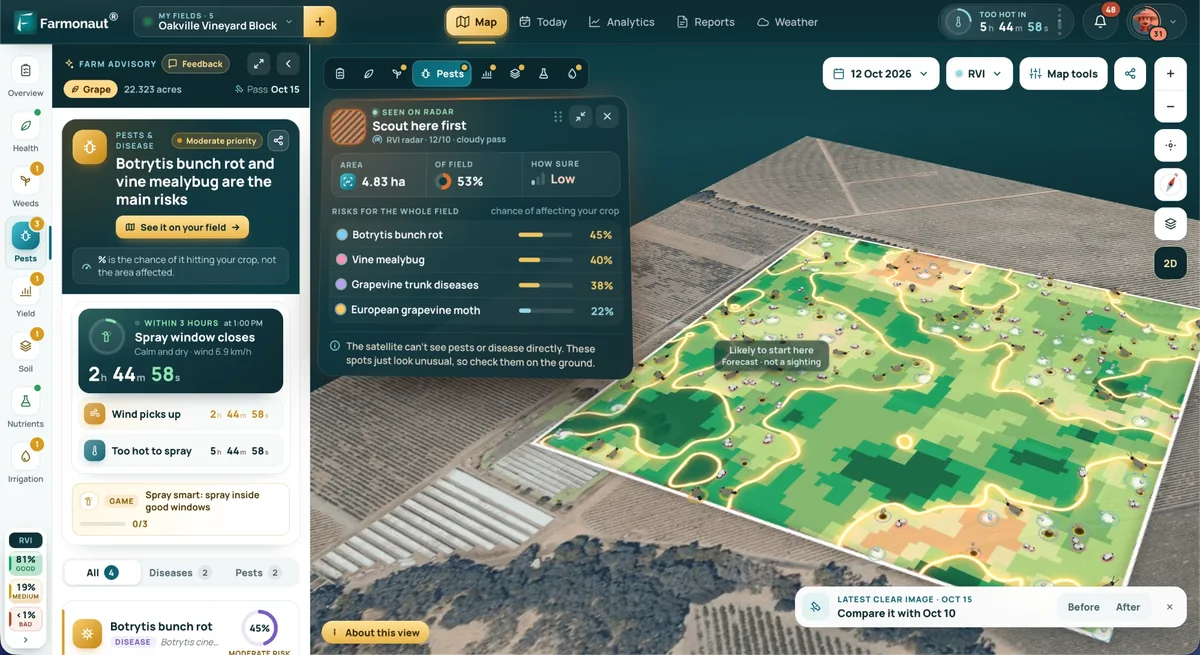
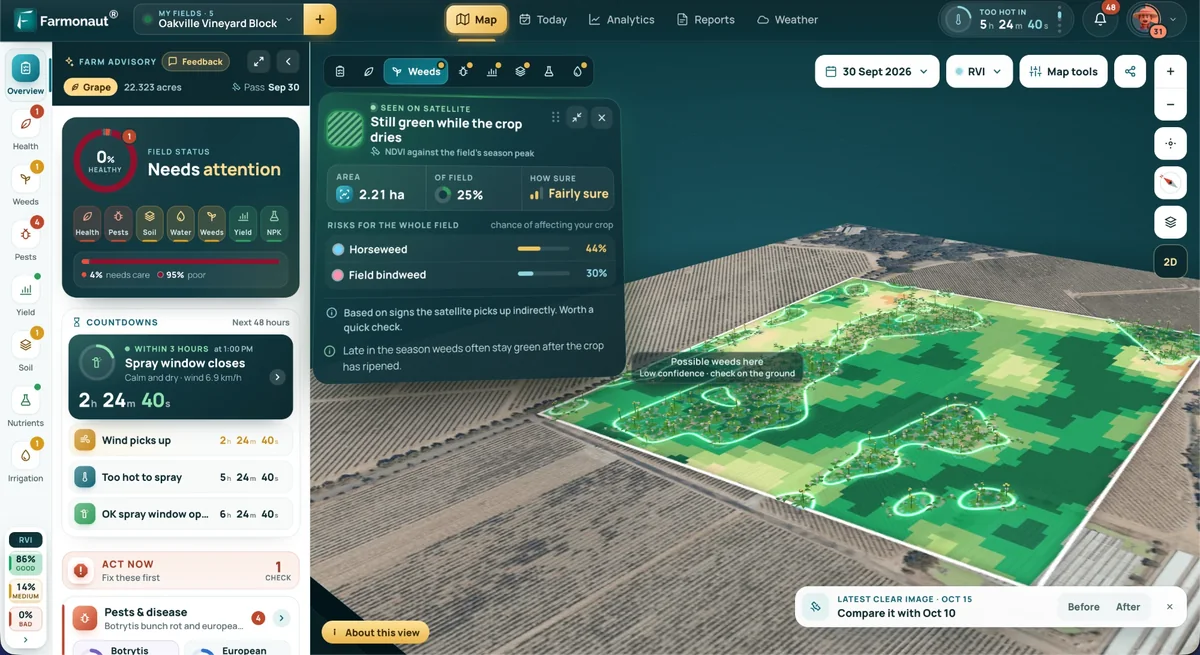
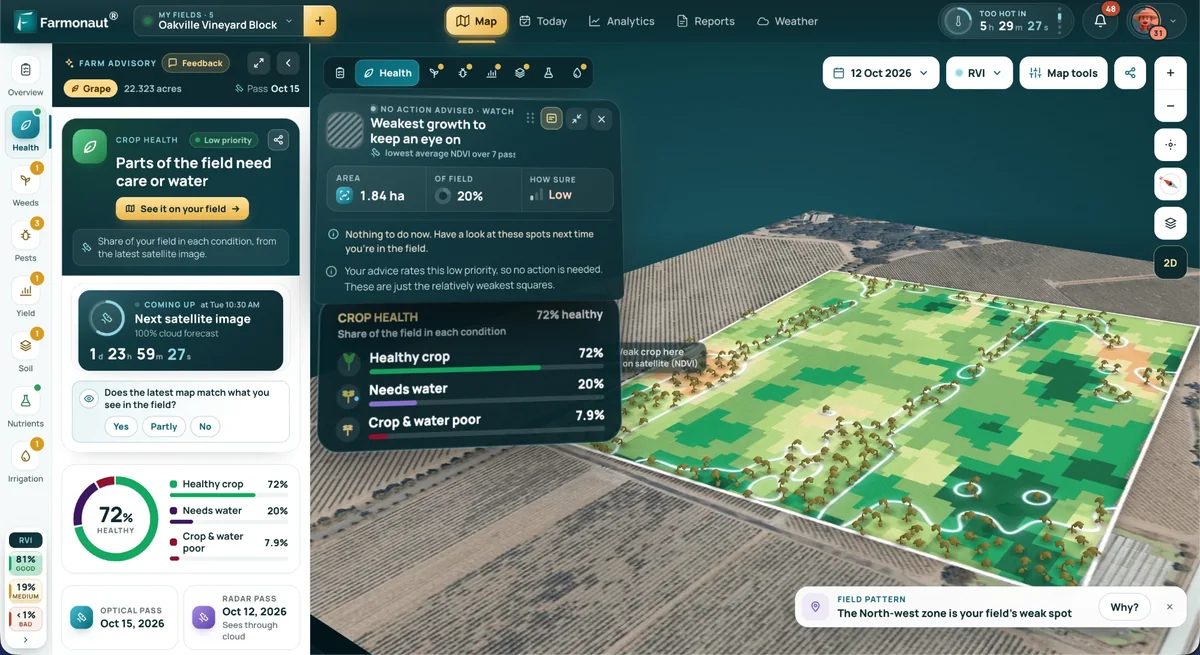
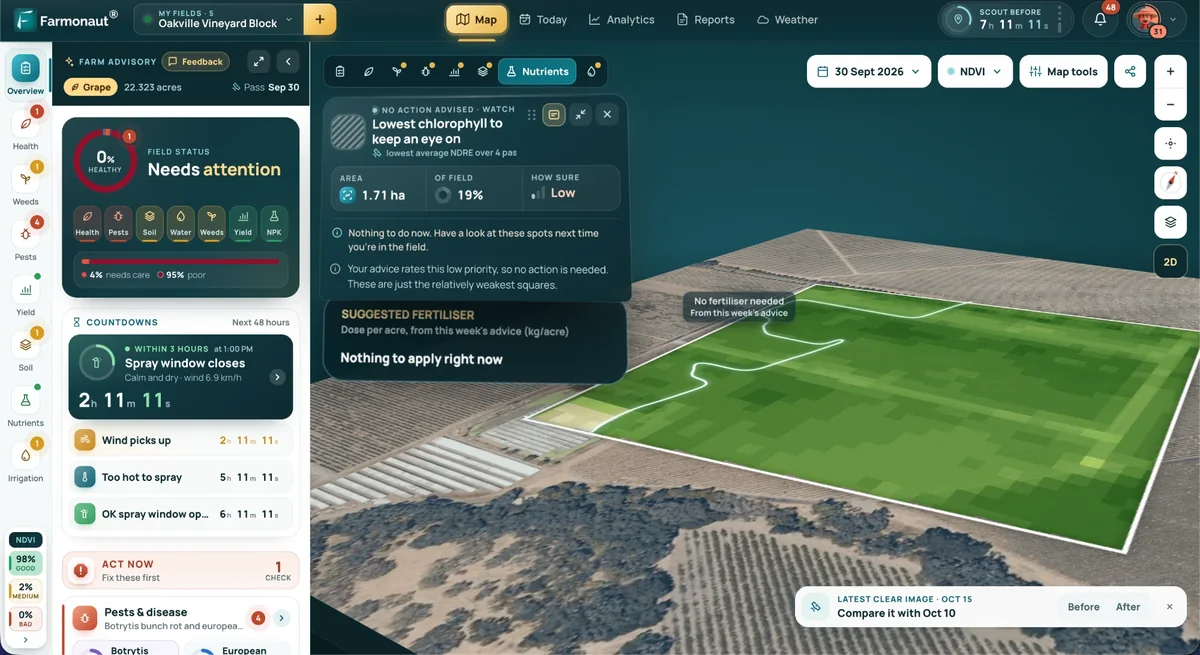
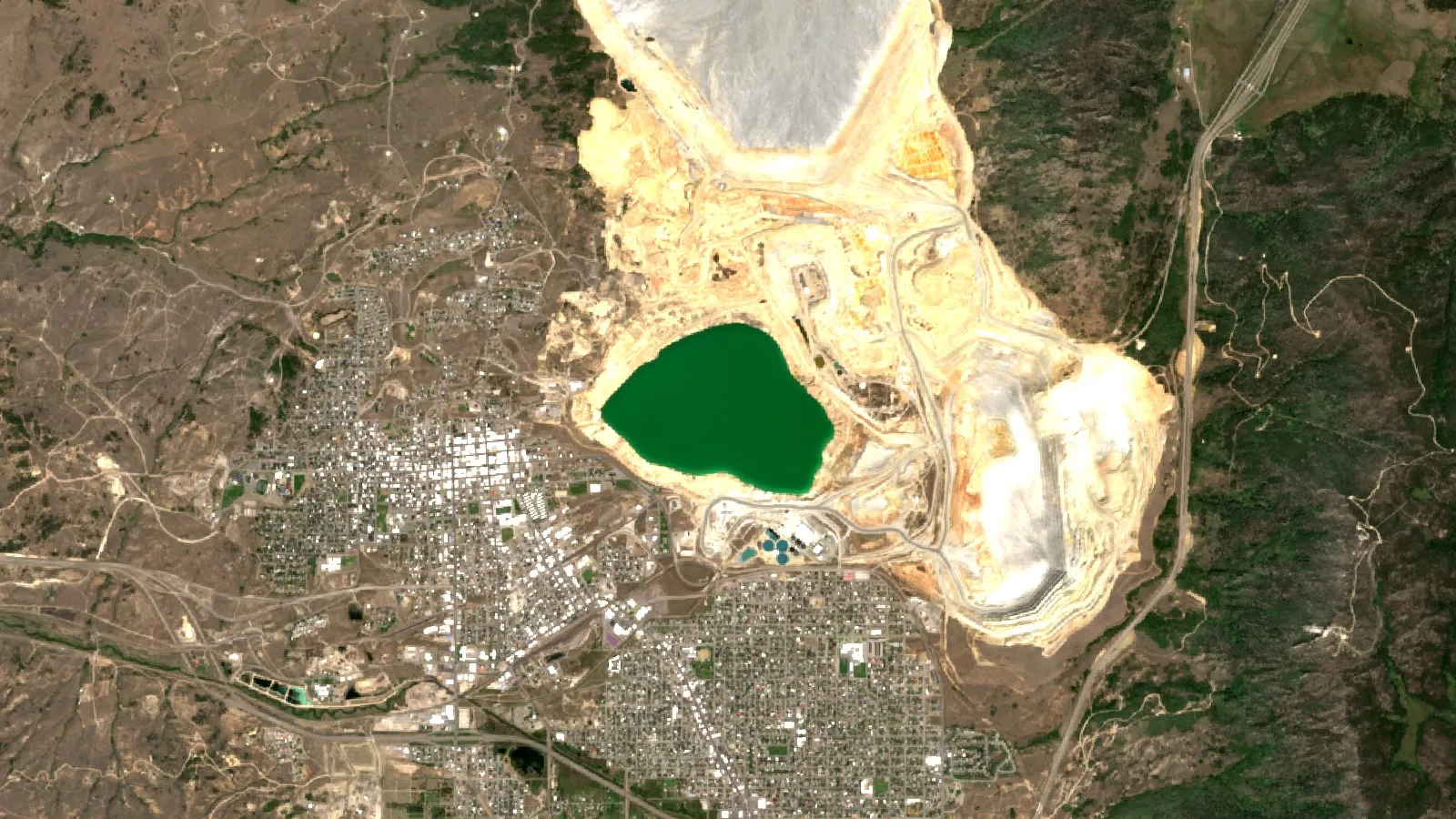
Once a plant runs, monitoring checks two things: whether the effluent meets its limits and whether the sources upstream are changing. Field sensors for pH, conductivity and flow, plus routine laboratory assays, cover the first. The second is a mapping job. Iron staining, bare or stressed ground around dumps and changes in pit lake colour can often be seen on repeat satellite images, which helps a team decide where to sample next and track whether covers and diversions are working. The same imagery is used to watch disturbed ground more widely, as in our article on satellite monitoring of illegal mining.
Farmonaut provides satellite-based mineral detection and site mapping for exploration and project teams; consultants can describe a site through the mining query form. Satellite maps support, but do not replace, water sampling and permit monitoring.
Frequently asked questions
What is acid mine drainage?
Acid mine drainage is acidic water, often pH 2.5 to 4, that forms when sulfide minerals such as pyrite react with air and water at mines. The acid dissolves iron, aluminium and metals such as copper, zinc and lead (USGS).
Can metal recovery from mine water pay for itself?
Sometimes. Recovery can offset part of the treatment cost where the metal load is large and steady and a clean product can be made. At most sites the plant is still justified by the permit, with recovery as a partial credit.
What is a modular mine water treatment plant?
It is a plant built from skid-mounted or containerised units for oxidation, staged pH adjustment, settling, filtration and polishing. Units can be added, removed or moved as flow and chemistry change.
Which metals are recovered from mine water?
Iron oxides, copper, zinc, cobalt, nickel, aluminium and rare earth elements are the usual candidates. Rare earth and cobalt concentrates have been made at pilot scale in West Virginia (NETL).
How is copper recovered from mine water?
Copper is usually taken out by sulfide precipitation, ion exchange, or at strongly acidic copper sites by solvent extraction and electrowinning. Iron must be removed first so it does not contaminate the copper product.
What is the cheapest passive treatment for acid drainage?
For suitable water, anoxic limestone drains are usually the lowest-cost passive option per tonne of acid neutralised (Virginia Tech). They only suit water with little oxygen, ferric iron and aluminium.
How much does acid mine drainage treatment cost?
EPA case studies range from about US$130,000 for a small passive cell to over US$1 million for wetlands and bioreactors, and engineering estimates of US$3 million or more a year to run a 1 million gallon per day active plant (2013 US dollars).
What are the discharge limits for metal mines in the United States?
Under 40 CFR 440.102, mine drainage from copper, lead, zinc, gold and silver mines must not exceed 0.30 mg/L copper, 1.5 mg/L zinc and 0.6 mg/L lead on any one day, with pH 6.0 to 9.0. State permits may be stricter.
How do you stop acid drainage forming at a mine?
Test waste rock with acid-base accounting, isolate acid-forming rock from air and water, blend it with carbonate rock where tests support it, divert clean water and cap dumps at closure (EPA).
What happens to the sludge from treatment?
It is thickened and filtered, then either sold as a product, reused, for example as a phosphorus filter medium tested by the USGS, or placed in a lined disposal area.
Who designs mine water recovery plants?
Mine water specialists, environmental engineering firms and university groups do most design work. For mapping support or a quote on site imagery, you can contact Farmonaut.
This page is for information only. It is not engineering or legal advice. Confirm discharge limits and permits with the regulator.
Farmonaut mining
Map your mine site and its drainage from space
Consultants can map dumps, pit lakes and disturbed ground around a site with repeat satellite imagery before planning field sampling.
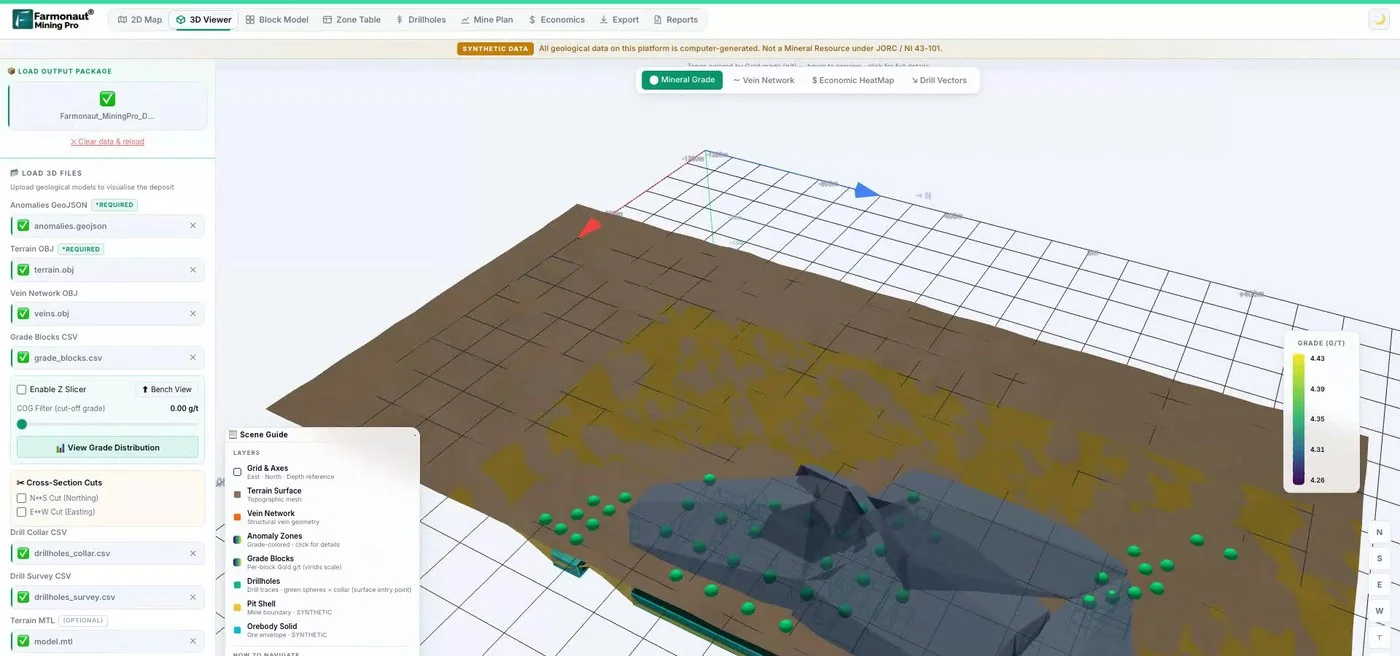
Mining Pro sample view, synthetic data
Keep reading
Sources
- US EPA, Reference Guide to Treatment Technologies for Mining-Influenced Water (2014): clu-in.org
- US Geological Survey, Mine Drainage: usgs.gov
- Virginia Tech Extension, Powell River Project: Passive Treatment of Acid-Mine Drainage: pubs.ext.vt.edu
- US EPA, Technical Document: Acid Mine Drainage Prediction (1994): epa.gov
- 40 CFR Part 440, Ore Mining and Dressing Point Source Category (2023 edition): govinfo.gov
- NETL, External Partnerships Help Power NETL Progress on REE Recovery from AMD and Fly Ash: netl.doe.gov
- NETL, WVU project reaches new REE recovery milestones: netl.doe.gov
- Ziemkiewicz, WVU Water Research Institute, REE/CM recovery from acid mine drainage, NETL review (2022): netl.doe.gov
- US EPA, Remediation System Evaluation, Summitville Mine Superfund Site (2002): epa.gov
- US EPA CADDIS, pH: epa.gov
- Banks et al., Mine-water chemistry: the good, the bad and the ugly: literature.wolkersdorfer.info
Discussion
Questions, corrections or field experience? Share them below. First-time comments are reviewed before they appear, and your email is never published.
No comments yet. Be the first to add a question or your experience.

 Sahara Mining
 Sean Mining Limited
 NTS Group (Pty) Ltd
 Mine4Africa
 Lithspo Minerals Limited
 Tintina Mining Group
 Dalgety Minerals Pty Ltd
 Faith At Work (Pty) Ltd
 Geotech Mining Solutions plc
 Vulcan International Limited
 Kidepo Associates
 GKY Mining
 Alkimy SARL
 Double A Trading
 GemSprout Metals Limited
 Qader Group
 Ileys General Trading
 SG Gold Mining LLC
 VRV Global Pte Ltd
 Omsri International FZE
 G.I.T.T.
 Jaunita Erss Ltd
 SRK Consulting
 Berks Gold Limited
 Client · Tanzania · Gold