

Gold claims · Arizona buyer guide
AZ Gold Claims for Sale: Fees, Rules and Buyer Checks
Most AZ gold claims for sale are unpatented BLM claims. Filing a new lode claim costs $274, then $200 a year (BLM, 2026). This guide covers Arizona and New Mexico rules, land types, a holding-cost calculator and the checks to run before you pay.
Key takeaways
- Most listings are unpatented lode or placer claims on federal land: the BLM says the claim right does not include exclusive surface rights.
- Filing a new lode claim costs $274 (processing $25, location $49, maintenance $200); after that the BLM charges $200 a year per lode claim or per 20 acres of placer (BLM, 2026).
- Owners of 10 or fewer claims nationwide can file a waiver, then file a work affidavit and pay $15 per claim by 30 December. A transfer costs $15 per claim per transferee.
- In Arizona the notice and map must be recorded with the county, and the claim monumented, within 90 days; missing it counts as abandonment (ARS 27-203).
- A lode claim is capped at 1,500 x 600 feet, an individual placer at 20 acres and an association placer at 160 acres (BLM).
In this article
- What AZ gold claims for sale usually are
- Arizona's claim location rules: what a valid claim looks like
- Federal fees and filings for AZ gold claims
- Where AZ gold claims come from: Quartzsite, Lynx Creek and more
- Gold claims in New Mexico: history, land and rules
- A due-diligence checklist for AZ gold claims
- Satellite geology checks for Arizona and New Mexico claims
- Frequently asked questions
Arizona and New Mexico have some of the oldest gold districts in the American West, and a steady flow of claims for sale to match. But state location law, a patchwork of federal, state trust and private land, and withdrawn recreation areas make these two states easy places to buy the wrong thing. Here are the rules, the land types and the checks to run before you pay.
Land types BLM · Forest Service · State trust · Private
State law ARS Title 27 · NMSA Ch. 69
Our role Due diligence, not brokerage
Most AZ gold claims for sale are unpatented placer or lode claims on federal land managed by the Bureau of Land Management or the Forest Service, sold by the claimant under a recorded deed. A smaller share are patented claims, which are private land, and a few are permits on Arizona state trust land. Each type has its own rules. The same is true across the border, where gold claims in New Mexico sit on the same federal system but under New Mexico’s own location statutes.
Try it: ARS 27-203 claim map check: will your claims fit the sheet at a legal scale? →
Buying in either state means checking three things in order: that the claim legally exists, that it sits on land where it can exist, and that the geology justifies the price. Below, each one is checked against the states’ own statutes and agency guidance. Farmonaut does not sell or broker claims; our part is the independent geology check at the end. For the market-wide version of these checks, see our ten checks before paying for any gold claim.
“In Arizona, the location monument must be a stone mound at least three feet high, or a post projecting four feet.”
In Arizona, state law adds deadlines on top of the federal ones. A claim can be properly filed with the BLM and still be abandoned under Arizona law if the county recording or boundary monuments were late. Check both layers for any AZ gold claims for sale.
What AZ gold claims for sale usually are
The Arizona Geological Survey (AZGS) explains that mineral rights in Arizona can be obtained on state or federal lands that are open to mineral entry, and that the BLM, the Forest Service and the Arizona State Land Department each administer different kinds of mineral rights on their land. For a buyer, that translates into four types of listing.
Chart
Largest federal claim size by type
Acres; lode size converted from 1,500 x 600 feet
| Listing type | Land owner | Who administers it | What you buy | Yearly obligation |
|---|---|---|---|---|
| Unpatented placer or lode claim (BLM) | United States | BLM Arizona State Office (Phoenix) + county recorder | Claimant’s right to develop the minerals | BLM maintenance fee or small miner waiver |
| Unpatented claim in a national forest | United States | BLM for records; Forest Service for surface use | Same claim right; Forest Service operating rules | Same as above |
| Patented claim | Private | County recorder and assessor | Fee title, usually surface and minerals | County property tax |
| State trust land exploration permit | State of Arizona | Arizona State Land Department | Permit rights, subject to department approval | Set by permit terms |
Most of these listings, like most Arizona mining claims generally, fall into the first two rows. Arizona is one of the 19 states where the BLM says mining claims can be located, and the BLM’s Arizona State Office in Phoenix is the federal filing office for them. The AZGS also publishes two reference guides worth reading before you buy: Laws and Regulations Governing Mineral Rights in Arizona (Special Report 12) and Manual for Determination of Status and Ownership, Arizona Mineral and Water Rights (Special Report 23).
AZ gold mining claims for sale vs AZ gold mines for sale
A claims listing is usually a set of unpatented claims. A listing for AZ gold mines for sale may be a patented property with old workings, an unpatented claim group with a small operation, or simply a claim with a historic adit. The word “mine” tells you nothing about production or permits. Ask exactly which claims, which serial numbers and which land status are included.
Lode, placer and association claims: size limits and what you do not get
Federal law limits a lode claim to 1,500 feet in length and 600 feet in width, about 20.7 acres. A placer claim (a claim on loose deposits such as gravel, as opposed to gold in a solid vein) can cover up to 20 acres per locator, and an association placer can reach 160 acres when eight or more people locate it together (BLM, Mining Claims). A listing of 80 acres of Arizona placer ground is therefore at least four 20-acre claims, or one association claim, and the yearly federal fee is the same US$800 either way, because the BLM charges US$200 for every 20 acres or part of 20 acres.
A claim is also not a lot you can build on. The BLM states that a claimant’s right to the minerals does not include exclusive surface rights (BLM, Mining Claims). A gold land or recreational-claim listing on federal ground sells a mineral right, not exclusive use of the surface, while a patented claim is private land with a county tax bill. If an advert says the ground is near you, look the claim up by township, range and section in the BLM’s Mineral & Land Records System (MLRS), which holds the federal claim records (BLM, MLRS), instead of trusting the map in the listing.
Arizona’s claim location rules: what a valid claim looks like
Federal law lets states set the detail of how claims are staked and recorded, and Arizona does so in Title 27 of the Arizona Revised Statutes. These rules are an easy place for hidden defects to creep into a purchase, because casual locators sometimes skip a step or complete it late.
Locating a lode claim (ARS 27-202)
ARS 27-202 says the locator must erect a location monument on the claim’s centre line: a conspicuous monument of stones not less than three feet high, or an upright post securely fixed and projecting at least four feet above the ground. The location notice is posted in or on that monument. It must give the claim name, the locator’s name and address, the date of location, the length and width of the claim in feet, the distance from the monument to each end, the general course of the claim, and its locality by reference to a natural object or permanent monument. The statute says no right of location is acquired until these steps are done.
Completing the location and recording (ARS 27-203)
Within 90 days of location, ARS 27-203 requires the locator of a lode, placer or mill site claim to do two things. First, record an executed copy of the location notice with the county recorder, with a map, plat or sketch attached. Second, monument the claim on the ground so its boundaries can be readily traced. Failure to do either within the time allowed is treated as an abandonment, and all rights are forfeited.
Arizona’s claim map requirements
The map, plat or sketch attached to the county filing has its own rules under ARS 27-203. It must be legible, no larger than 8½ × 14 inches, drawn at a scale of one inch to not more than 2,000 feet, and accurate enough for a reasonably knowledgeable person to find the claim on the ground. It must show the claim name and type, its tie to a public land survey monument (or other permanent monument), the scale, the county, a north arrow, the type of corner and location monuments used, and the bearing and distance between corners. Placer and mill site claims that follow legal subdivisions can give the legal description instead.
When a seller hands you a claim map, the scale and sheet size are the quickest things to check. Plug in the claim sizes to see what a compliant map of that block should look like.
ARS 27-203 claim map check: will your claims fit the sheet at a legal scale?
Assumptions: ARS 27-203 as published by the Arizona Legislature (checked September 2026): the map, plat or sketch may be no larger than 8.5 x 14 inches and must be drawn at a scale of one inch to not more than 2,000 feet. The default claim is the federal maximum lode size of 1,500 x 600 ft. The check assumes a rectangular block of claims and tries both sheet orientations; it does not check the other content the statute requires (tie to a survey monument, north arrow, monument types, bearings and distances). Confirm requirements with the county recorder before recording.
Checking only the BLM record. With AZ gold claims for sale, ask for the recorded county location notice and its attached map as well. A missing map, a map that doesn’t tie to a survey monument, or a recording made after 90 days can make the claim abandoned under state law even if the BLM file looks fine.
Before you pay for a claim, get a view of what’s under it. Draw the boundary on mining.farmonaut.com: Map Your Mining Site, or send the coordinates through our mining query form for a satellite prospectivity report.
Federal fees and filings for AZ gold claims
On top of Arizona law, every unpatented claim must meet the federal rules. The claim must be filed with the BLM state office within 90 days of location, with a map and fees. For claims filed on or after 1 September 2024, the BLM’s fee schedule lists a $25 processing fee, a $49 location fee and a $200 initial maintenance fee per lode claim, and $200 per 20 acres or part of 20 acres for placer claims. After that, the $200 maintenance fee is due on or before 1 September every year. These are the amounts listed on the BLM fee page in September 2026; the BLM adjusts them periodically, so check the page before you pay. Our walk-through of staking, filing and paying for BLM claims covers the federal side step by step.
Chart
First-year BLM filing cost of a new lode claim
US dollars per claim, for claims filed on or after 1 September 2024
- Small miner waiver: holders of 10 or fewer claims nationwide can file a waiver instead of paying, then must do at least $100 of assessment work per claim and file an affidavit by 30 December.
- Transfer filing: after you buy, file the transfer with the BLM ($15 per claim per transferee on the BLM fee page, September 2026) and record the deed with the Arizona county recorder.
- Forfeiture: a missed fee or waiver forfeits the claim by operation of law.
- Surface work: anything beyond casual use needs a BLM notice (5 acres or less of exploration disturbance) or plan of operations (over 5 acres), with a reclamation bond; on national forest land, a Forest Service operating plan.
The yearly fee is the same whether a claim is rich or empty. A package of ten 20-acre placer claims costs $2,000 a year in BLM fees at the $200 rate listed in September 2026, before any work is done. When comparing AZ gold claims for sale, weigh that recurring cost against the evidence, not against the gold price. This is general information, not investment advice.
What a claim costs to file and to hold
The table adds up the amounts the BLM publishes for the actions a buyer meets. They are US dollars from the BLM fee page as saved on 15 October 2026 (BLM, Mining Claim Fees); the BLM changes them from time to time, so confirm before paying.
| Action | When it is due | BLM amount (US$) |
|---|---|---|
| Locate a new lode claim | Within 90 days of location | $25 processing + $49 location + $200 maintenance = $274 |
| Locate a new placer claim | Within 90 days of location | $25 + $49 + $200 for each 20 acres or part of 20 acres |
| Annual maintenance, existing claim | On or before 1 September | $200 per lode claim; $200 per 20 acres or part for placer |
| Small miner waiver certification | On or before 1 September | No fee; 10 or fewer claims nationwide |
| Affidavit of assessment work (waiver route) | On or before 30 December | $15 per claim |
| Transfer of interest (quitclaim deed) | After recording the deed with the county recorder | $15 per claim per transferee |
Timing matters on a purchase made in November. The BLM schedule puts each year’s payment on or before 1 September, so ask the seller for the BLM case record that shows the payment, or the filed waiver, for the 1 September 2026 deadline, and diary 1 September 2027 for the next one. You can check the record yourself in MLRS (BLM, MLRS). The BLM also requires the deed to be recorded with the county first, then filed with the BLM.
Calculator
What does it cost to buy and hold your Arizona claims?
Enter the number of claims and years you plan to hold them.
- Transfer filing, paid once (US$): $90
- Waiver route: affidavit fees over the years (US$): $270
- Waiver route: assessment work required (US$): $1,800
- Filing these as new claims instead (US$): $1,644
Example values only, not a quote. Uses the BLM fee page (saved 15 October 2026): $200 maintenance per lode claim or per 20 acres of placer, $15 per claim per transferee, $15 affidavit fee, $100 labor per waiver claim (30 U.S.C. 28), $274 to locate a new claim. County recording fees are extra. The waiver is only open to owners of 10 or fewer claims nationwide.
Where AZ gold claims come from: Quartzsite, Lynx Creek and more
Arizona’s gold occurs both as placers and in lode deposits, and the state’s geological literature on both goes back more than a century. The USGS published a bulletin on Gold Deposits near Quartzsite, Arizona (Bulletin 620, by E. L. Jones Jr.), covering the placer ground of western Arizona, and Arizona Bureau of Mines Bulletin 168, Gold Placers and Placering in Arizona by Eldred D. Wilson, surveys the state’s placer ground. These are good starting points for understanding the geology behind any listing.
Lynx Creek mining claims for sale: check the withdrawal first
Lynx Creek, in the Prescott National Forest, is one of Arizona’s best-known placer streams. The Forest Service runs the Lynx Creek Gold Pan Day Use Area there, within the Lynx Creek Mineral Withdrawal Area, and manages it for recreational panning. New mining claims can’t be located on land withdrawn from mineral entry. So if you see a Lynx Creek listing, check exactly where they sit relative to the withdrawal boundary, and whether they were located before the withdrawal and have been validly maintained since.
Devil’s Canyon gold claims
Several places in Arizona share the name Devil’s Canyon, so a listing under that name must be pinned to exact coordinates. Treat any such listing the same way: get the BLM serial numbers, confirm the location in MLRS and on the master title plat, and check for withdrawals before you go further.
Arizona state trust land
Arizona State Land Department land is not open to federal mining claims. Instead, the department issues exploration permits and mineral leases. Under ARS 27-251, an adult or anyone qualified to do business in Arizona can apply for an exploration permit, with each application limited to no more than nine contiguous sections. Applications are time-stamped, and an application for a specific commodity has priority over later applications for the same land. If a listing is on state trust land, you are buying into a permit or lease, and the department’s rules on transfer apply.
Found a claim you like? Check the ground before you pay.
Send us the claim boundaries (coordinates, KML/KMZ or polygon) and we’ll return a satellite prospectivity report with ranked target zones, alteration and structure mapping, and GIS files in 5-20 business days.
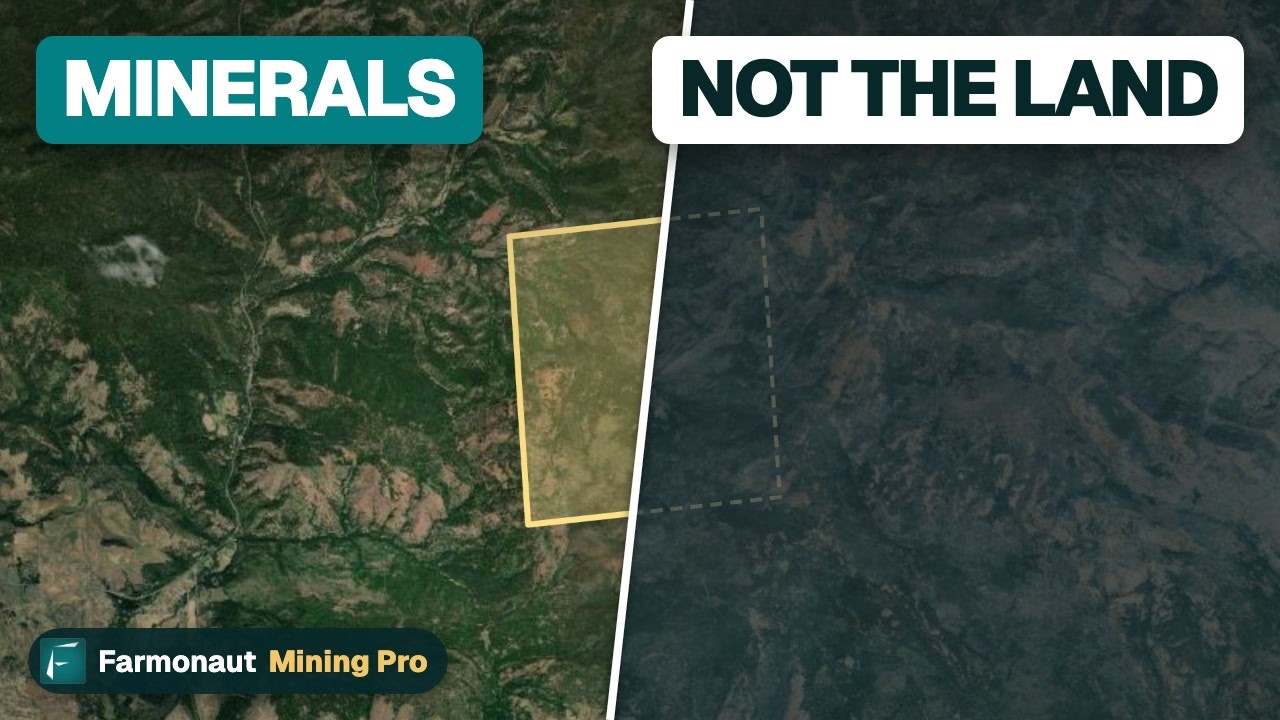
▶ Farmonaut explainer: owning a gold claim is not owning the land, and how to check the ground first. · 3:19
Gold claims in New Mexico: history, land and rules
New Mexico has one of the longest gold-mining histories in the United States. The New Mexico Bureau of Geology and Mineral Resources records placer mining along the northern Rio Grande in the 1600s, and notes that the 1828 discovery of large placers in the Ortiz Mountains of Santa Fe County (the Old Placers district) began one of the earliest gold rushes in the western US. It estimates that about 662,000 ounces of placer gold were produced statewide from 1828 to 1991.
“New Mexico produced an estimated 662,000 ounces of placer gold between 1828 and 1991.”
- 📊 Top placer districts: the Bureau lists Elizabethtown-Baldy, Hillsboro, Old Placers and New Placers as the four districts that each produced more than 100,000 ounces of placer gold.
- 📊 Most known placers were found early: the Bureau notes that most New Mexico placers had been discovered by 1900, and most known economic placers have been worked.
- ⚠ Implication for buyers: a claim in a famous district is not automatically rich. Historic miners took the easiest gold first.
The Bureau also notes that published historic reserves exist for only two districts, both estimated in 1936: Jicarilla, with about 230,000 ounces in place in 5.4 million cubic yards of gravel, and Pittsburg, with about 20,000 ounces in 2 million cubic yards. Set against the statewide output, that is a thin record of documented gold still in the ground.
Staking and buying gold claims in New Mexico for sale
New Mexico is also one of the BLM’s 19 claim states, and the BLM New Mexico State Office in Santa Fe is the federal filing office. The state’s Energy, Minerals and Natural Resources Department notes that the BLM administers subsurface minerals on federal public lands, and that New Mexico Statutes Chapter 69, Article 3 governs location, boundary posts, posting of notices and recording fees. Before locating or buying, confirm the land is open to filing through the BLM’s records.
State trust land in New Mexico is handled differently. The New Mexico State Land Office’s Minerals Program leases state trust land for minerals, including hard-rock minerals such as gold, silver and copper. Its hard-rock lease applications call for a mine operation plan and an environmental questionnaire, among other documents. A listing on state trust land is therefore a lease interest, and the State Land Office’s rules decide whether and how it can be transferred.
For gold claims in New Mexico for sale, start with the New Mexico Bureau of Geology’s placer and lode gold publications. They name the historic districts and describe where gold occurs, which lets you judge whether a listing sits in a known district, on its edge, or somewhere with no documented gold at all.
A due-diligence checklist for AZ gold claims
These checks work for Arizona and New Mexico claims alike. The first five cost nothing but time, and they rule out most weak listings before you spend money on a site visit.
Chart
Yearly BLM cash cost: paying versus the small miner waiver
US dollars per year by number of claims (waiver needs 10 or fewer claims nationwide)
- Get every BLM serial number and confirm each claim is active in MLRS, in the right place on the map, and of the right type.
- Confirm the most recent federal maintenance: fee paid by 1 September, or waiver filed with an affidavit of assessment work to follow by 30 December.
- Pull the county records: the recorded location notice and map, every deed back to the locator, and any liens or royalties.
- Check the state-law timing: in Arizona, county recording with a compliant map and boundary monuments within 90 days of location.
- Check land status on the master title plat for withdrawals, patented land and state trust land.
- Visit the claim and find the location monument and corners.
- Ask for real data: sample locations, lab names and assays, not just pan photos.
- Check surface-use obligations: any open notice, plan of operations, bond or reclamation liability.
- Check access and water, especially for placer ground that needs water to process.
- Get an independent geology read before agreeing a price.
Pricing AZ gold claims
There is no official price list or public record of completed claim sales, so asking prices range widely for ground that looks similar on a map. The fair way to compare them is to ask what you are actually paying for. If comparable open ground nearby could be located for the BLM’s filing fees, the seller’s premium has to be justified by something you can’t easily get yourself: a documented discovery, sampling and assay data, clean title, access, water, or permits already in place. Holding costs work very differently abroad, which matters if you are comparing Arizona with other markets: British Columbia claims carry work or payment obligations per hectare, and WA tenements carry rent plus a minimum spend.
- Evidence first: assays with lab names and sample locations carry more weight than nugget photos or district history.
- Holding cost: multiply the claim count by the yearly BLM fee and add county filings; that is your minimum annual outlay.
- Permits: an approved notice or plan of operations has value, but so do the reclamation obligations attached to it.
- Gold price: a higher spot price makes every listing sound better, but it doesn’t change what’s in the ground.
Negotiating and closing
Make any offer conditional on your checks. A short option or inspection period lets you run the MLRS, county and field checks and commission a geology review before the full price is paid. At closing, take a recordable deed (usually a quitclaim deed) that lists every claim name and BLM serial number, record it with the Arizona county recorder, and file the transfer with the BLM so fee notices reach you. Then diary 1 September for the next maintenance payment.
If a seller resists conditions, or can’t produce the recorded location notices and maps that Arizona law requires, treat that as information. Genuine claims with clean paperwork are easy to verify, and serious sellers usually expect buyers to check.
Gold mines for sale in Arizona: extra checks when there are workings
A listing with a shaft, adit or mill adds safety and permit duties on top of the claim checks. Under ARS 27-303, the operator or owner must give the Arizona State Mine Inspector written notice before mining begins, and must notify the inspector in writing before a suspension of more than six months or a permanent end to operations, with shafts, portals and adits secured against unauthorized entry. Ask the seller for the notice on file, any inspection letters and any reclamation plan, and ask what state the openings are in. Any work beyond casual use on a BLM claim also needs a notice or plan of operations, as described above.
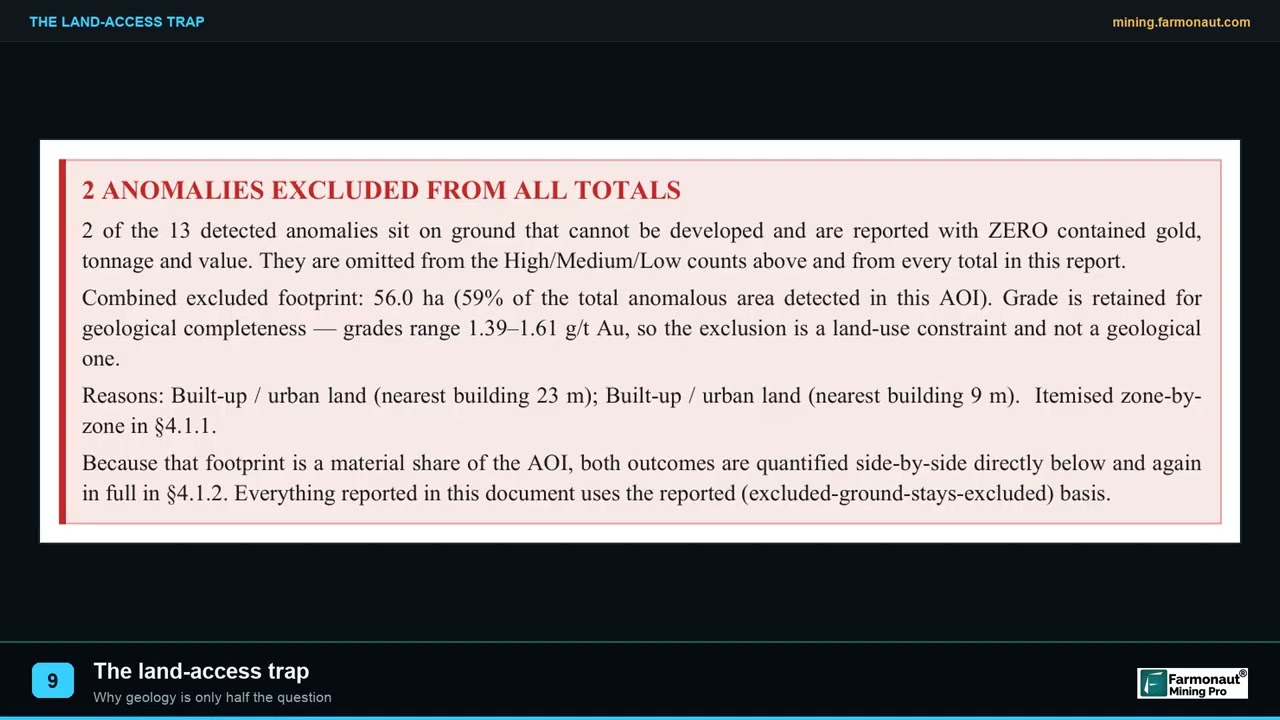
▶ Farmonaut explainer: why good rock can still be unmineable when land access is blocked. · 2:05
Satellite geology checks for Arizona and New Mexico claims
Satellite analysis works best where rock and alteration are exposed at the surface rather than hidden under dense vegetation, which is often the case on desert ground. Our satellite-based mineral detection uses multispectral and hyperspectral imagery, where each mineral and alteration zone reflects light with its own spectral signature. Our algorithms turn that into mapped target zones, alteration halos and structures such as faults and fractures across the claim and its surroundings.
- ✔ Screen several claims at once and send field time to the strongest.
- ✔ See the context: is the claim on the alteration trend, on its edge, or off it?
- 📊 Deliverables: prospectivity heatmaps, ranked high-potential zones with estimated location and depth ranges, geological interpretation, and PDF plus georeferenced GIS files. Premium+ adds TargetMax™ drilling intelligence and 3D subsurface models.
- 📊 Speed and cost: 5-20 business days, with up to 80–85% lower early-exploration cost than starting on the ground.
- ⚠ Limitation: satellite targets are exploration targets, not a resource estimate. Sampling confirms them.
Placer ground has a limit worth knowing. Imagery reads the surface: exposed rock, alteration and the drainage pattern that feeds a placer. The gold itself sits in the gravel, and the New Mexico Bureau of Geology notes that higher values occur near the base of alluvial gravels. Most of the state’s placer deposits are thin, less than 45 feet deep, but some run far deeper.
Desert ground recovers slowly from disturbance. Remote screening involves no vehicles, trenches or sample pits, so you can rule out weak claims without leaving a mark, and plan any field work around the most promising ground.
See a sample deliverable in the satellite-driven 3D mineral prospectivity mapping overview. We have scanned 100,000+ hectares for 20+ mineral types across 25+ countries.
Frequently asked questions
Are AZ gold claims for sale a good way to own gold?
Only if the claim is valid and there’s real evidence of gold. A claim is a right to develop minerals on federal land, not a store of gold, and it carries yearly BLM fees and permitting duties. Check title, state and federal filings, and geology first. This is general information, not investment advice.
What makes an Arizona mining claim valid under state law?
Under ARS 27-202 and 27-203, the locator must post a location notice on a monument of stones at least three feet high or a post projecting four feet, then within 90 days record the notice with a compliant map at the county recorder and monument the boundaries. Missing these steps is treated as abandonment. Federal filing with the BLM is also required.
How much does it cost to hold AZ gold mining claims for sale after buying?
As listed on the BLM fee page in September 2026, the BLM charges $200 per lode claim and $200 per 20 acres (or part) of a placer claim each year, due by 1 September, plus $15 per claim to file a transfer. County recording fees and any operating permits are extra. Check the BLM fee page before paying.
Can I buy Lynx Creek mining claims?
Lynx Creek includes a Forest Service mineral withdrawal area managed for recreational panning, where new claims can’t be located. Any claim offered nearby needs careful checking against the withdrawal boundary and its location date. Confirm with the BLM Arizona State Office and the Prescott National Forest.
Where are gold claims in New Mexico?
The New Mexico Bureau of Geology lists Elizabethtown-Baldy, Hillsboro, Old Placers and New Placers as the four placer districts that each produced over 100,000 ounces. Claims can be located on open federal land through the BLM New Mexico State Office; state trust land is leased by the State Land Office instead.
Does Farmonaut sell AZ gold claims?
No. We aren’t a marketplace, broker, lawyer or investment adviser, and we don’t list or sell claims. We provide independent satellite mineral intelligence to help buyers judge a claim’s geological potential as part of their due diligence.
Information in this guide comes from Arizona Revised Statutes §§ 27-202, 27-203 and 27-251, the Arizona Geological Survey, the Arizona State Land Department, the USGS, the Prescott National Forest, the New Mexico Bureau of Geology and Mineral Resources, the New Mexico Energy, Minerals and Natural Resources Department, the New Mexico State Land Office, and the Bureau of Land Management’s mining claim and fee pages. Laws, fees and land status change; confirm them with the BLM state office, the county recorder and the relevant state agency before you buy or pay. Farmonaut does not sell or broker claims. Satellite results are exploration targets, not mineral resources. Nothing here is legal or investment advice.
Are there Arizona placer claims for sale, and how big are they?
Yes, listings for Arizona placer claims for sale exist, but check each one for land status first. An individual placer claim is limited to 20 acres, an association placer to 160 acres (BLM, Mining Claims), and the BLM charges US$200 a year for every 20 acres or part (BLM fee page). New claims cannot be located inside a mineral withdrawal such as the Lynx Creek recreation area.
Do gold mines for sale in Arizona need anything extra?
A mine with workings has safety duties. ARS 27-303 requires written notice to the Arizona State Mine Inspector before mining begins and before a suspension of more than six months or a permanent end to operations, with openings secured. Ask the seller for the notice, inspection letters and any reclamation plan.
Are gold claims in New Mexico for sale on the same terms?
The federal side is the same: the BLM New Mexico State Office takes the filing, and the same US$200 yearly fee and US$15 transfer fee apply (BLM fee page). The state side differs, because New Mexico Statutes Chapter 69, Article 3 governs location and recording, and state trust land is leased by the New Mexico State Land Office, not claimed.
Are patented claims in Arizona different?
Yes. A patented claim is private land held by title and taxed by the county, so it needs a title search, not BLM maintenance fees. An unpatented claim is only a right to the minerals.
This page is for information only. It is not legal advice or investment advice. Confirm the rules with the BLM state office, the county recorder and the relevant state agency before you buy or pay. Ask permission before you prospect on any ground, follow safety rules, and never use mercury.
Farmonaut mining
Check the ground before you pay
Request a quote to screen a claim block with satellite data and get ranked exploration targets, ahead of a resource estimate.

Mining Pro sample view, synthetic data
Keep reading
Sources
- BLM, Mining Claim Fees: blm.gov
- BLM, Mining Claims: blm.gov
- BLM, Mineral & Land Records System (MLRS): blm.gov
- Arizona Revised Statutes 27-202 (location of lode claims): azleg.gov
- Arizona Revised Statutes 27-203 (recording and monuments): azleg.gov
- Arizona Revised Statutes 27-251 (state exploration permits): azleg.gov
- Arizona Revised Statutes 27-303 (notice to the State Mine Inspector): azleg.gov
- Arizona Geological Survey, Mineral rights: azgs.arizona.edu
- USGS, Bulletin 620: Gold deposits near Quartzsite, Arizona: pubs.usgs.gov
- Prescott National Forest, Lynx Creek Gold Pan Day Use Area: fs.usda.gov
- New Mexico Bureau of Geology, Placer gold: geoinfo.nmt.edu
- New Mexico EMNRD, Mineral rights, claims and geology FAQ: emnrd.nm.gov
- New Mexico State Land Office, Minerals lease information: nmstatelands.org
- 30 U.S. Code 28 (annual labor, waiver claims): law.cornell.edu
Discussion
Questions, corrections or field experience? Share them below. First-time comments are reviewed before they appear, and your email is never published.
No comments yet. Be the first to add a question or your experience.

 Klusetic Mining Investments
 Mine4Africa
 Lithspo Minerals Limited
 Tintina Mining Group
 Dalgety Minerals Pty Ltd
 Vortex Minerals Pty Ltd
 Faith At Work (Pty) Ltd
 Geotech Mining Solutions plc
 Vulcan International Limited
 Kidepo Associates
 GKY Mining
 Alkimy SARL
 Double A Trading
 GemSprout Metals Limited
 Qader Group
 Ileys General Trading
 SG Gold Mining LLC
 VRV Global Pte Ltd
 Omsri International FZE
 G.I.T.T.
 Jaunita Erss Ltd
 Almosi SARL
 SRK Consulting
 Berks Gold Limited
 Mwerezi Minerals Company Limited











