

Baffin Island iron ore · Status and data guide
Baffin Island Iron Mine: Output, Debt and Steensby Rail
Baffin Island’s iron mine, Mary River, is approved for 4.2 million tonnes a year and has been under court creditor protection since 15 May 2026. This guide gives shipments by season, grade, debt and the 22 Mt Steensby rail plan, with a calculator.
Key takeaways
- Mary River is approved to move 4.2 million tonnes (Mt) of ore a year through Milne Inlet; a temporary 6 Mt limit ran from 2018 to 2024 (Baffinland, 2024 summary; CBC, 2023).
- Shipments ranged from 4.0 Mt (2017) to 6.1 Mt (2023); about 51.1 Mt had been shipped by the end of 2025 (Baffinland NIRB reports; Yellowknifer, January 2026).
- Baffinland entered CCAA creditor protection on 15 May 2026 with about US$777 million of secured debt at filing (plus a DIP loan of up to US$400 million, about US$230 million drawn by 21 September); the court stay runs to 11 December 2026 (Insolvency Insider; FTI Consulting).
- Steensby rail and port would lift output to 22 Mt a year in about four years, but needs financing; reported costs run from at least US$4 billion (court record) to US$5.7 billion (2024) (Baffinland, 29 January 2026; CBC, 2024).
- Deposit 1 grades about 66% Fe, and 2018 shipments graded 66.8 to 67.7% Fe; a benchmark iron ore price was 90.57 US dollars per tonne on 15 October 2026 (Trading Economics).
In this article
- Is the Baffin Island iron mine still operating
- Mary River at a glance
- How much ore the mine ships each year
- Why expansion stalled and what the Steensby plan is
- How ore gets from the pit to a ship
- Geology and grade of the Mary River deposits
- Iron ore price and what the cap means for money
- Why debt, not ore, drove the court filing
- Jobs, Inuit agreements and community concerns
- Fording River in British Columbia: a coal mine, not an iron mine
- How satellites help on Arctic iron projects
- Frequently asked questions
The mine people mean by the Baffin Island iron mine is Mary River, an open-pit operation in Nunavut run by Baffinland Iron Mines. It is approved to move 4.2 million tonnes of ore a year to Milne Inlet, and on 15 May 2026 the company went into court creditor protection while a sale and investment process is argued over (Baffinland, 15 May 2026). The ore itself is not the problem. The company says it holds about one billion tonnes of high-grade direct shipping ore, and a rail and port plan that would lift output to 22 million tonnes a year (Baffinland, 29 January 2026).
This page sets out what is verified about the mine as of 16 October 2026: its legal and operating status, shipments by season, the geology and grade, how ore gets to a ship, the debt that led to the court filing, and the community questions around the rail plan. A short section covers Fording River, a coal mine in British Columbia that is often confused with Mary River. Every figure carries its source and date. A calculator lets you test what tonnes, price and costs mean for one shipping season.
Is the Baffin Island iron mine still operating
Yes. Baffinland filed under Canada’s Companies’ Creditors Arrangement Act (CCAA) on 15 May 2026, and said it expected no disruption at the mine or at Milne Port and that the 2026 shipping season would start as planned (Baffinland, 15 May 2026). A CCAA filing is a court-supervised pause on creditor action. It is not a closure order, and the court appointed FTI Consulting as Monitor to oversee the company. The EDC affidavit of 21 September 2026 says the court process was sought so Baffinland could meet its operating needs through the short 2026 shipping season.
The key dated steps so far:
- 15 May 2026: initial order granted by the Ontario Superior Court of Justice. The stay was extended to Baffinland Iron Mines LP, the partnership that owns the assets and employs the workforce (Insolvency Insider, 18 May 2026).
- 30 June 2026: debtor-in-possession (DIP) financing from Export Development Canada (EDC), Canada’s export credit agency, confirmed by the company (Baffinland news releases). An EDC director stated in a sworn affidavit of 21 September 2026 that the facility is up to US$400 million, rising to US$475 million in certain cases, with about US$230 million advanced (EDC affidavit, 21 September 2026).
- 27 August 2026: the court extended the stay period to 11 December 2026 (FTI Consulting, Monitor’s site).
- 9 October 2026: hearing scheduled for 9 October 2026 on the motion to approve a sale and investment solicitation process. The Monitor recommended the secured lenders’ version, and EDC and the senior lenders argued that the Chief Restructuring Officer (appointed 29 July 2026) should decide it, while the company proposed that its shareholder-appointed operating committee decide (EDC compendium, 8 October 2026).
The sale process can include a recapitalisation or a sale of the company, according to Baffinland’s own release. No sale of the mine has been announced. The hearing on the sale process was scheduled for 9 October 2026. For national context, see our note on mineral exploration spending in Canada.
Mary River at a glance
| Item | What the sources show |
|---|---|
| Operator | Baffinland Iron Mines Corporation, head office in Oakville, Ontario |
| Owners | Funds managed by The Energy & Minerals Group and a subsidiary of ArcelorMittal (Baffinland, May 2026) |
| Location | Qikiqtani Region, northern Baffin Island, Nunavut; ore is trucked about 100 km along the Tote Road to Milne Inlet |
| History | Mining began in 2014 and the first ore was shipped to Europe in 2015 (Baffinland, 2024 NIRB summary) |
| Products | Lump ore and fines (direct shipping ore), crushed and screened on site, with no tailings (Baffinland, May 2026) |
| Approved throughput | 4.2 million tonnes a year by Tote Road and Milne Inlet (Project Certificate No. 005, as amended 17 November 2023) |
| Workforce | About 1,200 people, including about 300 Inuit employees; 1,088 are based at the mine (court filing, May 2026) |
| Legal status | CCAA creditor protection since 15 May 2026; stay to 11 December 2026 |
How much ore the mine ships each year
Annual shipments have ranged between about 4.0 and 6.1 million tonnes (Mt) since 2017. A company spokesperson said that by the end of 2025 Baffinland had hauled 53.4 Mt of ore and shipped 51.1 Mt since mining began (Yellowknifer, 29 January 2026). The yearly figures below come from the company’s own annual reports to the Nunavut Impact Review Board (NIRB), the regulator that sets the project’s conditions.
Chart
Ore shipped from Milne Port, by season
Million tonnes shipped to international markets; 2024 is approximate
The ceiling is a permit, not geology. The base limit is 4.2 Mt a year. A temporary increase to 6 Mt ran from 2018 to the end of 2024, and the federal minister approved it again in November 2023 (CBC News, 20 November 2023). In October 2024 Baffinland said it would drop back to 4.2 Mt from 2025 and cut about 10% of its workforce, blaming weak iron ore prices and a shift of resources to the Steensby rail plan (CBC News, 19 October 2024). No full-year shipped total for 2025 is in the company documents cited here.
For scale, the USGS estimates Canada mined 69 Mt of usable iron ore in 2025 out of about 2,600 Mt worldwide (USGS, Mineral Commodity Summaries 2026). The 4.2 Mt permit equals roughly 6% of Canada’s output, and Canada is about 2.7% of the world total.
Why expansion stalled and what the Steensby plan is
Baffinland wanted to raise capacity to 12 Mt a year with a 110 km railway to Milne Inlet. The Nunavut Impact Review Board recommended refusal in May 2022 and the federal Minister of Northern Affairs rejected the proposal on 16 November 2022, after the company had spent more than US$1.06 billion between 2017 and 2022 in anticipation (Insolvency Insider, 18 May 2026). The company then returned to Steensby, a southern route first approved in 2012.
Chart
Annual ore capacity: approved, rejected and planned
Million tonnes a year
The Steensby plan is a 149 km railway from the mine south to a new deepwater port at Steensby Inlet (CBC News, 29 January 2026). On 29 January 2026 Baffinland said all key authorisations were in hand and that production could rise from about 4.2 Mt to 22 Mt a year in roughly four years, with substantial completion about three years after construction starts. Construction depended on debt and equity financing. The company expects 800 to 1,200 additional operating jobs at 22 Mt, and a spokesperson put peak construction employment at about 2,250.
The cost is not settled. CBC reported a US$5.7 billion figure in October 2024, and the 2026 court record, as reported by Insolvency Insider, puts it at no less than US$4 billion, with no committed capital. Because the Steensby project needs money the company did not have when it filed, its timeline now depends on the outcome of the sale process.
How ore gets from the pit to a ship
Mary River is a short-process mine. Ore is mined from Deposit No. 1, crushed and screened on site, then trucked about 100 km north along the Tote Road to Milne Port, where it is stockpiled all year until ships can enter (Baffinland, 2024 NIRB summary). There is no concentration plant, which is why the company reports no tailings. Drilling and blasting still use a large fleet, and drill automation is a general trend we cover in automated drilling systems.
Infographic
From pit to ship in 5 steps
- 1Mine and crushOre is mined from Deposit No. 1, then crushed and screened on site; there is no concentration plant.
- 2Truck to the coastHaul trucks carry ore about 100 km north along the Tote Road to Milne Port.
- 3Stockpile all yearOre is stored at Milne Port because ships can only enter in the open-water season.
- 4Ship in the ice-free windowCarriers load from about mid-July to mid-October once ice falls to 3/10ths.
- 5Deliver to steelmakersLump and fines go directly to markets in Europe and Asia.
Shipping is limited by sea ice. In 2024 the season began on 27 July, once ice concentration fell to 3/10ths, and lasted 92 days, with about 6 Mt moved on 70 ore carriers. Baffinland also used a dedicated shipping lane, no-go zones and speed limits under its narwhal management plan (same source). The court filing sets the usual window at mid-July to mid-October, although some seasons ran later (the 2023 season ended on 31 October), and fuel and supplies arrive by sea in the same window; the company put its near-term fuel and supply bill at about US$100 million in May 2026. Our guide to Arctic mining consultants covers the logistics side of northern projects.
Geology and grade of the Mary River deposits
The deposits sit in the Neoarchean Mary River Group, in banded iron formation of the Algoma type (a volcanic-linked iron formation), folded into several fold belts in the northwestern Rae Domain of the Churchill Province. High-grade ore concentrates where the iron formation was thickened at fold closures (Yellowknife Geoscience Forum abstract). Hematite and magnetite are the main iron oxides, and the ore is hard, which gives a high share of lump product.
Chart
Reported iron resources by deposit and class
Million tonnes; grades 66.3% Fe (Deposit 1 measured and indicated), 66.9% (Deposit 1 inferred), 65% and 65.9% (Deposits 2 and 3)
The same abstract, written in 2019, reports Deposit 1 at 418 Mt grading 66.3% Fe measured and indicated, plus 213 Mt at 66.9% Fe inferred, and Deposits 2 and 3 at 23 Mt and 336 Mt. Added together these come to about 990 Mt, which fits Baffinland’s 2026 statement of about one billion tonnes identified. Grade here means the iron content of the ore (Fe). Measured, indicated and inferred are confidence classes, with inferred the least certain.
In 2018 the shipped lump product (DSP) graded 67.7% Fe and the fines (SSF) graded 66.8% Fe (same abstract). The court filing says the average iron content mined historically exceeded 67%. Baffinland describes its ore as the highest-grade direct shipping iron ore in the world; treat that as a company claim.
Iron ore price and what the cap means for money
Iron ore traded at 90.57 US dollars per tonne on 15 October 2026, down 14.2% from a year earlier, according to a Trading Economics contract-for-difference series that tracks the benchmark market (Trading Economics, 15 October 2026). For context on the slide in prices, US mines reported an average of US$156.42 per tonne in 2022 and an estimated US$89 in 2025, though that is US pellet and concentrate pricing, a different product from Mary River’s direct shipping ore (USGS, 2026).
The cap on volume matters because the mine has large fixed costs. Baffinland’s court filing says it pays about US$2.5 million a month in interest on its bank and EDC facilities and US$25 million twice a year to holders of its 2026 notes, and that revenue at the 4.2 Mt limit did not cover operating costs and debt service. The calculator below uses your own numbers to show how tonnes, price, premium and fixed bills interact.
Calculator
What does one shipping season earn?
Enter your own tonnes, price, premium, cost and fixed bill.
- Season revenue: 420.0 US$ m
- Margin per tonne: 20.0 US$/t
- Season result after the fixed bill: -16.0 US$ m
- Result at 22 Mt a year (company target): 340.0 US$ m
Examples only, not Baffinland’s figures. Price is an input: example, use today’s price (Trading Economics showed US$90.57 per tonne on 15 October 2026). Premium and cost are placeholders for your own view. 22 Mt is the target Baffinland stated on 29 January 2026.
Why debt, not ore, drove the court filing
For the year ended 31 December 2025 Baffinland reported a consolidated net loss of US$102.4 million, with current liabilities exceeding current assets by US$761 million (Insolvency Insider, 18 May 2026). The court factum lists four converging causes: capital spent on the rejected Milne railway, high interest costs, high operating costs and the 4.2 Mt transport limit (Initial Factum of the Applicants).
Chart
Main debt instruments at the May 2026 filing
Principal in millions of US dollars as stated in the court record at 15 May 2026; excludes the later DIP loan
The secured debt was about US$777 million at filing (all dollar figures in the court record are US dollars). Since then the EDC debtor-in-possession facility has added about US$230 million of new borrowing, as of 21 September 2026. The largest piece was US$575 million of 8.75% senior secured notes that fell due on 15 July 2026 and were in default at filing, followed by a US$126.5 million facility held by entities linked to Oaktree and Hartree and a US$75 million EDC term loan. The companies were in default under the Oaktree and Hartree facility, which triggered cross-defaults on the EDC loan and the 2026 notes. Separately, about US$87 million of trade payables were past due, including roughly US$30 million for fuel supplied in the 2025 season.
Jobs, Inuit agreements and community concerns
Baffinland is Nunavut’s largest private employer, with about 1,200 staff, 1,088 of them based at the mine (about 830 hourly union members, with the rest flown in and out on a 21-day-on, 21-day-off rotation) and 112 at the Oakville head office (court factum, May 2026). It operates under an Inuit Impact and Benefit Agreement with the Qikiqtani Inuit Association (QIA), and said it will keep honouring that agreement during the court process. The federal and Nunavut governments and the QIA backed the Steensby component in January 2026.
Not everyone agrees. In 2021 hunters blockaded the mine to protest the earlier expansion plan. A University of Manitoba professor advising hunters’ organisations told CBC that caribou numbers on Baffin Island have grown and that train crossings could raise conflicts with wildlife (CBC News, 29 January 2026). On 6 February 2026 the Arviq hunters and trappers organization in Naujaat asked federal and territorial bodies to reconsider the project, saying it was never consulted and fearing effects on caribou migration and narwhals; Baffinland replied that the organization did not take part in the NIRB review and that its concerns are being addressed (CBC News, 28 April 2026). Other northern projects face the same permitting questions, as in our overview of the gold mines of Nunavut.

▶ A plain-language claymation on the seven environmental impacts of mining. · 2:31
Fording River in British Columbia: a coal mine, not an iron mine
Searches for Mary River often bring up Fording River, so the difference is worth stating. Fording River Operations is a steelmaking (metallurgical) coal mine in the East Kootenay region of southeastern British Columbia, one of the four steelmaking coal mines run by Elk Valley Resources (EVR) in the Elk Valley, which Glencore reports produced 25.2 million tonnes of steelmaking coal in 2025 (Glencore, EVR). Both mines feed the steel supply chain, but coal is the reducing fuel for the blast furnace while iron ore is the metal source.
EVR says the Fording River Extension would add about 35 years of life and sustain roughly 1,500 current employees at the site (Glencore, Fording River Extension). The Impact Assessment Agency of Canada posted its notice of commencement of an impact assessment on 9 March 2026 (IAAC, project 80702). The two mines have different owners, products and regulators.
How satellites help on Arctic iron projects
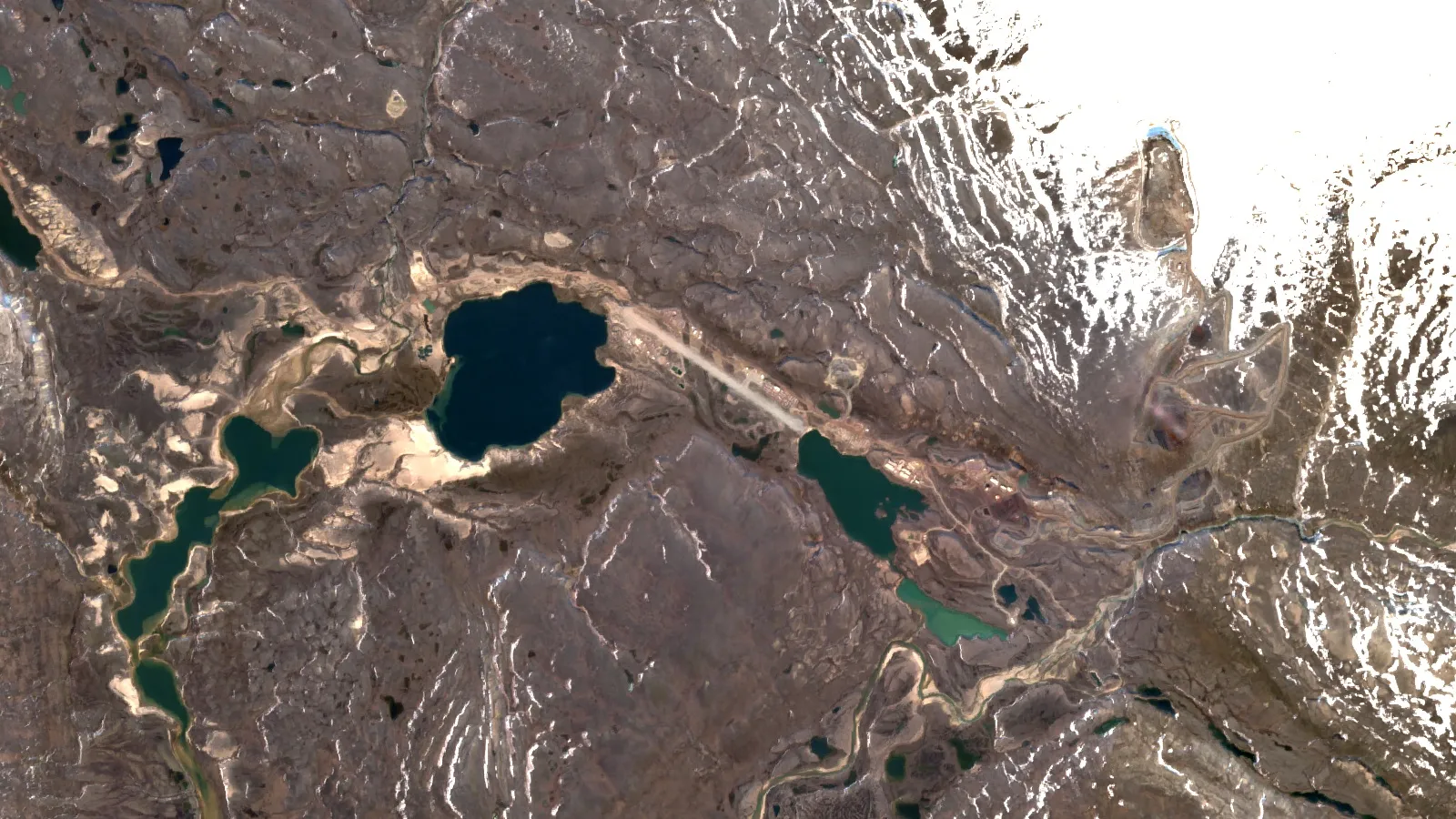
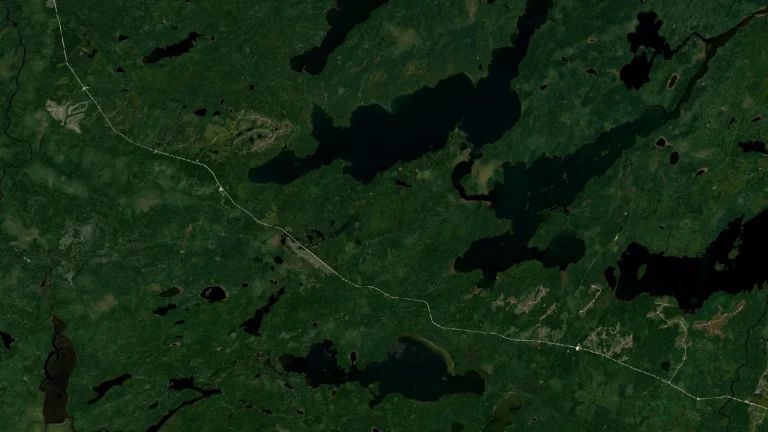
Satellites do two jobs at sites like this. One is operational: ice concentration decides when ore carriers can enter, since Baffinland’s season start is tied to ice falling to 3/10ths, and satellite imagery is the usual way to watch ice over large sea areas. The other is exploration: iron oxides such as hematite and goethite have distinct reflectance in the visible and near-infrared range, and Sentinel-2 measures 13 spectral bands at 10 to 60 m resolution (Copernicus SentiWiki, Sentinel-2 mission). Snow and ice cover limit usable optical scenes to the Arctic summer, which is why the hero image on this page is a summer composite.
Farmonaut screens a customer’s own licence polygon with multispectral and hyperspectral satellite data and returns a mineral report in 5 to 20 business days; iron is among the minerals it covers. These are exploration targets that sit ahead of any resource estimate, and nothing on this page describes a Farmonaut project at Mary River. You can read about the method on our satellite-based mineral detection page, request a quote, or contact the team.
▶ Remote sensing for mining in three minutes: what the instruments measure and why agreement between them matters. · 2:01
We cover a connected topic in Bunker Hill Mining Stock: Ticker, Debt and Restart.
Frequently asked questions
Where is the Baffin Island iron mine?
Mary River is in the Qikiqtani Region of northern Baffin Island, Nunavut, Canada. Ore leaves from Milne Port on Milne Inlet, about 100 km north of the mine by the Tote Road (Baffinland, 2024 NIRB summary). The nearest community is Pond Inlet.
Who owns the Mary River iron mine?
Baffinland is owned by funds managed by The Energy & Minerals Group and by a subsidiary of ArcelorMittal (Baffinland, 15 May 2026). It operates under creditor protection since that date.
How much iron ore does Mary River produce a year?
The permitted limit is 4.2 million tonnes a year. Shipments were 6.1 Mt in 2023 and about 6 Mt in 2024 under a temporary 6 Mt permit (Baffinland NIRB reports). The company’s target after the Steensby rail and port is 22 Mt a year.
Is the Mary River mine closed or still open?
It is open. Baffinland said in May 2026 that it expected no disruption, and the court-supervised process continues with a stay running to 11 December 2026. Creditor protection pauses debt claims; it does not close a mine.
What grade is the ore at Mary River?
Deposit 1 was reported at 66.3% Fe measured and indicated, and shipped lump and fines graded 67.7% and 66.8% Fe in 2018 (Yellowknife Geoscience Forum abstract). A court filing says the historic mined average exceeded 67%.
What is the Steensby railway?
It is a planned 149 km railway from the mine south to a deepwater port at Steensby Inlet. Baffinland says it would lift output to 22 Mt a year and lengthen the shipping season, but it needs financing and has drawn objections from some hunters’ organizations.
How many people work at Mary River?
About 1,200 people, including about 1,088 at the mine and about 300 Inuit employees, according to the May 2026 court filing. The company estimates 800 to 1,200 more jobs at full Steensby capacity.
Why can the mine only ship ore in summer?
Sea ice blocks Milne Inlet for most of the year. Shipping runs from about mid-July to mid-October, and the 2024 season began on 27 July once ice dropped to 3/10ths. Ore is mined and stockpiled all year to be shipped in that window.
Is Mary River related to Fording River, Island Copper or Island Gold?
No. Fording River is a coal mine in British Columbia, and Island Copper and Island Gold are unrelated mines in other provinces. We compare names that get mixed up in our post on island copper and island gold mines.
Can satellite data find iron ore deposits?
Satellite data can flag iron-oxide staining and alteration that guide field work, but it cannot measure grade at depth. A drill programme is still needed before any resource estimate.
This page is for information only. It is not investment advice and gives no view on any debt or equity of Baffinland. Court and company details are dated; check the Monitor’s site and Baffinland’s releases for later orders.
Farmonaut mining
Map your mining site from space
Consultants can see how satellite data screens a licence area for iron and other mineral targets ahead of any resource estimate.

Mining Pro sample view, synthetic data
Keep reading
Sources
- Baffinland, Cleared to Begin Construction of the Steensby Component (29 January 2026): baffinland.com
- Baffinland, Commencement of Proceedings Under the CCAA (15 May 2026): baffinland.com
- Baffinland, news releases list including DIP financing with EDC (30 June 2026): baffinland.com
- Baffinland, 2024 Annual Report to the NIRB, popular summary: baffinland.com
- Baffinland, 2023 Annual Report to the NIRB: baffinland.com
- Baffinland, 2022 Annual Report to the NIRB: baffinland.com
- Baffinland, 2020 Annual Report to the NIRB: baffinland.com
- Baffinland, 2019 Annual Report to the NIRB: baffinland.com
- Baffinland, 2018 Annual Report to the NIRB: baffinland.com
- Baffinland, 2017 Annual Report to the NIRB: baffinland.com
- Initial Factum of the Applicants, Ontario Superior Court (Commercial List), via FTI Consulting (May 2026): cfcanada.fticonsulting.com
- Affidavit of Ashley Glen, Export Development Canada (21 September 2026): cfcanada.fticonsulting.com
- Compendium of Export Development Canada (8 October 2026): cfcanada.fticonsulting.com
- FTI Consulting, Monitor’s site for the Baffinland CCAA: cfcanada.fticonsulting.com
- Insolvency Insider, Baffinland enters CCAA (18 May 2026): insolvencyinsider.ca
- CBC News, Baffinland says it is cleared to break ground on Steensby (29 January 2026): cbc.ca
- CBC News, Baffinland can ship 6 million tonnes until 31 December 2024 (20 November 2023): cbc.ca
- CBC News, Baffinland cuts 10% of workforce (19 October 2024): cbc.ca
- CBC News, Naujaat hunters want to halt the Steensby project (28 April 2026): cbc.ca
- Yellowknifer, Baffinland to quintuple Mary River production (29 January 2026): yellowknifer.com
- Yellowknife Geoscience Forum, Baffinland’s Mary River High Grade Iron Deposits (abstract, 2019): nwtgeoscience.ca
- USGS, Mineral Commodity Summaries 2026: Iron Ore: pubs.usgs.gov
- Trading Economics, Iron Ore price (15 October 2026): tradingeconomics.com
- Glencore, Elk Valley Resources: what we do: glencore.ca
- Glencore, Fording River Extension Project: glencore.ca
- Impact Assessment Agency of Canada, Fording River Extension Project: iaac-aeic.gc.ca
- Copernicus SentiWiki, Sentinel-2 mission overview: sentiwiki.copernicus.eu
Discussion
Questions, corrections or field experience? Share them below. First-time comments are reviewed before they appear, and your email is never published.
No comments yet. Be the first to add a question or your experience.

 Congo Mining Solutions
 Mining SARL
 SenGold Invest SAS
 Sania Corporation
 Sean Mining Limited
 NTS Group (Pty) Ltd
 Mine4Africa
 Lithspo Minerals Limited
 Tintina Mining Group
 Dalgety Minerals Pty Ltd
 Vortex Minerals Pty Ltd
 Faith At Work (Pty) Ltd
 Geotech Mining Solutions plc
 Vulcan International Limited
 Kidepo Associates
 GKY Mining
 Alkimy SARL
 Double A Trading
 GemSprout Metals Limited
 Qader Group
 Ileys General Trading
 SG Gold Mining LLC
 VRV Global Pte Ltd











