

Diamonds · Ranked guide
Best Place to Find Diamonds: 7 Top Countries Ranked
Russia leads on diamond output value, with Botswana and Angola next (Kimberley Process, 2025). This page ranks seven countries, shows where the public can dig, explains the geology and gives a break-even grade calculator.
Key takeaways
- Russia mined diamonds worth US$2.72 billion in 2025, ahead of Botswana (US$1.98 billion) and Angola (US$1.81 billion) (Kimberley Process, 2025).
- Namibia had the highest price, US$343.88 a carat; the DRC mined 8.9 million carats but at only US$5.01 a carat (Kimberley Process, 2025).
- USGS lists world gem-quality reserves above 2 billion carats, with Russia at 750 million (USGS, 2026).
- Crater of Diamonds State Park in Arkansas lets visitors keep what they find; more than 37,377 diamonds had been found by 13 January 2026 (Arkansas State Parks).
- Most diamond pipes sit in old stable cratons, and mined kimberlites hold 0.1 to 0.6 parts per million diamond (USGS Bulletin 1693).
In this article
- Best place to find diamonds: 7 top countries ranked by output value
- Volume is not value: why Congo and Zimbabwe are not on the list
- Where the known reserves are
- Where the public can search for diamonds
- How geologists narrow down where diamonds are
- 7 ways to mine and recover diamonds
- What a diamond deposit must earn per tonne
- Before you dig: permission, safety and land access
- Frequently asked questions
By the value of rough diamonds mined, the best place to find diamonds is Russia, followed by Botswana and Angola. The Kimberley Process 2025 statistics show Russia at US$2.72 billion, Botswana at US$1.98 billion and Angola at US$1.81 billion. If you want to dig with your own hands, the answer is different: the Crater of Diamonds State Park in Arkansas lets visitors keep what they find. If you hold a licence and want to know where to look, the answer is a geological setting, not a country: an old, stable block of continent with kimberlite or lamproite pipes in it.
This page ranks seven countries on one stated measure, then covers the public sites, the geology, seven ways to mine and recover diamonds, and a break-even calculator for a deposit. A carat is the unit diamonds are sold in (0.2 gram). Grade is quoted here in carats per hundred tonnes (cpht), the unit most diamond miners report. Rough means uncut stones as they leave the mine.
Best place to find diamonds: 7 top countries ranked by output value
How we chose. The measure is the value of rough diamonds each country produced in 2025, from the Kimberley Process annual summary. That is the scheme set up to keep conflict diamonds out of trade; its official site says its participants cover 99.8% of global share. We list every country above US$200 million of production value in that table. Exactly seven qualify. Ranking by volume would put the Democratic Republic of Congo (DRC) and Zimbabwe ahead of Namibia and Lesotho, so the next section explains why we did not.
Chart
Rough diamond production value, seven top countries
US$ billion, 2025
| Rank | Country | Value (US$ billion) | Volume (million carats) | US$ per carat | Worth knowing |
|---|---|---|---|---|---|
| 1 | Russia | 2.72 | 31.5 | 86.46 | Largest by volume and value; US, EU and G7 sanctions bar imports of Russian gem diamonds (USGS) |
| 2 | Botswana | 1.98 | 15.5 | 127.66 | Debswana and Karowe operate here |
| 3 | Angola | 1.81 | 15.2 | 119.22 | Volume, value and price per carat all rose against 2024 |
| 4 | Canada | 0.89 | 14.1 | 63.28 | Diavik mine finished production in March 2026 |
| 5 | Namibia | 0.72 | 2.1 | 343.88 | Highest price per carat of the seven; offshore mining |
| 6 | South Africa | 0.60 | 5.6 | 107.43 | Old kimberlite pipes mined from underground |
| 7 | Lesotho | 0.23 | 0.7 | 330.90 | Small volume, very high price per carat |
Figures are from the Kimberley Process annual global summary for 2025, rounded. Value is the declared value of rough production, not the value of polished stones.
1. Russia
Best for: sheer scale. Russia mined 31.5 million carats in 2025, about a third of the world’s 98.8 million (Kimberley Process). USGS puts Russia’s gem-quality output at about 30% of the global total by volume and lists the largest reserves in the world, 750 million carats. Pros: the biggest known reserves and output. Cons: USGS notes that sanctions from the US, the European Union and the Group of Seven prohibit imports of Russian rough and finished gem diamonds, including stones processed in third countries, so the market for these stones is restricted.
2. Botswana
Best for: large output at a high price per carat. Botswana’s 15.5 million carats were worth US$127.66 a carat. Debswana, a major producer, runs four processing plants at Orapa, Letlhakane, Damtshaa and Jwaneng. Lucara’s Karowe mine recovered 31 stones above 100 carats in 2025, three of them above 1,000 carats, and sold 353,302 carats for US$159.7 million revenue (Lucara, year-end 2025 results). Pros: USGS reserves of 250 million carats, second to Russia. Cons: volume fell to 15.5 million carats in 2025 from 18.1 million in 2024 (Kimberley Process), in a weak market.
3. Angola
Best for: a producer that grew. Angola’s output rose from 14.0 to 15.2 million carats, its value from US$1.41 billion to US$1.81 billion and its price per carat from US$100.68 to US$119.22 between the 2024 and 2025 Kimberley Process summaries. Pros: USGS reserves of 150 million carats. Cons: the average price per carat is still below Botswana’s.
4. Canada
Best for: a cold-climate, well-documented exploration history. Canada mined 14.1 million carats worth US$63.28 a carat on average, the lowest price of the seven. Rio Tinto says its Diavik mine in the Northwest Territories announced its final production on 26 March 2026 after more than 150 million carats over 23 years, with closure work running to 2029. The Northwest Territories Geological Survey’s 2016 exploration overview shows how explorers there still relied on kimberlite indicator mineral sampling, ground magnetics and gravity. Pros: USGS reserves of 110 million carats. Cons: the loss of Diavik reduces the number of operating mines.
5. Namibia
Best for: value per stone. At US$343.88 a carat, Namibia’s 2.1 million carats were worth US$721 million, a price per carat more than five times Canada’s. Much of the output comes from the sea floor off the coast. Debmarine Namibia added two 370-tonne crawlers to the vessel Benguela Gem in 2025, expected to add about 80,000 carats a year (African Review, September 2025). Pros: the highest price per carat of the seven. Cons: marine mining needs vessels and specialist equipment, which is not an entry point for a small licence holder.
6. South Africa
Best for: deep, long-lived kimberlite pipes. South Africa mined 5.6 million carats at US$107.43 a carat. Petra Diamonds reported that its Cullinan mine produced 1,398,604 carats in the year to 30 June 2026 and sold at an average of US$106 a carat. The same update says a business rescue process was announced for the Finsch mine on 29 May 2026; operations were suspended on 10 June 2026 and Petra’s update to 30 June 2026 said the process was continuing. Pros: mature infrastructure; USGS reserves of 87 million carats. Cons: USGS says the market downturn has hit the lower end of the commercial segment hardest, and Finsch’s rescue shows the strain on mid-sized mines.
7. Lesotho
Best for: very high value per carat from a small tonnage. Lesotho produced 695,888 carats worth US$230 million, or US$330.90 a carat, second only to Namibia. The Letšeng mine is one operation there. Pros: price per carat. Cons: small volume, so a few mines drive the whole country’s figure.
Volume is not value: why Congo and Zimbabwe are not on the list
The DRC mined 8.9 million carats in 2025, more than South Africa, but the output was worth US$44.6 million, or US$5.01 a carat. Zimbabwe mined 4.2 million carats worth US$102 million, or US$24.33 a carat (both Kimberley Process). Most of that rough is low-value industrial or near-gem material. A place can have plenty of diamonds and little money in them, which is why the chart below puts price per carat on one axis and volume on the other.
Chart
Volume against price per carat, 2025
Selected producers: seven ranked countries plus the DRC and Zimbabwe
USGS reports gem-quality output separately from the Kimberley Process total, so the two sets of numbers differ. For 2025, USGS estimates 21 million carats for Russia, 13 million each for Angola, Botswana and Canada, 2.3 million for Namibia and 2.1 million for South Africa. Use the Kimberley Process for value and USGS for gem-quality volume and reserves.
Where the known reserves are
Reserves are the part of a deposit that can be mined at a profit with today’s methods. USGS reports gem-quality reserves for seven countries. Russia holds 750 million carats; the other six together hold 803 million (250, 150, 150, 110, 87 and 56 million). Reserves are not the same as discoveries: a country with no reserve figure may simply have had less published work. The USGS lists world gem-quality reserves as more than 2 billion carats.
Chart
Gem-quality diamond reserves by country
Million carats
Where the public can search for diamonds
Crater of Diamonds State Park, Arkansas. The park says it is the only place where the public can search for natural diamonds in their original volcanic source. Visitors search a 37-acre plowed field, and anything they find is theirs to keep. You can bring your own hand tools; ladders and battery-powered or motor-driven tools are not allowed, and the park rents equipment. The park reports that visitors have found more than 37,377 diamonds since it became a state park in 1972 (count as of 13 January 2026), which is about 690 a year on average (our calculation). White, brown and yellow diamonds are the colours found there. The largest, the 40.23-carat Uncle Sam, is described by the park as the largest diamond ever unearthed in the US. Check the park’s site for current fees: see the Arkansas State Parks page before you go. The diamond search area is open daily 8 a.m. to 4 p.m. (Arkansas State Parks). Best for: families and first-timers who want a lawful place to dig. Cons: finds are not guaranteed.
Herkimer, New York. The Herkimer Diamond Mines sell the chance to hammer open rock for “Herkimer diamonds”, which the operator describes as 500 million-year-old quartz crystals (Herkimer Diamond Mines). They are quartz, not diamond. They make a good day out but are not a place to find true diamonds.
On state or federal land elsewhere in the US, the rules vary, and the US produced no natural gem diamonds in 2025 (USGS). For one state’s answer, read our post on whether you can find diamonds in Arizona.
How geologists narrow down where diamonds are
The USGS descriptive model of diamond pipes, written by Dennis Cox, is still a clear summary. It gives these points:
- Host rock. Diamonds are found in kimberlite diatremes (pipe-shaped volcanic vents) and in lamproite, both rocks that bring material up from the mantle.
- Setting. Most pipes intrude cratons, which are continental blocks stable since the Early Proterozoic, and many sit on major basement fractures.
- Grade. Diamonds are sparse in the rock. The model gives 0.1 to 0.6 parts per million for mined kimberlites, and it states that productive pipes are rare and can only be identified by their diamond content.
- Indicator minerals. Anomalous nickel and niobium, and the heavy minerals pyrope garnet, phlogopite and magnesium ilmenite, point to nearby pipes. Lamproite pipes lack ilmenite.
- Surface clue. Pipes weather rapidly and form topographic depressions.
A second USGS model covers diamond placers, deposits of river and beach sediment. It says alluvial diamonds can lie as far as 1,000 km from their source, collect in the low-energy parts of streams with other heavy minerals, and get smaller but cleaner with distance. In practice the search follows this order: pick a craton, sample streams for indicator minerals, trace them upstream, run ground magnetic and gravity surveys over the target, then take a bulk sample. Public geoscience databases hold much of the early data; see our guide to Ontario and British Columbia public geoscience data for how to use them in Canada.
Satellites cannot see diamonds. They can map the terrain, round depressions, weathered rock and vegetation patterns around a candidate pipe. Farmonaut’s satellite-based mineral detection screens a licence area for exploration targets ahead of any resource estimate; the results are not a JORC or NI 43-101 resource. Ground sampling still decides whether a target holds diamonds.
▶ Explains in about two minutes what remote sensing means for mining and why several instruments agreeing matters. · 2:01
7 ways to mine and recover diamonds
The method follows the deposit. Each of the seven below suits a different setting.
| Method | Suits | Real example | Trade-off |
|---|---|---|---|
| 1. Open pit | Pipes near the surface | Karowe, Botswana, processes open pit ore and stockpiles | The pit gets deeper and costs rise with the waste moved |
| 2. Underground | Deep pipes | Karowe is building an underground extraction level; Diavik used open pit and underground | High capital cost before the first carat |
| 3. Alluvial gravel | River channels and terraces | USGS placer model | Water and sediment management |
| 4. Beach and coastal gravel | Old shorelines | USGS lists beach sediments as a placer type | Tides, sand and access |
| 5. Marine | Sea floor off the coast | Debmarine Namibia crawlers | Needs vessels and specialist machines |
| 6. Small-scale and artisanal | Shallow gravels | Alluvial diggings whose exports are certified under the Kimberley Process | Hard to measure and certify |
| 7. Tailings retreatment | Old dumps | Cullinan, South Africa | Only worth it if the dump holds recoverable stones |
Open pit and underground. Lucara’s year-end report says the Karowe open pit fed the plant at 12.2 carats per hundred tonnes in the fourth quarter of 2025, while the company built the extraction level, crushing chamber and fine ore bins for its underground mine. Rio Tinto’s Diavik was mined using a combination of open pit and underground methods. The pattern is common: open pits end at a depth where the waste ratio makes them uneconomic, and underground mining takes over if the pipe continues.
Alluvial and beach gravel. Because diamonds travel with other heavy minerals, alluvial miners sample gravel traps and bedrock cracks. The USGS placer model also notes that stones decrease in size with distance from the pipe, so the pit location matters. Small-scale and artisanal digging uses hand tools and sieves in similar gravels. Output is hard to track, which is why the Kimberley Process certificate scheme exists for exports.
Marine. Offshore, crawlers vacuum gravel from the sea floor and send it to a vessel for screening. Debmarine’s two new 370-tonne crawlers are the clearest recent example.
Recovery and tailings. Modern plants treat old tailings as well as fresh ore. Petra treated 778,455 tonnes of tailings at Cullinan in the year to 30 June 2026 and recovered 224,171 carats from tailings and other sources. X-ray transmission sorters, which find diamonds by their atomic signature rather than weight, were commissioned at Karowe in April 2015 to cut breakage of large stones (Crown Publications, 2017).
Diamond drilling, which uses a diamond-tipped bit to take core, is a different subject from drilling for diamonds; for contractors see our page on diamond drilling companies in Canada.
Mining disturbs land and water. The ICMM Integrated Mine Closure good practice guide asks operators to plan closure from the start of a project. Rio Tinto’s Diavik closure runs to 2029, followed by monitoring, which shows how long that work lasts.
▶ A claymation walk through seven environmental impacts of mining, with satellite maps. · 2:31
What a diamond deposit must earn per tonne
Diamond deposits have far lower grades than gold or copper deposits, and the price per carat varies nearly 70-fold between countries (US$5.01 in the DRC, US$343.88 in Namibia). Petra’s Cullinan mine illustrates a profitable pipe: it treated ore at about 30.8 carats per hundred tonnes in the year to 30 June 2026 and sold at an average US$106 a carat (Petra, Q4 FY2026 update). USGS says most diamond ore bodies hold from less than 1 carat to about 6 carats per tonne of ore. The break-even grade is simple: operating cost per tonne divided by the price per carat. The calculator below does this arithmetic with your inputs.
Calculator
What grade does a diamond deposit need to break even?
Enter your own tonnage, grade, price per carat and operating cost.
- Revenue (US$): $30,000,000
- Operating cost (US$): $25,000,000
- Operating margin (US$): $5,000,000
- Break-even grade (cpht): 25.0 cpht
Example values only, not any mine’s figures or a forecast. Price is an input: example, use today’s price (US$ per carat). Operating cost is US$ per tonne of ore treated and excludes capital, royalties and tax. Grade is carats per hundred tonnes (cpht).
Before you dig: permission, safety and land access
If you prospect for diamonds, ask the landowner or land manager for permission, hold any licence the regulator requires, follow site safety rules around pits and water, and never use mercury, which is not needed for diamonds and is dangerous. In most countries minerals belong to the state, and a claim or licence is needed before you remove material. Confirm the rules with the mining authority of the country or state.
Good rock can still be unmineable if the land is blocked. Check land use, protected areas and settlements before you spend on sampling. To discuss mapping a licence area, contact Farmonaut.
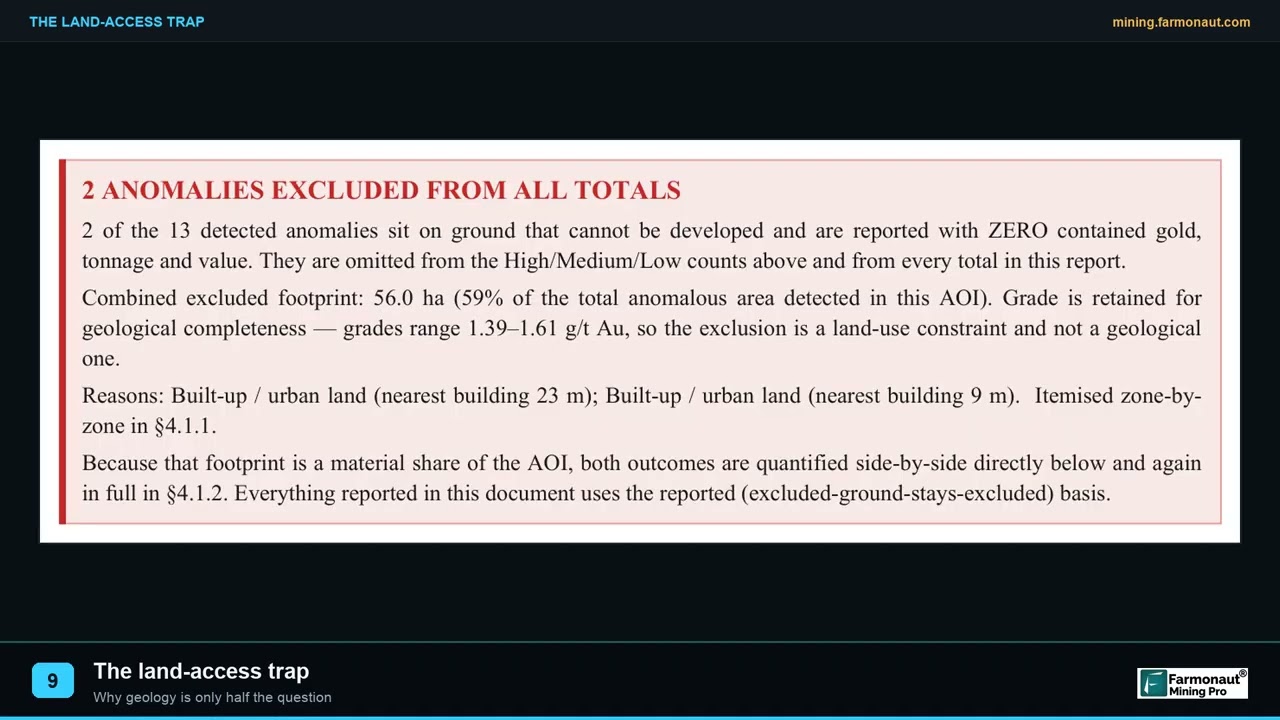
▶ Shows how land access can block good rock, using a survey where much of the anomalous ground lay under a town. · 2:05
Related reading on this site: Countries Buying Gold: Top Central Bank Buyers Ranked.
Frequently asked questions
What is the best place to find diamonds?
For commercial mining, Russia leads on output value (US$2.72 billion in 2025), followed by Botswana and Angola (Kimberley Process). For a person who wants to dig, Crater of Diamonds State Park in Arkansas lets visitors keep their finds.
Which country has the most diamonds?
By production, Russia mined 31.5 million carats in 2025 (Kimberley Process). By reserves, USGS lists Russia at 750 million carats of gem-quality stones, the largest figure.
Which country has the most valuable diamonds?
Namibia had the highest average price, US$343.88 a carat, followed by Lesotho at US$330.90 (Kimberley Process, 2025). Russia leads on total value.
Where can you dig for diamonds and keep what you find?
Crater of Diamonds State Park in Murfreesboro, Arkansas allows visitors to keep any diamond they find in its 37-acre search field, within park rules on tools.
Are Herkimer diamonds real diamonds?
No. The Herkimer Diamond Mines describe them as quartz crystals. They are collected at the mine but are not diamond.
What rock are diamonds found in?
Kimberlite and lamproite, volcanic rocks that carry diamonds up from the mantle. USGS says most pipes intrude old, stable cratons.
What are indicator minerals?
They are heavy minerals found alongside diamond pipes, such as pyrope garnet, phlogopite and magnesium ilmenite. USGS says they point to nearby pipes. Lamproites lack ilmenite.
Can you find diamonds in a river?
Yes, in some regions. Alluvial diamonds collect in low-energy parts of streams with other heavy minerals and can lie up to 1,000 km from the source (USGS). Check who owns the minerals and what permit you need first.
How much of the ore is diamond?
Very little. USGS says most ore bodies hold from less than 1 to about 6 carats per tonne. Cullinan recovered about 30.8 carats per hundred tonnes, and Karowe about 12.2 in one quarter (company reports).
Can satellites find diamonds?
Not directly. They can map terrain, rock type and depressions around a candidate pipe, which helps rank targets before sampling. Drilling and bulk sampling confirm the diamonds.
Do you need a licence to prospect for diamonds?
In most places you need permission from the landowner and a prospecting licence or claim from the regulator. Rules differ by country and state, so confirm them with the authority first.
Is mercury used to find diamonds?
No. Do not use mercury. It is a hazard to people and water, and diamonds are recovered by density and, in plants, X-ray sorting.
This page is for information only. It is not investment advice or legal advice. Confirm licence and claim rules with the regulator. If you prospect, get the landowner’s permission, hold any required licence, follow site safety rules and never use mercury.
Farmonaut mining
Map your licence area from space
Consultants can screen a licence area for exploration targets from satellite data before committing to field work.
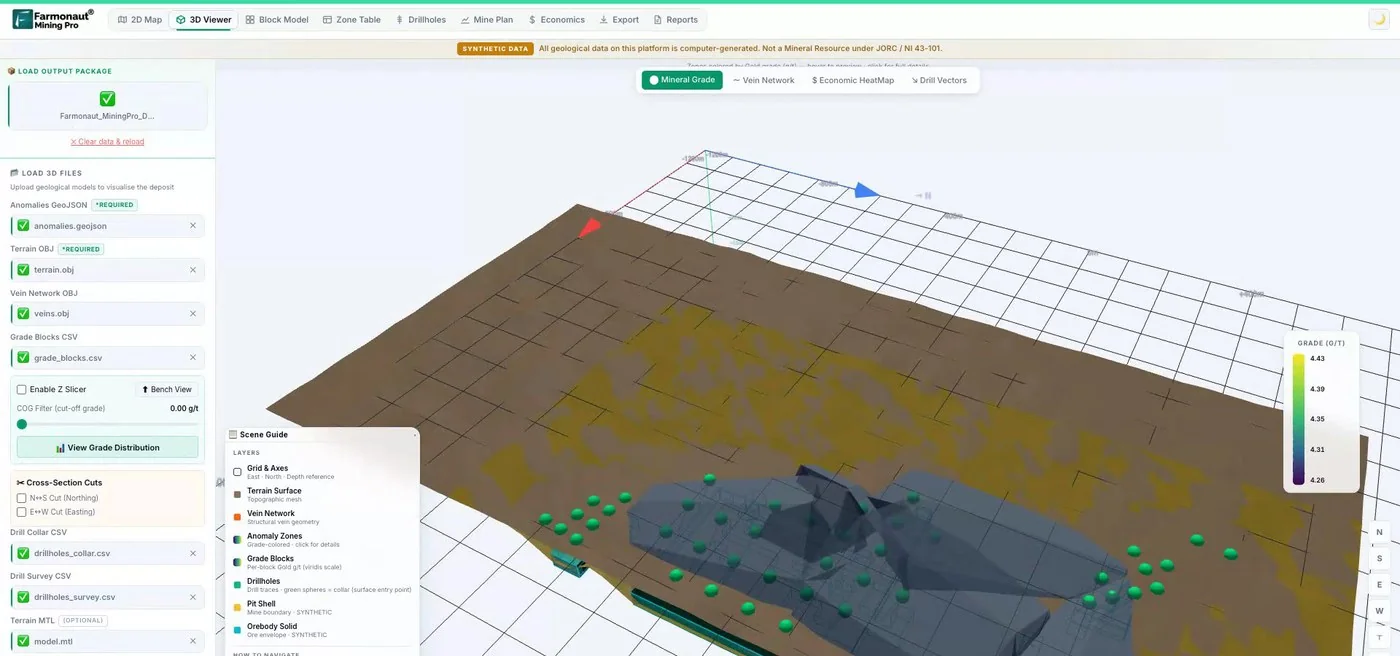
Mining Pro sample view, synthetic data
Keep reading
Sources
- Kimberley Process, Annual Global Summary 2025: kimberleyprocessstatistics.org
- Kimberley Process, Annual Global Summary 2024: kimberleyprocessstatistics.org
- Kimberley Process, official site: kimberleyprocess.com
- USGS, Mineral Commodity Summaries 2026: Gemstones: pubs.usgs.gov
- USGS Bulletin 1693, Descriptive model of diamond pipes (Cox): pubs.usgs.gov
- USGS Bulletin 1693, Descriptive model of diamond placers (Cox): pubs.usgs.gov
- Rio Tinto, Diavik delivers its final production (26 March 2026): riotinto.com
- Rio Tinto, Diavik operations page: riotinto.com
- Arkansas State Parks, Crater of Diamonds State Park: arkansasstateparks.com
- Herkimer Diamond Mines, Mine: herkimerdiamond.com
- Petra Diamonds, Q4 and FY 2026 operating and business update: investegate.co.uk
- Lucara Diamond, year-end 2025 results: lucaradiamond.mediaroom.com
- African Review, Debmarine Namibia launches next-generation crawler technology (2025): africanreview.com
- Mining Digital, A cut above: Debswana Diamonds: miningglobal.com
- Northwest Territories Geological Survey, 2016 NWT Mineral Exploration Overview: nwtgeoscience.ca
- ICMM, Integrated Mine Closure good practice guide (2019): icmm.com
- Crown Publications, XRT technology ushers in a new era in diamond recovery (2017): crown.co.za
Discussion
Questions, corrections or field experience? Share them below. First-time comments are reviewed before they appear, and your email is never published.
No comments yet. Be the first to add a question or your experience.

 Congo Mining Solutions
 Mining SARL
 SenGold Invest SAS
 Sania Corporation
 Sean Mining Limited
 NTS Group (Pty) Ltd
 Mine4Africa
 Lithspo Minerals Limited
 Tintina Mining Group
 Dalgety Minerals Pty Ltd
 Vortex Minerals Pty Ltd
 Faith At Work (Pty) Ltd
 Geotech Mining Solutions plc
 Vulcan International Limited
 Kidepo Associates
 GKY Mining
 Alkimy SARL
 Double A Trading
 GemSprout Metals Limited
 Qader Group
 Ileys General Trading
 SG Gold Mining LLC
 VRV Global Pte Ltd










