

Canada exploration · Company guide
Canadian Mineral Exploration Companies by Province
Juniors spent C$2.27 billion of Canada’s C$4.40 billion exploration total in 2025 (NRCan, preliminary). See where they work by province, nine companies with dated 2026 project facts, and how to check one.
Key takeaways
- Canadian exploration and deposit appraisal spending was C$4.40 billion in 2025 (preliminary), with juniors at C$2.27 billion and seniors at C$2.13 billion (NRCan, April 2026).
- Ontario (C$1.08 billion), Quebec (C$955 million) and Saskatchewan (C$711 million) led 2025 spending; Quebec plans the most in 2026 at C$1.16 billion.
- Juniors made up about 90% of Yukon spending in 2025 but only about 30% of Ontario spending (our arithmetic on NRCan tables).
- Precious metals, mainly gold, took 50% of 2025 spending and uranium C$458 million; uranium plans rise 61% in 2026.
- TMX counts 16 of the 48 mining names in the 2026 TSX Venture 50 as holding Canadian properties, mostly in the Yukon and Ontario (TMX, February 2026).
In this article
- What counts as a Canadian mineral exploration company
- Where Canadian exploration money goes, province by province
- Canadian exploration companies by flagship project
- Gold exploration companies in Canada
- Uranium, copper and critical-mineral explorers
- How Canadian juniors are funded
- How to check an exploration company's cash runway
- Juniors, seniors and the exploration cycle
- Where satellite data helps an exploration company
- What to check before relying on a company's claims
- Frequently asked questions
Canadian mineral exploration companies spent about half of the country’s exploration money: junior companies accounted for C$2.27 billion of the C$4.40 billion spent on exploration and deposit appraisal in 2025 (preliminary), according to Natural Resources Canada (NRCan, April 2026). Ontario, Quebec and Saskatchewan led by province, and precious metals, mainly gold, took half of all spending. This guide shows who the explorers are, where they work, which projects they hold, how they are paid for, and how to check any one of them before you rely on its claims.
It is written for licence and claim owners who want to know who explores next door, for consultants who build target lists, and for investors who need facts rather than tips. Company details come from each company’s own 2026 news releases and are dated. Nothing here is a ranking of quality, a forecast or a recommendation.
What counts as a Canadian mineral exploration company
A mineral exploration company searches for a deposit that could become a mine. In Canada the term usually means a “junior”: a company with no operating revenue that pays for drilling by selling shares. NRCan describes juniors as companies that rely on equity financing and tend to focus on higher-risk, early-stage work, while “seniors” are producers that are more likely to bring a mine into production. Seniors have mine income that supports exploration through price cycles; juniors do not.
The label is loose. Some companies in this guide have moved well past grassroots drilling. One has a feasibility study, one has a pre-feasibility study, and several hold large resource estimates. Each still raises money on the stock market and each still spends most of its cash in the field, so the market calls them juniors or developers. The table later in this guide gives the stage each company states for itself.
The stages in plain words
- Grassroots exploration: sampling, mapping and geophysics on new ground to find a target.
- Drilling and resource definition: diamond drill holes to prove tonnes and grade. A mineral resource is an estimate of the material that could be mined, split into inferred, indicated and measured by confidence.
- Economic studies: a preliminary economic assessment (PEA), then a pre-feasibility study (PFS) and a feasibility study (FS), each adding cost and engineering detail.
- Permitting and construction: impact assessment, licences, financing and building the mine.
Canadian public companies must publish the technical basis for resource and project claims in a technical report prepared under National Instrument 43-101, written by a qualified person. That rule is why most figures in this guide can be traced to a filing on SEDAR+, the Canadian securities filing system.
Why Canada hosts so many of them
TMX Group, the owner of the Toronto Stock Exchange (TSX) and TSX Venture Exchange (TSXV), states that about 40% of the world’s public mining companies are listed on its two exchanges. TMX also says its mining issuers raised C$52 billion in equity over five years through more than 6,400 financings, about 32% of the equity capital raised by public mining companies worldwide (TMX mining profile, company-reported). The exchange’s own figures are promotional, so read them as TMX’s claim, not an independent count. For the listing rules that separate the two boards, see our guide to TSX, TSXV and CSE requirements for miners.
Where Canadian exploration money goes, province by province
NRCan runs a yearly survey of exploration, deposit appraisal and mine-complex development spending with the provinces and territories. The 2025 figures are preliminary and the 2026 figures are spending intentions, so treat both as estimates. Even so, the pattern is stable.
Chart
Juniors carry the north; seniors carry Ontario
Junior companies’ share of 2025 exploration spending in eight selected provinces and territories, percent (preliminary)
Chart
Where Canadian exploration money was spent
Exploration and deposit appraisal spending, eight largest provinces and territories, C$ million, 2025 preliminary
Ontario led in 2025 with C$1.08 billion, followed by Quebec at C$955 million and Saskatchewan at C$711 million (NRCan commodity table, 2025 preliminary). British Columbia followed at C$662 million. NRCan says spending rose in Saskatchewan, Yukon, Newfoundland and Labrador and New Brunswick in 2025 and fell in British Columbia, Manitoba, Nunavut and the Northwest Territories. For 2026, companies plan the most in Quebec (C$1.16 billion), British Columbia (C$1.03 billion), Ontario (C$999 million) and Saskatchewan (C$823 million), with big planned rises in Yukon (C$323 million) and Nunavut (C$268 million).
Our separate article on Canadian exploration spending by the numbers goes deeper into the money side. This page uses the same official tables for a different question: which companies sit behind the dollars.
Juniors dominate the north; seniors dominate Ontario
The company-type table shows a clear split. In 2025, juniors made up about 90% of Yukon’s spending (C$218.6 million of C$241.7 million) and close to 80% of Saskatchewan’s. Ontario is the opposite: seniors spent C$752 million there against C$328 million by juniors. Juniors hold the biggest share of spending in the Yukon, the Northwest Territories, Saskatchewan and British Columbia. In dollars, Saskatchewan (C$562 million), Quebec (C$524 million) and British Columbia (C$410 million) had the largest junior budgets. Those percentages are our arithmetic on the NRCan company-type table.
What the explorers are looking for
Precious metals, mainly gold, took 50% of 2025 spending (C$2.18 billion). Base metals such as copper, nickel, zinc and lead took 27% (C$1.17 billion). Uranium took C$458 million, up 20% in 2025, and Saskatchewan remains its main destination. The “other metals” group, which includes lithium, cobalt and rare earths, fell to C$389 million as lithium prices came off their 2022 peak. Quebec still hosted 132 of the 228 active exploration projects in Canada that listed lithium as a primary commodity (NRCan bulletin). For where each metal is mined, see our Canada mineral deposits map.
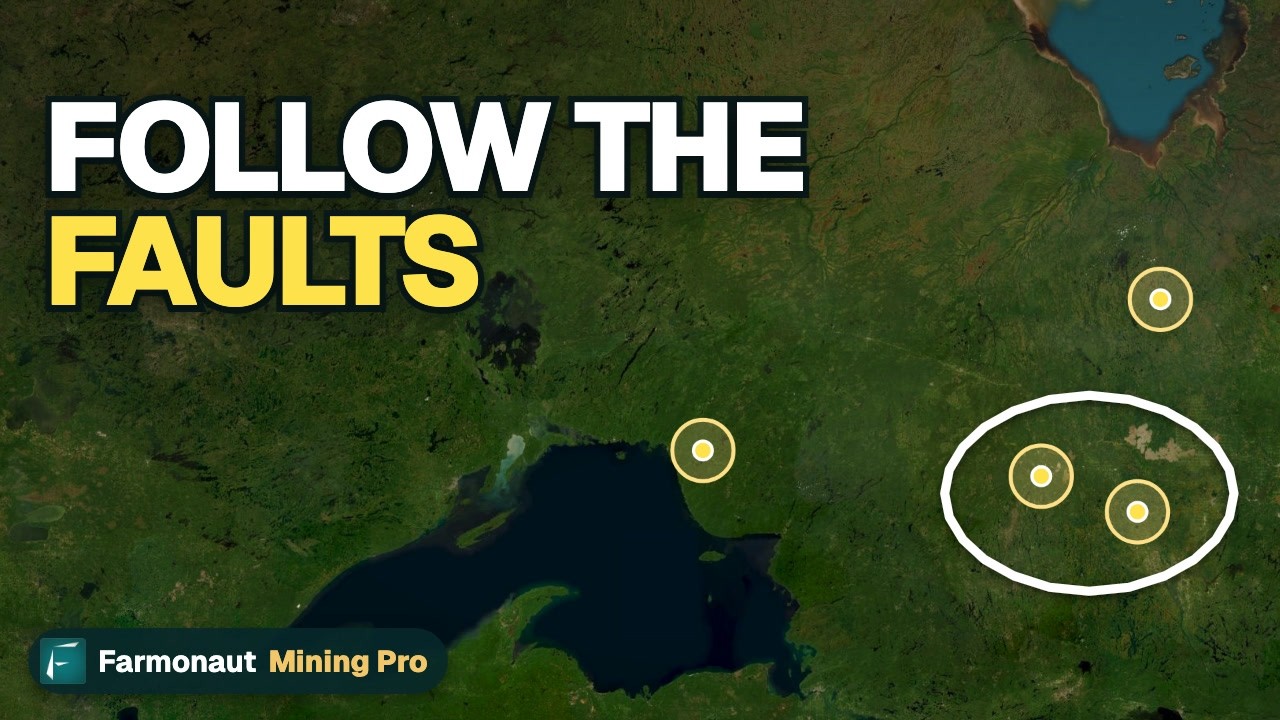
▶ Shows where Ontario’s gold sits, in a few belts of very old rock, and how prospecting there starts. · 2:53
Canadian exploration companies by flagship project
Many exploration companies trade in Canada, so no list can be complete. The table below is a sample built on three rules: the company’s flagship project is in Canada, it issued a news release in 2026, and the facts come from its own release. Seven are in the 2026 TSX Venture 50, a TMX ranking of the best-performing TSXV issuers of 2025 by market-value growth, share-price rise and trading value. Two more, IsoEnergy and Fireweed Metals, are included to cover Saskatchewan uranium and Yukon tungsten. A place in the ranking says how a share price moved. It says nothing about the quality of a deposit.
Of the 48 mining companies in that ranking, TMX counts 16 with properties in Canada, concentrated in the Yukon and Ontario, 15 in the United States and 14 in Mexico (TMX, 18 February 2026). The count adds to more than 48 because some companies hold ground in more than one country.
Terms in the table: Moz means million troy ounces, “g/t” means grams per tonne, and a “cut-off” is the lowest grade included in a resource figure. Resource numbers move with the cut-off, so two companies’ totals are only comparable at similar cut-offs and confidence classes. A PEA is a preliminary economic assessment, a PFS a pre-feasibility study, an FS a feasibility study, Mlb means million pounds and U3O8 is uranium oxide.
| Company (exchange: ticker) | Province or territory | Flagship project and metal | Latest disclosed fact (company release) |
|---|---|---|---|
| Banyan Gold (TSXV: BYN) | Yukon | AurMac, gold | May 2026 estimate: 3.64 Moz indicated (167.3 Mt at 0.68 g/t) and 4.98 Moz inferred (267.2 Mt at 0.58 g/t) at a 0.30 g/t cut-off; maiden PEA to follow |
| White Gold Corp. (TSXV: WGO) | Yukon | White Gold Project, gold | 1,732,300 oz indicated and 1,265,900 oz inferred; about 300,000 ha of claims; three drill rigs in 2026 (May 2026) |
| Fireweed Metals (TSXV: FWZ) | Yukon | Mactung (tungsten) and Macpass (zinc-lead-silver) | About 9,500 m of drilling planned in 2026; updated Mactung feasibility study due early 2027 (June 2026) |
| Amarc Resources (TSXV: AHR) | British Columbia | JOY, DUKE and IKE districts, copper-gold | JOY held 60% Freeport and 40% Amarc through AuRORA Minerals; DUKE is a 60:40 joint venture with Boliden; IKE is 100% Amarc (July 2026) |
| Northisle Copper and Gold (TSXV: NCX) | British Columbia | North Island Project, copper-gold | August 2026 estimate: 10.1 billion lb copper equivalent in indicated resources; PFS targeted for Q1 2027 |
| Thesis Gold & Silver (TSXV: TAU) | British Columbia | Lawyers-Ranch, gold-silver | 4.6 Moz gold equivalent measured and indicated at 1.21 g/t, including 3.2 Moz in reserves, per the company’s pre-feasibility study (1 December 2025) |
| Onyx Gold (TSXV: ONYX) | Ontario | Munro-Croesus, gold | Drill program expanded to 110,000 m; more than 50,000 m done by 22 April 2026; no resource estimate stated |
| Amex Exploration (TSXV: AMX) | Quebec | Perron, gold | April 2026 feasibility study: 1,989 kt at 12.1 g/t proven and probable, 774,000 oz |
| IsoEnergy (TSX: ISO) | Saskatchewan | Larocque East (Hurricane), uranium | 48.6 Mlb U3O8 at 34.5% indicated and 2.7 Mlb at 2.2% inferred (May 2026) |
The sections below add the context that a table cannot hold.
Gold exploration companies in Canada
Gold is the largest single target. NRCan links the planned 2026 jump of 21% to C$5.3 billion mainly to gold exploration, and it expects precious-metals spending to reach C$2.69 billion in 2026. The companies below show the range, from early drilling to a completed mine study.
Yukon: Banyan and White Gold
Banyan Gold’s AurMac project is a large, low-grade, open-pit-style gold system. Its May 2026 estimate added 42,000 m of drilling from 178 holes, and the company reports a higher-grade subset at a 0.55 g/t cut-off of 2.45 Moz indicated at 1.00 g/t and 2.72 Moz inferred at 0.96 g/t (Banyan, 19 May 2026). That cut-off effect is a good example of why a headline ounce figure needs its grade next to it. A 70,000 m drill program with up to six rigs was running when the estimate came out.
White Gold Corp. holds 15,362 quartz claims over 21 properties in the White Gold District. Its flagship project combines four open-pit deposits (Golden Saddle, Arc, Ryan’s Surprise and VG), and the company calls the 2026 program the largest drill campaign in its history (White Gold Corp., 28 May 2026). Both companies work in the Yukon, where juniors dominate spending.
Ontario: Onyx Gold at Munro-Croesus
Ontario led Canada’s provincial exploration spending in 2025 and the Abitibi greenstone belt around Timmins. Onyx Gold controls the Munro-Croesus project 75 km east of Timmins, a 109 km² package with an 8 km stretch of the Pipestone Fault. On 23 April 2026 it raised its planned drilling from 75,000 m to 110,000 m and added a fourth rig (Onyx Gold, 23 April 2026). It reported no resource estimate in that release, so its progress is judged on drilling results rather than a stated resource.
Quebec: Amex at Perron
Amex Exploration’s Perron project in Quebec has moved from discovery drilling to a Phase 1 feasibility study dated 13 April 2026. The study describes two years of pre-production followed by five years of production, using toll milling at an existing plant, with proven and probable reserves of 1.99 million tonnes at 12.1 g/t for 774,000 oz (Amex, 13 April 2026). The study’s economics assume a US$3,500 per ounce gold price, so they are sensitive to the price.
British Columbia: Thesis Gold & Silver
Thesis Gold & Silver, listed as Thesis Gold in the TMX ranking, owns Lawyers-Ranch in the Toodoggone district of northern British Columbia, inside a 495 km² land package. Its investor page reports 4.6 Moz of gold equivalent measured and indicated at 1.21 g/t, of which 3.2 Moz at 1.33 g/t is in reserves, and 68.7 Moz of silver in reserves (Thesis Gold & Silver, investor page). The figures come from its December 2025 pre-feasibility study.
For a wider view of where gold sits by province, read our guides to gold in Ontario and British Columbia.
Uranium, copper and critical-mineral explorers
Saskatchewan uranium: IsoEnergy
Uranium exploration spending has risen every year since 2022 and reached C$458 million in 2025; companies plan C$737 million for 2026, a 61% rise (NRCan bulletin). IsoEnergy’s Hurricane deposit at Larocque East sits in the eastern Athabasca Basin, about 40 km northwest of the McClean Lake mill, at a depth of roughly 325 m. Its resource is 48.6 million pounds of U3O8 at 34.5% indicated, an unusually high grade. Winter 2026 drilling returned 4.21% U3O8 over 3.5 m on the Hurricane South Trend (IsoEnergy, 12 May 2026). IsoEnergy lists on the TSX and on NYSE American.
Chart
What explorers plan to chase next year
Spending by commodity group, C$ million, 2025 preliminary versus 2026 intentions
British Columbia copper-gold porphyries
Amarc Resources is a case study in how juniors share risk. Freeport-McMoRan earned 60% of the JOY district by funding C$35 million, and Freeport funds the 2026 field program through the joint company AuRORA Minerals, with Amarc as contractor and 40% owner. At DUKE, Boliden sole-funded C$30 million of exploration to the end of 2025 and the two now run a 60:40 joint venture. Amarc keeps 100% of IKE (Amarc, 2 July 2026).
Northisle Copper and Gold holds the North Island Project on northern Vancouver Island. Its integrated 2026 resource estimate covers four deposits and states 10.1 billion pounds of copper equivalent, or 16.2 million ounces of gold equivalent, in the indicated category, a 36% rise in indicated tonnes. The company targets a pre-feasibility study in the first quarter of 2027 (Northisle, 6 August 2026). Copper-equivalent figures combine metals using the company’s price and recovery assumptions, so they are not a direct count of copper.
Yukon tungsten and zinc: Fireweed Metals
Fireweed Metals works on two critical-metal projects at Macmillan Pass: Mactung, a tungsten project with an updated feasibility study scheduled for early 2027, and Macpass, a zinc-lead-silver district with gallium and germanium also reported. Its 2026 plan was about 9,500 m of diamond and sonic drilling (Fireweed Metals, 4 June 2026). Tungsten is one of the metals the November 2025 federal budget proposed adding to Canada’s 30% exploration tax credit list, covered in the next section.
How Canadian juniors are funded
Most juniors fund work by selling shares. TMX reports that 43 of the 2026 TSX Venture 50 companies completed capital raises in 2025, totalling more than C$1.5 billion. Raises come in two main forms: ordinary “hard dollar” shares, and flow-through shares, a Canadian tax tool that lets a company pass certain exploration expenses to the investor as a deduction.
Flow-through shares matter to explorers because the tax benefit can lift demand for a raise. A federal Mineral Exploration Tax Credit of 15% and a 30% Critical Mineral Exploration Tax Credit exist for individual investors. The November 2025 federal budget proposed adding bismuth, cesium, chromium, fluorspar, germanium, indium, manganese, molybdenum, niobium, tantalum, tin and tungsten to the 30% list, for flow-through agreements entered into after budget day and on or before 31 March 2027, and confirmed renewal of the 15% credit to the same date (Lavery law firm summary). Check the final law with a tax adviser before acting. Our guide to flow-through shares and after-tax cost works through the arithmetic.
Other money sources include joint ventures with large miners, as at Amarc’s JOY and DUKE districts, government funding for critical-metal projects, and royalty or stream deals with companies that pay cash for a share of future production.
How to check an exploration company’s cash runway
Cash runway is the first thing a lender, a joint-venture partner or a shareholder checks. A company with a large drill program and little cash will have to raise money soon, which usually means issuing more shares. The quickest way to see this is to compare the cost of the planned program plus overhead with the cash in the last quarterly report.
Diamond drilling costs per metre vary widely by region, season, hole depth and whether a fly camp is needed. Our guide to diamond drilling companies in Canada explains what moves the price. The calculator below uses your own numbers, so replace the example values with those from a company’s financial statements and its stated program.
Calculator
Can the cash cover the drill program?
Enter figures from a company’s latest financial statements and its stated drill plan.
- Drilling cost: $5,250,000
- Overhead over the program: $1,800,000
- Share of cash used (percent): 88.1
Example values only, not a benchmark. Drilling cost per metre varies by region, depth and season; use the contractor quote or the company’s stated all-in cost. Overhead means salaries, office, listing and filing costs. Amounts in C$.
Juniors, seniors and the exploration cycle
Junior spending swings harder than senior spending. NRCan says juniors’ budgets follow investor sentiment, metal price expectations and financing conditions. Between 2019 and 2022 junior spending rose from C$957 million to C$2.47 billion, then settled at about C$2.1 billion in 2023 and 2024 before climbing to C$2.27 billion in 2025 (preliminary). Companies plan C$2.91 billion for 2026, which would be a new record for juniors (NRCan company-type table). Seniors planned C$2.43 billion.
Chart
Junior spending swings harder than senior spending
Exploration and deposit appraisal spending, C$ million (2025 preliminary, 2026 intentions)
The commodity mix is also shifting. Precious metals are planned to rise 24% in 2026 and uranium 61%, while base metals stay near C$1.16 billion and other metals recover only modestly. Plans are not results: financing, permits and metal prices change the final figures every year.
Where satellite data helps an exploration company
Many explorers use satellite imagery before they send a crew. Multispectral and radar data can map rust-coloured iron-oxide stains, clay-rich alteration and major faults, which are clues that hot fluids passed through the rock. Satellites cannot see ore at depth. They help rank ground for sampling, geophysics or drilling, so a company spends its first dollars where the clues are strongest.
For a claim owner this is a low-cost first screen on ground you already hold or plan to stake. For a consultant it narrows a long list of properties. For an investor it is a way to ask a company what the imagery showed and what ground work followed. Farmonaut offers satellite-based mineral screening of a licence boundary, and results are exploration targets that sit ahead of any resource estimate. Our guide to mineral claims in Canada by district shows how explorers stake ground in each province and territory.
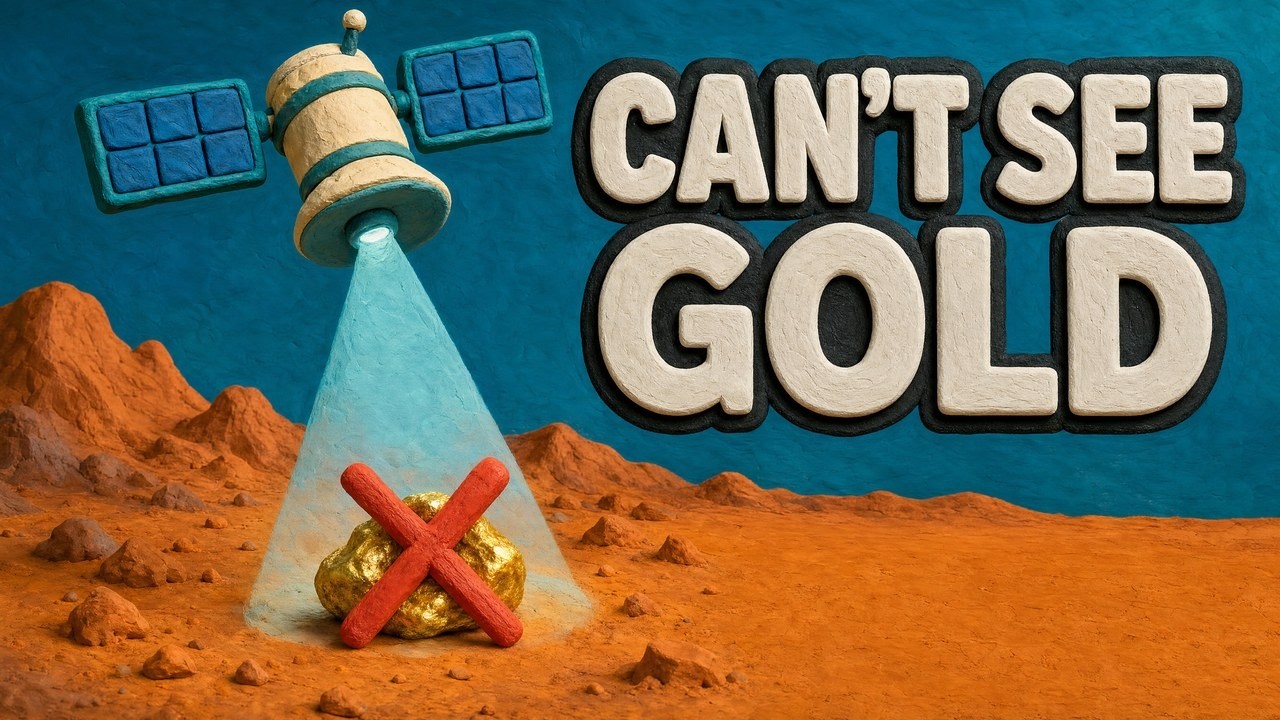
▶ Explains how satellites map rust stains, clay minerals and faults that point to where gold may be. · 4:25
What to check before relying on a company’s claims
A press release is a company’s own summary. Use this checklist to read one properly.
- Find the technical report. A resource or study claim should link to an NI 43-101 technical report on SEDAR+. If it does not, treat the number as unreviewed.
- Match grade to cut-off. Banyan’s 8.6 Moz total and its 5.2 Moz higher-grade subset describe the same deposit. Always read the cut-off.
- Separate resources from reserves. Reserves, such as Amex’s 774,000 oz at Perron, rest on a study that shows the ore can be mined and sold at a profit. Resources have not passed that test.
- Read the stage. A PEA is a scoping study that may include inferred resources. A PFS and an FS have more engineering and tighter cost ranges.
- Check who funds the work. A project funded by a large partner, like JOY, carries less financing risk for the junior than one it funds by share sales.
- Look at the land. Confirm the claims are in good standing with the provincial registry and note any Indigenous agreements or permits. Our guide to Canadian claim systems explains each registry.
- Compare the cash to the plan. Use the calculator above.
Satellite screening has limits too. It cannot confirm grade, depth or size, and a clean image does not replace sampling. Treat it as a way to choose where to look.
Frequently asked questions
What is a Canadian mineral exploration company?
It is a company that searches for mineral deposits in Canada and usually pays for the work by selling shares on the TSX, TSXV or Canadian Securities Exchange. NRCan calls the smaller ones junior companies: they typically have no operating revenue and focus on early-stage, higher-risk exploration.
How many exploration companies are there in Canada?
No source we opened gives a single agreed count of exploration companies. TMX says about 40% of the world’s public mining companies are listed on the TSX and TSXV, and it publishes a downloadable list of mining issuers on its mining page. Counts differ by how a company is classified.
Which Canadian province has the most exploration spending?
By spending, Ontario led in 2025 with C$1.08 billion, ahead of Quebec at C$955 million and Saskatchewan at C$711 million (NRCan, preliminary). In 2026, companies plan the largest budget in Quebec at C$1.16 billion.
What are the main gold exploration companies in Canada?
Examples with 2026 news and Canadian flagship projects include Banyan Gold and White Gold Corp. in the Yukon, Onyx Gold in Ontario, Amex Exploration in Quebec and Thesis Gold & Silver in British Columbia. The list above is a sample, not a complete ranking.
Are Canadian exploration companies the same as mining companies?
Not exactly. Exploration companies look for deposits and rarely run mines. Mining companies operate mines and earn revenue. Some juniors become developers, as Amex did when it completed a feasibility study, and some are bought by producers.
Where do Canadian juniors list?
Most list on the TSX Venture Exchange, the junior board of TMX, or on the senior TSX. Some also trade on the Canadian Securities Exchange or on US markets such as NYSE American and OTC markets. See our guide to listing requirements for miners.
What is NI 43-101?
National Instrument 43-101 is the Canadian securities rule that sets how public companies disclose scientific and technical information about mineral projects. It requires a qualified person and, for key claims, a technical report filed on SEDAR+.
What is the difference between a resource and a reserve?
A resource is an estimate of mineralised material with reasonable prospects of being mined. A reserve is the part shown by at least a pre-feasibility study to be economic to mine. Amex’s Perron feasibility study states reserves; Banyan’s AurMac estimate states resources.
Which Canadian explorers work on uranium?
Saskatchewan’s Athabasca Basin hosts most uranium exploration. IsoEnergy’s Hurricane deposit is one example. NRCan reports C$458 million of uranium exploration in 2025 and C$737 million planned for 2026.
Are flow-through shares only for Canadian investors?
The tax deduction applies to Canadian taxpayers. The company renounces eligible Canadian exploration expenses to the subscriber, so the benefit depends on the investor’s tax position. Speak to a tax adviser.
Does this page recommend companies to buy?
No. It lists facts that each company disclosed in 2026 and gives a method for reading them. It is not investment advice, and it does not rank companies on quality or value.
This page is for information only. It is not investment, legal or tax advice, or a recommendation to buy or sell any security. Company figures are as reported in the dated releases and can change; check SEDAR+ filings and confirm tax and legal rules with an adviser.
Farmonaut mining
Screen your ground from space
Request a quote to have your licence or claim block screened with satellite data before you spend on ground work.

Mining Pro sample view, synthetic data
Sources
- Natural Resources Canada, Canadian Mineral Exploration Information Bulletin (April 2026): natural-resources.canada.ca
- NRCan, Exploration and Deposit Appraisal by Commodity, 2025 preliminary: mmsd.nrcan-rncan.gc.ca
- NRCan, Exploration and Deposit Appraisal by Company Type: mmsd.nrcan-rncan.gc.ca
- TMX, 2026 TSX Venture 50 news release (18 February 2026): s21.q4cdn.com
- TMX, Mining sector profile (TSX and TSXV): tsx.com
- Banyan Gold, AurMac resource estimate (19 May 2026): banyangold.com
- White Gold Corp., 2026 exploration program (28 May 2026): whitegoldcorp.ca
- Fireweed Metals, 2026 field program (4 June 2026): fireweedmetals.com
- Amarc Resources, 2026 JOY district drilling (2 July 2026): amarcresources.com
- Northisle Copper and Gold, North Island resource estimate (6 August 2026): northisle.ca
- Thesis Gold & Silver, investor page (Lawyers-Ranch): thesisgoldsilver.com
- Onyx Gold, Munro-Croesus drill program (23 April 2026): onyxgold.com
- Amex Exploration, Perron feasibility study (13 April 2026): amexgoldmining.com
- IsoEnergy, Hurricane South drill results (12 May 2026): isoenergy.ca
- Lavery, Federal Budget of 4 November 2025: exploration tax credits: lavery.ca
- SEDAR+, Canadian securities filing system: sedarplus.ca
Discussion
Questions, corrections or field experience? Share them below. First-time comments are reviewed before they appear, and your email is never published.
No comments yet. Be the first to add a question or your experience.

 Nanita Company Limited
 Mwerezi Minerals Company Limited
 Congo Mining Solutions
 Mining SARL
 SenGold Invest SAS
 Sania Corporation
 Sean Mining Limited
 NTS Group (Pty) Ltd
 Mine4Africa
 Lithspo Minerals Limited
 Tintina Mining Group
 Dalgety Minerals Pty Ltd
 Vortex Minerals Pty Ltd
 Faith At Work (Pty) Ltd
 Geotech Mining Solutions plc
 Vulcan International Limited
 Kidepo Associates
 GKY Mining

 Licence holder · Nigeria · Gold + lithium










