

Mines for sale · Buyer guide
Cheap Mines for Sale: Gold and Uranium Price Ranges
In a 15 October 2026 snapshot of 24 gold claims, the median ask was about US$9,600. Uranium ground with permits sells for millions. This guide shows price ranges, what cheap listings usually are, yearly holding costs and a 7-step check.
Key takeaways
- A cheap gold mine for sale is usually a claim: 24 listings on 15 October 2026 asked US$500 to US$70,000, median about US$9,600 (MiningClaimSales.com).
- An unpatented claim gives a right to the minerals, not the land; the surface stays with the United States (BLM, 2026).
- Holding a claim costs US$200 per claim each year in BLM maintenance fees, or US$15 per claim under the small-miner waiver (BLM, 2026).
- Uranium ground is priced in millions: about US$2 million for four Colorado projects agreed in September 2026, paid in shares (Premier American Uranium, 2026).
- Spot uranium averaged US$91.55 per pound at the end of October 2026, up from US$72.63 at the end of 2024 (Cameco).
In this article
- Cheap mines for sale: price ranges for gold and uranium
- What a cheap gold mine for sale usually is
- Cheap uranium mines for sale: what is actually available
- Running costs after you buy: BLM and state fees
- How to check a cheap mine before you pay: 7 steps
- Red flags in a mine listing
- Where cheap mines are listed and who sells them
- Which kind of mine listing fits your budget
- Buying a mine in the United Kingdom
- Buying outside the United States
- Where satellite screening fits
- Frequently asked questions
A cheap mine for sale in the United States is usually a set of mining claims, not a working mine. In a snapshot of 24 gold claims on MiningClaimSales.com taken on 15 October 2026, the median asking price was about US$9,600 and the range ran from US$500 to US$70,000. Uranium is different: even a small package of uranium projects is priced in the millions, such as the roughly US$2 million (in shares and warrants) that Premier American Uranium agreed to take from DISA Uranium for four Colorado projects in September 2026.
This guide shows what the low end of the market looks like for gold and uranium, what cheap listings usually are, what the buyer pays every year to keep a claim, and a seven-step check to run before any money moves. Prices are in US dollars. One troy ounce is 31.1035 grams, and “U3O8” means uranium oxide concentrate, the yellowcake that mines sell.
Cheap mines for sale: price ranges for gold and uranium
There is no single price list, so the table below puts four dated sources side by side. Two of them are sellers’ own listings and rules of thumb, which show what owners ask, not what buyers pay. The uranium row is a reported company deal, which is the only way uranium ground tends to be priced in public.
Chart
Asking prices of 24 gold claims, by price band
Number of listings, snapshot of 15 October 2026
| What is for sale | Typical asking price | What you get | Source and date |
|---|---|---|---|
| Unproven placer claim, remote | US$500 to US$2,500 | A 20-acre federal claim with little documentation | MiningClaimSales seller guide, Jan 2026 |
| Placer claim with road access and gold showings | US$2,000 to US$8,000 | A claim near a creek or a past dredge area | MiningClaimSales seller guide, Jan 2026 |
| Documented small producer | US$5,000 to US$25,000 | A claim with records of gold recovered | MiningClaimSales seller guide, Jan 2026 |
| Lode claim (vein or rock in place) | US$3,000 to US$50,000 and up | Hard-rock ground; price follows assay results | MiningClaimSales seller guide, Jan 2026 |
| Patented claim (private land) | US$17,500 to US$75,000 (three Colorado examples); one claim broker puts the range at US$50,000 to US$500,000 and up | Title to land and minerals on 4 to 10 acres | Land Resellers, 16 Oct 2026; MiningClaimSales, Jan 2026 |
| Multi-claim packages with history | US$41,250 to US$1,000,000 | Four listings of 79 to about 140 acres with old workings or records | Mountain Man Mining, 15 Oct 2026 |
| Uranium project package (Colorado) | About US$2 million, paid in shares | Four projects, pending approvals | Premier American Uranium, 15 Sep 2026 |
The broker’s ranges come from a seller who has staked and sold claims since 1993 and who says prices for well-documented ground rose 10 to 15 percent over 2025, so treat them as an opening bid, not a valuation. The listing snapshot is more concrete. Of the 24 gold claims listed on 15 October 2026, seven asked under US$5,000, six asked US$5,000 to US$9,999, six asked US$10,000 to US$24,999, four asked US$25,000 to US$50,000, and one asked more. The count leaves out a collectible letter, a limestone claim and a ghost-town property on the same page. A second broker’s page showed 12 active claims from US$5,000 to US$1,000,000, with eight of them at US$21,500 or less.
For scale, gold traded at US$4,157.70 per troy ounce (bid) on Kitco on 15 October 2026. At that price, US$9,600 is about 2.3 ounces of gold. A claim is cheap because the buyer is paying for a right to look, not for ounces already found.
Prices also differ by state, because recording rules, access and permitting differ. See our state guides to gold mines for sale in Idaho and Nevada gold mines for sale, and our broader guide to land and mineral rights for sale.
What a cheap gold mine for sale usually is
Four things sit behind most low gold prices. Knowing which one you are looking at is the first filter.
Chart
One broker’s price ranges by claim type
US$; seller’s January 2026 rules of thumb, not sale prices
An unpatented claim, which is a right and not land
Most claims in the listings above are unpatented. Under the General Mining Law of 1872, a claim has five parts: discovery, location, recording, yearly maintenance and, in theory, a patent. Since 1 October 1994 Congress has barred BLM (the Bureau of Land Management) from accepting new patent applications, so a patented claim is one where the government already conveyed title. For an unpatented claim, the surface is not private property and ownership stays with the United States. You own the right to the minerals, subject to the claim staying valid.
A placer claim near old workings
A placer claim covers loose gold in gravel, up to 20 acres per locator. A lode claim covers gold in a vein or in rock in place. BLM describes lode ground as vein or disseminated rock in place, and the same page gives the placer limits. All seven listings under US$5,000 in the October snapshot were tagged as placer claims, so the lowest prices are for small gravel claims, not for hard-rock mines.
A historic mine with no current resource
Old mines are cheap when no one has proved what is left. A listing may quote a “historical reserve”, for example 21,474 ounces on an Ontario property offered for $75,000 cash (the listing does not state the currency) plus a 25 percent carried interest, which usually means the seller holds a share of the project while the buyer pays that share’s costs. Canada’s NI 43-101 rule says such a figure is a historical estimate: an estimate the issuer has not verified as a current resource or reserve. A listed company must say so with equal prominence when it quotes one. The rule binds issuers that report publicly, not a private seller’s brochure.
Marketing built on the neighbours
Listing pages often quote the output of the district around a claim. One Nevada listing, for example, notes that its claim lies in the valley surrounding a mine credited with more than 10 million ounces, and then adds that these are district totals, not a guarantee of production from the claim. That caution is correct and worth repeating: nearby production is context, not a grade on your ground. Another listing in the October snapshot, a 145-acre Arizona lode package at US$70,000, carries the words “est 500k – 1m oz potential” in its title. Use the second calculator on this page to see why that cannot be a resource: at the example gold price, 500,000 ounces would be worth about US$2 billion in the ground.
The wider gold industry shows how thin small ground is. The U.S. Geological Survey estimated 2025 U.S. mine output at 160 tonnes and found that the top 25 operations produced about 94 percent of the mined gold. A cheap claim can be a good place to prospect. It is rarely a mine.
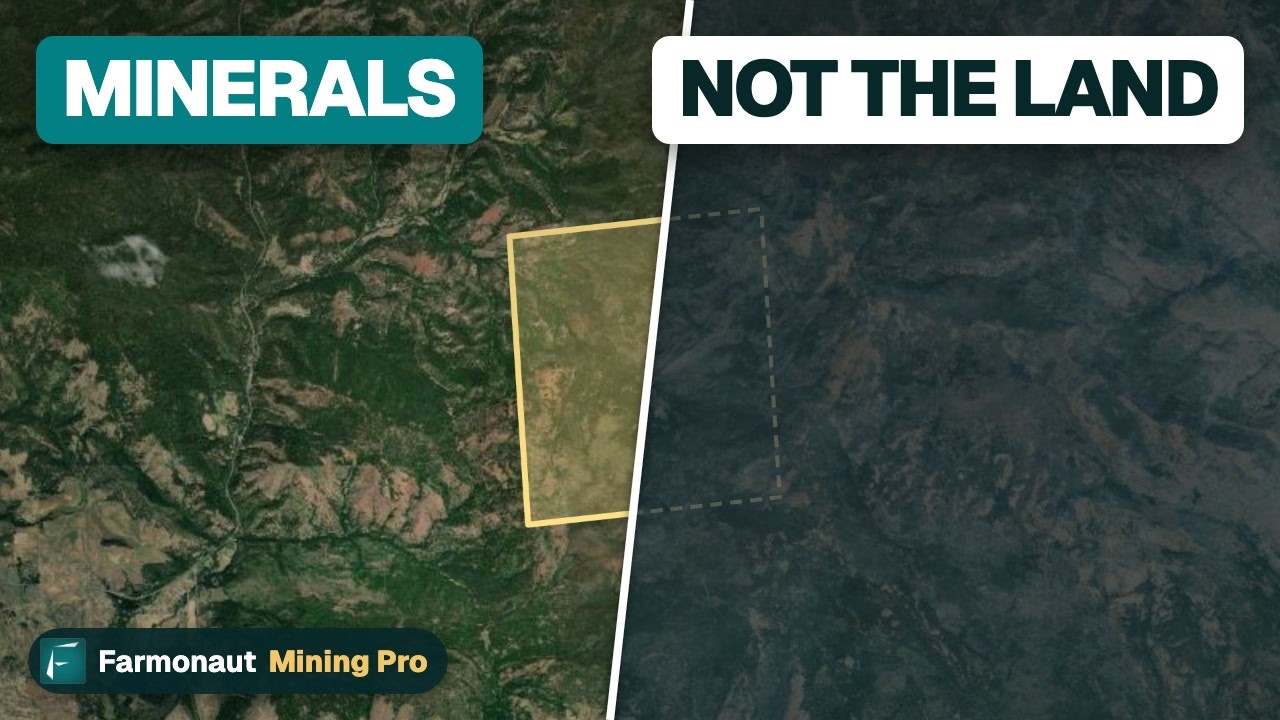
▶ Explains that a gold claim is a right to the minerals and not title to the land, with the 1872 mining law and how to check the ground first. · 3:19
Cheap uranium mines for sale: what is actually available
Searches for a uranium mine for sale mostly lead to company deals, not retail listings. On 16 October 2026 MineListings showed no listings for Utah, a leading uranium state, though its category list counted 673 listings across the United States and 241 in Canada. Uranium ground is sold between companies because the buyer needs permits, a processing route and a licence. Uranium sells as U3O8, priced per pound.
Chart
Uranium price at quarter-ends
US$ per pound U3O8, industry-average month-end price
The price of the metal drives what the ground is worth. Cameco, which averages the month-end prices published by two industry price reporters, shows spot at US$91.55 per pound at the end of October 2026 and the long-term contract price at US$98.00. Spot is the price for immediate delivery. The long-term price is what utilities agree for deliveries years ahead. Both rose between the end of 2024 and October 2026, as the chart shows (Cameco, uranium price table).
What does cheap look like in dollars? The deals below are reported prices for US uranium projects, companies and mills. They are not asking prices and they are not a price list, because each package differs in permits, resources and location. They do show that even “small” uranium assets are priced in millions. The Colorado package in the first bar was agreed on 14 September 2026 for about US$2 million in DISA Uranium shares and warrants, and completion needs approvals including the US Department of Energy. The others are older and come from the World Nuclear Association’s US country profile, so read them as history.
Why uranium ground is rarely cheap in the way gold claims are
- Regulation. Most US uranium-producing states are agreement states, so the state issues the permits and regulates mining and milling and the Nuclear Regulatory Commission has a small role. Wyoming, the leading producing state, became one in 2018, according to the World Nuclear Association.
- Processing. The White Mesa mill in Utah is the only conventional US uranium mill, so ore from Colorado Plateau mines is trucked there for treatment.
- Closed ground. The August 2023 Grand Canyon national monument permanently bars new uranium claims on nearly 4,000 square kilometres in Arizona, while existing valid claims were not affected, the World Nuclear Association reports.
- Legacy mines. Cheap uranium land can be an old mine. BLM notes that mines abandoned before 1981 often leave safety and contamination problems, and that BLM itself funds the clean-up of many because the original operators cannot be found. Some uranium sites are cleaned up by companies licensed to treat the waste, and DISA says it holds the only NRC licence to treat and recover waste from abandoned uranium mines across multiple sites.
Past-producing, permitted mines do trade. DISA’s portfolio includes the Tony M, Daneros and Rim mines in Utah, according to its own release, and Anfield Energy began site work at the Velvet-Wood uranium and vanadium site near Lisbon Valley, Utah, in November 2025. On 27 August 2026 the company announced the first underground blast at the mine in nearly 40 years. These are company assets with permits and resources behind them, which is why they do not carry claim-sized prices. For who produces and sells uranium, see our guide to the largest uranium producers in the world and our US uranium mine trends.
Chart
Reported prices of US uranium asset deals
US$ million, year of deal in the label

▶ A clay animation on uranium in Africa: a known deposit at Kanyemba in Zimbabwe, but no working mine, which shows how a known deposit differs from a mine. · 4:27
Running costs after you buy: BLM and state fees
A claim is cheap to buy but not cheap to hold. BLM charges a processing fee and a location fee when a new claim is filed, plus a yearly maintenance fee. The table shows the federal numbers as BLM published them. Counties and states add their own recording fees, and the rules differ by state, so confirm the local figure.
| Cost item | Amount (US$) | When |
|---|---|---|
| New lode, mill or tunnel site claim: processing fee | 25 | At filing |
| New claim: location fee | 49 | At filing |
| Maintenance fee per claim (placer: per 20 acres or part) | 200 | On or before 1 September each year |
| Transfer of interest, per claim per transferee | 15 | When a claim is sold |
| Small-miner waiver affidavit, per claim (10 or fewer claims nationwide) | 15 | By 30 December |
Source: BLM, mining claim fees page, checked 15 October 2026. New lode, mill-site or tunnel-site claims filed on or after 1 September 2024 cost US$274 each in total in the first year ($25 + $49 + $200). The notice of location is due within 90 days. A seller’s quit claim deed must be recorded with the county first, and then filed with BLM. For the 2027 assessment year the fee or waiver was due before 1 September 2026, and BLM stated there were no extensions.
The waiver does not remove the work. If you use it, you must still do the yearly assessment work and file the affidavit, and the work costs money. In Nevada, a notice of intent to hold filed when an affidavit was required causes forfeiture, so match the form to the claim. Use the first calculator below to see the full outlay on a claim you are weighing. Its defaults are examples, not benchmarks.
Calculator
What will a claim really cost you?
Enter the asking price and your own holding plan. Results update as you type.
- Average cost per year: $2,906
- Gold needed to break even: 3.63 oz
- The same in grams: 113 g
Example values only, not benchmarks. Federal figures: US$15 transfer filing per claim and US$200 yearly maintenance per claim (BLM fees page, checked 15 October 2026); a placer claim over 20 acres pays per 20 acres or part, so raise the claim count. Set the fee to 15 only if you qualify for the small-miner waiver, and add the cost of assessment work to the other yearly costs. County recording, travel, assays and insurance are your own estimate. Gold price is an input. The 4,000 is an example; Kitco’s bid was US$4,119.20 on 5 November 2026, so use today’s price.
How to check a cheap mine before you pay: 7 steps
Work through these in order. Each step is a cheap check that can end the deal before the next, costlier one.
Infographic
Check a cheap mine in 7 steps
- 1Get serial numbersAsk for the BLM serial number of every claim.
- 2Search MLRSCheck claim status on the BLM research map.
- 3Check the countyConfirm the recorder’s filing and the current fee or waiver.
- 4Ask for evidenceRequest assays, maps, logs and the author and date of any estimate.
- 5Read the classResource, reserve or historical estimate? Treat the rest as a lead.
- 6Check permits and bondNotice or plan of operations, and a financial guarantee, for work above casual use.
- 7Screen and visitRun a site assessment on old workings, then walk the ground.
- Ask for the BLM serial numbers. A properly recorded claim has one, and the seller should be able to provide it. No serial number means no recorded claim.
- Look the claim up in MLRS. BLM’s Mineral and Land Records System has a research map at mlrs.blm.gov where you can check status by serial number.
- Check the county recorder and the fee record. Confirm the notice of location was filed with the county, and that the maintenance fee or waiver was paid for the current assessment year.
- Ask for the technical evidence. Request assays, sample maps, drill logs and any resource report. Ask who wrote it and when. A figure with no named author and date is a sales description.
- Read the report for its class. Under S-K 1300, the US Securities and Exchange Commission’s mining disclosure rule, an initial assessment can disclose mineral resources but cannot be the basis for mineral reserves. Under NI 43-101 an older number is a historical estimate. Treat anything else as a lead.
- Check permits and the bond. Work above casual use needs a notice (small exploration) or a plan of operations approved by BLM, and a plan is needed before removing 1,000 tons or more of presumed ore for testing. Notice and plan operations need a financial guarantee, a reclamation bond, while casual use does not.
- Screen the environment and visit the ground. Order a site assessment on any old workings. A buyer who makes “all appropriate inquiries” before buying and meets later obligations can qualify as a bona fide prospective purchaser under the Superfund law, and EPA says such a buyer may acquire land knowing of contamination if it acquired the property after 11 January 2002 and meets the statute’s other conditions. Take a lawyer’s advice on that point.
Step 7 is also where a satellite screen is useful, because it is cheap to run before a site trip. See the last section.
Red flags in a mine listing
Most of these show up in the listing text itself. None proves bad faith, but each should lead to a question.
| What the listing says | What to ask |
|---|---|
| “Potential of 500,000 ounces” with a price under US$100,000 | Who estimated it, to which standard, and on what date? Compute the implied value with the second calculator. |
| “Next to a famous mine” | Where is the claim relative to the mineralised structure? District output is not claim output. |
| No BLM serial number, or only a claim name | Send the name to BLM and the county. No record, no deal. |
| “Historical reserve” from an old report | Is there a current estimate by a qualified person? Without one it is a historical estimate. |
| “Permitted” with no permit number | Which agency issued which permit, with what conditions and bond? |
| Seller wants payment by wire before a deed is signed | Use an escrow service and record the deed with the county first. |
| Price far below similar listings | Look for back fees, liens, a claim already lapsed, or a missing right of access. |
Calculator
Does the asking price match the claimed ounces?
Type the ounces a listing claims, the gold price and the asking price.
- Asking price as a share of that value: 0.0%
- Asking price per claimed ounce: $0
Example values only, not benchmarks. The 500,000 ounces mirror the lower end of a figure printed in one listing title in the October 2026 snapshot. A claimed potential is not a resource under NI 43-101 or S-K 1300. Gold price is an input. The 4,000 is an example; Kitco’s bid was US$4,119.20 on 5 November 2026, so use today’s price.
Where cheap mines are listed and who sells them
Four kinds of seller account for most listings. Claim brokers locate new claims each season and sell them; their pages are the cheapest and the most standardised. Marketplaces such as MineListings carry hundreds of listings: its sidebar counted 673 US listings and 241 Canadian ones on 16 October 2026. Land agents list patented claims; one site’s first results showed 145 patented-claim results, with Colorado examples at US$17,500, US$49,000 and US$75,000, and annual property tax listed at US$85 and US$138 on two of them. Companies sell non-core projects through press releases, which is how uranium moves.
Marketplaces do not vouch for what they list. One of them says plainly that listings should be verified for claim details and legal status, and recommends a title search and a site visit. The seller can also be the original locator, so ask how long they have held the claim. A claim in the mining-claim sales snapshot can be a federal claim, a state claim or a private parcel, and the three carry different rules.
If your interest is in exposure to gold or uranium without owning ground, listed companies and funds are a separate topic. See our fact-only guides to uranium companies and stocks and the Sprott Uranium Miners ETF and gold miners ETFs. Quartz-hosted gold, a common target of vein claims, is explained in our guide to gold in quartz.
Which kind of mine listing fits your budget
Searches for a “mine for sale”, “old mines for sale” or “hard rock mine for sale” lead to very different products. The table sorts them by what the buyer actually receives. Gold was quoted at US$4,119.20 per troy ounce (bid) on Kitco on 5 November 2026, so a US$10,000 claim costs about 2.4 ounces of gold. Spot uranium averaged US$91.55 per pound at the end of October 2026, the latest month-end on the Cameco price table when we checked on 5 November 2026.
| Search | What the listing usually is | What to check first |
|---|---|---|
| Mining projects for sale | A company asset: claims, data and sometimes a permit application, sold through a press release or a broker | Who holds title, what is already approved, and whether the price is cash or shares (the 2026 Colorado uranium deal above was paid in shares) |
| Hard rock mine or lode mine for sale | A lode claim or a group of them over a vein or rock in place; federal law limits one lode claim to 1,500 feet along the vein and 600 feet across (BLM) | Assay certificates, the BLM serial number, and whether the workings are open |
| Old mines for sale, cheap abandoned mines | Historic workings on a claim or a private parcel; the BLM describes abandoned hard rock mines as sites left before 1981 that can have open shafts and other physical hazards (BLM Abandoned Mine Lands) | Safety, access, liens, and clean-up liability; see the next paragraph |
| Diamond mine for sale | Few diamond ground listings exist in the United States. The best-known US diamond site is a state-owned park, not a property for sale (Arkansas State Parks) | The licence type, who may hold it, and independent proof of the stones recovered |
| Uranium mine for sale | A company project or a permitted site; MineListings showed no Utah listings on 16 October 2026 | Permit status, royalties and the date of any resource estimate |
Old workings carry the biggest hidden cost. The US EPA explains that a buyer can reduce Superfund liability for contamination that was already there by qualifying as a bona fide prospective purchaser, which depends on steps taken before and after the purchase. Ask a lawyer about this before you buy any private parcel with old tailings, adits or a mill site. A cheap price on such ground often reflects the clean-up risk, not a bargain.
On diamonds, the Arkansas park says more than 37,377 diamonds had been found by visitors since 1972 as of 13 January 2026, with the largest at 40.23 carats. That is a visitor attraction on public land. The USGS estimates the combined value of all US natural and synthetic gemstone output at about US$47 million in 2025, which shows how small domestic gem production is. A diamond mine listing from any country therefore needs independent evidence of recovered stones, not photographs.
Buying a mine in the United Kingdom
A UK buyer faces a different title question. The British Geological Survey says the state does not own mineral rights in the UK except for oil, gas, coal, gold and silver; other minerals in England, Wales and Scotland are generally privately owned and recorded with the Land Registry where information exists. Northern Ireland differs: most minerals there are vested in the Department for the Economy. Coal rights sit with the Coal Authority, and the Crown holds gold and silver rights. So a mine for sale in the UK can transfer the surface land and most minerals, but not the gold, silver or coal beneath it. Planning permission from the local minerals planning authority is a separate step.
Use the claim cost calculator above to test a cheap price against your holding plan. For a licence owner or investor weighing several sites, the same screening step applies everywhere: confirm the title, then use satellite imagery to look at the ground before you commit to a visit.
Buying outside the United States
Ownership rules change at the border, and a cheap price abroad often hides a licence that cannot be transferred to you. Ghana’s Minerals Commission says small-scale licences go only to Ghanaian citizens aged 18 or over, and under section 14 of the Minerals and Mining Act, dealings in mineral rights need ministerial approval. In Tanzania, a primary mining licence is limited to Tanzanian citizens or wholly Tanzanian companies, and under the Mining Act a mining licence cannot be assigned without written consent. Zimbabwe prohibits transfers of prospecting licences. Our guide to gold mines for sale in Africa covers these rules in more detail.
In other countries the buying route is the same set of questions: who holds the title, what the state allows a foreigner to hold, and whether the mineral right can move at all. Papua New Guinea is one example where the mining sector needs its own country check; see our Papua New Guinea economic outlook.
Where satellite screening fits
Step 7 above asks you to check the ground, and a site visit costs days. Farmonaut screens a claim polygon from satellite imagery first, flagging alteration zones, faults and other patterns linked to mineralisation, so you can see whether the claim touches any such pattern before you travel. The result is an exploration target, not a resource estimate and not an environmental clearance. Farmonaut reports 100,000+ hectares scanned across 20+ minerals, including gold and uranium, and delivers in 5 to 20 business days from a KML, KMZ or polygon. See the mining platform.
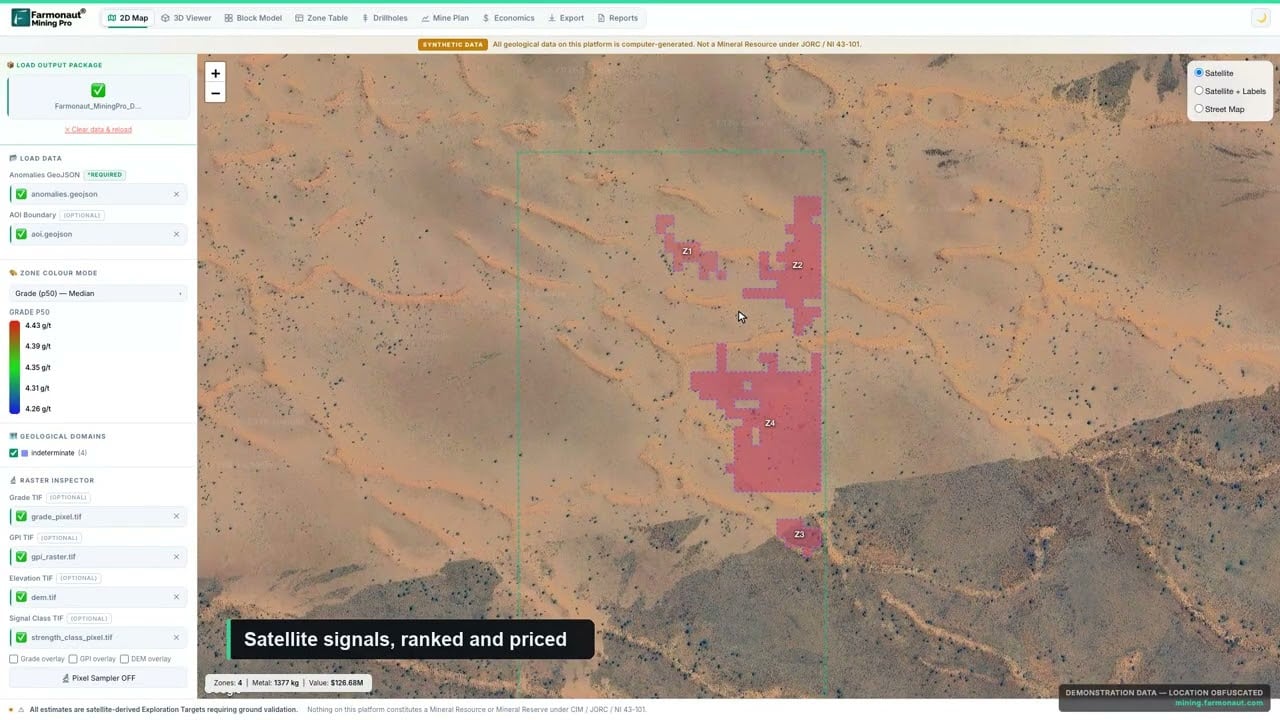
▶ A short look at Farmonaut Mining Pro, the satellite platform that turns a licence boundary into a geological and economic picture (demo data). · 4:56
Frequently asked questions
How much does a cheap gold mine cost?
In a snapshot of 24 gold claims listed on 15 October 2026, asking prices ran from US$500 to US$70,000 with a median of about US$9,600. A producing mine with permits and a plant costs far more; those sell through company deals.
Can I buy a uranium mine for under US$100,000?
Not a permitted mine. In areas open to claiming, a uranium claim can be located for the filing fees, but ground with permits, resources and a processing route sells for millions. The Colorado package agreed in September 2026 was priced at about US$2 million.
Is an unpatented mining claim the same as owning the land?
No. BLM states that the surface of an unpatented claim is not private property and ownership stays with the United States. The claim holder owns a right to the minerals, as long as the claim is maintained.
What does it cost to keep a claim each year?
BLM charges a US$200 maintenance fee per claim, due on or before 1 September, or a US$15 per claim affidavit for holders of 10 or fewer claims who qualify for the small-miner waiver. County recording fees are extra.
Why are some mines for sale so cheap?
Usually because the buyer is paying for a right to explore, not for proved ounces. Other causes are old workings with clean-up liability, no road or water, back fees, or a historic estimate that no one has rechecked.
What is the difference between a mineral resource and a reserve?
A resource is a deposit with reasonable prospects for economic extraction; a reserve is the part shown to be economic after studies. S-K 1300 says an initial assessment can support resources but not reserves.
How do I check that a claim is real?
Get the BLM serial number, look it up in the MLRS research map, and confirm the county recorder’s filing and the current maintenance fee or waiver. BLM says the seller of properly recorded claims should be able to provide the serial numbers.
Do I need a permit to work a claim I bought?
Casual use needs no plan or bond. Anything above casual use needs a notice or a plan of operations, and bulk sampling of 1,000 tons or more of presumed ore needs a plan of operations. Both need a financial guarantee for reclamation.
Can a foreigner buy a mine or a claim?
It depends on the country. Ghana limits small-scale licences to its citizens, and Tanzania limits primary mining licences to Tanzanian citizens or wholly Tanzanian companies. Check the mining act of the country first.
Are old abandoned mines safe to buy?
Not by default. BLM says many mines abandoned before 1981 left safety and environmental hazards. Order a site assessment, and ask a lawyer about the Superfund bona fide prospective purchaser conditions before you sign.
Is there a difference between a mine for sale and a mining claim for sale?
Yes. A claim is a legal right to look for and extract minerals on public land, while a mine implies workings, permits and usually a resource estimate. Most low-priced US listings are claims. Ask the seller for the BLM serial number and any permit numbers to see which one you are being offered.
What should I check before buying an old mine?
Check title and claim status, open shafts and other safety hazards, past contamination, and whether you can qualify for the EPA’s bona fide prospective purchaser protection. Do not enter old workings without a safety assessment.
Can I buy a mine in the UK?
You can buy land and the privately owned minerals under it, but oil, gas, coal, gold and silver are held by the state under UK law (British Geological Survey). Check the Land Registry and the minerals planning authority first.
Where can I find uranium mines for sale?
Most uranium assets move through company press releases and filings, not listing sites. MineListings showed no Utah listings on 16 October 2026. Track junior company releases on SEDAR+ and SEC EDGAR for the actual deals.
This page is for information only. It is not legal advice or investment advice. Confirm the rules with the regulator, and take legal advice before you buy a claim or a mine. Prices are dated examples from sellers and price reporters and change often. Do not enter old workings without a safety assessment, and get permission from the landowner or land manager before you prospect.
Farmonaut mining
Map your mining site from space before you buy
Send a KML, KMZ or polygon and Farmonaut screens the claim area from satellite images before a site visit.

Mining Pro sample view, synthetic data
Keep reading
Sources
- BLM, Mining claim fees: blm.gov
- BLM, 2027 assessment year mining season notice: blm.gov
- BLM, Mining claims packet (Montana), February 2026: blm.gov
- BLM, Mining claims and the General Mining Law of 1872: blm.gov
- BLM, Locatable minerals: mining claims: blm.gov
- BLM, Abandoned Mine Lands: blm.gov
- 43 CFR 3809.11, When a plan of operations is required: law.cornell.edu
- 43 CFR 3809.500, BLM financial guarantee requirements: law.cornell.edu
- 17 CFR 229.1300, Regulation S-K subpart 1300: law.cornell.edu
- Ontario Securities Commission, NI 43-101 unofficial consolidation: osc.ca
- US EPA, Bona Fide Prospective Purchasers: epa.gov
- USGS, Mineral Commodity Summaries 2026: Gold (February 2026): pubs.usgs.gov
- World Nuclear Association, US uranium mining and exploration (updated 10 April 2026): world-nuclear.org
- Cameco, Uranium price table: cameco.com
- Premier American Uranium, Colorado asset sale to DISA Uranium (15 September 2026): bnnbloomberg.ca
- Kitco, Gold price (15 October and 5 November 2026): kitco.com
- MiningClaimSales.com, active claim listings (15 October 2026): miningclaimsales.com
- MiningClaimSales.com, 2026 market overview (January 2026): miningclaimsales.com
- Mountain Man Mining, gold claims for sale (15 October 2026): mountainmanmining.com
- Land Resellers, patented mining claims (16 October 2026): landresellers.com
- MineListings.com, Utah listings (16 October 2026): minelistings.com
- Nevada Division of Minerals, Mining claims filing timelines: minerals.nv.gov
- Salt Lake Tribune, Velvet-Wood uranium mine (7 November 2025): sltrib.com
- Ghana Minerals Commission, FAQs: mincom.gov.gh
- Tanzania Mining Act: tanzanialaws.com
- Mayer Brown, Africa mining know-how: Zimbabwe: mayerbrown.com
- Anfield Energy, news (27 August 2026 Velvet-Wood announcement): anfieldenergy.com
- Ghana Minerals Commission, Overview of the Minerals and Mining Act 2006 (Act 703): mincom.gov.gh
- British Geological Survey, UK mineral ownership: bgs.ac.uk
- Arkansas State Parks, Crater of Diamonds State Park: arkansasstateparks.com
- USGS, Mineral Commodity Summaries 2026: Gemstones: pubs.usgs.gov
Discussion
Questions, corrections or field experience? Share them below. First-time comments are reviewed before they appear, and your email is never published.
No comments yet. Be the first to add a question or your experience.

 SRK Consulting
 Berks Gold Limited
 Mwerezi Minerals Company Limited
 Mining SARL
 SenGold Invest SAS
 Sania Corporation
 Sean Mining Limited
 NTS Group (Pty) Ltd
 Mine4Africa
 Lithspo Minerals Limited
 Tintina Mining Group
 Dalgety Minerals Pty Ltd
 Vortex Minerals Pty Ltd
 Faith At Work (Pty) Ltd
 Geotech Mining Solutions plc
 Vulcan International Limited

 Licence holder · Nigeria · Gold + lithium










