

Nevada silver-gold district · Fact guide
What Is the Comstock Lode? Location, Ore and Output
The Comstock Lode is a silver-gold vein system in Storey County, Nevada, found in 1859. The USGS records about 8.3 million ounces of gold and 192 million ounces of silver from it, and 80 percent came out before 1880 (NBMG).
Key takeaways
- The Comstock Lode is a silver-gold vein system in the Virginia Range, Storey County, Nevada, about 25 km southeast of Reno; it was found in 1859 (USGS Bulletin 1857-H, 1990).
- Recorded output is about 8.3 million oz of gold and 192 million oz of silver, with 80% mined before 1880 and a value of $412 million at the time (USGS, 1990; NBMG).
- The ore is fine-grained quartz with zinc, lead and silver sulfides and gold, formed in Miocene volcanic rock along the 11 km Comstock fault (USGS, 1990; Bastin, 1922).
- Gold was about 4% of the ounces but $8 billion of the $11 billion total at 2009 prices (NBMG figures quoted by the Mining History Association).
- Mills used mercury at about 236 sites and released an estimated 14 million pounds into the environment; the Carson River Mercury Site joined the EPA priority list in 1990.
In this article
- Comstock Lode facts at a glance
- Where is the Comstock Lode located?
- What is Comstock Lode ore made of?
- How the Comstock Lode formed
- Comstock Lode history: key dates
- How much was the Comstock Lode worth?
- How Comstock ore was mined and milled
- The mercury and land legacy of Comstock milling
- Reading the Comstock from space
- Lode claims and the mining law
- Frequently asked questions
The Comstock Lode is a silver and gold vein system in the Virginia Range of Storey County, Nevada, about 25 km (15 miles) southeast of Reno. It was found in 1859, and the U.S. Geological Survey (USGS) records about 8.3 million troy ounces of gold and 192 million ounces of silver from the district. The Nevada Bureau of Mines and Geology (NBMG) figures, quoted by the Mining History Association (MHA), add that 80 percent of that output came before 1880 and that it was worth $412 million when it was produced.
Three terms first. A lode is a hard-rock vein, or a zone of many veins, as opposed to a placer, which is gold in loose sand and gravel. Ore is rock that can be mined at a profit. A troy ounce is 31.1035 grams, so 192 million ounces of silver is about 5,970 tonnes and 8.3 million ounces of gold is about 258 tonnes (our conversion). This page covers the lode itself: where it is, what the ore is made of, how it formed, its history and its output, with a calculator that values that output at prices you type in. The company that holds ground there today has its own page: Comstock Mining Company and the Comstock silver mine.
Comstock Lode facts at a glance
This table gathers the numbers most readers look for, each with the source that states it. Where two sources differ, the next sections say so.
| Item | What the sources say | Source |
|---|---|---|
| Location | Virginia Range, Storey County, Nevada; about 25 km southeast of Reno | USGS Bulletin 1857-H |
| Found | 1859: the Ophir bonanza in the north and gold in place at Gold Hill in the south | USGS Bulletin 1857-H |
| Metals | Silver and gold, in ore that also held zinc, lead and copper sulfides | USGS Bulletin 735-C |
| Deposit type | Epithermal bonanza quartz veins in volcanic rock | USGS Bulletin 1857-H |
| Host rocks | Miocene andesite lavas and tuffs of the Alta and Kate Peak Formations | USGS Bulletin 1857-H |
| Main structure | The Comstock fault, an east-dipping normal fault at least 11 km long | USGS Bulletin 1857-H |
| Age of the ore | Miocene; potassium-argon ages on vein adularia run from 13.7 to 12.6 million years | PorterGeo summary of Hudson, 1987 |
| Recorded output | About 8.3 million oz gold and 192 million oz silver | USGS Bulletin 1857-H |
| Boom years | 1860 to 1880; production peaked in 1877 | National Park Service; MHA (1877 peak) |
| Status of the area | Virginia City Historic District, a National Historic Landmark | National Park Service |
Where is the Comstock Lode located?
The lode lies in the Virginia Range of Storey County, Nevada, as the NBMG describes it. The USGS places the district 25 km southeast of Reno and says the mining camps of Virginia City, Gold Hill and Silver City sit over its most productive parts. The National Park Service puts the historic district halfway between Reno and Carson City, and says buildings once ran in an unbroken line from Virginia City through Gold Hill to Silver City, four miles to the south. Dayton, on the Carson River, took the ore to its mills.
By road, the MHA gives the distance from Reno to Virginia City as 27 miles. The Grosh brothers found a vein on the slope of Mount Davidson in 1857, two years before the strikes that started the rush.
Main mines from north to south
The MHA lists the mines along the lode from north to south as the Sierra Nevada, Union, Mexican, Ophir, California, Consolidated Virginia, Best and Belcher, Gould and Curry, Savage, Hale and Norcross, Chollar, Potosi, Bullion, Exchequer, Alpha, Imperial, Challenge and Confidence, Yellow Jacket, Kentuck, Crown Point, Belcher, Overman and Caledonia. A few of them carry most of the story.
| Mine or camp | What the sources record |
|---|---|
| Ophir | Peter O’Riley and Patrick McLaughlin struck silver here in 1859. George Hearst bought a share, and his earnings from the Ophir and Gould and Curry mines began the Hearst fortune (MHA). |
| Consolidated Virginia | Its Big Bonanza produced $111 million between 1873 and 1880 (NBMG figure quoted by the MHA). The USGS describes the Consolidated Virginia and California ore as three bodies of crushed quartz and wall rock, cut by rare narrow veins. |
| Crown Point | The 1871 bonanza produced $35 million (NBMG figure quoted by the MHA). |
| Gold Hill | James Finney, Jack Yount and John Bishop found gold in place at the head of Gold Canyon in 1859 (USGS). This marks the southern end of the main trunk of the lode. |
| Silver City | The southern limit of the lode, four miles south of Virginia City (National Park Service). The USGS defines the Comstock Lode as the mines on mineralized rock between and including Silver City and Virginia City. |
Surface clues and hidden ore
The ore did not all show at the surface. USGS geologist Edson Bastin, writing in 1922, noted a weathered zone 300 to 500 feet deep above the old water table, and described rich silver ore at depths of 1,800 to 2,250 feet in a blind vein, one that never reaches the surface even as an empty crack. By then a large part of the lode had been drained to and below the 2,900-foot level. What the surface did show was altered rock, which the NBMG says turned white and red when hot water passed through it about 14 million years ago.
What is Comstock Lode ore made of?
The ore is dominated by quartz, sphalerite and galena, with smaller amounts of argentite, polybasite, stephanite, chalcopyrite, pyrite, gold and electrum, according to the USGS. In plain words: quartz is the glassy vein rock; sphalerite is zinc sulfide; galena is lead sulfide; chalcopyrite is copper-iron sulfide; pyrite is iron sulfide; argentite is silver sulfide (Ag2S); polybasite and stephanite are silver sulfosalts, minerals that hold silver with sulfur and either antimony or arsenic; and electrum is a natural gold-silver alloy. The NBMG notes that silver in these ores was most often combined with sulfur, which shaped how it had to be milled.
Chart
How big a Comstock ore shoot got
Upper limits for individual shoots, metres
Bastin’s microscope work for the USGS found the ore fine grained. Metallic grains were commonly under 1 millimetre across, and only rarely 5 to 10 millimetres. The gold was very pale yellow, which points to a high silver content, and some gold areas reached 1 millimetre. Gold, argentite, galena and chalcopyrite sat side by side in the spaces between quartz and sphalerite crystals, which Bastin read as one period of mineralization from rising hot water.
The ore was not a single thick vein. PorterGeo’s summary of the district, which draws on Hudson (1987), calls most of the lode a stockwork, a web of many small veins in rock. Individual veins were mostly 2 to 30 millimetres wide and rarely more than 300 millimetres, and as many as 30 generations of cross-cutting veins have been counted. Vein density did not track grade. The rich ore sat in shoots, which are pods of high-grade rock inside the wider lode, and a shoot rarely stood more than 150 metres tall.
Because gold and silver came out together, the ratio is worth a line. The recorded output is about 23 ounces of silver for every ounce of gold (192 divided by 8.3, our calculation). Gold was about 4 percent of the metal ounces. No published average grade covers the whole lode, so this page gives none; PorterGeo describes the district as a group of bonanza silver-gold shoots of exceptional grade.
How the Comstock Lode formed
The Comstock is classed by the USGS as an epithermal bonanza deposit in quartz veins hosted by volcanic rock. Epithermal means formed at shallow depth from hot water, and our guide to epithermal gold deposits covers the styles in detail. At the Comstock the ingredients were a volcanic pile, a large fault and hot water. The Alta Formation, which is 17 to 14 million years old, and the Kate Peak Formation, 15.3 million years old or younger, are lavas and tuffs. The Comstock fault cuts both. It dips east and is at least 11 km long, and the ore bodies sit along its plane and in its hanging wall, the rock above the fault.
Chart
Age ranges of the Comstock rocks and ore
Million years ago (Ma), potassium-argon dating
The USGS reports that fluid-inclusion filling temperatures in vein quartz ranged from 240 to 295 degrees Celsius, and that stable isotope studies show the hot water was mostly rain-derived groundwater, with a larger magma share only at depth. Volcanism, faulting and mineralization overlapped in time. Potassium-argon dating of vein adularia, a potassium feldspar that forms in veins like these, gives 13.7 to 12.6 million years for the Comstock and Occidental veins (PorterGeo summary of Hudson, 1987), and 12.8 million years for the Occidental vein (USGS).
The hot water also changed the rock around the veins. The USGS describes zones from weakly altered chlorite and epidote rock at the edge, through clay-rich rock, to silica-rich rock and cores of alunite and quartz near the fractures. Bastin concluded that the metals came up from depth, and noted in 1922 that water rising along the lode still carried small amounts of gold and silver.
Comstock Lode history: key dates
Placer gold came first. The NBMG dates the first discovery near present-day Dayton to 1849 and credits Abner Blackburn; the USGS says gold was first found in Gold Canyon in 1850 by John Orr and Nick Kelly. Either way, placer miners followed the traces up the canyons until the lode was found. The table lists the main dates, each with its source.
Chart
Two notable bonanzas against the whole lode
US$ million at the time of production; periods differ (see labels)
| Year | Event | Source |
|---|---|---|
| 1857 | Ethan and Hosea Grosh find a vein on Mount Davidson and die before developing it | MHA |
| 1859 | O’Riley and McLaughlin find the Ophir ore; Gold Hill gold found in place | USGS; MHA |
| 1860 | Philipp Deidesheimer devises square-set timbering; the rush to the Washoe begins | NBMG; MHA |
| 1862 | 80 mills are running; Virginia City and Gold Hill hold about 4,000 people | NBMG; National Park Service |
| 1863 | About $10 million produced from near-surface workings; Andrew Hallidie’s cable developed | USGS; NBMG |
| 1864 | Nevada becomes a state | NBMG |
| 1869 | Carson City Mint opens (NBMG’s date); Adolph Sutro starts his drainage tunnel | NBMG |
| 1871 | Crown Point bonanza, worth $35 million | MHA |
| 1873 to 1880 | Big Bonanza of the Consolidated Virginia mine, worth $111 million | MHA |
| 1874 | Virginia City and Gold Hill hold about 25,000 people | National Park Service |
| 1875 | Fire destroys the Virginia City business district | MHA |
| 1877 | Production peaks | MHA |
| 1878 | Sutro Tunnel finished, but the mines are already deeper than it | NBMG |
| 1880 | About 80 percent of all output already mined | MHA |
The MHA gives 1888 as the date the Sutro Tunnel was completed, while the NBMG says 1878; this page uses the NBMG date. By the National Park Service’s count, almost seven million tons of ore were mined and milled between 1860 and 1880, and the wealth helped fuel the growth of San Francisco through investment in the mines. The same source notes that Virginia City had the first miners’ union in the United States.
Federal mining law came after the discovery, not before it. The Bureau of Land Management (BLM) says the General Mining Law of 1872 combined two earlier laws, from 1866 and 1870, so the first Comstock claims were staked years before any federal rule existed.
How much was the Comstock Lode worth?
At the time of production, the metal was worth $412 million, in the NBMG figure quoted by the MHA. The same summary values the whole output at about $11 billion at 2009 prices, $3 billion in silver and $8 billion in gold. That split is the useful part. Silver made up about 96 percent of the ounces, but gold carried about 73 percent of the value at those prices (8 of 11 billion, our calculation).
Chart
The Comstock’s output in years of current U.S. output
Recorded Comstock metal divided by estimated 2025 U.S. mine production
The totals agree, but the end date differs by source. The USGS bulletin gives 8.3 million ounces of gold and 192 million of silver and says mining continued until about 1955; the NBMG figures run from 1859 to 1986. The USGS abstract rounds the same totals to more than 8 million ounces of gold and 190 million of silver.
To put the total in modern terms, the USGS estimates U.S. mines produced 160 tonnes of gold in 2025, and its silver summary estimates 1,100 tonnes of silver. The Comstock’s recorded gold, about 258 tonnes, equals roughly 1.6 years of that gold output, and its silver, about 5,970 tonnes, equals roughly 5.4 years of that silver output (our calculation).
The calculator below values the recorded output at any price pair you choose. The starting prices are the USGS 2025 average prices, $3,300 per troy ounce of gold and $38 per ounce of silver. They are examples, so replace them with today’s quote from a source such as Kitco or the LBMA before you read anything into the result.
Calculator
What is the Comstock’s output worth at your prices?
Enter the metal prices you want to test; the output figures can be changed too.
- Silver value (US$ billion): 7.3 US$bn
- Gold value (US$ billion): 27.4 US$bn
- Gold share of total value: 79.0 %
- Silver ounces per ounce of gold: 23.1 oz
Output defaults are the USGS recorded totals for the district (8.3 million oz gold, 192 million oz silver). Prices default to the USGS 2025 average prices (gold $3,300, silver $38 per troy ounce, Mineral Commodity Summaries 2026); they are examples, so use today’s price. This is the value of metal recorded long ago, not a resource or a forecast.
How Comstock ore was mined and milled
The Comstock forced new methods because the ore sat in wide masses of quartz inside soft, wet, clay-rich ground. The NBMG’s mining tour explains that miners built wooden platforms to replace each block of ore taken out, a method called square-set timbering, invented at Virginia City by Philipp Deidesheimer in 1860. The MHA adds that it became a standard practice worldwide.
- Hoisting. Andrew Hallidie developed the wire-rope cable in 1863, and head frames lifted ore up the shafts.
- Blasting. Miners drilled by hand and used black powder, then switched to dynamite after its invention in 1866. Compressed-air drills came later.
- Water and heat. Lower levels hit hot water. The MHA says underground temperatures passed 150 degrees Fahrenheit in some mines, and mines used Cornish pumping engines and ice to cope.
- Drainage. Sutro’s tunnel was started in 1869 and finished in 1878, by which time the mines were already deeper than it, so it did not drain the lower levels.
Milling started with stamp mills that crushed the rock. Silver then had to be freed from its sulfide. The NBMG chemistry pages describe the older patio process, which was slow, did not recover all the silver and struggled with Virginia City’s freezing climate. The Washoe process improved it by heating the ore in iron pans, which raised recovery and cut processing time. Mercury caught the silver as an amalgam, and a retort then boiled the mercury off. Later, the MHA says, mills such as the Donovan were among the earliest cyanide mills on the Comstock. Modern plants still use gravity steps for some gold ores; see our guide to gravity separation methods for gold ores.
▶ Follows a gold nugget from rock to ring: found, drilled, crushed, dissolved, caught on carbon, melted and refined. · 5:27
The mercury and land legacy of Comstock milling
The mills left a lasting mark on the Carson River. The U.S. Environmental Protection Agency (EPA) says miners used mercury at about 236 mills, and that the process released an estimated 14 million pounds of mercury into the environment. The EPA’s Carson River Mercury Site profile says the site joined the National Priorities List in 1990. It covers five counties, about 330 square miles and more than 130 river miles, and EPA found mercury in soil, sediment, fish and wildlife.
EPA lists these cleanup steps. In the early 1990s EPA removed 10,735 cubic yards of contaminated soil, and it issued a Record of Decision in 1995 for the old mill sites and tailings. For the river and its floodplain, EPA’s 2017 investigation found mercury compounds to be the only contaminant of concern. Arsenic and lead had also been released in places during ore processing.
The NBMG’s environment and mining-tour pages describe other changes. Mine dumps brought hydrothermally altered rock to the surface, and the vegetation on those dumps differs from the juniper and pinyon pine of the undisturbed hills. Getting timber for the mines and clean water for the town were, in the NBMG’s words, two huge obstacles. Waste slurry from the mills often ran straight into the river, and the NBMG notes that modern regulation has cut this kind of damage while saying vigilance is still needed.
▶ Explains seven environmental impacts of mining in plain words, as a claymation with satellite maps. · 2:31
Reading the Comstock from space
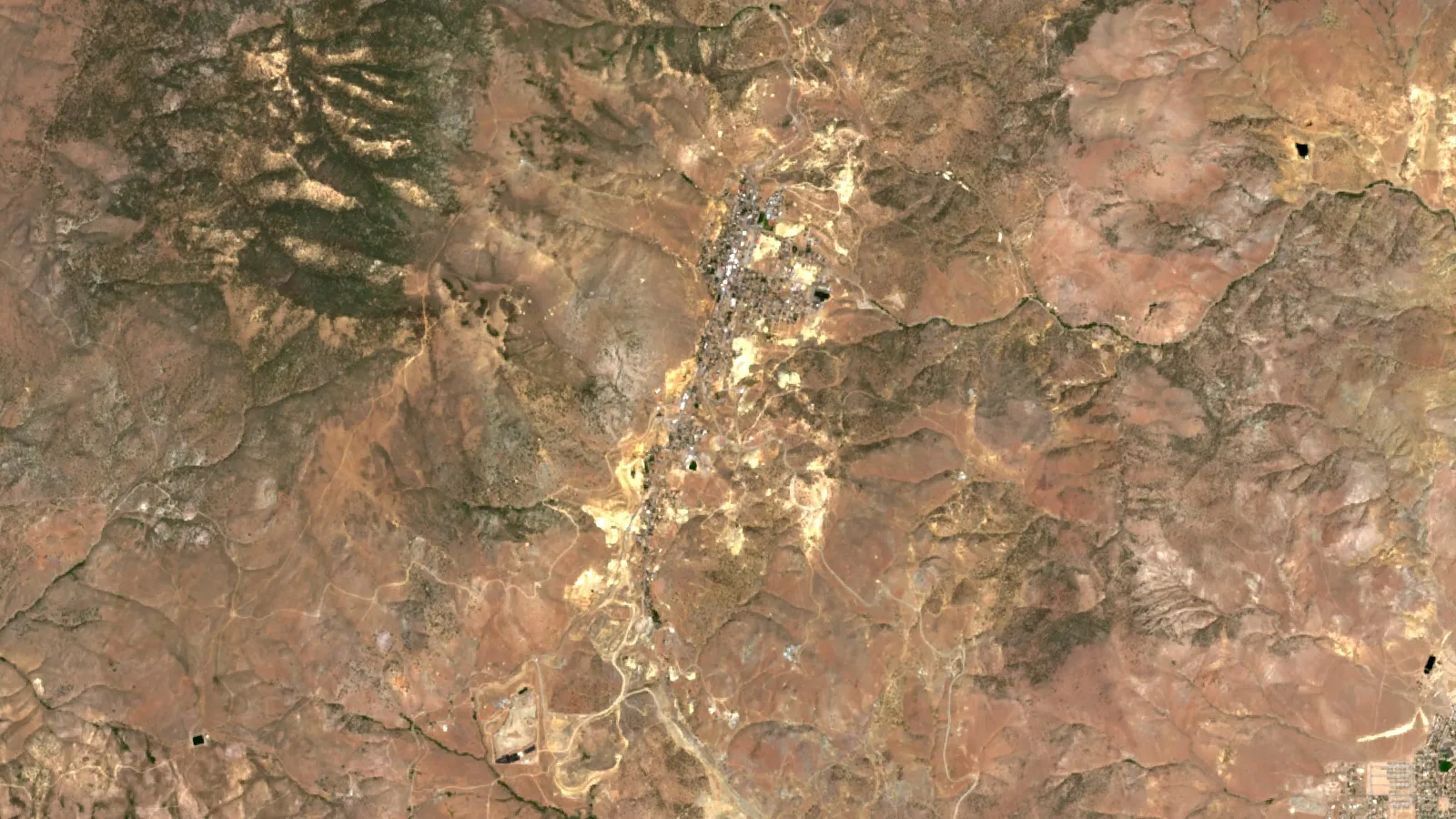
The Comstock is a textbook case of why altered ground matters. The hot water that made the ore also turned the host rock white and red, and the USGS maps clay, silica and alunite zones around the faults. Satellite sensors read these surface clues through iron-oxide staining and clay minerals, each of which has its own spectral signature. The Sentinel-2 summer satellite view at the top of this page covers the Virginia City and Gold Hill area.
Satellites show clues, not ore. The Comstock shoots were rarely more than 150 metres tall, and Bastin’s blind vein never reached the surface. Altered rock tells a geologist where to look, and drilling decides what is there. Farmonaut’s satellite mineral detection screens an area for alteration, faults and mineralized zones as exploration targets, which sit ahead of any resource estimate; the details are on our satellite mineral detection page. For a quote on your own ground, use the mining query form or contact us.
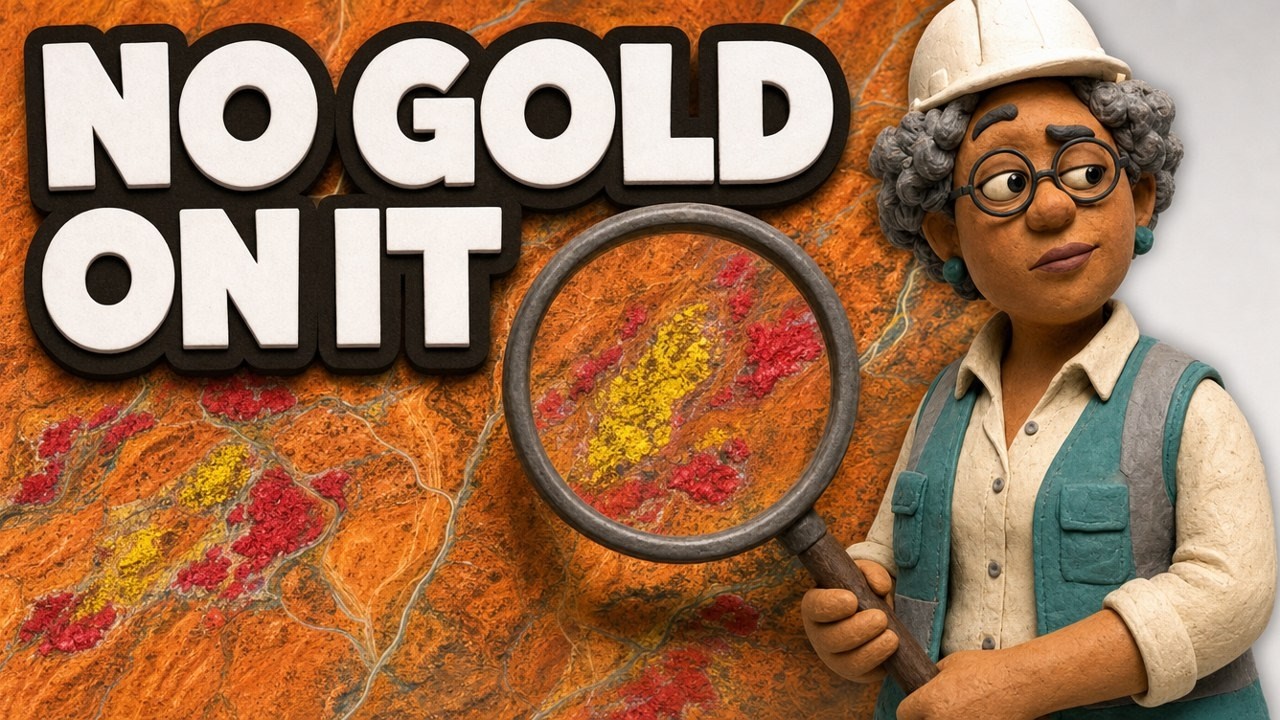
▶ Explains what a satellite gold map shows: iron-oxide rust, clay and mica, silica and faults, which are clues rather than gold itself. · 4:18
Lode claims and the mining law
Anyone reading about the Comstock soon meets the word claim. On U.S. federal land, a lode claim covers a vein or lode and the rock around it. Federal law caps a lode claim at 1,500 feet along the vein and 600 feet wide, 300 feet on each side of the centerline, as the BLM’s brochure on mining claims explains. A placer claim covers loose deposits and is limited to 20 acres per claim. Ground in and around a historic district may be private or protected, so check ownership and local rules with the county and the BLM before you stake or dig anything.
The BLM’s history of the 1872 law notes that it still governs hardrock minerals on federal land. Nevada is now the leading U.S. gold-producing state, at about 64 percent of domestic output in 2025, and the second-ranked silver state after Alaska, according to the USGS Mineral Commodity Summaries. For the state’s current gold districts, see our page on gold deposits in Nevada, and for other American silver producers see silver mines in the US.
Related reading on this site: Smelter Sulfuric Acid: Output, Capture and Where It Goes.
We cover a connected topic in Gold vs Pyrite: 7 Tests and Where Gold Hides.
Frequently asked questions
What is the Comstock Lode?
It is a silver-gold vein system in the Virginia Range of Storey County, Nevada, found in 1859. The USGS records about 8.3 million ounces of gold and 192 million ounces of silver from it. It formed in Miocene volcanic rock along the Comstock fault.
Where is the Comstock Lode located?
It is in western Nevada, about 25 km southeast of Reno, between Virginia City in the north and Silver City, four miles south. Gold Hill lies between them. Dayton, on the Carson River, was the milling town.
Who discovered the Comstock Lode?
The Grosh brothers found a vein on Mount Davidson in 1857 but died before developing it. Peter O’Riley and Patrick McLaughlin found the silver-rich Ophir ore in 1859. Henry Comstock, for whom the lode is named, joined them as a partner. Placer miners had found gold in the area a decade earlier.
How much gold and silver came from the Comstock Lode?
About 8.3 million troy ounces of gold and 192 million ounces of silver, per the USGS and the NBMG. That is roughly 258 tonnes of gold and 5,970 tonnes of silver. About 80 percent of it was produced before 1880.
What type of ore deposit is the Comstock Lode?
The USGS classes it as an epithermal bonanza deposit in quartz veins hosted by volcanic rocks. Epithermal means it formed at shallow depth from hot water. Bonanza means pockets of very rich ore.
What is Comstock Lode ore made of?
Mostly quartz, zinc sulfide (sphalerite) and lead sulfide (galena), with silver minerals such as argentite, polybasite and stephanite, plus gold and electrum. The ore was fine grained, with metallic grains commonly under 1 millimetre.
How old is the Comstock Lode?
The ore is Miocene in age. Potassium-argon ages on vein adularia run from about 12.6 to 13.7 million years, and the NBMG puts the hot-water alteration at about 14 million years ago. The host volcanic rocks are somewhat older, with the Alta Formation at 17 to 14 million years.
How deep is the Comstock Lode?
Bastin studied ore from a few hundred feet down to 2,900 feet, and a large part of the lode had been drained to that depth by 1922. He described rich silver ore at 1,800 to 2,250 feet in a blind vein. Individual ore shoots rarely stood more than 150 metres tall.
Why was the Comstock Lode important?
It was the first major U.S. silver strike, grew Virginia City and Gold Hill to about 25,000 people by 1874, and helped Nevada reach statehood in 1864. Its problems also led to square-set timbering, wire-rope hoisting and the Washoe milling process.
Is the Comstock Lode still being mined?
Large-scale mining has stopped. A 2015 MHA summary said mining on the Comstock was down to one heap-leach operation owned by Comstock Mining Inc., and the company’s SEC filings say it ceased mining in 2015 and finished leaching from its pads in December 2016; it has since focused on exploration. Heap leaching piles crushed ore on a pad and trickles a solution through it to dissolve the metal. For the company’s current activity, see our Comstock Mining Company page.
Can you visit the Comstock Lode?
The Virginia City Historic District is a National Historic Landmark and a working town, according to the National Park Service. Old shafts and tunnels are dangerous, and ground may be private or claimed, so ask permission and never enter old workings.
This page is for information only. It is not investment advice or legal advice. Confirm mining claim rules with the Bureau of Land Management and the county. Old mine workings are dangerous: get permission before you enter any land, never enter old shafts or tunnels, and never use mercury to recover gold.
Farmonaut mining
See altered ground from space before you drill
Investors can use satellite screening to see altered rock and faults across an area as exploration targets, ahead of any resource estimate.
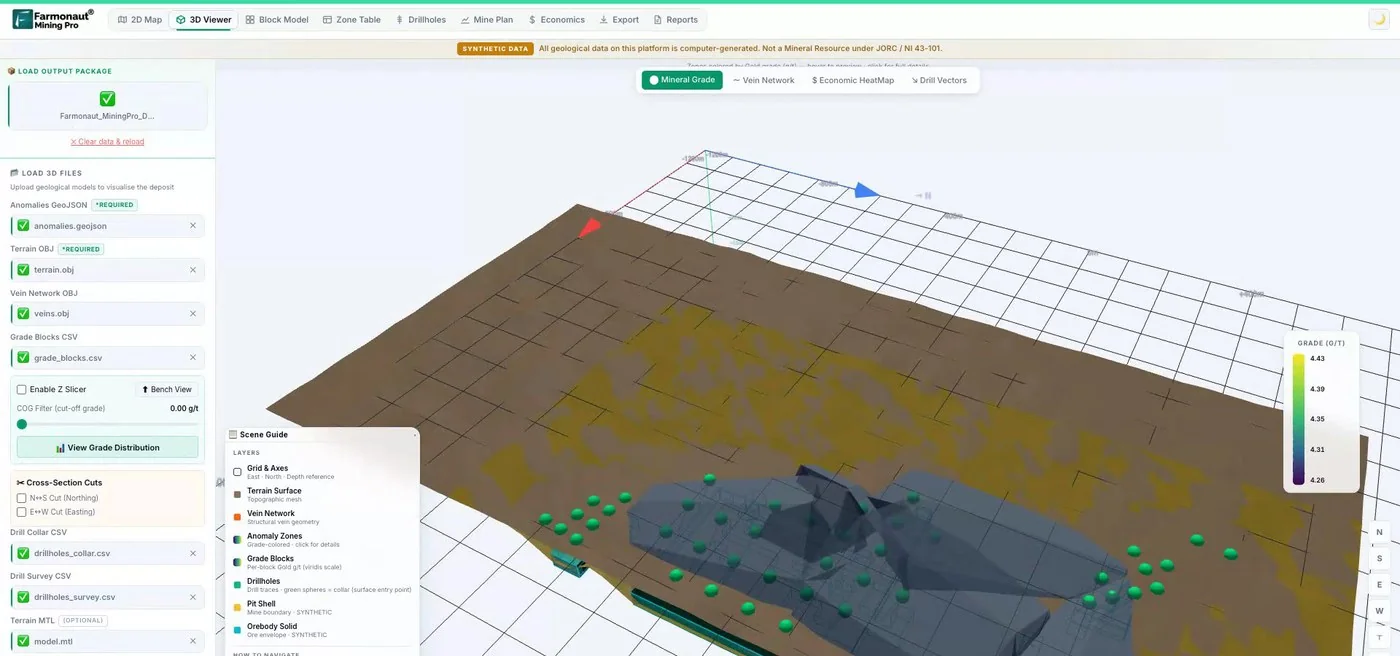
Mining Pro sample view, synthetic data
Keep reading
Sources
- USGS, Bulletin 1857-H: The Comstock Lode precious-metal district (Bagby and Ashley, 1990): pubs.usgs.gov
- USGS, Bulletin 735-C: Bonanza ores of the Comstock Lode (Bastin, 1922): pubs.usgs.gov
- Mining History Association, Virginia City and the Comstock (quoting Nevada Bureau of Mines and Geology): mininghistoryassociation.org
- National Park Service, Virginia City Historic District: nps.gov
- Nevada Bureau of Mines and Geology, Science of the Comstock: home: nbmg.unr.edu
- Nevada Bureau of Mines and Geology, Science of the Comstock: mining tour: nbmg.unr.edu
- Nevada Bureau of Mines and Geology, Science of the Comstock: ore processing chemistry: nbmg.unr.edu
- Nevada Bureau of Mines and Geology, Science of the Comstock: environment: nbmg.unr.edu
- PorterGeo, Ore Deposit Description: Comstock (summarizing Hudson, 1987): portergeo.com.au
- US EPA, Carson River Mercury Site: cleanup profile: cumulis.epa.gov
- Bureau of Land Management, Mining Claims and Sites on Federal Lands: blm.gov
- Bureau of Land Management, Lode and Placer: 150 years of mining claims: blm.gov
- USGS, Mineral Commodity Summaries 2026: Gold: pubs.usgs.gov
- USGS, Mineral Commodity Summaries 2026: Silver: pubs.usgs.gov
Discussion
Questions, corrections or field experience? Share them below. First-time comments are reviewed before they appear, and your email is never published.
No comments yet. Be the first to add a question or your experience.

 Sahara Mining
 Sean Mining Limited
 NTS Group (Pty) Ltd
 Mine4Africa
 Lithspo Minerals Limited
 Tintina Mining Group
 Dalgety Minerals Pty Ltd
 Vortex Minerals Pty Ltd
 Faith At Work (Pty) Ltd
 Geotech Mining Solutions plc
 Vulcan International Limited
 Kidepo Associates
 GKY Mining
 Alkimy SARL
 Double A Trading
 GemSprout Metals Limited
 Qader Group
 Ileys General Trading
 SG Gold Mining LLC
 VRV Global Pte Ltd
 Omsri International FZE
 G.I.T.T.
 Jaunita Erss Ltd
 SRK Consulting
 Berks Gold Limited










