
Copper exploration · Company guide
Copper Exploration Companies: Explorers and Services
Copper exploration spending hit US$3.27 billion in 2025, a 12-year high. Here are named explorers with project facts, the services that find copper, and how to read their disclosures.
Key takeaways
- Copper exploration budgets were about US$3.27 billion in 2025, up 2% and the highest in 12 years (S&P Global Market Intelligence, 2026).
- Minesite work took 45% of all nonferrous exploration money and grassroots only 21% (S&P, 2025 data).
- Named explorers here: Solaris, Ivanhoe Electric, Marimaca, Faraday, Hot Chili, Vicuña (Lundin and BHP) and KoBold, each with company-stated figures.
- Five service types do the work: satellite screening, assay labs, geophysics, drilling and consultants.
- Compare resource class, price basis and study stage before relying on any headline number.
In this article
- Who counts as a copper exploration company
- How much money goes into copper exploration
- Copper explorers and developers with named projects
- Project size and grade compared
- Where today's copper comes from
- Leading exploration services for finding copper deposits
- How to read a copper explorer's disclosures
- A simple calculator for contained copper
- Screening ground before you commit to drilling
- Frequently asked questions
Copper exploration companies are the firms that drill, sample and map ground to find new copper deposits, and they fall into three groups: majors with in-house exploration teams, listed juniors that explore and then sell or develop, and service firms that do the drilling, flying, assaying and modelling. In 2025 the industry spent about US$3.27 billion on copper exploration, a 12-year high and roughly a quarter of all nonferrous budgets (S&P Global Market Intelligence, as reported by BusinessDay, April 2026). This page lists named explorers with project facts, then the services behind them, then shows how to read their disclosures.
It is written for licence owners, consultants and investors. Company facts come from company pages, company releases and news reports opened in November 2026, each named where used. Nothing here is a recommendation to buy or sell any share; see the note at the end.
Who counts as a copper exploration company
The label covers very different businesses, and mixing them up is the most common mistake when people search for names. Three groups matter.
- Majors and large producers. They run exploration budgets next to operating mines. BHP, for example, holds half of the Vicuña project through a 50:50 joint arrangement with Lundin Mining. Our ranking of the largest copper mining companies by output covers the producers.
- Juniors and developers. These companies hold a project, drill it, publish a resource estimate and then study whether a mine pays. A “junior” has no production revenue and lives on share issues, partners or loans. Some have moved on from pure exploration into engineering studies, and several appear below.
- Service companies. Drilling contractors, airborne survey firms, assay laboratories and technical consultants. They rarely own deposits, but almost every discovery uses them.
A few terms first. Grade is the amount of copper in rock, usually as a percentage (0.5% Cu means 5 kg of copper per tonne of rock). CuEq means copper equivalent: a grade that adds gold, silver or molybdenum by converting them to copper at assumed prices, so two CuEq figures only compare if the price assumptions match. Measured, indicated and inferred are confidence classes for a resource, from most to least certain. A reserve is the part of a resource that a study shows can be mined at a profit. A pre-feasibility study (PFS) and a feasibility study (FS) are successive engineering and cost studies, and a final investment decision (FID) is the board vote to build.
How much money goes into copper exploration
S&P Global Market Intelligence put world nonferrous exploration budgets at US$12.4 billion for 2025, down 1% on 2024 and the third annual fall. Gold took US$6.15 billion, half of the total. Copper took US$3.27 billion, up 2% (BusinessDay, 9 April 2026).
Chart
Money is going to known ground
Global nonferrous budgets by stage, US$ billion, 2025
Chart
Where exploration money went in 2025
Global nonferrous exploration budgets, US$ billion
The split by stage matters more for anyone choosing a partner or a project. Spending at and around existing mines was US$5.63 billion, 45% of the total and a record share. Grassroots work, meaning early-stage hunting for new deposits, fell 8% to US$2.57 billion, the lowest share in that dataset at 21%. In plain terms, money is flowing to extending known deposits rather than to unexplored ground. That is why juniors with a drill-ready porphyry in a known belt get attention, and why early-stage screening tools are of interest to claim owners who cannot afford a drill programme.
The USGS adds the supply side. World mine output of copper was about 23 million tonnes in both 2024 and 2025 (estimate), with identified resources of 1.5 billion tonnes of unextracted copper and undiscovered resources of an estimated 3.5 billion tonnes (USGS assessment as of 2015) (USGS Mineral Commodity Summaries 2026, copper). The USGS puts the 2025 average LME grade A cash price at 440 US cents per pound, up from 414.7 cents in 2024. That price level is what pays for today’s drilling.
Copper explorers and developers with named projects
The companies below were picked because each has a copper project with published figures that we could read on a company page or in a company release, and because they span regions and stages. This is not a ranking and not a full list: hundreds of smaller firms hold copper ground. Figures are as the company states them, on the date given, and are not independently verified.
Solaris Resources (TSX: SLS)
Solaris describes itself as a copper exploration and development company. Its flagship is Warintza in south-eastern Ecuador, a porphyry system, meaning a large body of low-grade copper in rock around an old intrusion. The company reports measured and indicated resources of 3.7 billion tonnes at 0.32% CuEq and inferred resources of 2.1 billion tonnes at 0.20% CuEq. A pre-feasibility study released on 6 November 2025 gives a net present value of US$4.6 billion and more than 300,000 tonnes of CuEq a year in the first five years. Solaris also lists projects in Peru, Chile and Mexico, and gives full permitting as a target for the end of the first half of 2027 and a final investment decision in the second half of 2027 (Solaris Resources, company website).
Ivanhoe Electric (Santa Cruz, Arizona)
Ivanhoe Electric’s Santa Cruz copper project near Casa Grande sits on about 6,000 acres of private surface, mineral and water rights. The September 2026 pre-feasibility study describes a 20,000-tonne-per-day underground mine with heap leaching and a 24-year life. Probable reserves are 140 million tonnes at 1.08% copper, containing 1.5 million tonnes of copper, with a further 3.3 million tonnes of inferred copper across Santa Cruz, East Ridge and Texaco. First cathode is projected for 2029, subject to financing and permits. The company also lists a proprietary geophysical technology, Typhoon, and a 26.5 square kilometre survey at Santa Cruz reported in 2022 (Ivanhoe Electric, Santa Cruz page).
Marimaca Copper (TSX and ASX)
Marimaca’s Marimaca Oxide Deposit is in Chile’s Antofagasta Region, about 25 km from the port of Mejillones. Oxide copper is the near-surface, weathered part of a deposit that can be dissolved with acid, which is cheaper than milling sulphide ore. The company reports the project as permitted, with a definitive feasibility study completed in 2025 and a grid connection authorisation plus agreed power terms reported on 8 October 2026. Its exploration arm is Pampa Medina, bought in October 2024, about 28 km from the main deposit inside a 14,500-hectare package (Marimaca Copper, company website).
Faraday Copper (TSX: FDY)
Faraday’s Copper Creek project is part of the Redhawk Copper Complex in Pinal County, Arizona, with Copper Creek and the adjacent San Manuel project together holding about 35,000 acres of private land. The company’s site links to the closing of its acquisition of the San Manuel project in Arizona, dated 15 October 2026, with drill rigs mobilised to the property (Faraday Copper, company website). The Copper Creek and San Manuel ground sits in the same Arizona porphyry belt that produces most US copper: the USGS reports Arizona as the leading copper-producing state at about 70% of domestic output.
Hot Chili (ASX: HCH)
Hot Chili’s Costa Fuego project in Chile’s coastal Atacama region has a pre-feasibility study (company release) showing a post-tax NPV (at 8%) of US$1.2 billion, an IRR of 19%, start-up capital of US$1.27 billion, and average output of 116,000 tonnes of copper equivalent a year over the first 14 years, with a C1 cash cost of US$1.38 per pound. C1 cost means the direct cost of mining, milling and delivering the metal, before depreciation and corporate costs. The probable reserve is 502 million tonnes at 0.46% CuEq. The company also reports a discovery at La Verde, with a maiden resource due later in 2026, and targets environmental permitting in 2027 and first production around 2031 (Motley Fool Australia, 4 August 2026).
Vicuña (Lundin Mining and BHP, 50:50)
Vicuña, owned 50:50 by Lundin Mining and BHP through Vicuña Corp. (Lundin Mining), combines the Filo del Sol and Josemaria deposits along the Chile-Argentina border. As of Lundin’s February 2026 update, Filo del Sol holds measured and indicated resources of 2,572 million tonnes at 0.38% Cu, 0.32 g/t gold and 8.1 g/t silver, about 9.76 million tonnes of copper, drilled with 224,849 m in 435 holes. Josemaria has 1,609 million tonnes at 0.28% Cu, about 4.58 million tonnes of copper. The district total is 4,181 million tonnes with about 14.3 million tonnes of contained copper, on price assumptions of US$4.60 per pound copper. Lundin declassified the Vicuña reserves in April 2025 and expects to convert resources back to reserves as studies advance (Lundin Mining resource release, 19 February 2026).
KoBold Metals (Mingomba, Zambia)
KoBold Metals is a private company that uses machine-learning models on geological and geophysical data to rank exploration targets for copper, cobalt, nickel and lithium. At Mingomba in Zambia it said in March 2026 that it had begun development: capital cost of US$2.3 billion to US$2.5 billion, output of 300,000 tonnes of copper a year, shaft sinking expected in early 2027 and production targeted for the early 2030s. Its Africa chief executive said then that the project was still held by KoBold alone (Miningmx, 2026). It is a useful example of a data-led explorer that has moved into construction. For Zambian ground, see also our guide to where copper is found.
Project size and grade compared
Grade and tonnage tell different stories. Filo del Sol and Josemaria are low-grade, very large systems, while Santa Cruz is a smaller, high-grade underground deposit. The chart plots contained copper against grade, using only copper grades (not copper equivalent) so the comparison is fair. Note the basis: the Vicuña points are measured and indicated resources, and the Santa Cruz point is a probable reserve, which is a stricter class.
Chart
Big and low grade, or small and high grade
Contained copper vs grade; Cu only, not copper equivalent
Where today’s copper comes from
New projects matter because current mines are ageing and mine supply is concentrated. USGS tables show Chile at 5.51 million tonnes in 2024 and 5.3 million tonnes in 2025 (estimate), the Democratic Republic of the Congo at 2.99 million rising to 3.2 million, and Peru at 2.74 million easing to 2.7 million. Russia rose from 1.02 million to 1.3 million tonnes. The chart shows six producers side by side (USGS Mineral Commodity Summaries 2026). Chile is also home to several of the projects above: Marimaca, Hot Chili and, on the border with Argentina, Vicuña. For a deposit-type view, read our guides to copper deposit types and where to explore and porphyry copper deposits.
Chart
Mine output of six copper producers
Thousand tonnes of contained copper
▶ Explains why electric vehicles need more copper and where the metal is mined. · 6:03
Leading exploration services for finding copper deposits
People who search for “copper exploration services” usually want one of five things: drilling, airborne or ground geophysics, geochemistry and assays, technical consulting, or data and mapping. Each solves a different problem, and the order below follows the order of a typical campaign.
Geological mapping and satellite screening
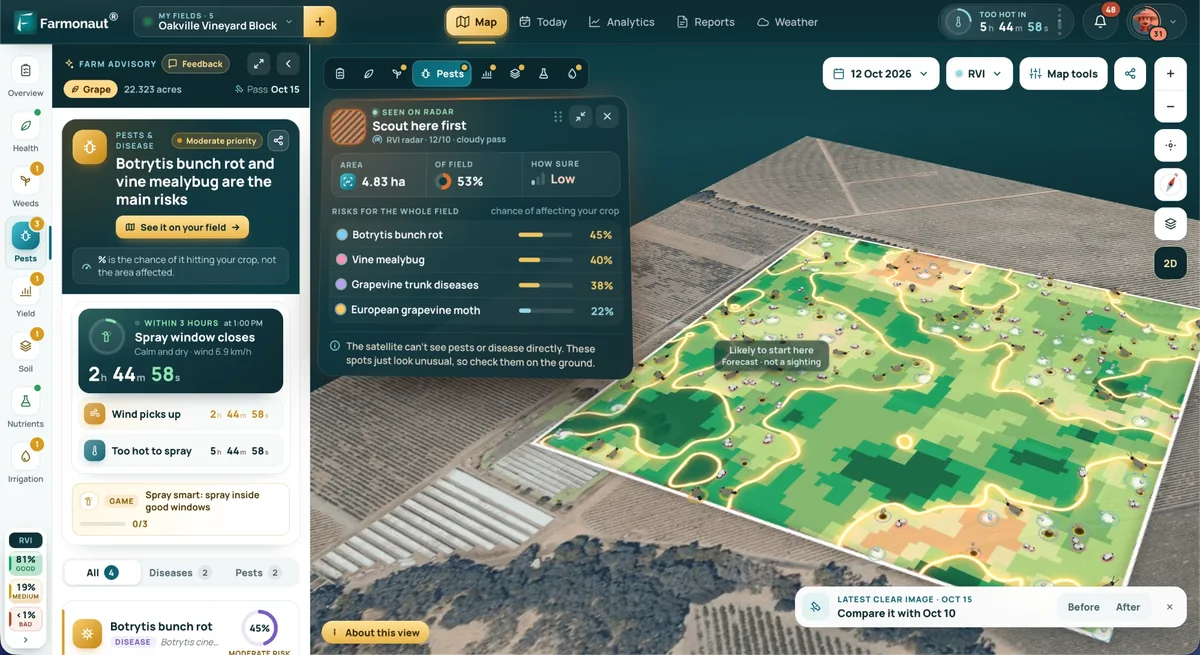
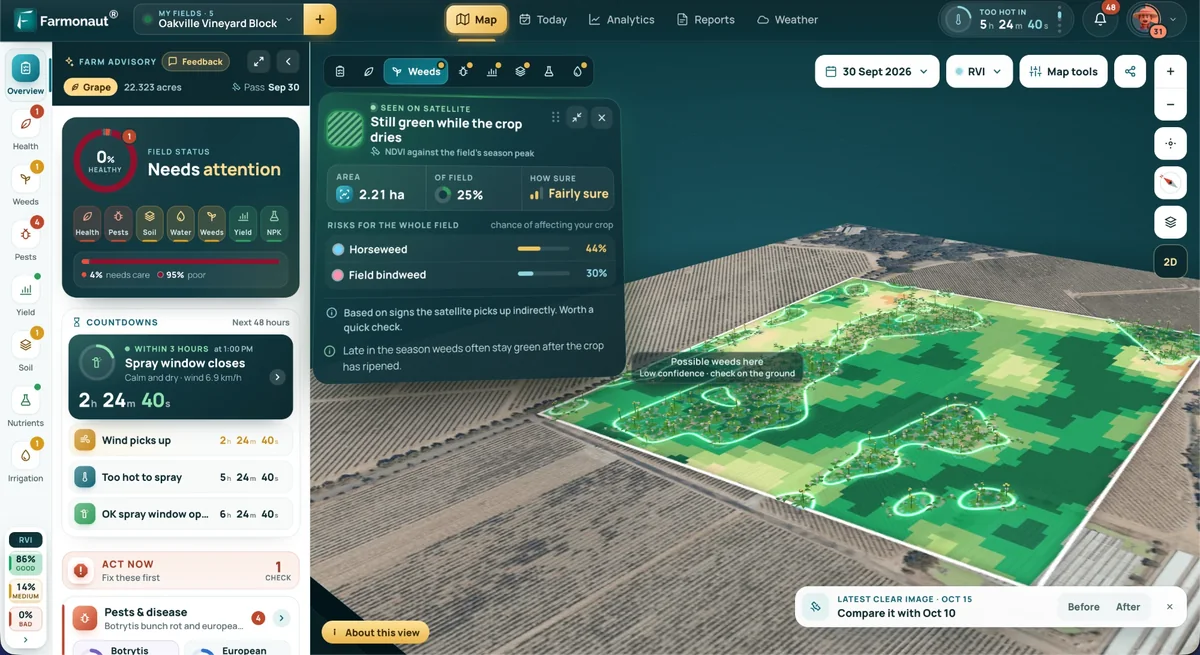
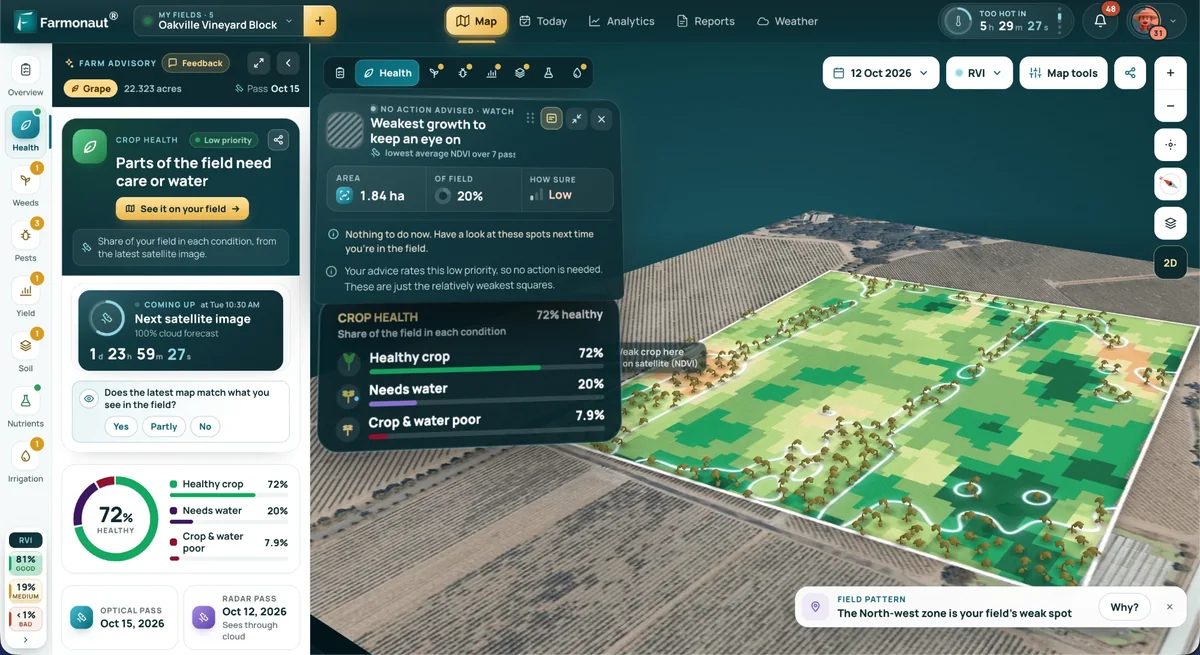
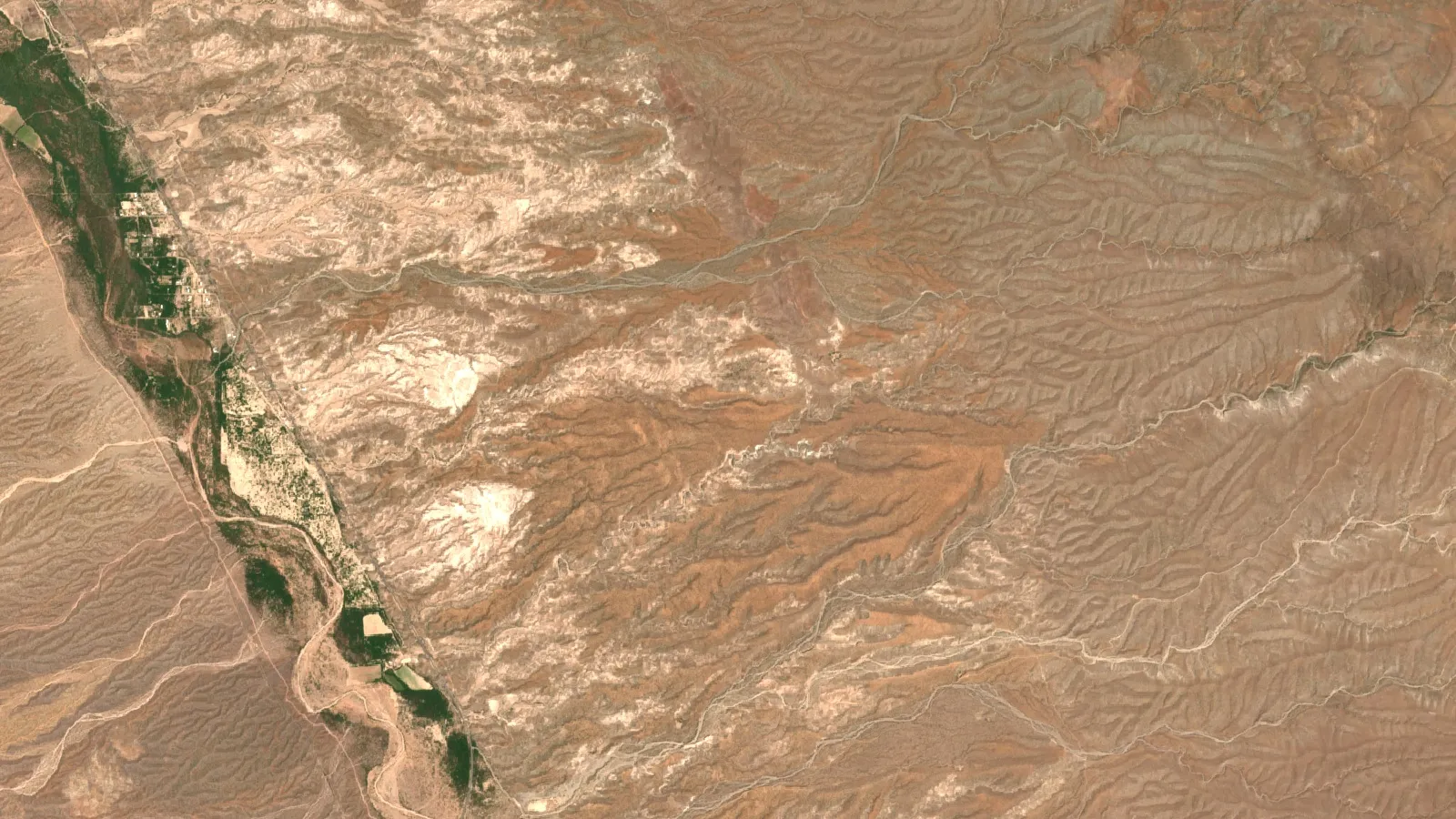
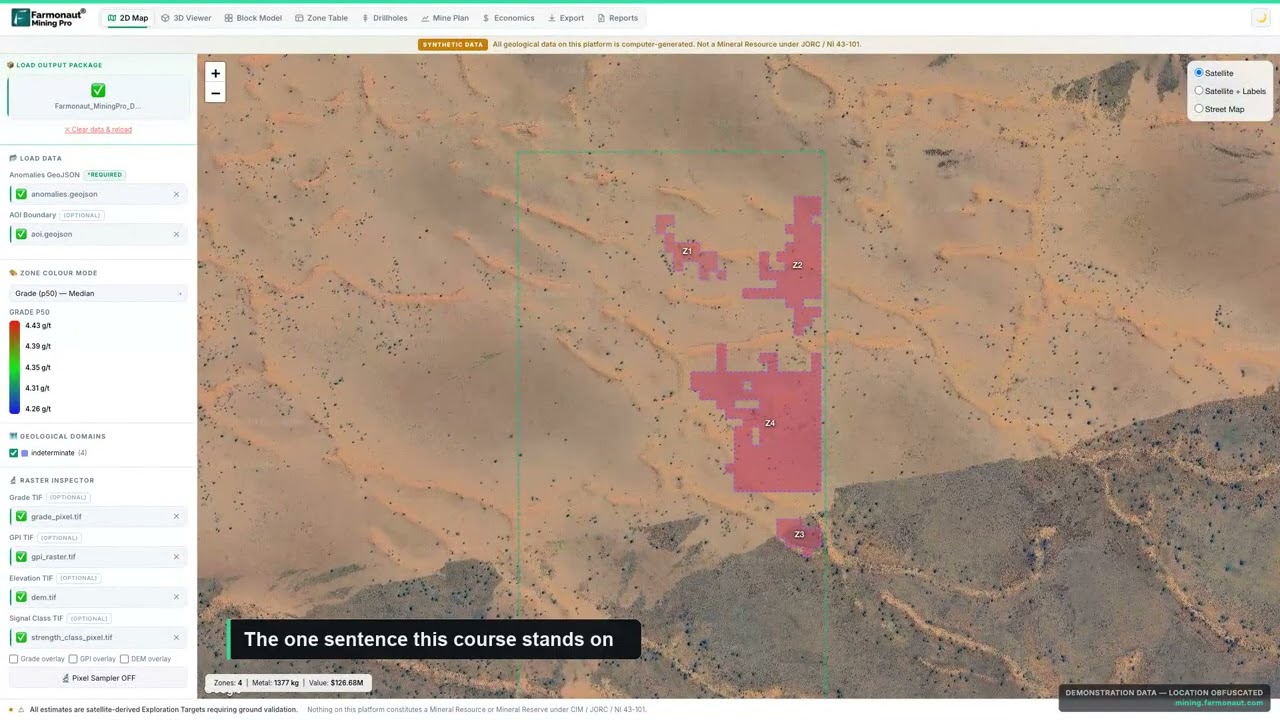
The first step is cheap: desk study of public geology, then satellite imagery. Multispectral satellites can show iron-oxide staining and clay or sericite alteration, which often surround porphyry copper systems; a USGS porphyry copper model describes how these alteration zones and geophysical signatures guide exploration. Sentinel-2 has 13 spectral bands at 10 to 60 m resolution and a 290 km swath, and NASA’s ASTER adds six shortwave-infrared bands at 30 m, the range used for clay and mica minerals. This narrows the area before a field crew goes in. It does not measure copper in rock, and a satellite anomaly is a target to check on the ground, not a resource. Farmonaut offers satellite mineral-target screening of a licence area for this stage, on a polygon you supply.
Geochemistry and assay laboratories
Soil, stream-sediment and rock samples go to a laboratory for sample preparation (drying, crushing, splitting, pulverising) and analysis. ALS lists base metals analysis by aqua regia, four-acid digestion and fusion, and states that its services meet ISO/IEC 17025:2017 and ISO 9001:2015 (ALS Geochemistry). Four-acid digestion dissolves most silicate minerals, which matters because copper can be locked in them. For sampling design, see our guide to geochemical survey design.
Airborne and ground geophysics
Geophysics measures physical properties below the surface. Airborne electromagnetic (EM) and magnetic systems cover large areas fast, while ground induced polarisation (IP) surveys detect disseminated sulphide minerals, which is why IP is a standard tool for porphyry copper. Geotech, an airborne survey company, offers helicopter and fixed-wing electromagnetic, magnetic and radiometric surveys, including its VTEM and ZTEM systems, and its news items describe porphyry copper projects where ZTEM data helped define drill targets (Geotech). Read more in our guides to airborne geophysical survey platforms and contractors and IP and chargeability surveys.
Drilling contractors
Core or reverse-circulation drilling is the only way to prove what is in the ground. Major Drilling, founded in 1980 and listed on the TSX as MDI, is headquartered in Moncton, New Brunswick, and reports more than 650 drills and over 6,000 employees working on surface and underground coring across North America, South America, Australia, Asia, Africa and Europe (Major Drilling). Contractors differ in depth capability, rig mobility and local permits, so see our notes on picking a drilling contractor.
Data science and AI targeting
KoBold, described above, is the best-known firm that sells itself as a model-led explorer. Other approaches combine public geoscience databases, geophysics and machine learning to rank ground. These tools help most where there is plenty of existing data to learn from. Where there is little data, expect more uncertainty.
Technical consultants and resource modellers
Independent consulting firms write the technical reports that a stock exchange expects before a resource figure can be published, check the sampling and build the resource model. Hiring one early is cheaper than correcting a weak dataset later, and a signature from a named qualified person is what turns a drill table into something an investor can rely on.

▶ Explains what AI does in mineral exploration, where it fails, and how to check any claim. · 4:37
How to read a copper explorer’s disclosures
Most claims about a project are only as good as their class and basis. Use this short checklist before you rely on a headline number.
- Confidence class. Inferred resources are the least certain. A headline that adds measured, indicated and inferred tonnes together is mixing confidence levels. Compare the classes separately, as in the Vicuña figures above.
- Cut-off and price basis. A resource is quoted above a cut-off grade, the lowest grade that is counted. Check the copper price assumed. Lundin’s Vicuña update uses US$4.60 per pound, while the USGS gives a 2025 average LME cash price of 440 US cents per pound, so the basis shifts the tonnage.
- CuEq basis. Compare copper equivalent figures only if the gold, silver and recovery assumptions match. Solaris, Hot Chili and Vicuña state CuEq or separate metals on their own bases.
- Study stage. Scoping, PFS and FS give accuracy bands that tighten from scoping to FS. A PFS NPV is a pointer, not a budget.
- Permit and finance status. Solaris targets permitting in the first half of 2027, Hot Chili in 2027 and Marimaca reports its project as permitted. A date on a slide is a target, not a commitment.
- Who signs. Look for a named qualified person and a technical report on SEDAR+ (Canada), EDGAR (US) or the ASX announcements platform (Australia).
None of these items is a view on a share price. Prices move with copper, financing and results, and every company named here can change its figures in the next release.
▶ Explains what an exploration target is and what it takes to become a classified resource. · 4:14
A simple calculator for contained copper
Use the calculator on this page to turn a tonnage and grade into contained copper, recovered copper and a gross value at a price you enter. It is a screening tool: it ignores mining, processing, haulage, royalties and tax, so the value it returns is revenue, not profit. The Hot Chili C1 cost of US$1.38 per pound, for scale, is about 31% of the 2025 average LME cash price quoted by the USGS.
Calculator
What is the contained copper worth?
Enter your own tonnage, grade, recovery and price.
- Recovered copper (kt): 425
- Gross value at your price (US$ million): $4,216
Example values only, not a benchmark. Price is an input: example, use today’s price. Revenue only: no mining, processing or tax costs. 1 tonne = 2,204.62 lb.
Screening ground before you commit to drilling
Licence owners and consultants rarely start with a drill rig. The cheapest information comes first, and each step either raises or lowers the case for spending on the next. The five-step flow below is a general sequence, not a Farmonaut service list. Our complete guide to mineral exploration gives stages, methods and timelines in more detail.
Infographic
Copper exploration in 5 steps
- 1Desk studyPublic geology, old reports and claim records for the area.
- 2Satellite screenMap alteration and structure to rank targets.
- 3Samples and geophysicsSoil, rock and IP or EM surveys on the best targets.
- 4DrillingCore holes to test grade and thickness.
- 5Resource and studiesTechnical report, then scoping and PFS.
A practical note on timing: the projects above show how long a good result takes to turn into a mine. Solaris published a PFS in November 2025 and targets a decision in the second half of 2027. Hot Chili’s PFS points to first production around 2031. KoBold’s Mingomba targets the early 2030s. A junior discovery today is therefore a decade-scale story, and a claim owner should plan funding to match.
Satellite screening sits at the start of that sequence. A Farmonaut polygon analysis maps alteration and structure inside a licence area so that sample lines and, if the case holds up, an IP survey can be placed with more information. It does not replace samples, drilling or a technical report.
Frequently asked questions
What are the leading exploration services for finding copper deposits?
Five service types do most of the work: geological mapping and satellite screening, geochemistry and assay laboratories (for example ALS), airborne and ground geophysics (for example Geotech), drilling contractors (for example Major Drilling) and technical consultants. Data-led firms such as KoBold add model-based target ranking.
Which companies explore for copper?
Majors such as BHP explore near their mines and through joint arrangements, listed juniors such as Solaris, Marimaca, Faraday and Hot Chili explore and develop their own projects, and private firms such as KoBold Metals explore with data models. The list on this page is a sample, not a ranking.
How much do companies spend on copper exploration?
S&P Global Market Intelligence reported US$3.27 billion of copper exploration budgets for 2025, up 2% and a 12-year high, out of US$12.4 billion for all nonferrous metals.
How much of exploration money goes to brand-new ground?
Less each year. Grassroots spending was US$2.57 billion in 2025, 21% of nonferrous budgets and the lowest share in the S&P dataset, while minesite spending was 45%.
What is the difference between an explorer and a developer?
An explorer is still finding and measuring a deposit. A developer has enough resource to run engineering studies and is working towards permits and financing. Many firms hold both roles, as Marimaca does with its permitted oxide deposit and its Pampa Medina exploration package.
How long does it take to go from discovery to a copper mine?
Often a decade or more. The company dates on this page give a feel: Hot Chili targets first production around 2031 after its PFS, and KoBold targets the early 2030s at Mingomba. Timelines depend on permits, power, water and finance.
Which countries produce the most copper?
USGS estimates for 2025 put Chile first at 5.3 million tonnes, then the Democratic Republic of the Congo at 3.2 million tonnes and Peru at 2.7 million tonnes, out of about 23 million tonnes worldwide.
Can satellite imagery find copper?
Satellite imagery can map surface clues such as iron-oxide staining and clay alteration that often sit above copper systems, and it can screen large areas quickly. It cannot measure copper grade at depth. Drill results and a technical report are what establish a resource.
How can I check a listed copper explorer before I rely on it?
Read its latest technical report and news release, check the confidence class and price basis of each figure, look for a named qualified person, and compare the study stage with the funding it still needs. Filings sit on SEDAR+, EDGAR or the ASX announcements platform depending on where the company lists.
Is this page investment advice?
No. It states company facts as published and gives no view on whether any share is a good purchase.
This page is for information only. It is not investment advice. Company figures are as published by each company and have not been independently verified. Mining rights, permits and reporting rules differ by country, so take legal advice before acting on any licence or claim. Never enter old workings or unfamiliar ground without trained people and permission.
Farmonaut mining
Map your own project area from space
Farmonaut screens a licence area for alteration and structure to help rank copper targets before drilling.
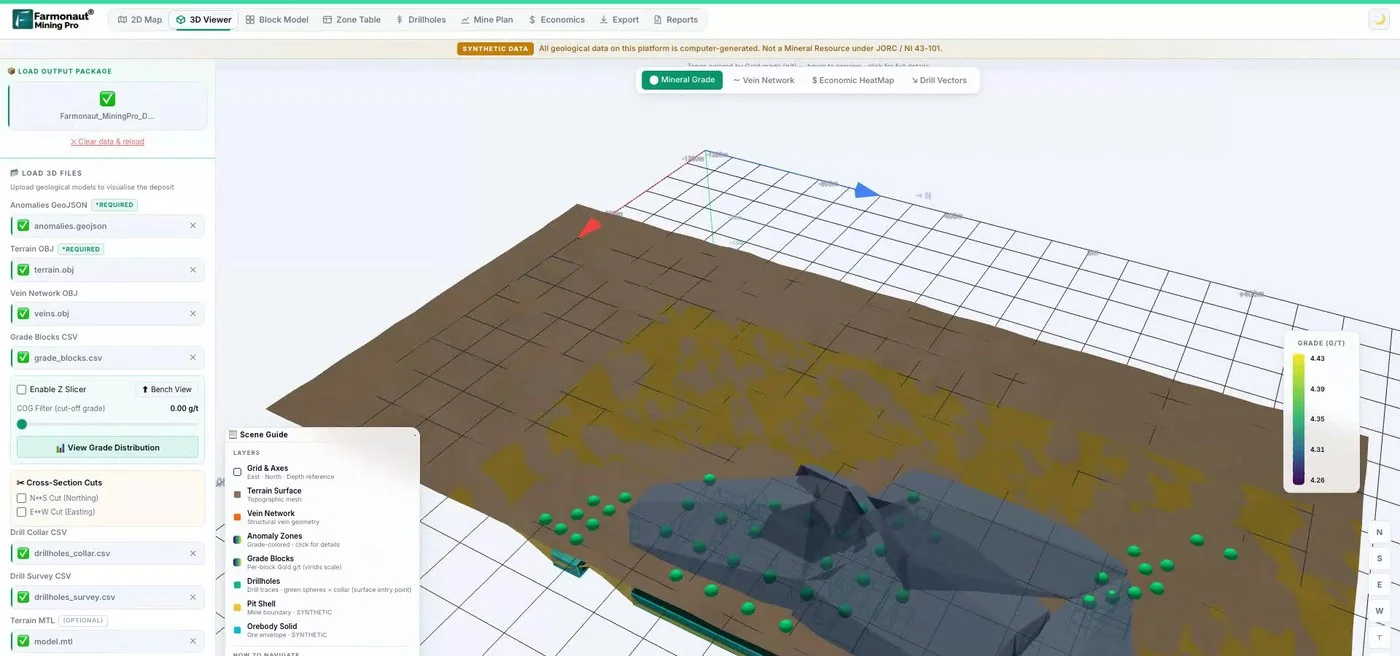
Mining Pro sample view, synthetic data
Sources
- BusinessDay, S&P Global exploration budgets story (2026): businessday.co.za
- USGS, Mineral Commodity Summaries 2026: Copper: pubs.usgs.gov
- Solaris Resources, company website: solarisresources.com
- Ivanhoe Electric, Santa Cruz copper project: ivanhoeelectric.com
- Marimaca Copper, company website: marimaca.com
- Faraday Copper, company website: faradaycopper.com
- Motley Fool Australia, Hot Chili Costa Fuego PFS (2026): fool.com.au
- Lundin Mining resource and reserve release (Feb 2026): bolsamania.com
- Miningmx, KoBold starts development of Zambia copper project (2026): miningmx.com
- Major Drilling Group International, company website: majordrilling.com
- ALS Geochemistry services: alsglobal.com
- Geotech, airborne geophysical surveys: geotech.ca
- USGS, Porphyry copper deposit model (SIR 2010-5070-B): pubs.usgs.gov
- Copernicus SentiWiki, Sentinel-2 mission: sentiwiki.copernicus.eu
- NASA JPL, ASTER instrument characteristics: asterweb.jpl.nasa.gov
- Hot Chili, La Verde and Costa Fuego release: hotchili.net.au
- Lundin Mining, Vicuña operations page: lundinmining.com
Discussion
Questions, corrections or field experience? Share them below. First-time comments are reviewed before they appear, and your email is never published.
No comments yet. Be the first to add a question or your experience.

 SenGold Invest SAS
 Sania Corporation
 Sean Mining Limited
 NTS Group (Pty) Ltd
 Mine4Africa
 Lithspo Minerals Limited
 Tintina Mining Group
 Dalgety Minerals Pty Ltd
 Vortex Minerals Pty Ltd
 Faith At Work (Pty) Ltd
 Geotech Mining Solutions plc
 Vulcan International Limited
 Kidepo Associates
 GKY Mining
 Alkimy SARL
 Double A Trading
 GemSprout Metals Limited
 Qader Group
 Ileys General Trading
 SG Gold Mining LLC
 VRV Global Pte Ltd
 Omsri International FZE
 G.I.T.T.
 Jaunita Erss Ltd