

Mining finance · Adviser guide
Mining Investment Banks: Top Advisers and Fees
RBC Capital Markets led mining M&A by value in 2025 (US$27.8 billion) and BMO Capital Markets by deal count (16), per GlobalData. See who does what, how banks are paid and how to pick one.
Key takeaways
- RBC Capital Markets topped 2025 mining M&A by value (US$27.8 billion); BMO Capital Markets topped it by count (16 deals) (GlobalData, 2025).
- Different jobs need different firms: M&A advice, share underwriting, project debt, royalty sales and fairness opinions.
- 2026 equity raises show a 5% cash commission on large Canadian deals, with 2% to 3% on president’s-list buyers (company filings, 2026).
- Anglo American and Teck used different advisers for deal advice and for the fairness opinion (company announcements, 9 September 2025).
- Small owners are more likely to work with a boutique, a broker or a direct buyer than with a major bank.
In this article
- Which mining investment banks advise on the most deals?
- What a mining adviser actually does
- Four types of adviser and where each fits
- How mining investment banks get paid
- Bought deal, brokered placement or LIFE: how junior miners raise equity
- Case study: who advised on Anglo American and Teck
- Who buys mines: deal flow behind the advisory business
- How to choose a mining investment bank for your project
- What to prepare before the first meeting
- Frequently asked questions
The mining investment banks that advised on the most deals in 2025 were RBC Capital Markets (first by value, US$27.8 billion) and BMO Capital Markets (first by number of deals, 16), according to GlobalData’s league table for metals and mining M&A. Behind them by value came Morgan Stanley, Goldman Sachs and Centerview Partners. Which bank is right for you depends on the size of the deal, the country where the project sits and whether you need a takeover adviser, an equity underwriter or a lender.
This guide is for licence and claim owners, mining consultants and investors who want to know who the banks are, what each kind of bank does, how they are paid and how to approach one. It uses published league tables, company filings and press releases, and it names the source and date next to every figure. It is general information, not advice on any deal.
Which mining investment banks advise on the most deals?
No single table covers every deal, so read league tables as a guide and not a verdict. GlobalData builds its tables from public tracking of company and adviser websites plus submissions from advisers, so private and small deals can be missing. For 2025 its metals and mining table shows two different kinds of leader.
Chart
Top five mining M&A advisers by deal value
Value of advised metals and mining deals, US$ billion
By value, RBC Capital Markets led with US$27.8 billion in advised deals, helped by four billion-dollar deals out of the eight it advised, including one above US$10 billion. Morgan Stanley followed with US$18.5 billion, then Goldman Sachs with US$17.8 billion, Centerview Partners with US$17.7 billion and BMO Capital Markets with US$15.6 billion. By volume, BMO advised 16 deals, the most in the sector, Canaccord Genuity Group also advised 16, and Evans & Evans advised nine. The busiest names by deal count are often smaller specialist advisers that are not the biggest by value.
The picture shifts by half-year. In the first half of 2025 GlobalData table, BMO led by value (US$4.1 billion across seven deals), with Macquarie next at US$2.3 billion and GenCap Mining Advisory and National Bank of Canada tied at US$2.1 billion each. By volume, Canaccord Genuity, INFOR Financial, Evans & Evans and SP Angel Corporate Finance each advised four deals. One large deal can reorder the value ranking, so a bank that tops a single year may not top the next.
Outside mining, the global fee league is a different group. Goldman Sachs, JPMorgan and Morgan Stanley led worldwide M&A rankings by fees in 2025, according to Dealogic data reported by Reuters on MINING.COM. The mining specialists above win mandates because their bankers know the assets, the technical reports and the investors who buy mining shares.
What a mining adviser actually does
People use the phrase for several different jobs. Knowing which one you need saves months of calls to the wrong desk.
- Sell-side and buy-side M&A advice. The bank values the asset or company, writes the sale material, approaches buyers, runs the bidding and helps negotiate the agreement. Buy-side teams do the reverse for an acquirer.
- Fairness opinions. A board asks an independent adviser to state whether the price is fair, from a financial point of view, to shareholders. In the Anglo American and Teck merger, Scotiabank gave Teck’s board an independent fairness opinion, and BMO Capital Markets also gave one, per Teck’s announcement.
- Equity capital markets (ECM). The bank sells new shares for a listed company, as underwriter in a public offering or as agent in a private placement. This is the main work of the Canadian dealers for juniors and developers.
- Debt and project finance. Banks arrange loans for building a mine, often as mandated lead arrangers who split the loan among several lenders. This desk is separate from M&A and ECM and needs a feasibility study and a long list of permits.
- Royalty and stream advice. Banks and boutiques help owners sell a royalty or a stream to a specialist buyer in return for cash. SRK Consulting notes that streaming has become a key source of funding for many development-stage projects (SRK, M&A Trends 2020 to 2025, February 2026).
- Corporate broking and research. In the UK and Australia a listed miner keeps a corporate broker who advises on share-price matters, places shares with investors and is usually the first call for deals. Reuters reported in January 2026 that JPMorgan, as corporate broker to Rio Tinto, was in the lead to advise it on the Rio Tinto and Glencore talks.
An owner of a single licence rarely needs all six. A junior with drill results usually needs ECM and perhaps a technical valuation. A seller of a producing mine needs sell-side M&A. A developer building a mine needs debt and maybe a stream. Our guide on how to sell a mine covers the owner’s side of a sale in more detail.
Four types of adviser and where each fits
Most mining deals are advised by one of four kinds of firm. The names below come from the league tables and deal announcements cited on this page; the lists are examples, not endorsements.
Global bulge-bracket banks
Goldman Sachs, Morgan Stanley and JPMorgan appear on the largest deals. On the Anglo American and Teck merger, announced on 9 September 2025, Anglo American named Centerview Partners, Morgan Stanley, Goldman Sachs and RBC Capital Markets as its financial advisers. These banks suit takeovers and merger talks measured in billions of US dollars, listed companies with a large investor base and debt packages for major mines. A small explorer is unlikely to get the attention of the mining team at one of them.
Canadian dealers
Canada is the centre of mining equity finance. PDAC’s 2025 Mineral Finance report, summarised by The Deep Dive, says Canadian mineral issuers raised about $7.7 billion of equity in 2024 (currency as reported by The Deep Dive), up about 45% on 2023, which took Canada’s share of world mine finance to 31% from 23% and ahead of Australia. RBC, BMO, CIBC, Scotiabank and National Bank sit among the largest names, with Canaccord Genuity, Stifel and similar mid-sized dealers serving juniors. Our comparison of Vancouver and Toronto mining companies shows how listings and capital are split across the two cities.
Boutique advisers
Smaller advisory firms sell advice and, in some cases, placement help for smaller transactions. Ardea Partners and BMO Capital Markets were the financial advisers to Teck. GenCap Mining Advisory, SP Angel Corporate Finance and SCP Resource Finance appear in the league tables or deal releases cited here. These firms often take mandates that the large banks decline because the deal is too small, and they sometimes give a more senior banker’s time to a smaller client.
Regional and corporate-broker firms
Australian and London-listed juniors usually work with a local broker such as Macquarie (second by value in the first-half 2025 table above) or a London adviser such as SP Angel. These firms know local exchange rules, the retail and institutional investors on the register and the sector’s own conventions. Explorers who want to meet Canadian dealers and investors in person can read our PDAC convention guide for juniors.
How mining investment banks get paid
Fees depend on the service. There is no standard rate card, and the figures below are examples from named transactions, not a price list.
Chart
Banks charge less on investors the company brings
Cash commission as % of gross proceeds, two 2026 offerings
Equity raises: commission on the money raised
For equity, the bank takes a cash commission as a percentage of the gross proceeds, and an agent in a private placement often also receives broker warrants (the right to buy shares at a set price for a set period). Recent examples from company filings:
- NovaGold sold US$310.2 million of shares on 5 February 2026 through BMO Nesbitt Burns, RBC Dominion Securities and Scotia Capital and paid the underwriters a cash commission of 5.0% of gross proceeds, per its Form 8-K filed with the SEC.
- Generation Mining closed a C$240 million financing in September 2026: a C$200 million public offering led by BMO Capital Markets as sole bookrunner, plus a C$40 million private placement with Canada Growth Fund. Underwriters received 5.0% on the public offering, cut to 3.0% on sales to certain president’s-list investors, and no commission on the Canada Growth Fund placement, per the company’s closing release.
- West Point Gold announced a brokered private placement of up to C$20 million in January 2026, led by SCP Resource Finance. The commission was 5%, or 2% on president’s-list purchasers, the agents could take up to half the commission in shares, and broker warrants equal to 5% of shares sold were exercisable at C$1.10 for two years, per the announcement. The deal was subject to TSX Venture Exchange approval.
A president’s list is a set of investors the company brings to the deal itself, so the bank charges a lower rate. The comparison chart below shows the gap in the two examples where the release states both rates.
M&A advice: retainer plus success fee
For takeover and sale advice, fees vary with size and complexity and are agreed in an engagement letter. Reuters reported in January 2026 that a deal the size of Rio Tinto and Glencore could generate advisory fees above US$100 million for the banks involved, and noted that fees depend on complexity and on whether advisers also provide funding. A smaller sale commonly combines a monthly or upfront retainer with a success fee paid only at closing, but terms differ by firm. Ask for the engagement letter in writing and check three points: whether the retainer is credited against the success fee, whether the success fee applies to the whole transaction value or only the cash paid at closing, and how long the bank can claim a fee after the mandate ends (the tail period).
Debt: arrangement and underwriting fees
Project loans carry their own arrangement, commitment and agency fees, which are set in a term sheet and depend on the lenders and the risk of the project. These are negotiated deal by deal and are not published in league tables.
Bought deal, brokered placement or LIFE: how junior miners raise equity
The Canadian market has three common routes for a listed junior. They differ in who carries the risk and how fast the money arrives.
Bought deal. The underwriters agree to buy the whole offering at a fixed price before the prospectus is filed, then resell it. Lexpert, a Canadian legal publication, explains that closing usually happens within two or three weeks and that the underwriters assume the pricing risk once they have committed (Lexpert). That is why banks offer bought deals mainly to established companies with a strong market following, such as NovaGold above.
Brokered private placement. The bank acts as agent on a best-efforts basis, meaning it tries to sell the shares but does not guarantee the full amount. The West Point Gold example above was offered on a commercially reasonable efforts basis. This route is common for smaller explorers on the TSX Venture Exchange.
Listed issuer financing exemption (LIFE). LIFE lets an eligible listed company sell shares that trade immediately without filing a full prospectus. The base limit is the greater of C$5 million or 10% of market value, capped at C$10 million in 12 months, with a 50% limit on dilution. The company must have been a reporting issuer for at least 12 months and must close within 45 days of the announcement, per Fogler Rubinoff. Under Coordinated Blanket Order 45-935 of 14 May 2025, an issuer that meets its conditions may instead raise the greater of C$25 million or 20% of market value, up to C$50 million in 12 months, according to the Ontario Securities Commission’s FAQ. Check the current text before relying on any amount, as the rules have been revised more than once.
The calculator below shows what a placement costs you in commission and warrants. Replace the example numbers with the terms in your own engagement letter.
Calculator
What does a share placement cost in commission and warrants?
Enter your own raise size and the terms in your engagement letter.
- Total cash commission: $440,000
- Effective commission rate (%): 4.40
- Broker warrants issued (shares): 800,000
- New shares sold: 20,000,000
Example values only, not a quote. The 5% and 2% commission rates and 5% warrant ratio follow the West Point Gold announcement (January 2026); other deals differ. Prices are inputs: example, use today’s share price. All money is in C$ if your raise is in Canadian dollars; use the same currency throughout.
Case study: who advised on Anglo American and Teck
The Anglo American and Teck merger of equals, announced on 9 September 2025, shows how advice is split between a bank’s roles. Each company used several firms for different jobs, and the same bank can appear in more than one role.
| Company | Financial advisers | Fairness opinion |
|---|---|---|
| Anglo American | Centerview Partners, Morgan Stanley, Goldman Sachs, RBC Capital Markets | Not named in the announcement |
| Teck Resources | Ardea Partners LP, BMO Capital Markets | Scotiabank (independent) and BMO Capital Markets |
The table follows the Anglo American announcement and the Teck announcement linked above. It shows a standard pattern: an independent opinion for the board comes from a firm that is not also running the sale.
The other big deal of the period did not close. Rio Tinto confirmed in early February 2026 that it was no longer considering a merger with Glencore after the deadline under UK takeover rules passed (PYMNTS report). Banks hired to advise on a deal still carry the cost of the work. Fees on a failed deal are set by the engagement letter, which is one reason to read it before signing.
Who buys mines: deal flow behind the advisory business
The advisory market follows the deal market. SRK Consulting documented over 130 public mining transactions from 2020 to 2025 worth more than US$300 billion. Australia and Canada together made up half of the deal activity, and deals of US$1 billion or more were 35% of the total. By number of deals, gold was 54% (70 deals), copper 19% (25 deals), lithium 9% (12 deals) and coal 6% (8 deals).
Chart
Documented mining deals per year
Number of public transactions in SRK’s database
The yearly count is uneven. SRK’s database shows 30 deals in 2024 and 14 in 2025, which is a reminder that the database is built from public sources and later years can fill in as more details are published. Treat the 2025 count as incomplete, and treat the trend in value and deal size as more informative than any one year’s count.
Streaming and royalty companies are buyers too. SRK reports that Royal Gold’s 2025 acquisitions of Sandstorm Gold and Horizon Copper created a combined portfolio of 393 streams and royalties, and that Wheaton Precious Metals and Franco-Nevada put billions of dollars of upfront payments into production-linked streams. For an owner who does not want to sell the ground outright, a royalty sale is a route that some mining banks arrange.
Buyers price a mine from its costs as much as its grade. A bank will ask for a cost per ounce or per tonne, a break-even metal price and a payback estimate in the sale pack. The Farmonaut course video on mine plan costs, shown below, walks through all-in sustaining cost, break-even price and payback on a mine plan.
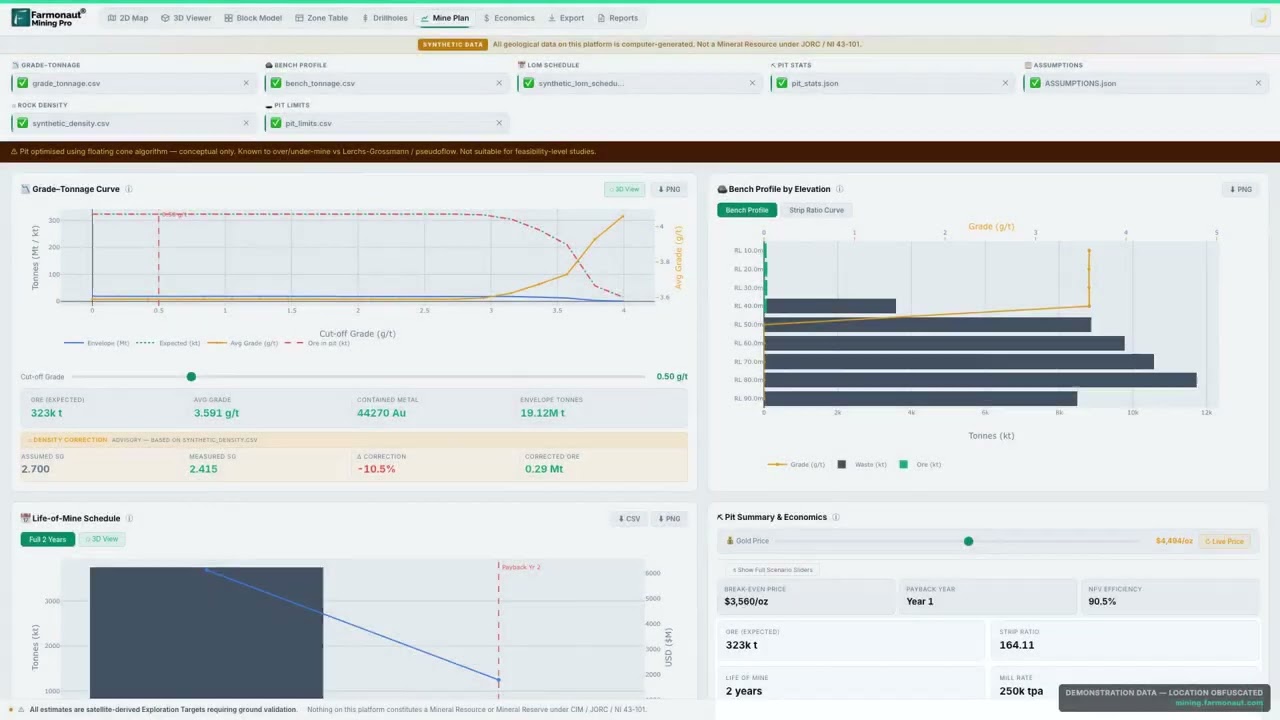
▶ Walks through all-in sustaining cost, break-even price, net present value and payback on a mine plan. · 14:58
How to choose a mining investment bank for your project
Use these checks before you sign any mandate. They are practical judgments, not rules from a regulator.
Infographic
How a mining sale or raise runs in 5 steps
- 1Pick the adviserCompare banks on deal size, metal and country, then sign an engagement letter.
- 2Build the data roomTitle, technical data, costs, permits and a use-of-proceeds plan.
- 3Sound out buyersThe bank approaches investors or bidders under confidentiality.
- 4Price and negotiateOffers or bids come in; terms and commission are set.
- 5CloseFilings, approvals and payment of the bank’s fee.
- Match the bank to the deal size. A US$3 million placement and a US$3 billion merger need different firms. Ask each bank for two or three transactions of your size that it closed in the last two years and check that those deals exist in press releases or on the exchange.
- Match the bank to the commodity and country. The banker’s mining sector experience matters more than the bank’s logo. Look for completed deals in your metal and jurisdiction.
- Check who will do the work. Ask which named people will be on your account and how many other mining mandates they carry.
- Read the fee terms. Compare the commission percentage, the broker warrants, the retainer, the expense cap and the tail period in the engagement letter. A lower percentage is not cheaper if you also pay a large retainer.
- Check registration. In the US, search the firm and the individual on FINRA BrokerCheck. In Australia, search ASIC’s professional registers to see what a person or company is licensed to do. In Canada and the UK, use the national regulator’s firm search for investment dealers and authorised firms.
- Ask about conflicts. A bank that lends to your buyer, or advises a competitor on a rival deal, should tell you so. Ask how it handles that.
- Keep your own technical adviser. The bank sells the deal; an independent geologist or engineer checks the numbers it uses. SRK also points to technical due diligence and other external expertise as essential parts of any mining transaction.
If your project is small, such as a licence or a few claims with a limited budget, a full-service bank will probably not take the mandate. A boutique, a regional broker or a direct sale to a neighbouring company is more realistic. Read what a mining concession is to confirm what you actually own and can transfer before approaching anyone.
What to prepare before the first meeting
Bankers decide within a few meetings whether a project is worth their time. These items make the first meeting productive.
- Proof of title. Licence or claim numbers, owner records, expiry dates, fees paid and any royalty, option or lien.
- Technical data. Maps, assays, drill logs, geophysics and any technical report. In Canada, a technical report that meets National Instrument 43-101 is the standard disclosure document for a mineral project, and the rules can change, so check the current text.
- Costs and plan. A budget for the next work program and a schedule linked to funding stages.
- Permits and community status. What is in place, what is pending, and any land-access issue.
- Use of proceeds. What the money buys and what milestones follow.
Satellite screening of the ground can add a map-based picture of alteration and structure to the data pack before drilling, as exploration targets rather than a resource estimate. Farmonaut Mining Pro, shown in the video below, produces this from a licence boundary.
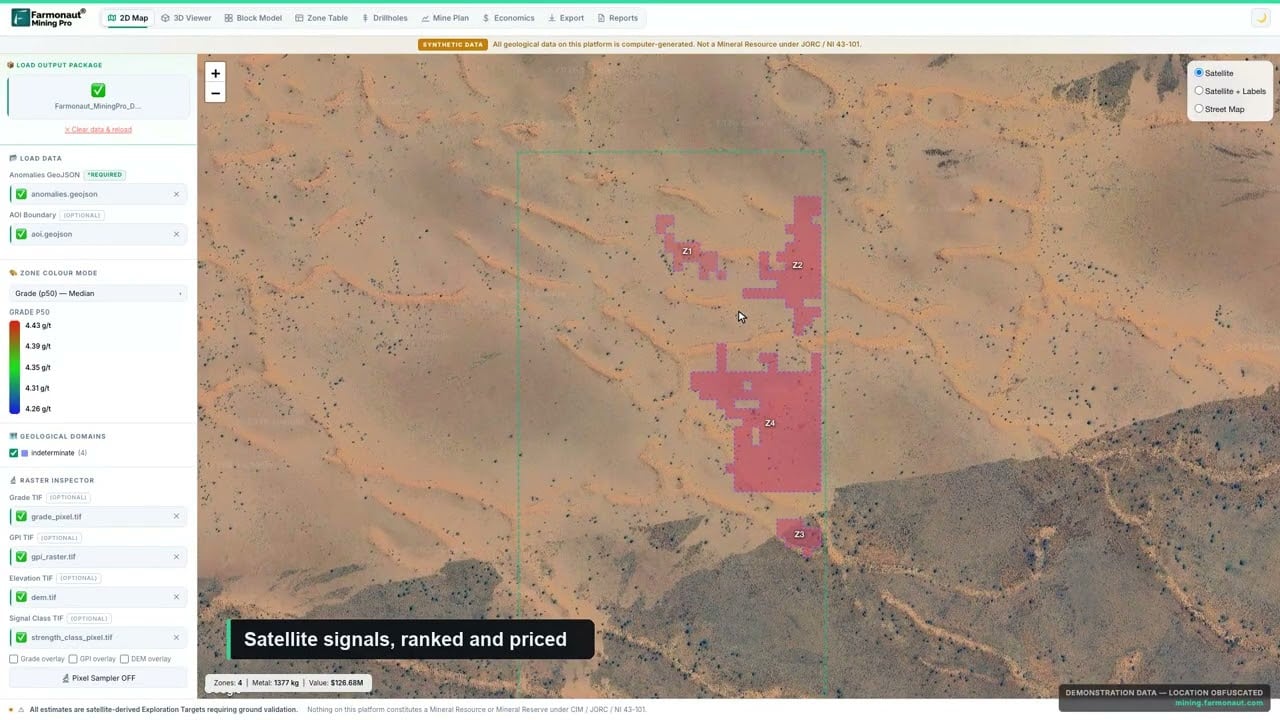
▶ Shows how Farmonaut Mining Pro turns a licence boundary into a satellite-based geological picture. · 4:56
Frequently asked questions
Who are the biggest mining investment banks?
By deal value in 2025, GlobalData ranked RBC Capital Markets first (US$27.8 billion), then Morgan Stanley, Goldman Sachs, Centerview Partners and BMO Capital Markets. By number of deals, BMO Capital Markets led with 16 and Canaccord Genuity Group also advised 16.
What is mining investment banking?
It is the part of investment banking that advises mining companies and owners on mergers, acquisitions, share and debt raises, fairness opinions and royalty or stream sales. Bankers who cover the sector work on assets such as mines, projects and licences, and they value them with metal price, grade, cost and permit assumptions.
Which banks are best for junior mining companies?
Juniors usually raise money through Canadian dealers such as Canaccord Genuity and Stifel, mining-focused agents such as SCP Resource Finance, or a regional broker. Large banks such as BMO and RBC handle larger developers. The best choice is a firm that has closed deals of your size in your metal.
How much do mining investment banks charge?
For equity raises, 2026 filings show cash commissions of 5% of gross proceeds on NovaGold’s US$310.2 million deal and on the Generation Mining public offering, and 5% on West Point Gold’s announced brokered placement. Generation Mining and West Point Gold set lower rates (3% and 2%) for president’s-list buyers. For M&A, fees are set in an engagement letter and usually combine a retainer with a success fee.
What is a bought deal in mining?
It is an equity offering in which underwriters agree to buy all the shares at a fixed price before the prospectus is filed and then resell them. Lexpert notes that closing usually follows within two or three weeks and that the underwriters take the pricing risk.
What does a mining investment bank need from a junior before it takes a mandate?
Expect requests for proof of title, technical data and reports, a work program with a budget, a view on permits and a clear use of proceeds. Banks also check management’s record and the company’s listing status before committing.
Can a small claim owner use an investment bank?
Rarely a major bank. Small owners more often sell through a mining broker, a boutique adviser, a direct option or farm-in with another company or a royalty sale. Our guide on selling a mine explains each route.
What is a fairness opinion?
A fairness opinion is a written view from a financial adviser on whether the price in a deal is fair, from a financial point of view, to a company’s shareholders. Teck’s board received opinions from Scotiabank and BMO Capital Markets on the merger with Anglo American.
What is the difference between an investment bank and a mining broker?
An investment bank advises on and arranges large corporate transactions. A broker, in the UK and Australian sense, acts as a listed company’s day-to-day adviser and sells its shares to investors. The roles overlap in practice, since many banks hold both.
How do I become a mining investment banker?
Most start as analysts in the metals and mining coverage group of a bank’s M&A or equity capital markets team. Banks recruit through graduate programmes, so check the careers page of each firm named above for current requirements.
Are league tables reliable?
They are a starting point. GlobalData states that its tables rely on public information and adviser submissions, so private or lightly reported deals can be missing. Compare two or three tables and ask each bank for references on deals like yours.
This page is for information only. It is not investment advice, and it does not recommend any bank or company. Listed companies are named as facts from public filings. Confirm fees and terms in writing and check a firm’s registration before you sign a mandate.
Farmonaut mining
Show lenders and buyers your ground from space
Request a quote to have your licence screened with satellite data so your pitch pack includes a map-based view of the ground.

Mining Pro sample view, synthetic data
Sources
- GlobalData via Mining Technology, metals and mining M&A financial advisers, full year 2025: mining-technology.com
- GlobalData via Mining Technology, metals and mining M&A financial advisers, first half 2025: mining-technology.com
- SRK Consulting, M&A Trends 2020 to 2025 (February 2026): cdn-web-content.srk.com
- Reuters via MINING.COM, Wall Street jostles to advise on Rio-Glencore (9 January 2026): mining.com
- Anglo American, merger of equals announcement (9 September 2025): angloamerican.com
- Teck, merger of equals announcement (9 September 2025): teck.com
- NovaGold, Form 8-K (February 2026): sec.gov
- Generation Mining, closing of bought deal (21 September 2026): bnnbloomberg.ca
- West Point Gold, brokered private placement (26 January 2026): miningstockeducation.com
- Lexpert, bought deals in Canada: lexpert.ca
- Fogler Rubinoff, CSA listed issuer financing exemption: foglers.com
- The Deep Dive, PDAC 2025 Mineral Finance report summary: thedeepdive.ca
- PYMNTS, Rio Tinto and Glencore call off talks (February 2026): pymnts.com
- FINRA BrokerCheck: brokercheck.finra.org
- Ontario Securities Commission, CSA Staff Notice 45-330 (Revised) on LIFE: osc.ca
- ASIC, search ASIC’s registers: asic.gov.au
Discussion
Questions, corrections or field experience? Share them below. First-time comments are reviewed before they appear, and your email is never published.
No comments yet. Be the first to add a question or your experience.

 Mine4Africa
 Lithspo Minerals Limited
 Tintina Mining Group
 Dalgety Minerals Pty Ltd
 Vortex Minerals Pty Ltd
 Faith At Work (Pty) Ltd
 Geotech Mining Solutions plc
 Vulcan International Limited
 Kidepo Associates
 GKY Mining
 Alkimy SARL
 Double A Trading
 GemSprout Metals Limited
 Qader Group
 Ileys General Trading
 SG Gold Mining LLC
 VRV Global Pte Ltd
 Omsri International FZE
 G.I.T.T.
 Jaunita Erss Ltd
 Almosi SARL
 SRK Consulting
 Berks Gold Limited
 Mwerezi Minerals Company Limited

 Exploration consultancy · South Africa · Gold










