

US gold mine profile · Output, reserves and costs
Cripple Creek Gold Mine: Output, Reserves, Costs
Cripple Creek & Victor is an open-pit, heap-leach gold mine owned by SSR Mining since 28 February 2025. It holds 2.7 million oz of reserves at 0.38 g/t and guides to 125,000 to 150,000 oz in 2026.
Key takeaways
- SSR Mining owns 100% of CC&V after buying it from Newmont for US$275 million in total; the deal closed on 28 February 2025 (SSR Mining).
- Reserves are 2.7 million oz at 0.38 g/t, with a further 4.8 million oz measured and indicated and 2.0 million oz inferred, as of 31 December 2025 (SSR Mining).
- Calendar 2025 output was 152,557 oz; 2026 guidance is 125,000 to 150,000 oz at AISC of US$1,780 to US$1,850 per ounce (SSR Mining, 17 February 2026).
- The mine is an open pit with two valley leach pads and a life-of-mine recovery of 51.6%; reserves are limited by permitted pad space, with the Amendment 14 permit expected by the end of 2027 (SSR Mining, 30 September 2026).
- The district produced 19,100,867 oz through 1959, peaking at 878,167 oz in 1900 (USGS, 1968).
In this article
- Cripple Creek mine key facts at a glance
- How the Cripple Creek mine works: open pit and valley leach
- From pit to gold bar: the leach process in 5 steps
- Production and costs by quarter at Cripple Creek
- How much gold is left at Cripple Creek: reserves and resources
- Estimate the gold a heap leach pad recovers
- Geology: why this volcanic crater holds gold
- History of the Cripple Creek district: from the gold rush to the open pit
- Who owns the Cripple Creek mine: timeline of owners
- Jobs, taxes and the town of Cripple Creek
- Water, closure and permits at the mine
- Visiting the Cripple Creek gold district
- What mining consultants should check on this mine
- Frequently asked questions
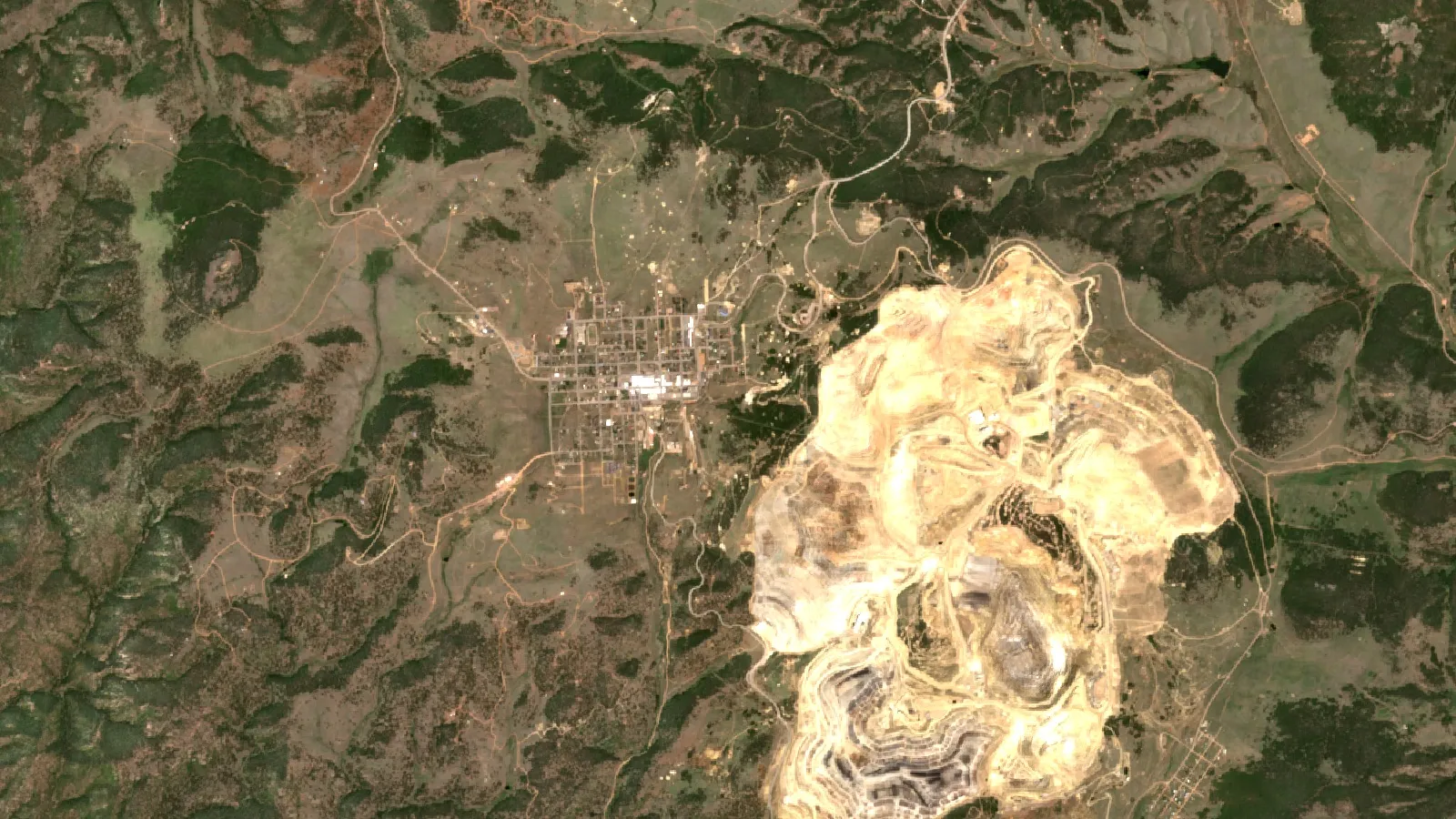
The Cripple Creek & Victor gold mine (CC&V) is an open-pit, heap-leach gold mine in Teller County, Colorado, owned 100% by SSR Mining since 28 February 2025. It stacked and leached ore to produce 152,557 oz of gold in calendar 2025 and has a 12-year mine plan built on 2.7 million oz of reserves at an average grade of 0.38 g/t (SSR Mining, CC&V operations page; SSR Mining results release, 17 February 2026). A grade of 0.38 g/t means 0.38 grams of gold in each tonne of rock, so the mine moves a lot of rock for each ounce. The numbers below come from SSR Mining filings and presentations, USGS publications and Colorado agencies, with the date beside each figure.
The page is written for mining consultants and anyone who needs the facts in one place: who owns the mine, what it produces, what it costs to run, how much gold is left, and what could change the plan. The current mine is a surface pit, and the underground workings are old ones that the pit crews have to map and avoid.
Cripple Creek mine key facts at a glance
The table gathers the figures most people search for. Each row names the source and its date.
| Item | Figure | Source and date |
|---|---|---|
| Location | About 100 miles (160 km) southwest of Denver, Teller County, Colorado | SSR Mining operations page |
| Owner | SSR Mining, 100%, since 28 February 2025 | SSR Mining operations page |
| Mining method | Conventional open pit, ore stacked on two valley leach facilities | SSR Mining site tour presentation, 30 September 2026 |
| Land held | About 6,075 hectares | SSR Mining site tour presentation, 30 September 2026 |
| Mineral reserves | 2.7 million oz at 0.38 g/t | SSR Mining, as of 31 December 2025 |
| Measured and indicated resources | 4.8 million oz at 0.44 g/t (on top of reserves) | SSR Mining, as of 31 December 2025 |
| Inferred resources | 2.0 million oz at 0.41 g/t | SSR Mining, as of 31 December 2025 |
| Gold produced in calendar 2025 | 152,557 oz (about 28,000 oz under Newmont, 124,557 oz under SSR Mining) | SSR Mining results release, 17 February 2026 |
| Gold guidance for 2026 | 125,000 to 150,000 oz | SSR Mining results release, 17 February 2026 |
| Life-of-mine plan | 12 years of mining, 26 years of gold production | SSR Mining operations page, from the November 2025 technical report |
| Direct employees | 428, average wage US$94,000 | SSR Mining site tour presentation, 30 September 2026 |
Mineral reserves are the part of a deposit that a company has shown can be mined at a profit under stated assumptions. Mineral resources have a lower level of proof and are not reserves. The SSR figures follow US Securities and Exchange Commission mining disclosure rules (known as S-K 1300), and the 2025 technical report summary is on file with the US Securities and Exchange Commission.
How the Cripple Creek mine works: open pit and valley leach
The pit sits at about 10,000 feet (3,050 m) elevation and receives about 18 inches of rain and snow a year. It is a dry pit that needs no dewatering, and the 2025 plan averages 85,000 tonnes of material mined per day with a life-of-mine strip ratio of 0.65 (SSR Mining, 30 September 2026). Strip ratio is the tonnes of waste rock moved for each tonne of ore. The fleet listed in the plan is 17 haul trucks, two front-end loaders and two hydraulic shovels (SSR Mining site tour presentation, 30 September 2026).
Most ore goes straight from the pit to the leach pad as run-of-mine (ROM) material, which means it is not crushed first. About 5% of life-of-mine ore is crushed in a two-stage plant rated at roughly 50,000 tonnes per day. A valley leach facility (VLF) is a lined pad built in a valley fill. Heap leaching is the method of stacking ore on a lined pad and trickling a weak cyanide solution through it, so that the gold dissolves and drains to a recovery plant. The EPA has a technical document on how these pads and ponds are managed in gold mining (US EPA, Technical Resource Document, Extraction and Beneficiation of Ores and Minerals, Volume 2: Gold).
CC&V has two VLFs, and each has its own adsorption-desorption-recovery (ADR) plant, where gold is caught on carbon and stripped off again. VLF1 took its first ore in December 1994 and holds more than 300 million tonnes. VLF2 took its first ore in October 2015 and holds about 175 million tonnes, and ore is now stacked on VLF2 while VLF1 is still leached. A leach cycle runs about 120 days from ore placement to a bullion pour. The life-of-mine gold recovery in the technical report is 51.6% (SSR Mining, 30 September 2026). The rest of the gold stays in the rock or in the pad.
Old underground workings cut through the ore body. The presentation notes that voids from historic vein mining must be mapped and managed during mining, and that the crews blend softer weathered ore from the Globe Hill area with harder rock to keep the pad stable and permeable.
From pit to gold bar: the leach process in 5 steps
The flow below follows the steps named in the SSR Mining plan, from the pit to the bullion pour.
Infographic
From pit to bullion in 5 steps
- 1MineShovels and trucks load ore from the open pit; waste rock goes to dumps.
- 2Crush or notMost ore is stacked run-of-mine; about 5% is crushed first.
- 3StackOre is placed on a valley leach facility.
- 4LeachSolution trickles through the heap for about 120 days.
- 5RecoverAn ADR plant catches the gold on carbon, and bullion is poured.
▶ Follows a nugget of gold from rock to ring: found, drilled, crushed, dissolved, caught on carbon and refined. · 5:27
Production and costs by quarter at Cripple Creek
Quarterly output moves with the grade and the amount of ore stacked. SSR Mining reported 44,062 oz in the second quarter of 2025 and 27,725 oz in the second quarter of 2026. The first half of 2026 produced 66.0 koz (thousand ounces) at an all-in sustaining cost (AISC) of US$1,802 per ounce. AISC is the cost of running the mine plus sustaining capital, shown per ounce sold. It excludes growth projects. The company expects 50 to 55% of 2026 output in the second half (SSR Mining, 30 September 2026; SSR Mining, 17 February 2026).
Chart
Cost of sales and AISC per ounce, by quarter
US$ per payable ounce sold; left dot is cost of sales, right dot is all-in sustaining cost
Chart
Gold produced at CC&V by quarter
Thousand ounces of gold, Q2 2025 to Q2 2026
| Quarter | Ore stacked (kt) | Grade stacked (g/t) | Gold produced (oz) | Cost of sales (US$/oz) | AISC (US$/oz) |
|---|---|---|---|---|---|
| Q2 2025 | 3,519 | 0.50 | 44,062 | 1,116 | 1,339 |
| Q3 2025 | 7,020 | 0.40 | 29,821 | 1,394 | 1,756 |
| Q4 2025 | 5,431 | 0.40 | 39,392 | 1,279 | 1,596 |
| Q1 2026 | 3,276 | 0.45 | 38,298 | 1,431 | 1,658 |
| Q2 2026 | 3,761 | 0.46 | 27,725 | 1,561 | 1,995 |
Gold produced in a quarter is not the ore stacked times grade, because gold leaches out over months after the ore is placed. That lag explains why the third quarter of 2025 stacked the most ore (7.0 million tonnes) but produced the least gold in the table’s first three quarters. For 2026, SSR Mining guides to 18 to 20 million tonnes stacked at 0.35 to 0.40 g/t, a stripping ratio near 1.0:1, cost of sales of US$1,420 to US$1,490 per ounce and AISC of US$1,780 to US$1,850 per ounce.
The technical report supports the plan at consensus gold prices averaging US$3,240 per ounce, with an after-tax net present value (NPV) at a 5% discount rate of US$824 million. The same plan is worth about US$1.5 billion after tax at US$4,000 per ounce, and SSR Mining’s 30 September 2026 presentation quotes about US$1.9 billion at a spot price near US$4,400 per ounce (SSR Mining operations page). Those are company projections, not guarantees, and this page is not investment advice.
If this topic matters to you, read Malartic Gold Mine: Output, Costs and Reserves in Quebec next.
Related reading on this site: Fresnillo Silver Mine: Output, Reserves and Shares.
How much gold is left at Cripple Creek: reserves and resources
At 31 December 2025, SSR Mining reported 2.7 million oz of reserves, 4.8 million oz of measured and indicated resources and 2.0 million oz of inferred resources. The resources are reported on top of the reserves, and inferred means the confidence is lowest. The company says the reserves are limited mostly by how much leach pad it is permitted to build, not by the amount of gold in the ground. Reserves use a gold price of US$1,700 per ounce and resources US$2,000 per ounce, so a higher price brings more rock into the reserve once the pad space is permitted (SSR Mining, 30 September 2026).
Chart
District output to 1959 versus gold still reported
Million ounces; district output is to 1959, the rest is at 31 December 2025
The key permit is called Amendment 14. Newmont filed it on 25 April 2024 to change the state mining permit, and it covers expansions of VLF1 (phase 6) and VLF2 (phase 4) that would add 171 million tonnes of leach capacity. SSR Mining expects approval by the end of 2027. A second US$87.5 million payment to Newmont depends on that approval (SSR Mining, 30 September 2026).
Drilling is deep and dense for a mine of this grade. Prior operators drilled 17,627 exploration holes for about 2.8 million metres at CC&V by the end of 2024, with an average hole depth of 275 m in the district.
Estimate the gold a heap leach pad recovers
The calculator turns ore tonnes, grade and recovery into ounces, then into revenue and margin. The defaults are round examples close to the life-of-mine plan: about 20 million tonnes a year at 0.39 g/t and 51.6% recovery. Type your own numbers, and use today’s gold price.
Calculator
How much gold could a leach pad recover, and what is it worth?
Enter your own ore tonnes, grade, recovery, gold price and cost per ounce.
- Revenue at your price (US$): $517,600,913
- Margin after AISC (US$): $258,800,457
- Gold left in the pad per year: 121,375
Example values only, not a forecast. Defaults follow SSR Mining’s CC&V plan (about 20 Mtpa stacked at 0.39 g/t, 51.6% recovery, SSR Mining, 30 September 2026); price (US$4,000, near SSR Mining’s sensitivity case) and AISC are examples, use today’s price. The margin ignores tax and timing.
Geology: why this volcanic crater holds gold
CC&V is an alkalic, low-sulfidation epithermal gold deposit. Epithermal means the gold was deposited from hot water close to the surface, and our guide to epithermal gold deposit styles and exploration clues explains the type. Here the host is a volcanic diatreme (a pipe formed by explosive volcanic gas) set in Proterozoic granite and gneiss. Tectonic movement along the Rio Grande Rift began about 34 million years ago, and the gold is dated to 31 and 27 million years ago. The oxidised zone averages 122 m deep, and all current reserves are oxide ore that suits heap leaching (SSR Mining, 30 September 2026).
Two styles of mineralisation exist. Low-grade gold in rock fractures with pyrite and gold telluride is what the pit mines today. High-grade fracture-hosted gold-silver telluride veins were the target of the historic underground mines. The USGS describes the district as an irregular mass of Miocene breccia in a basin about 4 miles long and 2 miles wide, with three stages of vein filling that include the gold tellurides (Koschmann and Bergendahl, USGS, 1968, reproduced by Western Mining History). A USGS study of the district measured how gold, tellurium, silver and mercury spread through the rocks (Gott and others, USGS Circular 543, 1967). The Colorado Geological Survey names CC&V as the largest gold producer in the state (Colorado Geological Survey, Metals). For other deposits in the country, see our overview of US gold deposits by state.
History of the Cripple Creek district: from the gold rush to the open pit
Prospector Robert Womack found gold ore in shallow pits in the 1880s. Others bought his claims in 1891, and W. S. Stratton recognised that ore taken for galena was a gold telluride mineral. By 1893 the Portland, Independence, Granite and Strong mines were producing. District output peaked in 1900 at 878,167 oz of gold, and the district had produced a total of 19,100,867 oz through 1959, making it, at that date, the leading gold producer in Colorado and the second most productive gold district in the United States (USGS, 1968, via Western Mining History). The Carlton drainage tunnel, finished in 1941, eased pumping problems in the deep mines.
Modern mining followed a different path. Heap-leach processing of low-grade waste rock began in 1985, and large-scale surface mining began in 1994. A mill started later to treat telluride ore, then milling stopped in the first quarter of 2022 because sulfide ore was limited and the mine moved to leach-only processing (SSR Mining, 30 September 2026).
Who owns the Cripple Creek mine: timeline of owners
- 1999: AngloGold bought a controlling 67% interest. Golden Cycle held the remaining 33%.
- 2008: AngloGold acquired Golden Cycle’s interest.
- 2015: Newmont acquired 100% of CC&V.
- 6 December 2024: SSR Mining announced the purchase from Newmont for US$275 million in total: US$100 million in cash at closing and US$175 million in two milestone payments of US$87.5 million.
- 28 February 2025: The acquisition closed. The first milestone, regulatory relief on Carlton Tunnel flow-related permitting, was paid in the first quarter of 2026. The second depends on Amendment 14 approval.
The sale terms also cover closure. The 2025 technical report estimates the asset retirement obligation (the cost of closing and cleaning up the site) at US$517 million. If an updated, regulator-approved closure plan shows costs above US$500 million, Newmont is to fund 90% of the extra cost. SSR Mining plans to submit the updated closure plan in 2027 (SSR Mining, 30 September 2026).
Jobs, taxes and the town of Cripple Creek
An economic study by the Metro Denver Economic Development Corporation, cited by SSR Mining, puts CC&V’s direct workforce at 428 people with an average wage of US$94,000. The mine supports 216 more jobs through suppliers and household spending, for 644 jobs in Teller County, 789 in the Pikes Peak region and 942 across Colorado. The mine generated about US$38.4 million in state and local taxes in 2025, and the study estimates US$6.6 billion in economic impact through 2050 if the Amendment 14 extension is approved. These are model estimates built with IMPLAN software and a long-run gold price of US$3,094 per ounce, so treat them as estimates (SSR Mining, 30 September 2026).
Gambling shaped the town as well. Colorado voters approved limited-stakes gaming in 1990 for Black Hawk, Central City and Cripple Creek only, and the casinos opened in 1991 (Legisource, timeline of Colorado gaming law). The casino economy and the mine now sit side by side. For a wider view of mine impacts on land and water, see our guide to the environmental effects of mining.
Water, closure and permits at the mine
The facts that are on the record are these. The pit is dry, so no pit dewatering is needed. Each leach pad feeds its own ADR plant. The Carlton Tunnel, which drains old workings, was the subject of a permitting issue that the first milestone payment resolved. The closure estimate is large for a mine of this size, which is why the sale agreement shares the extra cost. SSR Mining says it will engage stakeholders as the closure plan moves ahead. The state regulator for permits and reclamation is the Colorado Division of Reclamation, Mining and Safety (Colorado DRMS).
▶ A plain-language claymation of the seven environmental impacts of mining. · 2:31
Visiting the Cripple Creek gold district
The state mine-safety list names no tour of the working pit. It does list three places to learn the history near the district: the Mollie Kathleen Gold Mine, which offers an underground tour north of Cripple Creek on Highway 67, the Cripple Creek District Museum on Bennett Avenue and the Lowell Thomas Museum in Victor (Colorado DRMS tourist mines list). Call ahead for hours and prices. Do not enter old workings or fenced mine land on your own.
What mining consultants should check on this mine
If you review heap-leach gold projects, CC&V is a useful case because the plan is public and the sensitivity is clear. These are the points to test in any similar project.
- Grade and recovery together. A grade near 0.4 g/t with recovery near 52% leaves about 0.2 g/t of gold in the product. Small changes in either move the margin.
- Strip ratio. The life-of-mine ratio is 0.65, but SSR Mining’s quarterly strip ratios ran from 0.4 (Q3 2025) to 1.6 (Q1 and Q2 2026), and 2026 guidance is near 1.0:1. Compare like with like.
- Permitted pad capacity. Here the reserve is limited by the leach pad permit, not by geology.
- Cost basis. Cost of sales, cash cost and AISC differ. SSR Mining reports AISC per payable ounce sold.
- Closure cost. The US$517 million estimate is large next to the US$275 million purchase price.
- Old workings. Voids from historic mining affect blasting, haul roads and pad stability.
Satellite data does not replace drilling at a mine like this. The short video below explains what a satellite can and cannot see of a gold system. For a licence area, Farmonaut analyses satellite imagery to flag alteration zones, faults and mineralised target areas as exploration targets, which sit ahead of any resource estimate.
▶ Explains that satellites cannot see gold but can map the alteration halo around a gold system. · 2:00
Frequently asked questions
Who owns the Cripple Creek gold mine now?
SSR Mining owns 100% of the Cripple Creek & Victor mine. It completed the purchase from Newmont on 28 February 2025 (SSR Mining).
Is the Cripple Creek mine still operating?
Yes. The open pit is active, and SSR Mining guides to 125,000 to 150,000 oz of gold in 2026. Active mining is planned to 2036, and the plan covers 26 years of total gold production.
Is Cripple Creek an underground or open-pit mine?
It is an open pit today. The historic underground mines ceased operating in the 20th century, and most underground mining stopped by 1962 (SSR Mining, 30 September 2026).
How much gold has the Cripple Creek district produced?
The USGS counted 19,100,867 oz through 1959, with a peak of 878,167 oz in 1900. SSR Mining says the district has produced more than 25 million oz since the late 1800s. CC&V made 152,557 oz in 2025 and guides to 125,000 to 150,000 oz in 2026.
How much gold does the Cripple Creek mine have left?
SSR Mining reports 2.7 million oz of reserves, 4.8 million oz of measured and indicated resources and 2.0 million oz of inferred resources at 31 December 2025.
How many people work at the Cripple Creek mine?
SSR Mining reports 428 direct employees and 216 indirect and induced jobs in Teller County (30 September 2026).
What is the gold grade at Cripple Creek?
Reserves average 0.38 g/t, and the ore stacked in the second quarter of 2026 averaged 0.46 g/t. At grades this low, the mine relies on bulk open-pit mining and heap leaching.
Can I tour the Cripple Creek gold mine?
Not the working pit. The Mollie Kathleen Gold Mine runs underground tours, and two museums cover the history. Confirm hours first.
What does AISC mean for a gold mine?
All-in sustaining cost is the cost of mining and processing plus sustaining capital and site costs, divided by ounces sold. CC&V’s 2026 guidance is US$1,780 to US$1,850 per ounce.
Where is the Cripple Creek mine?
It lies near the towns of Cripple Creek and Victor in Teller County, about 100 miles southwest of Denver.
This page is for information only. It is not investment advice. Company figures are projections or reports by SSR Mining, and no share price or target is given. Do not enter old mine workings or fenced mine land.
Farmonaut mining
Map your mining site from space
Mining consultants can use satellite analysis to flag alteration zones and structures on a licence area as exploration targets.

Mining Pro sample view, synthetic data
Keep reading
Sources
- SSR Mining, Cripple Creek & Victor operations page (2026): ssrmining.com
- SSR Mining, CC&V site tour presentation (30 September 2026): s22.q4cdn.com
- SSR Mining, fourth quarter and full-year 2025 results (17 February 2026): ssrmining.com
- SSR Mining, CC&V initial 12-year life of mine plan (10 November 2025): ssrmining.com
- Koschmann and Bergendahl, USGS, Teller County gold production (1968), via Western Mining History: westernmininghistory.com
- USGS Circular 543, Gold, tellurium, silver and mercury in the Cripple Creek district (1967): pubs.usgs.gov
- Colorado Division of Reclamation, Mining and Safety, tourist mines and museums: drms.colorado.gov
- Legisource, A brief timeline of Colorado gaming law (2024): legisource.net
- Colorado Geological Survey, Metals: coloradogeologicalsurvey.org
- US EPA, Technical Resource Document: Extraction and Beneficiation of Ores and Minerals, Volume 2, Gold: archive.epa.gov
Discussion
Questions, corrections or field experience? Share them below. First-time comments are reviewed before they appear, and your email is never published.
No comments yet. Be the first to add a question or your experience.

 Qader Group
 Ileys General Trading
 SG Gold Mining LLC
 VRV Global Pte Ltd
 Omsri International FZE
 G.I.T.T.
 Jaunita Erss Ltd
 Almosi SARL
 SRK Consulting
 Berks Gold Limited
 Mwerezi Minerals Company Limited
 Mining SARL
 SenGold Invest SAS
 Sean Mining Limited
 NTS Group (Pty) Ltd
 Mine4Africa
 Lithspo Minerals Limited
 Tintina Mining Group

 Licence holder · Nigeria · Gold + lithium










