

Nevada gold history · Site guide
El Dorado Mine Nevada: Techatticup History and Output
The El Dorado mine in Nevada is a historic silver-gold district in Eldorado Canyon, not a working mine. Its mines produced about 100,600 oz of gold and 2.36 million oz of silver in 1907-1954 (USGS record). The Techatticup now runs tours.
Key takeaways
- Eldorado Canyon is a historic district near Nelson, Clark County; the Techatticup is its best-known mine (Nevada Mining Association).
- Recorded 1907-1954 output: about 100,600 oz gold and 2.36 million oz silver, a silver-to-gold ratio of about 23 to 1 (USGS record; Hansen, 1962).
- Large-scale production ended in the 1940s; the last significant output was a small heap leach in the late 1970s (USGS record).
- Nevada made about 64% of US gold in 2025 (USGS, 2026); the whole district’s 47-year output is close to one year at Barrick’s smallest Nevada complex.
- Tours run at 9 a.m., 12 p.m. and 2 p.m. by reservation; adult price up to US$20 (Nelson Ghost Town, read 16 October 2026).
In this article
- Where is the El Dorado mine in Nevada?
- Techatticup Mine history and timeline
- How much gold and silver did Eldorado Canyon produce?
- Geology: why this canyon holds gold and silver
- Is the El Dorado mine still operating?
- Visit the Techatticup Mine: tours, times and cost
- Which El Dorado mine do you mean?
- Nevada's place in US gold output
- How the old district compares with Nevada's working gold mines
- What modern Nevada mines do differently
- Run the numbers on a silver-rich vein
- Mine safety and rules around Eldorado Canyon
- Environmental legacy of a historic district
- Mapping old mining districts from space
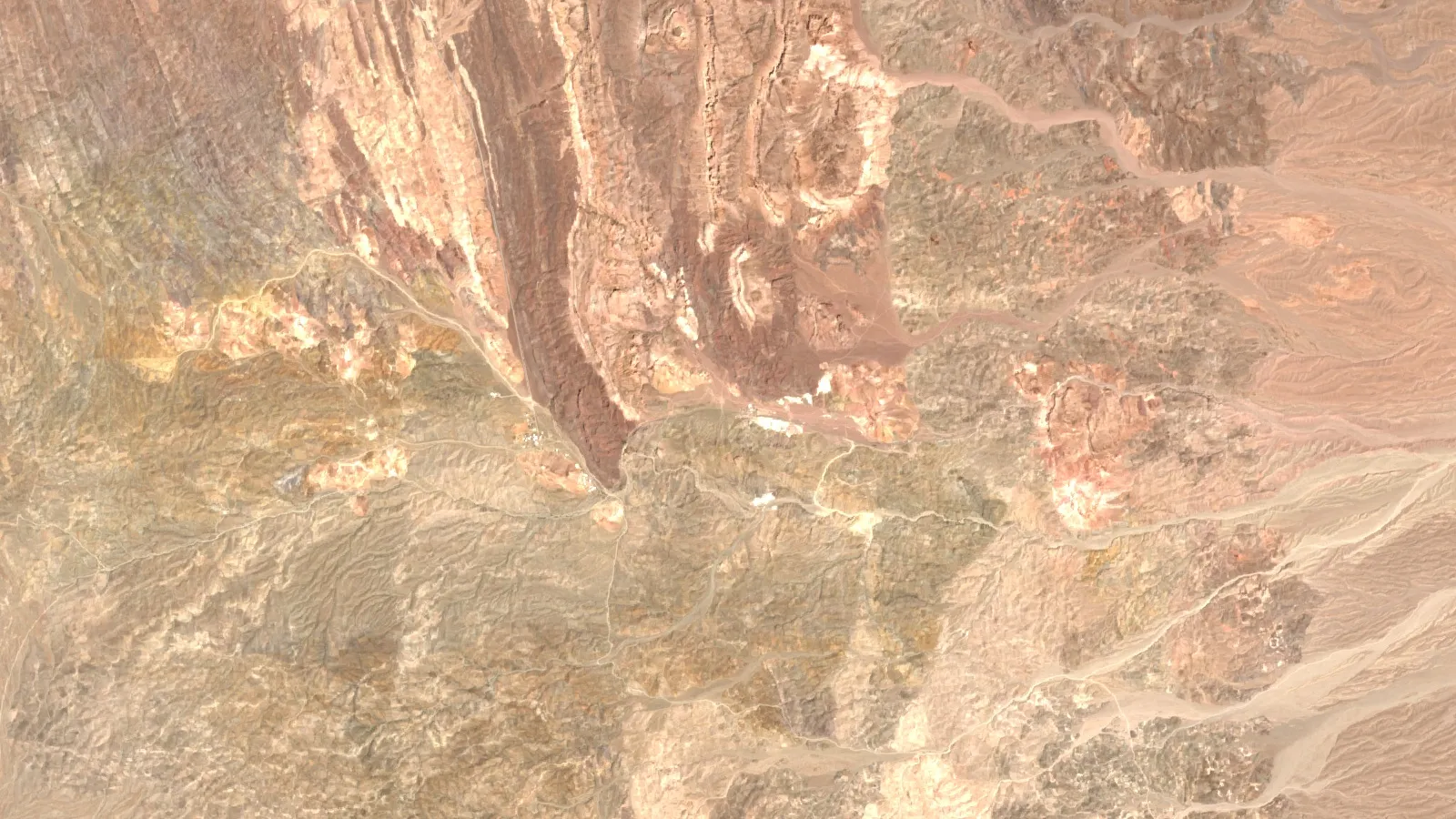
The El Dorado mine in Nevada is not one working mine. It is the old Eldorado Canyon mining district in southern Clark County, about 45 to 60 minutes by road from the Las Vegas Strip, and its best-known mine is the Techatticup. The district’s mines produced about 100,600 troy ounces of gold and 2.36 million ounces of silver between 1907 and 1954, according to the USGS mineral records summarised in the USGS Mineral Resources Data System record. Large-scale production stopped in the 1940s. Today the Techatticup is a guided tour, and Nevada’s working gold mines are hundreds of miles to the north.
This page covers where the mine is, what it produced, why the rock holds gold and silver, how to visit, and how the district compares with the mines that make Nevada the top gold state. It also separates the canyon from other mines with similar names. Every figure carries its source.
Where is the El Dorado mine in Nevada?
The Techatticup Mine sits midway up Eldorado Canyon, near the small town of Nelson. Nelson Ghost Town gives its address as 16880 State Highway 165, Nelson, NV 89046, southeast of Las Vegas (Nelson Ghost Town). The canyon runs down to the Colorado River, and the district lies in the Eldorado Mountains, on the western side of the river. The USGS record places the main gold deposit about 25 miles south of Boulder City.
The same place appears under several names. Maps and records use Eldorado Canyon, El Dorado Canyon, the Eldorado district, the Colorado district and the Nelson district for overlapping ground. When a production figure is quoted, check which boundary it covers. The National Park Service’s historic resources study for Lake Mead says the name is pronounced “Eldoraydo” (NPS Lake Mead historic resources study).
Techatticup Mine history and timeline
The table below lists the main dates, each with its source.
| Period | What happened | Source |
|---|---|---|
| Before the 1850s | Mexican or Spanish miners likely worked the Wall Street area; the NPS study says mining here predates the historic period | NPS historic resources study |
| 1859 | Soldiers camped in the canyon found ore samples and staked the Honest Miner claim (USGS and Hansen date the gold discovery on that claim to 1857) | NPS historic resources study |
| 1861 | The district was organised; the Techatticup is dated to this year by the Nevada Mining Association | USGS record; Nevada Mining Association |
| 1863 | The Techatticup was discovered and paid well from the start | Townley (1968) |
| 1865 | About 1,500 people lived in the canyon and over 760 lodes had been recorded | NPS historic resources study |
| 1870s | The El Dorado Mining Company built a mill and smelter; claim jumping and violence were common | Townley (1968) |
| 1879 | The company was sold to the Southwestern Mining Company; the Techatticup was over 380 feet deep | Townley (1968) |
| 1939 to 1942 | Years of greatest output in the district | Hansen (1962) |
| October 1942 | A wartime government order stopped production | Hansen (1962) |
| Late 1970s | A small heap leach on the Wall Street claim gave the last significant production | USGS record |
| 1994 | The Werly family bought the town of Nelson and later opened the Techatticup for tours | Nevada Mining Association |
Sources are the 1968 Nevada Historical Society Quarterly article by John Townley, the 1962 doctoral thesis by Spenst Hansen and the Nevada Mining Association history of Nelson. The operator’s own site calls the Techatticup the oldest, richest and most famous gold mine in southern Nevada and dates the business to 1861 (Eldorado Canyon Mine Tours). That is the operator’s description, not an independent ranking.
Ore was rich enough to pay for expensive transport. Townley reports that sacked Techatticup ore still made a profit after smelting and freight charges of US$150 per ton in the early years, and that freight to San Francisco fell to US$80 per ton by about 1879. Miners also added salt, rafted down from the Virgin River, to roast the ore for the patio process, an old method that uses salt and mercury to recover silver.
How much gold and silver did Eldorado Canyon produce?
There is no single reliable total, because most early production was never recorded. Townley writes that the two major companies of the period falsified their records to avoid taxes, that small miners rarely reported output, and that the county records were kept more than 300 miles away. He estimates that more than US$3 million was produced before 1879, and that the 37,551 tons of ore with a net value of US$934,015 recorded for 1874 to 1907 is less than a quarter of the real figure.
From 1907 the figures are better. The USGS mineral record states that the district’s mines produced 100,600 ounces of gold and 2,360,000 ounces of silver between 1907 and 1954 (USGS Mineral Resources Data System). That is about 3.1 tonnes of gold and 73 tonnes of silver. Hansen’s thesis gives a total of more than US$5 million since discovery in 1857, and a silver-to-gold ratio of about 23 to 1 by ounces since 1907. The two sources agree: 2.36 million divided by 100,600 is about 23.5.
The Nevada Mining Association estimates US$10 million worth of ore from the Nelson mines between 1864 and 1900, a wider area and period than the USGS ounce figures, so the two are not directly comparable.
Geology: why this canyon holds gold and silver
The ore comes from epithermal veins. Epithermal means the minerals formed from hot water close to the surface, and the result is narrow veins of quartz and calcite that carry gold and silver. Hansen describes the veins of the Eldorado district as fissure veins on the margins of a body of Miocene rock called the Nelson quartz monzonite, in nearby volcanic rocks and in the older basement of gneiss and schist. The ore contains native gold, silver, pyrite, galena, chalcopyrite and sphalerite. Silver was enriched near the surface in places, but most production came from primary ore, and the deepest workings reached about 600 feet.
The USGS record describes a second style of gold in the central part of the district: three shallow, flat-lying pods of disseminated gold, called the Wall Street-Black Hawk-Gracey deposit. Disseminated means the gold is scattered through the rock instead of concentrated in veins. The record links the mineralisation to extension faulting that stretched the crust about 10 to 15 million years ago, and brackets the gold between 14 and 11 million years in age. It lists the deposit model as detachment-fault-related polymetallic copper-gold-silver-lead-zinc.
The same record lists companies that examined the bulk-mineable potential of the ground from the 1970s: Intermountain Exploration, Amselco, Exxon, Weaco, Homestake, Zephyr Resources and Alta Gold. It shows the deposit held by Nevada Pacific Mining in 1995 and listed among the properties of Nelloro Corp. in 1997. Those are old ownership entries, not a current status.
Is the El Dorado mine still operating?
No. The district stopped producing at scale in the 1940s, and the last significant output was a small heap leach in the late 1970s (USGS record above). The Techatticup now operates as a tour site, and Nelson as a filming and photography location. Eldorado Canyon Mine Tours says it hosts historic mine tours, photo shoots, movie backdrops and weddings at the Techatticup (Eldorado Canyon Mine Tours).
Nevada’s active gold mines are large open-pit and underground operations farther north, and the sections below describe them.
Visit the Techatticup Mine: tours, times and cost
Tours are run by Eldorado Canyon Mine Tours. The Nelson Ghost Town site lists tours at 9 a.m., 12 p.m. and 2 p.m. every day, says reservations are required, groups can have up to 20 people, and gives adult pricing as up to US$20 (Nelson Ghost Town FAQ, read 16 October 2026). The operator’s own site says to call for details and pricing on (702) 291-0026. Phone to confirm the price before you drive.
- Call (702) 291-0026 and book a time slot, as reservations are required.
- Ask the current adult and child price, the group size limit and what to wear.
- Drive to 16880 State Highway 165, Nelson, NV 89046, allowing 45 to 60 minutes from the Strip.
- Bring water and sun protection, because the canyon is in the Mojave Desert.
- Stay with the guide underground and do not enter other workings in the canyon.
Which El Dorado mine do you mean?
Several different things share the name, and the searches overlap. The table separates them so that you can tell which one a page or filing is about.
| Name | What it is | Status |
|---|---|---|
| Eldorado Canyon / Techatticup Mine, Nevada | Historic silver-gold district and mine near Nelson, Clark County | Tour site; no large-scale production since the 1940s |
| Wall Street-Black Hawk-Gracey deposit, Nevada | Disseminated gold deposit in the same district | Past producer; explored since the 1970s (USGS record) |
| Eldorado Gold Corporation | Canadian gold and base-metal producer (TSX: ELD, NYSE: EGO) | Operates in Canada, Greece and Turkiye; its second-quarter 2026 results cover Kisladag, Efemcukuru, Lamaque, Olympias, Skouries and McIlvenna Bay, none in Nevada |
The third row is a company, not a mine. Its most recent results report gold production of 104,616 ounces in the second quarter of 2026 (Eldorado Gold, 30 July 2026). This page gives no share price and no view on the stock. It is not investment advice.
Nevada’s place in US gold output
Nevada is where US gold comes from today. The USGS estimates that US mines produced 160 tonnes of gold in 2025, and that Nevada accounted for about 64% of it, followed by Alaska at about 22% (USGS Mineral Commodity Summaries 2026). About 7% was recovered as a byproduct of base-metal ores, mainly copper. The top 25 operations produced about 94% of the gold.
Chart
US gold mine production, 2021 to 2025
Metric tons of gold per year (2025 is an estimate)
US output has drifted down for five years while the price has risen. For the price history and state ranking in more detail, see our guide to US gold production by state.
How the old district compares with Nevada’s working gold mines
The largest gold complexes in Nevada belong to Nevada Gold Mines, which Barrick operates with a 61.5% interest and Newmont owns the other 38.5%. Barrick’s 2025 annual report shows its 61.5% share of the joint venture’s output at 1.591 million ounces of gold (Barrick Annual Report 2025). The chart compares the Eldorado district’s entire 1907 to 1954 output with a single year at each of the four complexes, on Barrick’s share basis.
Chart
The whole district versus one year at each Nevada complex
Thousand troy ounces of gold; Nevada complexes are Barrick’s 61.5% share in 2025
The gap is large. The district’s 47 years of recorded output is close to what the smallest of the four complexes, Phoenix, produced in one year. This is a scale comparison only: the districts are different deposit types, and the historic ounces were mined at a very different cost and price.
What modern Nevada mines do differently
Modern gold ore in northern Nevada is often refractory, which means the gold is locked in sulphide minerals and a simple leach will not release it. Operators first break down the sulphides. Barrick’s report shows how Nevada Gold Mines split its 2025 gold between four routes. A roaster heats the ore to burn off sulphur and carbon. An autoclave does the same job with hot, pressurised water and oxygen. An oxide mill treats ore that needs no such step, and a heap leach sprays a weak cyanide solution over stacked ore.
Chart
Nevada Gold Mines output by processing route, 2025
Thousand troy ounces of gold, Barrick’s 61.5% share (total 1,591)
Recovery, the share of gold in the ore that ends up in the bar, averaged 83% across the joint venture in 2025 on ore that averaged 2.76 grams of gold per tonne (grade), as reported by Barrick. A grade is the weight of metal per tonne of rock, in grams per tonne (g/t). Compare that with the 1870s Eldorado method: stamp mills, salt roasting and the patio process, with ore and supplies moved by wagon and river steamboat.
Large mines also track their equipment and emissions. Operators who run haul trucks and loaders can follow them with fleet management software, and those who report emissions can use carbon footprinting tools. For a wider view of how mining fleets stay connected, read mobile fleet networks in mining.

▶ A clay nugget followed from rock to ring: how gold is found, crushed, dissolved and refined. · 5:27
Run the numbers on a silver-rich vein
The district’s ore carried far more silver than gold by weight. The calculator below lets you test how much metal a block of vein ore holds and what it is worth at prices you choose. Its default silver grade is set at about 23 times the gold grade, the ratio in the district’s 1907 to 1954 output. Change every number to your own.
Calculator
What is a block of silver-gold vein ore worth?
Enter your own tonnage, grades, recovery and prices.
- Recoverable silver: 19,130 oz
- Gross gold value (US$): $2,459,530
- Gross silver value (US$): $765,187
- Total gross metal value (US$): $3,224,717
Example values only, not a benchmark or any mine’s figures. The default silver grade is about 23 times the gold grade, the ratio in the Eldorado district’s 1907-1954 output (USGS record). Prices are inputs: example, use today’s price. The result is gross metal value in US$, before mining, processing, payable terms, royalties and tax.
Mine safety and rules around Eldorado Canyon
Old workings are dangerous. Nevada’s Division of Minerals estimates that the state has over 300,000 mining-related features, and about 50,000 of them are a significant physical hazard (Nevada Abandoned Mine Lands report, 2020). Its 2024 report counts 26,030 hazards discovered and ranked since 1987, of which 21,314 are recorded as secured, and no abandoned mine incidents were reported in 2024 (Nevada Abandoned Mine Lands report, 2024). Shafts can hide behind vegetation, and the air in old adits can be poor. Stay on the tour or out of the workings.
Collecting rules depend on the land manager. The National Park Service says that collecting, rockhounding and gold panning for recreation are generally prohibited in all units of the National Park System, with criminal penalties (NPS geology permits page). Lake Mead National Recreation Area is part of that system, and the NPS historic resources study covers Eldorado Canyon, so ask the park or the Bureau of Land Management which agency manages a given patch before you take anything, and respect private claims. This page is not legal advice.
Environmental legacy of a historic district
Historic districts leave open workings, waste rock and tailings. Reclamation today means closing openings, shaping waste dumps and monitoring water. The Nevada programme above is the state’s response to that legacy, and the secured-hazard count shows it is far from finished. For a plain-language overview of how mining changes land, air and water in general, see our short video on the main impacts, and our guide to environmental site assessment trends for how buyers and lenders review old sites.
▶ A plain-language claymation on the seven environmental impacts of mining. · 2:31
Mapping old mining districts from space
Satellites do not see gold. They map the rock around it: iron-stained and clay-altered ground, faults and vegetation changes. In a district like Eldorado Canyon, where several deposit styles overlap, a satellite screen can show where altered rock lies outside the known workings. Farmonaut offers satellite-based mineral screening of a licence area from a polygon or KML file as an exploration target, ahead of any resource estimate. It does not replace sampling, drilling or a qualified geologist. For a wider look at the topic, see gold deposits in Nevada.

▶ What satellites can and cannot show when they are used to look for gold. · 4:25
Related reading on this site: Mount Morgan Mine: History, Cleanup and Gold Restart.
We cover a connected topic in Consolidated Gold Mine Georgia: Tour Cost and History.
Frequently asked questions
Where is the El Dorado mine in Nevada?
It is in Eldorado Canyon, near the town of Nelson in southern Clark County, southeast of Las Vegas. The Techatticup Mine, the best-known mine in the canyon, is on State Highway 165.
Is the El Dorado mine in Nevada still operating?
No large-scale mining has taken place there since the 1940s, and the last significant output was a small heap leach in the late 1970s. The Techatticup now runs guided tours.
How much gold did Eldorado Canyon produce?
The USGS mineral record gives about 100,600 ounces of gold and 2.36 million ounces of silver for 1907 to 1954. Earlier output was recorded in dollars and is incomplete, with estimates of US$3 million before 1879 to US$10 million for 1864 to 1900, depending on the source and area.
Who owns the Techatticup Mine?
The Nevada Mining Association says the Werly family bought the town of Nelson in 1994 and later opened the mine to tours. Eldorado Canyon Mine Tours is the operator today. Eldorado Canyon Mine Tours is the contact for the site.
How much does the Techatticup tour cost?
Nelson Ghost Town lists adult pricing of up to US$20, as read on 16 October 2026. The operator’s own page asks visitors to call (702) 291-0026 for pricing, so confirm the current rate when you book.
How deep is the Techatticup Mine?
Townley reports that it was over 380 feet deep by about 1879, and Hansen puts the deepest workings in the district at about 600 feet.
Why is it called El Dorado?
El Dorado is Spanish for “the golden one”. The USGS record says Spanish explorers named Eldorado Canyon in the 1700s.
Can I pan for gold or prospect in Eldorado Canyon?
Not freely. National Park Service units generally prohibit recreational collecting and gold panning, and private claims and land need permission. Check with the land manager first.
Is Eldorado Gold’s mine in Nevada?
No. Eldorado Gold Corporation reports operations and projects in Canada, Greece and Turkiye, and it is a different business from the historic canyon.
How far is Eldorado Canyon from Las Vegas?
Nelson Ghost Town puts the drive at roughly 45 to 60 minutes from Las Vegas, depending on traffic.
This page is for information only. It is not investment advice and gives no share price or target. It is not legal advice; confirm land access, collecting and claim rules with the land manager and regulator. Never enter old mine workings: stay with a guide.
Farmonaut mining
Map a mining site from space
Consultants can screen a licence area from a polygon or KML file and see satellite-based exploration targets ahead of any resource estimate.

Mining Pro sample view, synthetic data
Keep reading
Sources
- Townley, Early Development of El Dorado Canyon and Searchlight Mining Districts, Nevada Historical Society Quarterly (1968): epubs.nsla.nv.gov
- USGS Mineral Resources Data System record, Eldorado Gold Property: mrdata.usgs.gov
- Hansen, The geology of the Eldorado Mining District, Clark County, Nevada, doctoral thesis (1962): scholarsmine.mst.edu
- Nevada Mining Association, Nevada Ghost Towns: Nelson: nevadamining.org
- Nelson Ghost Town, tours and FAQ (read 16 October 2026): nelsonghosttown.com
- Eldorado Canyon Mine Tours, home page: eldoradocanyonminetours.com
- National Park Service, Lake Mead historic resources study: npshistory.com
- National Park Service, Geology permits (rockhounding and collecting): nps.gov
- Nevada Division of Minerals, Abandoned Mine Lands Physical Hazards Report (2020): minerals.nv.gov
- Nevada Division of Minerals, Abandoned Mine Lands Physical Hazard Report (2024): minerals.nv.gov
- USGS, Mineral Commodity Summaries 2026, Gold: pubs.usgs.gov
- Barrick, Annual Report 2025: s25.q4cdn.com
- Eldorado Gold Corporation, Second Quarter 2026 results (30 July 2026): eldoradogold.com
Discussion
Questions, corrections or field experience? Share them below. First-time comments are reviewed before they appear, and your email is never published.
No comments yet. Be the first to add a question or your experience.

 Mwerezi Minerals Company Limited
 Congo Mining Solutions
 Mining SARL
 SenGold Invest SAS
 Sania Corporation
 Sean Mining Limited
 NTS Group (Pty) Ltd
 Mine4Africa
 Lithspo Minerals Limited
 Tintina Mining Group
 Dalgety Minerals Pty Ltd
 Vortex Minerals Pty Ltd
 Faith At Work (Pty) Ltd
 Geotech Mining Solutions plc
 Vulcan International Limited
 Kidepo Associates
 GKY Mining
 Alkimy SARL
 Double A Trading

 Licence holder · Nigeria · Gold + lithium










