

Western Australia gold · Mine profile
Deflector Gold Mine: Owner, Output, Costs and Reserves
The Deflector mine is an underground gold-copper mine in WA’s Murchison, owned by Vault Minerals. With Rothsay it produced 77,649 oz of gold in FY26 at A$3,282/oz, with costs guided higher for FY27.
Key takeaways
- Owner: Vault Minerals (ASX: VAU), 100%, formed from the Red 5 and Silver Lake merger (filings, 2024-2026).
- Output: 77,649 oz in FY26 for the region, with 74,000 to 78,000 oz guided for FY27 (Vault, July 2026).
- Cost: AISC of A$3,282/oz in FY26, guided to A$4,300 to A$4,500/oz in FY27 (Vault, July 2026).
- Ore left: 145,000 oz of Ore Reserves and 663,000 oz of Mineral Resources at the mine (30 June 2026).
- Next ounces: Contact Lode, Spanish Galleon and the Gullewa trend about 7 km from the plant (Vault, September 2026).
In this article
Deflector gold mine: the short answer
The Deflector gold mine is an underground gold and copper mine in the southern Murchison region of Western Australia, about 450 km north of Perth and 160 km east of Geraldton. Vault Minerals (ASX: VAU) owns it through a wholly owned subsidiary. With its satellite Rothsay mine, the Deflector region produced 77,649 ounces of gold in the year to June 2026.
That answer is easy to find. What is harder to find in one place is what a consultant or analyst needs next: the cost per ounce, how much ore is left, and what could change the picture. This page gathers those figures from Vault’s ASX filings, with the date on each one. Australian financial years end on 30 June, so FY26 means July 2025 to June 2026.
Deflector mine quick facts
| Item | Latest filed figure | Date |
|---|---|---|
| Owner | Vault Minerals Limited (ASX: VAU), 100% | September 2026 |
| Location | Gullewa greenstone belt, south of Yalgoo, Murchison, WA | Project profile |
| Main mining lease | M59/442, valid until 4 November 2039 | September 2026 |
| Mining method | Underground, longhole open stoping and modified Avoca | September 2026 |
| Region gold output | 77,649 oz | FY26 |
| Region all-in sustaining cost | A$3,282/oz | FY26 |
| Region output guidance | 74,000 to 78,000 oz | FY27 |
| Region cost guidance | A$4,300 to A$4,500/oz | FY27 |
| Deflector mine Mineral Resource | 2.5 Mt at 8.3 g/t for 663,000 oz | 30 June 2026 |
| Deflector mine Ore Reserve | 1.4 Mt at 3.3 g/t for 145,000 oz | 30 June 2026 |
Grade in grams per tonne (g/t) tells you how much gold sits in each tonne of rock. A Mineral Resource is mineralised rock with reasonable prospects of being mined. An Ore Reserve is the smaller part that a mine plan shows can be mined at a profit, after allowing for dilution and losses.
Where is the Deflector mine site?
The site lies within the Shire of Yalgoo, whose council lists Deflector among the mining operations in its area under the older Silver Lake name. The shire covers about 33,258 square kilometres of the Murchison goldfield. People often place Deflector in “the Goldfields”, but the Eastern Goldfields around Kalgoorlie are a different district. Deflector belongs to the Murchison.
The ground is held under mining leases M59/442 and M59/356, through Deflector Gold Pty Ltd and Gullewa Gold Project Pty Ltd. Vault’s September 2026 resource statement also records two royalties: a 1% royalty on gross revenue payable to Gullewa Ltd, and the WA state royalty of 2.5%. The same table notes that registration of the Yamatji Nation Indigenous Land Use Agreement extinguished native title over the Deflector tenements, and that the Yamatji Southern Regional Corporation remains a key stakeholder. Heritage surveys cover active exploration areas.
The site has its own processing plant, tailings storage, waste dump and on-site laboratory. Face samples are analysed at that laboratory, which Intertek manages. For the wider district, our Australia mining map shows how the Murchison sits against other producing regions.
Who owns the Deflector gold mine?
Vault Minerals is the owner. Vault is the company formed when Red 5 and Silver Lake Resources merged. They announced the merger on 5 February 2024, with Red 5 acquiring all of Silver Lake’s shares. Many older articles still name Silver Lake as the operator, so check the date of anything you read.
Vault’s other operations are Leonora (King of the Hills and Darlot) and Mount Monger in Western Australia. It also holds Sugar Zone in Canada, which has Mineral Resources and Ore Reserves in the same statement. Deflector is the smallest of the three WA production centres by FY26 output.
Ownership and exploration timeline
- 1990 to 1994: Sons of Gwalia carries out modern mapping, sampling and surface drilling.
- 1995 to 2002: National Resources Exploration, Gullewa Gold, then King Solomon Mines and Menzies Gold.
- 2003 to 2014: Batavia and Hallmark Consolidated, ATW Gold, then Mutiny Gold.
- 2015: Doray Minerals completes its takeover of Mutiny Gold and takes full ownership of the project.
- 2016: open-pit mining starts in February, with underground mining and a new gravity-flotation plant planned for later that year.
- 2024: Red 5 and Silver Lake, by then the holder of Deflector, agree to merge.
- November 2025: the Deflector underground moves to owner-operator mining, meaning Vault runs the fleet itself in place of a contractor.
Deflector gold production by quarter
Output fell from the June 2025 quarter to the December 2025 quarter and has recovered slowly since. The June 2026 quarterly report ties the recovery to the first full quarter of uninterrupted work after the switch to owner-operator mining. Ore mined at Deflector itself rose 50% on the prior quarter, and development advance rose 38%. Rothsay mined close to its record level.
Chart
Deflector region gold production by quarter
Ounces of gold, including Rothsay
The plant milled 789,526 tonnes in FY26 at 3.2 g/t gold, with gold recovery of 96.4%. Most gold leaves as bullion: 67,554 oz in FY26. A further 10,095 oz left inside a gold-copper concentrate.
Copper is real but small. The concentrate held 336 tonnes of copper in FY26, and by-product credits took about A$82/oz off costs in the June quarter. Silver also contributes to those credits. Treat Deflector as a gold mine with a minor copper credit, not as a true gold-copper producer in revenue terms.
Deflector all-in sustaining cost
All-in sustaining cost (AISC) adds mining, processing, overheads, royalties and the capital needed to keep a mine running, then divides by the ounces sold. Deflector was the highest-cost of Vault’s three producing centres in FY26, at A$3,282/oz against a group figure of A$2,924/oz.
Chart
Where a Deflector ounce cost went, June 2026 quarter
A$ per ounce sold, Deflector region, main cost lines before credits and inventory movements
Chart
All-in sustaining cost by Vault operation, FY26
A$ per ounce sold
Costs step up in FY27. Vault guides to A$4,300 to A$4,500/oz, and A$300 to A$350 of that is a non-cash charge for treating stockpiles. The filing gives the reason: ore production and development metres are planned 36% and 48% higher as the Spanish Galleon area ramps up, and those costs now sit inside AISC. In FY26 the capital to open Spanish Galleon was reported outside AISC, including A$5.6 million in the June quarter alone, so the two years do not compare directly.
The margin has been wide because of the price. Vault’s group average realised price was A$6,311/oz in the June 2026 quarter. Vault’s FY26 results add that all of Deflector’s gold sold at the spot price, while King of the Hills and Mount Monger were delivering into forward sales in the first half. Spot gold was about US$4,115/oz on Kitco at 12:26 pm New York time on 5 November 2026, in line with Trading Economics that day. For scale, Western Australia’s gold sales reached an all-time high of A$29 billion in 2024-25, on about 6.7 million ounces.
Calculator
What margin does a Deflector-style mine make at your gold price?
Enter your own output, price and cost figures.
- Margin per ounce, A$: 1,600
- State royalty at 2.5%, A$ per year: 11,400,000
- Gullewa royalty at 1%, A$ per year: 4,560,000
- Years of output from reserves alone: 2.1
Defaults are round examples, not a forecast. Reserve ounces (170,000) and recovery (96%) follow Vault, September and July 2026; royalty rates of 2.5% state and 1% Gullewa come from the same statement. AISC normally already includes royalties, so the royalty lines are shown for scale and are not subtracted. Price is an input: use today’s price.
Deflector reserves and mine life
At 30 June 2026 the Deflector mine held 663,000 oz of Mineral Resources and 145,000 oz of Ore Reserves. Adding Rothsay takes the region to 921,000 oz and 170,000 oz.
Chart
Deflector and Rothsay gold inventory, June 2025 to June 2026
Thousand ounces of gold
Read Vault’s growth percentages with care. It reports a 58% rise in underground Ore Reserves “net of depletion”, which measures against the June 2025 figure after removing what was mined in FY26. On an absolute basis the same reserve rose 10%, from 128,000 oz to 141,000 oz. Across the whole region, reserves fell from 192,000 oz to 170,000 oz in absolute terms, because Rothsay’s reserve dropped from 46,000 oz to 25,000 oz.
The large gap between resource grade (8.3 g/t) and reserve grade (3.3 g/t) is also worth a look. Part of it is dilution: narrow veins mean some waste rock is mined with the ore. Part is that only some of the resource has a mine plan behind it. So the resource total says little about the recoverable ounces.
What could extend the mine life
- Contact Lode: first developed in 2016, then little drilled. Drilling in FY26 brought it into the mine plan as a third mining front. Its southern end is largely Inferred, the lowest confidence class, and sits outside reserves.
- Spanish Galleon: massive sulphide veins in dolerite to the west of the main system. FY26 drilling here was mostly close-spaced grade control.
- Gullewa trend: old mining centres such as Michelangelo, Monarch and Rocksteady, about 7 km from the plant. First-phase drilling was completed in the second half of FY26, and none of it is in the June 2026 resource.
Underground drilling at Deflector totalled 51,830 metres in FY26, about 25% more than the year before. Vault expects output to stay broadly steady across its three-year outlook. That outlook partly relies on ounces beyond the current reserve, and Vault’s production-target wording in the filing sets out the conditions attached.
Deflector geology and mining method
Vault classes Deflector as a hybrid Archean orogenic gold-copper deposit. Orogenic means the gold came in with fluids moving along faults during mountain building. Here that produced narrow, roughly parallel quartz-sulphide veins in thick high-magnesium basalt, cut by later dykes. There are six main vein sets: Western, Central, DaVinci, Contact, Southwest and Spanish Galleon. Our guide to types of ore deposits compares this style with others.
The resource runs about 1,600 m along strike, 430 m across and 630 m in depth. Drilling averages about 600 m below surface. Crews use twin-boom jumbos for development, then longhole retreat stoping and the modified Avoca method. In both, ore is blasted from long holes and removed by loader, and Avoca stopes are progressively backfilled.
The plant uses gravity recovery and flotation, as set out in the original project design: a gravity circuit produces bullion, and flotation produces the gold-copper concentrate. The 2015 plan expected up to 160,000 oz a year over six years. It also planned for a 480,000 tonne-a-year plant. FY26 throughput of 789,526 tonnes shows how far the operation has moved from that first design.

▶ How gold moves from rock to refined metal, step by step · 5:27
Sustainability and environmental management at Deflector
The filings describe how waste is handled, and this is the firmest public detail available in them. Under the resource statement’s environmental factors, the waste dump is designed to take all waste rock types from the underground. Final landforms aim for surfaces that can support self-sustaining vegetation. Topsoil and laterite are stored around the landforms, close to where they will be reused. Process plant tailings go to a dedicated storage facility.
If you are comparing mines on environmental performance, ask for site-level water, energy and emissions data with the reporting year and boundary stated. WA’s regulator and the company’s own sustainability reporting are the places to check. Per-ounce numbers mean little unless the same boundary applies to both mines.

▶ The main environmental impacts of mining, in plain words · 2:31
What consultants and investors should check
- Region or mine? Production and AISC are reported for the Deflector region including Rothsay. Resources and reserves are split. Do not divide one by the other without noticing.
- Which reserve basis? Compare absolute ounces as well as growth net of depletion.
- What sits outside AISC? Growth capital, stockpile charges and Spanish Galleon costs moved between years.
- How does the royalty stack add up? The 2.5% state royalty and 1% Gullewa royalty rise with revenue, so higher prices lift AISC too. Vault’s FY27 guidance assumes A$6,000/oz for royalties.
- How old is the source? Older profiles still show open pits, Doray or Silver Lake.
Listed company details here are facts from filings, not a view on the shares.
Satellite data for ground near a mine like Deflector
Old workings and underexplored trends, like those along the Gullewa belt, are the usual place to look next. Satellite imagery can map alteration and structure across a licence before a drill rig is booked, which helps a consultant rank targets. These are exploration targets, not resource estimates. Our guide to exploration targeting covers the method, and our list of Australian mining exploration companies shows who is active.
Farmonaut offers satellite-based mineral detection from a KML, KMZ or polygon boundary. To scope a project, use the mining query form or contact us.

▶ How satellites help find gold by mapping the rock around it · 4:25
Frequently asked questions
Where is the Deflector gold mine?
It is in the southern Murchison region of Western Australia, south of Yalgoo, about 450 km north of Perth and 160 km east of Geraldton.
Who owns the Deflector mine?
Vault Minerals Limited (ASX: VAU) holds a 100% interest. Vault came from the merger of Red 5 and Silver Lake Resources.
Is Deflector still owned by Silver Lake Resources?
No. Silver Lake merged with Red 5, and the filings now come from Vault Minerals. The older name still appears on some sites.
How much gold does Deflector produce?
The Deflector region, including Rothsay, produced 77,649 oz in FY26. Guidance for FY27 is 74,000 to 78,000 oz.
What does Deflector cost per ounce?
AISC was A$3,282/oz in FY26. FY27 guidance is A$4,300 to A$4,500/oz, including a non-cash stockpile charge of A$300 to A$350/oz.
How much gold is left at Deflector?
The mine held 145,000 oz of Ore Reserves and 663,000 oz of Mineral Resources at 30 June 2026.
Is Deflector an open-pit or underground mine?
It works underground. Open pits were mined in the past, and the current plan centres on the underground lodes.
Does Deflector produce copper?
Yes, in a gold-copper concentrate. It held 336 tonnes of copper in FY26, with a copper recovery of about 53%.
What is the Rothsay mine’s link to Deflector?
Rothsay is a satellite underground mine in the same operating group. It held 25,000 oz of Ore Reserves at 30 June 2026.
What royalties apply at Deflector?
The WA state royalty is 2.5%, and a 1% royalty on gross revenue goes to Gullewa Ltd.
Where can I find Deflector mine photos?
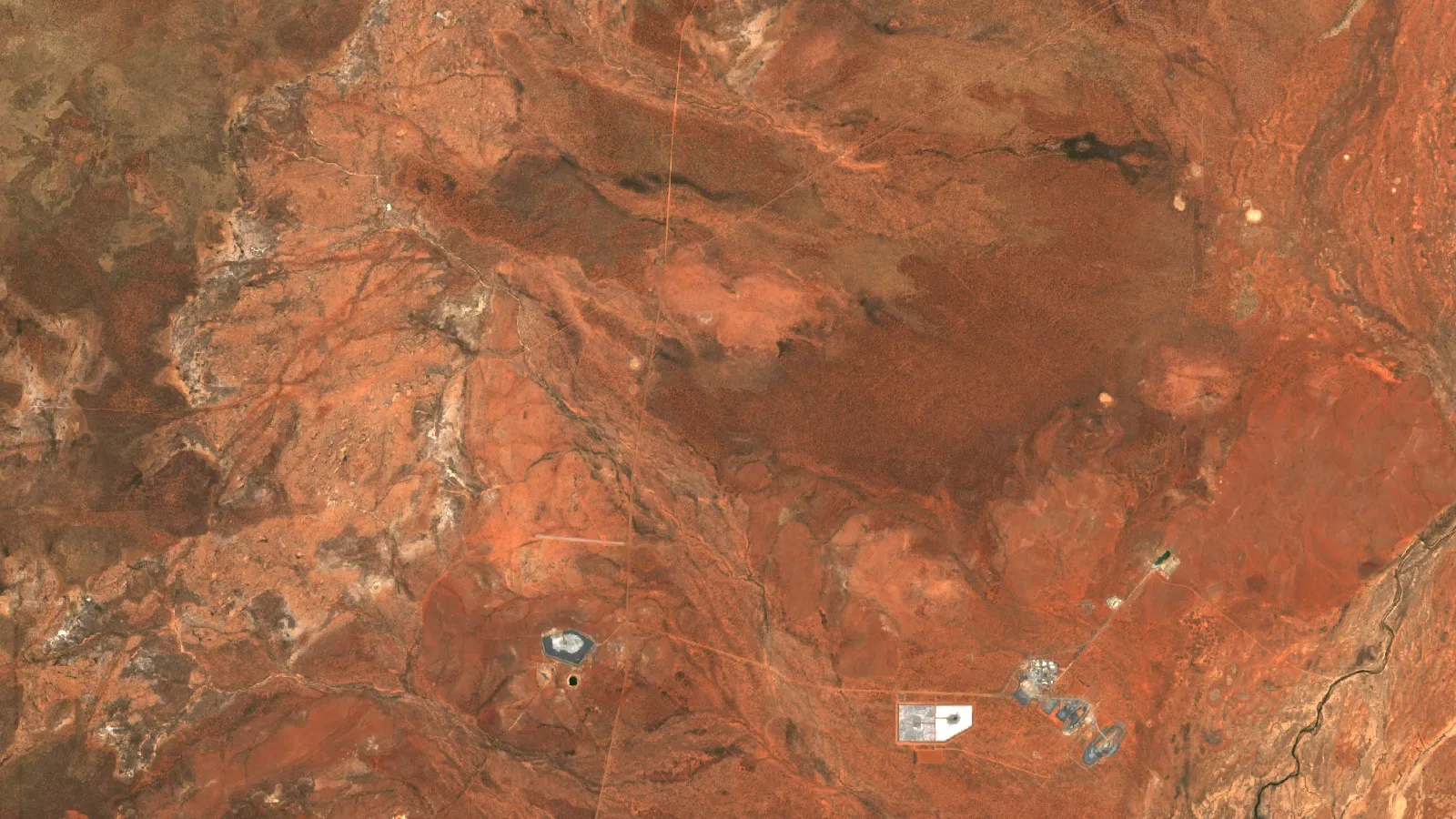
The image at the top of this page is a Sentinel-2 satellite view of the district. Vault’s filings include plan views of the lodes.
This page is for information only. It is not investment advice.
Farmonaut mining
Map your own mining site from space
Send a licence boundary to scope a satellite report that a consultant can use to rank targets before fieldwork.

Mining Pro sample view, synthetic data
Keep reading
Sources
- Vault Minerals, June 2026 Quarterly Activities Report (29 July 2026): investorpa.com
- Vault Minerals, 2026 Resource and Reserve Statement (3 September 2026): investorpa.com
- Vault Minerals, March 2026 quarterly report (22 April 2026): announcements.asx.com.au
- Vault Minerals, FY26 preliminary production (3 July 2026): announcements.asx.com.au
- Vault Minerals, FY26 results announcement (20 August 2026): investorpa.com
- Red 5 and Silver Lake Resources to Merge (5 February 2024): announcements.asx.com.au
- Mining Technology, Deflector Gold Project, Murchison: mining-technology.com
- WA Government, 2024-25 Statistics Digest: wa.gov.au
- Shire of Yalgoo, History: yalgoo.wa.gov.au
- Kitco, gold price chart (5 November 2026): kitco.com
- Trading Economics, gold (5 November 2026): tradingeconomics.com
Discussion
Questions, corrections or field experience? Share them below. First-time comments are reviewed before they appear, and your email is never published.
No comments yet. Be the first to add a question or your experience.

 Energy and Resources Ltd
 Mwerezi Minerals Company Limited
 Congo Mining Solutions
 Mining SARL
 SenGold Invest SAS
 Sania Corporation
 Sean Mining Limited
 NTS Group (Pty) Ltd
 Mine4Africa
 Lithspo Minerals Limited
 Tintina Mining Group
 Dalgety Minerals Pty Ltd
 Vortex Minerals Pty Ltd
 Faith At Work (Pty) Ltd
 Geotech Mining Solutions plc
 Vulcan International Limited
 Kidepo Associates
 GKY Mining
 Alkimy SARL

 Licence holder · Nigeria · Gold + lithium
 Client · Somalia · Gold










