

Mining Condition Monitoring & Blast Monitoring Systems
Reviewed August 2026 against OSMRE’s 30 CFR Part 816 blasting standards, MSHA’s flyrock safety guidance, and the Fortune Business Insights blast-monitoring and machine-condition-monitoring market reports.
Try it: Run your own numbers →
Mining condition monitoring is the continuous, sensor-based tracking of equipment health, ground stability, and blasting parameters across a mine site, in place of periodic manual inspection rounds. Electronic blast monitoring is the specific slice of that discipline that measures ground vibration, airblast, and rock movement from every shot against a fixed regulatory ceiling — in the United States, the peak-particle-velocity and airblast limits written into 30 CFR §816.67. Both disciplines exist to answer the same question from different angles: is this shift’s blasting or equipment operation safe enough to continue, and can the operator prove it to a regulator on demand.
What follows sets out what electronic blast monitoring systems record, how mining condition monitoring extends that to equipment and geotechnical data, the exact US ground-vibration and airblast thresholds a blast plan has to clear, the size of the underlying equipment market, how mining condition monitoring and blast optimization fit together operationally, and a calculator you can run against your own blast plan numbers.



Contents
Electronic Blast Monitoring and “Electronic Mining”: What the Terms Cover
“Electronic mining” is not one product category. Searches for the term resolve to two distinct things: electronic detonators (digital initiation systems that replace pyrotechnic delay elements with programmable timing chips) and electronic blast monitoring (the seismographs, microphones, and telemetry that record what a shot actually did, rather than what it was designed to do). This article covers both, because a US blasting operation is regulated on the second and increasingly sold on the first.
A production blast introduces three measurable hazards: ground vibration that can crack or destabilize nearby structures, airblast (the pressure wave and sudden loud report that can rattle windows and disturb communities), and flyrock — fragments thrown by the explosive charge. Electronic blast monitoring systems deploy seismographs and accelerometers for vibration, microphones for airblast pressure, and real-time transmitters that feed a shot’s waveform to a compliance dashboard within minutes of detonation, instead of a technician transcribing a paper gauge days later.
Regulators do not leave the definition of “safe” to the operator. 30 CFR §816.67, the Office of Surface Mining Reclamation and Enforcement’s (OSMRE) blasting-control rule for surface coal operations, sets fixed peak-particle-velocity (PPV) and airblast ceilings at the nearest dwelling, school, church, or occupied structure outside the permit area. Metal/nonmetal and industrial-mineral operations under MSHA jurisdiction, and most state blasting statutes, use the same underlying vibration science even where the specific limit numbers differ by state.

US Blast Limits: Ground Vibration and Airblast Thresholds
These are the numbers a compliant blast monitoring system is checking every shot against. They come directly from 30 CFR §816.67 and are the baseline most state surface-mining and quarry regulators reference or mirror:
| Parameter | Zone or instrument response | Maximum allowed |
|---|---|---|
| Ground vibration (PPV) | 0–300 ft from the blast | 1.25 in/second |
| Ground vibration (PPV) | 301–5,000 ft from the blast | 1.00 in/second |
| Ground vibration (PPV) | Beyond 5,000 ft | 0.75 in/second |
| Airblast | 0.1 Hz or lower, flat response | 134 dB peak |
| Airblast | 2 Hz or lower, flat response | 133 dB peak |
| Airblast | 6 Hz or lower, flat response | 129 dB peak |
| Airblast | C-weighted, slow response | 105 dBC peak |
| Flyrock | Any direction | Not beyond half the distance to the nearest occupied structure |
Operators can also work from the scaled-distance formula in the same section: W = (D/Ds)², where W is the maximum explosive weight in pounds detonated within any 8-millisecond period, D is the distance in feet to the nearest protected structure, and Ds is the scaled-distance factor the regulator has approved for that PPV band in the operator’s blast plan. That formula is what powers the calculator further down this page.
Blast Movement Monitoring: A Different Problem From Vibration
“Blast movement monitoring” is a separate discipline from the vibration and airblast monitoring above, and treating the two as interchangeable is the most common mix-up in this space. Vibration monitoring asks whether a shot stayed inside a safety limit. Blast movement monitoring asks where the ore actually ended up after the rock moved — because a blast doesn’t just fracture rock in place, it displaces it, and a grade boundary mapped before the shot is no longer where the excavator will find it afterward.
The technique places markers — sensors magnetically enhanced so they can be relocated with a detector — into blastholes before firing. After the shot, crews walk the muckpile to relocate each marker’s new 3D position, and the resulting displacement vectors are used to redraw the ore/waste dig line. Blast Movement Technologies (BMT), one of the commercial suppliers of this equipment, documents that movement is greatest mid-to-lower on the bench, is reduced near the floor by friction against the unbroken rock below, and runs roughly perpendicular to the blast’s initiation timing contours rather than in a single uniform direction — which is why the company states plainly that movement “cannot be predicted or modeled with sufficient accuracy for ore control purposes” from blast design alone; it has to be measured. At Cowal Gold Mine, BMT reports a 7% improvement in mill head grade from mining ore blocks in their post-blast, monitored locations rather than their pre-blast, modeled ones — a result specific to that site’s ore geometry, not a number to import wholesale into a different pit.
For a US operator, the practical takeaway is that blast movement monitoring is a grade-control and dilution-control investment, justified against ore value lost to misclassified boundaries, while vibration and airblast monitoring is a compliance investment, justified against 30 CFR §816.67 and the cost of a violation. Some sites run both; neither substitutes for the other.

Mining Condition Monitoring Systems Beyond the Blast
Outside the blast zone, mining condition monitoring systems track three other categories continuously rather than on an inspection schedule:
- Equipment health monitoring: sensors on drills, conveyors, and haul-fleet vehicles detect vibration anomalies, overheating, and wear signatures ahead of failure, feeding predictive-maintenance schedules instead of run-to-failure or fixed-interval servicing.
- Geotechnical monitoring: strain gauges, tiltmeters, and radar or InSAR-based slope monitoring detect the small, progressive ground movements that precede rockfalls, wall failures, or subsidence — the same underlying physics OSMRE’s blasting rule is trying to prevent from the explosive side.
- Environmental and air-quality monitoring: continuous gas (methane, particulate/dust) sensors support compliance with MSHA’s occupational exposure standards and give an operator its own record independent of a post-incident inspection.
A “mining monitoring system” in the broad sense is the dashboard that unifies these feeds — equipment, ground, environment, and blast — into one place a shift supervisor can act on in minutes rather than the days a paper-based inspection cycle used to take. That shift from reactive to predictive maintenance, and from after-the-fact to real-time safety response, is the single biggest change condition monitoring has made to how mines are run over the past decade.

Blast Monitoring Equipment: Market Size and Where It’s Growing
The equipment behind both disciplines is a defined, trackable market, not a niche add-on. The figures below are the ones to re-check against the source reports when planning a capital purchase, since forecasts get revised annually:
| Segment | Base-year value | Forecast value | CAGR |
|---|---|---|---|
| Blast monitoring equipment, global | $330.8M (2025) | $598.4M (2034) | 7.0% |
| Blast monitoring equipment, North America | $81.7M (2025) | $85.8M (2026) | — |
| Blast monitoring equipment, United States | — | $57.6M (2026) | — |
| Machine condition monitoring, global (incl. mining) | $3.00B (2025) | $6.80B (2034) | 9.7% |
| Machine condition monitoring, United States | — | $0.57B (2026) | — |
Two things stand out. First, North America holds 24.70% of the global blast-monitoring-equipment market in 2025 despite having some of the world’s strictest per-shot vibration limits — regulatory pressure drives adoption rather than suppressing it. Second, the broader machine-condition-monitoring category (equipment health across all industries, mining included) is roughly ten times the size of the blast-specific equipment market and growing faster, at a 9.7% CAGR against blast monitoring’s 7.0%, per Fortune Business Insights — consistent with equipment-health sensors spreading across more machine types than blast-specific seismographs ever will.

Electronic Detonators and the Shift Away From Non-Electric Systems
The other half of “electronic mining” is initiation hardware. Non-electric (shock-tube) detonators still carry the majority of open-pit volume today because they are cheaper and their supply chains are established, but electronic detonators — which use a programmable timing chip instead of a fixed pyrotechnic delay — are estimated at 25–30% of global detonator unit volume in 2026, according to IndexBox’s detonator market forecast. The same forecast projects electronic detonators exceeding 55% of open-pit volume by 2035, up from that 2026 base, at an overall market CAGR near 4.5% for 2026–2035. Mining already accounts for over 60% of global detonator consumption — 38% open-pit, 24% underground — so this swing is a mining-industry story more than a construction or quarrying one.
The link to blast monitoring is direct: programmable timing lets an operator sequence a shot to control both vibration propagation (spreading charge detonation over more, smaller time windows lowers the PPV a seismograph records at a given distance) and, per the movement patterns above, the direction rock is thrown relative to grade boundaries. Electronic monitoring proves what a shot did; electronic initiation is increasingly how operators design a shot to do less of it in the first place.
Scaled-Distance Blast Charge Calculator
The scaled-distance formula from 30 CFR §816.67 above — W = (D/Ds)² — is the fastest way to sanity-check a planned charge weight against your own approved blast plan before you load a hole. Enter your own distance, your own approved scaled-distance factor, and your own planned charge; nothing here is pre-filled with a real site’s numbers.
Run your own numbers
Farmonaut’s Role in Mining Condition Monitoring
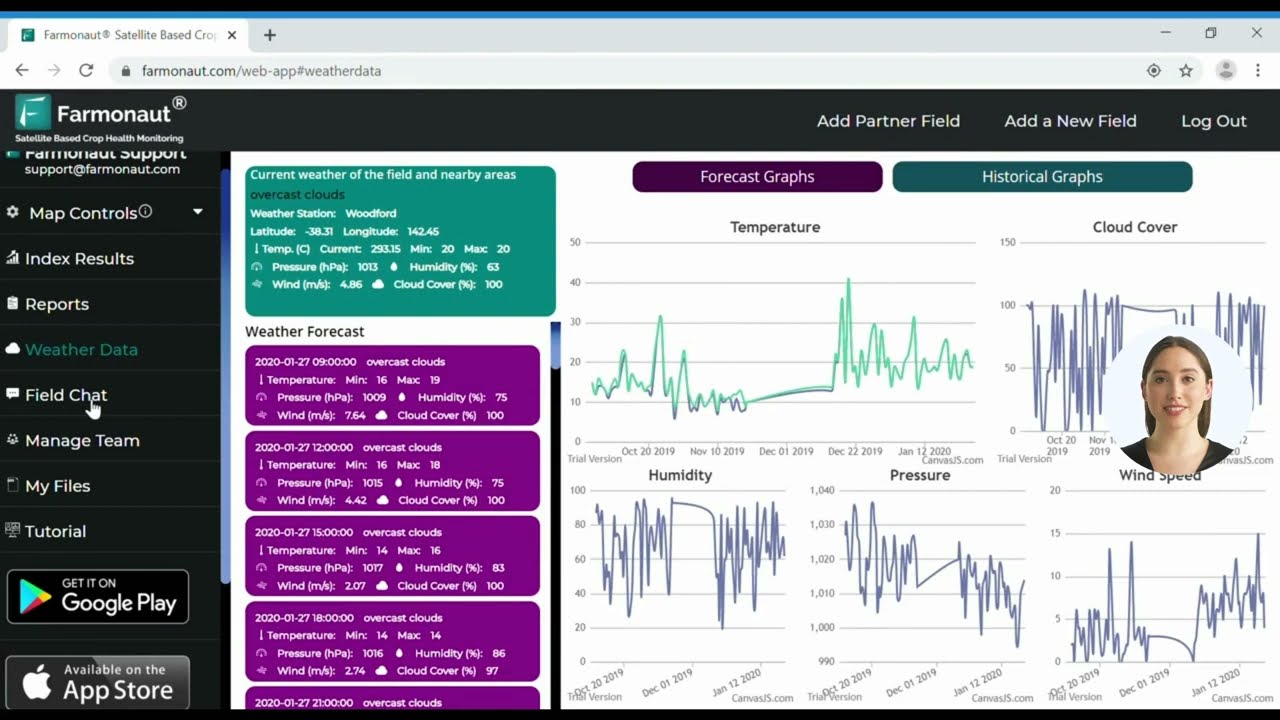
Farmonaut provides satellite-based monitoring and AI-driven analytics that sit above site-level sensor networks rather than replacing them — useful for the geotechnical and environmental side of condition monitoring in particular, where a single satellite pass can cover ground that would take a survey crew days to walk.
- Satellite-based site monitoring: repeat imagery over a permit area supports tracking of ground deformation, vegetation disturbance, and operational footprint change over time, feeding the same kind of decision dashboards described above.
- Blockchain traceability: tracking mineral movement from extraction through processing supports supply-chain accountability. Farmonaut’s traceability solution is built for this.
- Fleet and resource management: real-time tracking of haul trucks and site vehicles supports the equipment-health side of condition monitoring. See Farmonaut’s fleet management tools.
- Environmental tracking: carbon-footprint and land-disturbance monitoring support the environmental leg of a condition-monitoring program. Farmonaut’s carbon footprinting covers this.
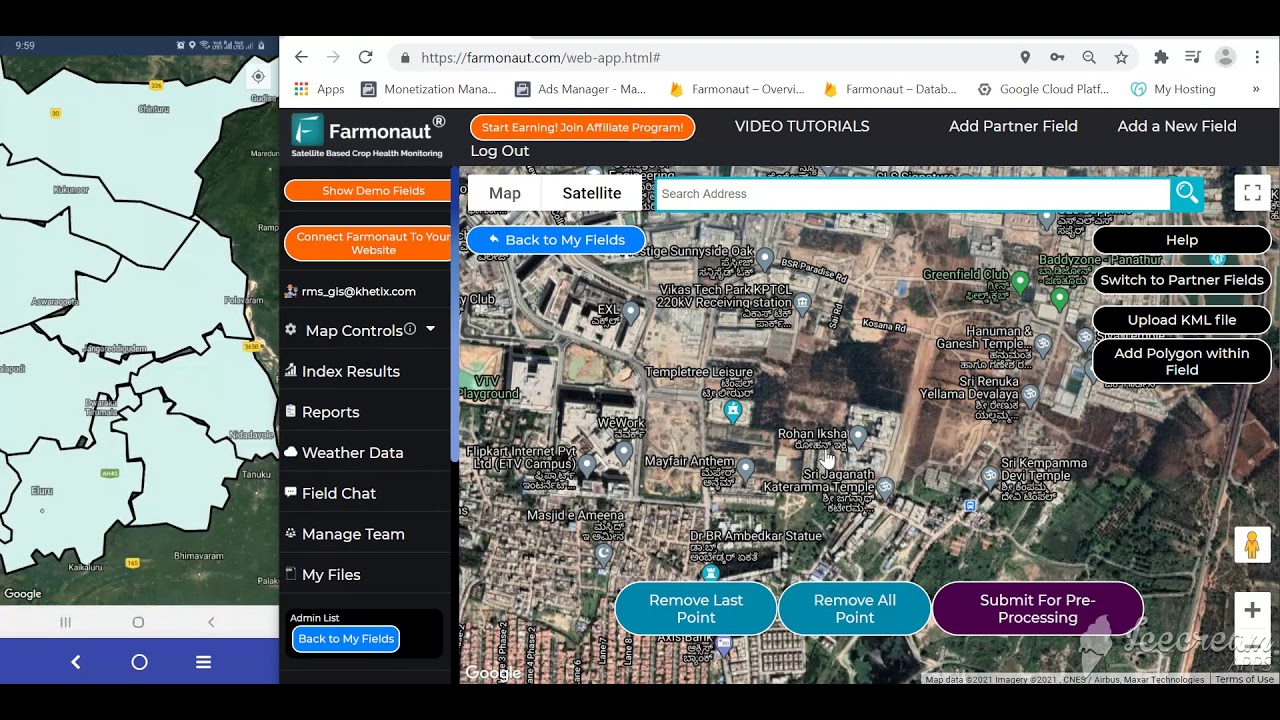
These are accessible through mobile and web apps and a developer API, so blast-monitoring data and satellite-derived site data can sit in the same operational picture rather than two disconnected systems: Farmonaut’s Mining & Satellite API, with implementation details in the developer docs. Multi-site operators managing several permit areas at once may also want Farmonaut’s large-scale admin app, built for coordinating monitoring across many parcels from one account.

Keeping These Numbers Current
Every figure in this article carries an expiration date, and the durable part is knowing where to re-check it rather than trusting this page indefinitely:
- Regulatory limits: 30 CFR §816.67’s PPV, airblast, and scaled-distance values are federal minimums; states can set tighter ones. Check the live text at Cornell LII’s eCFR mirror and your own state mining regulator before finalizing a blast plan.
- Injury and fatality data: MSHA publishes ongoing fatality and injury records rather than a single annual figure; the flyrock case studies cited above (2007, 2011, 2013, 2016) come from MSHA’s flyrock safety guidance, and current-year data sits in MSHA’s own fatality and injury reporting system.
- Market sizing: the market figures in the tables above are 2026-vintage forecasts from Fortune Business Insights and IndexBox; both firms reissue updated sizing annually, so a purchasing decision built on multi-year figures should pull the latest edition rather than this page’s numbers.
The scaled-distance formula and the three-tier PPV structure, by contrast, are the durable part of this page — they are the method a blaster uses to check a shot regardless of which year’s market report or fatality count is current.

Frequently Asked Questions
What is the difference between electronic blast monitoring and mining condition monitoring?
Electronic blast monitoring measures a single blasting event — ground vibration, airblast, and sometimes rock movement. Mining condition monitoring is the broader continuous tracking of equipment health, geotechnical stability, and environmental parameters across the whole site. Blast monitoring is one input into a condition-monitoring program, not a substitute for it.
What are the US ground vibration limits for blasting?
Under 30 CFR §816.67, peak particle velocity at the nearest protected structure is capped at 1.25 in/second within 300 feet of the blast, 1.00 in/second between 301 and 5,000 feet, and 0.75 in/second beyond 5,000 feet. Airblast is capped between 105 dBC and 134 dB peak depending on the instrument’s frequency response. State regulators can set stricter limits.
Is electronic blast monitoring legally required?
30 CFR §816.67 requires operators to demonstrate compliance with its vibration and airblast limits, which in practice means instrumented monitoring on most production blasts near occupied structures; it does not mandate one specific brand or sensor type. Some state programs are more prescriptive about instrumentation than the federal minimum.
What is blast movement monitoring used for if not safety compliance?
It is a grade-control tool. It tracks how far ore actually moved during a shot so the post-blast dig line matches the ore’s new position rather than its pre-blast, modeled one, reducing ore loss and dilution. It runs alongside vibration/airblast monitoring rather than replacing it.
Are electronic monitoring and condition-monitoring systems affordable for smaller operators?
Satellite-based monitoring and cloud-hosted dashboards have lowered the entry cost compared to building a dedicated site network from scratch, which is why the machine-condition-monitoring market’s 9.7% projected CAGR (2026–2034, per Fortune Business Insights) outpaces mining-specific blast equipment’s 7.0% — adoption is spreading beyond the largest operators, not concentrating within them.
Can blast monitoring data feed into an existing mine management system?
Yes. Modern electronic blast monitoring and condition-monitoring platforms expose their data through APIs, including Farmonaut’s Mining & Satellite API, so readings can flow into an operator’s existing dashboards rather than sitting in a standalone system.
Farmonaut Subscriptions: Flexible Plans for Modern Mining
Conclusion
Electronic blast monitoring and mining condition monitoring solve related but distinct problems: one proves a specific shot stayed inside 30 CFR §816.67’s vibration and airblast ceilings, the other keeps equipment, ground, and environmental readings flowing continuously so a site doesn’t wait for an inspection to find a problem. Blast movement monitoring is a third, separate discipline again, aimed at ore recovery rather than compliance. A US operator evaluating blast monitoring equipment or a broader mining monitoring system should treat the regulatory thresholds in this article as the fixed part of the decision and the market-size and adoption figures as the part to re-verify against the source reports before committing capital.
For blast optimization equipment and hardware specifics, see Farmonaut’s guide to blast optimisation systems.
Discussion
Questions, corrections or field experience? Share them below. First-time comments are reviewed before they appear, and your email is never published.
No comments yet. Be the first to add a question or your experience.

 Denkyira Nkoranza Concession
 Mwerezi Minerals Company Limited
 Congo Mining Solutions
 Mining SARL
 SenGold Invest SAS
 Sania Corporation
 Sean Mining Limited
 NTS Group (Pty) Ltd
 Mine4Africa
 Lithspo Minerals Limited
 Tintina Mining Group
 Dalgety Minerals Pty Ltd
 Vortex Minerals Pty Ltd
 Faith At Work (Pty) Ltd
 Geotech Mining Solutions plc
 Vulcan International Limited
 Kidepo Associates
 GKY Mining
 Alkimy SARL
 Double A Trading
 Licence holder · Nigeria · Gold + lithium










