

Reviewed September 2026 against GASTAT (Saudi General Authority for Statistics) and the Saudi Ministry of Industry & Mineral Resources.
Try it: Run your own numbers →
Esnad Saudi Mining Services Company is a KSA-based mining services provider whose role centers on compliance support, reporting workflows, and licensing navigation for operators working inside the Kingdom’s Mining Investment Law framework. It does not replace the government’s own licensing authority — the Ministry of Industry & Mineral Resources issues and administers mining licenses directly — but it sits alongside applicants and license holders as a services layer for the paperwork, geological documentation, and regulatory correspondence that a mining license, exploration permit, or compliance audit requires. This article evaluates what that role actually covers, cross-checks it against the sector data the Saudi government itself publishes, and gives readers a way to verify licensing and exploration figures independent of any vendor’s claims.
Table of Contents
- What Esnad Mining Services Does
- The Saudi Mining Sector, By the Numbers
- Esnad Saudi Mining Services Company: Role and Scope
- How to Register an Order for a Mining License Through Esnad
- Automated Mining Reporting in Practice
- Mining Compliance Solutions and What They Cover
- Mining License & Licensing Practices in Saudi Arabia
- Exploration Permits: The KSA Process
- Where Farm Compliance Services Fit Alongside Mining Compliance
- Comparison: Manual Reporting vs. Automated Compliance Workflows
- Licensing Documentation Timeline Estimator
- Satellite Technology & Farmonaut’s Role in Mining Oversight
- FAQ: Esnad, Saudi Mining Investment & Licensing
- Conclusion
Esnad Mining Saudi: What the Company Does, and How to Verify It
Esnad Saudi Mining Services Company operates as a compliance and reporting services provider inside Saudi Arabia’s mining sector, supporting license applicants and holders with the geological, environmental, and administrative documentation that the Ministry of Industry & Mineral Resources requires under the Mining Investment Law. It is one part of a much larger buildout: GASTAT recorded 2,401 mining licenses issued in Saudi Arabia in 2024, against 5,651 discovered mineralization sites identified by geological survey work the same year, per GASTAT’s mining and quarrying release (GASTAT, 2024). That gap — thousands of known sites, a fraction licensed — is the practical reason a services layer around licensing and exploration permitting exists at all.
This review covers what a “saudi mining services company (esnad)” actually does for compliance, reporting, and license registration, sets it against sector-wide licensing and exploration figures published by GASTAT and the Ministry, and points to where Farmonaut’s own satellite, traceability, and reporting tools overlap with the same problem set — automated data collection, audit-ready records, and environmental tracking — in agriculture and adjacent sectors.
The Saudi Mining Sector, By the Numbers
Before evaluating any single services company, it helps to see the scale it operates within. GASTAT’s 2024 mining and quarrying release put total licenses issued at 2,401 and discovered mineralization sites at 5,651 (GASTAT, 2024). The same release recorded 283,000 tonnes of aluminum exports and 5.7 million tonnes of phosphate fertilizer exports in 2024, the latter a 4.6% increase over 2023 — both figures a proxy for how much licensed extraction is actually reaching export markets rather than sitting at the permit stage.
On the exploration side, the Saudi Ministry of Industry & Mineral Resources reported 933 exploration locations at various development stages in 2024 — 691 gold, 242 base metals — alongside SAR 1.05 billion (about $280.5 million) in annual private-sector exploration spending, a 164% year-over-year increase in private-sector exploration licenses, and 226 active exploration companies, up from just 6 in 2020 (MiningWeekly, 2025, citing Ministry data). That 6-to-226 company count is the single clearest indicator of how fast the compliance and reporting services market around Saudi mining has had to scale — five years ago there were barely enough license holders to need a dedicated services layer; now there are 226 companies generating exploration paperwork simultaneously.
For US and Australian readers used to different benchmarks: the Society for Mining, Metallurgy & Exploration (SMENET) puts the average US mining development timeline at 29 years from discovery to first production, with copper specifically averaging 24 years (SMENET white paper). Australia’s disclosure framework, the JORC Code, was established in 1989 and last substantively revised in 2012 (JORC Committee) — it governs how exploration results, mineral resources, and ore reserves must be classified and reported for any project seeking ASX-listed investment. Saudi Arabia’s Mining Investment Law framework is newer and structured differently; it doesn’t publish a directly comparable discovery-to-production timeline, which is one of the open questions below.
To keep current on these figures: GASTAT republishes mining and quarrying statistics annually, typically each December for the prior full year, at stats.gov.sa under Economic Releases → Mining and Quarrying Statistics. The Ministry’s exploration-sector reviews come out two to three times a year and are aggregated by trade outlets like MiningWeekly’s Mining Arabia coverage — check there before citing an exploration or licensing figure as current.
Esnad Saudi Mining Services Company: Role and Scope
Esnad Mining Services Company positions itself around four functions inside the Saudi mining lifecycle: compliance documentation, automated-style reporting support, licensing and permitting assistance, and environmental risk documentation. Independent background on the company’s establishment and stated licensing role is available via Saudipedia’s profile of the Saudi Mining Services Company (Saudipedia), which covers its formation and function within the Saudi mining regulatory structure without the promotional framing that vendor material typically carries.
What isn’t independently published: Esnad’s own financial performance (revenue, cost structure, customer satisfaction data) is not available through standard English-language sources — no company filing or third-party audit surfaced in researching this piece. Similarly, no third-party survey or audit of adoption rates for Esnad’s Ta’adeen platform among international mining operators was found. Readers evaluating Esnad as a vendor should ask the company directly for client references and audited figures rather than relying on marketing copy — including this article’s own description of the sector context, which is sourced entirely from GASTAT and Ministry data, not from Esnad.
What the sector data does establish is the environment Esnad and comparable services companies operate in: 226 active exploration companies as of 2024, up from 6 in 2020, each of which needs licensing documentation, exploration permit filings, and — increasingly — digital reporting compatible with Ministry systems. A services company’s value proposition in this market is speed and error-reduction on that paperwork, not a change to the underlying legal requirements set by the Mining Investment Law itself.

How to Register an Order for a Mining License Through Esnad
“Register an order mining license esnad” is a specific, transactional search — readers typing it want the actual submission mechanics, not a sector overview. Here is what that process structurally involves under Saudi Arabia’s Mining Investment Law, based on the licensing framework itself rather than any single vendor’s marketing:
- Application submission: A mining license, exploration license, or small-mine license application is filed with the Ministry of Industry & Mineral Resources, typically through its digital licensing portal. A services company like Esnad assists in preparing and submitting this package on the applicant’s behalf.
- Required documentation: Geological survey data, an environmental impact assessment, community consultation records where applicable, and corporate/financial standing documentation.
- Pre-screening and review: The Ministry reviews the application against Mining Investment Law criteria — legal standing, technical capacity, environmental commitments — before granting, rejecting, or requesting revisions.
- Ongoing reporting obligations: Once a license is granted, the holder is subject to periodic reporting to the Ministry and, for exploration activity specifically, coordination with the Saudi Geological Survey.
- Try it: Run your own numbers
What is not publicly available is a published, Ministry-stated processing timeline for license approval that could be benchmarked against, say, US permitting timelines or Australia’s JORC-linked reporting cadence — this is a genuine data gap. If timeline certainty matters to your application, request a written estimate directly from the Ministry’s licensing office or from your services provider before submitting, rather than relying on any general figure quoted online, including in this piece’s own comparison table below, which is built from industry-typical ranges rather than an official KSA benchmark.
Automated Mining Reporting in Practice
Reporting accuracy and timeliness matter for both operational management and regulatory standing. Where Esnad and comparable Saudi mining services providers describe automation, the components typically fall into three categories:
1. Automated Data Collection: IoT, Sensors, and Drones
- IoT sensors record equipment status, extraction volumes, and site-specific conditions on an ongoing basis rather than through periodic manual logs.
- Drones capture aerial surveys for volumetric analysis, land deformation monitoring, and environmental compliance checks.
- Analytics platforms flag anomalies and operational gaps for review, reducing the manual reconciliation step that paper-based reporting requires.
The stated goal of this kind of digitalization is standardized, regulator-ready reporting that integrates with Ministry digital systems. Whether any specific vendor’s integration is verified end-to-end by the Ministry itself is not something this article can confirm from published sources — treat vendor claims of “direct integration” as a claim to verify with the Ministry, not a settled fact.
2. Stakeholder Transparency
- Real-time or near-real-time visibility into extraction volumes, emissions, energy use, and environmental impact metrics.
- Faster internal decision-making and risk mitigation tied to continuously updated data rather than monthly snapshots.

3. Integration With National Databases
- Digital reporting systems designed to reduce manual re-entry into government platforms and speed up audit turnaround.
- Unified data formats intended to reduce the reporting inconsistencies that slow down Ministry review.
Products Relevant to Mining-Adjacent Reporting Automation:
- Farmonaut Agro-Admin App — built for agricultural monitoring, but its real-time dashboard model (satellite data in, standardized report out) is structurally similar to what automated mining reporting platforms aim for.
- Carbon Footprinting Tools from Farmonaut — satellite-based emissions tracking built for agricultural operations, illustrating the same underlying approach — remote sensing feeding directly into a regulatory-style report — that environmental compliance reporting in mining requires.

Mining Compliance Solutions and What They Cover
Compliance in the Saudi mining sector spans environmental standards, worker safety, labor law, and the Mining Investment Law’s own operational requirements. A compliance solution — whether built in-house or delivered by a services company like Esnad — typically addresses:
1. Regulatory Monitoring
- Tracking updates to environmental, safety, and labor regulations issued by the Ministry and related bodies.
- Flagging operational metrics that fall outside stated benchmarks before they become violations found at audit.
2. Audit-Ready Documentation
- Coordination with the Saudi Geological Survey and Ministry on data verification.
- Digital record-keeping structured so an audit doesn’t require reconstructing paper trails after the fact.
Key Areas Compliance Solutions Typically Address:
- Environmental compliance: groundwater usage, emissions, waste handling against Saudi environmental regulation.
- Worker safety: incident tracking and notification workflows.
- Record retention: digital documentation retained for the periods Saudi regulation requires.
Farmonaut’s Blockchain Traceability:
A parallel approach to audit-ready transparency exists in agricultural supply chains: Farmonaut Blockchain Traceability provides real-time, tamper-evident verification of resource origin — the same underlying principle (an immutable audit trail rather than a re-editable spreadsheet) that mining compliance reporting depends on for regulator and investor trust.
What genuinely varies and cannot be reduced to one figure: the cost of compliance per permit or per audit. Saudi Arabia publishes fines collected for violations, but not a standardized cost-per-permit or cost-per-compliance-audit figure comparable across jurisdictions — this is one of the clearest information gaps in evaluating any mining services company’s compliance value proposition, Esnad included. If cost-per-compliance-cycle is the deciding factor in choosing a provider, request an itemized quote directly rather than accepting an industry-wide average, because no such average is published.

Mining License & Licensing Practices in Saudi Arabia
Securing a mining license in Saudi Arabia requires navigating the Mining Investment Law’s documentation and review process. GASTAT recorded 2,401 licenses issued in 2024 (GASTAT, 2024) against 5,651 identified mineralization sites the same year — meaning a large share of known mineral occurrences remain unlicensed, whether by choice, ongoing application, or exploration-stage status.
1. Licensing Process Components
- Environmental impact assessments, geological studies, and community consultation documentation.
- Digital submission through Ministry portals, intended to speed pre-screening versus paper-based filing.
2. Key Regulatory Requirements
- Mining Investment Law: defines legal parameters for operations, environmental responsibility, labor, and safety.
- Environmental and community impact: rehabilitation plans aligned with sustainable development commitments.
- Corporate standing: compliance history and technical capacity weighed in review.
A services company’s track record in this space is best evaluated by the number and type of licenses it has helped clients secure — a figure that, per the gaps noted above, is not independently published for Esnad specifically. Ask any prospective provider for client-referenceable license outcomes rather than aggregate marketing claims.
Practical Tools for Streamlined Licensing Documentation:
- Farmonaut’s Crop Loan and Insurance Verification Tools — built for agricultural finance, these satellite-verification systems show how remote monitoring can cut documentation turnaround and reduce fraud risk, a model transferable to license-application evidence gathering.
- Fleet Monitoring and Management Systems — equipment and vehicle usage records matter for mining license compliance the same way they do for large agricultural fleets; digital tracking replaces manual logbooks in both cases.

Exploration Permits: The KSA Process
Exploration is the gateway stage to Saudi Arabia’s mineral reserves and one of the most closely regulated phases. The Ministry reported 933 exploration locations at various development stages in 2024 (691 gold, 242 base metals), alongside 226 active exploration companies — up from 6 in 2020 — and $280.5 million in annual private exploration spend (MiningWeekly, 2025).
1. Application & Permit Management
- Geo-environmental assessments, public disclosures, and documented ecological-disturbance mitigation are standard requirements.
- Geospatial mapping and satellite data support data-backed exploration plans submitted for Ministry review.
2. Coordination Practices
- Data-sharing and cross-verification with the Saudi Geological Survey can shorten review cycles.
- Environmental risk assessment ahead of filing helps applicants anticipate mitigation requirements rather than respond to them after rejection.
For comparison, US mining projects average 29 years from discovery to first production (24 years for copper specifically), per SMENET (SMENET) — a timeline shaped heavily by federal and state permitting review. Saudi Arabia’s framework is younger and its comparable discovery-to-production benchmark is not separately published, which is worth flagging plainly rather than guessing at a number.
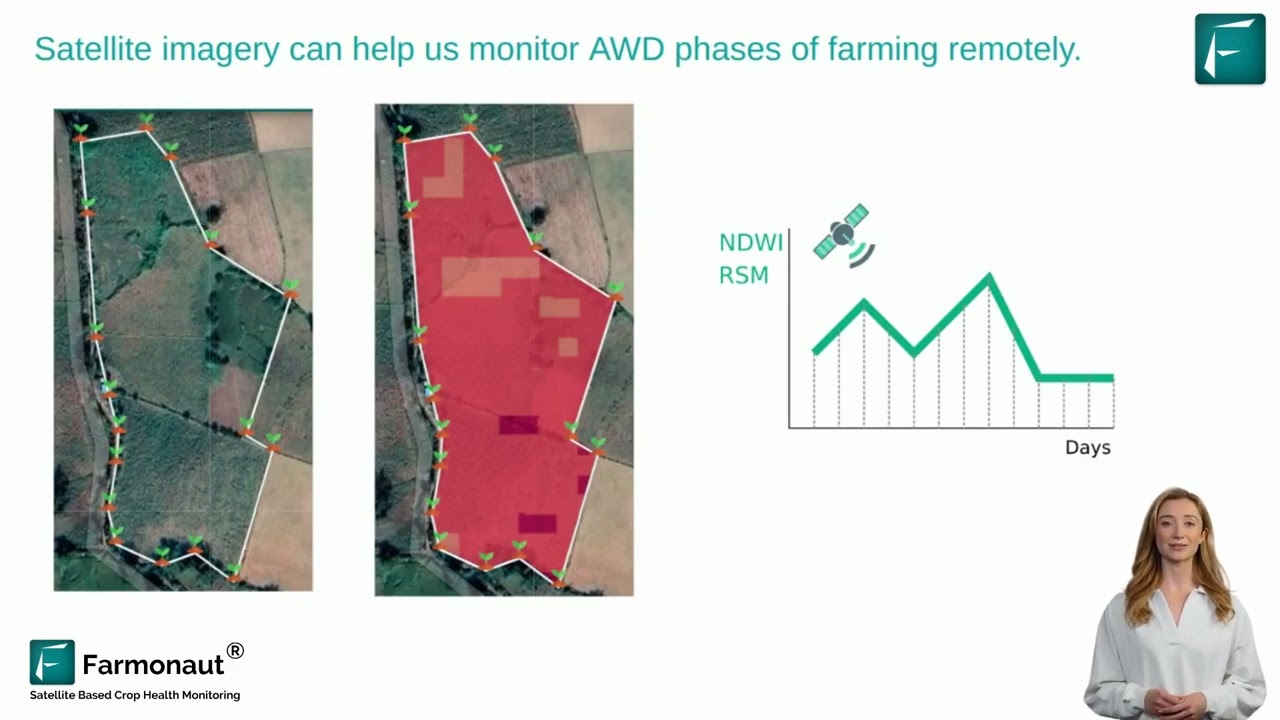
Tools Relevant to Exploration-Stage Monitoring:
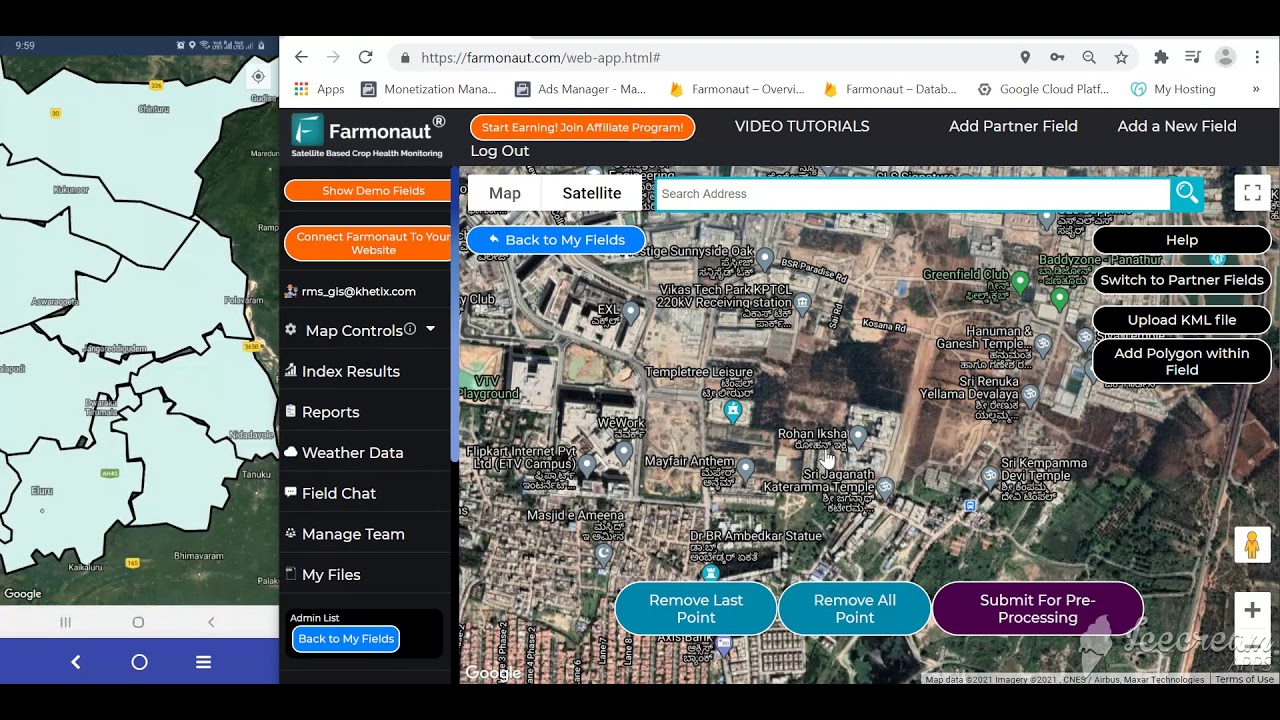
- Farmonaut Satellite and Weather API — direct integration of satellite data for environmental monitoring during exploration-stage permitting.
- API Developer Docs — integration guidance for teams building data-backed exploration or compliance dashboards.

Where Farm Compliance Services Fit Alongside Mining Compliance
Readers searching “farm compliance services” alongside Esnad mining queries are typically evaluating the same underlying question from the agricultural side: how do you produce audit-ready, regulator-facing records without a manual paper trail? The mechanics are structurally close to mining compliance — documented inputs, tracked outputs, and a verifiable chain of custody — even though the regulatory bodies differ (USDA and state agriculture departments in the US, rather than a mining ministry).
Farmonaut’s traceability and carbon-tracking tools, built for agricultural operators, apply the same principle mining compliance platforms use: satellite or sensor data feeding directly into a report format regulators and buyers can audit, rather than a spreadsheet assembled after the fact. See the traceability tool and carbon footprinting tool referenced above for the agricultural-side equivalent of what a mining compliance service like Esnad delivers for mineral operators.



Comparison: Manual Reporting vs. Automated Compliance Workflows
The ranges below reflect general industry patterns for manual-versus-digital reporting workflows, not an Esnad-specific or Ministry-published benchmark — treat them as a framework for the questions to ask a provider, not a guaranteed outcome.
| Process | Manual / Paper-Based Approach | Digital / Automated Approach | What to Verify With Your Provider |
|---|---|---|---|
| Reporting cadence | Monthly paper logs, manual collation | Continuous IoT/drone data feed, digital submission | Does it write directly into a Ministry-compatible format? |
| Licensing documentation prep | Sequential document assembly, in-person review cycles | Digital EIA packaging, remote geospatial evidence | Request a written processing-time estimate — no official KSA average is published |
| Compliance monitoring | Reactive — reviewed after an audit or complaint | Ongoing flagging against regulatory benchmarks | Ask which specific regulations (environmental, safety, labor) are covered |
| Data accuracy safeguards | Manual entry, human-error-prone | Automated capture with error-checking | Ask for an audit trail sample, not a stated accuracy percentage |
| Environmental tracking | Periodic spot checks | Continuous emissions/water-use monitoring | Confirm which metrics are actually measured vs. estimated |
| Cost structure | Labor-hour billing, variable by document volume | Platform/subscription plus service fee (structure varies by provider) | No published USD/SAR per-permit benchmark exists — get an itemized quote |
Licensing Documentation Timeline Estimator
Since no official KSA-wide licensing timeline is published, use this estimator to build your own working figure from the document types your application actually needs, then compare it against whatever your services provider quotes in writing.
Run your own numbers
Assumptions: this estimator models document preparation and Ministry review as the two main time components and does not include time spent gathering underlying source data (e.g., a multi-season geological survey), legal negotiation, or appeals. It is a planning tool built from user-supplied inputs, not a Ministry-published or Esnad-quoted timeline — no official KSA-wide processing-time average is currently published.
Satellite Technology & Farmonaut’s Role in Mining Oversight
Farmonaut’s core business is agricultural, but the underlying technology — satellite-based monitoring, AI-driven advisory analysis, blockchain traceability, and fleet management — addresses the same categories of problem that mining compliance and reporting depend on: continuous ground-truth data, tamper-evident records, and environmental tracking that a regulator or auditor can independently verify.
- Satellite-based monitoring: High-resolution multispectral imagery for site integrity, environmental impact tracking, and land-condition analysis.
- AI advisory systems: Farmonaut’s Jeevn AI analyzes satellite data for risk assessment, compliance alerts, and decision support.
- Blockchain-based traceability: Digital transparency for resource flows, supporting regulatory compliance and auditability.
- Fleet and resource optimization: Equipment and vehicle tracking for large-scale operations.
- Environmental impact tracking: Carbon emissions and resource-use monitoring for sustainability reporting.
This technology is accessible via Android, iOS, and web apps, as well as via dedicated APIs. Technical teams can reference the API documentation for integration guidance.
For mining operators specifically, Farmonaut’s mine and extraction monitoring methods and environmental assessment guide cover the monitoring and EIA side of the same compliance problem that a services provider like Esnad addresses on the licensing and reporting side. Sector context on how new mine openings ripple through supply chains is covered in this analysis of new gold mine impacts.
Farmonaut Subscriptions: Get Started with Satellite Insights
View current subscription plans and pricing:
FAQ: Esnad, Saudi Mining Investment & Licensing
1. What does Esnad Saudi Mining Services Company actually do?
Esnad provides compliance documentation, reporting support, and licensing/permitting assistance for mining operators and applicants working under Saudi Arabia’s Mining Investment Law. It supports the paperwork and coordination process; it does not issue licenses itself — that authority sits with the Ministry of Industry & Mineral Resources. Independent background is available via Saudipedia’s company profile.
2. How many mining licenses has Saudi Arabia issued, and how many mineral sites has it identified?
GASTAT recorded 2,401 mining licenses issued and 5,651 discovered mineralization sites for 2024 (GASTAT, 2024). Check GASTAT’s Economic Releases section each December for the following year’s update.
3. How do I register an order for a mining license through Esnad?
The process runs through the Ministry’s licensing framework: application submission with supporting geological and environmental documentation, Ministry pre-screening and review, and post-grant reporting obligations. A services provider like Esnad assists in preparing and submitting that package, but the license itself is issued by the Ministry, not the services company.
4. How fast is Saudi Arabia’s exploration sector growing?
The Ministry reported 226 active exploration companies in 2024, up from 6 in 2020, with $280.5 million in annual private exploration spending and a 164% year-over-year increase in private exploration licenses (MiningWeekly, 2025).
5. How does Saudi Arabia’s licensing timeline compare to the US or Australia?
US mining projects average 29 years from discovery to first production overall, 24 years for copper specifically (SMENET). Australia’s JORC Code (established 1989, last revised 2012) governs disclosure standards rather than approval speed (JORC). Saudi Arabia has not published a directly comparable discovery-to-production benchmark — this is a genuine gap, not an oversight in this piece.
6. Is Esnad’s financial performance or client satisfaction data publicly available?
No — company-level revenue, cost structure, or third-party satisfaction audits were not found in standard English-language sources at the time of this review. Request client references and audited outcomes directly from the company rather than relying on marketing claims.
7. What is “farm compliance services” doing in an article about mining?
It’s a related but separate question: agricultural operators face the same audit-trail and regulatory-reporting problem mining operators do, just under different regulators. Farmonaut’s own traceability and carbon tracking tools serve that need on the agricultural side using the same satellite-plus-digital-record model that mining compliance platforms use.
8. Can other companies replicate Esnad’s approach without using Esnad specifically?
Yes — the underlying components (satellite/IoT data collection, digital EIA packaging, automated compliance flagging) are available from multiple vendors, including Farmonaut’s API for teams building their own environmental monitoring and reporting stack, and the EIA guide referenced above for the environmental-assessment side specifically.
Conclusion: Evaluating a Mining Services Provider on Verifiable Terms
Esnad Saudi Mining Services Company operates in a sector that grew from 6 active exploration companies in 2020 to 226 in 2024, with $280.5 million in annual private exploration spending and 2,401 mining licenses issued against 5,651 identified mineralization sites in 2024 alone (GASTAT; MiningWeekly). That scale is real and independently sourced; the specific claims any individual services provider makes about its own reporting automation, adoption rates, or licensing speed generally are not — and readers should ask for client references, written timeline estimates, and itemized costs rather than accepting industry-wide figures as provider-specific guarantees.
The durable way to evaluate any mining compliance or licensing services company, in Saudi Arabia or elsewhere, is the same regardless of which vendor you’re looking at: check the sector-wide licensing and exploration data directly against GASTAT and Ministry sources first, ask the provider for outcomes it can document rather than describe, and treat any timeline or cost figure that isn’t independently published — like KSA’s licensing-approval speed — as a number to negotiate in writing rather than assume from a marketing page.
For the environmental-monitoring and audit-trail side of that evaluation, Farmonaut’s satellite, traceability, and API tools referenced throughout this article are available for teams building or benchmarking their own compliance stack, in mining or in agriculture.
Discussion
Questions, corrections or field experience? Share them below. First-time comments are reviewed before they appear, and your email is never published.
No comments yet. Be the first to add a question or your experience.

 Critica Metals Limited
 Congo Mining Solutions
 Mining SARL
 SenGold Invest SAS
 Sania Corporation
 Sean Mining Limited
 NTS Group (Pty) Ltd
 Mine4Africa
 Lithspo Minerals Limited
 Tintina Mining Group
 Dalgety Minerals Pty Ltd
 Vortex Minerals Pty Ltd
 Faith At Work (Pty) Ltd
 Geotech Mining Solutions plc
 Vulcan International Limited
 Kidepo Associates
 GKY Mining
 Alkimy SARL
 Double A Trading
 GemSprout Metals Limited
 Qader Group
 Ileys General Trading










