

Hiring a study firm · Buyer's guide
Feasibility Study Consultant: How to Choose a Firm
Match the study stage to a firm that has signed it before on your commodity, name the qualified person, and set the estimate class in the contract. A 2004 rule of thumb puts study cost at 0.5 to 1.5 per cent of capital for a full feasibility study.
Key takeaways
- JORC says an Ore Reserve must not be reported from a scoping study; a pre-feasibility study is the minimum (JORC Code, 2012).
- NI 43-101 defines a Qualified Person as an engineer or geoscientist with at least five years of relevant experience, in good standing with a professional association (OSC text).
- Rule-of-thumb study cost: 0.1 to 0.3 per cent of capital for scoping, 0.2 to 0.8 for pre-feasibility, 0.5 to 1.5 for full feasibility (Rupprecht, SAIMM, 2004; indicative only).
- AACE Class 3, typical of a feasibility study, expects minus 10 to 20 and plus 10 to 30 per cent; a review of 63 projects found as-built capital averaged 14 per cent above bankable estimates (Suarez Nieto et al.).
- Export Development Canada’s 2015 study of 78 projects found an average capital overrun of 37 per cent, even though all had pre-feasibility or feasibility estimates (Sphinx summary).
In this article
- Scoping, pre-feasibility and bankable feasibility: which study do you need
- Types of feasibility study consultants and who signs the report
- Feasibility study rules by country: who may sign and how independent they must be
- What a study costs and how accurate the estimate should be
- Examples: how owners structured the work
- How to choose a feasibility study consultant: nine checks
- Scope of work and contract terms to agree before you sign
- Who can review the mine plan in a feasibility study to improve project NPV
- Why studies miss: capital cost overruns and what to ask about them
- Frequently asked questions
The firms that do feasibility studies for mining and metals projects fall into three groups: independent technical consultants who sign resource and reserve work, engineering companies that design the plant and cost it, and specialist firms for one discipline such as geotechnics or hydrology. A small project often needs one lead firm plus two or three specialists. You choose by matching the study stage you need to a firm that has signed that stage before, on your commodity, in your country, and that can name the qualified person who will put a name on the report.
This guide is for licence and claim owners, consultants who buy in specialist work, and investors who read the studies other people commission. It explains what each study stage delivers, who is allowed to sign it, what it costs as a share of capital, how to test a firm before you hire it, and who can review a mine plan when the aim is a better project NPV (net present value, the discounted sum of future cash flows). It does not rank firms, because no public ranking measures what matters, which is fit with your project.
Scoping, pre-feasibility and bankable feasibility: which study do you need
Every study asks the same question at a different depth: can this deposit be mined at a profit? The stages differ in how much engineering sits behind the answer, and that decides who can use it. The JORC Code (Australasia) defines a scoping study as an order of magnitude study of potential viability, and says an Ore Reserve must not be reported from it alone (JORC Code, 2012 edition). A pre-feasibility study (PFS) is more comprehensive: it compares options, fixes a preferred mining method or pit shape and a processing route, and gives a Competent Person enough to convert Mineral Resources to an Ore Reserve. A feasibility study (FS) goes further, with a selected development option and detail good enough to support a decision to build or to lend. JORC notes that “bankable feasibility study” and “definitive feasibility study” are equivalent terms. JORC is reviewing the 2012 Code, and its code update page says a new Code would start only after a transition period, so check the JORC site before you brief a consultant (JORC code update).
In Canada, NI 43-101 uses the term preliminary economic assessment (PEA) for an early study done before a PFS. The Canadian Securities Administrators published a proposal on 12 June 2025 to replace the PEA label with the CIM term “scoping study” (CSA request for comments). It was a proposal, so check the current instrument on your provincial regulator’s site before you brief a consultant.
| Stage | What it answers | Typical use | Who relies on it |
|---|---|---|---|
| Scoping study (PEA in Canada) | Is the idea worth more work? Rough mine plan and costs from similar operations | Decide whether to drill more, buy, option or sell | Owner, early investors; not enough for reserves |
| Pre-feasibility study | Which mining method, plant and layout is best? Can resources convert to reserves? | Choose the option, raise development money, seek a partner | Investors, joint-venture partners, regulators |
| Feasibility study (bankable or definitive) | Is the chosen design justified and can it be financed? | Final investment decision, project debt | Lenders, boards, construction contractors |
Many owners hire for the wrong stage. If you hold ground with a handful of drill holes, a PFS or FS has nothing to stand on, because a pre-feasibility study needs Indicated or Measured resources and a reserve-level set of factors. If you already have a resource and a partner is asking for a bankable document, a scoping study will not do. Our guide to bankable feasibility study steps covers the content of the final stage, and the explainer on resource estimation from inferred to measured shows what must exist before a PFS can start.
Types of feasibility study consultants and who signs the report
When people search for a feasibility consultant they usually mean one of three roles. Knowing which role you are buying prevents most scope disputes.
Independent technical consultants and qualified person firms
These firms estimate resources, design the mine plan and check the economics. Their staff act as the Qualified Person (QP) under NI 43-101 or the Competent Person (CP) under JORC. AMC Consultants, for example, describes scoping, pre-feasibility and feasibility work, with cost estimates to about plus or minus 20 per cent at pre-feasibility and plus or minus 10 to 15 per cent for a bankable study (AMC Consultants, feasibility studies page). SRK Consulting is another firm that acts as Qualified Person; in a November 2025 release, First Mining Gold stated that its resource estimate was completed under the supervision of an SRK Qualified Person (First Mining Gold, 18 November 2025).
Engineering firms that design and cost the plant
Larger studies are led by an engineering company that owns the process design, the capital cost estimate and the schedule, and brings in the mining and resource consultants as sub-consultants. Examples from recent announcements show how owners describe their choice. Rupert Resources appointed Ausenco to lead the feasibility study for its Ikkari gold project in Finland, citing Ausenco’s experience designing gold plants of similar size in cold climates, with completion expected in the first half of 2027 (Mining Technology). AbraSilver selected Worley as engineering contractor for the definitive feasibility study at its Diablillos silver-gold project in Argentina after what it called a competitive evaluation, noting Worley’s recent work on lithium projects in the same region (Panorama Minero). Scandium International said on 17 June 2026 that Lycopodium, which wrote the original 2016 definitive feasibility study for its Nyngan scandium project in New South Wales, would update its capital and operating costs (AZoMining).
These are examples of how owners justified a selection, not endorsements. They show the three reasons that appear again and again: commodity and plant-type experience, local or regional delivery experience, and having done the earlier study for the same asset.
Specialist firms
Metallurgical testwork, geotechnical drilling, hydrogeology, tailings design, environmental and social baseline work, and market studies are often bought separately and fed into the lead study. An ALTA Metallurgical Services article warned that cut-price pre-feasibility studies can lead to costly problems later, because the PFS is where the flowsheet is fixed (ALTA Metallurgical Services via Mining.com, 2016). Whoever leads, the testwork behind the recovery numbers deserves its own line in the budget.
Feasibility study rules by country: who may sign and how independent they must be
The word “consultant” hides a legal point: a study you will publish or file must be signed by a person who meets the local definition. The rules below come from the primary texts.
| Jurisdiction | Study terms | Who signs | Independence |
|---|---|---|---|
| Canada (NI 43-101) | Preliminary economic assessment, preliminary feasibility study, feasibility study | Qualified Person: engineer or geoscientist, at least five years of relevant experience, in good standing with a professional association | Report must be independent of the issuer in listed cases, including first-time disclosure of a preliminary assessment or resources or reserves on a material property |
| Australia (JORC and ASX) | Scoping study, pre-feasibility study, feasibility study | Competent Person: member of a recognised professional organisation, five years of relevant experience | ASX says there is no general independence requirement, with an exception for a production target based solely on inferred resources |
| United States (SEC S-K 1300) | Initial assessment, preliminary feasibility study, feasibility study | Qualified person: five years of relevant experience, member of a recognised professional organisation | The definitions page does not set independence criteria |
Sources: the NI 43-101 text on the Ontario Securities Commission site (sections 1.1 and 5.3), the JORC Code definitions of Competent Person, the ASX mining reporting FAQs, and 17 CFR 229.1300. The ASX FAQ also points out that other laws, such as the Corporations Act, can require an independent expert for certain reports, so ask a lawyer when a document goes to shareholders. Our explainers on NI 43-101 technical reports and JORC and how to read a resource table go deeper on each code.
For a private owner with no listing, the codes are not a legal requirement, but lenders, buyers and partners still ask for a report that follows one. A study signed by someone who cannot meet a code definition is hard to sell later.
What a study costs and how accurate the estimate should be
Fees depend on size, location, commodity and the number of options studied, and public price lists do not exist. The most citable rule of thumb is old: a 2004 paper presented to the Southern African Institute of Mining and Metallurgy, attributing the figures to AMC, gave study costs as a share of project capital of 0.1 to 0.3 per cent for scoping, 0.2 to 0.8 per cent for pre-feasibility and 0.5 to 1.5 per cent for a full feasibility study (Rupprecht, SAIMM, 2004). The same paper gave accuracy ranges for capital and operating cost estimates of 30 to 50 per cent for scoping, 15 to 30 per cent for pre-feasibility and 10 to 15 per cent for a full feasibility study. Treat the percentages as a way to sanity-check a quote, not as a price. Costs have changed since 2004, so ask for quotes from at least three firms.
Chart
Rule-of-thumb study cost as a share of project capital
Per cent of project capital cost, by study stage (indicative, 2004 paper)
Chart
How far capital cost can land above the estimate, by AACE class
Upper end of the expected high-side range, per cent above estimate (AACE 47R-11, mining)
A more current framework is AACE International recommended practice 47R-11, which classes cost estimates for mining and mineral processing from Class 5 (concept) to Class 1 (check estimate). A 2024 peer-reviewed analysis of copper project reports tabulates the expected accuracy (80 per cent confidence interval) as: Class 5, minus 20 to minus 50 per cent and plus 30 to plus 100 per cent; Class 4, minus 15 to minus 30 and plus 20 to plus 50; Class 3, minus 10 to minus 20 and plus 10 to plus 30; Class 2, minus 5 to minus 15 and plus 5 to plus 20; Class 1, minus 3 to minus 10 and plus 3 to plus 15 (Suárez Nieto et al., University of Oviedo). The same paper lists how four published copper studies declared accuracy: the Kutcho pre-feasibility study as Class 4 at plus or minus 25 per cent, the Josemaria and Eva feasibility studies as Class 3 at plus or minus 15 per cent, and the Arctic pre-feasibility study as minus 20 to plus 30 per cent without following the practice.
Real feasibility studies state their class. Solidus Resources reported an initial capital cost of US$823 million for its Spring Valley gold project in Q3 2024 dollars, described as AACE Class 3 with an expected accuracy of plus or minus 15 per cent, with sustaining capital of US$388 million (Solidus Resources, 2025 feasibility study). Putting the class and range in the contract tells the consultant what depth of engineering you are paying for.
Calculator
What might a study cost, and what is the capital at risk?
Enter your own capital estimate, accuracy range and fee share to size the budget.
- Capital at the high end of the range (US$ million): 650.0
- Extra capital at risk (US$ million): 150.0
- Extra capital at risk per US$1 of study fee: 30.0
Example values only, not quotes or forecasts. The default fee share (1.0 per cent) sits inside the 2004 SAIMM range for a full feasibility study (0.5 to 1.5 per cent) and the default accuracy is the Class 3 high side; replace both with real quotes and your estimate class. Money in US$ millions.
Examples: how owners structured the work
Three patterns show up in public disclosures. First, the owner picks a lead engineer by competitive tender and names the reasons, as Rupert Resources and AbraSilver did. Second, the owner returns to the author of the earlier study when it only needs updated costs, as Scandium International did with Lycopodium. Third, the lead firm sits above specialists: the Eva Copper capital cost estimate, for example, was prepared by Merit Consultants International, a Canadian mining consulting firm, with support from the owner and other independent engineers, and put initial capital at US$393.1 million in the 2020 study (Suárez Nieto et al., above).
Studies are also refreshed when the rules change. Trilogy Metals updated its Arctic feasibility study to file an S-K 1300 technical report summary with the SEC, with capital and operating costs brought up to the fourth quarter of 2022 (Trilogy Metals, 14 February 2023). If your project may list in a second market, ask the consultant up front whether the report can be reissued under the other code.
How to choose a feasibility study consultant: nine checks
Use the same checklist for every bidder and score the answers side by side.
Infographic
Choosing a firm in six steps
- 1Set the stageScoping, pre-feasibility or feasibility, and the code the report must follow.
- 2Write the scopeEstimate class, options to compare, deliverables and ownership.
- 3Shortlist threeFirms with signed studies on your commodity and region.
- 4Score the checksNamed QP, team, testwork, basis of estimate, conflicts.
- 5Check referencesTwo clients whose projects reached a financing decision.
- 6Sign with milestonesFixed fee for defined scope, unit rates for changes.
- Stage experience. Ask for three studies of the stage you need, finished in the last five years, with the public report or the release for each.
- Commodity and deposit type. A firm that has costed gold heap leach plants may not know lithium brine or heavy mineral sands. Ask who in the team has done your type.
- Named qualified person. Get the names and credentials of the QP or CP, their professional body and years of relevant experience, and check them against the code definitions above.
- Country experience. Permitting, royalty, power and logistics assumptions are local. Look for delivered work in your region, as the Diablillos selection did.
- Independence and conflicts. Ask whether the firm or its affiliates hold shares, options or contracts to build the project. JORC requires potential conflicts of interest to be disclosed, which the ASX FAQ discusses under clause 9.
- Team continuity. The people who pitch are not always the people who write. Ask who does the mine design, the cost estimate and the QP review, and whether they stay for the whole study.
- Testwork and data handling. Ask which laboratories and drilling contractors are used, how samples are verified, and who owns the data at the end.
- Basis of estimate. Ask for a sample basis of estimate and a sample sensitivity table. A strong firm shows how each cost line was built and what contingency it carries.
- Liability and references. Read the liability cap, ask for two client references from projects that later reached a financing decision, and ask what went wrong on a past study and how it was fixed.
Our overview of mining consultant roles, CP and QP rules and fees covers the wider market of advisers if you are not yet sure that a full study is the right purchase.
Scope of work and contract terms to agree before you sign
Studies drift when the scope is vague. A short scope document should state the study stage, the code the report must follow, the cost estimate class and accuracy range, the commodity price and exchange rate basis supplied by you or by the consultant, the list of options to be compared, and the deliverables: report, models, drawings and the files behind them. It should also set milestones with payments tied to them, the number of review rounds, and who owns the work. Ask for the financial model in a usable format and for the right to give the report to lenders and partners.
Agree up front what happens if new drilling changes the resource during the study, because that is the most common cause of delays and extra fees. A fixed-fee contract for a defined scope, with unit rates for additional work, gives you a clear budget and a clear price for changes.
Who can review the mine plan in a feasibility study to improve project NPV
If you already have a study and want a second opinion, the right reviewer depends on what you are testing. A mine planning specialist can test the pit or stope design, the production rate and the cut-off grade, which are the choices that move NPV most. Optimisation tools exist for this: AMC lists its Hill of Value project optimiser for cut-off grade, production rate and project financials, and first-principles cost models for open pit and underground mining on its feasibility page (AMC, above). A metallurgist tests recovery and reagent assumptions, a geotechnical engineer tests slope angles and ground conditions, and a cost engineer tests unit rates and contingency against recent quotes.
Whatever the discipline, ask the reviewer to run a sensitivity table. In its pre-feasibility study, Solaris Resources varied copper, gold, molybdenum and silver prices, operating costs and initial capital by plus or minus 20 per cent, and reported that after-tax NPV at an 8 per cent discount rate was most sensitive to the copper price (Solaris Resources). A reviewer should be able to tell you which two or three inputs drive your NPV and whether the design can be changed to reduce exposure to them.
Lenders also review studies. Practitioners describe an independent engineer or technical adviser who checks the resource, reserve, cost and schedule assumptions before financing, but the scope depends on the lender and the deal, so ask your lender what they require. An owner who commissions an independent review before approaching lenders often finds problems while they are cheap to fix.
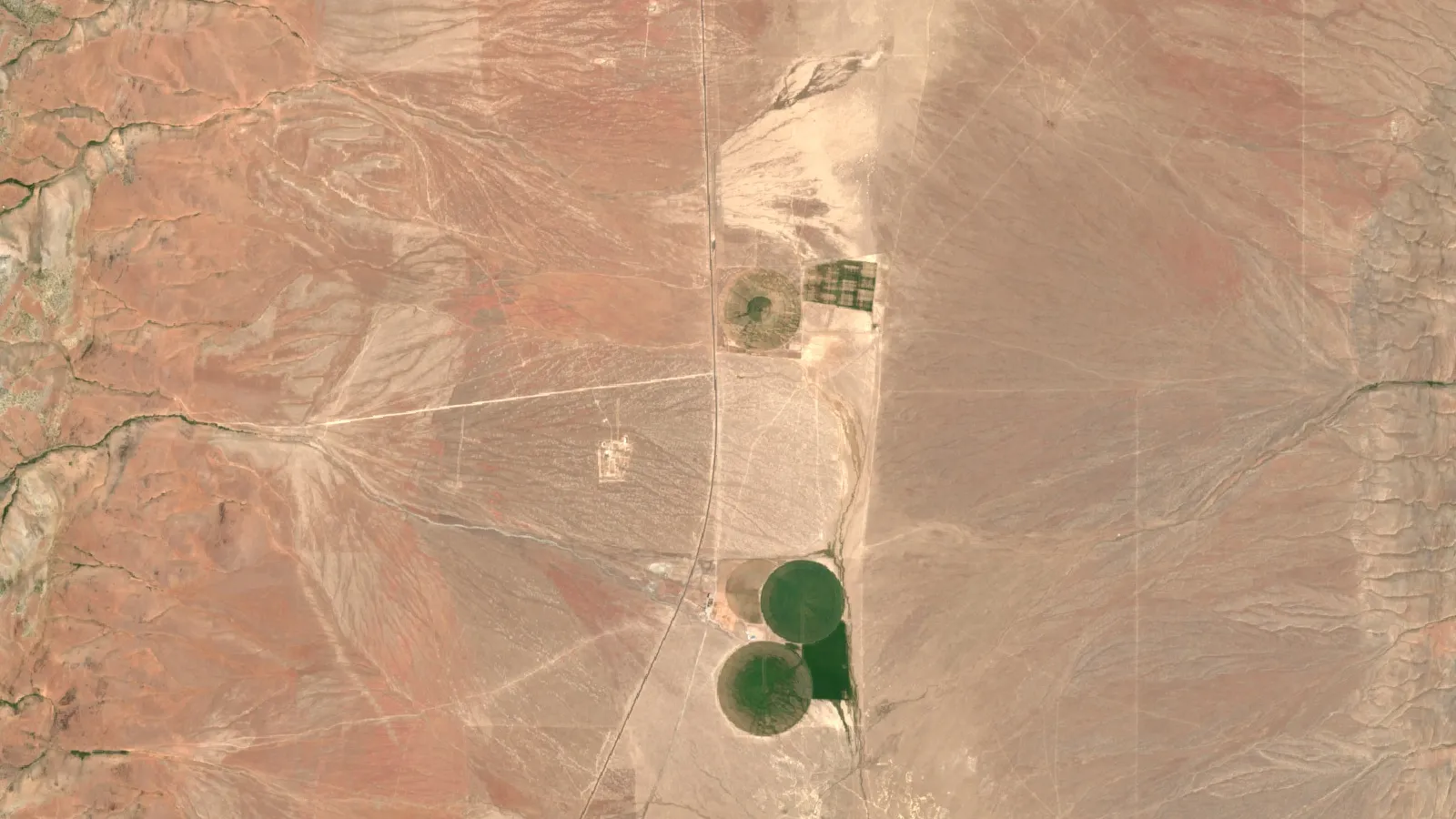
Satellite imagery has a small, specific role at the front of this chain. Alteration and structure maps can help a consultant plan drilling and decide which parts of a licence deserve resource work, but they sit ahead of a resource estimate and do not replace one. Farmonaut offers this kind of screening for licence areas; it is an exploration target input, not a study stage.
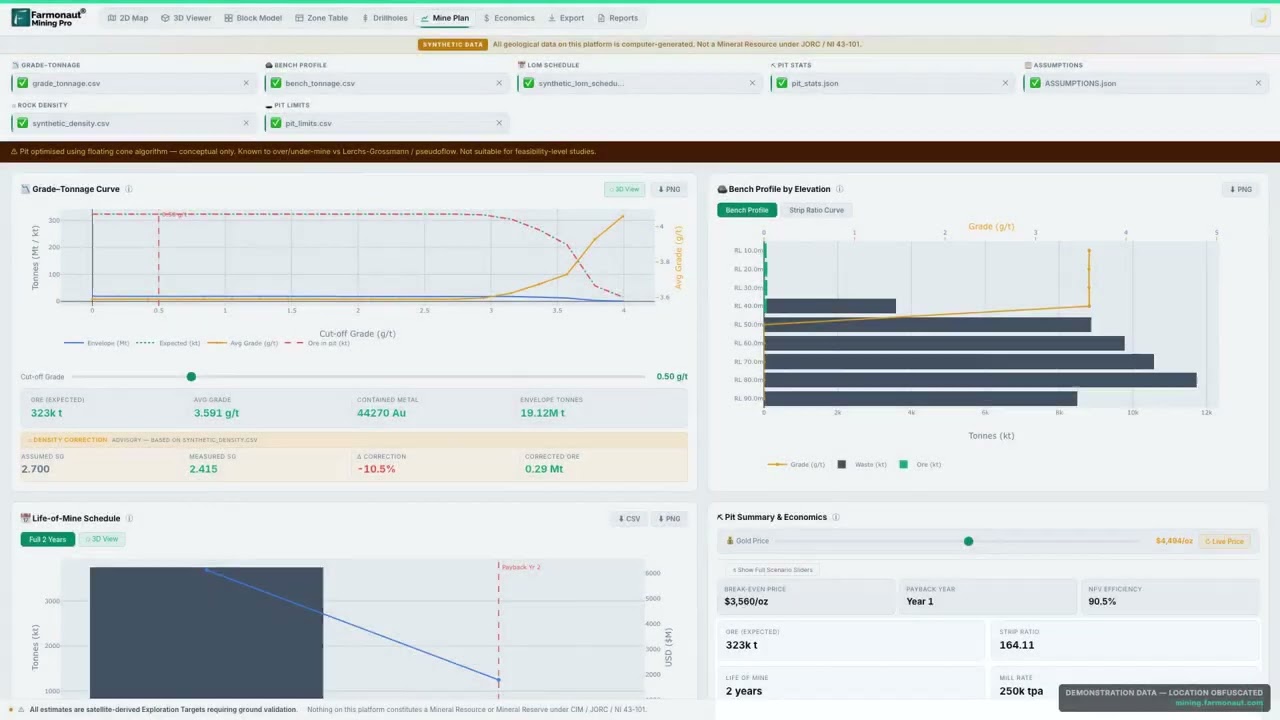
▶ Mine plan costs, break-even and payback explained in a Farmonaut Mining Pro course chapter. · 14:58
Why studies miss: capital cost overruns and what to ask about them
The reason to pay for a careful study is that mining projects often cost more than the study said. Bertisen and Davis reviewed 63 mining and smelting projects and found as-built capital costs averaged 14 per cent above bankable feasibility estimates, with roughly half falling outside the plus or minus 15 per cent range; Haubrich’s survey of 50 years of projects put average overruns between 20 and 60 per cent (both summarised in Suárez Nieto et al., above). A 2015 Export Development Canada study of 78 projects with capital above US$50 million, all costed to pre-feasibility or feasibility level, found an average overrun of 37 per cent, with iron ore lowest and nickel highest (Sphinx Mining Systems summary). Sphinx also notes that CRIRSCO-family standards expect cost accuracy of plus or minus 25 per cent at pre-feasibility and plus or minus 15 per cent at feasibility.
Chart
Stated accuracy against reported capital overruns
Stated estimate tolerance beside average as-built overrun, per cent
These studies cover different samples and periods, so do not average them. They support one practical point: ask every bidder how it treats owner’s costs, indirect costs and contingency, which the Oviedo paper reports tend to be underestimated, and ask what share of the estimate is based on firm quotes. A good consultant will welcome the question.
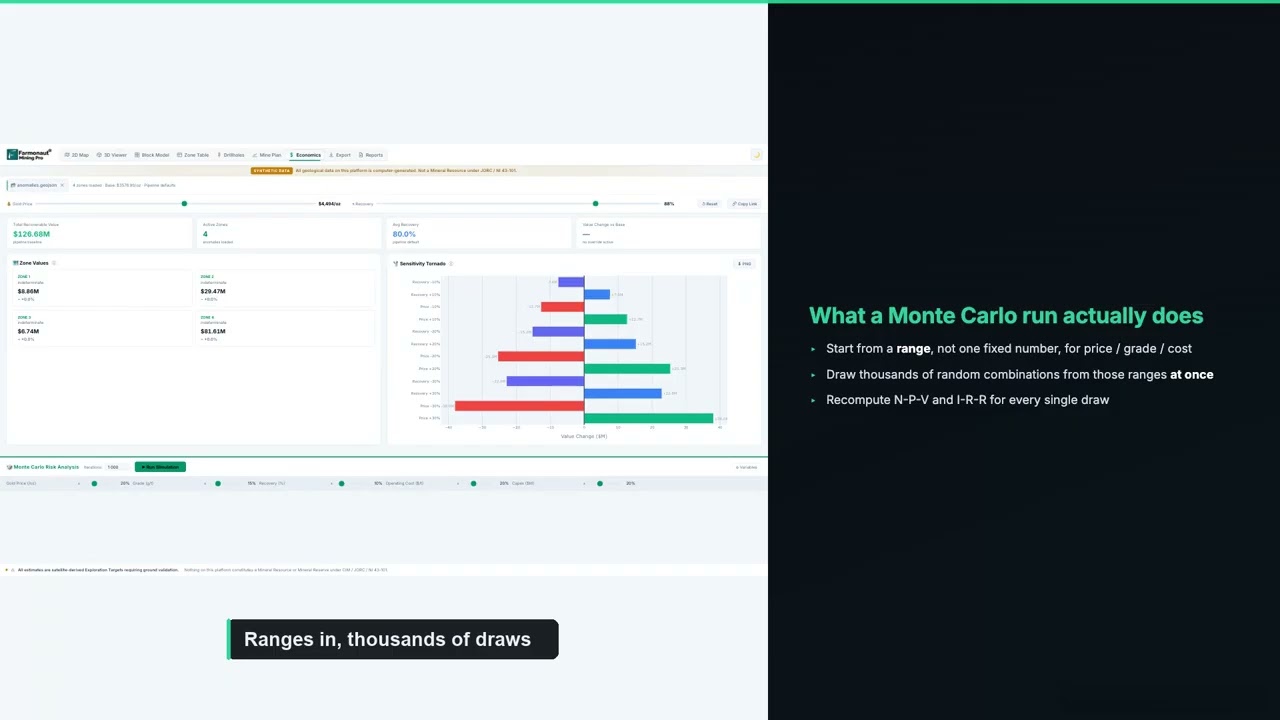
▶ How Monte Carlo P10, P50 and P90 outcomes show the range of project economics. · 14:59
Feasibility work is one service among many: see mining consulting companies by type and project stage.
Frequently asked questions
Who does feasibility studies for mining and metals projects?
Engineering companies lead plant design and costing, independent technical consultants supply resource, mine plan and reserve work with a qualified or competent person, and specialist firms cover testwork, geotechnics, water, tailings and environmental baselines. Owners usually hire a lead firm and let it manage the specialists.
Which engineering firm is recommended for a bankable feasibility study in mining?
No public ranking exists, and the best choice depends on your commodity, country and project size. Compare firms on signed studies at the same stage, named qualified persons, regional delivery record and how their cost estimates held up. Public examples such as Ausenco at Ikkari or Worley at Diablillos show owners choosing on those grounds.
How much does a feasibility study cost?
A 2004 SAIMM paper gave indicative costs as a share of project capital: 0.1 to 0.3 per cent for scoping, 0.2 to 0.8 per cent for pre-feasibility and 0.5 to 1.5 per cent for full feasibility. Use the calculator above to turn that into a budget range, then compare it with written quotes.
How long does a feasibility study take?
It depends on testwork and drilling. Rupert Resources expected its Ikkari feasibility study, with Ausenco leading, to finish in the first half of 2027 after the appointment. Ask each bidder for a schedule that shows testwork and geotechnical work on the critical path.
What is the difference between a scoping study and a pre-feasibility study?
A scoping study is an order of magnitude check that cannot support an Ore Reserve. A pre-feasibility study compares options, fixes the preferred mining method and process, and can support a reserve estimate if the other factors are met (JORC Code).
Which consultant do I need for a scoping study in Canada?
You need a firm with a Qualified Person who meets NI 43-101, five years of relevant experience and good standing with a professional association. Independence from the issuer applies in listed cases, such as first-time disclosure of a preliminary assessment on a material property. Check the current status of the proposal to rename the PEA a scoping study.
Can a Competent Person be employed by the company that owns the project?
Under the ASX FAQ, there is no general independence requirement for a Competent Person, except for a production target based solely on inferred resources, and conflicts of interest must be disclosed. Lenders and buyers may still prefer an independent author.
Who can review our mine plan to improve project NPV?
Hire an independent mine planning consultant with experience in your mining method to test pit or stope design, production rate and cut-off grade, and ask for a sensitivity table. Add a metallurgist and cost engineer where recovery or unit costs drive the result.
Is a bankable feasibility study the same as a definitive feasibility study?
Yes for reporting purposes. JORC states that the terms bankable and definitive feasibility study are equivalent to a feasibility study as it defines one.
What accuracy should a feasibility study estimate have?
Under AACE 47R-11 as tabulated in a 2024 paper, a Class 3 estimate, typical of a feasibility study, carries an expected range of minus 10 to minus 20 and plus 10 to plus 30 per cent. Companies often state plus or minus 15 per cent, and actual projects have overrun by more, as the studies above show.
Do I need a feasibility study to sell or option my claims?
Usually not. Buyers of early-stage ground look at title, drill data and a resource if one exists, and a scoping study can help. See our guide on how to sell a mine for the deal steps.
This page is general information about study stages and consultant selection. It is not an engineering opinion, legal advice or investment advice.
This page is for information only. It is not engineering, legal or investment advice. Confirm reporting rules with the regulator and a qualified lawyer.
Farmonaut mining
Screen your ground before you commission a study
Request a quote to have your licence area mapped from satellite data before you spend on drilling or a scoping study.

Mining Pro sample view, synthetic data
Sources
- JORC Code, 2012 edition: jorc.org
- Ontario Securities Commission, NI 43-101 Standards of Disclosure for Mineral Projects: osc.ca
- CSA, Request for comments on proposed NI 43-101 (12 June 2025): osc.ca
- ASX, Mining reporting rules FAQs: asx.com.au
- 17 CFR 229.1300, definitions (Cornell LII): law.cornell.edu
- Rupprecht, Establishing the feasibility of your proposed mining venture, SAIMM (2004): saimm.co.za
- AMC Consultants, Feasibility studies: amcconsultants.com
- Suarez Nieto et al., Economic risks in mining investments: capital expenditure estimation in copper mining projects, University of Oviedo: digibuo.uniovi.es
- Sphinx Mining Systems, Implications of mining project cost overruns for QP liability: sphinxminingsystems.com
- Mining Technology, Rupert Resources picks Ausenco for Ikkari feasibility study: mining-technology.com
- Panorama Minero, AbraSilver selects Worley for Diablillos DFS: panorama-minero.com
- AZoMining, Scandium International initiates DFS update (17 June 2026): azomining.com
- Solidus Resources, 2025 feasibility study, Spring Valley: solidus-resources.com
- Trilogy Metals, Updated feasibility study results for the Arctic Project (14 February 2023): trilogymetals.com
- Solaris Resources, Pre-feasibility study, Warintza: solarisresources.com
- ALTA Metallurgical Services via Mining.com, Feasibility studies: foundation or fantasy (2016): mining.com
- First Mining Gold news release (18 November 2025): firstmininggold.com
- JORC, Code update: jorc.org
Discussion
Questions, corrections or field experience? Share them below. First-time comments are reviewed before they appear, and your email is never published.
No comments yet. Be the first to add a question or your experience.

 G.I.T.T.
 Jaunita Erss Ltd
 Almosi SARL
 SRK Consulting
 Berks Gold Limited
 Mwerezi Minerals Company Limited
 Mining SARL
 SenGold Invest SAS
 Sean Mining Limited
 NTS Group (Pty) Ltd
 Mine4Africa
 Lithspo Minerals Limited
 Tintina Mining Group
 Dalgety Minerals Pty Ltd
 Faith At Work (Pty) Ltd
 Geotech Mining Solutions plc

 Licence holder · Nigeria · Gold + lithium
 Client · Somalia · Gold










