

Gemstone pricing · Price guide
Mexican Fire Opal Price Per Carat: Chart and Auctions
Faceted Mexican fire opal mostly sells for US$10 to US$150 per carat wholesale; only clean red stones with play-of-color approach the quoted US$10,000 top (Gem Rock Auctions, June 2025). Bonhams results ran from about US$12 to US$402 per carat.
Key takeaways
- Wholesale bands per carat: faceted red US$30 to US$150 (about US$210 for the best), orange US$10 to US$55, light yellow US$10 to US$27, cabochons US$7 to US$20, rough US$3.50 to US$6 (Gem Rock Auctions, updated 4 June 2025).
- A 9.52-carat Mexican freeform with play-of-color sold for US$3,825 including premium at Bonhams on 15 June 2021, about US$402 per carat.
- A translucent 228.5-carat cabochon made US$2,745 at Bonhams in May 2010, about US$12 per carat: size alone does not set the price.
- GIA’s 1992 study says Querétaro’s orange-to-red fire opal had not been found in significant quantities at any other locality; ordinary yellow and orange material is not rare.
- Opal holds water and can craze if it dries out (GIA), so stability, treatment and lab confirmation all move the price.
In this article
- Mexican fire opal price per carat at a glance
- What sets the price of a fire opal
- Real auction results for Mexican fire opal
- Is Mexican fire opal rare?
- Where Mexican fire opal is mined
- How Mexican stones compare with other fire opal
- How to check a fire opal price quote
- Estimate the value of a fire opal
- Mapping opal-bearing volcanic ground from orbit
- Frequently asked questions
Most faceted Mexican fire opal sells for about US$10 to US$150 per carat at wholesale, and only rare, clean, red stones with play-of-color climb toward the top of a quoted US$10 to US$10,000 range. A dealer guide from Gem Rock Auctions, updated 4 June 2025, puts faceted red stones at US$30 to US$150 per carat (up to about US$210 for flawless, well-cut pieces), faceted orange at US$10 to US$55, light yellow at US$10 to US$27, cabochons at US$7 to US$20 and rough at US$3.50 to US$6 per carat (Gem Rock Auctions). Public auction results sit in the same zone: a 9.52-carat orange freeform with play-of-color made US$3,825 at Bonhams in June 2021, about US$402 per carat.
No exchange or index publishes a daily opal price, so every number on this page carries its source and date. Below you will find the price tiers, real hammer results worked out per carat, the factors that move a stone up or down, how rare the material really is, where it is mined, a five-step check for any quote, and a calculator for your own stone.
Mexican fire opal price per carat at a glance
Fire opal is a transparent to translucent opal with a yellow, orange, red or brown body color. In the trade it is also called “Mexican opal” or “Mexican fire opal”, and it may or may not show play-of-color, the flashes of spectral color that make precious opal famous (GIA, opal quality factors). The “fire” in the name describes the body color, not color play (International Gem Society, updated 10 July 2025).
Chart
Wholesale fire opal price per carat, by type
US dollars per carat, dealer wholesale bands
A carat is a unit of gem weight: 0.2 grams, so five carats make one gram. Prices are quoted per carat, which means a 4-carat stone at US$50 per carat costs about US$200 before any dealer margin.
| Type of stone | Wholesale price per carat | What pushes it to the top of the band |
|---|---|---|
| Faceted, red | US$30 to US$150; about US$210 for the best | Clean, well cut, some play-of-color |
| Faceted, orange | US$10 to US$55 | Saturated orange, no haze |
| Faceted, light yellow to white | US$10 to US$27; US$70 to US$90 with color play and a fine cut | Play-of-color, precision cut |
| Cabochon (domed, unfaceted) | Mostly US$7 to US$20 | Strong color, clean polish |
| Rough | About US$3.50 to US$6 | Size and clarity of the usable piece |
| Exceptional stones | Up to US$10,000 quoted | Intense orange-red, strong play-of-color, no inclusions |
Source for every row: Gem Rock Auctions dealer guide, updated 4 June 2025. These are wholesale figures. Finished jewelry in a retail shop costs more, because the setting, labor and retail margin are added, so treat the table as a floor for comparison, not as a selling price you can expect for a stone you own.
Two points stand out. First, the gap between ordinary and top material is huge: a rough piece at US$4 per carat and a premium red faceted stone at US$150 per carat differ by a factor of almost forty. Second, the US$10,000 figure is an outer limit for a handful of collector stones. Very few transactions reach it, and none of the public auction results we checked come close.
What sets the price of a fire opal
Dealers weigh the same handful of factors on every stone. The guide above names color, color play and transparency as the main ones, with cut, clarity and treatment also playing a role (Gem Rock Auctions, June 2025). Here is how each one works in practice.
Body color
Red and orange-red stones command the highest prices; orange sits in the middle and pale yellow at the bottom. A brownish or milky tone pulls the price down. Even saturation matters: a stone that is deep red at one end and washed-out at the other is priced closer to its weaker half.
Play-of-color
Most Mexican fire opal shows no play-of-color, and is sold as “fire opal” on body color alone. A stone that adds flashes of green, yellow or blue becomes “precious fire opal” and can sell for several times the price of a plain stone of the same color. The rare “contraluz” type shows color play that seems to float inside the gem when light comes from behind (International Gem Society, July 2025).
Transparency and clarity
The best stones are almost water-clear, so a viewer can read print through them. Cloudiness, visible inclusions and matrix (host rock left in the stone) lower the value. For transparent faceted stones, inclusions show easily, so buyers look closely.
Cut
Transparent material is usually faceted, which shows off the glow; translucent or included material is cut as a cabochon. A precise, well-proportioned facet cut adds value. A cut that leaves the stone thin, lopsided or with a dark center reduces it.
Size
Larger clean stones are harder to find, so the per-carat price tends to rise with size within the same quality. The reverse applies to cloudy or pale material: very large pieces of low-grade opal can sell for very little per carat, as the auction results below show.
Treatments and look-alikes
Some fire opal is treated, mostly to improve durability, for example by filling fractures or coating with resin. Some Ethiopian fire opal is darkened by smoke or sugar treatment, and lab-made “Mexifire” material imitates Mexican stones but shows pinpoint inclusions (Gem Rock Auctions, June 2025). Oil, wax and plastic impregnation are also used on opal in general to hide crazing (International Gem Society, July 2025). A treated or imitation stone is worth a fraction of a natural one, so disclosure changes the price completely.
Real auction results for Mexican fire opal
Dealer bands describe the market in general. Auction results give exact prices for named stones on named dates. The three Bonhams lots below are public, include the buyer’s premium, and are all Mexican material. Per-carat values are our calculation (price divided by stated weight).
Chart
Bonhams results for Mexican fire opal, per carat
US dollars per carat, price including buyer’s premium divided by stated weight
| Lot | Weight | Price paid (incl. premium) | Per carat | Sale |
|---|---|---|---|---|
| Large fire opal cabochon, translucent deep orange | 228.5 ct | US$2,745 | About US$12 | Bonhams New York, 27 May 2010 |
| Three faceted stones (two orange, one red) | 12.33 ct in total | US$1,211.25 | About US$98 | Bonhams Los Angeles, 7 December 2021 |
| Orange freeform with multicolor play-of-color | 9.52 ct | US$3,825 | About US$402 | Bonhams Los Angeles, 15 June 2021 |
The pattern matches the dealer guide. The very large cabochon was translucent rather than transparent, so it sold at about US$12 per carat even though it was an impressive display piece. The trio of faceted stones landed near the top of the wholesale band for faceted orange and red. The freeform with vivid green, orange and yellow color play fetched about four times the trio’s rate per carat, which shows how much play-of-color adds.
Auction prices include the buyer’s premium, the fee the auction house adds on top of the hammer price. A seller receives the hammer price minus the seller’s commission, so what an owner nets is lower than the figures shown.
Is Mexican fire opal rare?
Not as a group. Yellow and orange fire opal without color play is mined in commercial quantities, and fire opal is also found outside Mexico: dealers list Ethiopia, Oregon in the US, Turkey, Honduras and Brazil among other sources (Gem Rock Auctions, June 2025). Nevada’s Virgin Valley produces black fire opal, which is the state’s official gemstone (Wikipedia, Opal).
What is rare is the top end. GIA’s 1992 study of Querétaro opal says the distinctive orange-to-red fire opal from Querétaro had not been found in significant quantities at any other locality (Gems & Gemology, Spring 1992). Large, transparent, saturated red stones, and especially red stones that also show play-of-color, are scarce. Those are the stones behind the high end of the price range.
For context, opal as a whole is dominated by Australia: GIA states that about 90% of the world’s opals come from there (GIA, opal quality factors). Australian production is mostly precious opal with color play, a different product from Mexican fire opal; our guide to Australian black opal prices covers that side of the market, and the Ethiopian opal value guide covers the newer African supply.
Fire opal is also a delicate gem, which limits how much durable top material reaches the market. Opal holds water in its structure, and losing moisture through heat, dryness or bright light can cause crazing, a fine web of cracks (GIA, opal quality factors). Crazed stones lose most of their value, so buyers pay a premium for stones from sources known to be stable.
Where Mexican fire opal is mined
Mexican opal occurs in cavities in silica-rich volcanic lavas at many localities. The International Gem Society names Zimapán in Hidalgo, where yellow and red fire opal comes from a trachyte porphyry, plus San Luis Potosí and Querétaro (International Gem Society, July 2025).
Querétaro
Querétaro, about 200 km northwest of Mexico City, has produced fine, unusually transparent opal for over 100 years. The opal sits largely in gas cavities in pink to brick-red, thinly bedded rhyolitic lava flows and is mined in open-pit quarries (Gems & Gemology, Summer 1983). Rhyolite is a light-colored, silica-rich volcanic rock. GIA’s later work found these opals formed at about 160 °C from hydrous silica gels (Gems & Gemology, Spring 1992). The deposits lie mainly in the municipalities of Colón, Tequisquiapan and Ezequiel Montes, and the oldest mine named in public sources is Santa María del Iris (Wikipedia, Opal). Some mines near Tequisquiapan take visitors; our piece on opal mining for tourists covers what such visits involve.
Jalisco
The second major area is around Magdalena in Jalisco, near the Tequila volcano. Bonhams catalogued a 30.47-carat cherry-red faceted stone from Magdalena, with a GIA report confirming natural reddish-orange opal, in a December 2016 sale (Bonhams, lot 137). The catalogue notes that red opals from this region are increasingly difficult to obtain.
Hidalgo and other states
Hidalgo (Zimapán), San Luis Potosí, Chihuahua and other states also yield opal, mostly of lesser commercial importance. Dealer sources say fire opal occurs in seven Mexican states, with Querétaro the most significant (Gem Rock Auctions, June 2025).
Small open pits in volcanic hills leave visible scars and spoil heaps, which is why mine permitting and land rehabilitation matter as much for gem quarries as for metal mines. The short video below explains the main environmental impacts any mine has to manage.

▶ The seven main environmental impacts of mining, explained in clay animation. · 2:31
How Mexican stones compare with other fire opal
For a buyer, origin matters less than the stone in front of you, but it does change what to check.
- Mexico: the classic source of transparent orange and red fire opal, including contraluz and “cantera” material (opal left in its host rock). Buyers check for crazing and for clean transparency.
- Ethiopia: precious opal from the Welo (Wollo) area, discovered in 2008 near Wegel Tena, and some fire opal. Buyers ask about smoke or sugar treatment (International Gem Society; Gem Rock Auctions).
- Brazil: known for large yellow to orange “Dourada” fire opal without play-of-color.
- United States: small supplies from Oregon and from Virgin Valley, Nevada, where much of the opal replaces fossil wood.
Because Mexican material set the standard, many dealers use “Mexican fire opal” for any orange-red stone. Ask for the actual origin if it matters to you; a gem lab report can confirm that a stone is natural opal but origin statements vary by lab.
How to check a fire opal price quote
Whether you are buying a stone or pricing one you own, run every quote through the same steps.
Infographic
Check a fire opal quote in 5 steps
- 1Confirm naturalAsk for an independent gem lab report.
- 2Ask about treatmentResin, oil, wax or smoke must be disclosed.
- 3Place it in a bandMatch color, cut and play-of-color to the table.
- 4Check channel and dateRetail, wholesale, auction or insurance value?
- 5Look for crazingCheck for fine cracks under magnification.
- Confirm it is natural opal. For any stone worth more than a few hundred dollars, ask for a report from an independent gem lab. Glass imitations and lab-made opal are common; they often show bubbles, swirl marks or unusual specific gravity (International Gem Society).
- Ask about treatment. Resin, oil, wax, plastic and smoke treatments must be disclosed. A treated stone belongs in a much lower band.
- Place the stone in a band. Use the table above: color, faceted or cabochon, transparency, color play. Then compare the per-carat quote with that band.
- Check the channel and date. Is the figure a retail asking price, a wholesale price, an auction result with premium, or an insurance replacement value? Each sits at a very different level.
- Check for crazing. Look under magnification for fine cracks, and ask how long the stone has been out of the ground. Stones that have stayed stable for months are safer.
Insurance appraisals usually state replacement value at retail, which is often several times what a dealer would pay you. Do not read an appraisal as a resale price.
Estimate the value of a fire opal
The calculator below turns a per-carat figure into a stone price, an all-in cost and the same weight valued at two points from the dealer guide. Enter the weight from a lab report or a precise gem scale, and the per-carat price you were quoted.
Chart
What a 5-carat fire opal costs at each wholesale band
US dollars, 5 carats times the top of each band
Remember that a dealer buying from you will pay below the wholesale band, because the dealer must still cut, certify or sell the stone. Your realistic resale value is usually the lowest figure on the page, not the highest.
Calculator
What is my fire opal worth?
Enter the weight and the per-carat price you were quoted.
- Stone price before margin and fees (US$): $180
- Your quote per gram (US$): $300
- Same weight at top of orange band, US$55/ct: $165
- Same weight at top of red band, US$150/ct: $450
Example values only, not a quote or an appraisal. The per-carat price is an input (example, use today’s price). The comparison rates of US$55 and US$150 per carat are the tops of the faceted orange and red wholesale bands in the Gem Rock Auctions guide (updated 4 June 2025). One carat is 0.2 g. All amounts are US dollars.
Mapping opal-bearing volcanic ground from orbit
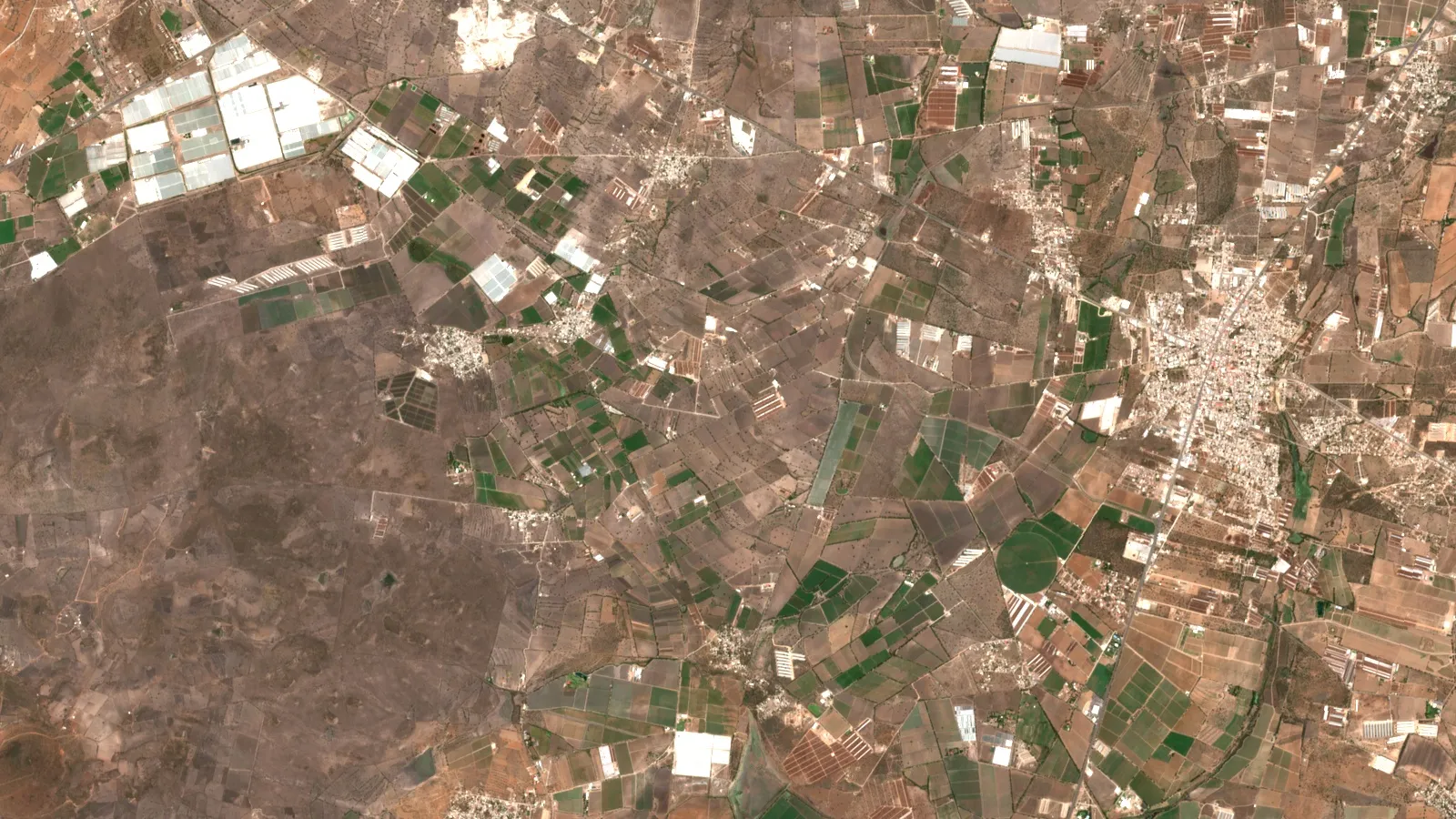
Fire opal forms in silica-rich volcanic rocks such as rhyolite and trachyte, often where hot fluids have altered the host rock. Satellite sensors such as Sentinel-2 and Landsat record the color and mineral signature of exposed rock, which helps geologists map volcanic units, alteration zones and old workings across a whole district before anyone walks the ground. The image at the top of this page is a Sentinel-2 view of the Querétaro opal district. Farmonaut screens licence areas from satellite data for 20+ minerals; for gem ground, the useful output is a map of where to look first, not a promise that stones are there.
▶ Remote sensing for mining explained in three minutes, without jargon. · 2:01
Frequently asked questions
How much is a Mexican fire opal worth per carat?
Most faceted stones trade at US$10 to US$150 per carat wholesale, with orange at US$10 to US$55 and red at US$30 to US$150 (about US$210 for the finest), according to the Gem Rock Auctions guide updated in June 2025. Exceptional stones with strong play-of-color are quoted up to US$10,000 per carat.
How much is a 1 carat fire opal worth?
A typical 1-carat faceted orange stone is worth about US$10 to US$55 at wholesale, and a red one about US$30 to US$150. Retail prices in jewelry are higher because of the setting and margins.
Is Mexican fire opal rare?
Ordinary yellow and orange fire opal is mined in commercial quantities. Large, clean, transparent red stones and red stones with color play are rare, and GIA’s 1992 study notes Querétaro’s orange-to-red opal had not been found in significant quantity elsewhere.
Why are red fire opals worth more than orange?
Saturated red is the rarest body color, so the wholesale band for red faceted stones starts and ends higher than for orange or yellow ones.
Is fire opal more valuable than regular opal?
Not usually. Fine black and boulder opal from Australia with strong play-of-color often sells for far more per carat. Fire opal is valued mainly for body color, and only stones that also show color play reach comparable prices.
What is the most expensive type of fire opal?
Transparent orange-red stones with strong play-of-color, including contraluz opal, which shows color play in light from behind. These are the stones behind the top of the price range.
How can I tell if a fire opal is real?
Ask for a gem lab report. Imitations such as glass and lab-made opal often show bubbles, swirl marks or pinpoint inclusions, and their specific gravity and refractive index differ from natural opal.
Does fire opal crack easily?
It can. Opal contains water, and drying, heat or strong light can cause crazing. Keep it away from heat, store it apart from harder gems, and choose protective settings such as bezels for rings.
Where is the best fire opal mined?
Querétaro in central Mexico is the classic source, with the Magdalena area of Jalisco the other main district. Fire opal also comes from Ethiopia, Brazil, Turkey, Honduras and Oregon.
Can I sell a fire opal for the price in a price guide?
Usually not. Price guides and auction results show what buyers paid. A dealer buying from you will offer below wholesale, and an auction will deduct a seller’s commission from the hammer price.
Fire opal sits among many coloured stones priced by the carat; our list of the most valuable minerals by price per carat shows where it falls, and black opal price per carat compares the precious-opal side.
More from Farmonaut: farmonaut.com, carbon footprinting, crop loan and insurance, farmonaut satellite weather api developer docs, product traceability.
This page is for information only. It is not investment advice or an appraisal. Get any valuable stone tested and appraised independently.
Farmonaut mining
Screen a volcanic district from space
Map volcanic units, alteration and old workings across your area of interest with satellite exploration before you fund fieldwork.

Mining Pro sample view, synthetic data
Keep reading
Sources
- Gem Rock Auctions, Mexican fire opal guide (updated 4 June 2025): gemrockauctions.com
- GIA, Opal quality factors: gia.edu
- GIA, Opal description: gia.edu
- International Gem Society, Opal value, price and jewelry information (updated 10 July 2025): gemsociety.org
- Koivula et al., Opal from Querétaro, Mexico: occurrence and inclusions, Gems & Gemology (Summer 1983): gia.edu
- Spencer et al., Fluid inclusions in Querétaro opal, Gems & Gemology (Spring 1992): gia.edu
- Bonhams, Large fire opal cabochon, lot 1431 (27 May 2010): bonhams.com
- Bonhams, Three faceted fire opals, lot 2046 (7 December 2021): bonhams.com
- Bonhams, Orange fire opal, lot 2141 (15 June 2021): bonhams.com
- Bonhams, Large and exceptional red fire opal, lot 137 (December 2016): bonhams.com
- Wikipedia, Opal (Mexico and other sources): en.wikipedia.org
- USGS, Mineral Commodity Summaries 2026: Gemstones: pubs.usgs.gov
Discussion
Questions, corrections or field experience? Share them below. First-time comments are reviewed before they appear, and your email is never published.
No comments yet. Be the first to add a question or your experience.

 Southbridge & Wess PDC Ltd
 Qader Group
 Ileys General Trading
 SG Gold Mining LLC
 VRV Global Pte Ltd
 Omsri International FZE
 G.I.T.T.
 Jaunita Erss Ltd
 Almosi SARL
 SRK Consulting
 Berks Gold Limited
 Mwerezi Minerals Company Limited
 Mining SARL
 SenGold Invest SAS
 Sean Mining Limited
 NTS Group (Pty) Ltd
 Mine4Africa
 Lithspo Minerals Limited

 Client · Oregon, USA · Gold










